REVIEW 3 major objections 5 minor 1 cited by
Multi-band observation of lensed gravitational waves as a probe of small-mass dark matter halos
T0 review · 3 major / 5 minor · reviewed 2026-08-07 · deepseek-v4-flash
Pith's one-line read Observing the same lensed gravitational-wave event in two bands—one wave-optics, one geometrical-optics—breaks the degeneracy between halo mass, impact parameter, and core size, cutting errors by roughly a third to two-thirds.
desk verdict The qualitative result — that combining ET and DECIGO on the same lensed binary breaks the y–M_Lz degeneracy and improves lens parameter errors — is plausible and useful, but the headline percentages need a correction and a Fisher-robustness caveat before they are quoted. read the letter →
The pith
A machine-rendered reading of the paper's core claim, the machinery that carries it, and where it could break.
The reading
What carries the argument
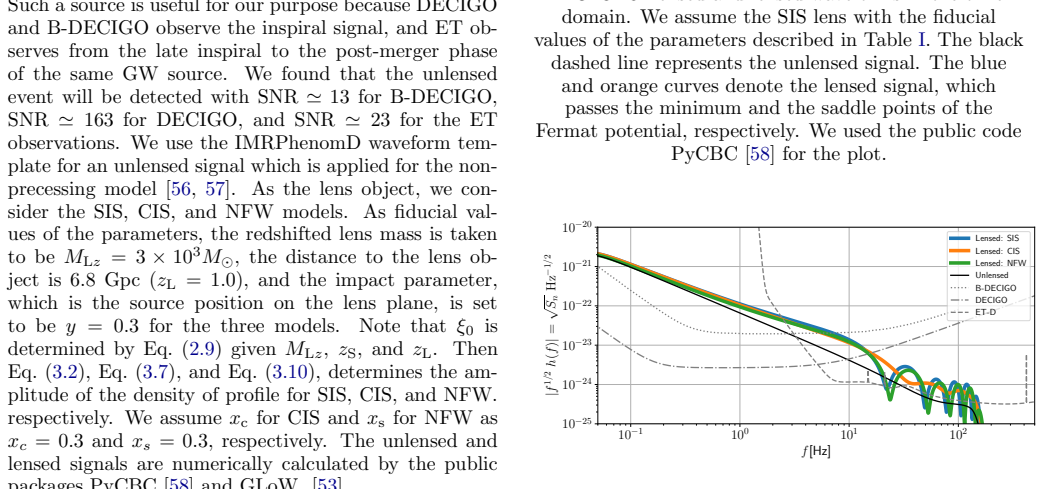
The amplification factor $F(w,y)$ of wave-optics gravitational lensing, computed through the diffraction integral $F = (w/2\pi i)\int d^2x \exp[i w T(x,y)]$, is the object that carries the argument. Here $w = 4 G M_{Lz}\omega$ is the dimensionless frequency measuring the lens Schwarzschild radius in units of the gravitational-wave wavelength, $y$ is the impact parameter, and $T(x,y)$ is the Fermat time delay. This single function interpolates between the wave-optics regime ($w\ll 1$), where the signal phase is insensitive to $y$, and the geometrical-optics regime ($w\gg 1$), where the stationary-phase images encode $y$ and the lens profile. The Fisher information matrix is then evaluated separately for ET, B-DECIGO, DECIGO, and their sums, with the noise assumed independent across detectors.
What would settle it
Run a full Bayesian parameter-estimation pipeline, such as nested sampling, on simulated lensed signals with the same fiducial source and lens parameters, detector noise curves, and the three halo profiles; if the posterior widths for $M_{Lz}$, $y$, and $x_c$ from ET plus DECIGO are not substantially smaller than the single-detector widths, or if the degeneracy between $y$ and $M_{Lz}$ persists in the joint posterior, the paper's central claim would be falsified.
Extended reading notes
Core claim
The paper's central discovery is that the degeneracy between the lens mass $M_{Lz}$, the impact parameter $y$, and the core scale $x_c$ (or $x_s$) can be broken by combining two detectors that see different frequency regimes of the same lensed gravitational-wave signal. In the high-frequency (geometrical optics) regime, the magnification is set by the image configuration through the lens equation, which couples $y$ and the profile parameters; in the low-frequency (wave optics) regime, the amplification factor depends on $w = 4 G M_{Lz}\omega$ in a way that is less sensitive to $y$, so $M_{Lz}$ is better constrained. The joint Fisher matrix for ET and DECIGO shrinks the error ellipses in the $(M_{Lz}, y, x_c)$ space, with the headline numbers for the CIS model being a roughly 71% reduction in the lens mass error and a roughly 65% reduction in the impact parameter error relative to ET alone. The same qualitative improvement holds for the NFW and SIS models, while the B-DECIGO plus ET combination is not powerful enough to break the degeneracy.
Load-bearing premise
The Fisher information matrix, computed for a fixed waveform template under stationary Gaussian noise, accurately predicts the parameter uncertainties at the forecast signal-to-noise ratios; if the true posterior is non-Gaussian or multimodal, the reported error reductions could be overestimated.
Editorial extensions
If this is right
- If the forecasts hold, ET plus DECIGO can measure the lens mass of a $3\times10^3 M_\odot$ halo to roughly $0.2\%$ for the SIS model and $0.3\%$ for the CIS model, and the impact parameter to about $1.4\%$ for SIS and $2.0\%$ for CIS.
- The core radius of a cored isothermal sphere halo becomes measurable to about $4\%$ with the combined observation, instead of being essentially unconstrained by DECIGO alone at the $12\%$ level.
- The B-DECIGO plus ET combination does not significantly break the degeneracy, so the multi-band advantage is tied to the full DECIGO sensitivity rather than its pathfinder mission.
- Because the method works for SIS, CIS, and NFW profiles, it offers a way to distinguish cored from cuspy halo models by measuring the profile scale parameter in the same lensed event.
Reading between the lines
- A full Bayesian parameter-estimation treatment of the same fiducial setup would likely show smaller but still substantial error reductions, because Fisher matrices tend to be optimistic in the presence of strong degeneracies and non-Gaussian posteriors; the qualitative conclusion that joint GO and WO observation breaks the degeneracy should survive.
- The same two-regime logic could be applied to other detector pairs, such as LISA-like space detectors combined with third-generation ground detectors, and to neutron-star binaries, extending the mass range of halos that can be probed.
- If the forecasts are realized, stacking many multi-band lensed events could map the core-size distribution of low-mass halos, directly testing dark matter models that predict cores at these scales, such as self-interacting or warm dark matter.
- The event rate of simultaneously observable lensed binaries is a key unknown; the paper's fiducial source is a single event, so the practical impact depends on population rates that are not computed here.
Editorial analysis
A structured set of objections, weighed in public.
Referee Report
Summary. The paper proposes using multi-band gravitational-wave observations, combining ET with DECIGO or B-DECIGO, to observe both wave-optics and geometrical-optics lensing effects from the same binary source and thereby constrain small-mass dark matter halo parameters. For a fiducial (30+20) solar-mass binary at z=1.5 lensed by a 3x10^3 solar-mass halo at z=1.0, the authors perform Fisher-matrix forecasts for SIS, CIS, and NFW halo profiles. They report that joint ET+DECIGO observation reduces the CIS lens-mass error by about 71% relative to ET alone and by about 58% relative to DECIGO alone, with analogous improvements in the impact parameter and core size, and conclude that multi-band observation resolves parameter degeneracies. The B-DECIGO+ET combination is found to yield only modest improvements over ET alone.
Significance. If the quantitative forecasts are reliable, this is a timely and useful contribution to multi-band gravitational-wave astronomy: it identifies a concrete configuration in which GO and WO effects from the same source are simultaneously measurable and quantifies the expected gains for small-mass halo parameters. The paper uses standard lensing and Fisher methodology, builds on public codes (PyCBC and GLoW), and provides correlation matrices that are helpful for interpreting the results. The qualitative message, that joint ET+DECIGO improves lens-parameter constraints compared with either detector alone, is supported by the tables, and the comparison between B-DECIGO and DECIGO is informative. However, the headline percentages and the 'degeneracy resolution' interpretation require correction and validation before the numbers can be used as design targets.
major comments (3)
- [Abstract; Sec. IV E; Table IIIb] The abstract and Sec. IV E state that for the CIS model the lens mass error improves by about 58% compared with DECIGO alone, but Table IIIb gives Delta ln M_Lz / ln M_Lz = 0.522% (DECIGO) and 0.331% (ET+DECIGO), which corresponds to an improvement of (0.522 - 0.331)/0.522 = 36.6%, not 58%. The 71% improvement relative to ET is correct. The 58% figure appears to come from (0.522 - 0.331)/0.331, i.e., the improvement relative to the joint error rather than relative to the single-detector error. Please correct the abstract and Sec. IV E and ensure that all percentage improvements use the same convention.
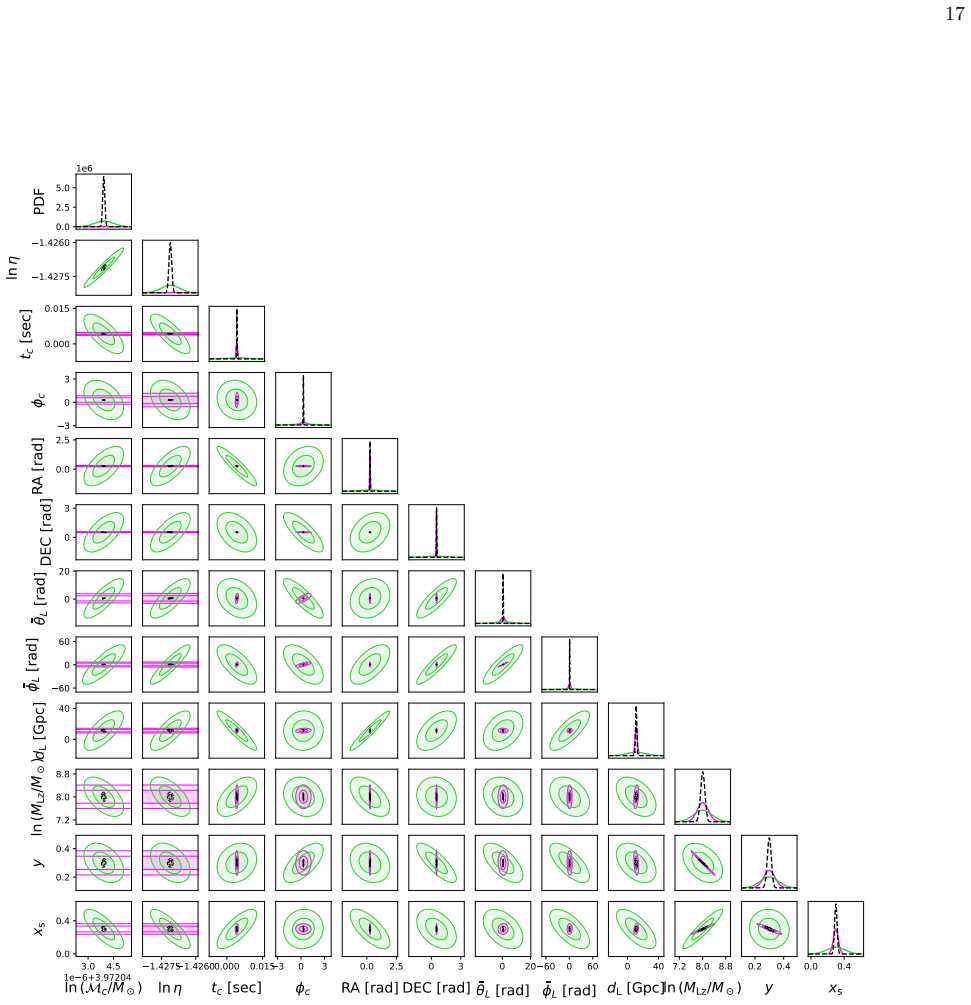
- [Sec. IV E; Fig. 11] The conclusion that multi-band observation 'resolves parameter degeneracies' is not supported by the correlation matrices in Fig. 11. For the CIS model, the correlation between ln M_Lz and y changes from -0.36 (DECIGO alone) to -0.93 (DECIGO+ET); for SIS it changes from -0.38 to -1.00. A correlation moving toward +/-1 indicates a stronger degeneracy, not a broken one. The reduction in marginalized errors is compatible with the two parameters remaining strongly degenerate but being constrained along a narrow combination; it does not demonstrate that the degeneracy is resolved. Please revise the interpretation or, if the claim is retained, provide a measure of the posterior width along the degenerate direction, such as the conditional error or the volume of the joint confidence region.
- [Sec. IV B-C; Sec. V] All headline improvement percentages are derived from the Fisher matrix in Eqs. (4.5)-(4.6) under stationary Gaussian noise and a Gaussian likelihood. The forecast SNRs in the channels that carry the GO information are moderate (ET ~23 unlensed and 36-41 lensed; B-DECIGO ~13-21), and the near-singular correlation coefficients in Fig. 11 indicate that the likelihood is far from Gaussian in the lens-parameter subspace. The paper itself cites Vallisneri (2008) and Rodriguez et al. (2013), which demonstrate that Fisher forecasts can be systematically optimistic in exactly this regime. I therefore request a full Bayesian parameter-estimation check for at least one lens model (e.g., CIS) to validate the quantitative improvement percentages, or, failing that, that the claims be reframed as Fisher-conditional forecasts with a clear caveat.
minor comments (5)
- [Table I] The entry for x_s reads 'Dimsensionless core radius (NFW)'; this should be 'Dimensionless scale radius (NFW)'.
- [Sec. V] The sentence 'We also take into account that the large correlation between spin and mass increases statistical uncertainties [63,64]' is inconsistent with the non-spinning setup and the parameter list in Table I; rephrase as a future-work item.
- [Sec. IV C] The phrase 'by fixing parameters theta = {d_L, t_c, phi_c, RA, DEC, theta_L, phi_L}' is ambiguous; state explicitly whether Tables II and III are conditional on exact knowledge of these parameters or marginalized over them, and describe the verification that the impact is limited.
- [Figs. 10 and 11] Several correlation coefficients are reported as -1.00, which signals a nearly singular Fisher matrix; please report the matrix condition number or use higher precision so the reader can judge the reliability of the quoted errors.
- [Sec. IV B] The paper states that GLoW [53] was used, but it does not give a version or release identifier; please cite a specific version to support reproducibility.
Circularity Check
No significant circularity: the Fisher forecast is self-contained and the error-reduction claims follow from combining independent Fisher matrices, not from fitted parameters or self-citations.
full rationale
The paper constructs the lensed waveform from standard wave-optics formulae (Eq. 2.5) and the IMRPhenomD template, computes a Fisher matrix from the assumed Gaussian likelihood (Eqs. 4.5-4.6), and sums the Fisher matrices of ET and (B-)DECIGO (Eq. 4.7). The reported improvements are ratios of the resulting diagonal covariance elements, so they are direct outputs of the model, not quantities fitted to data and then re-predicted. No fitted parameter is renamed as a prediction; the fiducial values (Table I) are fixed model inputs, not estimated values. There are no load-bearing self-citations: the cited lensing and waveform results are external (Takahashi/Nakamura, IMRPhenomD papers, GLoW/PyCBC packages), and no uniqueness theorem or prior work by the same authors is invoked to force the choice of model. The central derivation is therefore self-contained. Some internal inconsistencies exist - for example, the text/abstract claim a 58% lens-mass improvement over DECIGO alone for CIS, whereas Table IIIb gives (0.522-0.331)/0.522 = 36.6%, and the appendix correlation maps show the M_Lz-y correlation strengthening after combination for some models (e.g., -0.38 to -1.00 for SIS). These are correctness and interpretational concerns about Fisher-based forecasts, but they are not circularity: the forecast is not equivalent to its inputs by construction. Accordingly, the circularity score is 0.
Assumptions & free parameters
free parameters (5)
- Fiducial impact parameter y =
0.3
- Fiducial redshifted lens mass M_Lz =
3 x 10^3 M_sun
- Fiducial dimensionless core/scale radius x_c (CIS), x_s (NFW) =
0.3 for both
- Source masses and redshift (m1=30, m2=20, z=1.5) =
30/20 M_sun, z=1.5
- Frequency integration bands for Fisher matrix =
0.05-20 Hz (DECIGO), 10-200 Hz (ET)
assumptions (4)
- domain assumption The scalar-wave amplification factor F(w,y) in Eq. (2.5) fully describes gravitational lensing of GWs under the thin-lens, weak-field, Born approximation.
- domain assumption The detector noise is stationary and Gaussian, so the Fisher matrix (Eq. 4.5) yields the parameter covariance.
- ad hoc to paper The lens density profiles are spherically symmetric (SIS, CIS, NFW) with normalizations chosen so xi0 equals the Einstein radius (Eqs. 3.2, 3.7, 3.10).
- domain assumption The unlensed signal is described by the IMRPhenomD template (non-precessing, non-spinning) and the two detectors observe the same event simultaneously with independent noises.
Cite this review
Pith. "Pith review of Multi-band observation of lensed gravitational waves as a probe of small-mass dark matter halos." pith.science (2026). https://pith.science/paper/6BN7XRGZ
@misc{pith2026250607507,
  author       = {Pith},
  title        = {Pith review of: Multi-band observation of lensed gravitational waves as a probe of small-mass dark matter halos},
  year         = {2026},
  howpublished = {\url{https://pith.science/paper/6BN7XRGZ}},
  note         = {Machine review of arXiv:2506.07507}
}
abstract
The gravitational lensing effect of gravitational waves (GWs) has been extensively discussed as a probe of small-mass dark matter halos, which can provide missing information about dark matter. We propose a multi-band observation of lensed GWs from a compact binary to observe both geometrical optics (GO) and wave optics (WO) effects from the same source. This method is expected to be advantageous in breaking parameter degeneracies between a GW source and a dark matter halo acting as a lens. We assume DECIGO or B-DECIGO as a space-based detector observing the early inspiral phase, and the ET as a ground-based detector observing the merger phase. We perform a Fisher analysis of multi-band detection for a source with masses $m_1 = 30 M_{\odot}, m_2 = 20 M_{\odot}$ at redshift $z = 1.5$, and a lens with mass $3 \times 10^{3} M_{\odot}$ at redshift $z = 1.0$. With this setup, the GO effect appears in the ET frequency band, and the WO effect in that of DECIGO. For the halo density profile, we adopt Singular Isothermal Sphere, Cored Isothermal Sphere (CIS), and Navarro-Frenk-White models. We find that multi-band observation resolves parameter degeneracies and significantly reduces errors in estimated parameters. For the CIS model, in particular, we show that, by combining ET and DECIGO observations, the lens mass error improves by about 71 $\%$ and 58 $\%$ compared to ET and DECIGO alone, respectively. Similarly, the impact parameter error is reduced by about 65 $\%$ and 70 $\%$, and the core size error by 34 $\%$ and 68 $\%$, respectively. From these results, we conclude that the multi-band observation of GWs from compact binaries improves the estimation of the lens object properties by breaking the parameter degeneracy.
Figures


Figures from the paper (8 more)




Forward citations
Cited by 1 Pith paper
-
Detection of Multiband Lensed Gravitational Waves from Dark Matter Halos with Deep Learning
A dual-branch neural network fusing simulated DECIGO and ET data classifies SIS, CIS, and NFW lensed binary-neutron-star signals with 97% accuracy, far above single-detector performance.
Reference graph
Works this paper leans on
-
[1]
A. G. Riess et al. (Supernova Search Team), Observa- tional evidence from supernovae for an accelerating uni- verse and a cosmological constant, Astron. J.116, 1009 (1998), arXiv:astro-ph/9805201
arXiv 1998
-
[2]
S. Perlmutter et al. (Supernova Cosmology Project), Measurements of Ω and Λ from 42 High Redshift Su- pernovae, Astrophys. J.517, 565 (1999), arXiv:astro- ph/9812133
arXiv 1999
-
[3]
P. A. R. Ade et al. (Planck), Planck 2015 results. XIII. Cosmological parameters, Astron. Astrophys.594, A13 (2016), arXiv:1502.01589 [astro-ph.CO]
arXiv 2016
-
[4]
N. Aghanim et al. (Planck), Planck 2018 results. VI. Cosmological parameters, Astron. Astrophys.641, A6 (2020), [Erratum: Astron.Astrophys. 652, C4 (2021)], arXiv:1807.06209 [astro-ph.CO]
arXiv 2020
-
[5]
N. Aghanim et al. (Planck), Planck 2018 results. V. CMB power spectra and likelihoods, Astron. Astrophys.641, A5 (2020), arXiv:1907.12875 [astro-ph.CO]
arXiv 2020
-
[6]
D. M. Scolnic et al. (Pan-STARRS1), The Complete Light-curve Sample of Spectroscopically Confirmed SNe Ia from Pan-STARRS1 and Cosmological Constraints from the Combined Pantheon Sample, Astrophys. J.859, 101 (2018), arXiv:1710.00845 [astro-ph.CO]
arXiv 2018
-
[7]
T. M. C. Abbott et al. (DES), Dark Energy Survey year 1 results: Cosmological constraints from galaxy cluster- ing and weak lensing, Phys. Rev. D98, 043526 (2018), arXiv:1708.01530 [astro-ph.CO]
arXiv 2018
-
[8]
S. Alam et al. (eBOSS), Completed SDSS-IV extended Baryon Oscillation Spectroscopic Survey: Cosmological implications from two decades of spectroscopic surveys at the Apache Point Observatory, Phys. Rev. D103, 083533 (2021), arXiv:2007.08991 [astro-ph.CO]
arXiv 2021
Show all 64 references
-
[9]
A. A. Klypin, A. V. Kravtsov, O. Valenzuela, and F. Prada, Where are the missing Galactic satellites?, As- trophys. J.522, 82 (1999), arXiv:astro-ph/9901240
1999 arXiv
-
[10]
Koposov et al., The Luminosity Function of the Milky Way Satellites, Astrophys
S. Koposov et al., The Luminosity Function of the Milky Way Satellites, Astrophys. J.686, 279 (2008), arXiv:0706.2687 [astro-ph]
2008 arXiv
-
[11]
Boyarsky, O
A. Boyarsky, O. Ruchayskiy, D. Iakubovskyi, and J. Franse, Unidentified Line in X-Ray Spectra of the An- dromeda Galaxy and Perseus Galaxy Cluster, Phys. Rev. Lett.113, 251301 (2014), arXiv:1402.4119 [astro-ph.CO]
2014 arXiv
-
[12]
Bulbul, M
E. Bulbul, M. Markevitch, A. Foster, R. K. Smith, M. Loewenstein, and S. W. Randall, Detection of An Unidentified Emission Line in the Stacked X-ray spec- trum of Galaxy Clusters, Astrophys. J.789, 13 (2014), arXiv:1402.2301 [astro-ph.CO]. 13
2014 arXiv
-
[13]
D. N. Spergel and P. J. Steinhardt, Observational ev- idence for selfinteracting cold dark matter, Phys. Rev. Lett.84, 3760 (2000), arXiv:astro-ph/9909386
2000 arXiv
-
[14]
Colombi, S
S. Colombi, S. Dodelson, and L. M. Widrow, Large scale structure tests of warm dark matter, Astrophys. J.458, 1 (1996), arXiv:astro-ph/9505029
1996 arXiv
-
[15]
D. J. E. Marsh, Axion Cosmology, Phys. Rept.643, 1 (2016), arXiv:1510.07633 [astro-ph.CO]
2016 arXiv
-
[16]
C. A. J. O’Hare, Cosmology of axion dark matter, PoS COSMICWISPers, 040 (2024), arXiv:2403.17697 [hep- ph]
2024 arXiv
-
[17]
L. Hui, J. P. Ostriker, S. Tremaine, and E. Witten, Ul- tralight scalars as cosmological dark matter, Phys. Rev. D95, 043541 (2017), arXiv:1610.08297 [astro-ph.CO]
2017 arXiv
-
[18]
Schneider, J
P. Schneider, J. Ehlers, and E. E. Falco, Gravitational Lenses, Astronomy and Astrophysics Library (Springer, 1992)
1992
-
[19]
T. E. Collett et al. (DES), Core or Cusps: The Central Dark Matter Profile of a Strong Lensing Cluster with a Bright Central Image at Redshift 1, Astrophys. J.843, 148 (2017), arXiv:1703.08410 [astro-ph.CO]
2017 arXiv
-
[20]
Mahler et al., Precision Modeling of JWST’s First Cluster Lens SMACS J0723.3–7327*, Astrophys
G. Mahler et al., Precision Modeling of JWST’s First Cluster Lens SMACS J0723.3–7327*, Astrophys. J.945, 49 (2023), arXiv:2207.07101 [astro-ph.GA]
2023 arXiv
-
[21]
Bartelmann, Gravitational Lensing, Class
M. Bartelmann, Gravitational Lensing, Class. Quant. Grav.27, 233001 (2010), arXiv:1010.3829 [astro-ph.CO]
2010 arXiv
-
[22]
S. S. Shapiro, J. L. Davis, D. E. Lebach, and J. S. Gre- gory, Measurement of the Solar Gravitational Deflection of Radio Waves using Geodetic Very-Long-Baseline Inter- ferometry Data, 1979-1999, Phys. Rev. Lett.92, 121101 (2004)
2004
-
[23]
P. L. Kelly et al., Constraints on the Hubble constant from supernova Refsdal’s reappearance, Science380, abh1322 (2023), arXiv:2305.06367 [astro-ph.CO]
2023 arXiv
-
[24]
Pascale et al., SN H0pe: The First Measurement ofH 0 from a Multiply-Imaged Type Ia Supernova, Discovered by JWST, (2024), arXiv:2403.18902 [astro-ph.CO]
M. Pascale et al., SN H0pe: The First Measurement ofH 0 from a Multiply-Imaged Type Ia Supernova, Discovered by JWST, (2024), arXiv:2403.18902 [astro-ph.CO]
2024 arXiv
-
[25]
Niikura et al., Microlensing constraints on primordial black holes with Subaru/HSC Andromeda observations, Nature Astron.3, 524 (2019), arXiv:1701.02151 [astro- ph.CO]
H. Niikura et al., Microlensing constraints on primordial black holes with Subaru/HSC Andromeda observations, Nature Astron.3, 524 (2019), arXiv:1701.02151 [astro- ph.CO]
2019 arXiv
-
[26]
Abbott et al
R. Abbott et al. (LIGO Scientific, VIRGO), Search for Lensing Signatures in the Gravitational-Wave Observa- tions from the First Half of LIGO–Virgo’s Third Observ- ing Run, Astrophys. J.923, 14 (2021), arXiv:2105.06384 [gr-qc]
2021 arXiv
-
[27]
Abbott et al
R. Abbott et al. (LIGO Scientific, KAGRA, VIRGO), Search for Gravitational-lensing Signatures in the Full Third Observing Run of the LIGO–Virgo Network, As- trophys. J.970, 191 (2024), arXiv:2304.08393 [gr-qc]
2024 arXiv
-
[28]
J. C. L. Chan, E. Seo, A. K. Y. Li, H. Fong, and J. M. Ezquiaga, Detectability of lensed gravitational waves in matched-filtering searches, Phys. Rev. D111, 084019 (2025), arXiv:2411.13058 [gr-qc]
2025 arXiv
-
[29]
Jung and C
S. Jung and C. S. Shin, Gravitational-Wave Fringes at LIGO: Detecting Compact Dark Matter by Gravi- tational Lensing, Phys. Rev. Lett.122, 041103 (2019), arXiv:1712.01396 [astro-ph.CO]
2019 arXiv
-
[30]
Urrutia and V
J. Urrutia and V. Vaskonen, Lensing of gravitational waves as a probe of compact dark matter, Mon. Not. Roy. Astron. Soc.509, 1358 (2021), arXiv:2109.03213 [astro- ph.CO]
2021 arXiv
-
[31]
Oguri and R
M. Oguri and R. Takahashi, Probing Dark Low-mass Halos and Primordial Black Holes with Frequency- dependent Gravitational Lensing Dispersions of Gravitational Waves, Astrophys. J.901, 58 (2020), arXiv:2007.01936 [astro-ph.CO]
2020 arXiv
-
[32]
Oguri and R
M. Oguri and R. Takahashi, Amplitude and phase fluc- tuations of gravitational waves magnified by strong grav- itational lensing, Phys. Rev. D106, 043532 (2022), arXiv:2204.00814 [astro-ph.CO]
2022 arXiv
-
[33]
T. T. Nakamura, Gravitational lensing of gravitational waves from inspiraling binaries by a point mass lens, Phys. Rev. Lett.80, 1138 (1998)
1998
-
[34]
T. T. Nakamura and S. Deguchi, Wave Optics in Grav- itational Lensing, Prog. Theor. Phys. Suppl.133, 137 (1999)
1999
-
[35]
Takahashi and T
R. Takahashi and T. Nakamura, Wave effects in grav- itational lensing of gravitational waves from chirping binaries, Astrophys. J.595, 1039 (2003), arXiv:astro- ph/0305055
2003
-
[36]
M. H.-Y. Cheung, K. K. Y. Ng, M. Zumalac´ arregui, and E. Berti, Probing minihalo lenses with diffracted gravitational waves, Phys. Rev. D109, 124020 (2024), arXiv:2403.13876 [gr-qc]
2024 arXiv
-
[37]
Tambalo, M
G. Tambalo, M. Zumalac´ arregui, L. Dai, and M. H.-Y. Cheung, Gravitational wave lensing as a probe of halo properties and dark matter, Phys. Rev. D108, 103529 (2023), arXiv:2212.11960 [astro-ph.CO]
2023 arXiv
-
[38]
Sesana, Prospects for Multiband Gravitational-Wave Astronomy after GW150914, Phys
A. Sesana, Prospects for Multiband Gravitational-Wave Astronomy after GW150914, Phys. Rev. Lett.116, 231102 (2016), arXiv:1602.06951 [gr-qc]
2016 arXiv
-
[39]
Muttoni, A
N. Muttoni, A. Mangiagli, A. Sesana, D. Laghi, W. Del Pozzo, D. Izquierdo-Villalba, and M. Rosati, Multiband gravitational wave cosmology with stellar ori- gin black hole binaries, Phys. Rev. D105, 043509 (2022), arXiv:2109.13934 [astro-ph.CO]
2022 arXiv
-
[40]
Kawamura et al., The Japanese space gravitational wave antenna: DECIGO, Class
S. Kawamura et al., The Japanese space gravitational wave antenna: DECIGO, Class. Quant. Grav.28, 094011 (2011)
2011
-
[41]
Punturo et al., The Einstein Telescope: A third- generation gravitational wave observatory, Class
M. Punturo et al., The Einstein Telescope: A third- generation gravitational wave observatory, Class. Quant. Grav.27, 194002 (2010)
2010
-
[42]
Kawamura et al., Space gravitational-wave antennas DECIGO and B-DECIGO, Int
S. Kawamura et al., Space gravitational-wave antennas DECIGO and B-DECIGO, Int. J. Mod. Phys. D28, 1845001 (2019)
2019
-
[43]
Grimm and J
S. Grimm and J. Harms, Multiband gravitational-wave parameter estimation: A study of future detectors, Phys. Rev. D102, 022007 (2020), arXiv:2004.01434 [gr-qc]
2020 arXiv
-
[44]
Nakano, R
H. Nakano, R. Fujita, S. Isoyama, and N. Sago, Scope out multiband gravitational-wave observations of GW190521-like binary black holes with space gravita- tional wave antenna B-DECIGO, Universe7, 53 (2021), arXiv:2101.06402 [gr-qc]
2021 arXiv
-
[45]
P. C. Peters, Index of refraction for scalar, electro- magnetic, and gravitational waves in weak gravitational fields, Phys. Rev. D9, 2207 (1974)
1974
-
[46]
J. S. C. Poon, S. Rinaldi, J. Janquart, H. Narola, and O. A. Hannuksela, Galaxy lens reconstruction based on strongly lensed gravitational waves: similarity transfor- mation degeneracy and mass-sheet degeneracy, (2024), arXiv:2406.06463 [astro-ph.HE]
2024 arXiv
-
[47]
Matsunaga and K
N. Matsunaga and K. Yamamoto, The finite source size effect and the wave optics in gravitational lensing, JCAP 01, 023, arXiv:astro-ph/0601701
-
[48]
Kormann, P
R. Kormann, P. Schneider, and M. Bartelmann, Isother- mal elliptical gravitational lens models., Astronomy and Astrophysics284, 285 (1994). 14
1994
-
[49]
R. A. Flores and J. R. Primack, Cluster cores, gravita- tional lensing, and cosmology, Astrophys. J. Lett.457, L5 (1996), arXiv:astro-ph/9512063
1996 arXiv
-
[50]
Treu, Strong Lensing by Galaxies, Ann
T. Treu, Strong Lensing by Galaxies, Ann. Rev. Astron. Astrophys.48, 87 (2010), arXiv:1003.5567 [astro-ph.CO]
2010 arXiv
-
[51]
J. F. Navarro, C. S. Frenk, and S. D. M. White, The Structure of cold dark matter halos, Astrophys. J.462, 563 (1996), arXiv:astro-ph/9508025
1996 arXiv
-
[52]
J. F. Navarro, C. S. Frenk, and S. D. M. White, A Uni- versal density profile from hierarchical clustering, Astro- phys. J.490, 493 (1997), arXiv:astro-ph/9611107
1997 arXiv
-
[53]
Villarrubia-Rojo, S
H. Villarrubia-Rojo, S. Savastano, M. Zumalac´ arregui, L. Choi, S. Goyal, L. Dai, and G. Tambalo, GLoW: novel methods for wave-optics phenomena in gravitational lens- ing (2024), arXiv:2409.04606 [gr-qc]
2024 arXiv
-
[54]
Branchesi et al., Science with the Einstein Tele- scope: a comparison of different designs, JCAP07, 068, arXiv:2303.15923 [gr-qc]
M. Branchesi et al., Science with the Einstein Tele- scope: a comparison of different designs, JCAP07, 068, arXiv:2303.15923 [gr-qc]
-
[55]
Hild et al., Sensitivity Studies for Third-Generation Gravitational Wave Observatories, Class
S. Hild et al., Sensitivity Studies for Third-Generation Gravitational Wave Observatories, Class. Quant. Grav. 28, 094013 (2011), arXiv:1012.0908 [gr-qc]
2011 arXiv
-
[56]
S. Husa, S. Khan, M. Hannam, M. P¨ urrer, F. Ohme, X. Jim´ enez Forteza, and A. Boh´ e, Frequency-domain gravitational waves from nonprecessing black-hole bina- ries. I. New numerical waveforms and anatomy of the sig- nal, Phys. Rev. D93, 044006 (2016), arXiv:1508.07250 [gr-qc]
2016 arXiv
-
[57]
S. Khan, S. Husa, M. Hannam, F. Ohme, M. P¨ urrer, X. Jim´ enez Forteza, and A. Boh´ e, Frequency-domain gravitational waves from nonprecessing black-hole bi- naries. II. A phenomenological model for the ad- vanced detector era, Phys. Rev. D93, 044007 (2016), arXiv:1508.07253 [gr-qc]
2016 arXiv
-
[58]
A. Nitz, I. Harry, D. Brown, C. M. Biwer, J. Willis, T. D. Canton, C. Capano, T. Dent, L. Pekowsky, G. S. C. Davies, S. De, M. Cabero, S. Wu, A. R. Williamson, B. Machenschalk, D. Macleod, F. Pannarale, P. Kumar, S. Reyes, and A. Tolley, gwastro/pycbc: v2.3.3 release of pycbc ...
2024 doi
-
[59]
T. Nakamura et al., Pre-DECIGO can get the smoking gun to decide the astrophysical or cosmological origin of GW150914-like binary black holes, PTEP2016, 093E01 (2016), arXiv:1607.00897 [astro-ph.HE]
2016 arXiv
-
[60]
Yagi and N
K. Yagi and N. Seto, Detector configuration of DE- CIGO/BBO and identification of cosmological neutron- star binaries, Phys. Rev. D83, 044011 (2011), [Erratum: Phys.Rev.D 95, 109901 (2017)], arXiv:1101.3940 [astro- ph.CO]
2011 arXiv
-
[61]
Vallisneri, Use and abuse of the Fisher infor- mation matrix in the assessment of gravitational- wave parameter-estimation prospects, Phys
M. Vallisneri, Use and abuse of the Fisher infor- mation matrix in the assessment of gravitational- wave parameter-estimation prospects, Phys. Rev. D77, 042001 (2008), arXiv:gr-qc/0703086
2008 arXiv
-
[62]
C. L. Rodriguez, B. Farr, W. M. Farr, and I. Man- del, Inadequacies of the Fisher Information Matrix in gravitational-wave parameter estimation, Phys. Rev. D 88, 084013 (2013), arXiv:1308.1397 [astro-ph.IM]
2013 arXiv
-
[63]
Cutler and E
C. Cutler and E. E. Flanagan, Gravitational waves from merging compact binaries: How accurately can one extract the binary’s parameters from the inspiral wave form?, Phys. Rev. D49, 2658 (1994), arXiv:gr- qc/9402014
1994
-
[64]
E. Lee, S. Morisaki, and H. Tagoshi, Mass-spin reparametrization for a rapid parameter estimation of inspiral gravitational-wave signals, Phys. Rev. D105, 124057 (2022), arXiv:2203.05216 [gr-qc]. 15 SUPPLEMENT MA TERIALS 0 5 PDF 1e6 1.4272 1.4266 ln 0.000 0.008 tc [sec] 0 3 c ...
2022 arXiv
Reviewed August 7, 2026 · model on record in the stance chip above.
Discussion (0). Continue with ORCID to comment.