Simulation of a radiobiology facility for the Centre for the Clinical Application of Particles
Pith reviewed 2026-05-24 16:53 UTC · model grok-4.3
The pith
Simulations show that a laser-driven proton beam with 0.2 rad angular spread can be captured and transported through the LhARA facility with nearly 100 percent transmission while keeping end-station divergence below 0.1 mrad.
A machine-rendered reading of the paper's core claim, the machinery that carries it, and where it could break.
Core claim
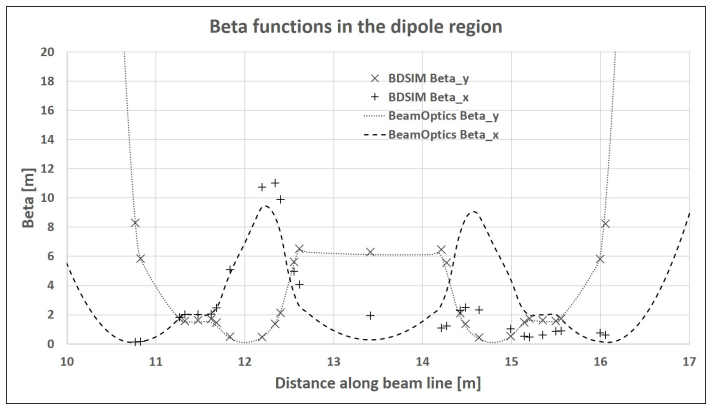
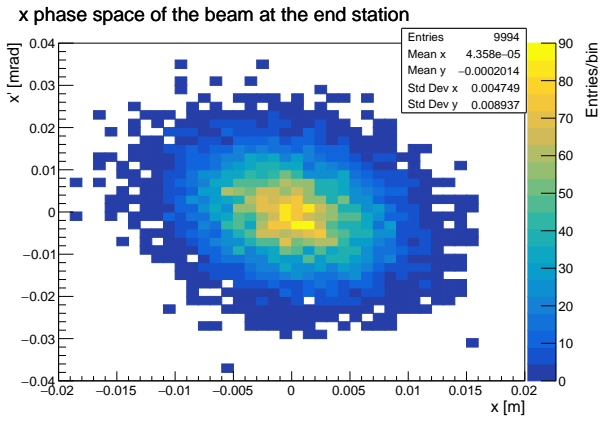
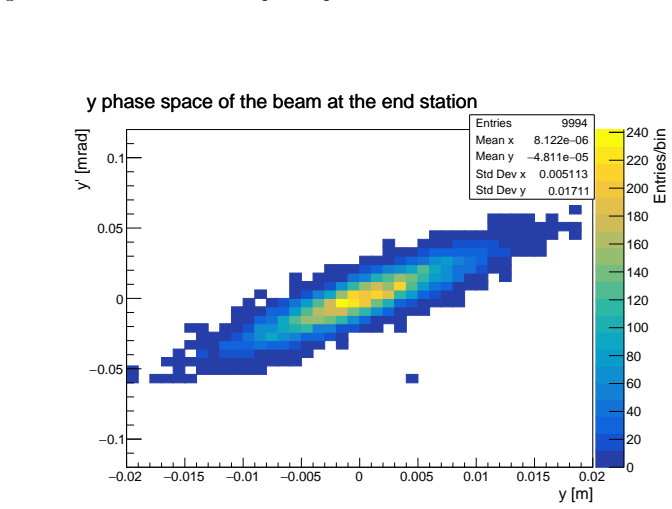
BDSIM tracking of the LhARA beamline confirms that the optics design transports the full angular spread of the input beam with transmission approaching 100 percent and final divergence remaining under 0.1 mrad, in agreement with the independent BeamOptics calculation.
What carries the argument
BDSIM particle-tracking simulation, driven by mono-energetic beams extracted from EPOCH laser-plasma output, used to verify the Gabor-lens capture and fixed-field optics layout.
If this is right
- The same capture approach can be scaled to the second-stage fixed-field accelerator for higher-energy protons and heavier ions.
- High transmission removes the need for strong collimation that would otherwise reduce usable beam intensity.
- Low final divergence supports precise dose delivery to cell samples in vitro.
- Demonstration of the laser-plus-Gabor-lens combination provides data that can guide later clinical ion-therapy systems.
Where Pith is reading between the lines
- If the transmission result holds in experiment, laser sources could replace conventional injectors in some radiobiology setups, shrinking facility size.
- The simulation workflow could be reused to test capture of carbon or helium ions once the second stage is modeled.
- Agreement between two independent optics codes increases that the design is robust to small parameter changes.
Load-bearing premise
The mono-energetic beams taken from the EPOCH simulation correctly represent the energy and angle distributions that the real laser source will deliver to the capture system.
What would settle it
Direct measurement of the laser-plasma source showing that the actual angular or energy spread differs substantially from the EPOCH-derived inputs, or beamline measurements showing transmission well below 90 percent or divergence well above 0.1 mrad.
Figures


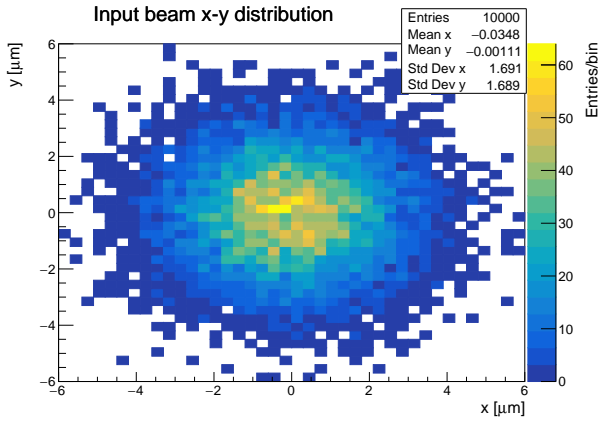




read the original abstract
The Centre for the Clinical Application of Particles' Laser-hybrid Accelerator for Radiobiological Applications (LhARA) facility is being studied and requires simulation of novel accelerator components (such as the Gabor lens capture system), detector simulation and simulation of the ion beam interaction with cells. The first stage of LhARA will provide protons up to 15 MeV for in vitro studies. The second stage of LhARA will use a fixed-field accelerator to increase the energy of the particles to allow in vivo studies with protons and in vitro studies with heavier ions. BDSIM, a Geant4 based accelerator simulation tool, has been used to perform particle tracking simulations to verify the beam optics design done by BeamOptics and these show good agreement. Design parameters were defined based on an EPOCH simulation of the laser source and a series of mono-energetic input beams were generated from this by BDSIM. The tracking results show the large angular spread of the input beam (0.2 rad) can be transported with a transmission of almost 100% whilst keeping divergence at the end station very low (<0.1 mrad). The legacy of LhARA will be the demonstration of technologies that could drive a step-change in the provision of proton and light ion therapy (i.e. a laser source coupled to a Gabor lens capture and a fixed-field accelerator), and a system capable of delivering a comprehensive set of experimental data that can be used to enhance the clinical application of proton and light ion therapy.
Editorial analysis
A structured set of objections, weighed in public.
Referee Report
Summary. The manuscript presents BDSIM particle-tracking simulations for the LhARA laser-hybrid accelerator facility. Design parameters are taken from an EPOCH laser-plasma simulation; mono-energetic input beams are generated and tracked through a Gabor-lens capture system and fixed-field accelerator. The central result is that an input beam with 0.2 rad angular spread can be transported with near-100% transmission while keeping end-station divergence below 0.1 mrad. Good agreement is reported between BDSIM and the BeamOptics design.
Significance. If the transmission and divergence results remain valid once energy spread is included, the work provides concrete evidence that a laser-driven source coupled to a Gabor lens and FFA can deliver the beam quality required for radiobiological studies, supporting the broader claim that such a hybrid system could enable a step-change in proton and ion therapy delivery.
major comments (2)
- [Input beam generation] Input beam generation section: the reported transmission (~100%) and final divergence (<0.1 mrad) are obtained exclusively with mono-energetic slices extracted from the EPOCH simulation. Real laser-plasma sources have broad energy spectra; the manuscript does not propagate the full spectrum or demonstrate that the Gabor lens and FFA are achromatic. If either element has non-zero chromaticity, both transmission and divergence will degrade, directly undermining the central feasibility claim.
- [Abstract / tracking results] Abstract and tracking results: the statement of 'good agreement' between BDSIM and BeamOptics is given without quantitative metrics, error bars, or reference to specific figures/tables showing the level of agreement. This absence makes it impossible to assess whether the reported performance is robust or sensitive to modeling approximations.
Simulated Author's Rebuttal
We thank the referee for their constructive comments on our manuscript describing BDSIM simulations for the LhARA facility. We respond point by point to the major comments, indicating revisions where appropriate.
read point-by-point responses
-
Referee: [Input beam generation] Input beam generation section: the reported transmission (~100%) and final divergence (<0.1 mrad) are obtained exclusively with mono-energetic slices extracted from the EPOCH simulation. Real laser-plasma sources have broad energy spectra; the manuscript does not propagate the full spectrum or demonstrate that the Gabor lens and FFA are achromatic. If either element has non-zero chromaticity, both transmission and divergence will degrade, directly undermining the central feasibility claim.
Authors: We agree that restricting the input to mono-energetic slices is a simplification. The simulations were performed to verify the optics design at the nominal 15 MeV energy using representative slices from the EPOCH output. We will revise the input beam generation section to state this limitation explicitly and note that the Gabor lens and FFA designs aim for low chromaticity over the relevant energy range, although full-spectrum propagation is required for a complete assessment. This revision will include a brief discussion of expected degradation and plans for future work, without altering the reported mono-energetic results. revision: partial
-
Referee: [Abstract / tracking results] Abstract and tracking results: the statement of 'good agreement' between BDSIM and BeamOptics is given without quantitative metrics, error bars, or reference to specific figures/tables showing the level of agreement. This absence makes it impossible to assess whether the reported performance is robust or sensitive to modeling approximations.
Authors: The agreement statement is supported by the visual overlap of beam envelopes and transmission curves in the relevant figures. To improve clarity, we will add quantitative metrics in the revised manuscript, including RMS differences in beam size and divergence at key locations, together with explicit references to the figures and tables that display the comparison. This will allow readers to evaluate the level of agreement directly. revision: yes
Circularity Check
No circularity: forward simulation of design with independent inputs
full rationale
The paper describes BDSIM tracking of mono-energetic beams generated from an external EPOCH laser-plasma simulation. Design verification consists of direct propagation results (transmission ~100%, final divergence <0.1 mrad) with no fitted parameters, no predictions derived from the simulation outputs themselves, and no load-bearing self-citations or uniqueness theorems. The central claim is a numerical outcome of the chosen optics, not a re-expression of the input beam definition. This matches the default case of a self-contained simulation study.
Axiom & Free-Parameter Ledger
Reference graph
Works this paper leans on
-
[1]
Cancer Research UK, Worldwide cancer incidence statistics, https://www.cancerresearchuk.org/health-professional/ cancer-statistics/worldwide-cancer/incidence, 2018. Accessed: 2019-04-13
work page 2018
-
[2]
Cancer Research UK, Cancer diagnosis and treatment statistics, https://www.cancerresearchuk.org/health-professional/ cancer-statistics/diagnosis-and-treatment , 2017. Accessed: 2019-04-13
work page 2017
-
[3]
W. P. Levin, H. Kooy, J. S. Loeffler, T. F. DeLaney, Proton beam therapy, British Journal of Cancer 93 (2005) 849–854
work page 2005
-
[4]
NHS UK, Proton beam therapy, https://www.england.nhs.uk/ commissioning/spec-services/highly-spec-services/pbt/ , 2019. Accessed: 2019-04-13
work page 2019
-
[5]
S. Bulanov, T. Esirkepov, V. Khoroshkov, A. Kuznetsov, F. Pegoraro, Oncological hadrontherapy with laser ion accelerators, Physics Letters A 299 (2002) 240–247
work page 2002
-
[6]
E. Fourkal, J. S. Li, M. Ding, T. Tajima, C. M. Ma, Particle selection for laser-accelerated proton therapy feasibility study, Medical Physics 30 (2003) 1660–1670. 22
work page 2003
- [7]
-
[8]
V. Favaudon, L. Caplier, V. Monceau, F. Pouzoulet, M. Sayarath, C. Fouillade, M.-F. Poupon, I. Brito, P. Hup´ e, J. Bourhis, J. Hall, J.-J. Fontaine, M.-C. Vozenin, Ultrahigh dose-rate flash irradiation increases the differential response between normal and tumor tissue in mice, Sci- ence Translational Medicine 6 (2014) 245ra93–245ra93
work page 2014
-
[9]
M. C. Vozenin, P. De Fornel, K. Petersson, V. Favaudon, M. Jaccard, J. F. Germond, B. Petit, M. Burki, G. Ferrand, D. Patin, H. Bouchaab, M. Ozsahin, F. Bochud, C. Bailat, P. Devauchelle, J. Bourhis, The Advantage of FLASH Radiotherapy Confirmed in Mini–pig and Cat– cancer Patients, Clin. Cancer Res. 25 (2019) 35–42
work page 2019
-
[10]
Paganetti, Relative biological effectiveness (RBE) values for proton beam therapy
H. Paganetti, Relative biological effectiveness (RBE) values for proton beam therapy. Variations as a function of biological endpoint, dose, and linear energy transfer, Phys. Med. Biol. 59 (2014) R419
work page 2014
- [11]
-
[12]
G. Giovannini, T. B¨ ohlen, G. Cabal, J. Bauer, T. Tessonnier, K. Frey, J. Debus, A. Mairani, K. Parodi, Variable RBE in proton therapy: comparison of different model predictions and their influence on clinical- like scenarios, Radiation Oncology 11 (2016) 68
work page 2016
- [13]
-
[14]
S. D. Kraft, C. Richter, K. Zeil, M. Baumann, E. Beyreuther, S. Bock, M. Bussmann, T. E. Cowan, Y. Dammene, W. Enghardt, U. Helbig, L. Karsch, T. Kluge, L. Laschinsky, E. Lessmann, J. Metzkes, D. Naum- burger, R. Sauerbrey, M. Schrer, M. Sobiella, J. Woithe, U. Schramm, 23 J. Pawelke, Dose–dependent biological damage of tumour cells by laser– accelerated ...
work page 2010
-
[15]
F. Fiorini, D. Kirby, M. Borghesi, D. Doria, J. C. Jeynes, K. F. Kakolee, S. Kar, S. Kaur, K. J. Kirby, M. J. Merchant, S. Green, Dosimetry and spectral analysis of a radiobiological experiment using laser-driven proton beams, Phys Med Biol 56 (2011) 6969–6982
work page 2011
-
[16]
D. Doria, K. F. Kakolee, S. Kar, S. K. Litt, F. Fiorini, H. Ahmed, S. Green, J. C. G. Jeynes, J. Kavanagh, D. Kirby, K. J. Kirkby, C. L. Lewis, M. J. Merchant, G. Nersisyan, R. Prasad, K. M. Prise, G. Schet- tino, M. Zepf, M. Borghesi, Biological effectiveness on live cells of laser driven protons at dose rates exceeding 109 Gy/s, AIP Advances 2 (2012) 011209
work page 2012
-
[17]
K. Zeil, M. Baumann, E. Beyreuther, T. Burris-Mog, T. E. Cowan, W. Enghardt, L. Karsch, S. D. Kraft, L. Laschinsky, J. Metzkes, D. Naumburger, M. Oppelt, C. Richter, R. Sauerbrey, M. Sch¨ urer, U. Schramm, J. Pawelke, Dose–controlled irradiation of cancer cells with laser-accelerated proton pulses, Applied Physics B 110 (2013) 437–444
work page 2013
- [18]
-
[19]
O. Zlobinskaya, C. Siebenwirth, C. Greubel, V. Hable, R. Herten- berger, N. Humble, S. Reinhardt, D. Michalski, B. Rper, G. Multhoff, G. Dollinger, J. J. Wilkens, T. E. Schmid, The effects of ultra–high dose rate proton irradiation on growth delay in the treatment of human tumor xenografts in nude mice, Radiation Research 181 (2014) 177–183
work page 2014
-
[20]
L. Manti, F. Perozziello, M. Borghesi, G. Candiano, P. Chaudhary, G. Cirrone, D. Doria, D. Gwynne, R. Leanza, K. M. Prise, L. Ro- magnani, F. Romano, V. Scuderi, A. Tramontana, The radiobiology of laser-driven particle beams: focus on sub-lethal responses of normal human cells, Journal of Instrumentation 12 (2017) C03084–C03084
work page 2017
-
[21]
F. Romano, F. Schillaci, G. Cirrone, G. Cuttone, V. Scuderi, L. Allegra, A. Amato, A. Amico, G. Candiano, G. D. Luca, G. Gallo, S. Gior- danengo, L. F. Guarachi, G. Korn, G. Larosa, R. Leanza, R. Manna, 24 V. Marchese, F. Marchetto, D. Margarone, G. Milluzzo, G. Petringa, J. Pipek, S. Pulvirenti, D. Rizzo, R. Sacchi, S. Salamone, M. Sedita, A. Vignati, Th...
work page 2016
-
[22]
U. Masood, T. E. Cowan, W. Enghardt, K. M. Hofmann, L. Karsch, F. Kroll, U. Schramm, J. J. Wilkens, J. Pawelke, A light-weight com- pact proton gantry design with a novel dose delivery system for broad- energetic laser-accelerated beams, Physics in Medicine & Biology 62 (2017) 5531–5555
work page 2017
-
[23]
P. Chaudhary, D. Gwynne, D. Doria, L. Romagnani, C. Maiorino, H. Padda, A. Alejo, N. Booth, D. Carroll, S. Kar, P. McKenna, G. Schet- tino, M. Borghesi, K. M. Prise, Effectiveness of laser accelerated ultra high dose rate protons in DNA DSB damage induction under hypoxic conditions, in: 44th EPS Conference on Plasma Physics, EPS 2017, volume 44F, European ...
work page 2017
-
[24]
D. Margarone, G. A. P. Cirrone, G. Cuttone, A. Amico, L. And, M. Borghesi, S. S. Bulanov, S. V. Bulanov, D. Chatain, A. Fajs- tavr, L. Giuffrida, F. Grepl, S. Kar, J. Krasa, D. Kramer, G. Larosa, R. Leanza, T. Levato, M. Maggiore, L. Manti, G. Milluzzo, B. Odlozi- lik, V. Olsovcova, J.-P. Perin, J. Pipek, J. Psikal, G. Petringa, J. Ridky, F. Romano, B. Rus...
work page 2018
- [25]
- [26]
-
[27]
J. Allison, K. Amako, J. Apostolakis, P. Arce, M. Asai, T. Aso, E. Bagli, A. Bagulya, S. Banerjee, G. Barrand, B. Beck, A. Bogdanov, D. Brandt, J. Brown, H. Burkhardt, P. Canal, D. Cano-Ott, S. Chauvie, K. Cho, G. Cirrone, G. Cooperman, M. Corts-Giraldo, G. Cosmo, G. Cuttone, G. Depaola, L. Desorgher, X. Dong, A. Dotti, V. Elvira, G. Folger, Z. Francis, A...
work page 2016
- [28]
-
[29]
Borghesi, Laser-driven ion acceleration: State of the art and emerg- ing mechanisms, Nucl
M. Borghesi, Laser-driven ion acceleration: State of the art and emerg- ing mechanisms, Nucl. Instrum. Meth. A740 (2014) 6–9
work page 2014
-
[30]
T. D. Arber, K. Bennett, C. S. Brady, A. Lawrence-Douglas, M. G. Ramsay, N. J. Sircombe, P. Gillies, R. G. Evans, H. Schmitz, A. R. Bell, C. P. Ridgers, Contemporary particle-in-cell approach to laser-plasma modelling, Plasma Physics and Controlled Fusion 57 (2015) 113001
work page 2015
-
[31]
J. Pozimski, M. Aslaninejad, Gabor lenses for capture and energy selec- tion of laser driven ion beams in cancer treatment, Laser and Particle Beams 31 (2013) 723–733. 26
work page 2013
-
[32]
I. Hofmann, J. Meyer-ter Vehn, X. Yan, A. Orzhekhovskaya, S. Yaramy- shev, Collection and focusing of laser accelerated ion beams for therapy applications, Phys. Rev. ST Accel. Beams 14 (2011) 031304
work page 2011
-
[33]
P. A. Posocco, M. Merchant, J. Pozimski, Y. Xia, First Test of The Im- perial College Gabor (Plasma) Lens prototype at the Surrey Ion Beam centre, in: Proceedings, 7th International Particle Accelerator Confer- ence (IPAC 2016): Busan, Korea, May 8–13, 2016, p. TUPMY024
work page 2016
-
[34]
S. Reinhardt, M. W¨ url, C. Greubel, N. Humble, J. J. Wilkens, M. Hill- brand, A. Mairani, W. Assmann, K. Parodi, Investigation of EBT2 and EBT3 films for proton dosimetry in the 4–20 Mev energy range, Radia- tion and Environmental Biophysics 54 (2015) 71–79
work page 2015
-
[35]
J. H. Bin, Q. Ji, P. A. Seidl, D. Raftrey, S. Steinke, A. Persaud, K. Naka- mura, A. Gonsalves, W. P. Leemans, T. Schenkel, Absolute calibration of GafChromic film for very high flux laser driven ion beams, Review of Scientific Instruments 90 (2019) 053301. 27
work page 2019
discussion (0)
Sign in with ORCID, Apple, or X to comment. Anyone can read and Pith papers without signing in.