REVIEW 3 major objections 4 minor 82 references
Formation of massive star clusters with and without iron abundance spreads in a dwarf galaxy merger
T0 review · 3 major / 4 minor · reviewed 2026-08-10 · deepseek-v4-flash
Pith's one-line read A high-resolution simulation of a dwarf-dwarf galaxy merger produces 13 young massive star clusters that split into two types: those with iron abundance spreads and those that stay chemically homogeneous, with the split set by whether…
desk verdict Dwarf-dwarf merger simulation shows a plausible but provisional split between Fe-spread and non-Fe-spread clusters, weakened by a post-hoc reclassification. read the letter →
The pith
A machine-rendered reading of the paper's core claim, the machinery that carries it, and where it could break.
The reading
What carries the argument
The central objects are the 13 resolved young star clusters, identified as concentrations of collisionless star particles around local potential minima within 20 pc and with total masses above $10^{5}$ solar masses. The mechanism that sorts them into iron-spread and iron-pure classes is the competition between gas fallback and gas expulsion, set by the subgrid star-formation and feedback prescriptions: stars form only in gas colder than 100 K and denser than 100 hydrogen atoms per cubic centimeter, and each Type II supernova deposits $10^{51}$ erg of thermal energy into the surrounding gas particles. Whether the supernova-contaminated gas is retained and recaptured, which is decided by the cluster's gravitational potential and the local gas abundance, determines whether a second generation of stars with elevated [Fe/H] appears. Metal enrichment is tracked with a chemical evolution library using standard Type II supernova yield tables, with a metal diffusion coefficient of 0.01.
What would settle it
Run the same merger with twice the supernova energy per event or a different star-formation density threshold: if clusters that were Type II become Type I or vice versa, the claimed dichotomy is a product of the prescriptions. Observationally, a single measurement of the iron abundance distribution in a young massive cluster embedded in dense, supernova-enriched gas within a dwarf-dwarf merger remnant would settle it, because the fallback path requires that such gas actually produces a second, more metal-rich stellar generation.
Extended reading notes
Core claim
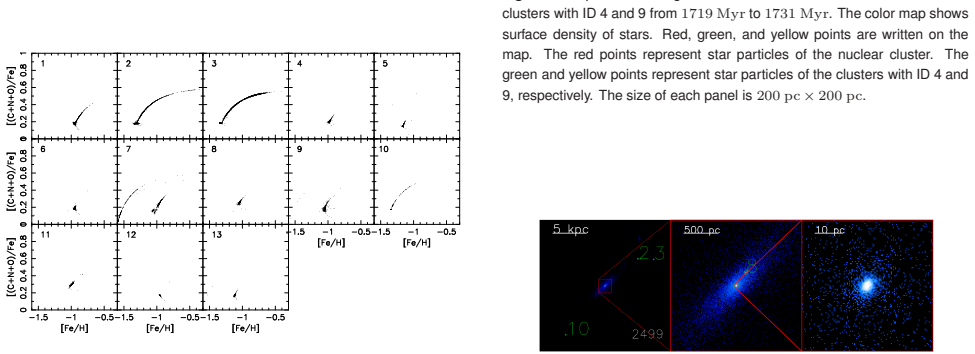
In a high-resolution N-body/SPH simulation of a dwarf-dwarf galaxy merger, the authors find that 13 young massive star clusters form, and these naturally divide into two classes distinguished by their iron abundance distributions. Clusters such as IDs 2 and 3 form when the first-generation stars, born in the compressed gas of the collision interface, inject Type II supernova ejecta into the surrounding gas; because the supernova energy injection is too weak to expel this gas, the contaminated gas falls back and gives rise to a second stellar generation with higher [Fe/H]. Clusters such as ID 8 follow the opposite path: the supernova-driven outflows evacuate the surrounding gas before fallback, so only one, chemically homogeneous generation forms. Nine of the clusters, formed in the central region after the second encounter, sink into the galactic center through dynamical friction; close encounters tidally disrupt the more loosely bound ones, while the survivors merge to assemble a nuclear star cluster containing several stellar generations with a range of [Fe/H] and ages. The authors argue this behavior reproduces the observational Type I/Type II dichotomy of globular clusters and demonstrates that dwarf-dwarf mergers can build nuclear star clusters through cluster merging alone.
Load-bearing premise
The reported split between clusters with and without iron spreads rests on the adopted subgrid rules for when stars form and how much energy each supernova deposits, and on the single galaxy merger orbit simulated, so a different choice of these rules might erase the dichotomy.
Editorial extensions
If this is right
- If the mechanism is right, dwarf-dwarf mergers are a viable birthplace for both Type I and Type II globular cluster analogs, with the same competing processes of fallback and outflow determining the class.
- Nuclear star clusters can be assembled purely by the merger-driven infall and coalescence of young massive star clusters, without a pre-existing nuclear cluster, and will then contain multiple stellar generations that reflect the encounter history.
- The deepest-potential clusters are the most likely to retain supernova-contaminated gas and become Type II, linking cluster mass and binding energy to the presence of iron spreads, as broadly seen in observations.
- In the simulated remnant, the gas blowout after the final encounter quenches further cluster formation, so the nuclear star cluster in this case contains no young stellar population, whereas more massive mergers with sustained gas inflow would add in-situ generations.
- Clusters formed at the first encounter survive in the outer halo on highly eccentric orbits, while later-formed clusters are gradually destroyed or merged into the center, explaining a radial segregation of cluster types.
Reading between the lines
- The paper runs a single merger model with one set of feedback and star-formation parameters; extending the same analysis to varying supernova energies, density thresholds, metal diffusion coefficients, or galaxy mass ratios would test whether the Type I/Type II dichotomy survives or is an artifact of the chosen prescriptions.
- The retention-versus-expulsion threshold implies a continuous metric, the ratio of supernova energy injection to the binding energy of the gas reservoir, that could be computed across simulations and compared directly with the observed fraction of clusters showing iron spreads.
- If the nuclear star cluster is assembled mostly from one dominant cluster (ID 1 contributes about 87 percent of its mass within 20 pc), then the chemical and kinematic properties of the nuclear cluster in dwarf remnants should strongly resemble the most massive cluster, a prediction testable in nearby compact dwarf mergers.
- The authors classify ID 12 as Type I despite a 0.32 dex iron dispersion because only a minor fraction of its stars are metal-rich; this highlights that the mapping between simulated [Fe/H] spreads and observed Type II classification depends on the fraction of enriched stars and on detection limits, an observational selection effect worth quantifying.
Signed reviews
Editorial analysis
A structured set of objections, weighed in public.
Referee Report
Summary. The paper presents a single high-resolution Tree+GRAPE SPH simulation of a dwarf-dwarf galaxy merger, using the ASURA code with chemical evolution through CELib and Type II SN yields. From this run, 13 young massive star clusters are identified, and the paper argues that they split into two types: Type II clusters with [Fe/H] spreads, formed when Type II SN-contaminated gas falls back onto a seed cluster and forms second-generation stars, and Type I clusters without such spreads, formed when SN feedback expels the surrounding gas before fallback can occur. The paper further claims that nine clusters sink into the galactic center by dynamical friction and merge to build a nuclear star cluster with mixed ages and metallicities.
Significance. If the claims are robust, the simulation offers an appealing mechanism for the observed dichotomy between Type I and Type II globular clusters in the context of dwarf-dwarf mergers, and provides an explicit formation path for nuclear star clusters through cluster assembly. The work uses established codes and chemical yield tables, and the qualitative mechanism (deeper potential wells retain contaminated gas) is physically plausible. However, the significance is strongly tempered by the reliance on a single realization with no resolution or subgrid-parameter variations, and by an internally inconsistent classification of one cluster in the defining table.
major comments (3)
- [§2.2, §3.2] The central Type I/Type II dichotomy is controlled by the subgrid star-formation thresholds (T<100 K, n_H>100 cm^-3), the thermal SN energy input (10^51 erg per SN), and the adopted metal diffusion coefficient (0.01). The paper presents exactly one simulation and no resolution or feedback-parameter variations. In SPH, thermal feedback is known to be resolution dependent, so the claimed retention/outflow switch may be a numerical artifact rather than a robust physical result. The authors should add a resolution study or a small parameter exploration (at least varying the feedback energy or the density threshold) to demonstrate that the dichotomy does not depend on these choices, or explicitly qualify the claim as a single-realization result.
- [Table 1, ID 12] The classification rule stated in §3.2 is that clusters with σ([Fe/H]) > 0.1 are Type II. Cluster ID 12 has σ=0.32, yet it is classified as Type I because the high-[Fe/H] stars are a 'minor fraction.' This exception is introduced post hoc in the same table that defines the criterion. If the distinction is based on the distribution shape rather than σ alone, the criterion should be defined quantitatively (e.g., a minimum fraction of high-[Fe/H] stars) and applied uniformly to all clusters. As written, the exception undermines the claim of a clean two-type separation and suggests the underlying distribution may be continuous.
- [§3.2, §4.1] The paper explains the Type I/II outcome as a competition between SN energy injection and the ability of the cluster's gravitational potential to retain the contaminated gas, but it does not quantify this balance for the individual clusters. For example, comparing the total SN energy injected in the seed cluster to the binding energy of the surrounding gas (or to the virial energy of the cluster) would provide a direct test of the proposed mechanism and help distinguish it from timing or subgrid artifacts. The qualitative snapshots in Figures 4 and 5 support the narrative, but a quantitative energy-budget analysis is needed to make the mechanism convincing.
minor comments (4)
- [Figure 3] The [Fe/H] histograms are plotted with a fixed bin width of 0.25 dex. For clusters with small particle counts (e.g., ID 12, with mass ~1e5 Msun and ~150 particles), the measured σ is sensitive to this binning. Please report the number of star particles per cluster and consider showing Poisson error bars or adaptive binning.
- [§3.3] The nuclear star cluster mass is quoted at a radius of 20 pc (1.75e6 Msun) and also at 100 pc (2.0e6 Msun). The definition of 'nuclear star cluster' and the radius dependence should be stated more explicitly, since the mass fraction of each contributing cluster changes substantially between these two radii.
- [§2.2] The text says a newly formed star particle is treated as a single stellar population with a Kroupa IMF, but it does not specify how Type II SN yields are realized for a particle of 666 Msun (i.e., whether the SN rate is sampled stochastically or averaged). Please clarify the implementation.
- [General] The header still shows 'Publ. Astron. Soc. Japan (2018)' as the journal year; this should be updated to the intended publication year. Also ensure consistent spelling of 'Lahén et al.' in the text and references.
Circularity Check
No significant circularity: the paper is a forward simulation with externally adopted subgrid physics and an observational classification threshold.
full rationale
The paper's derivation chain is a forward numerical simulation: initial dwarf galaxy models, star formation criteria, Type II SN thermal feedback, and metal yields are specified in Section 2.2 using external references (ASURA, CELib, Nomoto et al. 2013, Seitenzahl et al. 2013, Kroupa 2001). The Type I/II classification is not fitted to make clusters appear Type II; it uses the observational threshold sigma > 0.1 dex from Milone et al. (2017), applied after the simulation output. The proposed formation mechanisms for clusters with and without [Fe/H] spreads are read off the simulation through snapshots and time evolution, not imposed by the input definitions. The nuclear star cluster assembly follows from dynamical friction and cluster merging, again emergent from the simulation. Self-citations to Saitoh et al. (2008, 2009), Matsui et al. (2012, 2019), and Hirai & Saitoh (2017) are methodological references for the code and chemical library; they are not uniqueness theorems or load-bearing arguments that force the paper's conclusions. The notable limitations are robustness-related, not circularity-related: only one simulation is run with no resolution or feedback-parameter variations, and the classification of cluster ID 12 as Type I despite sigma = 0.32 is a post-hoc exception to the stated threshold. These affect the strength of the two-type claim but do not make any prediction reduce to its inputs by construction.
Assumptions & free parameters
free parameters (5)
- Initial gas metallicity [Fe/H]_init =
-1.6
- Star formation thresholds (T<100 K, nH>100 cm^-3, div v<0)
- Type II SN energy per event =
10^51 erg
- Type I/II classification threshold sigma([Fe/H]) > 0.1 dex =
0.1 dex
- Metal diffusion coefficient =
0.01
assumptions (4)
- domain assumption ASURA code accurately solves the collisional N-body and SPH equations with the adopted subgrid prescriptions.
- domain assumption Kroupa (2001) IMF for newly formed stellar populations and its SN yields.
- domain assumption Type II SNe dominate iron enrichment on the simulation timescale.
- ad hoc to paper The adopted mass and spatial resolution (m_particle=2e3 Msun, softening 1 pc) is sufficient to capture the gas infall and supernova feedback balance that controls self-enrichment.
Cite this review
Pith. "Pith review of Formation of massive star clusters with and without iron abundance spreads in a dwarf galaxy merger." pith.science (2026). https://pith.science/paper/6FBRTDH5
@misc{pith2026250112658,
  author       = {Pith},
  title        = {Pith review of: Formation of massive star clusters with and without iron abundance spreads in a dwarf galaxy merger},
  year         = {2026},
  howpublished = {\url{https://pith.science/paper/6FBRTDH5}},
  note         = {Machine review of arXiv:2501.12658}
}
abstract
To study the formation of star clusters and their properties in a dwarf-dwarf merging galaxy, we have performed a numerical simulation of a dwarf-dwarf galaxy merger by using the Tree+GRAPE $N$-body/SPH code ASURA. In our simulation, 13 young star clusters are formed during the merger process. We show that our simulated star clusters can be divided into two types: with and without [Fe/H] abundance variations. The former is created by a seed star cluster (the first-generation stars) formed in compressed gas. These stars contaminate the surrounding gas by Type II supernovae (SNe). At that time, the energy injection is insufficient to induce an outflow of the surrounding gas. After that, the contaminated gas falls into the seed, thereby forming a new generation of stars from the contaminated gas. We also show that most star clusters are formed in the galactic central region after the second encounter and fall into the galactic center due to dynamical friction within several hundred Myr. As a result, close encounters and mergers between the clusters take place. Although the clusters with shallower gravitational potential are tidally disrupted by these close encounters, others survive and finally merge at the center of the merged dwarf galaxies to create a nuclear star cluster. Therefore, the nuclear star cluster is comprised of various stellar components in [Fe/H] abundance and age. We discuss our work in the context of observations and demonstrate the diagnostic power of high-resolution simulations in the context of star cluster formation.
Figures


Figures from the paper (7 more)




Reference graph
Works this paper leans on
-
[1]
2011, , 729, 35
Agarwal , M., & Milosavljevi \'c , M. 2011, , 729, 35
2011
-
[2]
2015, , 812, 72
Antonini , F., Barausse , E., & Silk , J. 2015, , 812, 72
2015
- [3]
-
[4]
2008, , 388, L10
Bekki , K. 2008, , 388, L10
2008
- [5]
-
[6]
Bekki , K., & Freeman , K. C. 2003, , 346, L11
work page 2003
- [7]
-
[8]
Calura , F., D'Ercole , A., Vesperini , E., Vanzella , E., & Sollima , A. 2019, , 489, 3269
work page 2019
Show all 82 references
-
[9]
W., & Lattanzio , J
Campbell , S. W., & Lattanzio , J. C. 2008, , 490, 769
2008
-
[10]
2015, , 810, 148
Carretta , E. 2015, , 810, 148
2015
-
[11]
2009 a , , 508, 695
Carretta , E., Bragaglia , A., Gratton , R., D'Orazi , V., & Lucatello , S. 2009 a , , 508, 695
2009
-
[12]
2009 b , , 505, 139
Carretta , E., Bragaglia , A., Gratton , R., & Lucatello , S. 2009 b , , 505, 139
2009
-
[13]
G., et al
Carretta , E., Bragaglia , A., Gratton , R. G., et al. 2009 c , , 505, 117
2009
-
[14]
E., Kewley , L
Chien , L.-H., Barnes , J. E., Kewley , L. J., & Chambers , K. C. 2007, , 660, L105
2007
-
[15]
L., Gil-Pons , P., Lau , H
Doherty , C. L., Gil-Pons , P., Lau , H. H. B., Lattanzio , J. C., & Siess , L. 2014, , 437, 195
2014
-
[16]
G., Cortesi , A., Faifer , F
Escudero , C. G., Cortesi , A., Faifer , F. R., et al. 2022, , 511, 393
2022
-
[17]
2022, , 667, A101
Fahrion , K., Bulichi , T.-E., Hilker , M., et al. 2022, , 667, A101
2022
-
[18]
Freeman , K. C. 1993, in Astronomical Society of the Pacific Conference Series, Vol. 48, The Globular Cluster-Galaxy Connection, ed. G. H. Smith & J. P. Brodie , 608
1993
-
[19]
L., Lau , H., et al
Gil-Pons , P., Doherty , C. L., Lau , H., et al. 2013, , 557, A106
2013
-
[20]
Y., Ostriker , J
Gnedin , O. Y., Ostriker , J. P., & Tremaine , S. 2014, , 785, 71
2014
-
[21]
2019 a , , 27, 8
Gratton , R., Bragaglia , A., Carretta , E., et al. 2019 a , , 27, 8
2019
-
[22]
2019 b , , 27, 8
---. 2019 b , , 27, 8
2019
-
[23]
2004, , 42, 385
Gratton , R., Sneden , C., & Carretta , E. 2004, , 42, 385
2004
-
[24]
G., Carretta , E., & Bragaglia , A
Gratton , R. G., Carretta , E., & Bragaglia , A. 2012, , 20, 50
2012
-
[25]
G., Johnson , C
Gratton , R. G., Johnson , C. I., Lucatello , S., D'Orazi , V., & Pilachowski , C. 2011, , 534, A72
2011
-
[26]
G., Bonifacio , P., Bragaglia , A., et al
Gratton , R. G., Bonifacio , P., Bragaglia , A., et al. 2001, , 369, 87
2001
-
[27]
Hirai , Y., & Saitoh , T. R. 2017, , 838, L23
2017
-
[28]
F., Cox , T
Hopkins , P. F., Cox , T. J., Hernquist , L., et al. 2013, , 430, 1901
2013
-
[29]
T., Schiavon , R
Horta , D., Mackereth , J. T., Schiavon , R. P., et al. 2021, , 500, 5462
2021
-
[30]
I., & Pilachowski , C
Johnson , C. I., & Pilachowski , C. A. 2010, , 722, 1373
2010
-
[31]
Kaneko , H., Kuno , N., & Saitoh , T. R. 2018, , 860, L14
2018
-
[32]
Karakas , A. I. 2010, , 403, 1413
2010
-
[33]
N., Cohen , J
Kirby , E. N., Cohen , J. G., Guhathakurta , P., et al. 2013, , 779, 102
2013
-
[34]
I., & Lugaro , M
Kobayashi , C., Karakas , A. I., & Lugaro , M. 2020, , 900, 179
2020
-
[35]
2001, , 322, 231
Kroupa , P. 2001, , 322, 231
2001
-
[36]
2024, arXiv e-prints, arXiv:2402.09518
Lah \'e n , N., Naab , T., & Sz \'e csi , D. 2024, arXiv e-prints, arXiv:2402.09518
2024 arXiv
-
[37]
S., Brodie , J
Larsen , S. S., Brodie , J. P., Grundahl , F., & Strader , J. 2014, , 797, 15
2014
-
[38]
F., Sneden , C., Kraft , R
Marino , A. F., Sneden , C., Kraft , R. P., et al. 2011, , 532, A8
2011
-
[39]
F., Yong , D., Milone , A
Marino , A. F., Yong , D., Milone , A. P., et al. 2018, , 859, 81
2018
-
[40]
F., Milone , A
Marino , A. F., Milone , A. P., Renzini , A., et al. 2019, , 487, 3815
2019
-
[41]
2021, , 923, 22
---. 2021, , 923, 22
2021
-
[42]
L., Smolinski , J
Martell , S. L., Smolinski , J. P., Beers , T. C., & Grebel , E. K. 2011, , 534, A136
2011
-
[43]
L., Shetrone , M
Martell , S. L., Shetrone , M. D., Lucatello , S., et al. 2016, , 825, 146
2016
-
[44]
Matsui , H., Tanikawa , A., & Saitoh , T. R. 2019, , 71, 19
2019
-
[45]
R., Makino , J., et al
Matsui , H., Saitoh , T. R., Makino , J., et al. 2012, , 746, 26
2012
-
[46]
2021 a , , 507, 834
McKenzie , M., & Bekki , K. 2021 a , , 507, 834
2021
-
[47]
2021 b , , 500, 4578
---. 2021 b , , 500, 4578
2021
-
[48]
F., et al
McKenzie , M., Yong , D., Marino , A. F., et al. 2022, , 516, 3515
2022
-
[49]
D., Thatte , N
Mengel , S., Lehnert , M. D., Thatte , N. A., et al. 2008, , 489, 1091
2008
-
[50]
G., et al
M \'e sz \'a ros , S., Masseron , T., Fern \'a ndez-Trincado , J. G., et al. 2021, , 505, 1645
2021
-
[51]
2016, , 817, 20
Mezcua , M., Civano , F., Fabbiano , G., Miyaji , T., & Marchesi , S. 2016, , 817, 20
2016
-
[52]
Mezcua , M., & S \'a nchez , H. D. 2024, , arXiv:2401.15152
2024 arXiv
-
[53]
2018, , 475, 2269
Miki , Y., & Umemura , M. 2018, , 475, 2269
2018
-
[54]
P., & Marino , A
Milone , A. P., & Marino , A. F. 2022, Universe, 8, 359
2022
-
[55]
P., Piotto , G., Renzini , A., et al
Milone , A. P., Piotto , G., Renzini , A., et al. 2017, , 464, 3636
2017
-
[56]
M., Wyse , R
Nataf , D. M., Wyse , R. F. G., Schiavon , R. P., et al. 2019, , 158, 14
2019
-
[57]
F., Frenk , C
Navarro , J. F., Frenk , C. S., & White , S. D. M. 1996, , 462, 563
1996
-
[58]
D., Seth , A
Nguyen , D. D., Seth , A. C., den Brok , M., et al. 2017, , 836, 237
2017
-
[59]
D., Seth , A
Nguyen , D. D., Seth , A. C., Neumayer , N., et al. 2019, , 872, 104
2019
-
[60]
S., Neumayer , N., Clontz , C., et al
Nitschai , M. S., Neumayer , N., Clontz , C., et al. 2023, arXiv e-prints, arXiv:2309.02503
2023 arXiv
-
[61]
2013, , 51, 457
Nomoto , K., Kobayashi , C., & Tominaga , N. 2013, , 51, 457
2013
-
[62]
Norris , J., & Freeman , K. C. 1979, , 230, L179
1979
-
[63]
J., Calder \'o n-Castillo , P., & Duc , P.-A
Paudel , S., Smith , R., Yoon , S. J., Calder \'o n-Castillo , P., & Duc , P.-A. 2018, , 237, 36
2018
-
[64]
R., Anderson , J., et al
Piotto , G., Bedin , L. R., Anderson , J., et al. 2007, , 661, L53
2007
-
[65]
2019, , 626, A56
Posti , L., Fraternali , F., & Marasco , A. 2019, , 626, A56
2019
-
[66]
2015, , 446, 2038
Renaud , F., Bournaud , F., & Duc , P.-A. 2015, , 446, 2038
2015
-
[67]
P., Pontzen , A., Agertz , O., et al
Rey , M. P., Pontzen , A., Agertz , O., et al. 2022, , 511, 5672
2022
-
[68]
M., Knapen , J
Rom \'a n , J., S \'a nchez-Alarc \'o n , P. M., Knapen , J. H., & Peletier , R. 2023, , 671, L7
2023
-
[69]
Saitoh , T. R. 2017, , 153, 85
2017
-
[70]
R., Daisaka , H., Kokubo , E., et al
Saitoh , T. R., Daisaka , H., Kokubo , E., et al. 2008, , 60, 667
2008
-
[71]
2009, , 61, 481
---. 2009, , 61, 481
2009
-
[72]
R., Ciaraldi-Schoolmann , F., R \"o pke , F
Seitenzahl , I. R., Ciaraldi-Schoolmann , F., R \"o pke , F. K., et al. 2013, , 429, 1156
2013
-
[73]
Trancho , G., Bastian , N., Schweizer , F., & Miller , B. W. 2007, , 658, 993
2007
-
[74]
D., Ostriker , J
Tremaine , S. D., Ostriker , J. P., & Spitzer , Jr., L. 1975, , 196, 407
1975
-
[75]
R., et al
van Donkelaar , F., Mayer , L., Capelo , P. R., et al. 2024, , 529, 4104
2024
-
[76]
2014, , 789, L39
Wanajo , S., Sekiguchi , Y., Nishimura , N., et al. 2014, , 789, L39
2014
-
[77]
L., van der Marel , R
Watkins , L. L., van der Marel , R. P., Bellini , A., & Anderson , J. 2015, , 812, 149
2015
-
[78]
C., & Schweizer , F
Whitmore , B. C., & Schweizer , F. 1995, , 109, 960
1995
-
[79]
L., Bekki , K., & McKenzie , M
Williams , M. L., Bekki , K., & McKenzie , M. 2022, , 512, 4086
2022
-
[80]
2008, , 672, L29
Yong , D., & Grundahl , F. 2008, , 672, L29
2008
-
[81]
2020, , 900, 152
Zhang , H.-X., Smith , R., Oh , S.-H., et al. 2020, , 900, 152
2020
-
[82]
Computer Modern (defalt font)
\@bibitem \@bib@author\@prev@author \@set@biblabel \@lbibitem[#1] \@bib@parse#1()\@nil \@set@biblabel \@bib@parse#1(#2)#3\@nil \@bib@author #1 @edef\@bib@year @space#2 \@empty \@set@biblabel#1 \@bib@author\@empty \@latex@warning Author name should be given for reference entry ...
Reviewed August 10, 2026 · model on record in the stance chip above.
Discussion (0). Continue with ORCID to comment.