REVIEW 2 major objections 5 minor 21 references
Generalized chip firing and critical groups of arithmetical structures on trees
T0 review · 2 major / 5 minor · reviewed 2026-08-15 · deepseek-v4-flash
Pith's one-line read The paper proves that every finite abelian group is the critical group of some arithmetical structure on a tree, and that the number of invariant factors of such a group is bounded by a starlike decomposition of the tree.
desk verdict Solid paper that settles two open questions in arithmetical structures on trees; the only soft spot is a terse induction in Lemma 4.3, which is fixable. read the letter →
The pith
A machine-rendered reading of the paper's core claim, the machinery that carries it, and where it could break.
The reading
What carries the argument
Four pieces carry the argument. generalized chip firing: firing at a vertex $v$ replaces a divisor $\delta$ by $\delta$ minus the column of $\operatorname{diag}(d)-A(G)$ indexed by $v$; divisors modulo firing form the cokernel, and the degree weighted by $r$ is preserved, so degree-zero classes form the critical group. starlike decompositions: a tree is recursively split into starlike trees (one vertex of degree at least $3$) and paths, and Lemma 4.3 uses borrowing along tentacles to concentrate any divisor at $\sum_i(\ell_i-2)+1$ vertices. the wedge-sum merge of Proposition 3.1, with the coprime-$r$ condition, gives $K(G_1\vee G_2)\cong K(G_1)\oplus K(G_2)$ (Theorem 3.3). Finally, the starlike-tree formula $K(S)\oplus (\mathbb{Z}/r_0\mathbb{Z})^2\cong \bigoplus_{i=1}^{\ell} \mathbb{Z}/d_i^*\mathbb{Z}$ (Theorem 6.1) is the constructive engine: it turns prescribed invariant factors into $r$-values on a broom graph, and tentacles can be extended without changing the critical group.
What would settle it
Compute the Smith normal form of $\operatorname{diag}(d)-A(T)$ for every arithmetical structure on a small tree $T$ with two non-adjacent degree-$3$ vertices; finding any critical group with more than $\ell(T)-2-\iota(T)$ invariant factors, or any divisor class that cannot be represented on at most that many plus one vertices, would refute Theorem 4.5 and Lemma 4.3.
Extended reading notes
Core claim
The central discovery is a transfer between chip-firing geometry and linear algebra: if every divisor on a graph is equivalent, under this generalized firing, to one supported on a set $Z$ of vertices, then the critical group has at most $|Z|-1$ invariant factors (Theorem 2.4). For trees, the paper shows that a starlike decomposition $\{S_i\}$ lets every divisor be supported on at most $\sum_i(\ell_i-2)+1$ vertices, giving the bound that every arithmetical structure on $T$ has at most $\sum_i(\ell_i-2)=\ell(T)-2-\iota(T)=|E(T)|-\nu_2(T)$ invariant factors (Theorems 4.5 and 5.5). On the construction side, the paper combines a formula for critical groups of starlike trees with a wedge-sum additivity theorem: Theorem 6.1 computes critical groups of starlike trees, Theorem 3.3 makes critical groups additive under merging vertices with coprime $r$-values, and the resulting broom-graph construction realizes every finite abelian group; Corollary 6.5 realizes any group with at most $\ell(T)-2$ invariant factors on a subdivision of any tree $T$. The classification of trees with only cyclic critical groups (Corollary 4.6) is a direct corollary of the invariant-factor bound: the allowed trees are paths, starlike trees with three leaves, and trees with exactly two adjacent degree-$3$ vertices and no vertex of degree at least $4$.
Load-bearing premise
The load-bearing premise is Lemma 4.3's claim that, using borrowing along tentacles, every divisor on a tree can be concentrated on at most $\sum_i(\ell_i-2)+1$ vertices for arbitrary integer labelings $d$; if the induction silently leaves one extra vertex with chips, the invariant-factor upper bounds and the classification of cyclic critical groups collapse.
Editorial extensions
If this is right
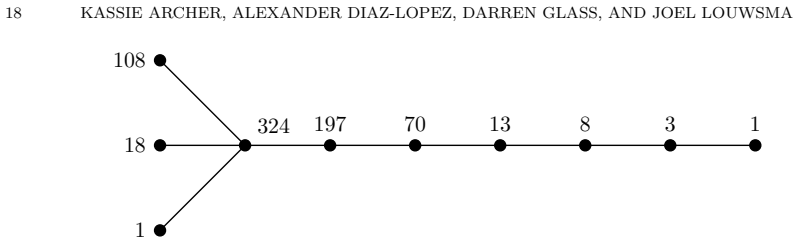
- Every finite abelian group $G$ appears as the critical group of an arithmetical structure on a broom graph, that is, a starlike tree with at most one tentacle of length greater than one (Proposition 6.3).
- For any tree $T$ and any finite abelian group $G$ with at most $\ell(T)-2$ invariant factors, some subdivision of $T$ carries an arithmetical structure with critical group $G$ (Corollary 6.5).
- The number of invariant factors of the critical group of any arithmetical structure on $T$ is at most $\ell(T)-2-\iota(T)=|E(T)|-\nu_2(T)$, and every integer from $0$ up to that bound is attained by some arithmetical structure on $T$ (Theorems 4.5 and 5.5).
- All arithmetical structures on a tree have cyclic critical group exactly when the tree is a path, a starlike tree with three leaves, or a tree with two adjacent degree-$3$ vertices and nothing of degree at least $4$ (Corollary 4.6 and Remark 4.7).
- Under wedge merging with coprime $r$-values at the merged vertices, critical groups add as a direct sum; this also gives arithmetical structures on $c$-cyclic graphs with any prescribed finite abelian critical group, for every positive integer $c$ (Remark 6.7).
Reading between the lines
- Because the support bound in Lemma 4.3 holds for arbitrary integer labelings $d$, not only for arithmetical-structure matrices, the same invariant-factor upper bound should apply to any integer matrix $\operatorname{diag}(d)-A(T)$; a computational search over small trees with non-arithmetical $d$ could test whether the bound is sharp outside the intended setting.
- The paper's bound ties invariant factors to purely graph-theoretic parameters (leaves, splitting irregularity number, 2-matching number), suggesting that the structure of the critical group is carried by branch vertices and their adjacencies; one could attempt analogous bounds for graphs of higher cyclomatic number by decomposing along blocks.
- The realization result yields a natural optimization problem not addressed in the paper: the minimum number of leaves a tree needs to realize a given finite abelian group $G$, which Corollary 6.5 places between the number of invariant factors of $G$ plus $2$ and the leaf count of a chosen host tree; determining this minimum exactly would be a next step.
Signed reviews
Editorial analysis
A structured set of objections, weighed in public.
Referee Report
Summary. The paper develops a generalized chip-firing framework for arithmetical structures and uses it to bound the number of invariant factors of the associated critical groups, with a focus on trees. The main results are: (1) an upper bound on the number of invariant factors in terms of a starlike decomposition of a tree (Theorem 4.5(a)); (2) a matching lower construction showing every number of invariant factors up to that bound occurs (Theorem 4.5(b)); (3) a classification of trees for which every arithmetical structure has cyclic critical group (Corollary 4.6); (4) a reinterpretation of the invariant-factor bound via a new tree invariant, the splitting irregularity number, and the 2-matching number (Theorem 5.5); and (5) constructions of arithmetical structures on broom graphs and on subdivisions of arbitrary trees with prescribed critical groups, culminating in the statement that every finite abelian group is realized as the critical group of some arithmetical structure on a tree (Section 6, especially Proposition 6.3 and Corollary 6.5). The paper also proves a wedge-sum additivity theorem for critical groups under a coprimality hypothesis (Theorem 3.3).
Significance. If the proofs are fully repaired, these are substantial results. The wedge-sum additivity theorem cleanly extends Lorenzini's p-primary result, the invariant-factor bounds give a new structural restriction on critical groups of arithmetical structures on trees, and the classification of trees with only cyclic critical groups is a natural and satisfying corollary. The constructive results in Section 6 are particularly strong: they not only realize every finite abelian group on a tree but do so on subdivisions of any given tree with enough leaves, and the broom construction is explicit and elementary. The paper is generally clearly written, the Smith normal form arguments in Section 2 are sound, and the authors are careful to identify the external results on which they rely, such as [18, Theorem 2.1] for starlike critical groups. The main weakness is that the central upper-bound lemma is not stated with the fixed-support property needed for its application, and its proof is too terse at the key inductive step.
major comments (2)
- [Lemma 4.3 and Theorem 4.5(a)] The inference from Lemma 4.3 to Theorem 4.5(a) is not justified as written. Lemma 4.3 concludes only that, for each individual divisor, there exists a support set of size at most sum_i(ell_i - 2) + 1; this set may depend on the divisor. Theorem 2.4, however, requires a fixed set Z such that every divisor is equivalent to a divisor supported on Z. The proof of Theorem 4.5(a) invokes Theorem 2.4 immediately after Lemma 4.3, so the bound on invariant factors does not follow from the stated lemma. The lemma should be strengthened to assert the existence of a fixed set Z of size at most sum_i(ell_i - 2) + 1, with the proof adjusted accordingly, or Theorem 4.5(a) needs a different argument.
- [Proof of Lemma 4.3] The induction step in the proof of Lemma 4.3 is under-specified at the merged vertex v. The induction hypothesis applied to T' allows arbitrary firings on T', including firings at v; when these firings are repeated on T, they change the chip count at the central vertex of S1. The subsequent instruction to 'borrow out along all other tentacles of S1' does not explain how the vertices of T' (which include v) are protected from disturbance, nor why the final support is contained in a fixed set independent of the original divisor. This is connected to the previous comment, but it deserves separate attention because the repair requires a detailed induction invariant: for example, a fixed support set for T' that includes v, and a rule that S1's central vertex is cleared using only non-v tentacles.
minor comments (5)
- [Lemma 4.3] The statement of Lemma 4.3 says 'let d in Z^{V(G)}', but the graph is T; this should be 'd in Z^{V(T)}'.
- [Corollary 4.6] The phrase 'T has does not have non-adjacent vertices of degree at least 3' is grammatically incorrect, and the sentence 'By Theorem 4.5(b), it suffices...' should reference both Theorem 4.5(a) and Theorem 4.5(b), since the 'if' direction uses part (a) and the 'only if' direction uses part (b).
- [Example 6.2 and Proposition 6.3] In Example 6.2, the computation 'r(v4) = -(108 + 18 + 1) mod 364 = 197' uses 364, but r(v0) = 324; the modulus should be 324.
- [Theorem 6.4] In the statement of Theorem 6.4, the phrase 'an arithmetical structure on T'' should read 'an arithmetical structure on tilde T'; the current wording introduces a symbol T' that is not defined in the statement.
- [Proof of Theorem 6.4] In the final paragraph of the proof of Theorem 6.4, the tree obtained by subdividing all edges is denoted with the same symbol T as the original tree, which is confusing; using a different symbol such as tilde T would clarify the argument.
Circularity Check
No load-bearing circularity: the critical-group bounds and constructions are derived from chip-firing, Smith normal form, and independent external results; the only self-citation is non-essential.
full rationale
The paper's main upper bound (Theorem 4.5(a)) is obtained from Lemma 4.3 (divisor support reduction by generalized chip firing) and Theorem 2.4 (Smith normal form / minor criterion). Neither step assumes the conclusion: Lemma 4.3 is proved by induction on starlike splittings, and Theorem 2.4 is a self-contained matrix argument. The only subtlety is that Lemma 4.3 as worded gives a support set that may depend on the divisor, while Theorem 2.4 is stated for a fixed Z; the proof can be read constructively to yield a fixed set, so this is an expositional gap rather than a circular reduction. Theorem 4.5(b) invokes the authors' own [2, Theorem 1] for star critical groups; this is a genuine self-citation, but it is not load-bearing because the star computation is independently published with its own proof and the paper notes it also follows from Lorenzini's external [18, Theorem 2.1]. Section 6's realization of every finite abelian group is an explicit r-label construction verified by Theorem 6.1 (Lorenzini) and the wedge-sum Theorem 3.3; no parameter is fitted and then renamed as a prediction. Corollaries 4.6 and 6.5 are immediate consequences of the proved bounds, not of assuming the target classification. I therefore find no circular derivation; the score of 2 reflects the minor non-essential self-citation rather than any reduction by construction.
Assumptions & free parameters
assumptions (6)
- standard math Smith normal form over Z and the Cauchy-Binet formula characterize when an integer matrix has a right inverse
- standard math Every finite abelian group has an invariant factor decomposition and direct-summand cancellation is valid
- standard math The signed Euclidean recurrence r(v(j+1)) = (-r(v(j-1))) mod r(v(j)) preserves consecutive gcds and terminates at a unit
- domain assumption The generalized Laplacian L(G, d) of an arithmetical structure has rank |V| - 1
- domain assumption Starlike-tree critical group formula: K(S; d, r) plus (Z/r0 Z)^2 is isomorphic to the direct sum of Z/(r0/ri) Z over the leaves
- domain assumption Star critical group computations from Archer et al. [2, Theorem 1]
Cite this review
Pith. "Pith review of Generalized chip firing and critical groups of arithmetical structures on trees." pith.science (2026). https://pith.science/paper/6FM452K6
@misc{pith2026250505392,
  author       = {Pith},
  title        = {Pith review of: Generalized chip firing and critical groups of arithmetical structures on trees},
  year         = {2026},
  howpublished = {\url{https://pith.science/paper/6FM452K6}},
  note         = {Machine review of arXiv:2505.05392}
}
read the original abstract
Chip firing provides a way to study the sandpile group (also known as the Jacobian) of a graph. We use a generalized version of chip firing to bound the number of invariant factors of the critical group of an arithmetical structure on a graph. We also show that, under suitable hypotheses, critical groups are additive under wedge sums of graphs with arithmetical structures. These results allow us to relate the number of invariant factors of critical groups associated to any given tree to decompositions of the tree into simpler trees. We use this to classify those trees for which every arithmetical structure has cyclic critical group. Finally, we show how to construct arithmetical structures on trees with prescribed critical groups. In particular, every finite abelian group is realized as the critical group of some arithmetical structure on a tree.
Figures


Figures from the paper (3 more)


Reference graph
Works this paper leans on
-
[2]
Kassie Archer, Alexander Diaz-Lopez, Darren Glass, and Joel Louwsma, Critical groups of arithmetical structures on star graphs and complete graphs , Electron. J. Combin. 31 (2024), no. 1, Paper No. 1.5, 28 pp., https://doi.org/10.37236/11729
-
[1]
Bishop, Alexander Diaz-Lopez, Luis D
Kassie Archer, Abigail C. Bishop, Alexander Diaz-Lopez, Luis D. Garc´ ıa Puente, Darren Glass, and Joel Louwsma, Arithmetical structures on bidents, Discrete Math. 343 (2020), no. 7, Paper No. 111850, 23 pp., https://doi.org/10.1016/j.disc.2020.111850
-
[3]
Arash Asadi and Spencer Backman, Chip-firing and Riemann–Roch theory for directed graphs , arXiv:1012.0287 [math.CO], https://doi.org/10.48550/arXiv.1012.0287
-
[4]
Roland Bacher, Pierre de la Harpe, and Tatiana Nagnibeda, The lattice of integral flows and the lattice of integral cuts on a finite graph , Bull. Soc. Math. France 125 (1997), no. 2, 167–198, https://doi. org/10.24033/bsmf.2303
-
[5]
Matthew Baker and Serguei Norine, Riemann–Roch and Abel–Jacobi theory on a finite graph , Adv. Math. 215 (2007), no. 2, 766–788, https://doi.org/10.1016/j.aim.2007.04.012
-
[6]
Glass, Cyclic critical groups of graphs , Australas
Ryan Becker and Darren B. Glass, Cyclic critical groups of graphs , Australas. J. Combin. 64 (2016), 366–375, https://ajc.maths.uq.edu.au/pdf/64/ajc_v64_p366.pdf
work page 2016
-
[7]
N. L. Biggs, Chip-firing and the critical group of a graph , J. Algebraic Combin. 9 (1999), no. 1, 25–45, https://doi.org/10.1023/A:1018611014097
-
[8]
Martin, Gregg Musiker, and Carlos E
Benjamin Braun, Hugo Corrales, Scott Corry, Luis David Garc´ ıa Puente, Darren Glass, Nathan Kaplan, Jeremy L. Martin, Gregg Musiker, and Carlos E. Valencia,Counting arithmetical structures on paths and cycles, Discrete Math. 341 (2018), no. 10, 2949–2963, https://doi.org/10.1016/j.disc.2018.07.002
Show all 21 references
- [9]
-
[10]
Valencia, Arithmetical structures on graphs , Linear Algebra Appl
Hugo Corrales and Carlos E. Valencia, Arithmetical structures on graphs , Linear Algebra Appl. 536 (2018), 120–151, https://doi.org/10.1016/j.laa.2017.09.018
2018 doi
-
[11]
Valencia, Arithmetical structures on graphs with connectivity one, J
Hugo Corrales and Carlos E. Valencia, Arithmetical structures on graphs with connectivity one, J. Algebra Appl. 17 (2018), no. 8, Paper No. 1850147, 13 pp., https://doi.org/10.1142/S0219498818501475
2018 doi
-
[12]
Scott Corry and David Perkinson, Divisors and sandpiles: An introduction to chip-firing , American Mathematical Society, Providence, RI, 2018, https://doi.org/10.1090/mbk/114
2018 doi
-
[13]
Deepak Dhar, Self-organized critical state of sandpile automaton models , Phys. Rev. Lett. 64 (1990), no. 14, 1613–1616, https://doi.org/10.1103/PhysRevLett.64.1613
1990 doi
-
[14]
22 KASSIE ARCHER, ALEXANDER DIAZ-LOPEZ, DARREN GLASS, AND JOEL LOUWSMA
Jeremiah Hower, On Elliptic Curves and Arithmetical Graphs , University of Georgia, 2009, Thesis (Ph.D.), https://openscholar.uga.edu/record/9140. 22 KASSIE ARCHER, ALEXANDER DIAZ-LOPEZ, DARREN GLASS, AND JOEL LOUWSMA
2009
-
[15]
Klivans, The mathematics of chip-firing , Discrete Mathematics and its Applications, CRC Press, Boca Raton, FL, 2019, https://doi.org/10.1201/9781315206899
Caroline J. Klivans, The mathematics of chip-firing , Discrete Mathematics and its Applications, CRC Press, Boca Raton, FL, 2019, https://doi.org/10.1201/9781315206899
2019 doi
-
[16]
Dino Lorenzini, Arithmetical graphs, Math. Ann. 285 (1989), no. 3, 481–501, https://doi.org/10. 1007/BF01455069
1989
-
[17]
73 (1990), no
Dino Lorenzini, Groups of components of N´ eron models of Jacobians, Compositio Math. 73 (1990), no. 2, 145–160, http://www.numdam.org/item?id=CM_1990__73_2_145_0
1990
-
[18]
Reine Angew
Dino Lorenzini, Jacobians with potentially good ℓ-reduction, J. Reine Angew. Math. 430 (1992), 151–177, https://doi.org/10.1515/crll.1992.430.151
1992 doi
-
[19]
Reine Angew
Dino Lorenzini, Reduction of points in the group of components of the N´ eron model of a Jacobian , J. Reine Angew. Math. 527 (2000), 117–150, https://doi.org/10.1515/crll.2000.078
2000 doi
-
[20]
Number Theory 257 (2024), 215–248, https: //doi.org/10.1016/j.jnt.2023.10.009
Dino Lorenzini, The critical polynomial of a graph , J. Number Theory 257 (2024), 215–248, https: //doi.org/10.1016/j.jnt.2023.10.009
2024 doi
-
[21]
Raynaud, Sp´ ecialisation du foncteur de Picard, Inst
M. Raynaud, Sp´ ecialisation du foncteur de Picard, Inst. Hautes ´Etudes Sci. Publ. Math. 38 (1970), 27–76, http://www.numdam.org/item?id=PMIHES_1970__38__27_0. (K. Archer) Department of Mathematics, United States Naval Academy, Annapolis, MD 21402, USA Disclaimer: The views e...
1970
Reviewed August 15, 2026 · model on record in the stance chip above.
Discussion (0). Continue with ORCID to comment.