REVIEW 2 major objections 5 minor 43 references
A split-step Active Flux method for the Vlasov-Poisson system
T0 review · 2 major / 5 minor · reviewed 2026-08-11 · deepseek-v4-flash
Pith's one-line read Split-step Active Flux reaches third-order accuracy for Vlasov–Poisson.
desk verdict Worth reading: the split-step Active Flux variants are new and clearly specified, the low-dissipation claim is supported by independent physical benchmarks, but the convergence argument is self-referential and the Yoshida+Discrepancy runs violate the stated CFL bound. read the letter →
The pith
A machine-rendered reading of the paper's core claim, the machinery that carries it, and where it could break.
The reading
What carries the argument
The load-bearing object is the one-dimensional Active Flux update pair: the characteristic-tracing formulas (16)–(17) for interface point values and cell averages in linear advection, which the scheme applies directionally on grids where the 'cell average' is replaced by a line average or a two-dimensional cell average. For the third-order flux integral, the machinery is the nine-point composite Simpson rule in space and time (41)–(42), which combines point values at three time levels to update the two-dimensional cell average conservatively. The discrepancy-distribution variant instead distributes the local conservation error to all point values via parameters $\alpha$ and $\beta$, dissolving the distinction between averages and point values. Time accuracy is supplied by Strang splitting (Alg. 3) or the fourth-order Yoshida splitting (Alg. 4), and the Poisson solve is handled by reconstructing pointwise charge densities from the inhomogeneous grid.
What would settle it
Compute the local truncation error of a single split-direction sweep of the third-order flux-integral method with a line average in place of the cell average; if the error is $\mathcal{O}(\Delta x^2)$ rather than $\mathcal{O}(\Delta x^3)$, the third-order claim fails. Alternatively, run the scheme on a 2D2V manufactured solution with a known exact solution and measure the $L^1$ error against resolution: a decay at second order rather than third would confirm the order loss.
Extended reading notes
Core claim
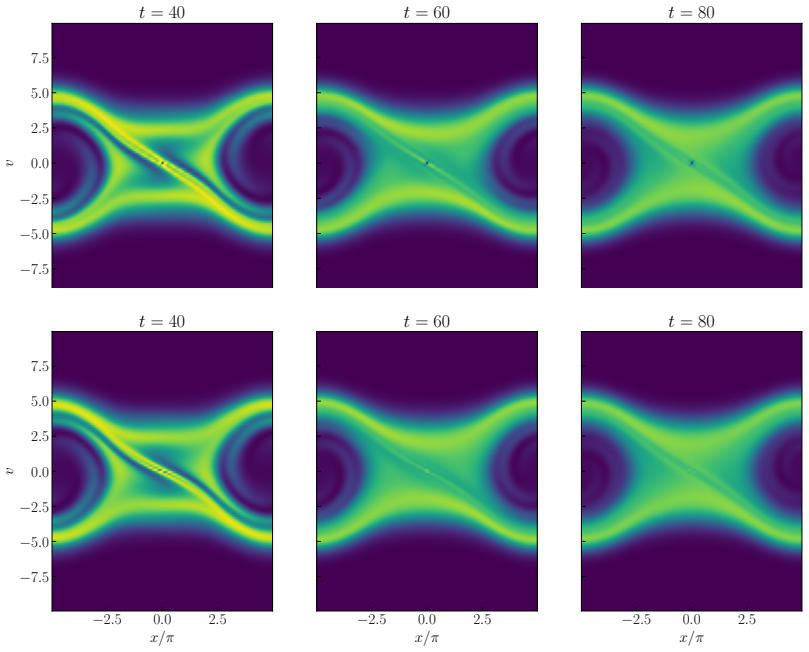
The central claim is that the one-dimensional Active Flux update formulas, derived for constant-coefficient linear advection with true cell averages, remain accurate enough when used directionally on split grids in which line averages and two-dimensional cell averages replace the one-dimensional cell average. On that basis, the paper constructs a second-order scheme that applies formulas (16)–(17) slice by slice, and two third-order schemes: one that evaluates a nine-point Simpson flux integral using point values on edges at times $t^n$, $t^{n+1/2}$, $t^{n+1}$, and one that uses the discrepancy-distribution formulation of Active Flux, which corrects point values so that the cell average is conserved. The observed convergence is second order for the first construction and third order (sometimes better) for the latter two on weak Landau damping and the two-stream instability. Long-time runs show the Active Flux results to be substantially less dissipative than the PFC reference at equal degrees of freedom, with sharper filaments in the distribution function.
Load-bearing premise
The one-dimensional Active Flux update formulas are assumed to keep their order when line averages and two-dimensional cell averages are substituted for the one-dimensional cell average in the split-direction sweeps; this is checked only numerically, with no formal order analysis, so if the substitution introduces an error at the spatial-discretization order, the claimed convergence rates would not reflect the true order of the flux integrals.
Editorial extensions
If this is right
- If the third-order flux integral stays third-order in six dimensions, kinetic simulations could use much coarser grids than PFC for the same dissipation, directly cutting the dominant memory cost of six-dimensional phase-space grids.
- The second-order flux-integral scheme is enough when velocity resolution dominates, because the tests show spatial error dominates over temporal splitting error; this supports pairing cheap Strang splitting with high-order spatial methods.
- The Active Flux methods conserve mass and the $L^2$ norm to machine precision, with the third-order flux-integral scheme preserving conservation exactly between adjacent cells because it uses explicitly computed fluxes.
- The discrepancy-distribution variant needs the stricter CFL bound $|\nu| \le 1/2$ and shows dissipation comparable to PFC, while the other two variants run at $|\nu| \le 1$ with sharper solutions.
Reading between the lines
- A formal consistency analysis of the directional application of formulas (16)–(17) would settle whether the third-order convergence is genuine or an artifact of the test problems; the paper only verifies it numerically, and this is the load-bearing gap.
- The same splitting strategy could be applied to Vlasov–Maxwell, but the paper's rationale for splitting rests on the electrostatic limit; magnetized problems introduce non-commuting operators, so the split-step Active Flux approach would need the back-substitution or alternative handling mentioned in the introduction.
- A natural testable extension is a 2D2V or 3D3V linear Landau-damping run with a manufactured solution, measuring whether the third-order rate persists when the split grids have four- or six-dimensional averages; if it drops a full order, the substitution of higher-dimensional averages in the 1D update is the cause.
- The sharper long-time filaments in the Active Flux runs suggest the method could serve as a reference solver for benchmarking the heating rate of other kinetic schemes, since it supplies low dissipation without the time-step restrictions of characteristic-level exact tracing.
Signed reviews
Editorial analysis
A structured set of objections, weighed in public.
Referee Report
Summary. The paper proposes split-step Active Flux methods for the 1D1V Vlasov–Poisson system. Three spatial discretizations are considered: a second-order flux integral using a one-dimensional reconstruction, a third-order flux integral that uses information along each dimension, and a third-order discrepancy distribution variant. The methods are combined with Strang or fourth-order Yoshida time splitting, and the Poisson equation is solved with a Fourier spectral method on both homogeneous and inhomogeneous grids. Numerical experiments on weak and strong Landau damping and the two-stream instability report convergence orders, long-time damping behavior, conservation properties, and qualitative comparisons of phase-space filamentation against the PFC semi-Lagrangian method. The central claim is that the third-order variants achieve overall third-order spatial accuracy with low dissipation at compact stencils.
Significance. If the claimed third-order accuracy and low dissipation hold, the methods offer a promising path toward high-dimensional kinetic simulations: the split-step formulation keeps the per-update cost to one-dimensional slices, and the compact stencil is attractive for parallelization. The paper provides detailed algorithms and explicit analytic update formulas, which is a strength. It also demonstrates the expected Landau damping rates and conservation properties. However, the convergence evidence is weakened by the use of the same code at higher resolution as the reference, and the split-grid application of the one-dimensional Active Flux formulas is not analyzed formally. The concern that the Yoshida + Discrepancy runs violate the |ν|≤1/2 CFL bound is not supported by the manuscript: with the standard Yoshida coefficients γ1=(2−2^{1/3})^{-1}≈1.35 and γ2=−2^{1/3}(2−2^{1/3})^{-1}≈−1.70, the x-substep Courant numbers are γ1ν/2≈0.22 and |γ2|ν/2≈0.27, both within the stated bound.
major comments (2)
- [Sec. 5.1, Eq. (54)] The convergence study uses a high-resolution run of the same code as the reference solution. This measures only self-convergence; it does not verify that the numerical solution converges to the true solution at the claimed rate. Because the third-order claim is the central result, please add a test against a manufactured solution of the Vlasov–Poisson system (or, at minimum, a 2D advection problem with an exact solution) to confirm the absolute order of accuracy. The current evidence is necessary but not sufficient.
- [Sections 3.3–3.5, Algorithms 5–7] The one-dimensional Active Flux update formulae (16)–(17) and (27)–(30) are derived for point values and cell averages of a scalar constant-coefficient advection equation. In the split two-dimensional algorithm, these formulae are applied after substituting line averages and two-dimensional cell averages for the one-dimensional cell average (e.g., Algorithm 5 updates the line average f̂_{i+1/2,j} using f̄_{i,j} as the cell average). No formal consistency or error analysis is provided for this substitution, and it is not self-evident that the high order of the one-dimensional scheme survives, particularly for line averages where the advection speed varies across the integrated direction. Please provide a truncation-error analysis or a numerical convergence test on a problem with a known exact solution. This is load-bearing for the claimed third-order convergence.
minor comments (5)
- [Algorithm 4] The definitions of γ1 and γ2 are typeset without clear fraction bars; please rewrite as γ1=1/(2−2^{1/3}) and γ2=−2^{1/3}/(2−2^{1/3}) to avoid ambiguity. With these values, the substep Courant numbers in the Yoshida splitting are within the |ν|≤1/2 bound.
- [Sec. 5.3] The phrase 'not completely fair' regarding the comparison with PFC should be expanded; specifically, the same-DOF comparison uses different cell sizes and time steps, so the conclusion about dissipation should be stated with that caveat.
- [Figs. 5 and 6] Please define the reference slope lines '2nd order', '3rd order', and '4th order' in the captions and state which curves they correspond to.
- [Sec. 6] The sentence 'The discrepancy distribution formulation ... allowed a third-order scheme by using only a higher order time splitting method' is ambiguous in light of the numerical results, which show high-order convergence even with Strang splitting; please clarify the role of the time splitting in achieving third order.
- [Sec. 1] The phrase 'Find a algorithmic description' should be 'Find an algorithmic description'.
Circularity Check
No significant circularity: the Active Flux update and flux-integral constructions are derived from cited external 1D linear-advection results, and the benchmarks include an analytic Landau damping rate and an independent PFC comparison; the same-code high-resolution reference is a self-convergence check, not a fitted prediction.
full rationale
The paper's central claims are not reduced to their own inputs by construction. The one-dimensional update formulas (16)-(17) and the discrepancy-distribution formulas (27)-(30) are taken from prior external Active Flux literature (Eymann-Roe and He-Roe), and the proposed split-step algorithms (Algorithms 5-7) apply these formulas directionally to the Vlasov-Poisson system. The third-order flux integrals (41)-(42) are explicit Simpson-type quadratures over spatial and temporal stages obtained from those one-dimensional updates; no parameter is fitted to the benchmark data and no output quantity is defined in terms of the claimed result. The convergence study in Section 5.1 uses a high-resolution solution produced by the same code as a reference, which is a self-convergence test rather than an independent accuracy certification, but this is not a circular derivation: the method's order is not forced by the error metric. The paper additionally validates against the analytic Landau damping rate and compares against the independent PFC method. The Yoshida substep CFL concern raised in the reader materials is a stability or correctness question, not a circularity question, and therefore does not increase the circularity score. No load-bearing self-citation chain or uniqueness-import argument appears in the derivation.
Assumptions & free parameters
free parameters (2)
- Discrepancy distribution weights alpha, beta =
alpha=1, beta=1
- CFL number nu =
nu = 1/pi ~ 0.318
assumptions (5)
- standard math The 1D Active Flux scheme (Sec. 2.1) and the discrepancy distribution scheme (Sec. 2.2) are stable and third-order accurate for constant-coefficient linear advection as established in [18] and [21].
- domain assumption The Vlasov-Poisson system can be split into an x-advection with constant v and a v-advection with constant E, where E is computed from the density and held fixed during the v-step (Alg. 1).
- domain assumption The Strang (2nd order) and Yoshida (4th order) operator splittings keep the time error below the spatial error for the CFL numbers and grid sizes considered, so the measured convergence slopes in Sec. 5.1 reflect spatial order.
- domain assumption The high-resolution reference solution (N=512) is sufficiently converged and its recursive downscaling (eq. 53) yields accurate cell averages of the exact solution at lower resolutions.
- ad hoc to paper The Fourier spectral Poisson solve on the periodic domain, combined with the moment integration and field averaging in Sec. 4 (eqs. 47-50), provides the electric field to an accuracy consistent with the advertised order.
Cite this review
Pith. "Pith review of A split-step Active Flux method for the Vlasov-Poisson system." pith.science (2026). https://pith.science/paper/6FRSBOHX
@misc{pith2026241206525,
  author       = {Pith},
  title        = {Pith review of: A split-step Active Flux method for the Vlasov-Poisson system},
  year         = {2026},
  howpublished = {\url{https://pith.science/paper/6FRSBOHX}},
  note         = {Machine review of arXiv:2412.06525}
}
read the original abstract
Active Flux is a modified Finite Volume method that evolves additional Degrees of Freedom for each cell that are located on the interface by a non-conservative method to compute high-order approximations to the numerical fluxes through the respective interface to evolve the cell-average in a conservative way. In this paper, we apply the method to the Vlasov-Poisson system describing the time evolution of the time-dependent distribution function of a collisionless plasma. In particular, we consider the evaluation of the flux integrals in higher dimensions. We propose a dimensional splitting and three types of formulations of the flux integral: a one-dimensional reconstruction of second order, a third-order reconstruction based on information along each dimension, and a third-order reconstruction based on a discrepancy formulation of the Active Flux method. Numerical results in 1D1V phase-space compare the properties of the various methods.
Figures


Figures from the paper (9 more)




Reference graph
Works this paper leans on
-
[1]
M. Palmroth, U. Ganse, Y. Pfau-Kempf, M. Battarbee, L. Turc, T. Brito, M. Grandin, S. Hoilijoki, A. Sandroos, S. von Alfthan, Vlasov methods in space physics and astrophysics, 30 Living Reviews in Computational Astrophysics 4 (2018) 1
work page 2018
-
[2]
F. Allmann-Rahn, S. Lautenbach, R. Grauer, An Energy Conserving Vlasov Solver That Tolerates Coarse Velocity Space Resolutions: Simulation of MMS Reconnection Events, Journal of Geophysical Research: Space Physics 127 (2) (2022) e2021JA029976. doi: https://doi.org/10.1029/2021JA029976
-
[3]
K. Nishikawa, I. Dut ¸an, C. K¨ ohn, Y. Mizuno, PIC methods in astrophysics: simulations of relativistic jets and kinetic physics in astrophysical systems, Living Reviews in Computa- tional Astrophysics 7 (2021) 1
work page 2021
-
[4]
R. J. LeVeque, Finite Volume Methods for Hyperbolic Problems, Cambridge Texts in Applied Mathematics, Cambridge University Press, 2002
2002
-
[5]
J. Juno, A. Hakim, J. TenBarge, E. Shi, W. Dorland, Discontinuous Galerkin algorithms for fully kinetic plasmas, J. Comput. Phys. 353 (2018) 110–147
work page 2018
- [6]
- [7]
-
[8]
J. Rossmanith, D. Seal, A positivity-preserving high-order semi-Lagrangian discontinuous Galerkin scheme for the Vlasov-Poisson equations, J. Comput. Phys. 230 (2011) 6203–6232
work page 2011
Show all 43 references
-
[9]
Eliasson, Numerical modelling of the two-dimensional Fourier transformed Vlasov- Maxwell system, J
B. Eliasson, Numerical modelling of the two-dimensional Fourier transformed Vlasov- Maxwell system, J. Comput. Phys. 190 (2003) 501–522
2003
-
[10]
Delzanno, Multi-dimensional, fully-implicit, spectral method for the Vlasov-Maxwell equations with exact conservationlaws in discrete form, J
G. Delzanno, Multi-dimensional, fully-implicit, spectral method for the Vlasov-Maxwell equations with exact conservationlaws in discrete form, J. Comput. Phys. 301 (2015) 338– 356
2015
-
[11]
Arber, K
T. Arber, K. Bennett, C. Brady, A. Lawrence-Douglas, M. Ramsay, N. Sircombe, P. Gillies, R. Evans, H. Schmitz, A. Bell, Contemporary particle-in-cell approach to laser-plasma modelling, Plasma Physics and Controlled Fusion 57 (2015) 113001
2015
-
[12]
Masek, P
M. Masek, P. Gibbon, Mesh-Free Magnetoinduced Plasma Models, IEEE Transactions on Plasma Science 38 (2010) 2377–2382
2010
-
[13]
Cheng, G
C.-Z. Cheng, G. Knorr, The integration of the Vlasov equation in configuration space, Journal of Computational Physics 22 (3) (1976) 330–351
1976
-
[14]
Schmitz, R
H. Schmitz, R. Grauer, Comparison of time splitting and backsubstitution methods for integrating Vlasov’s equation with magnetic fields, Comp. Phys. Comm. 175 (2006) 86–92
2006
-
[15]
Roe, Multidimensional upwinding, in: R
P. Roe, Multidimensional upwinding, in: R. Abgrall, C.-W. Shu (Eds.), Handbook of Numerical Methods for Hyperbolic Problems, Elsevier, 2017, pp. 53–80
2017
-
[16]
Schmitz, R
H. Schmitz, R. Grauer, Darwin-Vlasov simulations of magnetised plasmas, J. Comput. Phys. 214 (2006) 738–756. 31
2006
-
[17]
Filbet, E
F. Filbet, E. Sonnendr¨ ucker, Comparison of Eulerian Vlasov solvers, Computer Physics Communications 150 (2003) 247–266
2003
-
[18]
Eymann, P
T. Eymann, P. Roe, Active Flux schemes, in: 49th AIAA Aerospace Sciences Meeting including the New Horizons Forum and Aerospace Exposition, 2011, p. 382
2011
-
[19]
Eymann, P
T. Eymann, P. Roe, Multidimensional active flux schemes, in: 21st AIAA computational fluid dynamics conference (2013)
2013
-
[20]
Roe, Designing CFD methods for bandwidth—a physical approach, Comput
P. Roe, Designing CFD methods for bandwidth—a physical approach, Comput. & Fluids 214 (2021) Paper No. 104774, 13
2021
-
[21]
F. He, P. L. Roe, The Treatment of Conservation in the Active Flux method, in: AIAA A VIATION 2020 FORUM, 2020, p. 3032
2020
-
[22]
Abgrall, W
R. Abgrall, W. Barsukow, Extensions of Active Flux to arbitrary order of accuracy, ESAIM: M2AN 57 (2) (2023) 991–1027. doi:10.1051/m2an/2023004
2023
-
[23]
Barsukow, J
W. Barsukow, J. Hohm, C. Klingenberg, P. Roe, The Active Flux Scheme on Cartesian Grids and Its Low Mach Number Limit, J. Sci. Comput. 81 (2019) 594–622
2019
-
[24]
Barsukow, The Active Flux scheme for nonlinear problems, J
W. Barsukow, The Active Flux scheme for nonlinear problems, J. Sci. Comput. 86 (2021) Paper No. 3, 34
2021
-
[25]
Chudzik, C
E. Chudzik, C. Helzel, D. Kerkmann, The Cartesian grid Active Flux method: linear sta- bility and bound preserving limiting, Appl. Math. Comput. 393 (2021) Paper No. 125501, 19
2021
-
[26]
Y. Bai, P. L. Roe, Toward Physically-based limiting for the Active Flux scheme, in: AIAA A VIATION 2021 FORUM, 2021, p. 2744
2021
-
[27]
Kiechle, E
Y.-F. Kiechle, E. Chudzik, C. Helzel, An Active Flux method for the Vlasov-Poisson sys- tem, in: International Conference on Finite Volumes for Complex Applications, Springer, 2023, pp. 93–101
2023
-
[28]
Chudzik, C
E. Chudzik, C. Helzel, Y. Kiechle, A Positivity Preserving Active Flux Method for the Vlasov–Poisson System, personal communication (2024)
2024
-
[29]
Yoshida, Construction of higher order symplectic integrators, Physics letters A 150 (5-7) (1990) 262–268
H. Yoshida, Construction of higher order symplectic integrators, Physics letters A 150 (5-7) (1990) 262–268
1990
-
[30]
Marcowith, G
A. Marcowith, G. Ferrand, M. Grech, Z. Meliani, I. Plotnikov, R. Walder, Multi-scale sim- ulations of particle acceleration in astrophysical systems, Living Reviews in Computational Astrophysics 6 (1) (2020) 1. doi:10.1007/s41115-020-0007-6
2020 doi
-
[31]
Kormann, K
K. Kormann, K. Reuter, M. Rampp, A massively parallel semi-Lagrangian solver for the six-dimensional Vlasov–Poisson equation, The International Journal of High Performance Computing Applications 33 (5) (2019) 924–947. doi:10.1177/1094342019834644
2019 doi
-
[32]
Chudzik, C
E. Chudzik, C. Helzel, M. Luk´ aˇ cov´ a-Medvid’ov´ a, Active Flux Methods for Hyperbolic Systems Using the Method of Bicharacteristics, Journal of Scientific Computing 99 (1) (2024) 16. doi:10.1007/s10915-024-02462-z . 32
2024 doi
-
[33]
Abgrall, W
R. Abgrall, W. Barsukow, C. Klingenberg, The Active Flux method for the Euler equations on Cartesian grids (2023). arXiv:2310.00683. URL https://arxiv.org/abs/2310.00683
2023 arXiv
-
[34]
Maeng, On the advective component of Active Flux schemes for nonlinear hyperbolic conservation laws, Ph.D
J. Maeng, On the advective component of Active Flux schemes for nonlinear hyperbolic conservation laws, Ph.D. thesis (2017)
2017
-
[35]
Robidoux, Polynomial histopolation, superconvergent degrees of freedom, and pseudospectral discrete hodge operators, Unpublished: http://www
N. Robidoux, Polynomial histopolation, superconvergent degrees of freedom, and pseudospectral discrete hodge operators, Unpublished: http://www. cs. laurentian. ca/nrobidoux/prints/super/histogram. pdf (2008)
2008
-
[36]
Kormann, E
K. Kormann, E. Sonnendr¨ ucker, A dual grid geometric electromagnetic particle in cell method, SIAM Journal on Scientific Computing 46 (5) (2024) B621–B646
2024
-
[37]
Schild, M
N. Schild, M. R¨ ath, S. Eibl, K. Hallatschek, K. Kormann, A performance portable imple- mentation of the semi-Lagrangian algorithm in six dimensions, Computer Physics Com- munications 295 (2024) 108973. doi:10.1016/j.cpc.2023.108973
2024
-
[38]
Sonnendr¨ ucker, K
E. Sonnendr¨ ucker, K. Kormann, Numerical methods for vlasov equations, Lecture notes 107 (2013) 108
2013
-
[39]
Tanaka, K
S. Tanaka, K. Yoshikawa, T. Minoshima, N. Yoshida, Multidimensional Vlasov–Poisson Simulations with High-order Monotonicity- and Positivity-preserving Schemes, The Astro- physical Journal 849 (2) (2017) 76. doi:10.3847/1538-4357/aa901f
2017 doi
-
[40]
Allmann-Rahn, S
F. Allmann-Rahn, S. Lautenbach, M. Deisenhofer, R. Grauer, The muphyii code: Multi- physics plasma simulation on large hpc systems, Computer Physics Communications 296 (2024) 109064. doi:10.1016/j.cpc.2023.109064
2024
-
[41]
Lautenbach, R
S. Lautenbach, R. Grauer, Multiphysics simulations of collisionless plasmas, Frontiers in Physics 6 (2018). doi:10.3389/fphy.2018.00113
2018
-
[42]
Lautenbach, F
S. Lautenbach, F. Allmann-Rahn, R. Grauer, muphy2 (Jan. 2024). doi:10.5281/zenodo. 10547265
2024 doi
-
[43]
Alvarez, JUWELS Cluster and Booster: Exascale Pathfinder with Modular Super- computing Architecture at Juelich Supercomputing Centre 7 A183–A183
D. Alvarez, JUWELS Cluster and Booster: Exascale Pathfinder with Modular Super- computing Architecture at Juelich Supercomputing Centre 7 A183–A183. doi:10.17815/ jlsrf-7-183. 33
Reviewed August 11, 2026 · model on record in the stance chip above.
Discussion (0). Continue with ORCID to comment.