REVIEW 4 major objections 4 minor 25 references
Loop Closure Detection in Closed Environments
T0 review · 4 major / 4 minor · reviewed 2026-08-14 · deepseek-v4-flash
Pith's one-line read A robot that only follows a wall with wheel odometry can close loops and build an accurate map of an enclosed area.
desk verdict Odometry-only loop closure via orientation-profile matching is a genuinely new idea with a real robot test, but the discriminative assumption is unproven for shapes without corners within the neighborhood window and there is no outlier rejection. read the letter →
The pith
A machine-rendered reading of the paper's core claim, the machinery that carries it, and where it could break.
The reading
What carries the argument
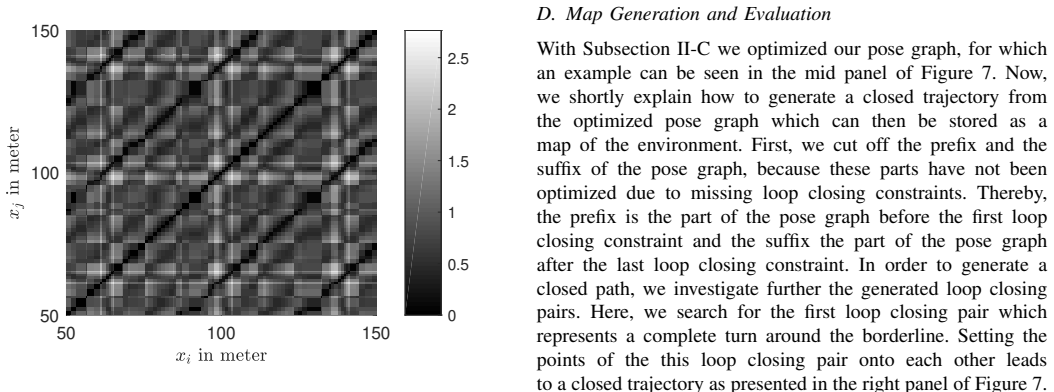
The central object is the piecewise-linear orientation profile $\theta(x)$ of the pruned path, built from cumulative orientation and path length. To test a loop-closing candidate $(i,j)$, the profile is re-centered so both neighborhoods are compared from the same reference orientation and path coordinate, sampled at $m$ points, and scored by the correlation error $C_{ij} = \frac{1}{m}\sum_{k=1}^{m}\|\theta_{i,k}-\theta_{j,k}\|^2$; pairs with $C_{ij}$ below a threshold $c_{\min}$ become loop closures. Each closure enters the pose graph as a zero relative measurement $\hat{\xi}_{ij} = [0,0,0]^\top$ with covariance $P_{\mathrm{lc},ij} = \mathrm{diag}([\gamma_1, \gamma_1, \gamma_2])\,C_{ij}$, so the loop-closure confidence is encoded directly into the optimization weight.
What would settle it
Run the method on a perfect square or rectangle with the same odometry model: the corners have identical orientation profiles under rotation, so the detector should produce false loop closures between different corners; if the resulting map stays near the reported area deviation the assumption holds, and if the polygon collapses or skews the assumption fails.
Extended reading notes
Core claim
The paper's central claim is that the shape of the odometry path itself carries enough information to close loops: when the robot passes the same place, the orientation profile of the path over a sufficiently long neighborhood matches, and this match can be detected without external sensors. The authors represent the pruned path as a piecewise-linear orientation function over path length, compare neighborhoods of poses through a correlation error, and use a threshold to select loop-closing pose pairs. These pairs enter the pose graph as zero relative measurements whose covariance grows with the correlation error, after which standard pose graph optimization is used to refine all poses. The paper reports accurate map estimates in simulation and with a real lawn mower, and argues that its assumption about the discriminative nature of neighboring poses holds even under large odometric noise.
Load-bearing premise
The whole method rests on the assumption that two poses with similar local orientation profiles are the same place; in environments with repeated or mirrored wall shapes, distinct places can look identical to the detector and cause false loop closures.
Editorial extensions
If this is right
- A robot that only follows a wall, using bumpers or signal-wire sensors to generate odometry, can produce a boundary polygon map of its workspace without cameras, LIDAR, or time-of-flight sensors.
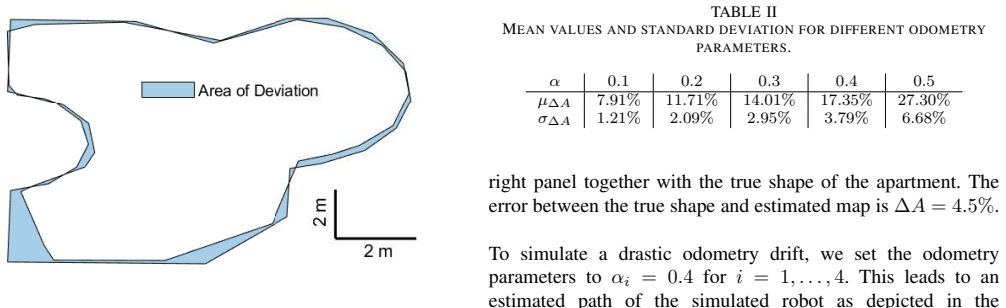
- The reported area errors of 4.5% in the simulated apartment and 11.87% on a real lawn mower in a courtyard suggest the map is accurate enough to support planning tasks such as complete coverage.
- The method remains usable under substantial odometric drift: mean area deviation rises from 7.91% to 27.30% as the odometry noise parameter $\alpha$ grows from 0.1 to 0.5.
- The loop-closing constraints are ordinary relative pose measurements, so standard pose graph optimization software can consume them without modifying the optimizer.
Reading between the lines
- The orientation-profile comparison could be applied to other one-dimensional signals a cheap robot already has, such as bumper contact patterns or signal-wire crossings, extending the method beyond wheel odometry without new sensors.
- The most likely breaking point is repetitive geometry: in a symmetric courtyard or a long corridor with evenly spaced doors, different places can produce nearly identical neighborhoods, so a targeted test there would reveal whether the covariance weighting suppresses false closures.
- Because the output is a closed boundary with a quantitative area error, the map confidence itself could drive navigation decisions, for example telling the robot when to re-traverse the boundary to shrink uncertainty.
Signed reviews
Editorial analysis
A structured set of objections, weighed in public.
Referee Report
Summary. The paper proposes a loop closure detection method for mapping the boundary of closed environments using only odometry data. Odometry is pruned into dominant points via path segmentation, a pose graph is built, and loop closure candidates are found by comparing grounded orientation profiles over a neighborhood of length LNH and selecting pairs whose correlation error C_ij is below a threshold cmin. Zero-measurement loop-closing constraints are added and the graph is optimized with Levenberg-Marquardt. The map is obtained by closing the optimized trajectory at a selected loop-closing pair. The evaluation reports area deviation between the estimated map and a ground-truth polygon: 4.5% for a simulated apartment, 17.8% under large simulated odometry noise, and 11.87% for a real courtyard. The abstract claims accurate maps from odometry only and states that the discriminative nature of neighboring poses is solid.
Significance. If the method works as claimed, it would let low-cost robots build boundary maps using only wheel odometry and wall following, which is practically significant. The paper's strengths are its simple pipeline, the use of standard pose graph optimization, and the evaluation with a real lawn mower. The area-deviation numbers for the two tested environments are encouraging. However, the paper does not report loop closure precision or recall, does not compare against a no-loop-closure baseline, and tunes the key thresholds per environment. The claimed generality of the discriminative-neighborhood assumption is not supported by experiments whose small circumferences relative to LNH avoid the straight-segment failure mode described below.
major comments (4)
- [II-B (Eq. 12), V (Table III)] The loop closure detector has no false-positive rejection or consistency check. For any straight wall segment longer than 2·LNH (LNH=30 m in Table III, so 60 m), every pose whose ±LNH neighborhood lies entirely inside the segment has a constant grounded orientation profile; consequently C_ij=0 for all such pose pairs, not only for true revisits. The algorithm then adds zero-measurement loop-closing edges for all selected local minima below cmin (Section II-B, 'Third') and optimizes the graph in Section II-C, so in a 100 m×100 m square, non-corresponding pairs on parallel sides would be linked and the map estimate would be corrupted. The two test environments have circumferences of 100 m and 106.79 m, so their straight segments are shorter than 60 m; the experiments therefore do not support the abstract's claim that the discriminative nature of neighboring poses is 'solid.' The authors should either add an outlier rejection mechanism or explicitly restrict the claim to environments where the maximal straight segment length is bounded in terms of LNH.
- [III] The evaluation reports only the final area deviation ΔA. It does not report loop closure precision or recall, nor the number of loop closures detected per experiment, and it does not compare against a no-loop-closure baseline such as the raw odometry trajectory or a graph closed only at the start and end. Since the paper's contribution is the loop closure detector, the results do not establish that the detected constraints improve map accuracy; the improvement could be due to the final closing step or to the pose graph optimization alone. Please add these standard measures.
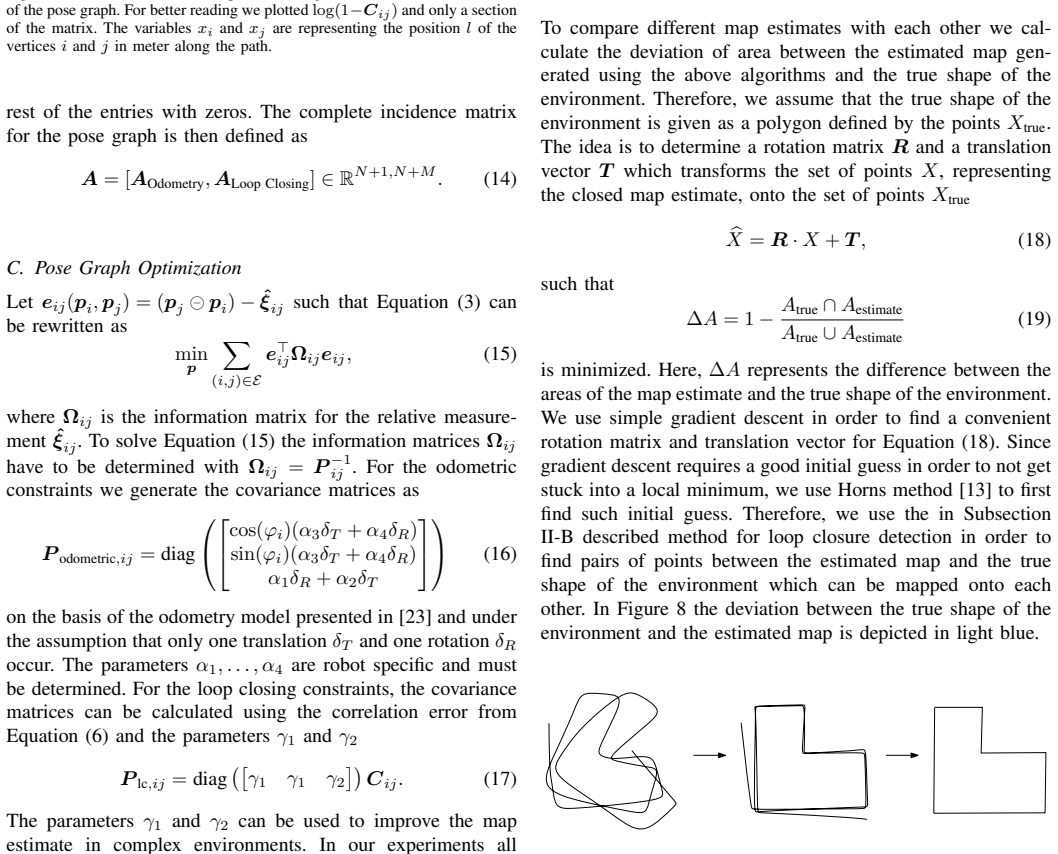
- [II-D] The area-error evaluation in Section II-D uses the same loop-closure detector from Section II-B to find correspondence pairs between the estimated map and the ground-truth polygon via Horn's method. Because false positives in that detector are not quantified, the reported ΔA values may partly reflect alignment success or failure rather than map quality. Please report the alignment results separately or use an alignment procedure that is independent of the loop-closure detector.
- [II-B, V] The key parameters cmin and LNH are tuned per test environment: cmin is set to 1.0 for the apartment and 0.3 for the courtyard, and LNH=30 m is justified in the Appendix because the test environments have circumferences of about 100 m. The paper acknowledges that these parameters significantly affect detection, so the results do not establish a generally applicable, parameter-free method, and the Introduction's claim of applicability to 'arbitrary shapes' is not supported by the evidence.
minor comments (4)
- [II-B (Eq. 17)] The text says 'the correlation error from Equation (6)' but C_ij is defined in Equation (12); please correct the reference.
- [II-A, Algorithm 1] The pseudocode and the prose disagree about the condition that ends a segment: Algorithm 1 continues the segment when d<Lmin and e<emax, while the surrounding text says the segment is 'not any longer a valid representation' when both are true. Please align the prose and the pseudocode.
- [V, Table III] The table of default parameters omits cmin, although cmin is a critical threshold that is assigned different values for the two experiments; please list it in the table or explain why it is excluded.
- [II-A, Eq. (6)] The denominator (|S|-2) is not rendered clearly in the equation; please fix the typesetting.
Circularity Check
No circularity found; the core result is externally benchmarked against ground-truth maps.
full rationale
We examined the full derivation chain: odometry data, path segmentation (Algorithm 1), pose-graph construction, loop-closure detection via orientation-profile correlation (Eq. 12), pose-graph optimization (Eq. 15), and area-deviation evaluation (Eq. 19). No step defines its output in terms of its target. The loop-closure detector compares grounded orientation profiles of path neighborhoods, and the loop-closing measurement is zero with covariance proportional to C_ij (Eq. 17); this is a weighting choice, not a constructed prediction. The reported area errors are computed against independent ground-truth polygons (the simulated apartment and the CAD courtyard), so the central accuracy claim is externally grounded. The parameters cmin and LNH are tuned per environment (Sec. III, Table III), and the evaluation alignment in Sec. II-D reuses the shape-comparison method to find initial correspondences for Horn's method; these are legitimate limitations and fairness risks, but not circular steps, because the tuning does not define the reported delta-A and the reuse does not feed back into the map-generation optimization. The paper contains no load-bearing self-citations and no imported uniqueness theorem. The 'discriminative nature of neighboring poses' premise is an empirical assumption validated by benchmarks, not an equation that reduces to itself. Therefore there is no significant circularity.
Assumptions & free parameters
free parameters (7)
- Lmin =
0.1 m
- emax =
0.001
- LNH =
30 m
- cmin =
1.0 (apartment), 0.3 (courtyard)
- M =
100
- gamma1, gamma2 =
1.0, 1.0
- alpha1..alpha4 =
0.0849, 0.0412, 0.0316, 0.0173
assumptions (5)
- standard math The pose graph formulation and Levenberg-Marquardt optimization produce a valid map estimate when loop closures are correct.
- domain assumption The odometry motion model of [23] describes the differential drive robot's noise behavior.
- domain assumption Low correlation error C_ij between orientation profiles implies the poses are the same place (discriminative neighborhood assumption).
- domain assumption The robot follows the boundary repeatedly, producing a path that can be closed into a single loop.
- domain assumption The area deviation metric after Horn-alignment is a fair measure of map quality.
Cite this review
Pith. "Pith review of Loop Closure Detection in Closed Environments." pith.science (2026). https://pith.science/paper/6HALA7CV
@misc{pith2026190804558,
  author       = {Pith},
  title        = {Pith review of: Loop Closure Detection in Closed Environments},
  year         = {2026},
  howpublished = {\url{https://pith.science/paper/6HALA7CV}},
  note         = {Machine review of arXiv:1908.04558}
}
read the original abstract
Low cost robots, such as vacuum cleaners or lawn mowers employ simplistic and often random navigation policies. Although a large number of sophisticated mapping and planning approaches exist, they require additional sensors like LIDAR sensors, cameras or time of flight sensors. In this work, we propose a loop closure detection method based only on odometry data which can be generated using low-range or binary signal sensors together with simple wall following techniques. We show how to include the detected loop closing constraints into a pose graph formulation such that standard pose graph optimization techniques can be used for map estimation. We evaluate our map estimate and loop closure approach using both, simulation and a real lawn mower in complex and realistic environments. Our results demonstrate that our approach generates accurate map estimates on the basis of odometry data only. We further show that our assumption about the discriminative nature of neighboring poses in the pose graph is solid, even under large odometry noise. These improved map estimates provide the basis for smart navigation policies in low cost robots and extends their abilities to goal-directed behavior like pick and place or complete coverage path planning in realistic environments.
Figures


Figures from the paper (8 more)



Reference graph
Works this paper leans on
-
[1]
Consistency of the ekf-slam algorithm
Tim Bailey, Juan Nieto, Jose Guivant, Michael Stevens, and Eduardo Nebot. Consistency of the ekf-slam algorithm. In Intelligent Robots and Systems, 2006 IEEE/RSJ International Conference on , pages 3562–3568. IEEE, 2006
work page 2006
-
[2]
Kristopher R Beevers and Wesley H Huang. Slam with sparse sensing. In ICRA, pages 2285–2290, 2006
work page 2006
-
[3]
Using 3d laser range data for slam in outdoor environments
Christian Brenneke, Oliver Wulf, and Bernardo Wagner. Using 3d laser range data for slam in outdoor environments. In Intelligent Robots and Systems, 2003.(IROS 2003). Proceedings. 2003 IEEE/RSJ International Conference on, volume 1, pages 188–193. IEEE, 2003
work page 2003
-
[4]
Robust coverage by a mobile robot of a planar workspace
Timothy Bretl and Seth Hutchinson. Robust coverage by a mobile robot of a planar workspace. In Robotics and Automation (ICRA), 2013 IEEE International Conference on , pages 4582–4587. IEEE, 2013
work page 2013
-
[5]
A fast and accurate approximation for planar pose graph optimization
Luca Carlone, Rosario Aragues, Jos ´e A Castellanos, and Basilio Bona. A fast and accurate approximation for planar pose graph optimization. The International Journal of Robotics Research , 33(7):965–987, 2014
work page 2014
-
[6]
Young-Ho Choi, Tae-Kyeong Lee, and Se-Young Oh. A line feature based slam with low grade range sensors using geometric constraints and active exploration for mobile robot. Autonomous Robots , 24(1):13–27, 2008
work page 2008
-
[7]
Towards semantic slam using a monocular camera
Javier Civera, Dorian G ´alvez-L´opez, Luis Riazuelo, Juan D Tard ´os, and JMM Montiel. Towards semantic slam using a monocular camera. In Intelligent Robots and Systems (IROS), 2011 IEEE/RSJ International Conference on, pages 1277–1284. IEEE, 2011
work page 2011
-
[8]
Real-time 3d visual slam with a hand-held rgb-d camera
Nikolas Engelhard, Felix Endres, J ¨urgen Hess, J ¨urgen Sturm, and Wol- fram Burgard. Real-time 3d visual slam with a hand-held rgb-d camera. In Proc. of the RGB-D Workshop on 3D Perception in Robotics at the European Robotics F orum, V asteras, Sweden , volume 180, pages 1–15, 2011
work page 2011
Show all 25 references
-
[9]
A tutorial on graph-based slam
Giorgio Grisetti, Rainer Kummerle, Cyrill Stachniss, and Wolfram Bur- gard. A tutorial on graph-based slam. IEEE Intelligent Transportation Systems Magazine , 2(4):31–43, 2010
2010
-
[10]
Nonlinear con- straint network optimization for efficient map learning
Giorgio Grisetti, Cyrill Stachniss, and Wolfram Burgard. Nonlinear con- straint network optimization for efficient map learning. IEEE Transactions on Intelligent Transportation Systems , 10(3):428–439, 2009
2009
-
[11]
Fast and accurate slam with rao–blackwellized particle filters
Giorgio Grisetti, Gian Diego Tipaldi, Cyrill Stachniss, Wolfram Burgard, and Daniele Nardi. Fast and accurate slam with rao–blackwellized particle filters. Robotics and Autonomous Systems , 55(1):30–38, 2007
2007
-
[12]
A probabilis- tic approach to high-confidence cleaning guarantees for low-cost cleaning robots
J ¨urgen Hess, Maximilian Beinhofer, and Wolfram Burgard. A probabilis- tic approach to high-confidence cleaning guarantees for low-cost cleaning robots. In Robotics and Automation (ICRA), 2014 IEEE International Conference on, pages 5600–5605. IEEE, 2014
2014
-
[13]
Closed- form solution of absolute orientation using orthonormal matrices
Berthold KP Horn, Hugh M Hilden, and Shahriar Negahdaripour. Closed- form solution of absolute orientation using orthonormal matrices. JOSA A, 5(7):1127–1135, 1988
1988
-
[14]
isam2: Incremental smoothing and mapping using the bayes tree
Michael Kaess, Hordur Johannsson, Richard Roberts, Viorela Ila, John J Leonard, and Frank Dellaert. isam2: Incremental smoothing and mapping using the bayes tree. The International Journal of Robotics Research , 31(2):216–235, 2012
2012
-
[15]
Outdoor mapping and navigation using stereo vision
Kurt Konolige, Motilal Agrawal, Robert C Bolles, Cregg Cowan, Martin Fischler, and Brian Gerkey. Outdoor mapping and navigation using stereo vision. In Experimental Robotics , pages 179–190. Springer, 2008
2008
-
[16]
g 2 o: A general framework for graph optimization
Rainer K ¨ummerle, Giorgio Grisetti, Hauke Strasdat, Kurt Konolige, and Wolfram Burgard. g 2 o: A general framework for graph optimization. In Robotics and Automation (ICRA), 2011 IEEE International Conference on, pages 3607–3613. IEEE, 2011
2011
-
[17]
Robust loop closing over time for pose graph slam
Yasir Latif, C ´esar Cadena, and Jos ´e Neira. Robust loop closing over time for pose graph slam. The International Journal of Robotics Research , 32(14):1611–1626, 2013
2013
-
[18]
Go straight, turn right: Pose graph reduction through trajectory segmentation using line segments
Yasir Latif and Jos ´e Neira. Go straight, turn right: Pose graph reduction through trajectory segmentation using line segments. In Mobile Robots (ECMR), 2013 European Conference on , pages 144–149. IEEE, 2013
2013
-
[19]
Globally consistent range scan alignment for environment mapping
Feng Lu and Evangelos Milios. Globally consistent range scan alignment for environment mapping. Autonomous robots, 4(4):333–349, 1997
1997
-
[20]
Fastslam: A factored solution to the simultaneous localization and mapping problem
Michael Montemerlo, Sebastian Thrun, Daphne Koller, Ben Wegbreit, et al. Fastslam: A factored solution to the simultaneous localization and mapping problem. Aaai/iaai, 593598, 2002
2002
-
[21]
Fast iterative alignment of pose graphs with poor initial estimates
Edwin Olson, John Leonard, and Seth Teller. Fast iterative alignment of pose graphs with poor initial estimates. In Robotics and Automation,
-
[22]
Simultaneous loclization and mapping with limited sensing using extended kalman filter and hough transfrom
Ozan Ozisik and Sirma Yavuz. Simultaneous loclization and mapping with limited sensing using extended kalman filter and hough transfrom. Tehnicki vjesnik/Technical Gazette, 23(6), 2016
2016
-
[23]
Probabilistic robotics
Sebastian Thrun. Probabilistic robotics. Communications of the ACM , 45(3):52–57, 2002
2002
-
[24]
Real-time indoor mapping for mobile robots with limited sensing
Ying Zhang, Juan Liu, Gabriel Hoffmann, Mark Quilling, Kenneth Payne, Prasanta Bose, and Andrew Zimdars. Real-time indoor mapping for mobile robots with limited sensing. In Mobile Adhoc and Sensor Systems (MASS), 2010 IEEE 7th International Conference on , pages 636–641. IEEE, 2010
2010
-
[2006]
Proceedings 2006 IEEE International Conference on , pages 2262–2269
ICRA 2006. Proceedings 2006 IEEE International Conference on , pages 2262–2269. IEEE, 2006
2006
Reviewed August 14, 2026 · model on record in the stance chip above.
Discussion (0). Continue with ORCID to comment.