REVIEW 3 major objections 4 minor 25 references
Hydrodynamic Limit of the Symmetric Zero-Range Process with Slow Boundary
T0 review · 3 major / 4 minor · reviewed 2026-08-05 · deepseek-v4-flash
Pith's one-line read The zero-range process with slow boundary reservoirs has a rigorous hydrodynamic limit: its empirical density converges to the unique weak solution of a nonlinear heat equation, with boundary conditions that switch from Robin (at the critic
desk verdict Rigorous hydrodynamic limit for a standard boundary-driven zero-range model, but the proof leans on an unproved boundary replacement lemma that carries the θ-dependent boundary conditions. read the letter →
The pith
A machine-rendered reading of the paper's core claim, the machinery that carries it, and where it could break.
The reading
What carries the argument
The central objects are the flux function Φ = R^{-1}, where R(φ) is the expected occupation under the product invariant measure with fugacity φ (so that Φ(α) is the expected jump rate at density α), and the entropy method with a translation-invariant reference measure: the invariant measure of the dynamics restricted to the bulk, denoted ¯ν_φ. The one-block estimate uses a spectral gap lower bound (Assumption (SG)) together with the Rayleigh estimate, while the two-block estimate requires a new spectral gap bound for a coupled two-box zero-range process. The indicator κ̃ = κ1_{θ=1} encodes the critical slowdown: only at θ = 1 do the reservoirs survive in the macroscopic boundary conditions.
What would settle it
Run microscopic simulations for a specific jump rate that satisfies (ND) and (2.1) but violates (SG) — for example, a rate with strong blocking that makes the spectral gap decay faster than ℓ^{-2} — and test whether the empirical density still converges to the nonlinear heat equation with the stated boundary conditions; a persistent mismatch as N grows would refute the sufficiency of the theorem's hypotheses, while convergence would indicate that (SG) is not necessary.
Extended reading notes
Core claim
Theorem 2.12: for θ ≥ 1, the sequence of empirical measures π_t^N converges in probability to the absolutely continuous measure ρ(t,u)du, where ρ is the unique weak solution of the nonlinear heat equation ∂_t ρ = ΔΦ(ρ) with boundary conditions ∂_uΦ(ρ(0)) = κ̃(λΦ(ρ(0)) − α) and ∂_uΦ(ρ(1)) = κ̃(β − δΦ(ρ(1))), with κ̃ = κ1_{θ=1}. The proof is built on the entropy method of Guo, Papanicolaou and Varadhan, adapted to the non-conservative, non-translation-invariant setting by using the bulk-restricted invariant measure as a reference, establishing one-block and two-block replacement lemmas via spectral gap estimates, and proving a spectral gap bound for a coupled two-box process. The restriction θ
Load-bearing premise
Assumption (SG): the spectral gap of the zero-range process on a box of size ℓ with j particles must be bounded below by C/ℓ², uniformly in j; if this rate fails, the denominators in the Rayleigh estimates inside the replacement lemmas can lose positivity and the proof collapses.
Editorial extensions
If this is right
- The hydrostatic limit follows as a corollary: the stationary measure ¯ν_N converges to the stationary profile ¯ρ_θ, the solution of the elliptic problem with the corresponding Robin or Neumann boundary conditions.
- For θ > 1 the reservoirs have no macroscopic influence: the limiting equation is the nonlinear heat equation with zero-flux Neumann boundary conditions, so the system behaves as isolated in the limit.
- The uniqueness of the weak solution, proved in Lemma 2.10, ensures that the identification of the limit is complete: any limit point must equal the unique solution.
- The replacement lemmas are stated for the jump rate g but extend to any Lipschitz cylinder function Ψ, yielding a Boltzmann-Gibbs-type principle for a whole class of observables, not just the jump rate.
- The spectral gap assumption (SG) is only used in the replacement lemmas; the paper notes that a positive lower bound depending on g, ℓ and j would suffice.
Reading between the lines
- The method likely extends to long-range jumps, where the same entropy approach with a translation-invariant reference measure and replacement lemmas would produce convergence in probability to a fractional nonlinear heat equation—this is suggested by the paper's discussion of the exclusion analogue, but is not proved here.
- For θ < 1 the paper's strategy would require the stationary measure as reference, at the cost of losing translation invariance; a plausible outcome is that Dirichlet boundary conditions emerge, but the necessary equivalence-of-ensembles and spectral gap estimates are not yet available.
- The stochastic domination hypothesis µ_N ≤ ¯ν_N may be replaceable by a weaker uniform moment bound combined with a truncation argument, since its only role is to bound high-density configurations and moments of g; a testable variation is to verify the hydrodynamic limit for product initial measures with slowly varying parameter without imposing domination.
- One can quantitatively test the critical slowdown: for θ = 1, the boundary flux should equal λΦ(ρ(0)) − α in the limit, while for θ > 1 it should vanish; finite-size simulations measuring the boundary flux for increasing N would directly probe the sharp transition.
Editorial analysis
A structured set of objections, weighed in public.
Referee Report
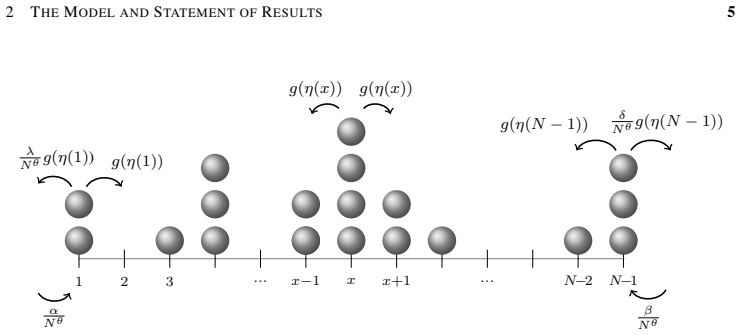
Summary. The paper studies the symmetric nearest-neighbour zero-range process on the finite interval {1,...,N-1} in contact with reservoirs at the boundary sites 1 and N-1, with injection/removal rates scaled by N^{-theta}, theta >= 1. Under assumptions that the jump rate g is nondecreasing with bounded increments, the initial measures have relative entropy O(N) with respect to the NESS and are stochastically dominated by it, and that a spectral-gap lower bound (SG) holds, the authors claim that the empirical density converges in probability to the unique weak solution of the nonlinear heat equation partial_t rho = Delta Phi(rho) with Robin boundary conditions for theta=1 and Neumann conditions for theta>1 (Eqs. (2.23)-(2.24)). The proof follows the entropy method: Dynkin martingales, tightness, absolute continuity of limit points, bulk one-block and two-block replacement lemmas, a boundary replacement lemma, and an energy estimate for the regularity of Phi(rho).
Significance. If the proof is completed, this would be the first rigorous hydrodynamic limit for the boundary-driven zero-range process in the nearest-neighbour case with slow reservoirs, closing a gap left open in [FMN21] and extending the slow-boundary exclusion results to a model with unbounded occupation numbers. The theta=1 Robin-type transition is a genuinely new feature for zero-range. The paper has clear strengths: the explicit product NESS is used intelligently, the translation-invariant reference measure is a good choice, Lemma 2.7 on the coupled two-box spectral gap is a useful tool, and the uniqueness proof for the nonlinear Robin problem is careful. The bulk replacement estimates are detailed. However, the boundary treatment is incomplete in a load-bearing way: the boundary replacement lemma is stated without proof, and the remainder R5 in Section 3.4.1 is asserted to vanish by an argument that does not apply to it. The energy estimate is also delegated to [KL99] with little adaptation. These gaps must be addressed before the main theorem can be considered established.
major comments (3)
- [Section 3.4.1, Eq. (3.27), R5] The proof asserts that E_mu[|R5|] tends to 0 'by the same argument given for R3'. This is not justified and is load-bearing. R3 is a bulk remainder with an explicit 1/N factor and a smooth factor Delta G_s; after summation by parts it is controlled by the continuity of Delta G. R5 has no such factor: it contains g(eta_s(1)) - (1/epsilon N) sum_{y=1}^{epsilon N} g(eta_s(y)) (and the analogous right-boundary term), multiplied by partial_u G_s(0), plus for theta=1 additional terms with G_s(0). A single-site rate does not converge in L1 to its spatial block average under product-type measures with slowly varying profile; the L1 difference is of order one. Vanishing of R5 is a boundary one-block replacement, not a corollary of the R3 estimate. Without a proof of this step, the boundary terms in (3.27) cannot be replaced by Phi of directed density averages, and the boundary conditions in (2.24
- [Section 3.6, Lemma 3.14] The boundary replacement lemma is stated without proof, with only the remark that the proof is 'almost identical' to the bulk argument. This lemma is exactly what sends R6 to zero in Section 3.4.1 and hence produces the Robin (theta=1) and flux (theta>1) boundary terms in (2.24). The directed averages in (3.28) are one-sided, the boxes touch the boundary, and the reference measure is not translation-invariant near the boundary; the bulk one-block and two-block estimates (Lemmas 3.12-3.13) are formulated for symmetric bulk boxes. Surface terms in the Feynman-Kac/Rayleigh estimates (3.43)-(3.48) could survive after summation. A complete proof, or a precise reduction to Lemmas 3.12-3.13, is required.
- [Appendix A.1, Lemma A.1 / Eq. (A.3)] The proof of the energy estimate stops at (A.3) with 'the exact same argument given in the proof of [KL99, Lemma 7.3]'. This estimate is used to prove Proposition 3.8, i.e., item ii) of Definition 2.9, namely Phi(rho) in L^2([0,T],H^1). The adaptation is not routine: the process has boundary reservoirs, the Dirichlet form D_N^0 in (3.44) is only the bulk part, and the auxiliary Lemmas B.1-B.3 involve boundary corrections. The reader cannot verify that the expression W_N is controlled without seeing the argument. Please include the details or a precise statement of the modified estimate.
minor comments (4)
- [Appendix A.1, first paragraph] The text says 'By the bulk replacement lemma, namely Lemma 3.14'; Lemma 3.14 is the boundary replacement lemma. The reference should be to Lemma 3.9.
- [Eq. (3.27)] In the last term there is a misplaced parenthesis: 'delta { g(eta_s(N-1) - 1/(epsilon N) ...' should read 'delta ( g(eta_s(N-1)) - 1/(epsilon N) ...'.
- [Lemma 3.13] The statement uses 'sup_{|y|<=epsilon N}' inside the expectation while y subsequently appears in the sums; clarify whether y is a fixed index over which the sup is taken. Also the order of limits in the lemma statement should match the order used at the end of the proof (N -> infinity, then epsilon -> 0, then ell -> infinity).
- [Remark 3.2] The notation 'Q_N' with 'N >= 0' appears to be a typo for 'N >= 1'.
Circularity Check
No circular derivation: the hydrodynamic equation and its boundary conditions are obtained from the generator via martingale and replacement arguments; the omitted boundary replacement proof is a rigor gap, not a circular step.
full rationale
I found no circular step in which a prediction is equivalent to an input by construction. The main result, Theorem 2.12, is not obtained by fitting parameters to data or by renaming a known pattern: the limiting PDE (2.23) and its θ-dependent Robin boundary terms are derived from the Dynkin martingale decomposition of the empirical measure, after bulk and boundary replacement lemmas. The boundary conditions are read off from the generator terms after passing to limits, not imposed by hand. Two passages assert missing support and should be weighed as rigor gaps rather than circularity. First, Lemma 3.14 (Boundary Replacement Lemma) is stated and then its proof is omitted: 'The proof of this lemma follows from an argument which is almost identical to the one given in the previous section, so we omit it. The reader is invited to retrace all the steps of the proof of Lemma 3.9, replacing the centred averages with the directed averages, and will see that no additional argument is required.' This lemma directly controls the remainder R6_{N,ε} in Section 3.4.1, and hence the θ=1 Robin boundary terms. The omission is a completeness gap in the proof of the boundary condition, but it is not circular: Lemma 3.14 is not a restatement of Theorem 2.12, and the analogous bulk lemma is proved in detail in Section 3.5. Second, the energy estimate in Appendix A.1 is delegated to [KL99]: 'From here, the conclusion follows from the exact same argument given in the proof of [KL99, Lemma 7.3].' This is another proof gap, but again not a circular reduction. The paper does lean on several results coauthored by the present authors: [FMN21] (with A. Neumann), [BDGN20] (with P. Gonçalves and A. Neumann), and [BMNS17] (with A. Neumann). These are used for auxiliary ingredients: a Feynman-Kac formula, spectral gap examples, and a uniqueness framework. These citations are not load-bearing in the sense that the central convergence theorem reduces to them; the paper provides proofs or adaptations for the claims it directly uses, and the cited items are standard tools with independent content. There is no invocation of a self-authored uniqueness theorem to forbid alternatives; uniqueness of weak solutions is proved in Appendix A.2 using a generalization of [BDGN20, Lemma 7.3] with proof included. Assumption (SG), the spectral gap lower bound, is an explicit hypothesis of the theorem rather than a derived consequence, and the examples satisfying it are cited from the external literature
Assumptions & free parameters
free parameters (1)
- reference fugacity phi =
phi >= max{sup_{N,x} phi_bar_N(x), alpha/lambda, beta/delta}
assumptions (5)
- domain assumption Assumption (ND): g is nondecreasing (2.16)
- domain assumption Assumption (SG): spectral gap gap(ell,j) >= C/ell^2 for box size ell with j particles (2.18)
- domain assumption lim_{phi uparrow phi*} Z(phi) = infinity (after Remark 2.2)
- domain assumption Condition (2.6) for the unique invariant product measure nu_bar_N
- domain assumption Initial measures satisfy H(mu_N | nu_bar_N) <~ N and mu_N <= nu_bar_N (Theorem 2.12 hypotheses)
Cite this review
Pith. "Pith review of Hydrodynamic Limit of the Symmetric Zero-Range Process with Slow Boundary." pith.science (2026). https://pith.science/paper/6IWMKNDW
@misc{pith2026250819447,
  author       = {Pith},
  title        = {Pith review of: Hydrodynamic Limit of the Symmetric Zero-Range Process with Slow Boundary},
  year         = {2026},
  howpublished = {\url{https://pith.science/paper/6IWMKNDW}},
  note         = {Machine review of arXiv:2508.19447}
}
abstract
We study the hydrodynamic behaviour of the symmetric zero-range process on the finite interval $\{1, \ldots, N-1\}$ in contact with slow reservoirs at the boundary. Particles are injected and removed at sites $1$ and $N-1$ at rates that scale like $N^{-\theta}$ with $\theta\ge1$. Under mild assumptions on the jump rate and the sequence of initial measures, we show that the empirical density evolves on the diffusive scale according to a nonlinear heat equation, with boundary conditions reflecting the strength of the reservoirs.
Figures
Reference graph
Works this paper leans on
-
[1]
, " * write output.state after.block = add.period write newline
ENTRY address author booktitle chapter edition editor howpublished institution journal key month note number organization pages publisher school series title type url doi eprint volume year label extra.label sort.label INTEGERS output.state before.all mid.sentence after.sentence after.block FUNCTION not #0 #2 if INTEGERS l FUNCTION string.length #1 'l := ...
-
[2]
" write newline "" before.all 'output.state := FUNCTION n.dashify 't := "" t empty not t #1 #1 substring "-" = t #1 #2 substring "--" = not "--" * t #2 global.max substring 't := t #1 #1 substring "-" = "-" * t #2 global.max substring 't := while if t #1 #1 substring * t #2 global.max substring 't := if while FUNCTION word.in bbl.in capitalize " " * FUNCT...
-
[3]
D. Aldous . Stopping Times and Tightness . Ann. Probab. 6, no. 2, (1978), 335--340. doi:10.1214/aop/1176995579 https://doi.org/10.1214/aop/1176995579
arXiv 1978
-
[4]
C. Bernardin , P. Cardoso , P. Gonçalves , and S. Scotta . Hydrodynamic Limit for a Boundary Driven Super-Diffusive Symmetric Exclusion . Stochastic Process. Appl. 165, (2023), 43--95. doi:10.1016/j.spa.2023.08.002 https://doi.org/10.1016/j.spa.2023.08.002
-
[5]
L. Bonorino , R. De Paula , P. Gonçalves , and A. Neumann . Hydrodynamics of Porous Medium Model with Slow Reservoirs . J. Stat. Phys. 179, no. 3, (2020), 748--788. doi:10.1007/s10955-020-02550-y https://doi.org/10.1007/s10955-020-02550-y
-
[6]
C. Bernardin , P. Gonçalves , and B. Jim\'enez-Oviedo . Slow to Fast Infinitely Extended Reservoirs for the Symmetric Exclusion Process with Long Jumps . Markov Process. Related Fields 25, no. 2, (2019), 217--274
work page 2019
-
[7]
C. Bernardin , P. Gonçalves , and B. Jim\'enez-Oviedo . A Microscopic Model for a One Parameter Class of Fractional Laplacians with Dirichlet Boundary Conditions . Arch. Ration. Mech. Anal. 239, no. 1, (2021), 1--48. doi:10.1007/s00205-020-01549-9 https://doi.org/10.1007/s00205-020-01549-9
-
[8]
C. Bernardin , P. Gonçalves , B. Jim\'enez-Oviedo , and S. Scotta . Non-Equilibrium Stationary Properties of the Boundary Driven Zero-Range process with Long Jumps . J. Stat. Phys. 189, no. 3, (2022), Paper No. 32, 32. doi:10.1007/s10955-022-02987-3 https://doi.org/10.1007/s10955-022-02987-3
Show all 25 references
-
[9]
Baldasso , O
R. Baldasso , O. Menezes , A. Neumann , and R. R. Souza . Exclusion Process with Slow Boundary . J. Stat. Phys. 167, no. 5, (2017), 1112--1142. doi:10.1007/s10955-017-1763-5 https://doi.org/10.1007/s10955-017-1763-5
2017 doi
- [10]
-
[11]
Franco , P
T. Franco , P. Gonçalves , and A. Neumann . Equilibrium Fluctuations for the Slow Boundary Exclusion Process . In From Particle Systems to Partial Differential Equations , vol. 209 of Springer Proc. Math. Stat., 177--197. Springer, Cham, 2017. doi:10.1007/978-3-319-66839-0_9 h...
2017 doi
-
[12]
Franco , P
T. Franco , P. Gonçalves , and A. Neumann . Non-Equilibrium and Stationary Fluctuations of a Slowed Boundary Symmetric Exclusion . Stochastic Process. Appl. 129, no. 4, (2019), 1413--1442. doi:10.1016/j.spa.2018.05.005 https://doi.org/10.1016/j.spa.2018.05.005
2019 doi
-
[13]
Fr\'ometa , R
S. Fr\'ometa , R. Misturini , and A. Neumann . The Boundary Driven Zero-Range Process . In From Particle Systems to Partial Differential Equations , vol. 352 of Springer Proc. Math. Stat., 253--281. Springer, Cham, 2021. doi:10.1007/978-3-030-69784-6_12 https://doi.org/10.1007...
2021 doi
-
[14]
Funaki , P
T. Funaki , P. Van Meurs , S. Sethuraman , and K. Tsunoda . Motion by Mean Curvature from Glauber-Kawasaki Dynamics with Speed Change . J. Stat. Phys. 190, no. 3, (2023), Paper No. 45, 30. doi:10.1007/s10955-022-03044-9 https://doi.org/10.1007/s10955-022-03044-9
2023 doi
-
[15]
Gonçalves
P. Gonçalves . Hydrodynamics for Symmetric Exclusion in Contact with Reservoirs . In Stochastic Dynamics Out of Equilibrium , vol. 282 of Springer Proc. Math. Stat., 137--205. Springer, Cham, 2019. doi:10.1007/978-3-030-15096-9\\_4 https://doi.org/10.1007/978-3-030-15096-9\
2019 doi
-
[16]
M. Z. Guo , G. C. Papanicolaou , and S. R. S. Varadhan . Nonlinear Diffusion Limit for a System with Nearest Neighbor Interactions . Comm. Math. Phys. 118, no. 1, (1988), 31--59. http://projecteuclid.org/euclid.cmp/1104161907 http://projecteuclid.org/euclid.cmp/1104161907
1988
-
[17]
Gonçalves and S
P. Gonçalves and S. Scotta . Diffusive to Super-Diffusive Behavior in Boundary Driven Exclusion . Markov Process. Related Fields 28, no. 1, (2022), 149--178
2022
-
[18]
Kipnis and C
C. Kipnis and C. Landim . Scaling Limits of Interacting Particle Systems. Springer-Verlag, Berlin, 1999. doi:10.1007/978-3-662-03752-2 https://doi.org/10.1007/978-3-662-03752-2
1999 doi
-
[19]
T. M. Liggett . Interacting Particle Systems . Classics in Mathematics. Springer-Verlag, Berlin, 2005. doi:10.1007/b138374 https://doi.org/10.1007/b138374
2005 doi
-
[20]
Levine , D
E. Levine , D. Mukamel , and G. M. Sch\"utz . Zero-Range Process with Open Boundaries . J. Stat. Phys. 120, no. 5-6, (2005), 759--778. doi:10.1007/s10955-005-7000-7 https://doi.org/10.1007/s10955-005-7000-7
2005 doi
-
[21]
Landim , S
C. Landim , S. Sethuraman , and S. Varadhan . Spectral Gap for Zero-Range Dynamics . Ann. Probab. 24, no. 4, (1996), 1871--1902. doi:10.1214/aop/1041903209 https://doi.org/10.1214/aop/1041903209
1996
- [22]
-
[23]
B. Morris . Spectral Gap for the Zero Range Process with Constant Rate . Ann. Probab. 34, no. 5, (2006), 1645--1664. doi:10.1214/009117906000000304 https://doi.org/10.1214/009117906000000304
2006 doi
-
[24]
Nagahata
Y. Nagahata . Spectral Gap for Zero-Range Processes with Jump Rate g(x)=x^ . Stochastic Process. Appl. 120, no. 6, (2010), 949--958. doi:10.1016/j.spa.2010.01.019 https://doi.org/10.1016/j.spa.2010.01.019
2010 doi
-
[25]
F. Spitzer . Interaction of Markov Processes . Advances in Math. 5, (1970), 246--290. doi:10.1016/0001-8708(70)90034-4 https://doi.org/10.1016/0001-8708(70)90034-4
1970 doi
Reviewed August 5, 2026 · model on record in the stance chip above.
Discussion (0). Sign in to comment.