REVIEW 4 major objections 4 minor 42 references
Joint Power Control and User Association for NOMA-Based Full-Duplex Systems
T0 review · 4 major / 4 minor · reviewed 2026-08-14 · deepseek-v4-flash
Pith's one-line read For full-duplex NOMA small cells, optimizing user pairing and uplink decoding order jointly with power control gets within 1–2% of the exhaustive optimum at polynomial per-iteration cost.
desk verdict A competent FD-NOMA resource-allocation paper with a genuinely new joint association formulation, but the headline 1–2% gap to brute-force rests on a rounding step the authors admit can violate QoS. read the letter →
The pith
A machine-rendered reading of the paper's core claim, the machinery that carries it, and where it could break.
The reading
What carries the argument
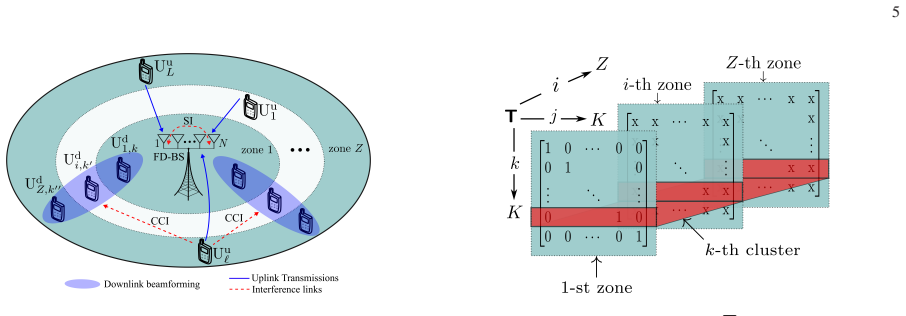
The central object is the third-order tensor $T$ of zone-to-cluster association matrices, with $C_1 = I_K$ and all $C_i$ permutation matrices; the pairing between any two zones is recovered by $T^{iz}=C_i^{\mathsf{T}}C_z$, which cuts the number of association variables from $\binom{Z}{2}K^2$ to $(Z-1)K^2$. The argument runs on an inner-convex-approximation loop: each non-concave log-rate is lower-bounded by a concave minorant (e.g., $\ln(1+1/\omega)\ge A(\omega^{(\kappa)})+B(\omega^{(\kappa)})\omega$), each interference term is upper-bounded by the convex majorant of Lemma 1, and the resulting constraints are SOC-representable. The second algorithm adds the penalty $f_p(\alpha_n)=\varrho_n(\alpha_n^2-\alpha_n)$ to force the relaxed binaries to 0 or 1, with the log-sum-exp trick making the distinct-decoding-order constraint convex.
What would settle it
Run Algorithms 1 and 2 over thousands of random small-cell channel realizations, record the largest non-binary entries of the relaxed association variables at convergence, then round via (33) and compare the rounded spectral efficiency and feasibility against the brute-force benchmark of Algorithm 3. If any rounded point violates a rate constraint or misses the 1–2% gap, the central performance claim is falsified.
Extended reading notes
Core claim
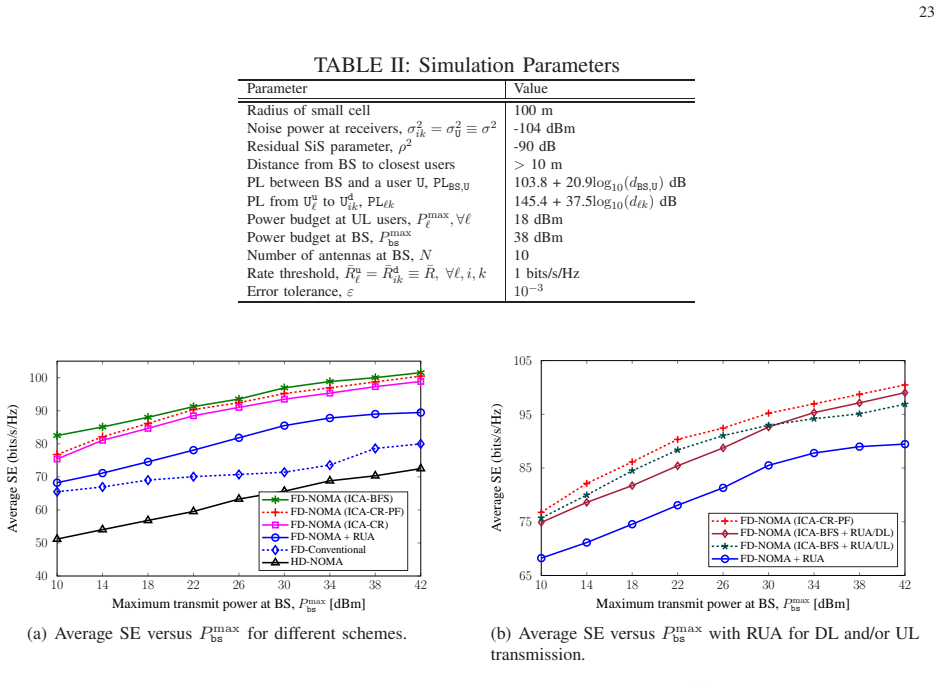
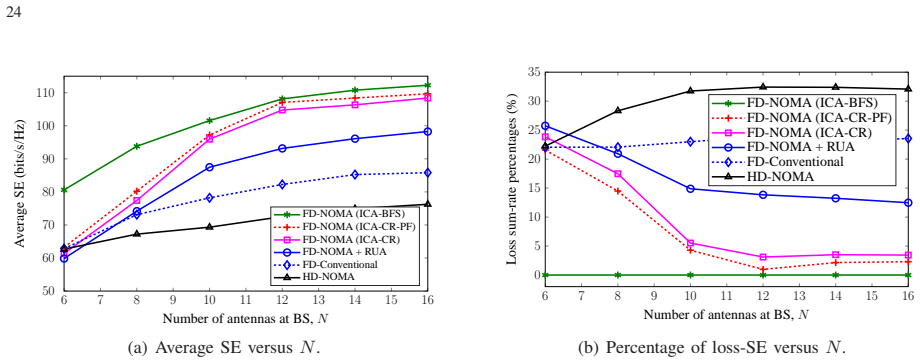
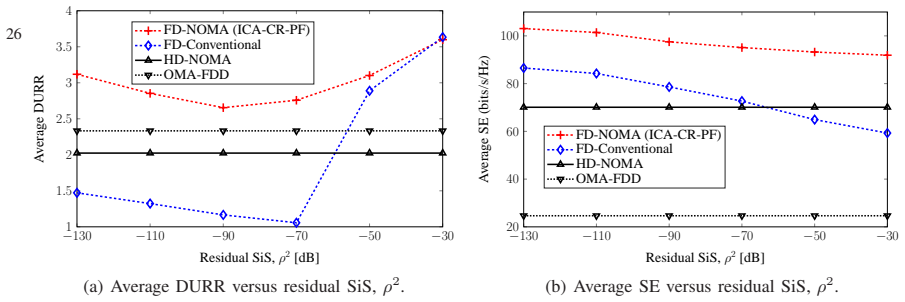
On the paper's own terms, the central discovery is that joint user association and power control for FD-NOMA can be attacked through a continuous relaxation that stays nearly binary at convergence, paired with a sequence of second-order cone programs. Downlink clustering is encoded as a tensor of permutation matrices, so any two-zone association matrix is the change-of-basis product $T^{iz} = C_i^{\mathsf{T}}C_z$; uplink decoding order is encoded by a binary matrix $\beta$ subject to order constraints. The inner convex approximation turns the non-concave log rates and interference terms into concave minorants and SOC constraints, and the penalty variant adds $\varrho_n(\alpha_n^2-\alpha_n)$ to drive the association variables to 0 or 1. The paper reports that the two ICA-based algorithms "deviate only 1% ~ 2% from the optimal SE" relative to a brute-force benchmark, and that they improve the achievable SE at every iteration and converge, beating conventional FD, FD-NOMA with random UA, and HD-NOMA in the simulated scenarios.
Load-bearing premise
The load-bearing premise is that the relaxed user-pairing and decoding-order variables end up almost exactly 0 or 1, so the rounding step that turns them into binary choices does not lose spectral efficiency or violate the users' rate requirements.
Editorial extensions
If this is right
- Both proposed algorithms solve one convex SOC program per iteration, so their per-iteration cost is polynomial in the numbers of antennas and users, unlike the $K!\times L!$ brute-force benchmark.
- The tensor representation cuts the number of downlink association variables from $\binom{Z}{2}K^2$ to $(Z-1)K^2$ without losing the ability to recover any zone-to-zone pairing.
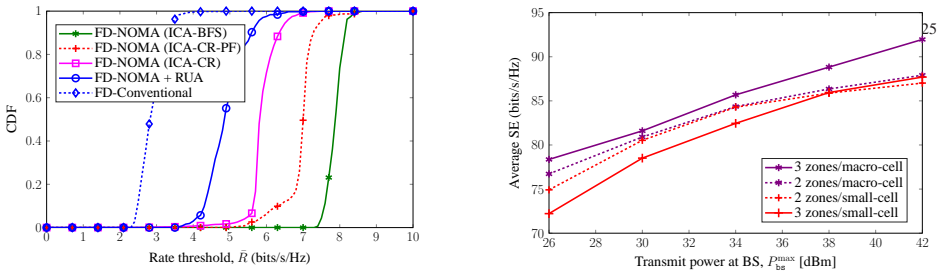
- In the simulated small-cell configurations, the penalty variant converges faster and reaches a higher spectral efficiency than the plain ICA-CR variant, and both stay within 1–2% of the brute-force optimum.
- Optimizing either the downlink pairing or the uplink decoding order alone already gives large gains over random association, and joint optimization gives the best results.
- Whether two-zone or three-zone NOMA is better depends on the cell: three-zone NOMA wins in macro-cells, while two-zone NOMA is preferred in small cells.
Reading between the lines
- The same relaxation-plus-penalty recipe should transfer to other combinatorial resource-allocation problems in wireless design, such as subcarrier assignment, antenna selection, or cluster-size optimization, wherever the integer variables enter through products with continuous powers.
- The tensor/permutation-matrix view identifies user pairing with the group of permutation matrices, which suggests an exact search or a bound on rounding over doubly stochastic relaxations rather than heuristic rounding.
- The 1–2% gap is demonstrated under perfect CSI in slow-fading small cells; a natural next test is whether the gap widens with imperfect channel knowledge, since all convexifications use the true channels.
Signed reviews
Editorial analysis
A structured set of objections, weighed in public.
Referee Report
Summary. This paper studies joint downlink user clustering and uplink decoding-order selection together with power and beamforming control in a full-duplex NOMA small-cell system. The authors formulate a mixed-integer nonconvex sum-spectral-efficiency maximization problem (9)/(11), relax the binary association variables, and develop two inner-convex-approximation (ICA) based algorithms: Algorithm 1 (ICA-CR) and Algorithm 2 (ICA-CR-PF), the latter adding a penalty function to drive the relaxed variables toward binary values. Algorithm 3 is a brute-force benchmark that enumerates K!×L! associations and applies ICA to each resulting nonconvex power-control subproblem. Numerical results report that the proposed algorithms come within 1–2% of the BFS benchmark spectral efficiency, outperform conventional FD, FD-NOMA with random user association, and HD-NOMA baselines, and exhibit convergence over iterations. The paper also includes an extended discussion of three-zone NOMA, SI/CCI effects, and convergence behavior.
Significance. If the performance claims are correct, the paper makes a useful contribution to full-duplex NOMA resource allocation. The tensor-based user-association model is a genuine structural idea that reduces the number of binary variables; the ICA construction yields disciplined subproblems containing only SOC and linear constraints; and the penalty variant is a reasonable mechanism for accelerating binary recovery. The numerical study is extensive, with many topologies and channel realizations, and the BFS benchmark provides an independent comparison point. The paper does not ship code, but the structural parts—Lemma 1, the SOC reformulations, and the penalty-method theorem—are plausible and are partly corroborated by the simulations. The main value of the paper would be in the low-complexity SOCP per iteration and the reported small gap to a systematic association search, provided the feasibility of the rounded output and the benchmark's optimality claims are properly qualified.
major comments (4)
- [Section III-A, Eq. (33); Algorithm 1, Steps 8–9; Section VI-B] The rounding step is load-bearing and currently unsupported. The paper states immediately before (33) that the ICA-CR solution 'yields nearly binary values at convergence, but some relaxed variables are non-binary' and that the rounded point 'can be infeasible to problem (11)'; Algorithm 1 nevertheless rounds α and β to binary values and then computes the reported spectral efficiency. Rounding can violate the row/column constraints (11e), the UL ordering constraints (9j)–(9k), and the QoS constraints (9d)–(9e). No bound is given on the resulting SE loss or on the probability and magnitude of QoS violation, so the 1–2% gap reported in Section VI-B is not established for feasible outputs. The paper also acknowledges infeasibility in Fig. 8(c) but does not state how infeasible trials are treated in the averages of Figs. 3 and 4. The authors should report the feasibility rate of the rounded points, exclude or repair infeasible realizations before averaging, or provide a rounding guarantee with quantified SE and QoS loss.
- [Section V-B, Theorem 3] The convergence claim is delegated rather than proved. The proof asserts that the approximate functions satisfy 'Property A' of [34] and that the feasible sets satisfy the 'connectedness condition for KKT invexity' of [38], but neither hypothesis is verified for the specific approximations (14)–(31) and the relaxed feasible region (12). Because Algorithm 1 may terminate with a rounded point and Algorithm 2 modifies the objective with penalty terms, the monotone-improvement and local-optimality statement needs a direct argument or an explicit verification of the cited hypotheses. Please either provide that verification or weaken the claim to numerically observed convergence.
- [Section IV, Algorithm 3; Section VI-B] The BFS benchmark is not a global optimum as labeled. Algorithm 3 enumerates all K!×L! associations, but for each association it solves the nonconvex problem (41) using the ICA method, which only guarantees a local optimum of that subproblem. Therefore the phrase 'optimal SE' in Section VI-B and the 'optimal solution' claim for Algorithm 3 are not justified; the benchmark is the best among many locally optimized association-specific solutions. Please rephrase these claims as 'best BFS-local solution' and state the 1–2% gap relative to that benchmark, not to a proven global optimum.
- [Section III-A, Eq. (20) and (22a)] The equivalence used to convert the max in (10b) into the reciprocal-min form in (20) is not established for the relaxed problem. For binary α with one nonzero entry per column the identity is plausible only with the ε regularization, but for fractional α in (12), max_k α_kj A_k and min_k A_k/(α_kj+ε) are different objects. Consequently, constraints (22a) and (23a) may not be valid inner approximations of the SINR constraint (10b) during the relaxation, and the corresponding ICA minorant is not guaranteed to be a lower bound. Please provide a formal derivation of (20) for the relaxed domain or state explicitly that the reciprocal-min form is a heuristic and quantify the resulting error in the reported rates.
minor comments (4)
- [General] There are several typos: 'Transact ions' and 'witho ut' in the header line, 'Algorithmsp' in Theorem 3, and '3:=' instead of '3:' in Algorithm 3's initialization.
- [Fig. 8(c)] The legend label 'ICA-CRP-PF' should read 'ICA-CR-PF'.
- [Appendix C, Eq. (C.5)] The text around (C.5) contains a stray 'B.' in 'ln(P max bs B.σ 2)', which should be removed or replaced with the intended notation.
- [References] Reference [31] lists pages '4483–4454', which appears to be a reversed or incorrect page range and should be checked against the original source.
Circularity Check
No circularity found; the central SE comparison is against an independent BFS benchmark and the cited minorants are parameter-free inequalities.
full rationale
The paper's core claim is that the ICA-CR and ICA-CR-PF algorithms approach the spectral efficiency of an exhaustive user-association search (Algorithm 3). This is an empirical comparison on simulated channels, not a quantity produced by the algorithms' own assumptions: the BFS benchmark enumerates K! x L! UA permutations independently of the relaxation, and each fixed-UA subproblem is then solved with ICA, so the reported 1-2% gap is a measured outcome rather than an input. The rounding step (33) is explicitly acknowledged in the text to be capable of returning points infeasible for problem (11); that is a correctness and robustness limitation, not circularity, because no fitted parameter is renamed as a prediction and no target quantity is assumed in constructing the algorithm. The ICA minorants in (14) and (48) are cited from the authors' prior works ([32, Eq. (82)] and [37, Eq. (20)]), but they are parameter-free convexity inequalities with derivations independent of the present problem, so under the review rules they count as external support rather than load-bearing self-citation. Theorem 3's convergence argument invokes Property A of [34] and the KKT-invexity condition of [38]; these are external references, and any lack of verification is a rigor gap rather than a circular reduction. No load-bearing step was found that reduces, by the paper's own equations or by self-citation, to its own inputs.
Assumptions & free parameters
free parameters (3)
- Penalty scaling factor a in rho = a^kappa =
a = 3 in the reported setting; binary search over [2, 5]
- Epsilon perturbation in alpha_kj + epsilon =
unspecified ('a given small number')
- LSE smoothing parameter Omega =
unspecified ('a predefined large number')
assumptions (5)
- domain assumption Perfect CSI for all DL, UL, and CCI links is available at the BS.
- standard math The constructed convex approximations satisfy Property A of the ICA framework in [34].
- domain assumption The feasible sets satisfy the connectedness condition for KKT invexity as the iteration index goes to infinity.
- ad hoc to paper The min-max reciprocal identity max_k {...} = min_k {...} holds at optimality in the SINR expression (20).
- domain assumption Standard Rician self-interference and 3GPP path-loss models govern all simulated channels.
Cite this review
Pith. "Pith review of Joint Power Control and User Association for NOMA-Based Full-Duplex Systems." pith.science (2026). https://pith.science/paper/6KMZSP4R
@misc{pith2026190800833,
  author       = {Pith},
  title        = {Pith review of: Joint Power Control and User Association for NOMA-Based Full-Duplex Systems},
  year         = {2026},
  howpublished = {\url{https://pith.science/paper/6KMZSP4R}},
  note         = {Machine review of arXiv:1908.00833}
}
read the original abstract
This paper investigates the coexistence of non-orthogonal multiple access (NOMA) and full-duplex (FD) to improve both spectral efficiency (SE) and user fairness. In such a scenario, NOMA based on the successive interference cancellation technique is simultaneously applied to both uplink (UL) and downlink (DL) transmissions in an FD system. We consider the problem of jointly optimizing user association (UA) and power control to maximize the overall SE, subject to user-specific quality-of-service and total transmit power constraints. To be spectrally-efficient, we introduce the tensor model to optimize UL users' decoding order and DL users' clustering, which results in a mixed-integer non-convex problem. For practically appealing applications, we first relax the binary variables and then propose two low-complexity designs. In the first design, the continuous relaxation problem is solved using the inner convex approximation framework. Next, we additionally introduce the penalty method to further accelerate the performance of the former design. For a benchmark, we develop an optimal solution based on brute-force search (BFS) over all possible cases of UAs. It is demonstrated in numerical results that the proposed algorithms outperform the conventional FD-based schemes and its half-duplex counterpart, as well as yield data rates close to those obtained by BFS-based algorithm.
Figures
Figures from the paper (6 more)


Reference graph
Works this paper leans on
-
[34]
A. Beck, A. Ben-Tal, and L. Tetruashvili, “A sequential parametric convex approximation method with applications to nonconvex truss topology design problems,” J. Global Optim. , vol. 47, no. 1, pp. 29–51, May 2010
work page 2010
-
[38]
K. Bestuzheva and H. Hijazi, “Invex optimization revis ited,” July 2017. [Online]. Available: https://arxiv.org /abs/1707.01554v1
work page Pith review arXiv 2017
-
[1]
J. Andrews, S. Buzzi, W. Choi, S. Hanly, A. Lozano, A. Soon g, and J. Zhang, “What will 5G be?” IEEE J. Select. Area Commun. , vol. 32, no. 6, pp. 1065–1082, June 2014
work page 2014
-
[2]
All technologies work together for good: A glance at future mobile networks,
A. Y adav and O. A. Dobre, “All technologies work together for good: A glance at future mobile networks,” IEEE Wireless Commun. , vol. 25, no. 4, pp. 10–16, Aug. 2018
work page 2018
-
[3]
Application of non-orthogonal multiple access i n LTE and 5G networks,
Z. Ding, Y . Liu, J. Choi, Q. Sun, M. Elkashlan, C. L. I, and H . V . Poor, “Application of non-orthogonal multiple access i n LTE and 5G networks,” IEEE Commun. Mag. , vol. 55, no. 2, pp. 185–191, Feb. 2017
work page 2017
-
[4]
Nonorthogonal multiple access for 5G and beyond,
Y . Liu, Z. Qin, M. Elkashlan, Z. Ding, A. Nallanathan, and L. Hanzo, “Nonorthogonal multiple access for 5G and beyond, ” Proc. of the IEEE, vol. 105, no. 12, pp. 2347–2381, Dec. 2017
work page 2017
-
[5]
Pow er-domain non-orthogonal multiple access (NOMA) in 5G syst ems: Potentials and challenges,
S. M. R. Islam, N. Avazov, O. A. Dobre, and K.-S. Kwak, “Pow er-domain non-orthogonal multiple access (NOMA) in 5G syst ems: Potentials and challenges,” IEEE Commun. Surveys Tutor ., vol. 19, no. 2, pp. 721–742, Second quarter 2017
work page 2017
-
[6]
Resource allocation for downlink NOMA systems: Key techniques and op en issues,
S. M. R. Islam, M. Zeng, O. A. Dobre, and K. Kwak, “Resource allocation for downlink NOMA systems: Key techniques and op en issues,” IEEE Wireless Commun. , vol. 25, no. 2, pp. 40–47, Apr. 2018
work page 2018
Show all 42 references
-
[7]
A survey on non-orthogonal multiple acc ess for 5G networks: Research challenges and future trends,
Z. Ding, X. Lei, G. K. Karagiannidis, R. Schober, J. Y uan, and V . K. Bhargava, “A survey on non-orthogonal multiple acc ess for 5G networks: Research challenges and future trends,” IEEE J. Select. Areas Commun. , vol. 35, no. 10, pp. 2181–2195, Oct. 2017
2017
-
[8]
Impact of user pairing on 5 G nonorthogonal multiple-access downlink transmissions,
Z. Ding, P . Fan, and H. V . Poor, “Impact of user pairing on 5 G nonorthogonal multiple-access downlink transmissions, ” IEEE Trans. V eh. Tech., vol. 65, no. 8, pp. 6010–6023, Aug. 2016
2016
-
[9]
Low complex ity beamforming and user selection schemes for 5G MIMO-NOMA systems,
C. Chen, W. Cai, X. Cheng, L. Y ang, and Y . Jin, “Low complex ity beamforming and user selection schemes for 5G MIMO-NOMA systems,” IEEE J. Select. Areas Commun. , vol. 35, no. 12, pp. 2708–2722, Dec. 2017
2017
-
[10]
V . W. Wong, R. Schober, D. W. K. Ng, and L.-C. Wang, Key Technologies for 5G Wireless Systems . Cambridge, MA, USA: Cambridge Univ. Press, 2017
2017
-
[11]
Full-dupl ex communications: Performance in ultradense mm-wave smal l-cell wireless networks,
A. Y adav, G. I. Tsiropoulos, and O. A. Dobre, “Full-dupl ex communications: Performance in ultradense mm-wave smal l-cell wireless networks,” IEEE V eh. Technol. Mag., vol. 13, no. 2, pp. 40–47, June 2018
2018
-
[12]
Full duplex radi os,
D. Bharadia, E. McMilin, and S. Katti, “Full duplex radi os,” in Proc. ACM SIGCOMM Computer Commun. Review , vol. 43, no. 4, 2013, pp. 375–386
2013
-
[13]
In-band full-duplex wireless: Chall enges and opportunities,
A. Sabharwal, P . Schniter, D. Guo, D. W. Bliss, S. Rangar ajan, and R. Wichman, “In-band full-duplex wireless: Chall enges and opportunities,” IEEE J. Select. Areas Commun. , vol. 32, no. 9, pp. 1637–1652, Feb. 2014
2014
-
[14]
Full duplex MIMO radios,
D. Bharadia and S. Katti, “Full duplex MIMO radios,” in Proc. 11th USENIX Symp. Netw. Syst. Design Implement. (NSDI ), Seattle, W A, USA, 2014, pp. 369–372
2014
-
[15]
On the spectral efficiency of full-duplex small cell wireless s ystems,
D. Nguyen, L.-N. Tran, P . Pirinen, and M. Latva-aho, “On the spectral efficiency of full-duplex small cell wireless s ystems,” IEEE Trans. Wireless Commun., vol. 13, no. 9, pp. 4896–4910, Sept. 2014
2014
-
[16]
Weighted s um rate maximization in full-duplex multi-user multi-cell MIMO networks,
P . Aquilina, A. C. Cirik, and T. Ratnarajah, “Weighted s um rate maximization in full-duplex multi-user multi-cell MIMO networks,” IEEE Trans. Commun., vol. 65, no. 4, pp. 1590–1608, Apr. 2017
2017
-
[17]
Spectral efficiency of full-duplex multiuser system: Beam forming design, user grouping, and time allocation,
V .-D. Nguyen, H. V . Nguyen, C. T. Nguyen, and O.-S. Shin, “Spectral efficiency of full-duplex multiuser system: Beam forming design, user grouping, and time allocation,” IEEE Access , vol. 5, pp. 5785–5797, Mar. 2017
2017
-
[18]
Energy and traffic a ware full duplex communications for 5G systems,
A. Y adav, O. A. Dobre, and N. Ansari, “Energy and traffic a ware full duplex communications for 5G systems,” IEEE Access , vol. 5, pp. 11 278–11 290, May 2017
2017
-
[19]
A new design paradigm for secure full-duplex multiuser syst ems,
V .-D. Nguyen, H. V . Nguyen, O. A. Dobre, and O.-S. Shin, “ A new design paradigm for secure full-duplex multiuser syst ems,” IEEE J. Select. Areas Commun. , vol. 36, no. 7, pp. 1480–1498, July 2018
2018
-
[20]
Successive convex quadratic programming for quality-of-service management in full-duplex MU-MIMO multicell networks,
H. H. M. Tam, H. D. Tuan, and D. T. Ngo, “Successive convex quadratic programming for quality-of-service management in full-duplex MU-MIMO multicell networks,” IEEE Trans. Commun. , vol. 64, no. 6, pp. 2340–2353, June 2016
2016
-
[21]
Joint antenna array mode selection and user assignmen t for full-duplex MU-MISO systems,
H. V . Nguyen, V .-D. Nguyen, O. A. Dobre, Y . Wu, and O.-S. S hin, “Joint antenna array mode selection and user assignmen t for full-duplex MU-MISO systems,” IEEE Trans. Wireless Commun. , vol. 18, no. 6, pp. 2946–2963, June 2019
2019
-
[22]
Optimal join t power and subcarrier allocation for full-duplex multicar rier non-orthogonal multiple access systems,
Y . Sun, D. W. K. Ng, Z. Ding, and R. Schober, “Optimal join t power and subcarrier allocation for full-duplex multicar rier non-orthogonal multiple access systems,” IEEE Trans. Commun. , vol. 65, no. 3, pp. 1077–1091, Mar. 2017
2017
-
[23]
On the coexistence betwe en full-duplex and NOMA,
Z. Ding, P . Fan, and H. V . Poor, “On the coexistence betwe en full-duplex and NOMA,” IEEE Wireless Commun. Lett. , vol. 7, no. 5, pp. 692–695, Oct. 2018
2018
-
[24]
Robust and sec ure resource allocation for full-duplex MISO multicarrier NOMA systems,
Y . Sun, D. W. K. Ng, J. Zhu, and R. Schober, “Robust and sec ure resource allocation for full-duplex MISO multicarrier NOMA systems,” IEEE Trans. Commun. , vol. 66, no. 9, pp. 4119–4137, Sept. 2018
2018
-
[25]
Joint NOMA b eamforming and user scheduling for sum rate maximization in a full-duplex system,
H. V . Nguyen, V .-D. Nguyen, and O.-S. Shin, “Joint NOMA b eamforming and user scheduling for sum rate maximization in a full-duplex system,” in Proc. Inter . Conf. Inform. Commun. Technol. Converg. (ICTC ), Oct. 2017, pp. 731–733
2017
-
[26]
Beamforming optimization for full-duplex wirel ess-powered MIMO systems,
B. K. Chalise, H. A. Suraweera, G. Zheng, and G. K. Karagi annidis, “Beamforming optimization for full-duplex wirel ess-powered MIMO systems,” IEEE Trans. Commun. , vol. 65, no. 9, pp. 3750–3764, Sept. 2017
2017
-
[27]
Minimum power multicast beamforming with sup erposition coding for multiresolution broadcast and appli cation to NOMA systems,
J. Choi, “Minimum power multicast beamforming with sup erposition coding for multiresolution broadcast and appli cation to NOMA systems,” IEEE Trans. Commun. , vol. 63, no. 3, pp. 791–800, Mar. 2015
2015
-
[28]
On the application of quasi-degradation to MISO-NOMA downlink,
Z. Chen, Z. Ding, X. Dai, and G. K. Karagiannidis, “On the application of quasi-degradation to MISO-NOMA downlink,” IEEE Trans. Signal Process. , vol. 64, no. 23, pp. 6174–6189, Dec. 2016
2016
-
[29]
Beamforming for combating inter-cluster and intra-cluster interference in hybrid NO MA systems,
Z. Chen, Z. Ding, and X. Dai, “Beamforming for combating inter-cluster and intra-cluster interference in hybrid NO MA systems,” IEEE Access, vol. 4, pp. 4452–4463, 2016
2016
-
[30]
A minorization-maximization method for optimizing s um rate in the downlink of non-orthogonal multiple access systems,
M. F. Hanif, Z. Ding, T. Ratnarajah, and G. K. Karagianni dis, “A minorization-maximization method for optimizing s um rate in the downlink of non-orthogonal multiple access systems,” IEEE Trans. Signal Process. , vol. 64, no. 1, pp. 76–88, Jan. 2016
2016
-
[31]
A general MIMO frame work for NOMA downlink and uplink transmission based on sign al alignment,
Z. Ding, R. Schober, and H. V . Poor, “A general MIMO frame work for NOMA downlink and uplink transmission based on sign al alignment,” IEEE Trans. Wireless Commun. , vol. 15, no. 6, pp. 4483–4454, June 2016
2016
-
[32]
Precoder design for signal superposition in MIMO-N OMA multicell networks,
V .-D. Nguyen, H. D. Tuan, T. Q. Duong, H. V . Poor, and O.-S . Shin, “Precoder design for signal superposition in MIMO-N OMA multicell networks,” IEEE J. Select. Areas Commun. , vol. 35, no. 12, pp. 2681–2695, Dec. 2017
2017
-
[33]
A general inner approximat ion algorithm for nonconvex mathematical programs,
B. R. Marks and G. P . Wright, “A general inner approximat ion algorithm for nonconvex mathematical programs,” Operations Research, vol. 26, no. 4, pp. 681–683, July-Aug. 1978
1978
-
[35]
Tse and P
D. Tse and P . Viswanath, Fundamentals of Wireless Communication. Cambridge Univ. Press, UK, 2005
2005
-
[36]
Boyd and L
S. Boyd and L. V andenberghe, Convex Optimization. Cambridge Univ. Press, UK, 2007
2007
-
[37]
Spectral and energy efficiencies in full-duplex wir eless information and power transfer,
V .-D. Nguyen, T. Q. Duong, H. D. Tuan, O.-S. Shin, and H. V . Poor, “Spectral and energy efficiencies in full-duplex wir eless information and power transfer,” IEEE Trans. Commun. , vol. 65, no. 5, pp. 2220–2233, May 2017
2017
-
[39]
User’ s guide for SeDuMi interface 1.04,
D. Peaucelle, D. Henrion, Y . Labit, and K. Taitz, “User’ s guide for SeDuMi interface 1.04,” in LAAS-CNRS, Toulouse, France, June 2002
2002
-
[40]
Experiment-driv en characterization of full-duplex wireless systems,
M. Duarte, C. Dick, and A. Sabharwal, “Experiment-driv en characterization of full-duplex wireless systems,” IEEE Trans. Wireless Commun., vol. 11, no. 12, pp. 4296–4307, Dec. 2012
2012
-
[41]
3GPP Technical Specification Group Radio Access Network, Ev olved Universal Terrestrial Radio Access (E-UTRA): Furthe r Advancements for E-UTRA Physical Layer Aspects (Release 9) , document 3GPP TS 36.814 V9.0.0, 2010
2010
-
[42]
J. R. Munkres, Topology: A First Course . Englewood Cliffs, NJ: Prentice-Hall, 1974
1974
Reviewed August 14, 2026 · model on record in the stance chip above.
Discussion (0). Continue with ORCID to comment.