REVIEW 3 major objections 6 minor 5 cited by
High-redshift Millennium and Astrid galaxies in effective field theory at the field level
T0 review · 3 major / 6 minor · reviewed 2026-08-15 · deepseek-v4-flash
Pith's one-line read Field-level EFT fits find $z=3$ LAEs and LBGs remain within perturbative reach, and LAEs show weak Fingers of God.
desk verdict First field-level EFT bias and stochastic measurements for z=3 LBG/LAE-like galaxies; the qualitative small-FoG result is solid, but the headline kmax ranges rest on proxy selections that Appendix A shows to be resolution-sensitive. read the letter →
The pith
A machine-rendered reading of the paper's core claim, the machinery that carries it, and where it could break.
The reading
What carries the argument
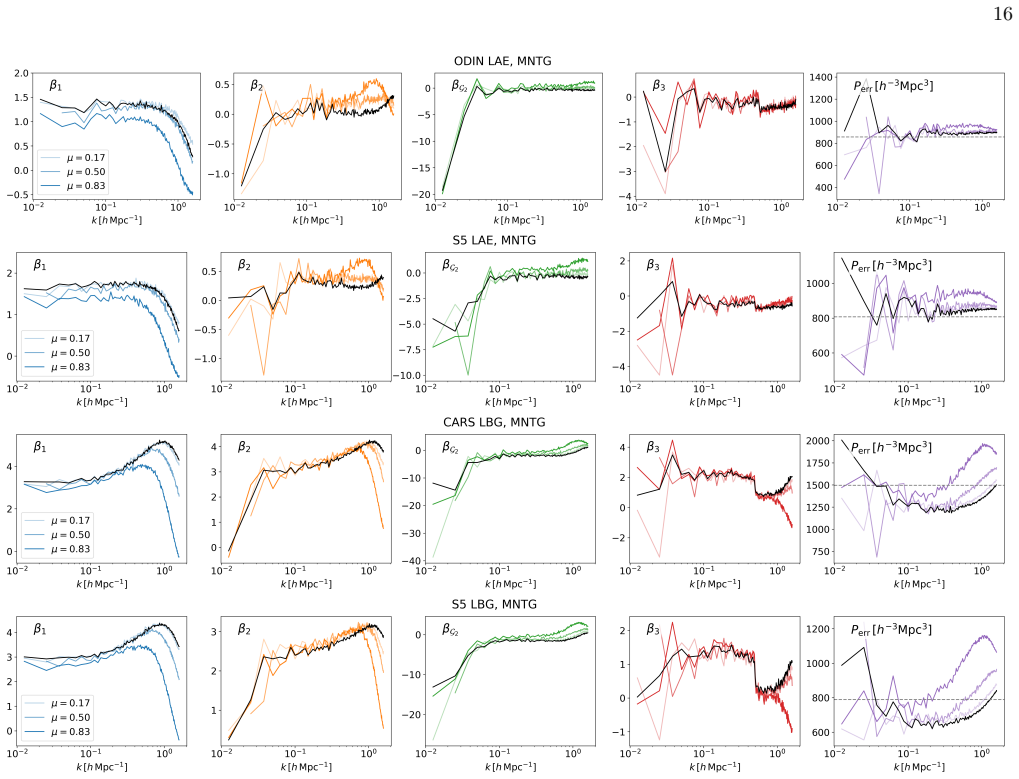
The central object is the field-level EFT forward model: a bias expansion of the galaxy density field in shifted (Zel'dovich-advected) operators, with free transfer functions $\beta_i(k,\mu)$ extracted by projecting simulated galaxy fields onto an orthogonalized operator basis. Matched to the one-loop EFT power spectrum, these transfer functions give EFT bias parameters ($b_1$, $b_2$, $b_{G_2}$, $b_{\Gamma_3}$, $b_{\nabla^2\delta}$), redshift-space counterterms $c_{\mu^2}$ and $b_4$, and stochastic coefficients $\alpha_0$, $\alpha_1$, $\alpha_2$ without cosmic variance. The momentum reach is estimated from the scale dependence of the stochastic error spectrum, with $k_{\rm max}$ set where two-loop corrections reach 15% of the leading $k^2$ noise. Sample construction is also load-bearing: Lyman-$\alpha$ fluxes are assigned from star formation via a metallicity-dependent conversion, and metallicity or stellar-mass cuts are tuned to match observed LAE and LBG number densities and biases.
What would settle it
Compare the EFT predictions to real spectroscopic samples at $z\approx 3$: if a survey such as DESI-II or Spec-S5 measures linear bias and Fingers of God for LAEs or LBGs that fall outside $b_1\approx 2.1$-$2.7$ or $3.9$-$4.2$ and the corresponding $k_{\rm max}$ ranges, the proxy selection is not representative. A test that can be run now is to post-process the same MTNG and Astrid galaxies with Lyman-$\alpha$ radiative transfer to assign fluxes and equivalent widths, rebuild the LAE samples from those fluxes, and see whether the fitted $b_1$, $\alpha_2$, and $k_{\rm max}$ values move beyond the current uncertainties.
Extended reading notes
Core claim
On the paper's own terms, the discovery is that high-redshift star-forming galaxies are tame tracers for EFT. Fitting the field-level EFT forward model to simulated $z=3$ LBG and LAE samples whose number densities and angular clustering match observed ODIN LAEs, CARS LBGs, and projected Stage-5 survey targets, the authors measure $b_1=2.1$-$2.7$ for LAEs and $b_1=3.9$-$4.2$ for LBGs, together with quadratic and cubic bias parameters broadly consistent with a simple halo-occupation model. The stochastic EFT coefficients imply real-space momentum reaches up to roughly $1\,h\,{\rm Mpc}^{-1}$ for LAEs and redshift-space reaches $k_{\rm max}^{\rm FoG}\approx 0.3$-$0.6\,h\,{\rm Mpc}^{-1}$ for LAEs and $0.2$-$0.8\,h\,{\rm Mpc}^{-1}$ for LBGs. Notably, LAE samples with satellite fractions as high as $\sim 30\%$ show only weak Fingers-of-God damping because their host halos are low-mass and hence have low velocity dispersion. The paper reads this as evidence that EFT-based clustering analysis of high-redshift surveys should stay under perturbative control.
Load-bearing premise
The load-bearing assumption is that the simulated samples, selected by proxy Lyman-alpha flux and metallicity or stellar-mass cuts, stand in for the actual Lyman-break galaxy and Lyman-alpha emitter populations that future surveys will observe; the paper itself notes that realistic LAE selection requires radiative transfer that cosmological hydrodynamical simulations do not include.
Editorial extensions
If this is right
- LAEs at $z\approx 3$ can be analyzed with EFT in redshift space up to $k\approx 0.3$-$0.6\,h\,{\rm Mpc}^{-1}$, a larger reach than current LRG analyses, so LAE samples should yield more small-scale information than low-redshift tracers.
- LBGs behave like high-redshift LRGs in their bias and Fingers of God, so they can be modeled with familiar EFT machinery with $k_{\rm max}$ similar to or better than current LRG samples.
- The measured bias and stochastic parameters provide physically motivated priors for EFT full-shape analyses of real high-redshift surveys, the paper's stated first step toward simulation-based priors.
- The unusual, low-occupation, satellite-rich HODs of LAEs imply that standard Zheng07 HOD mocks used for survey validation may misrepresent the clustering of LAEs.
- The weak Fingers of God measured for LAEs mean that their clustering is closer to linear theory along the line of sight than expected from their satellite fractions, improving prospects for redshift-space distortion measurements.
Reading between the lines
- Beyond the paper: if real LAEs have the weak Fingers of God measured here, then LAE survey mocks built from LRG-like velocity dispersions will overestimate line-of-sight damping, and redshift-space distortion constraints from LAEs could be tighter than current forecasts suggest.
- Beyond the paper: because the Astrid LAE selection substitutes a stellar-mass cut for the metallicity cut used in MTNG, part of the small difference in fitted EFT parameters between the two simulations likely encodes selection-modeling degeneracy rather than galaxy-physics differences; a simulation with both gas metallicities and higher resolution could separate these effects.
- Beyond the paper: applying the same field-level pipeline to $z\approx 4$-$5$ snapshots, or to LBG samples selected by synthetic photometric bands rather than stellar-mass cuts, would test whether the claimed momentum reach degrades as bias grows with redshift.
Signed reviews
Editorial analysis
A structured set of objections, weighed in public.
Referee Report
Summary. The paper uses a field-level EFT forward model to measure bias parameters, stochastic amplitudes, and redshift-space counterterms for simulated Lyman-break galaxy (LBG) and Lyman-alpha emitter (LAE) samples at z=3, drawn from the MilleniumTNG and Astrid hydrodynamical simulations. The samples are constructed by assigning Ly-alpha fluxes through a metallicity-dependent SFR conversion (Eq. 4) and applying flux, metallicity, or stellar-mass cuts designed to reproduce the observed number densities and angular clustering of ODIN LAEs, CARS LBGs, and plausible Stage-5 samples. The main claims are that LAEs have low linear bias b1 ≈ 2, LBGs have b1 ≈ 4, LAEs show surprisingly small Fingers-of-God despite high satellite fractions, and that the effective EFT momentum reach is kmax = 0.3–0.6 h/Mpc for LAEs and 0.2–0.8 h/Mpc for LBGs, so EFT should work well for high-redshift galaxy clustering in upcoming surveys.
Significance. If the simulated samples are representative, this is a useful first step toward simulation-based EFT priors for high-redshift surveys such as DESI-II and Spec-S5. The field-level methodology is mature, cancels cosmic variance, and has been successfully applied to lower-redshift tracers in prior work. The qualitative cross-simulation consistency for the linear bias is reassuring, and the paper usefully highlights that LAE HODs may differ substantially from standard LRG-like forms. The central quantitative conclusions, however, are only as strong as the proxy selections used to define the simulated LAE and LBG samples; the paper itself notes the fundamental limitation of modeling LAE selection without radiative transfer, and the appendices show sensitivity to resolution and selection choices.
major comments (3)
- [Appendix A and Section 3.4] The MTNG ODIN LAE sample, which anchors the LAE kmax claim, is shown in Appendix A to be highly sensitive to the stellar-particle resolution cut: imposing minima of 10 and 100 star particles shifts the clustering-inferred bias from b1 ≈ 2.1 to b1 ≈ 2.4 and 3.0, respectively, and reduces the satellite fraction by up to 20 percentage points. Since the small LAE Fingers-of-God and the favorable kmax range in Eq. (25) are attributed to low-mass halos and small velocity dispersions, the conclusion depends precisely on the least-resolved, satellite-dominated galaxies that the resolution cut removes. The manuscript should quantify how α2, the stochastic FoG coefficient, and the derived kmax values change under the Nstar > 10 and Nstar > 100 selections, or otherwise provide a robustness argument that does not rely solely on qualitative agreement with Astrid.
- [Section 2.2, Table III, Eqs. (21)–(26)] The agreement between the simulated linear bias and the ODIN/CARS measurements is partly built in, because the metallicity and stellar-mass cuts were tuned to reproduce the observed number density and angular clustering. The genuinely new content—the higher-order bias parameters, stochastic coefficients, counterterms, and the kmax estimates—is not protected by that tuning, and the paper does not quantify how these quantities vary across plausible selection proxies. The MTNG/Astrid comparison provides only two discrete proxy choices, and for the decisive stochastic FoG coefficient α2 the two simulations disagree even in sign for LAEs (MTNG: 0.18 and 0.32; Astrid: −0.12 and −0.093 in Table III), which propagates directly into the quoted kmax spread. The authors should provide a systematic exploration, or at least a conservative envelope, of the EFT parameters over the range of selection choices considered in Appendices A and B.
- [Table III] Table III reports all EFT parameters without uncertainties. Given that the paper's conclusions rest on quantitative comparisons between MTNG and Astrid, and on ranges such as b1 = 2.1–2.7 and kmax = 0.3–0.6 h/Mpc, the absence of error bars prevents the reader from judging whether the cross-simulation differences are significant or whether the quoted ranges are compatible with the data. Error estimates from the field-level transfer-function fits, as used in Ref. [28], should be added to Table III and to the derived kmax values.
minor comments (6)
- [Section 2.2] The ODIN target bias is quoted as b1 = 2.0 ± 2.0; given the context, this should be b1 = 2.0 ± 0.2.
- [Section 2.2] The maximum metallicity cut for the MTNG ODIN sample is written as Z ≥ 0.04 Z⊙, but the surrounding text describes it as a maximum; this should read Z < 0.04 Z⊙.
- [Section 2.2 and Figure 2 caption] The text states the S5 LAE sample uses a maximum metallicity cut at the 10th percentile (Z < 0.19 Z⊙), while the Figure 2 caption says the cut is at the 20th percentile; this discrepancy should be resolved.
- [Eqs. (21) and (24)] The notation "0.40.45 hMpc−1" is ambiguous and should be written as 0.4 × 0.45 hMpc−1 or with appropriate parentheses.
- [Figure 6 caption] The caption says "Panels are organized as in Fig. 2," but the figure displays Astrid samples and should presumably reference Fig. 4; please correct the cross-reference.
- [Figure 5] The panel label "ODIN LAE, MNTG" appears to be missing the final T in MTNG.
Circularity Check
Linear bias agreement is built into sample selection, but the central kmax and higher-order EFT results are measured, not fitted.
-
fitted input called prediction
[Section 2.2 (LAE ODIN sample construction) and Section 3.3 / Table III]
"We then apply an aggressive maximum metallicity cut (at the 5th percentile of SubhaloGasMetallicity for galaxies satisfying the flux cut, Z≥ 0.04Z⊙) to the galaxies satisfying this flux cut to ensure that we obtain a sample that approximately matches the number density and angular clustering of the ODIN observations."
The ODIN LAE and CARS LBG samples are defined by cuts chosen explicitly to reproduce the observed number density and angular clustering. The linear bias is then read off from that same angular clustering (Tables I and II) and the field-level fit returns b1 ≈ 2.33 (MTNG ODIN) and b1 ≈ 4.24 (MTNG CARS), i.e. it recovers the selection target rather than making an independent prediction. The paper itself states in Section 3.3: 'This is the specific sample for which we aimed to match the clustering.' Thus the reported agreement of b1 with ODIN and CARS is partly by construction. The independent content — b2, bG2, b3, stochastic coefficients, FoG counterterms, and the resulting kmax ranges — is not fitted to those observations and does not reduce to the input clustering.
full rationale
The paper's central claim is the effective momentum reach of EFT for high-redshift LAEs and LBGs, estimated from the measured stochastic coefficients α1 and α2 (Eqs. 21 and 24) and from the field-level bias transfer functions. Those quantities are extracted from the simulated galaxy density fields, not fitted to observed galaxy clustering, so the kmax prediction retains independent content. The one genuinely input-driven result is the linear bias: the fiducial ODIN and CARS samples are constructed by adjusting metallicity and stellar-mass cuts to match observed number densities and angular clustering, so the subsequent statement that the EFT b1 values are consistent with ODIN and CARS is a calibration check rather than a prediction. This is transparently acknowledged in the text, and it does not propagate to the higher-order bias or stochastic parameters. The use of Ref. [28] (overlapping authors) for the field-level methodology is a normal extension of the authors' own prior framework, not a load-bearing uniqueness argument. Appendix A does expose a serious robustness limitation: the MTNG ODIN sample's bias shifts from b1 ≈ 2.1 to ≈ 3.0 when a 100-star-particle cut is imposed, and the satellite fraction drops by up to 20 percentage points. This undermines the representativeness of the fiducial LAE sample and hence the quantitative LAE kmax claim, but it is a modeling-validity concern, not a circular reduction: the EFT parameters are still measured from whatever sample is defined. Appendix B similarly shows that relaxing the cut while downsampling moves the bias away from the ODIN value, again a robustness caveat rather than a circular step. Overall, the derivation chain is largely self-contained; the only scoring-relevant circularity is the input-matched linear bias presented among the results.
Assumptions & free parameters
free parameters (7)
- Maximum gas metallicity cut for MTNG ODIN LAEs =
Z < 0.04 Zsun
- Maximum gas metallicity cut for MTNG S5 LAEs =
Z < 0.19 Zsun
- Maximum stellar mass cut for Astrid ODIN LAEs =
Mstar <= 7e7 Msun
- Maximum stellar mass cut for Astrid S5 LAEs =
Mstar <= 2.6e8 Msun
- LBG minimum stellar mass cuts =
CARS MTNG 1.8e10, CARS Astrid 2.1e10, S5 MTNG 1.0e10, S5 Astrid 1.3e10 h^-1 Msun
- SFR-to-Ly-alpha luminosity conversion fLy-alpha(Z) =
Metallicity interpolation from Table 4 of Schaerer (2003); fixed at fLy-alpha(0.2 Zsun) for Astrid
- kmax noise-level threshold =
15% of the next-to-leading-order scale dependence
assumptions (6)
- standard math The one-loop EFT bias expansion (Eq. 5) with operators delta, delta^2, G2, Gamma3, and nabla^2 delta describes the z=3 galaxy density field on the fitted scales.
- domain assumption Galaxy samples selected through SFR-derived Ly-alpha flux, metallicity cuts, and stellar mass cuts approximate observed LBGs and LAEs.
- standard math The equivalence principle makes the c_mu4 counterterm the same for galaxies and dark matter.
- domain assumption The analytic halo model used as a benchmark for bias parameters is reliable for high-redshift star-forming galaxies.
- standard math Initial conditions are Gaussian linear density fields as in Eqs. 8 and 11.
- domain assumption A maximum stellar mass cut can proxy for the Ly-alpha escape fraction trend with metallicity in Astrid.
Cite this review
Pith. "Pith review of High-redshift Millennium and Astrid galaxies in effective field theory at the field level." pith.science (2026). https://pith.science/paper/6LY44Q3T
@misc{pith2026250503626,
  author       = {Pith},
  title        = {Pith review of: High-redshift Millennium and Astrid galaxies in effective field theory at the field level},
  year         = {2026},
  howpublished = {\url{https://pith.science/paper/6LY44Q3T}},
  note         = {Machine review of arXiv:2505.03626}
}
abstract
Effective Field Theory (EFT) modeling is expected to be a useful tool in the era of future higher-redshift galaxy surveys such as DESI-II and Spec-S5 due to its robust description of various large-scale structure tracers. However, large values of EFT bias parameters of higher-redshift galaxies could jeopardize the convergence of the perturbative expansion. In this paper we measure the bias parameters and other EFT coefficients from samples of two types of star-forming galaxies in the state-of-the-art MilleniumTNG and Astrid hydrodynamical simulations. Our measurements are based on the field-level EFT forward model that allows for precision EFT parameter measurements by virtue of cosmic variance cancellation. Specifically, we consider approximately representative samples of Lyman-break galaxies (LBGs) and Lyman-alpha emitters (LAEs) that are consistent with the observed (angular) clustering and number density of these galaxies at $z=3$. Reproducing the linear biases and number densities observed from existing LAE and LBG data, we find quadratic bias parameters that are roughly consistent with those predicted from the halo model coupled with a simple halo occupation distribution model. We also find non-perturbative velocity contributions (Fingers of God) of a similar size for LBGs to the familiar case of Luminous Red Galaxies. However, these contributions are quite small for LAEs despite their large satellite fraction values of up to $\sim 30\%$. Our results indicate that the effective momentum reach $k_{\rm{Max}}$ at $z=3$ for LAEs (LBGs) will be in the range $0.3-0.6 ~h\rm{Mpc}^{-1}$ ($0.2-0.8~h\rm{Mpc}^{-1}$), suggesting that EFT will perform well for high redshift galaxy clustering. This work provides the first step toward obtaining realistic simulation-based priors on EFT parameters for LAEs and LBGs.
Figures


Figures from the paper (7 more)


Forward citations
Cited by 5 Pith papers
-
Modeling the Cosmological Lyman-$\alpha$ Forest at the Field Level
An effective-field-theory forward model reproduces the Lyman-alpha forest field from a hydrodynamic simulation at percent level, down to a few megaparsecs, using the same initial conditions.
-
Constraining Dynamical Dark Energy from Galaxy Clustering with Simulation-Based Priors
Adding BOSS galaxy clustering with simulation-based priors modeled as Gaussian mixtures shifts the DESI plus CMB plus supernova constraints on dark energy toward a cosmological constant and improves the w0-wa figure o...
-
Sample Variance Cancellation for Future Spectroscopic Surveys
A multi-tracer statistical toolbox can detect, characterize, and constrain angular clustering distortions in LAE surveys using a clean second tracer, within a linear Gaussian framework.
-
One-Loop Galaxy Bispectrum: Consistent Theory, Efficient Analysis with COBRA, and Implications for Cosmological Parameters
Using the COBRA basis, the one-loop EFT galaxy bispectrum runs in about one second per cosmology and recovers the input cosmology of PTChallenge simulations up to k_max = 0.15 h/Mpc (monopole) and 0.12 h/Mpc (higher m...
-
GGI Lectures on Large-Scale Structure Perturbation Theory (Effective Field Theory)
Pedagogical notes derive large-scale-structure EFT from symmetries, covering SPT failures, BAO IR resummation, counterterms, galaxy bias, redshift-space distortions, and Lagrangian PT.
Reference graph
Works this paper leans on
-
[28]
S. R. Furlanetto, J. Schaye, V. Springel, and L. Hern- quist, ApJ 622, 7 (2005), arXiv:astro-ph/0409736 [astro-ph]
arXiv 2005
-
[1]
We build the samples in both simu- lations by assigning Lyman-α flux to every galaxy using eqn
LAEs ODIN sample: We construct the ODIN sample to reproduce the observed clustering and number density of ODIN LAEs [49]. We build the samples in both simu- lations by assigning Lyman-α flux to every galaxy using eqn. 4 and then applying the reported ODIN flux cut of fLyα > 1.8× 10⁻¹⁷ erg s−1cm−2. MTNG: In MTNG, we use the metallicity-aware ver- sion of t...
-
[2]
metallicity
Modeling LBGs & LAEs in hydrodynamical simulations Following Refs. [48, 54], we adapt a modified version of the procedure used there to assign Lyman-α luminosities (and therefore fluxes) based on physical star formation subsampling in this way in Appendix B, effectively changing the Ly-α effective escape fraction at fixed number density. 8 While stellar m...
-
[3]
CARS sample: For the CARS sample, we attempt to match the angular clustering of the CARS data of Ref
LBGs For both LBG samples, we select galaxies with spe- cific star formation rate between 10 −10 ≤ sSFR < 10−8 h yr−1. CARS sample: For the CARS sample, we attempt to match the angular clustering of the CARS data of Ref. [60]. Specifically, we consider their u−drop sample with a limiting magnitude of 23 .0 < r < 24.5 (in an effective are of≈ 3 deg2). For ...
-
[4]
shifted operators
EFT PARAMETERS 3.1. Recap of the EFT forward model The basis for our EFT forward model [69, 70] is the EFT bias expansion for the galaxy density field δg rele- vant at the one-loop power spectrum level, [6, 71, 72], δEFT g 2−pf (k) =b1δ + b2 2δ2 +bG2G2 +bΓ3Γ3−b′ ∇2δ∇2δ +ϵ, (5) where δ is the non-linear matter density field, and the non-linear integral ker...
-
[5]
It matches the Eulerian bias operator b3 3!δ3 which is important at the level of the one-loop bispectrum [92, 93] and the two- loop power spectrum. The performance of the EFT forward model is esti- mated by the error spectrum, which by definition cap- tures the part of the density field uncorrelated with the EFT operators in eq. (16), Perr(k,µ ) =⟨|δEFT(k...
-
[6]
V. Desjacques, D. Jeong, and F. Schmidt, Phys. Rept. 733, 1 (2018), arXiv:1611.09787 [astro-ph.CO]
arXiv 2018
-
[7]
Understanding the clustering properties of these galax- ies is crucial for extract cosmological information from such surveys
CONCLUSIONS High-redshift star-forming galaxies will be the targets of leading cosmological survey efforts in the next decade. Understanding the clustering properties of these galax- ies is crucial for extract cosmological information from such surveys. In this paper, we take the first step to- ward characterizing the non-linear bias and EFT param- eters ...
2024
Show all 119 references
-
[8]
D. J. Schlegel, S. Ferraro, G. Aldering, C. Baltay, S. BenZvi, R. Besuner, G. A. Blanc, A. S. Bolton, A. Bonaca, D. Brooks, E. Buckley-Geer, Z. Cai, J. DeRose, A. Dey, P. Doel, A. Drlica-Wagner, X. Fan, G. Gutierrez, D. Green, J. Guy, D. Huterer, L. In- fante, P. Jelinsky, D. ...
2022 arXiv
-
[9]
Besuner, A
R. Besuner, A. Dey, A. Drlica-Wagner, H. Ebina, G. Fernandez Moroni, S. Ferraro, J. Forero-Romero, K. Honscheid, P. Jelinsky, D. Lang, M. Levi, P. Mar- tini, A. Myers, N. Palanque-Delabrouille, S. Panda, C. Poppett, N. Sailer, D. Schlegel, A. Shafieloo, J. Sil- ber, M. White, ...
2025
-
[10]
Baumann, A
D. Baumann, A. Nicolis, L. Senatore, and M. Zaldar- riaga, JCAP 1207, 051 (2012), arXiv:1004.2488 [astro- ph.CO]
2012 arXiv
-
[11]
J. J. M. Carrasco, M. P. Hertzberg, and L. Senatore, JHEP 09, 082 (2012), arXiv:1206.2926 [astro-ph.CO]
2012 arXiv
-
[12]
M. M. Ivanov, (2022), arXiv:2212.08488 [astro-ph.CO]
2022 arXiv
-
[13]
A. E. Shapley, C. C. Steidel, M. Pettini, and K. L. Adel- berger, ApJ 588, 65 (2003), arXiv:astro-ph/0301230 [astro-ph]
2003 arXiv
-
[14]
J. M. Bardeen, J. R. Bond, N. Kaiser, and A. S. Szalay, Astrophys. J. 304, 15 (1986)
1986
-
[15]
Kaiser, ApJ 284, L9 (1984)
N. Kaiser, ApJ 284, L9 (1984)
1984
-
[16]
D. J. Eisenstein, J. Annis, J. E. Gunn, A. S. Szalay, A. J. Connolly, R. C. Nichol, N. A. Bahcall, M. Bernardi, S. Burles, F. J. Castander, M. Fukugita, D. W. Hogg, ˇZ. Ivezi´ c, G. R. Knapp, R. H. Lupton, V. Narayanan, M. Postman, D. E. Reichart, M. Richmond, D. P. Schneider,...
2001 arXiv
- [17]
-
[18]
Raichoor, J
A. Raichoor, J. Moustakas, J. A. Newman, T. Karim, S. Ahlen, S. Alam, S. Bailey, D. Brooks, K. Daw- son, A. de la Macorra, A. de Mattia, A. Dey, B. Dey, G. Dhungana, S. Eftekharzadeh, D. J. Eisen- stein, K. Fanning, A. Font-Ribera, J. Garc´ ıa-Bellido, E. Gazta˜ naga, S. G. A ...
2023 arXiv
-
[19]
C. C. Steidel and D. Hamilton, AJ 104, 941 (1992)
1992
-
[20]
R. B. Partridge and P. J. E. Peebles, ApJ 147, 868 (1967)
1967
-
[21]
Moscardini, P
L. Moscardini, P. Coles, F. Lucchin, and S. Matarrese, MNRAS 299, 95 (1998), arXiv:astro-ph/9712184 [astro- ph]
1998 arXiv
-
[22]
M. J. Wilson and M. White, J. Cosmology As- tropart. Phys. 2019, 015 (2019), arXiv:1904.13378 [astro-ph.CO]
2019 arXiv
-
[23]
Ebina and M
H. Ebina and M. White, J. Cosmology Astropart. Phys. 2024, 052 (2024), arXiv:2401.13166 [astro-ph.CO]
2024 arXiv
-
[24]
Park, H.-S
J. Park, H.-S. Kim, J. S. B. Wyithe, C. G. Lacey, C. M. Baugh, R. L. Barone-Nugent, M. Trenti, and R. J. Bouwens, MNRAS 461, 176 (2016), arXiv:1511.01983 [astro-ph.GA]
2016 arXiv
-
[25]
Ruhlmann-Kleider, C
V. Ruhlmann-Kleider, C. Y` eche, C. Magneville, H. Co- quinot, E. Armengaud, N. Palanque-Delabrouille, A. Raichoor, J. N. Aguilar, S. Ahlen, S. Arnouts, D. Brooks, E. Chaussidon, T. Claybaugh, K. Dawson, A. de la Macorra, A. Dey, B. Dey, P. Doel, K. Fanning, S. Ferraro, J. E. ...
2024 arXiv
-
[26]
N. M. Firestone, E. Gawiser, K. G. Iyer, K.-S. Lee, V. Ramakrishnan, F. Valdes, C. Park, Y. Yang, A. Alavi, R. Ciardullo, N. Grogin, C. Gronwall, L. Guaita, S. Hong, H. S. Hwang, S. H. Im, W.- S. Jeong, S. Kim, A. M. Koekemoer, A. Kumar, J. Lee, V. Mehta, G. Nagaraj, J. Nantai...
2025 arXiv
-
[27]
N. M. Firestone, E. Gawiser, V. Ramakrishnan, K.- S. Lee, F. Valdes, C. Park, Y. Yang, R. Ciardullo, M. C. Artale, B. Benda, A. Broussard, L. Eid, R. Fa- rooq, C. Gronwall, L. Guaita, S. Gwyn, H. S. Hwang, S. H. Im, W.-S. Jeong, S. Karthikeyan, D. Lang, B. Moon, N. Padilla, M....
2024 arXiv
-
[29]
Ouchi, Y
M. Ouchi, Y. Ono, and T. Shibuya, ARA&A 58, 617 (2020), arXiv:2012.07960 [astro-ph.GA]
2020 arXiv
-
[30]
K.-S. Lee, E. Gawiser, C. Park, Y. Yang, F. Valdes, D. Lang, V. Ramakrishnan, B. Moon, N. Firestone, S. Appleby, M. C. Artale, M. Andrews, F. Bauer, B. Benda, A. Broussard, Y.-K. Chiang, R. Ciardullo, A. Dey, R. Farooq, C. Gronwall, L. Guaita, Y. Huang, H. S. Hwang, S. H. Im, ...
2024 arXiv
-
[31]
Kikuta, M
S. Kikuta, M. Ouchi, T. Shibuya, Y. Liang, H. Umeda, A. Matsumoto, K. Shimasaku, Y. Harikane, Y. Ono, A. K. Inoue, S. Yamanaka, H. Kusakabe, R. Momose, N. Kashikawa, Y. Matsuda, and C.-H. Lee, ApJS 268, 24 (2023), arXiv:2305.08921 [astro-ph.GA]
2023 arXiv
-
[32]
Davis, K
D. Davis, K. Gebhardt, E. M. Cooper, R. Ciardullo, M. Fabricius, D. J. Farrow, J. J. Feldmeier, S. L. Finkel- stein, E. Gawiser, C. Gronwall, G. J. Hill, U. Hopp, L. R. House, D. Jeong, W. Kollatschny, E. Komatsu, M. Landriau, C. Liu, S. Saito, S. Tuttle, I. G. B. Wold, G. R. ...
2023 arXiv
-
[33]
Landriau, E
M. Landriau, E. Mentuch Cooper, D. Davis, K. Geb- hardt, R. Ciardullo, ´E. Armengaud, A. Dey, A. Rai- choor, D. J. Schlegel, M. Wilson, J. Aguilar, S. Ahlen, D. Bianchi, D. Brooks, T. Claybaugh, A. de la Ma- corra, S. Ferraro, J. E. Forero-Romero, E. Gazta˜ naga, S. G. A. Gont...
2025
-
[34]
McQuinn, L
M. McQuinn, L. Hernquist, M. Zaldarriaga, and S. Dutta, MNRAS 381, 75 (2007), arXiv:0704.2239 [astro-ph]
2007 arXiv
-
[35]
M. M. Ivanov, C. Cuesta-Lazaro, A. Obuljen, M. W. Toomey, Y. Ni, S. Bose, B. Hadzhiyska, C. Hern´ andez-Aguayo, L. Hernquist, R. Kannan, and V. Springel, arXiv e-prints , arXiv:2412.01888 (2024), arXiv:2412.01888 [astro-ph.CO]
2024 arXiv
-
[36]
Pakmor et al., Mon
R. Pakmor et al., Mon. Not. Roy. Astron. Soc.524, 2539 (2023), arXiv:2210.10060 [astro-ph.CO]
2023 arXiv
-
[37]
S. Bird, Y. Ni, T. Di Matteo, R. Croft, Y. Feng, and N. Chen, Mon. Not. Roy. Astron. Soc.512, 3703 (2022), arXiv:2111.01160
2022 arXiv
-
[38]
Y. Ni, T. Di Matteo, S. Bird, R. Croft, Y. Feng, N. Chen, M. Tremmel, C. DeGraf, and Y. Li, MNRAS 513, 670 (2022), arXiv:2110.14154 [astro-ph.GA]
2022 arXiv
-
[39]
Hern´ andez-Aguayoet al
C. Hern´ andez-Aguayoet al. , Mon. Not. Roy. Astron. Soc. 524, 2556 (2023), arXiv:2210.10059 [astro-ph.CO]
2023 arXiv
-
[40]
Y. Ni, N. Chen, Y. Zhou, M. Park, Y. Yang, T. DiMatteo, S. Bird, and R. Croft, arXiv e-prints , arXiv:2409.10666 (2024), arXiv:2409.10666 [astro- ph.GA]
2024 arXiv
-
[41]
Runnholm, M
A. Runnholm, M. J. Hayes, V. Mehta, M. A. Malkan, C. Scarlata, K. V. Nedkova, M. Rafelski, B. Vul- cani, M. Huberty, E. C. Herenz, A. Hutter, S. Bru- ton, A. Acharyya, H. Atek, I. Baronchelli, A. J. Bat- tisti, M. Bradaˇ c, A. J. Bunker, Y. S. Dai, C. Han- nahs, F. Hasan, K. J...
2025 arXiv
-
[42]
Ouchi, K
M. Ouchi, K. Shimasaku, H. Furusawa, T. Saito, M. Yoshida, M. Akiyama, Y. Ono, T. Yamada, K. Ota, N. Kashikawa, M. Iye, T. Kodama, S. Okamura, C. Simpson, and M. Yoshida, ApJ 723, 869 (2010), arXiv:1007.2961 [astro-ph.CO]
2010 arXiv
-
[43]
Konno, M
A. Konno, M. Ouchi, Y. Ono, K. Shimasaku, T. Shibuya, H. Furusawa, K. Nakajima, Y. Naito, R. Momose, S. Yuma, and M. Iye, ApJ 797, 16 (2014), arXiv:1404.6066 [astro-ph.CO]
2014 arXiv
-
[44]
Ouchi, Y
M. Ouchi, Y. Harikane, T. Shibuya, K. Shimasaku, Y. Taniguchi, A. Konno, M. Kobayashi, M. Kajisawa, T. Nagao, Y. Ono, A. K. Inoue, M. Umemura, M. Mori, K. Hasegawa, R. Higuchi, Y. Komiyama, Y. Matsuda, K. Nakajima, T. Saito, and S.-Y. Wang, PASJ 70, S13 (2018), arXiv:1704.0745...
2018 arXiv
-
[45]
A. K. Inoue, K. Hasegawa, T. Ishiyama, H. Yajima, I. Shimizu, M. Umemura, A. Konno, Y. Harikane, T. Shibuya, M. Ouchi, K. Shimasaku, Y. Ono, H. Kusakabe, R. Higuchi, and C.-H. Lee, PASJ 70, 55 (2018), arXiv:1801.00067 [astro-ph.GA]
2018 arXiv
-
[46]
Y. Ning, L. Jiang, Z.-Y. Zheng, and J. Wu, ApJ 926, 230 (2022), arXiv:2112.07800 [astro-ph.GA]
2022 arXiv
-
[47]
Umeda, M
H. Umeda, M. Ouchi, Y. Kageura, Y. Harikane, M. Nakane, T. T. Thai, and K. Nakajima, arXiv e-prints , arXiv:2504.04683 (2025), arXiv:2504.04683 [astro-ph.GA]
2025
-
[48]
J. Ravi, B. Hadzhiyska, M. J. White, L. Hern- quist, and S. Bose, Phys. Rev. D 110, 103509 (2024), arXiv:2403.02414 [astro-ph.CO]
2024 arXiv
-
[49]
Sobacchi and A
E. Sobacchi and A. Mesinger, MNRAS 453, 1843 (2015), arXiv:1505.02787 [astro-ph.CO]
2015 arXiv
-
[50]
Nagamine, M
K. Nagamine, M. Ouchi, V. Springel, and L. Hernquist, PASJ 62, 1455 (2010), arXiv:0802.0228 [astro-ph]
2010 arXiv
-
[51]
Nagamine, V
K. Nagamine, V. Springel, L. Hernquist, and M. Machacek, MNRAS 350, 385 (2004), arXiv:astro- ph/0311295 [astro-ph]
2004
-
[52]
Night, K
C. Night, K. Nagamine, V. Springel, and L. Hernquist, MNRAS 366, 705 (2006), arXiv:astro-ph/0503631 [astro-ph]
2006 arXiv
-
[53]
S. H. Im, H. S. Hwang, J. Park, J. Lee, H. Song, S. Ap- pleby, Y. Dubois, C. G. Few, B. K. Gibson, J. Kim, Y. Kim, C. Park, C. Pichon, J. Shin, O. N. Snaith, M. C. Artale, E. Gawiser, L. Guaita, W.-S. Jeong, K.- S. Lee, N. Padilla, V. Ramakrishnan, P. Troncoso, and Y. Yang, Ap...
2024 arXiv
-
[54]
J. Lee, J. Shin, O. N. Snaith, Y. Kim, C. G. Few, J. De- vriendt, Y. Dubois, L. M. Cox, S. E. Hong, O.-K. Kwon, C. Park, C. Pichon, J. Kim, B. K. Gibson, and C. Park, ApJ 908, 11 (2021), arXiv:2006.01039 [astro-ph.GA]
2021 arXiv
-
[55]
R. C. Kennicutt, Jr., ARA&A 36, 189 (1998), arXiv:astro-ph/9807187 [astro-ph]
1998 arXiv
-
[56]
White, A
M. White, A. Raichoor, A. Dey, L. H. Garrison, E. Ga- wiser, D. Lang, K.-s. Lee, A. D. Myers, D. Schlegel, F. Valdes, J. Aguilar, S. Ahlen, D. Brooks, E. Chaus- sidon, T. Claybaugh, K. Dawson, A. de la Macorra, B. Dey, P. Doel, K. Fanning, A. Font-Ribera, J. E. Forero-Romero, ...
2024 arXiv
-
[57]
Zheng, A
Z. Zheng, A. L. Coil, and I. Zehavi, Astrophys. J. 667, 760 (2007), arXiv:astro-ph/0703457
2007 arXiv
-
[58]
Smith, R
A. Smith, R. Kannan, E. Garaldi, M. Vogelsberger, R. Pakmor, V. Springel, and L. Hernquist, Mon. Not. Roy. Astron. Soc. 512, 3243 (2022), arXiv:2110.02966 [astro-ph.CO]
2022 arXiv
-
[59]
Nelson, V
D. Nelson, V. Springel, A. Pillepich, V. Rodriguez- Gomez, P. Torrey, S. Genel, M. Vogelsberger, R. Pak- mor, F. Marinacci, R. Weinberger, L. Kelley, M. Lovell, B. Diemer, and L. Hernquist, Computational Astro- physics and Cosmology 6, 2 (2019), arXiv:1812.05609 [astro-ph.GA]
2019 arXiv
-
[60]
decorated
(specifically for the u−drop galaxies with r < 24.5 with “BC sim” photometric redshifts, which corresponds to redshift distribution centered at z≈ 3), as expected. Figure 8 also shows in gray the density contours cor- responding to a modified Zheng07 HOD (i.e. with the 18 Thou...
-
[61]
Kerutt, L
J. Kerutt, L. Wisotzki, A. Verhamme, K. B. Schmidt, F. Leclercq, E. C. Herenz, T. Urrutia, T. Garel, T. Hashimoto, M. Maseda, J. Matthee, H. Kusakabe, J. Schaye, J. Richard, B. Guiderdoni, V. Mauerhofer, T. Nanayakkara, and E. Vitte, A&A 659, A183 (2022), arXiv:2202.06642 [ast...
2022 arXiv
-
[62]
Dijkstra and E
M. Dijkstra and E. Westra, MNRAS 401, 2343 (2010), arXiv:0911.1357 [astro-ph.CO]
2010 arXiv
-
[63]
E. E. Salpeter, ApJ 121, 161 (1955)
1955
-
[64]
Schaerer, A&A 397, 527 (2003), arXiv:astro- ph/0210462 [astro-ph]
D. Schaerer, A&A 397, 527 (2003), arXiv:astro- ph/0210462 [astro-ph]
2003
-
[65]
Dijkstra, arXiv e-prints , arXiv:1704.03416 (2017), arXiv:1704.03416 [astro-ph.GA]
M. Dijkstra, arXiv e-prints , arXiv:1704.03416 (2017), arXiv:1704.03416 [astro-ph.GA]
2017 arXiv
-
[66]
S. L. Finkelstein, G. J. Hill, K. Gebhardt, J. Adams, G. A. Blanc, C. Papovich, R. Ciardullo, N. Drory, E. Gawiser, C. Gronwall, D. P. Schneider, and K.- V. Tran, ApJ 729, 140 (2011), arXiv:1011.0431 [astro- ph.CO]
2011 arXiv
-
[67]
Hildebrandt, J
H. Hildebrandt, J. Pielorz, T. Erben, L. van Waer- beke, P. Simon, and P. Capak, arXiv e-prints , arXiv:0903.3951 (2009), arXiv:0903.3951 [astro-ph.CO]
2009 arXiv
-
[68]
G. J. Hill, K. Gebhardt, E. Komatsu, N. Drory, P. J. MacQueen, J. Adams, G. A. Blanc, R. Koehler, M. Rafal, M. M. Roth, A. Kelz, C. Gronwall, R. Cia- rdullo, and D. P. Schneider, in Panoramic Views of Galaxy Formation and Evolution , Astronomical Soci- ety of the Pacific Confe...
2008 arXiv
-
[69]
Kannan, E
R. Kannan, E. Puchwein, A. Smith, J. Borrow, E. Garaldi, L. Keating, M. Vogelsberger, O. Zier, W. McClymont, X. Shen, F. Popovic, S. Tac- chella, L. Hernquist, and V. Springel, arXiv e-prints , arXiv:2502.20437 (2025), arXiv:2502.20437 [astro- ph.GA]
2025
-
[70]
G. A. Oyarz´ un, G. A. Blanc, V. Gonz´ alez, M. Ma- teo, J. I. Bailey, III, S. L. Finkelstein, P. Lira, J. D. Crane, and E. W. Olszewski, ApJ 821, L14 (2016), arXiv:1604.03113 [astro-ph.GA]
2016 arXiv
-
[71]
S. Yuan, B. Hadzhiyska, S. Bose, and D. J. Eisen- stein, Mon. Not. Roy. Astron. Soc. 512, 5793 (2022), arXiv:2202.12911 [astro-ph.CO]
2022 arXiv
-
[72]
Hadzhiyska, S
B. Hadzhiyska, S. Tacchella, S. Bose, and D. J. Eisenstein, MNRAS 502, 3599 (2021), arXiv:2011.05331 [astro-ph.GA]
2021 arXiv
-
[73]
Hadzhiyska, D
B. Hadzhiyska, D. Eisenstein, S. Bose, L. H. Garrison, and N. Maksimova, Mon. Not. Roy. Astron. Soc. 509, 501 (2021), arXiv:2110.11408 [astro-ph.CO]
2021 arXiv
-
[74]
Davis, G
M. Davis, G. Efstathiou, C. S. Frenk, and S. D. M. White, APJ 292, 371 (1985)
1985
-
[75]
Springel, S
V. Springel, S. D. M. White, G. Tormen, and G. Kauffmann, MNRAS 328, 726 (2001), arXiv:astro- ph/0012055 [astro-ph]
2001
-
[76]
Schmittfull, M
M. Schmittfull, M. Simonovi´ c, V. Assassi, and M. Zaldarriaga, Phys. Rev. D 100, 043514 (2019), arXiv:1811.10640 [astro-ph.CO]
2019 arXiv
-
[77]
Schmittfull, M
M. Schmittfull, M. Simonovi´ c, M. M. Ivanov, O. H. E. Philcox, and M. Zaldarriaga, JCAP 05, 059 (2021), arXiv:2012.03334 [astro-ph.CO]
2021 arXiv
-
[78]
Assassi, D
V. Assassi, D. Baumann, D. Green, and M. Zaldar- riaga, JCAP 1408, 056 (2014), arXiv:1402.5916 [astro- ph.CO]
2014 arXiv
-
[79]
M. M. Ivanov, M. Simonovi´ c, and M. Zaldarriaga, JCAP 05, 042 (2020), arXiv:1909.05277 [astro-ph.CO]
2020 arXiv
-
[80]
Bernardeau, S
F. Bernardeau, S. Colombi, E. Gaztanaga, and R. Scoccimarro, Phys. Rept. 367, 1 (2002), arXiv:astro- ph/0112551 [astro-ph]
2002
-
[81]
Chudaykin, M
A. Chudaykin, M. M. Ivanov, O. H. E. Philcox, and M. Simonovi´ c, Phys. Rev. D 102, 063533 (2020), arXiv:2004.10607 [astro-ph.CO]
2020 arXiv
- [82]
-
[83]
M. M. Ivanov and S. Sibiryakov, JCAP 1807, 053 (2018), arXiv:1804.05080 [astro-ph.CO]
2018 arXiv
-
[84]
J. C. Jackson, Mon. Not. Roy. Astron. Soc. 156, 1P (1972), arXiv:0810.3908 [astro-ph]
1972 arXiv
-
[85]
M. M. Ivanov, (2025), arXiv:2503.07270 [astro-ph.CO]
2025 arXiv
-
[86]
Chudaykin, M
A. Chudaykin, M. M. Ivanov, and M. Simonovi´ c, Phys. Rev. D 103, 043525 (2021), arXiv:2009.10724 [astro- ph.CO]
2021 arXiv
-
[87]
Taule and M
P. Taule and M. Garny, JCAP 11, 078 (2023), arXiv:2308.07379 [astro-ph.CO]. 26
2023 arXiv
-
[88]
M. M. Ivanov, O. H. E. Philcox, M. Simonovi´ c, M. Zal- darriaga, T. Nischimichi, and M. Takada, Phys. Rev. D 105, 043531 (2022), arXiv:2110.00006 [astro-ph.CO]
2022 arXiv
-
[89]
M. M. Ivanov, (2021), arXiv:2106.12580 [astro-ph.CO]
2021 arXiv
-
[90]
Senatore and M
L. Senatore and M. Zaldarriaga, JCAP 1502, 013 (2015), arXiv:1404.5954 [astro-ph.CO]
2015 arXiv
-
[91]
Baldauf, M
T. Baldauf, M. Mirbabayi, M. Simonovi´ c, and M. Zaldarriaga, Phys. Rev. D92, 043514 (2015), arXiv:1504.04366 [astro-ph.CO]
2015 arXiv
-
[92]
Z. Vlah, U. Seljak, M. Y. Chu, and Y. Feng, JCAP 1603, 057 (2016), arXiv:1509.02120 [astro-ph.CO]
2016 arXiv
-
[93]
D. Blas, M. Garny, M. M. Ivanov, and S. Sibiryakov, JCAP 1607, 052 (2016), arXiv:1512.05807 [astro- ph.CO]
2016 arXiv
-
[94]
D. Blas, M. Garny, M. M. Ivanov, and S. Sibiryakov, JCAP 1607, 028 (2016), arXiv:1605.02149 [astro- ph.CO]
2016 arXiv
-
[95]
Vasudevan, M
A. Vasudevan, M. M. Ivanov, S. Sibiryakov, and J. Lesgourgues, JCAP 09, 037 (2019), arXiv:1906.08697 [astro-ph.CO]
2019 arXiv
-
[96]
O. H. E. Philcox and M. M. Ivanov, Phys. Rev. D 105, 043517 (2022), arXiv:2112.04515 [astro-ph.CO]
2022 arXiv
-
[97]
Maus et al., (2024), arXiv:2404.07312 [astro-ph.CO]
M. Maus et al., (2024), arXiv:2404.07312 [astro-ph.CO]
2024 arXiv
-
[98]
Obuljen, M
A. Obuljen, M. Simonovi´ c, A. Schneider, and R. Feldmann, Phys. Rev. D 108, 083528 (2023), arXiv:2207.12398 [astro-ph.CO]
2023 arXiv
-
[99]
Eggemeier, R
A. Eggemeier, R. Scoccimarro, and R. E. Smith, (2018), arXiv:1812.03208 [astro-ph.CO]
2018 arXiv
-
[100]
O. H. E. Philcox, M. M. Ivanov, G. Cabass, M. Si- monovi´ c, M. Zaldarriaga, and T. Nishimichi, Phys. Rev. D 106, 043530 (2022), arXiv:2206.02800 [astro-ph.CO]
2022 arXiv
-
[101]
Obuljen, W
A. Obuljen, W. J. Percival, and N. Dalal, JCAP 10, 058 (2020), arXiv:2004.07240 [astro-ph.CO]
2020 arXiv
-
[102]
M. M. Ivanov, C. Cuesta-Lazaro, S. Mishra-Sharma, A. Obuljen, and M. W. Toomey, Phys. Rev. D 110, 063538 (2024), arXiv:2402.13310 [astro-ph.CO]
2024 arXiv
-
[103]
M. M. Ivanov, A. Obuljen, C. Cuesta-Lazaro, and M. W. Toomey, (2024), arXiv:2409.10609 [astro- ph.CO]
2024 arXiv
-
[104]
Baldauf, U
T. Baldauf, U. Seljak, R. E. Smith, N. Hamaus, and V. Desjacques, Phys. Rev. D 88, 083507 (2013), arXiv:1305.2917 [astro-ph.CO]
2013 arXiv
-
[105]
Kaiser, Mon
N. Kaiser, Mon. Not. Roy. Astron. Soc. 227, 1 (1987)
1987
-
[106]
Umeda, M
H. Umeda, M. Ouchi, S. Kikuta, Y. Harikane, Y. Ono, T. Shibuya, A. K. Inoue, K. Shimasaku, Y. Liang, A. Matsumoto, S. Saito, H. Kusakabe, Y. Kageura, and M. Nakane, arXiv e-prints , arXiv:2411.15495 (2024), arXiv:2411.15495 [astro-ph.GA]
2024 arXiv
- [107]
-
[108]
A. P. Hearin, A. R. Zentner, F. C. van den Bosch, D. Campbell, and E. Tollerud, Mon. Not. Roy. Astron. Soc. 460, 2552 (2016), arXiv:1512.03050 [astro-ph.CO]
2016 arXiv
-
[109]
S. Yuan, L. H. Garrison, B. Hadzhiyska, S. Bose, and D. J. Eisenstein, Mon. Not. Roy. Astron. Soc.510, 3301 (2022), arXiv:2110.11412 [astro-ph.CO]
2022 arXiv
- [110]
-
[111]
Baldauf, E
T. Baldauf, E. Schaan, and M. Zaldarriaga, JCAP 03, 017 (2016), arXiv:1505.07098 [astro-ph.CO]
2016 arXiv
-
[112]
Baldauf, E
T. Baldauf, E. Schaan, and M. Zaldarriaga, JCAP 03, 007 (2016), arXiv:1507.02255 [astro-ph.CO]
2016 arXiv
-
[113]
Chudaykin, M
A. Chudaykin, M. M. Ivanov, and T. Nishimichi, (2024), arXiv:2410.16358 [astro-ph.CO]
2024
-
[114]
Chudaykin and M
A. Chudaykin and M. M. Ivanov, JCAP 11, 034 (2019), arXiv:1907.06666 [astro-ph.CO]
2019 arXiv
-
[115]
Sailer, E
N. Sailer, E. Castorina, S. Ferraro, and M. White, JCAP 12, 049 (2021), arXiv:2106.09713 [astro-ph.CO]
2021 arXiv
-
[116]
Cabass, M
G. Cabass, M. M. Ivanov, O. H. E. Philcox, M. Simonovic, and M. Zaldarriaga, (2022), arXiv:2211.14899 [astro-ph.CO]
2022 arXiv
-
[117]
Akitsu, (2024), arXiv:2410.08998 [astro-ph.CO]
K. Akitsu, (2024), arXiv:2410.08998 [astro-ph.CO]
2024 arXiv
-
[118]
Zhang, M
H. Zhang, M. Bonici, G. D’Amico, S. Paradiso, and W. J. Percival, JCAP 04, 041 (2025), arXiv:2409.12937 [astro-ph.CO]
2025 arXiv
-
[119]
Shiferaw, N
M. Shiferaw, N. Kokron, and R. H. Wechsler, arXiv e-prints , arXiv:2412.06886 (2024), arXiv:2412.06886 [astro-ph.CO]
2024
Reviewed August 15, 2026 · model on record in the stance chip above.
Discussion (0). Continue with ORCID to comment.