REVIEW 2 major objections 4 minor 1 cited by
Charge and pair density waves in a spin and valley-polarized system at a Van-Hove singularity
T0 review · 2 major / 4 minor · reviewed 2026-08-16 · deepseek-v4-flash
Pith's one-line read This paper shows that a fully spin- and valley-polarized electron gas at a Van-Hove singularity develops pair density wave order when its effective interactions are attractive, while repulsive interactions leave it a stable metal.
desk verdict A promising weak-coupling PDW mechanism that is currently undermined by a sign error in the printed one-loop beta function—likely a typo, but load-bearing. read the letter →
The pith
A machine-rendered reading of the paper's core claim, the machinery that carries it, and where it could break.
The reading
What carries the argument
The central object is the Van-Hove patch model: a low-energy theory keeping only fermion fields near the three or six symmetry-related saddle points, where the density of states diverges logarithmically. The heavy lifting is done by a one-loop frequency-shell renormalization group, in which both the BCS (particle-particle) and ZS' (particle-hole) diagrams contribute to a flow coefficient $a(\eta)$ or $A(\eta,\phi)$ that is positive everywhere and diverges at $\eta=1/3$. The mass-anisotropy parameter $\eta$ and the principal-axis angle $\phi$ enter only through these flow coefficients, and the test-vertex flows then determine whether CDW or PDW is the leading instability.
What would settle it
Measure the spin and valley polarization of the normal state in rhombohedral multilayer graphene at the Van-Hove density, for example by quantum oscillation or compressibility probes: seeing Fermi surfaces from both valleys or both spin species would invalidate the single-flavor model's phase diagram. Alternatively, in a candidate 3q PDW state, magnetometry that counts only $h/2e$ vortices per applied flux quantum would contradict the predicted $h/6e$ vortices.
Extended reading notes
Core claim
The paper's central claim is that in a fully spin- and valley-polarized $C_{3v}$-symmetric two-dimensional metal at a Van-Hove singularity, the weak-coupling physics is governed by the sign and geometry of the interpatch interaction. In the three-VH-point model the one-loop flow of the single coupling is $\dot g=-a(\eta)g^2$ with $a(\eta)>0$, so repulsive $g$ flows to zero and the metal is stable, while attractive $g$ diverges at the energy scale $E_c=\Lambda_0\exp(-1/t_c)$. Tracking test vertices gives susceptibility exponents $\alpha_{\text{CDW}}=-a_{ZS'}(\eta)/a(\eta)$ and $\alpha_{\text{PDW}}=-2a_{BCS}(\eta)/a(\eta)$, producing a crossover at $\eta_c\approx 0.157$ between PDW-dominated ($\eta<\eta_c$) and CDW-dominated ($\eta>\eta_c$) regions. The six-VH-point model adds a second geometric parameter, the angle $\phi$ between principal axes of mirror-related saddle points, and yields a phase diagram in $(\eta,\phi)$ in which CDW fills most of the plane and PDW appears at large mass anisotropy and small angles around $\phi=n\pi/3$. A three-component pair density wave, selected near the transition, breaks translation symmetry and supports $h/6e$ vortices bound to lattice dislocations.
Load-bearing premise
The whole calculation assumes that a fully spin- and valley-polarized normal state already exists; if the actual normal state is not fully polarized, the single-flavor patch model and its predicted phase boundaries do not describe the system.
Editorial extensions
If this is right
- A fully polarized normal state with net attractive inter-VH interactions will not remain a Fermi liquid; it develops an ordered state at a parametrically low energy scale $E_c$.
- Which order wins is controlled by saddle-point geometry: the mass-anisotropy ratio $\eta$, and for six VH points also the angle $\phi$, select between CDW and PDW, so tuning a displacement field or strain could switch the ground state.
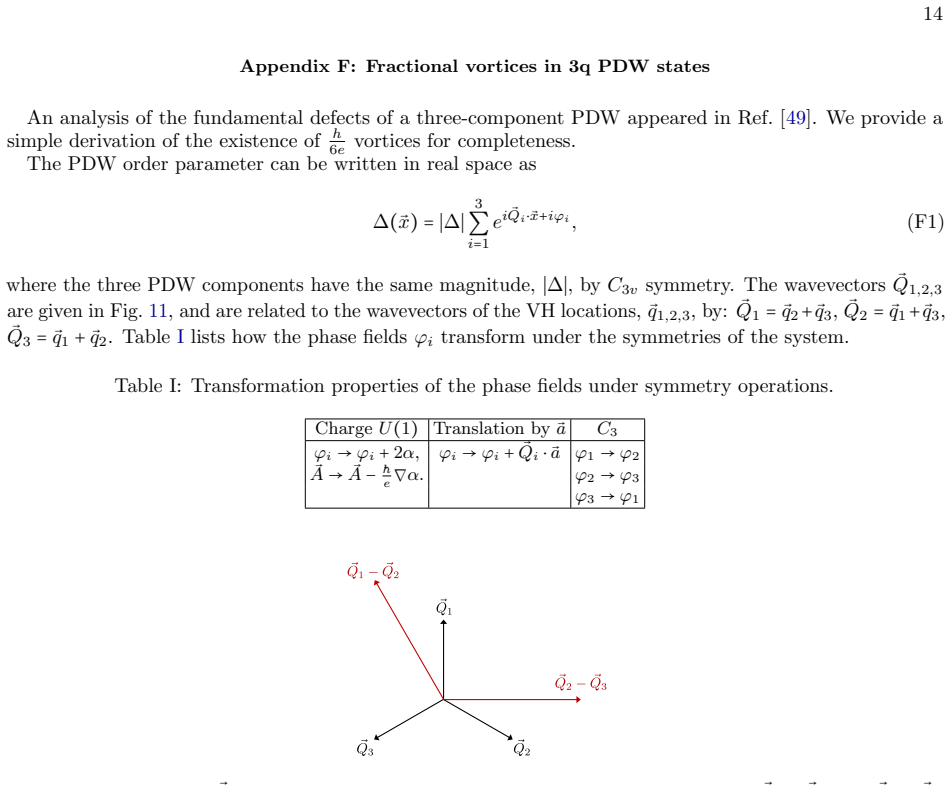
- The $3q$ PDW state is a translation-symmetry-breaking superconductor with an accompanying $3q$ CDW, and its elementary defects carry flux $h/6e$ rather than $h/2e$, giving a sharp experimental fingerprint.
- In the weak-coupling limit, PDW and CDW orders leave gapless fermionic excitations; PDW states exhibit Bogoliubov Fermi surfaces, so the low-energy spectrum is not fully gapped.
- Repulsive interactions are marginally irrelevant even at the diverging density of states, so no Stoner-type or nematic instability appears in this single-flavor model.
Reading between the lines
- If the polarized normal state is confirmed in rhombohedral multilayer graphene, this mechanism suggests the observed superconductivity is a PDW selected by the specific $\eta$ and $\phi$ of the band structure; tuning the displacement field across the VH point should move the system along the CDW/PDW boundary.
- Because the RG treats particle-particle and particle-hole channels on equal footing here, the same single-flavor VH setup could serve as a controlled theoretical laboratory for competing PDW and CDW order in other fully valley-polarized moiré systems, not only rhombohedral graphene.
- The predicted $h/6e$ vortices provide a direct test: counting vortices versus applied magnetic field in a SQUID scan, or searching for zero-field dislocation-bound fractional vortices, could distinguish a $3q$ PDW from a conventional $h/2e$ superconductor.
- The RPA estimate that an effective interpatch attraction can emerge from repulsive Coulomb interactions depends on wavefunction overlap factors near the VH points; a more quantitative calculation of that overlap would sharpen the experimental regime where the predicted instability applies.
Signed reviews
Editorial analysis
A structured set of objections, weighed in public.
Referee Report
Summary. The manuscript studies a single-flavor (spin- and valley-polarized) two-dimensional Fermi liquid with C3v symmetry tuned to a Van-Hove singularity, using a frequency-cutoff patch renormalization group. For three VH points it derives a one-loop beta function for the single inter-patch coupling and claims that repulsive interactions are marginally irrelevant, while attractive interactions produce either CDW or PDW order depending on mass anisotropy and patch orientation, with a 3q PDW supporting h/6e vortices. A six-VH-point extension and an RPA estimate of the initial coupling for rhombohedral tetralayer graphene are also presented. The paper is clearly written and the RG setup is well motivated, but the central one-loop coefficients as printed have the wrong sign in 0<η<1/3 and are non-real for η>1/3, so the main stability/instability claim is not supported by the calculation as written.
Significance. If the RG calculation is corrected and the claimed sign of a(η) holds, the paper would provide a rare weak-coupling mechanism for PDW and CDW order in a spin/valley-polarized system, directly relevant to recent experiments on rhombohedral multilayer graphene. The manuscript contains explicit derivations of the beta functions, susceptibility exponents, GL coefficients, and an RPA estimate of the initial g(0), which are valuable for reproducibility. The h/6e vortex result is a standard re-derivation and not new. At present, however, the sign/domain inconsistency in the central beta function prevents the main physical conclusion from being accepted.
major comments (2)
- [Eq. (5), Appendix B, and Appendix E] The central claim that weak repulsive interactions are marginally irrelevant and weak attractive interactions drive CDW/PDW order rests entirely on a(η)>0 in Eq. (5). The printed coefficients in Eqs. (B1)–(B2) do not satisfy this. For 0<η<1/3, the logarithm in Eq. (B1) is positive (its argument exceeds 1) and the arctangent in Eq. (B2) is positive, while both prefactors carry an overall minus sign, so a_ZS'(η), a_BCS(η), and hence a(η) are negative. For 1/3<η<1, the logarithm in Eq. (B1) has a negative argument and the square root in Eq. (B2) is imaginary, so the beta function is not real. With a(η)<0, Eq. (5) makes positive g grow and negative g flow to zero, which is the opposite of the claimed behavior. Since Eqs. (8) and (9) inherit these signs, the predicted stability/instability dichotomy is not established by the manuscript as written. A similar domain problem appears in Eq. (E1), where the argument of arcsin can exceed unity for allowed values of η and φ, so the six-VH coefficient A(η,φ) is not real over the full domain of Fig. 6. The authors should recompute or correct these coefficients and verify the sign of a(η) on the entire interval 0<η<1.
- [Sec. II.D and Appendix D] The selection between single-q and multi-q order is not derived from the microscopic model. The quartic GL functional in Eq. (10) is unbounded below (Appendix D), and the authors stabilize it by adding a phenomenological sixth-order term w[Σ(|Δ|²+ζ|ρ|²)]³ with arbitrary positive coefficients. The 3q PDW region in Fig. 4 therefore depends both on this uncalculated sixth-order term and on the assumed T_PDW(η) and T_CDW(η) profiles stated in the caption; the computed GL coefficients are evaluated only at η=ηc. The one-loop RG instability calculation is not affected, but the 'multiple wavevector' part of the central claim is illustrative rather than controlled. I recommend either computing the sixth-order coefficients from the patch model or explicitly presenting the multi-q phase selection as model-dependent.
minor comments (4)
- [Throughout] There are several typos: 'This a consequence' in the Introduction, 'the the CDW phase' in the Introduction, and repeated misspellings of 'anisotropy' as 'anistropy'.
- [Eq. (D7)] The lower-left block of the 6x6 matrix in Eq. (D7) appears to be written incorrectly: rows 4–6 begin with cP, bP, bP rather than the corresponding u-type coefficients, so the matrix does not have the expected block structure. Please check this expression.
- [Fig. 4 caption] The figure caption states that the phase diagram is independent of w as long as w>0, but the boundary between 3q CDW and 1q PDW depends on the phenomenological parameter ζ; this dependence should be stated in the main text as well.
- [Reference [48]] Reference [48] is formatted as 'Jiang-Xiazi et al. Lin'; the author name should be cleaned up to a standard format.
Circularity Check
No load-bearing circularity: the central RG result is a self-contained one-loop calculation, with a separate non-circular sign/domain issue in Appendix B.
full rationale
The central derivation is a conventional one-loop patch RG starting from the stated model Hamiltonian (1) and dispersions (2)–(3). The beta function (5) and the vertex flows (8) are computed from the printed integrals in Appendices B and C; no parameter is fitted to the target CDW/PDW phases, and the crossover at ηc ≈ 0.157 is obtained by evaluating the resulting integrals, not by imposing the phase diagram. The attractive initial coupling g(0) < 0 is not reverse-engineered from the desired instability: Appendix A estimates it independently via RPA using R4G parameters taken from Ref. [28]. The fractional h/6e vortex claim is explicitly presented as a re-derivation of a known result (Ref. [49]) and is not used to justify the RG flow. The self-citations to Berg and co-workers provide contextual theory, band-structure inputs, or standard formulas (e.g., the RPA polarization expression) and are not load-bearing reductions of the paper's own prediction to its input. One non-circular internal consistency issue should be flagged: as printed, Eqs. (B1)–(B2) give aZS'(η) and aBCS(η) negative for 0 < η < 1/3 and non-real for η > 1/3, contradicting the claim after Eq. (5) that a(η) > 0 for all η. Taken literally, those printed formulas would flip the sign in Eq. (5) and invert the advertised stability/instability dichotomy. This is an arithmetic or typographical correctness problem, not an input–output circularity, so it does not raise the circularity score.
Assumptions & free parameters
free parameters (3)
- zeta =
>0, undetermined
- w =
0.1
- TPDW/TCDW temperature profiles =
TPDW = Tx[1 - (eta - eta_c)/(2 eta_c)], TCDW = Tx[1 + (eta - eta_c)/(2 eta_c)]
assumptions (5)
- domain assumption A fully spin and valley polarized normal state exists at the densities of interest
- domain assumption The patch approximation with a single inter-patch coupling g and no intra-patch interactions captures the low-energy theory
- domain assumption One-loop RG is sufficient; higher-loop corrections do not change the sign of the beta function or the leading instabilities
- ad hoc to paper The RPA provides a valid estimate of the effective inter-patch interaction g(0)
- ad hoc to paper The GL free energy can be made bounded by adding a sixth-order term with arbitrary positive coefficients
Cite this review
Pith. "Pith review of Charge and pair density waves in a spin and valley-polarized system at a Van-Hove singularity." pith.science (2026). https://pith.science/paper/6MKDPFQA
@misc{pith2026250419321,
  author       = {Pith},
  title        = {Pith review of: Charge and pair density waves in a spin and valley-polarized system at a Van-Hove singularity},
  year         = {2026},
  howpublished = {\url{https://pith.science/paper/6MKDPFQA}},
  note         = {Machine review of arXiv:2504.19321}
}
abstract
We study a single component (i.e., single valley, spin-polarized) two-dimensional electron gas with $C_{3v}$ symmetry tuned to a Van-Hove (VH) singularity. Generically, there may be either three or six VH points at the Fermi level, related to each other by symmetry. Using a renormalization group analysis, we show that when the effective interactions between electrons at the VH points are positive, the system is stable. In contrast, if the effective interactions are negative, the system develops an instability toward either pair density wave (PDW) or charge density wave (CDW) orders, depending on the anisotropy of the dispersion at the VH points. The PDW may have either a single wavevector or multiple wavevectors. The PDW phase with three coexisting wavevectors can support fractional $\tfrac{h}{6e}$ vortices. The interplay between the geometry of the Fermi surface and the singularity of the density of states is the key that enables PDW formation.
Figures


Figures from the paper (8 more)


Forward citations
Cited by 1 Pith paper
-
Emblems of pair density waves: dual identity of topological defects and their transport signatures
Mobile fractional vortices that are simultaneously crystal dislocations can explain the resistive switching in tetralayer graphene's SC1 state and give testable anisotropy and Hall signatures.
Reference graph
Works this paper leans on
-
[1]
Theory of the striped superconductor,
Erez Berg, Eduardo Fradkin, and Steven A. Kivel- son, “Theory of the striped superconductor,” Phys. Rev. B 79, 064515 (2009)
work page 2009
-
[2]
has a divergence at η = 1 3, due to the presence of a susceptibility that diverges as log squared of the IR cutoff. 6 C. Instabilities To probe the tendency to develop each order, we add test vertices to the Hamiltonian and track how they flow. The test vertices and the diagrams that contribute to the renormalization in this model are similar to those in ...
-
[3]
Thus, near η = 1 3 our description breaks down
For η = 1 3, the contribution of the particle- hole channel has a log-squared divergence, due to the perfect nesting of the Fermi surface. Thus, near η = 1 3 our description breaks down. An analysis of the case of η = 1 3 for spinful fermions can be found in [42]. Solving Eq. (5), We find that for an initial repulsive interaction (g > 0), g flows towards ...
-
[4]
The physics of pair-density waves: Cuprate supercon- ductors and beyond,
Daniel F Agterberg, JC S´ eamus Davis, Stephen D Edkins, Eduardo Fradkin, Dale J Van Harlingen, Steven A Kivelson, Patrick A Lee, Leo Radzihovsky, John M Tranquada, and Yuxuan Wang, “The physics of pair-density waves: Cuprate supercon- ductors and beyond,” Annual Review of Condensed Matter Physics 11, 231–270 (2020)
work page 2020
-
[5]
Superconduc- tivity in a Strong Spin-Exchange Field,
Peter Fulde and Richard A. Ferrell, “Superconduc- tivity in a Strong Spin-Exchange Field,” Phys. Rev. 135, A550–A563 (1964)
work page 1964
-
[6]
Nonuniform state of superconductors,
A. I. Larkin and Yu N. Ovchinikov, “Nonuniform state of superconductors,” Zh. Eksp. Teor. Fiz 47, 1136 (1964)
work page 1964
-
[7]
Two-Dimensional Superconducting Fluctuations in Stripe-Ordered La1.875Ba0.125CuO4,
Q. Li, M. H¨ ucker, G. D. Gu, A. M. Tsve- lik, and J. M. Tranquada, “Two-Dimensional Superconducting Fluctuations in Stripe-Ordered La1.875Ba0.125CuO4,” Phys. Rev. Lett. 99, 067001 (2007)
work page 2007
-
[8]
Dynamical Layer Decoupling in a Stripe-Ordered High-Tc Superconductor,
E. Berg, E. Fradkin, E.-A. Kim, S. A. Kivelson, V. Oganesyan, J. M. Tranquada, and S. C. Zhang, “Dynamical Layer Decoupling in a Stripe-Ordered High-Tc Superconductor,” Phys. Rev. Lett. 99, 127003 (2007)
work page 2007
Show all 55 references
-
[9]
Evidence for unusual super- conducting correlations coexisting with stripe order in La1.875Ba0.125CuO4,
J. M. Tranquada, G. D. Gu, M. H¨ ucker, Q. Jie, H.-J. Kang, R. Klingeler, Q. Li, N. Tristan, J. S. Wen, G. Y. Xu, Z. J. Xu, J. Zhou, and M. v. Zimmermann, “Evidence for unusual super- conducting correlations coexisting with stripe order in La1.875Ba0.125CuO4,” Phys. Rev. B 78,...
2008
-
[10]
Magnetic field–induced pair density wave state in the cuprate vortex halo,
Stephen D Edkins, Andrey Kostin, Kazuhiro Fu- jita, Andrew P Mackenzie, Hiroshi Eisaki, S Uchida, Subir Sachdev, Michael J Lawler, E-A Kim, JC S´ eamus Davis,et al. , “Magnetic field–induced pair density wave state in the cuprate vortex halo,” Science 364, 976–980 (2019)
2019
-
[11]
Small Fermi Pockets Intertwined with Charge Stripes and Pair Density Wave Order in a Kagome Superconduc- tor,
Hong Li, Dongjin Oh, Mingu Kang, He Zhao, Bren- den R. Ortiz, Yuzki Oey, Shiang Fang, Zheng Ren, Chris Jozwiak, Aaron Bostwick, Eli Rotenberg, Joseph G. Checkelsky, Ziqiang Wang, Stephen D. Wilson, Riccardo Comin, and Ilija Zeljkovic, “Small Fermi Pockets Intertwined with Char...
2023
-
[12]
Pair den- sity wave state in a monolayer high-T c iron-based superconductor,
Yanzhao Liu, Tianheng Wei, Guanyang He, Yi Zhang, Ziqiang Wang, and Jian Wang, “Pair den- sity wave state in a monolayer high-T c iron-based superconductor,” Nature 618, 934–939 (2023)
2023
-
[13]
Detection of a pair density wave state in UTe2,
Qiangqiang Gu, Joseph P Carroll, Shuqiu Wang, Sheng Ran, Christopher Broyles, Hasan Siddiquee, Nicholas P Butch, Shanta R Saha, Johnpierre Paglione, JC S´ eamus Davis, et al. , “Detection of a pair density wave state in UTe2,” Nature 618, 921–927 (2023)
2023
-
[14]
Magnetic-field- sensitive charge density waves in the superconductor UTe2,
Anuva Aishwarya, Julian May-Mann, Arjun Ragha- van, Laimei Nie, Marisa Romanelli, Sheng Ran, Shanta R Saha, Johnpierre Paglione, Nicholas P Butch, Eduardo Fradkin, et al. , “Magnetic-field- sensitive charge density waves in the superconductor UTe2,” Nature 618, 928–933 (2023)
2023
-
[15]
Evidence of striped electronic phases in a struc- turally modulated superlattice,
A Devarakonda, A Chen, S Fang, D Graf, M Kriener, AJ Akey, DC Bell, T Suzuki, and JG Checkel- sky, “Evidence of striped electronic phases in a struc- turally modulated superlattice,” Nature 631, 526– 530 (2024)
2024
-
[16]
Striped superconductors: how spin, charge and superconducting orders intertwine in the cuprates,
Erez Berg, Eduardo Fradkin, Steven A Kivelson, and John M Tranquada, “Striped superconductors: how spin, charge and superconducting orders intertwine in the cuprates,” New Journal of Physics 11, 115004 (2009)
2009
-
[17]
Pair-Density-Wave Correlations in the Kondo- Heisenberg Model,
Erez Berg, Eduardo Fradkin, and Steven A. Kivel- son, “Pair-Density-Wave Correlations in the Kondo- Heisenberg Model,” Phys. Rev. Lett. 105, 146403 16 (2010)
2010
-
[18]
Coexistence of Charge-Density- Wave and Pair-Density-Wave Orders in Underdoped Cuprates,
Yuxuan Wang, Daniel F. Agterberg, and An- drey Chubukov, “Coexistence of Charge-Density- Wave and Pair-Density-Wave Orders in Underdoped Cuprates,” Phys. Rev. Lett. 114, 197001 (2015)
2015
-
[19]
Superconductivity on the Brink of Spin- Charge Order in a Doped Honeycomb Bilayer,
Oskar Vafek, James M. Murray, and Vladimir Cvetkovic, “Superconductivity on the Brink of Spin- Charge Order in a Doped Honeycomb Bilayer,” Phys. Rev. Lett. 112, 147002 (2014)
2014
-
[20]
Evidence of pair-density wave in spin-valley locked systems,
Jordan Venderley and Eun-Ah Kim, “Evidence of pair-density wave in spin-valley locked systems,” Sci- ence advances 5, eaat4698 (2019)
2019
-
[21]
Precursor of pair-density wave in doping Kitaev spin liquid on the honeycomb lattice,
Cheng Peng, Yi-Fan Jiang, Thomas P Devereaux, and Hong-Chen Jiang, “Precursor of pair-density wave in doping Kitaev spin liquid on the honeycomb lattice,” npj Quantum Materials 6, 64 (2021)
2021
-
[22]
Pair density wave and reentrant superconducting tendencies orig- inating from valley polarization,
Zhaoyu Han and Steven A. Kivelson, “Pair density wave and reentrant superconducting tendencies orig- inating from valley polarization,” Phys. Rev. B 105, L100509 (2022)
2022
-
[23]
Pair- density-wave superconductor from doping Haldane chain and rung-singlet ladder,
Ya-Hui Zhang and Ashvin Vishwanath, “Pair- density-wave superconductor from doping Haldane chain and rung-singlet ladder,” Phys. Rev. B 106, 045103 (2022)
2022
-
[24]
Pair-density-wave in the strong coupling limit of the Holstein-Hubbard model,
Kevin S Huang, Zhaoyu Han, Steven A Kivelson, and Hong Yao, “Pair-density-wave in the strong coupling limit of the Holstein-Hubbard model,” npj Quantum Materials 7, 17 (2022)
2022
-
[25]
Weak-coupling theory of pair density wave in- stabilities in transition metal dichalcogenides,
Daniel Shaffer, F. J. Burnell, and Rafael M. Fernan- des, “Weak-coupling theory of pair density wave in- stabilities in transition metal dichalcogenides,” Phys. Rev. B 107, 224516 (2023)
2023
-
[26]
Pair-Density-Wave and Chiral Superconductivity in Twisted Bilayer Transition Metal Dichalcogenides,
Yi-Ming Wu, Zhengzhi Wu, and Hong Yao, “Pair-Density-Wave and Chiral Superconductivity in Twisted Bilayer Transition Metal Dichalcogenides,” Phys. Rev. Lett. 130, 126001 (2023)
2023
-
[27]
Pair-Density-Wave Superconductivity: A Microscopic Model on the 2D Honeycomb Lattice,
Yi-Fan Jiang and Hong Yao, “Pair-Density-Wave Superconductivity: A Microscopic Model on the 2D Honeycomb Lattice,” Phys. Rev. Lett. 133, 176501 (2024)
2024
-
[28]
Pair density wave and loop current promoted by Van Hove singularities in moir´ e systems,
Zhengzhi Wu, Yi-Ming Wu, and Fengcheng Wu, “Pair density wave and loop current promoted by Van Hove singularities in moir´ e systems,” Phys. Rev. B 107, 045122 (2023)
2023
-
[29]
Signatures of chiral superconductivity in rhombo- hedral graphene,
Tonghang Han, Zhengguang Lu, Yuxuan Yao, Li- han Shi, Jixiang Yang, Junseok Seo, Shenyong Ye, Zhenghan Wu, Muyang Zhou, Haoyang Liu, et al. , “Signatures of chiral superconductivity in rhombo- hedral graphene,” arXiv preprint arXiv:2408.15233 (2024)
2024 arXiv
-
[30]
Intravalley spin-polarized superconductiv- ity in rhombohedral tetralayer graphene,
Yang-Zhi Chou, Jihang Zhu, and Sankar Das Sarma, “Intravalley spin-polarized superconductiv- ity in rhombohedral tetralayer graphene,” (2024), arXiv:2409.06701 [cond-mat.supr-con]
2024 arXiv
-
[31]
Chiral and topological superconductivity in isospin polarized multilayer graphene,
Max Geier, Margarita Davydova, and Liang Fu, “Chiral and topological superconductivity in isospin polarized multilayer graphene,” (2024), arXiv:2409.13829 [cond-mat.supr-con]
2024 arXiv
-
[32]
Band Renormalization, Quarter Metals, and Chi- ral Superconductivity in Rhombohedral Tetralayer Graphene,
Guillermo Parra-Martinez, Alejandro Jimeno-Pozo, Vo Tien Phong, Hector Sainz-Cruz, Daniel Kaplan, Peleg Emanuel, Yuval Oreg, Pierre A. Pantaleon, Jose Angel Silva-Guillen, and Francisco Guinea, “Band Renormalization, Quarter Metals, and Chi- ral Superconductivity in Rhombohedr...
2025
-
[33]
Topological chiral superconductivity beyond pairing in a Fermi liquid,
Minho Kim, Abigail Timmel, Long Ju, and Xiao- Gang Wen, “Topological chiral superconductivity beyond pairing in a Fermi liquid,” Phys. Rev. B 111, 014508 (2025)
2025
-
[34]
Quantum Geomet- ric Unconventional Superconductivity,
Gal Shavit and Jason Alicea, “Quantum Geomet- ric Unconventional Superconductivity,” (2024), arXiv:2411.05071 [cond-mat.supr-con]
2024 arXiv
-
[35]
Topological incommensurate Fulde-Ferrell-Larkin-Ovchinnikov superconductor and Bogoliubov Fermi surface in rhombohedral tetra-layer graphene,
Hui Yang and Ya-Hui Zhang, “Topological incommensurate Fulde-Ferrell-Larkin-Ovchinnikov superconductor and Bogoliubov Fermi surface in rhombohedral tetra-layer graphene,” (2024), arXiv:2411.02503 [cond-mat.supr-con]
2024 arXiv
-
[36]
Intrinsic su- perconducting diode effect and nonreciprocal super- conductivity in rhombohedral graphene multilayers,
Yinqi Chen and Constantin Schrade, “Intrinsic su- perconducting diode effect and nonreciprocal super- conductivity in rhombohedral graphene multilayers,” (2025), arXiv:2503.16391 [cond-mat.supr-con]
2025 arXiv
-
[37]
Spontaneous vortex-antivortex lattice and Majo- rana fermions in rhombohedral graphene,
Filippo Gaggioli, Daniele Guerci, and Liang Fu, “Spontaneous vortex-antivortex lattice and Majo- rana fermions in rhombohedral graphene,” (2025), arXiv:2503.16384 [cond-mat.supr-con]
2025
-
[38]
Superconducting transitions due to van hove singularities in the electron spectrum,
I. Dzyaloshinskii, “Superconducting transitions due to van hove singularities in the electron spectrum,” Sov. Phys. JETP 66, 848 (1987)
1987
-
[39]
Superconductivity and Antiferro- magnetism in the Two-Dimensional Hubbard Model: Scaling Theory,
H. J. Schulz, “Superconductivity and Antiferro- magnetism in the Two-Dimensional Hubbard Model: Scaling Theory,” Europhysics Letters 4, 609 (1987)
1987
-
[40]
Antifer- romagnetism and superconductivity in a quasi two- dimensional electron gas. Scaling theory of a generic Hubbard model,
D.Poilblanc P. Lederer, G. Montambaux, “Antifer- romagnetism and superconductivity in a quasi two- dimensional electron gas. Scaling theory of a generic Hubbard model,” J. Phys. France 48 (1987)
1987
-
[41]
Truncation of a Two-Dimensional Fermi Surface due to Quasiparticle Gap Formation at the Saddle Points,
Nobuo Furukawa, T. M. Rice, and Manfred Salmhofer, “Truncation of a Two-Dimensional Fermi Surface due to Quasiparticle Gap Formation at the Saddle Points,” Phys. Rev. Lett. 81, 3195–3198 (1998)
1998
-
[42]
Chiral superconductivity from repulsive interactions in doped graphene,
Rahul Nandkishore, Leonid S Levitov, and Andrey V Chubukov, “Chiral superconductivity from repulsive interactions in doped graphene,” Nature Physics 8, 158–163 (2012)
2012
-
[43]
Electronic phases in twisted bilayer graphene at magic angles as a result of Van Hove singularities and interactions,
Yury Sherkunov and Joseph J. Betouras, “Electronic phases in twisted bilayer graphene at magic angles as a result of Van Hove singularities and interactions,” Phys. Rev. B 98, 205151 (2018)
2018
-
[44]
Topological superconductivity, ferromagnetism, and valley-polarized phases in moir´ e systems: Renor- malization group analysis for twisted double bilayer graphene,
Yi-Ting Hsu, Fengcheng Wu, and S. Das Sarma, “Topological superconductivity, ferromagnetism, and valley-polarized phases in moir´ e systems: Renor- malization group analysis for twisted double bilayer graphene,” Phys. Rev. B 102, 085103 (2020)
2020
-
[45]
Half- and quarter- metals in rhombohedral trilayer graphene,
Haoxin Zhou, Tian Xie, Areg Ghazaryan, Tobias Holder, James R. Ehrets, Eric M. Spanton, Takashi Taniguchi, Kenji Watanabe, Erez Berg, Maksym Serbyn, and Andrea F. Young, “Half- and quarter- metals in rhombohedral trilayer graphene,” Nature 598, 429–433 (2021)
2021
-
[46]
Inter-valley coherent order and isospin fluctuation 17 mediated superconductivity in rhombohedral trilayer graphene,
S. Chatterjee, T. Wang, E. Berg, and M. Zaletel, “Inter-valley coherent order and isospin fluctuation 17 mediated superconductivity in rhombohedral trilayer graphene,” Nature Communications 13, 6013 (2022)
2022
-
[47]
Renormalization-group approach to interacting fermions,
R. Shankar, “Renormalization-group approach to interacting fermions,” Rev. Mod. Phys. 66, 129– 192 (1994)
1994
-
[48]
Chiral twist on the high- Tc phase diagram in moir´ e het- erostructures,
Yu-Ping Lin and Rahul M. Nandkishore, “Chiral twist on the high- Tc phase diagram in moir´ e het- erostructures,” Phys. Rev. B 100, 085136 (2019)
2019
-
[49]
d-Wave Superconductivity and Pomeranchuk Instability in the Two-Dimensional Hubbard Model,
Christoph J. Halboth and Walter Metzner, “ d-Wave Superconductivity and Pomeranchuk Instability in the Two-Dimensional Hubbard Model,” Phys. Rev. Lett. 85, 5162–5165 (2000)
2000
-
[50]
Zero-field superconducting diode effect in small-twist-angle trilayer graphene,
Jiang-Xiazi et al. Lin, “Zero-field superconducting diode effect in small-twist-angle trilayer graphene,” Nature Physics 18, 1221–1227 (2022)
2022
-
[51]
Conventional and charge-six superfluids from melting hexagonal Fulde-Ferrell-Larkin-Ovchinnikov phases in two dimensions,
D. F. Agterberg, M. Geracie, and H. Tsunetsugu, “Conventional and charge-six superfluids from melting hexagonal Fulde-Ferrell-Larkin-Ovchinnikov phases in two dimensions,” Phys. Rev. B 84, 014513 (2011)
2011
-
[52]
Chern Fermi pocket, topological pair density wave, and charge-4e and charge-6e superconductivity in kagom´ e superconduc- tors,
Sen Zhou and Ziqiang Wang, “Chern Fermi pocket, topological pair density wave, and charge-4e and charge-6e superconductivity in kagom´ e superconduc- tors,” Nature Communications 13, 7288 (2022)
2022
-
[53]
Spectral signatures of modulated d-wave superconducting phases,
Shirit Baruch and Dror Orgad, “Spectral signatures of modulated d-wave superconducting phases,” Phys. Rev. B 77, 174502 (2008)
2008
-
[54]
Bogoliubov Fermi surfaces: General theory, magnetic order, and topology,
P. M. R. Brydon, D. F. Agterberg, Henri Menke, and C. Timm, “Bogoliubov Fermi surfaces: General theory, magnetic order, and topology,” Phys. Rev. B 98, 224509 (2018)
2018
-
[55]
Multilayer graphenes as a platform for interaction-driven physics and topological super- conductivity,
Areg Ghazaryan, Tobias Holder, Erez Berg, and Maksym Serbyn, “Multilayer graphenes as a platform for interaction-driven physics and topological super- conductivity,” Phys. Rev. B 107, 104502 (2023)
2023
Reviewed August 16, 2026 · model on record in the stance chip above.
Discussion (0). Continue with ORCID to comment.