REVIEW 3 major objections 3 minor 75 references
Improved Global Ocean Heat Content Estimation by Modeling Vertical Spatio-Temporal Dependence
T0 review · 3 major / 3 minor · reviewed 2026-07-14 · grok-4.5
Pith's one-line read Jointly mapping two ocean layers with their correlation cuts global OHC anomaly uncertainty by up to 15%.
desk verdict Abstract-only methods paper: joint bivariate GP mapping of two OHC layers is a sensible fix for a real operational flaw, with a claimed ~15% uncertainty cut that we cannot verify yet. read the letter →
The pith
A machine-rendered reading of the paper's core claim, the machinery that carries it, and where it could break.
The reading
What carries the argument
Bivariate locally stationary Gaussian processes used to represent the joint spatio-temporal field of the two pressure layers, combined with conditional simulations that propagate the estimated vertical dependence into total-OHC maps and uncertainties.
What would settle it
If independent validation against withheld deep Argo profiles or against independent full-depth hydrographic sections shows that the joint bivariate maps produce larger or poorly calibrated total-OHC errors than the separate-layer maps, the claimed 15 percent uncertainty reduction would be falsified.
Extended reading notes
Core claim
Modeling the correlation between two pressure layers with bivariate locally stationary Gaussian processes and conditional simulations improves OHC anomaly mapping and yields up to a 15 percent reduction of global OHC anomaly uncertainties compared with mapping the two layers separately without accounting for their dependence.
Load-bearing premise
The true vertical dependence of OHC anomalies between the two chosen pressure layers is adequately described by a bivariate locally stationary Gaussian process, so that the reported uncertainty reduction is not an artifact of model misspecification.
Editorial analysis
A structured set of objections, weighed in public.
Referee Report
Summary. The manuscript proposes a joint mapping method for ocean heat content (OHC) anomalies in two pressure layers using Argo data (2004–2022). Prior practice maps layers independently, which complicates uncertainty quantification when layers are summed. The authors instead use bivariate locally stationary Gaussian processes with conditional simulations to map the layers jointly while accounting for vertical correlation. They report improved OHC anomaly maps and up to a 15% reduction in global OHC anomaly uncertainties relative to independent mapping, and illustrate the use of the resulting uncertainties for assessing statistical significance of regional and global OHC anomalies in climatological case studies.
Significance. If the reported uncertainty reduction and map improvements hold under proper diagnostics, the contribution is practically important: OHC is the primary reservoir of Earth’s energy imbalance, and reliable layer-summed uncertainties are needed for regional and global significance statements. Joint bivariate modeling of vertical dependence is a natural and methodologically coherent improvement over independent layer mapping. The use of conditional simulations for uncertainty quantification is a strength if implemented and validated carefully. The work is applied and empirical rather than theoretical; its value rests on whether the bivariate locally stationary GP is adequate and whether the 15% figure is robust.
major comments (3)
- [Abstract (methods and results not available)] Abstract-only review: the central claim of up to ~15% global OHC-anomaly uncertainty reduction and improved maps cannot be verified without methods, residual diagnostics, cross-validation, and sensitivity analyses. The load-bearing premise is that a bivariate locally stationary Gaussian process adequately captures vertical spatio-temporal dependence between the two chosen pressure layers. The full manuscript must report diagnostics that could falsify local stationarity or Gaussianity (e.g., residual correlation structure, QQ/score diagnostics, leave-region-out or temporal holdout skill) and show that the uncertainty reduction is not an artifact of misspecification or of the chosen covariance form.
- [Abstract (hyperparameters and layer definition)] The free parameters of the procedure—GP covariance hyperparameters (length scales, variances, cross-layer correlation), the local-stationarity window / nonstationarity structure, and the two pressure-layer boundaries—are estimated from the same Argo data used for mapping. The manuscript must clarify how hyperparameters are estimated, whether uncertainty in those hyperparameters is propagated into the reported OHC uncertainties, and how sensitive the 15% reduction and significance case studies are to layer boundaries and to the bivariate covariance specification. Without that, the headline uncertainty reduction remains incompletely supported.
- [Abstract (uncertainty comparison design)] The abstract states that independent layer mapping “complicates the estimation of uncertainties when the maps are summed.” The joint method’s advantage should be demonstrated not only via a global scalar uncertainty reduction but via explicit comparison of summed-layer variance (including the cross-layer covariance term) against the independent-mapping baseline on the same grid and period. If the full text only reports a global percentage without decomposing where the gain comes from (cross-covariance vs. better marginal fits), the claim that dependence modeling is the operative mechanism is under-supported.
minor comments (3)
- [Abstract] The abstract’s “up to a 15 percent” phrasing should be paired in the full text with the spatial/temporal distribution of the reduction (global mean, regional range, time dependence) so readers can judge whether the figure is typical or a peak value.
- [Methods (expected)] Clarify in the introduction/methods how the two pressure-layer boundaries are chosen and whether results are robust to alternative partitions used in the OHC literature.
- [Case studies (expected)] Case-study significance statements should specify the null, the spatial aggregation, and multiple-testing or spatial-dependence adjustments if regional maps are interpreted jointly.
Circularity Check
No significant circularity: empirical joint-vs-separate mapping comparison on Argo data, not forced by definition or self-citation.
full rationale
Only the abstract is available. The central claim is an empirical comparison: bivariate locally stationary Gaussian process mapping of two pressure layers (with conditional simulations) versus separate univariate mapping, reporting improved OHC anomaly maps and up to ~15% reduction in global OHC anomaly uncertainties on Argo 2004–2022 data. That comparison is not equivalent to its inputs by construction; the bivariate model is a modeling choice whose adequacy is an assumption, not a tautology that renames a fitted target as a prediction. Hyperparameter estimation from the same data used for mapping is standard geostatistical practice and does not constitute the self-definitional or fitted-input-called-prediction circularity patterns that raise the score. No uniqueness theorem, load-bearing self-citation chain, or ansatz smuggled via prior author work is present in the abstract. The result is falsifiable against the separate-mapping baseline and against external OHC products; therefore the derivation chain as stated is self-contained against the available text. Score 0 is the honest finding under the abstract-only limit.
Assumptions & free parameters
free parameters (3)
- GP covariance hyperparameters (length scales, variances, cross-layer correlation)
- Local-stationarity window / nonstationarity structure
- Two pressure-layer boundaries
assumptions (3)
- domain assumption OHC anomaly fields in the two layers are well modeled as a bivariate Gaussian process with local stationarity.
- domain assumption Argo profiling float data from 2004–2022 adequately sample the spatio-temporal field for the GP posterior to be meaningful globally and regionally.
- standard math Standard properties of Gaussian processes and conditional simulation for uncertainty quantification.
Cite this review
Pith. "Pith review of Improved Global Ocean Heat Content Estimation by Modeling Vertical Spatio-Temporal Dependence." pith.science (2026). https://pith.science/paper/6MLDZOW4
@misc{pith2026260711832,
  author       = {Pith},
  title        = {Pith review of: Improved Global Ocean Heat Content Estimation by Modeling Vertical Spatio-Temporal Dependence},
  year         = {2026},
  howpublished = {\url{https://pith.science/paper/6MLDZOW4}},
  note         = {Machine review of arXiv:2607.11832}
}
read the original abstract
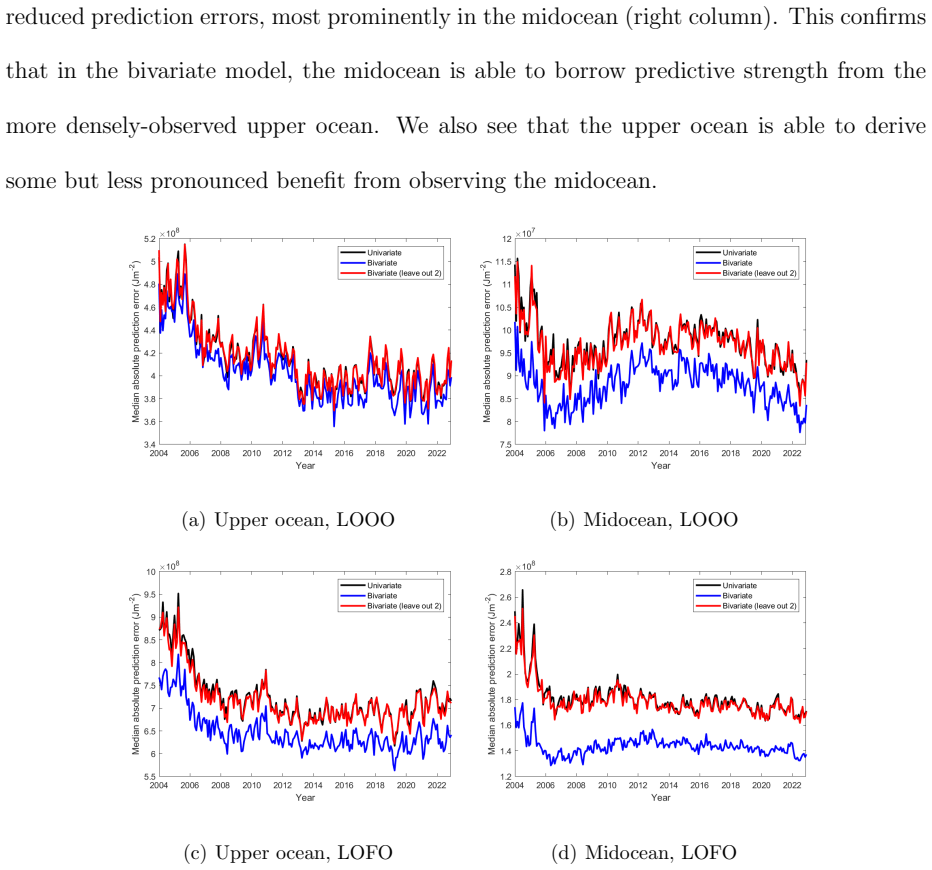
Estimating ocean heat content (OHC) with reliable uncertainties is critical for understanding and monitoring the evolution of Earth's climate, as the ocean has stored most of the energy accumulated in the climate system due to Earth Energy Imbalance. Here, we use Argo profiling float data from 2004-2022 to map OHC. As fewer Argo observations are available deeper in the water column, previous studies have partitioned the ocean into at least two pressure layers and mapped each separately, which complicates the estimation of uncertainties when the maps are summed to get the total OHC. In this work, we consider the case of two pressure layers and propose an improved mapping and uncertainty quantification method using bivariate locally stationary Gaussian processes and conditional simulations to map the two sections jointly while accounting for the correlation between them. We find that modeling this correlation results in improved OHC anomaly mapping and up to a 15 percent reduction of global OHC anomaly uncertainties in comparison to mapping the two layers separately without accounting for their dependence. These estimated uncertainties are essential to analyze the statistical significance of OHC anomalies on both regional and global scales, which we demonstrate using several climatological case studies.
Figures


Figures from the paper (10 more)



Reference graph
Works this paper leans on
-
[1]
Neural likelihood surfaces for spatial processes with computationally intensive or intractable likelihoods , journal =. 2024 , issn =. doi:https://doi.org/10.1016/j.spasta.2024.100848 , author =
-
[2]
Journal of Computational and Graphical Statistics , volume =
Matthew Sainsbury-Dale and Andrew Zammit-Mangion and Jordan Richards and Raphaël Huser , title =. Journal of Computational and Graphical Statistics , volume =. 2025 , publisher =
2025
-
[3]
The Galerkin finite element method for elliptic problems
Quarteroni, Alfio. The Galerkin finite element method for elliptic problems. Numerical Models for Differential Problems. 2014. doi:10.1007/978-88-470-5522-3_4
-
[4]
2025 , howpublished=
Neural Conditional Simulation for Complex Spatial Processes , author=. 2025 , howpublished=
2025
-
[5]
The Graph Neural Network Model , year=
Scarselli, Franco and Gori, Marco and Tsoi, Ah Chung and Hagenbuchner, Markus and Monfardini, Gabriele , journal=. The Graph Neural Network Model , year=
-
[6]
G. C. Johnson and others. Global Oceans. Bulletin of the American Meteorological Society. 2024. doi:10.1175/BAMS-D-24-0100.1
-
[7]
The Annals of Applied Statistics , number =
Beomjo Park and Mikael Kuusela and Donata Giglio and Alison Gray , title =. The Annals of Applied Statistics , number =. 2023 , doi =
2023
-
[8]
WIREs Computational Statistics , volume =
Porcu, Emilio and Furrer, Reinhard and Nychka, Douglas , title =. WIREs Computational Statistics , volume =. doi:10.1002/wics.1512 , year =
Show all 75 references
-
[9]
Proceedings of the 19th International Conference on Artificial Intelligence and Statistics , pages =
Deep Kernel Learning , author =. Proceedings of the 19th International Conference on Artificial Intelligence and Statistics , pages =. 2016 , editor =
2016
-
[10]
Space and Space-Time Modeling using Process Convolutions
Higdon, Dave. Space and Space-Time Modeling using Process Convolutions. Quantitative Methods for Current Environmental Issues. 2002
2002
-
[11]
Scandinavian Journal of Statistics , volume =
Wallin, Jonas and Bolin, David , title =. Scandinavian Journal of Statistics , volume =. doi:https://doi.org/10.1111/sjos.12141 , year =
-
[12]
2022 , note =
The SPDE approach for Gaussian and non-Gaussian fields: 10 years and still running , journal =. 2022 , note =. doi:https://doi.org/10.1016/j.spasta.2022.100599 , author =
2022 doi
-
[13]
and others , Doi =
Hakuba, Maria Z. and others , Doi =. Trends and Variability in. Surveys in Geophysics , Number =
-
[14]
, title=
Kuusela, Mikael and Stein, Michael L. , title=. 2018 , journal=
2018
-
[15]
Lyman and Gregory C
John M. Lyman and Gregory C. Johnson. Global High-Resolution Random Forest Regression Maps of Ocean Heat Content Anomalies Using In Situ and Satellite Data. Journal of Atmospheric and Oceanic Technology. 2023. doi:10.1175/JTECH-D-22-0058.1
2023 doi
-
[16]
, title =
Rodrigues, Alexandre and Diggle, Peter J. , title =. Scandinavian Journal of Statistics , volume =. doi:10.1111/j.1467-9469.2009.00675.x , year =
2009 doi
-
[17]
Journal of the American Statistical Association , volume =
Tilmann Gneiting , title =. Journal of the American Statistical Association , volume =. 2002 , publisher =
2002
- [18]
-
[19]
2000 , journal=
Argo , title=. 2000 , journal=
2000
-
[20]
Progress in Oceanography , volume =
The 2004–2008 mean and annual cycle of temperature, salinity, and steric height in the global ocean from the. Progress in Oceanography , volume =. 2009 , issn =. doi:10.1016/j.pocean.2009.03.004 , author =
2004 doi
-
[21]
2012 , issn =
Nonstationary modeling for multivariate spatial processes , journal =. 2012 , issn =. doi:10.1016/j.jmva.2012.05.011 , author =
2012 doi
-
[22]
2016 , publisher=
Pattern Recognition and Machine Learning , author=. 2016 , publisher=
2016
-
[23]
2010 , publisher=
Handbook of Spatial Statistics , author=. 2010 , publisher=
2010
-
[24]
Haas , title =
Timothy C. Haas , title =. Journal of the American Statistical Association , volume =. 1990 , publisher =
1990
-
[25]
Haas , title =
Timothy C. Haas , title =. Journal of the American Statistical Association , volume =. 1995 , publisher =
1995
-
[26]
2018 , note =
Modeling and emulation of nonstationary Gaussian fields , journal =. 2018 , note =. doi:10.1016/j.spasta.2018.08.006 , author =
2018 doi
-
[27]
Frontiers in Marine Science , VOLUME=
Meyssignac, Benoit and others , TITLE=. Frontiers in Marine Science , VOLUME=. 2019 , DOI=
2019
-
[28]
An imperative to monitor Earth's Energy Imbalance
von Schuckmann, K and Palmer, M D and Trenberth, K E and Cazenave, A and Chambers, D and Champollion, N and Hansen, J and Josey, S A and Loeb, N and Mathieu, P-P and Meyssignac, B and Wild, M. An imperative to monitor Earth's Energy Imbalance. Nat. Clim. Chang
-
[30]
Global Oceans
Johnson, Gregory C and others. Global Oceans. Bull. Am. Meteorol. Soc
-
[31]
Hurricane Harvey links to ocean heat content and climate change adaptation
Trenberth, Kevin E and Cheng, Lijing and Jacobs, Peter and Zhang, Yongxin and Fasullo, John. Hurricane Harvey links to ocean heat content and climate change adaptation. Earth's Future
-
[32]
Mikael Kuusela and Donata Giglio , title =
-
[33]
F. N. Fritsch and R. E. Carlson , journal =. Monotone Piecewise Cubic Interpolation , urldate =
-
[34]
Journal of Atmospheric and Oceanic Technology , year = 2020, month = apr, volume =
Two Interpolation Methods Using Multiply-Rotated Piecewise Cubic Hermite Interpolating Polynomials. Journal of Atmospheric and Oceanic Technology , year = 2020, month = apr, volume =. doi:10.1175/JTECH-D-19-0211.1 , adsnote =
2020 doi
-
[35]
2020 , note=
Statistics for Mapping Ocean Heat Content with Argo Floats: Modeling and Uncertainty Quantification , author =. 2020 , note=
2020
-
[36]
Johnson and Stephen Riser and Russ Davis and John Gilson and W
Dean Roemmich and Gregory C. Johnson and Stephen Riser and Russ Davis and John Gilson and W. Brechner Owens and Silvia L. Garzoli and Claudia Schmid and Mark Ignaszewski , journal =. The Argo Program: Observing the Global Ocean with Profiling Floats , urldate =
-
[37]
Fifteen years of ocean observations with the global
Riser, Stephen C and Freeland, Howard J and Roemmich, Dean and Wijffels, Susan and Troisi, Ariel and Belb. Fifteen years of ocean observations with the global. Nature Climate Change , volume=. 2016 , publisher=
2016
-
[38]
Bridges-2: A platform for rapidly-evolving and data intensive research
Brown, Shawn T and Buitrago, Paola and Hanna, Edward and Sanielevici, Sergiu and Scibek, Robin and Nystrom, Nicholas A. Bridges-2: A platform for rapidly-evolving and data intensive research. Practice and Experience in Advanced Research Computing
-
[39]
2005 , issn =
The evolution of El Niño, past and future , journal =. 2005 , issn =. doi:https://doi.org/10.1016/j.epsl.2004.12.003 , author =
2005 doi
-
[40]
McPhaden and Stephen E
Michael J. McPhaden and Stephen E. Zebiak and Michael H. Glantz , title =. Science , volume =. 2006 , doi =
2006
-
[41]
Record-breaking warming and extreme drought in the Amazon rainforest during the course of El Ni \ n o 2015-2016
Jim \'e nez-Mu \ n oz, Juan C and Mattar, Cristian and Barichivich, Jonathan and Santamar \' a-Artigas, Andr \'e s and Takahashi, Ken and Malhi, Yadvinder and Sobrino, Jos \'e A and Schrier, Gerard van der. Record-breaking warming and extreme drought in the Amazon rainforest d...
2015
-
[42]
Observing and predicting the 2015/16 El Ni \ n o
L'Heureux, Michelle L and Takahashi, Ken and Watkins, Andrew B and Barnston, Anthony G and Becker, Emily J and Di Liberto, Tom E and Gamble, Felicity and Gottschalck, Jon and Halpert, Michael S and Huang, Boyin and Mosquera-V \'a squez, Kobi and Wittenberg, Andrew T. Observing...
2015
-
[43]
Impact of the 2015 El Nino event on winter air quality in China
Chang, Luyu and Xu, Jianming and Tie, Xuexi and Wu, Jianbin. Impact of the 2015 El Nino event on winter air quality in China. Sci. Rep
2015
-
[44]
, year =
McDougall, Trevor and Barker, P.M. , year =. Getting started with TEOS-10 and the Gibbs Seawater (GSW) Oceanographic Toolbox , volume =
-
[45]
McDougall
Trevor J. McDougall. Potential Enthalpy: A Conservative Oceanic Variable for Evaluating Heat Content and Heat Fluxes. Journal of Physical Oceanography. 2003
2003
-
[46]
Descriptive Physical Oceanography (Sixth Edition) , publisher =
Chapter 3 - Physical Properties of Seawater , editor =. Descriptive Physical Oceanography (Sixth Edition) , publisher =. 2011 , isbn =. doi:https://doi.org/10.1016/B978-0-7506-4552-2.10003-4 , author =
2011 doi
-
[47]
Principles of geostatistics
Matheron, Georges. Principles of geostatistics. Econ. Geol
-
[48]
Journal of Machine Learning Research , year =
Nikola Kovachki and Zongyi Li and Burigede Liu and Kamyar Azizzadenesheli and Kaushik Bhattacharya and Andrew Stuart and Anima Anandkumar , title =. Journal of Machine Learning Research , year =
-
[49]
Bayesian Data Analysis
Gelman, Andrew and Carlin, John B and Stern, Hal S and Dunson, David B and Vehtari, Aki and Rubin, Donald B. Bayesian Data Analysis
-
[50]
Loeb and David R
Norman G. Loeb and David R. Doelling and Hailan Wang and Wenying Su and Cathy Nguyen and Joseph G. Corbett and Lusheng Liang and Cristian Mitrescu and Fred G. Rose and Seiji Kato. Clouds and the E arth’s Radiant Energy System (CERES) Energy Balanced and Filled (EBAF) Top-of-At...
2018 doi
-
[51]
Rose and David A
Seiji Kato and Fred G. Rose and David A. Rutan and Tyler J. Thorsen and Norman G. Loeb and David R. Doelling and Xianglei Huang and William L. Smith and Wenying Su and Seung-Hee Ham. Surface Irradiances of Edition 4.0 Clouds and the Earth’s Radiant Energy System (CERES) Energy...
2018 doi
-
[52]
Zenodo , version =
Giglio, Donata and Sukianto, Thea and Kuusela, Mikael , title =. Zenodo , version =
-
[53]
1995 , issn =
A multidimensional unfolding method based on Bayes' theorem , journal =. 1995 , issn =. doi:https://doi.org/10.1016/0168-9002(95)00274-X , author =
1995 doi
-
[54]
doi:10.1088/1361-6420/aaa34d , year =
Calvetti, Daniela and Dunlop, Matthew and Somersalo, Erkki and Stuart, Andrew , title =. doi:10.1088/1361-6420/aaa34d , year =
-
[55]
Learning Uncertainties the Frequentist Way: Calibration and Correlation in High Energy Physics , volume=
Gambhir, Rikab and Nachman, Benjamin and Thaler, Jesse , year=. Learning Uncertainties the Frequentist Way: Calibration and Correlation in High Energy Physics , volume=. Physical Review Letters , publisher=. doi:10.1103/physrevlett.129.082001 , number=
-
[56]
Gramacy and David Higdon , title =
Annie Sauer, Robert B. Gramacy and David Higdon , title =. Technometrics , volume =. 2023 , publisher =
2023
-
[57]
, publisher =
Trenberth, Kevin E. , publisher =. El Ni\. doi:https://doi.org/10.1002/9781119548164.ch2 , year =
-
[58]
CLIVAR Exchanges , volume=
Argo: The global array of profiling floats , author=. CLIVAR Exchanges , volume=. 1999 , publisher=
1999
-
[59]
The Annals of Applied Statistics , number =
Drew Yarger and Stilian Stoev and Tailen Hsing , title =. The Annals of Applied Statistics , number =. 2022 , doi =
2022
-
[60]
Mary Lai Salvana and Jian Cao and Mikyoung Jun , year=
-
[61]
Multivariate Type
Bolin, David and Wallin, Jonas , year=. Multivariate Type. Journal of the Royal Statistical Society Series B: Statistical Methodology , publisher=. doi:10.1111/rssb.12351 , number=
-
[62]
Trenberth and John T
Kevin E. Trenberth and John T. Fasullo and Karina von Schuckmann and Lijing Cheng. Insights into E arth's Energy Imbalance from Multiple Sources. Journal of Climate. 2016. doi:10.1175/JCLI-D-16-0339.1
2016 doi
-
[63]
Nychka , title =
Thea Sukianto and Mikael Kuusela and Donata Giglio and Anirban Mondal and Pulong Ma and Douglas W. Nychka , title =
-
[64]
, year =
McDougall, Trevor and Barker, P.M. , year =. Getting started with
-
[65]
Bamston and Muthuvel Chelliah and Stanley B
Anthony G. Bamston and Muthuvel Chelliah and Stanley B. Goldenberg , title =. Atmosphere-Ocean , volume =. 1997 , publisher =
1997
-
[66]
Statistics for Spatial Data
Cressie, Noel A C. Statistics for Spatial Data
-
[67]
Interpolation of Spatial Data
Stein, Michael L. Interpolation of Spatial Data
-
[68]
Incorporating correlated nugget effects in multivariate spatial models: An application to Argo ocean data
Saduakhas, Damilya and Bolin, David and Jin, Xiaotian and Simas, Alexandre B and Wallin, Jonas. Incorporating correlated nugget effects in multivariate spatial models: An application to Argo ocean data
-
[69]
The Annals of Applied Statistics , number =
Saduakhas, Damilya and Bolin, David and Jin, Xiaotian and Simas, Alexandre B and Wallin, Jonas , title =. The Annals of Applied Statistics , number =. 2026 , doi =
2026
-
[70]
2021 , author =
Optimization Toolbox version: 9.1 (R2021a) , publisher =. 2021 , author =
2021
-
[71]
and others , TITLE=
Wong, Annie P. and others , TITLE=. Frontiers in Marine Science , VOLUME=. 2020 , DOI=
2020
-
[72]
Johnson and Stephen Riser and Russ Davis and John Gilson and W
Dean Roemmich and Gregory C. Johnson and Stephen Riser and Russ Davis and John Gilson and W. Brechner Owens and Silvia L. Garzoli and Claudia Schmid and Mark Ignaszewski , journal =. The
-
[73]
2023 , journal=
Argo , title=. 2023 , journal=
2023
-
[74]
Journal of the Royal Statistical Society Series C: Applied Statistics , volume =
Korte-Stapff, Moritz and Yarger, Drew and Stoev, Stilian and Hsing, Tailen , title =. Journal of the Royal Statistical Society Series C: Applied Statistics , volume =. 2025 , month =
2025
-
[75]
and others , TITLE =
von Schuckmann, K. and others , TITLE =. Earth System Science Data , VOLUME =. 2023 , NUMBER =
2023
-
[76]
Neural Methods for Amortized Inference
Zammit-Mangion, Andrew and Sainsbury-Dale, Matthew and Huser, Raphaël. Neural Methods for Amortized Inference. Annual Review of Statistics and Its Application. 2025. doi:https://doi.org/10.1146/annurev-statistics-112723-034123
2025 doi
Reviewed July 14, 2026 · model on record in the stance chip above.
Discussion (0). Sign in to comment.