REVIEW 5 major objections 4 minor 24 references
Effective Bounds on Network-Size for Anti-phase Synchronization
T0 review · 5 major / 4 minor · reviewed 2026-08-14 · deepseek-v4-flash
Pith's one-line read The paper maps anti-phase oscillator synchronization onto Ising spins and argues that the practical limit near six oscillators explains why soap bubbles solve only small Steiner trees.
desk verdict Plausible numerics on anti-phase synchronization in Stuart-Landau networks, but the Ising/Steiner explanation doesn't survive contact with the paper's own equations. read the letter →
The pith
A machine-rendered reading of the paper's core claim, the machinery that carries it, and where it could break.
The reading
What carries the argument
The load-bearing object is the Stuart-Landau oscillator, the simplest nonlinear oscillator with amplitude dynamics (the normal form of a Hopf bifurcation). The carrying identity is the claimed steady-state reduction: with $\hat{z}_i=e^{i\theta_i}$, the anti-phase condition $\theta_i\in\{0,\pi\}$ makes $\hat{z}_i$ a binary variable, and the coupling term in the oscillator equation is read as the Ising interaction $\sum_j J_{ij}\sigma_i\sigma_j$; the coupling matrix $A_{ij}$ plays the role of the Ising couplings $J_{ij}$. The second piece of machinery is the probability estimate $P(\mathrm{AP\text{-}Sync})$ over random network realizations, which supplies the numerical thresholds, and the spin count $s(V)=2V-3$ that carries the threshold into the Steiner-tree problem.
What would settle it
Compute the real part of $\hat{z}_i\hat{z}_j=e^{i(\theta_i+\theta_j)}$ for a generic steady state and compare it with $\cos(\theta_j-\theta_i)$: the two agree only for phases restricted to $0$ and $\pi$, so a network that exhibits a stable anti-phase-like state with intermediate phases would falsify the binary-spin reduction as written.
Extended reading notes
Core claim
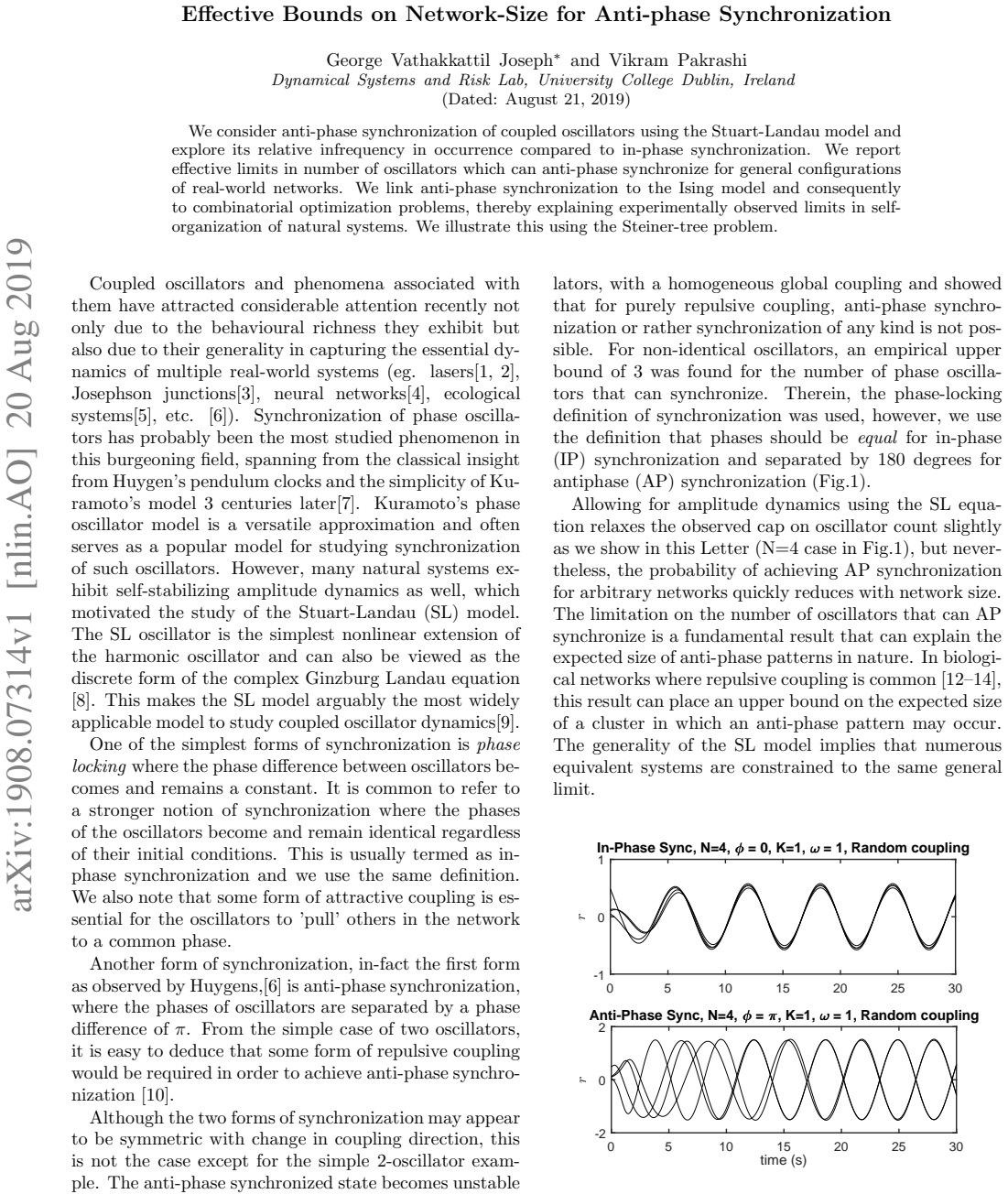
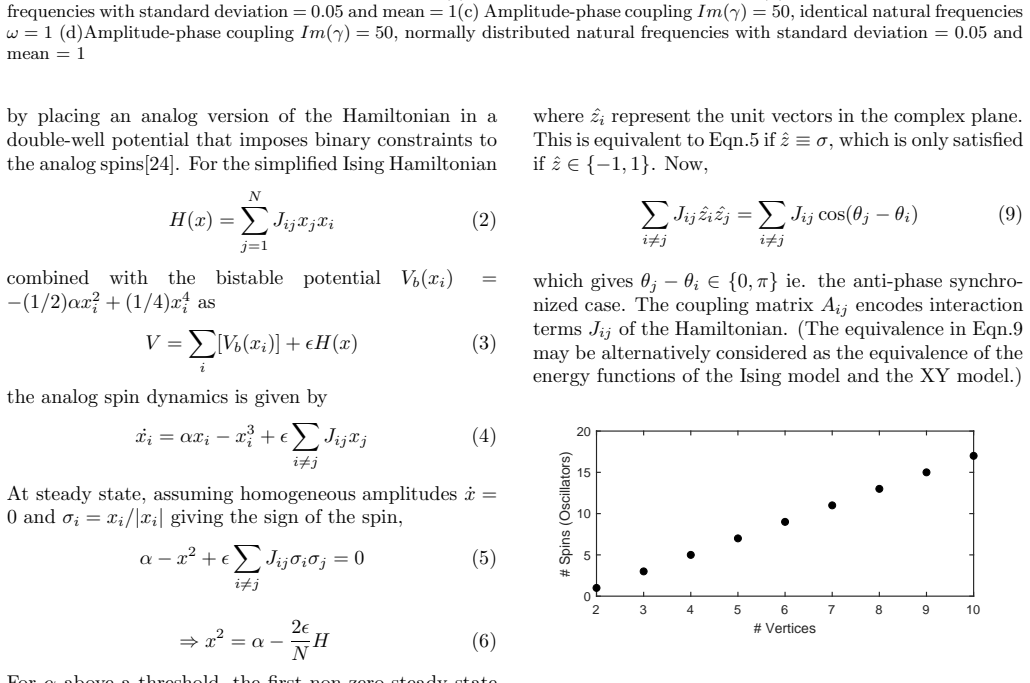
The paper's central claim is that a network of Stuart-Landau oscillators with repulsive coupling reaches anti-phase synchronization precisely when every oscillator phase locks to $0$ or $\pi$, so each oscillator acts as an Ising spin $\sigma_i=\pm1$. In that regime the coupling sum in the Stuart-Landau steady state is identified with the Ising Hamiltonian $\sum_j J_{ij}\sigma_i\sigma_j$, making the oscillator network an analog solver for Ising-type optimization problems. Numerical trials over homogeneous, random, bisymmetric, and cross-diagonal-weakened coupling matrices show that the probability $P(\mathrm{AP\text{-}Sync})$ falls below $1/2$ by about $N=6$ under general conditions, rises to roughly $N=8$ for specially weakened cross-coupling, and can be removed entirely for even $N$ when strong amplitude-phase coupling is present, while spread in natural frequencies makes $N>6$ almost impossible. Applying the Ising formulation to the Steiner-tree problem, whose maximal spin count is $s(V)=2V-3$ for $V$ vertices, puts instances with $V>4$ outside the reliable self-organizing regime, matching the soap-bubble experiments.
Load-bearing premise
The bridge to the Ising model depends on one algebraic equivalence: that the product of two oscillator phases can be replaced by the cosine of their phase difference, so that only phase differences of $0$ or $\pi$ survive; if that equivalence fails, the spin picture and the derived size bound do not follow.
Editorial extensions
If this is right
- Biological or physical networks with predominantly repulsive coupling should rarely exhibit anti-phase patterns beyond about six units, so observed anti-phase clusters in nature are expected to be small.
- Any optimization problem encoded as an Ising Hamiltonian inherits an effective self-organization limit: instances requiring more than roughly six binary variables are unlikely to reach their ground state through unassisted analog dynamics.
- For the Steiner-tree problem, the $2V-3$ spin count places $V\le4$ in the reliable regime and $V>4$ outside it, giving a quantitative explanation of why soap bubbles solve three- and four-peg instances but get stuck on larger ones.
- Strong amplitude-phase coupling (anisochronicity) can lift the size barrier for even-sized networks, so the bound is not universal; it depends on oscillator parameters and coupling structure.
- A spread in natural frequencies, as expected in real oscillators, tightens the bound further, with $P(\mathrm{AP\text{-}Sync})$ dropping below $0.1$ for $N>6$.
Reading between the lines
- Inference: the same N = 6 threshold should appear in other physical implementations of Ising optimization, such as coupled lasers or parametric oscillator networks, if the mechanism is generic; measuring ground-state success probability versus spin count would test this transfer.
- Inference: the even/odd distinction and the benefit of bisymmetry suggest that symmetry, not only size, controls the threshold; controlled experiments varying only the symmetry of random coupling could separate these effects.
- Inference: the bound concerns spontaneous self-organization from random initial conditions; it does not rule out solving larger Ising instances with annealing or engineered initial states, so it is a statement about autonomous physical dynamics rather than computational hardness.
- Inference: the maximal spin count $2V-3$ assumes all possible edges participate; for sparser Steiner-graph encodings the threshold in $V$ could shift, giving a testable prediction that the soap-bubble limit depends on how the problem is encoded.
Signed reviews
Editorial analysis
A structured set of objections, weighed in public.
Referee Report
Summary. The manuscript studies anti-phase (AP) synchronization in networks of Stuart-Landau oscillators with repulsive coupling. It numerically estimates the probability P(AP-Sync) that a network of N oscillators reaches a 0/π phase pattern, for homogeneous, random, bisymmetric, and cross-diagonal-weakened coupling matrices, with and without frequency detuning and amplitude-phase coupling. The authors then attempt to connect AP synchronization to the Ising model by identifying ±1 spins with 0/π phases, derive an effective upper bound of about N=6 oscillators (below 50% synchronization probability), and use this bound together with a 2V−3 spin mapping to argue that soap-bubble Steiner trees find optimal solutions only for V≤4. The stated contribution is a physical explanation for observed size limits in self-organizing combinatorial optimization.
Significance. If valid, the paper would offer a novel and broad link between amplitude-mediated synchronization and the difficulty of self-organized combinatorial optimization. The numerical probability curves for AP synchronization under different network topologies are a useful empirical addition, and the identification of 0/π phase patterns with binary variables is intuitive. However, the central derivation connecting the Stuart-Landau steady state to the Ising ground state contains a false algebraic identity, and the manuscript does not establish that AP-synchronized configurations selected by the dynamics are global minima of the corresponding Ising Hamiltonian. The predicted Steiner-tree limit is obtained by applying the same empirically fitted threshold that it is meant to explain, so the explanatory claim is not independently tested.
major comments (5)
- [Eq. (9)] The equality ∑_{i≠j} J_{ij} \hat z_i \hat z_j = ∑ J_{ij} cos(θ_j−θ_i) is algebraically false for \hat z_i = e^{iθ_i}: the real part of the product is cos(θ_i+θ_j), not the cosine of the phase difference. Even taking real parts, the identity does not hold as written. Since this equality is the only step connecting the complex steady-state equation to the real Ising equation, the derivation of the claimed equivalence collapses at this point. If the intended expression was ∑ J_{ij} z_j/z_i = ∑ J_{ij}e^{i(θ_j−θ_i)}, that ratio differs from the product in Eq. (8) and still requires justification.
- [Eqs. (7)-(8)] Equation (8) does not follow from Eq. (7). Dividing Eq. (7) by z_i at steady state gives α + iω − |z_i|² + ε∑_{i≠j} J_{ij} z_j/z_i = 0, so the coupling term involves the ratio of complex amplitudes, not the product \hat z_i \hat z_j. The manuscript silently replaces the ratio with the product, which is only valid when each phase is 0 or π. This is a second algebraic gap in the same derivation, and it is not merely a typo because it changes the structure of the steady-state equation.
- [Eqs. (5)-(8) and interpretation of P(AP-Sync)] Even after repairing the algebra, the steady-state condition for a uniform amplitude r is a single scalar equation, α + iω − r² + ε∑_{i≠j} J_{ij} σ_i σ_j = 0, which can be satisfied for every binary configuration by adjusting r. The argument imported from Ref. [24] that the first nonzero steady state gives the global minimum of H is not shown to hold for the Stuart-Landau system in Eq. (1), which has diffusive coupling, explicit amplitude dynamics, and a different coupling phase. The reported P(AP-Sync) only records whether a 0/π pattern appears from random initial conditions; it does not compare the Ising energy of the final pattern with the energies of all 2^N configurations. Consequently, the paper does not establish that AP synchronization selects Ising ground states, which is the essential step for the optimization claim.
- [Steiner-tree prediction and Fig. 3] The bound N≈6 is read off from the same numerical curves that are then used to predict the observed V≤4 limit, so the explanation is not an independent test. In addition, the mapping s(V)=2V−3 is stated for the maximal number of edges and Steiner points, but no argument is given that the Ising spin count in this formulation corresponds to the number of AP-synchronized oscillators in the dynamical system or to the topology of the soap-film experiment. The agreement with the three-to-four peg observation is therefore a qualitative matching of a fitted threshold rather than a falsifiable prediction.
- [Fig. 2 and definition of P(AP-Sync)] The probability P(AP-Sync) is never defined formally, the number of trials is not reported, no error bars are shown, and the parameter regimes for 'random', 'bisymmetric', and 'weak cross-diagonal' networks are not specified precisely. Because the quantitative N≈6 threshold is the paper's central result, these omissions make the empirical bound impossible to evaluate or reproduce from the manuscript alone.
minor comments (4)
- [Abstract and Introduction] There are several typographical errors, including 'in-fact' for 'in fact' and 'Fig2a)' for 'Fig. 2(a)'; the manuscript would benefit from a careful proofread.
- [Eqs. (2) and (9)] The sentence following Eq. (9), which refers to an equivalence of the energy functions of the Ising model and the XY model, is vague and should either be removed or expanded into a precise statement.
- [Steiner tree formulation] The claim that the maximum number of Steiner points is V−2 should be qualified: it holds for the Euclidean Steiner tree problem, but the manuscript does not specify whether the Ising formulation applies to the Euclidean or graph version of the problem.
- [References] Several references contain encoding artifacts, for example 'Rhm, Ldge' in Ref. [9] and 'Garca-Morales' in Ref. [8]; these should be corrected to standard forms.
Circularity Check
The AP-sync/Ising equivalence is imposed by identifying binary phases with spins, so the Steiner-tree limit is the simulated N≈6 threshold restated.
-
self definitional
[Eqs. (8)-(9) and final paragraph ('Consider the Steiner tree problem...')]
"This is equivalent to Eqn.5 if ˆz ≡ σ, which is only satisfied if ˆz ∈ {−1, 1}. Now, ∑ i⁄=j Jij ˆzi ˆzj = ∑ i⁄=j Jij cos(θj − θi) (9) which gives θj − θi ∈ { 0, π} ie. the anti-phase synchronized case. The number of spins required exceeds 6 as V > 4, implying that the probability of a system finding an optimal Steiner tree by self organizing for V > 4 is small whereas for trees with 3 or 4 vertices, it usually finds the optimal solution, agreeing with the experiments [21]."
The claimed equivalence between the SL steady state (Eqn.8) and the Ising steady state (Eqn.5) is made by requiring \hat z≡σ and \hat z∈{−1,1}; but 'phases separated by a phase difference of π' is exactly how the paper defines anti-phase synchronization, so {−1,1} is the AP-sync state space by definition. With that identification, Eqn.8 and Eqn.5 coincide by construction; no dynamical or energy comparison shows that Eqn.1's diffusive dynamics selects the global minimum of H rather than any 0/π pattern. The final Steiner paragraph then converts the numerically obtained N≈6 threshold to s(V)=2V−3, so the 'prediction' for V>4 is the Fig.2 P(AP-Sync) curve re-expressed in spin variables, not an independently derived bound.
full rationale
The paper's central inference—that AP synchronization limits explain the Steiner-tree size limit—rests on identifying the 0/π phase states with Ising spins. This identification is not derived from the dynamics; it is imposed by the statement 'ˆz ≡ σ' and 'ˆz ∈ {−1,1}', which is exactly the definition of anti-phase synchronization. Consequently, the steady-state equation (8) becomes the Ising steady state only after assuming the AP-sync subspace, and nothing in the paper shows that the simulated SL network selects the ground state of H as opposed to any binary phase pattern. The final jump to Steiner trees uses the same simulated N≈6 threshold (from Fig.2) and then maps vertices to spins via s(V)=2V−3, so the 'explanation' is a restatement of the fitted probability curve, not an independent prediction. The algebraic slip in Eqn.9 reinforces the point but is secondary to the definitional circularity.
Assumptions & free parameters
free parameters (5)
- Coupling phase phi =
pi
- Base parameters (lambda, K, gamma) =
(1, 3, 1)
- Frequency spread standard deviation =
0.05
- Amplitude-phase coupling Im(gamma) =
50
- Weak cross-diagonal threshold =
close to 0
assumptions (4)
- domain assumption Stuart-Landau model is a universal enough description of coupled oscillators for the results to apply to general real-world networks.
- ad hoc to paper The steady state of the complex generalization of the coherent Ising machine (Eqn.7) is equivalent to the real Ising steady state (Eqn.5).
- domain assumption Numerical probability over random coupling matrices with specific distributions represents general configurations of real-world networks.
- ad hoc to paper The number of binary variables needed to formulate the Steiner tree problem as an Ising model is 2V-3.
Cite this review
Pith. "Pith review of Effective Bounds on Network-Size for Anti-phase Synchronization." pith.science (2026). https://pith.science/paper/6MRTVPKZ
@misc{pith2026190807314,
  author       = {Pith},
  title        = {Pith review of: Effective Bounds on Network-Size for Anti-phase Synchronization},
  year         = {2026},
  howpublished = {\url{https://pith.science/paper/6MRTVPKZ}},
  note         = {Machine review of arXiv:1908.07314}
}
read the original abstract
We consider anti-phase synchronization of coupled oscillators using the Stuart-Landau model and explore its relative infrequency in occurrence compared to in-phase synchronization. We report effective limits in number of oscillators which can anti-phase synchronize for general configurations of real-world networks. We link anti-phase synchronization to the Ising model and consequently to combinatorial optimization problems, thereby explaining experimentally observed limits in self-organization of natural systems. We illustrate this using the Steiner-tree problem.
Figures

Reference graph
Works this paper leans on
- [24]
-
[1]
G. Kozyreff, A. G. Vladimirov, and P. Mandel, Phys. Rev. Lett. 85, 3809 (2000)
work page 2000
- [2]
-
[3]
J. R. Phillips, H. S. J. van der Zant, J. White, and T. P. Orlando, Phys. Rev. B 47, 5219 (1993)
work page 1993
- [4]
-
[5]
T. Banerjee, P. S. Dutta, A. Zakharova, and E. Sch¨ oll, Phys. Rev. E 94, 032206 (2016)
work page 2016
-
[6]
S. Boccaletti, A. N. Pisarchik, C. I. del Genio, and A. Amann, Synchronization: From Coupled Systems to Complex Networks (Cambridge University Press, 2018)
work page 2018
-
[7]
S. H. Strogatz, Physica D: Nonlinear Phenomena 143, 1 (2000)
2000
Show all 24 references
-
[8]
Garca-Morales and K
V. Garca-Morales and K. Krischer, Contemporary Physics 53, 79 (2012)
2012
-
[9]
A. Rhm, K. Ldge, and I. Schneider, Chaos: An Interdisciplinary Journal of Nonlinear Science 28, 063114 (2018)
2018
-
[10]
Kim, T.-W
P.-J. Kim, T.-W. Ko, H. Jeong, and H.-T. Moon, Phys. Rev. E 70, 065201 (2004)
2004
-
[11]
L. S. Tsimring, N. F. Rulkov, M. L. Larsen, and M. Gab- bay, Phys. Rev. Lett. 95, 014101 (2005)
2005
-
[12]
Myung, S
J. Myung, S. Hong, D. DeWoskin, E. De Schut- ter, D. B. Forger, and T. Takumi, Proceedings of the National Academy of Sciences 112, E3920 (2015)
2015
-
[13]
Bal´ azsi, A
G. Bal´ azsi, A. Cornell-Bell, A. B. Neiman, and F. Moss, Phys. Rev. E 64, 041912 (2001)
2001
-
[14]
Ullner, A
E. Ullner, A. Zaikin, E. I. Volkov, and J. Garc ´ ıa-Ojalv o, Phys. Rev. Lett. 99, 148103 (2007)
2007
-
[15]
J. Kim, J. E. Straub, and T. Keyes, Phys. Rev. Lett. 97, 050601 (2006)
2006
-
[16]
Imparato, A
A. Imparato, A. Pelizzola, and M. Zamparo, Phys. Rev. Lett. 98, 148102 (2007)
2007
-
[17]
Bouchaud, Journal of Statistical Physics 151, 567 (2013)
J.-P. Bouchaud, Journal of Statistical Physics 151, 567 (2013)
2013
-
[18]
Lucas and C
A. Lucas and C. H. Lee, Phys. Rev. E 87, 032806 (2013)
2013
-
[19]
Lucas, Frontiers in Physics 2, 5 (2014)
A. Lucas, Frontiers in Physics 2, 5 (2014)
2014
-
[20]
F. K. Hwang and D. S. Richards, Networks 22, 55 (1992)
1992
-
[21]
Aaronson, SIGACT News 36, 30 (2005)
S. Aaronson, SIGACT News 36, 30 (2005)
2005
-
[22]
B. D. MacArthur, R. J. Snchez-Garca, and J. W. Ander- son, Discrete Applied Mathematics 156, 3525 (2008)
2008
-
[23]
B¨ ohm, A
F. B¨ ohm, A. Zakharova, E. Sch¨ oll, and K. L¨ udge, Phys. Rev. E 91, 040901 (2015)
2015
Reviewed August 14, 2026 · model on record in the stance chip above.
Discussion (0). Continue with ORCID to comment.