REVIEW 4 major objections 4 minor 30 references
Rotational laser spectroscopy of the $X^1\Sigma_g^+\rightarrow B^1\Pi_u$ transition of $\text{Rb}_2$ molecule in a supersonic beam: As good as it gets
T0 review · 4 major / 4 minor · reviewed 2026-08-14 · deepseek-v4-flash
Pith's one-line read A 958-transition laser study of three Rb2 isotopologues determines the first Lambda-doubling constant for the B^1Πu state and refines its Dunham coefficients.
desk verdict New high-resolution Rb2 B1Pi_u data and a first p0 determination, but the global fit rests on model-reconstructed 'data' and the error bars likely undercount; worth a careful referee. read the letter →
The pith
A machine-rendered reading of the paper's core claim, the machinery that carries it, and where it could break.
The reading
What carries the argument
The argument rests on the Dunham expansion of the excited-state energy with an explicit $\Lambda$-doubling term, $$E'(i)(v',J',\pm)/hc = \sum_{k,l} Y'_{kl}\,\$rho_i^{{k/2+l}}$(v'+\tfrac12)^k [J'(J'+1)-1]^l \pm \tfrac12\left[p_0\$rho_i^{{1/2}}$X' + q_0\rho_i X'^2\right],$$ where $X'=J'(J'+1)-1$ and $\rho_i$ is the reduced-mass ratio of each isotopologue. The $\pm$ term separates the parity components of the $\Pi$ state and carries the new $\Lambda$-doubling physics; $p_0$ is the zeroth-order constant extracted by the fit. The same expansion, with ground-state coefficients held fixed from an earlier direct-potential analysis, turns every measured line into a constraint on the excited-state parameters. A weighted global least-squares fit then combines the low-$J'$ information from the new beam spectra with the broad vibrational coverage of the older dataset.
What would settle it
Recover the original transition frequencies of the older dataset and repeat the same weighted global fit with the 709 new transitions; if the resulting $Y'_{k,l}$ and $p_0$ move outside their quoted one-standard-deviation uncertainties, the reconstruction-based claims are not supported.
Extended reading notes
Core claim
The central claim is that a global analysis of new high-resolution beam spectra together with the earlier Fourier-transform dataset yields the most accurate low-$J'$ description of the $B^1\Pi_u$ state of Rb2 available. The paper determines the first $\Lambda$-doubling constant of this state, $p_0 = (4.28\pm0.21)\times10^{-7}\ \mathrm{cm^{-1}}$, and it sharpens the rotational and rovibrational coupling constants by roughly an order of magnitude compared with the earlier values. The new data consist of 958 assigned transitions in the $X^1\Sigma_g^+\to B^1\Pi_u$ bands for $^{85}$Rb$_2$, $^{85}$Rb$^{87}$Rb, and $^{87}$Rb$_2$; for the $v''=1\to v'=1$ band of $^{87}$Rb$_2$ no transitions could be assigned. The authors emphasize that the purely vibrational coefficients remain anchored by the older data, since only $v'=1$ and $v'=2$ are directly sampled here.
Load-bearing premise
The global-fit conclusions rest on treating the 611 excited-state levels reconstructed from the published figure and coefficients of the older study as faithful stand-ins for the original measured levels; if that reconstruction is biased, the claimed refinements inherit the bias.
Editorial extensions
If this is right
- Low-$J'$ term values of the $B^1\Pi_u$ state can now be predicted for all three isotopologues with uncertainties near $10^{-4}\ \mathrm{cm^{-1}}$, an order-of-magnitude improvement over the earlier model in the probed region.
- The measured $\Lambda$-doubling $p_0$ fixes the parity splitting for the $v'=1$ and $v'=2$ levels, removing a free parameter from double-resonance and ionization schemes that pass through this state.
- Improved values of $Y'_{0,1}$, $Y'_{1,1}$, and $Y'_{0,2}$ make the $B$ state a more reliable intermediate level for resonantly enhanced two-photon ionization and for proposed laser-cooling routes for Rb2.
- The global fit preserves the high-$v'$ vibrational description of the older dataset while reducing the combined residual scatter to $\sigma = 6.6\times10^{-4}\ \mathrm{cm^{-1}}$.
Reading between the lines
- Beyond the paper: if the new $p_0$ survives independent checks, it becomes a quantitative benchmark for ab initio calculations of $\Lambda$-doubling in the Rb2 $B$ state, a quantity that electronic-structure methods rarely predict to better than tens of percent.
- Beyond the paper: because the fit residuals against the older dataset are largest at the lowest $v'$ levels, a direct potential-curve fit of the $B$ state may eventually absorb the small systematic deviations that a Dunham expansion leaves behind.
- Beyond the paper: extending the beam spectra to $v'=3$ and beyond, and assigning the $v''=1\to v'=1$ band of $^{87}$Rb$_2$, would test whether the improved constants extrapolate outside the two vibrational levels fitted here.
Editorial analysis
A structured set of objections, weighed in public.
Referee Report
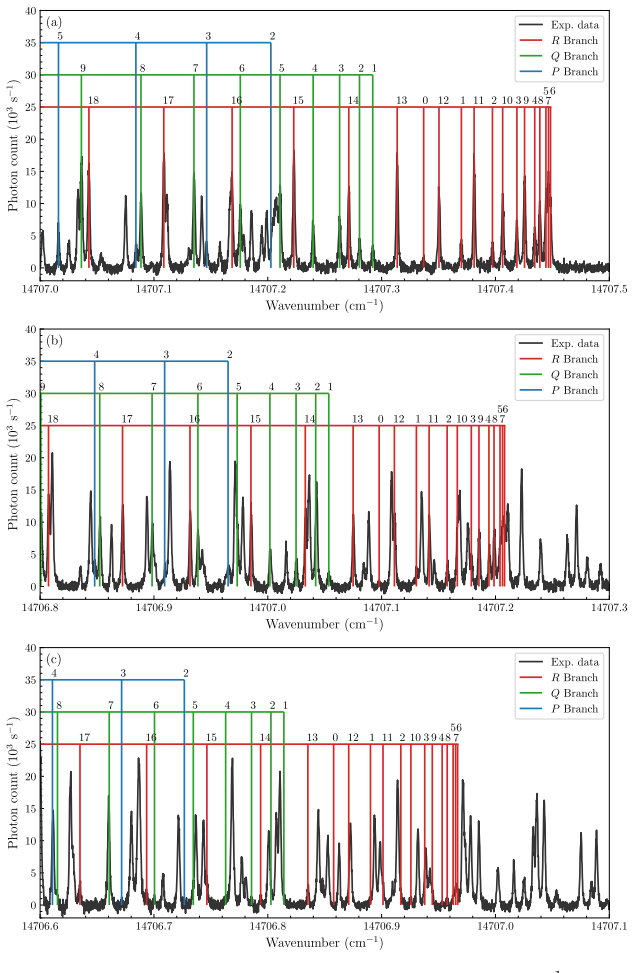
Summary. The paper reports cw-diode-laser fluorescence spectroscopy of Rb₂ in a supersonic beam, resolving the R, Q, and P branches of the X¹Σ₉⁺ → B¹Πᵤ bands for ⁸⁵Rb₂, ⁸⁵Rb⁸⁷Rb, and ⁸⁷Rb₂. A total of 958 rovibronic transitions were recorded, of which 709 (excluding the v″ = 1 band) were used in a least-squares fit to determine rotational, rovibrational, and Λ-doubling parameters of the B¹Πᵤ state. The main new result is a first determination of the Λ-doubling constant p₀, with p₀ = (4.28 ± 0.21) × 10⁻⁷ cm⁻¹ in the band-origin treatment. The paper also presents a 'global' fit that combines the new transitions with excited-state levels attributed to the earlier work of Amiot and Vergès [18], and uses the resulting Table 5 to claim improved Dunham coefficients for the B state.
Significance. If the standalone Section 4 analysis is accepted, the work provides a valuable high-resolution, three-isotopologue data set with dense low-J coverage of the B¹Πᵤ state, plus the first Λ-doubling constant for this state, which is relevant for spectroscopy and for applications such as laser-cooling proposals and ultracold-molecule studies. The reported residual scatter, 2.8 × 10⁻⁴ cm⁻¹, shows that the fit to the new data is internally consistent. The Section 5 global fit, however, is not an independent combination of measured data sets, and therefore the abstract's claim of improved Dunham coefficients from combining new and published data is not supported as stated. The stress-test concern about circularity lands directly on Section 5 and Table 5.
major comments (4)
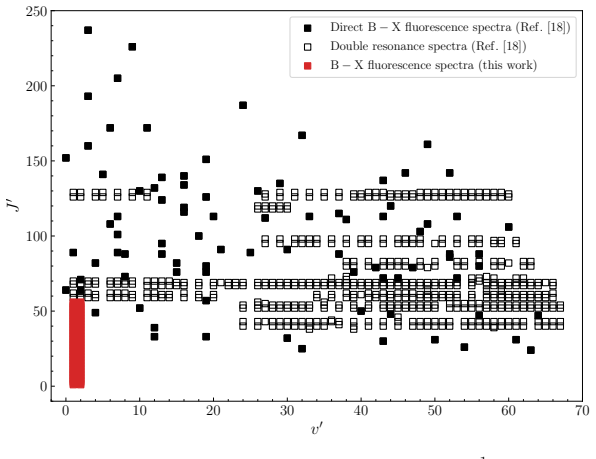
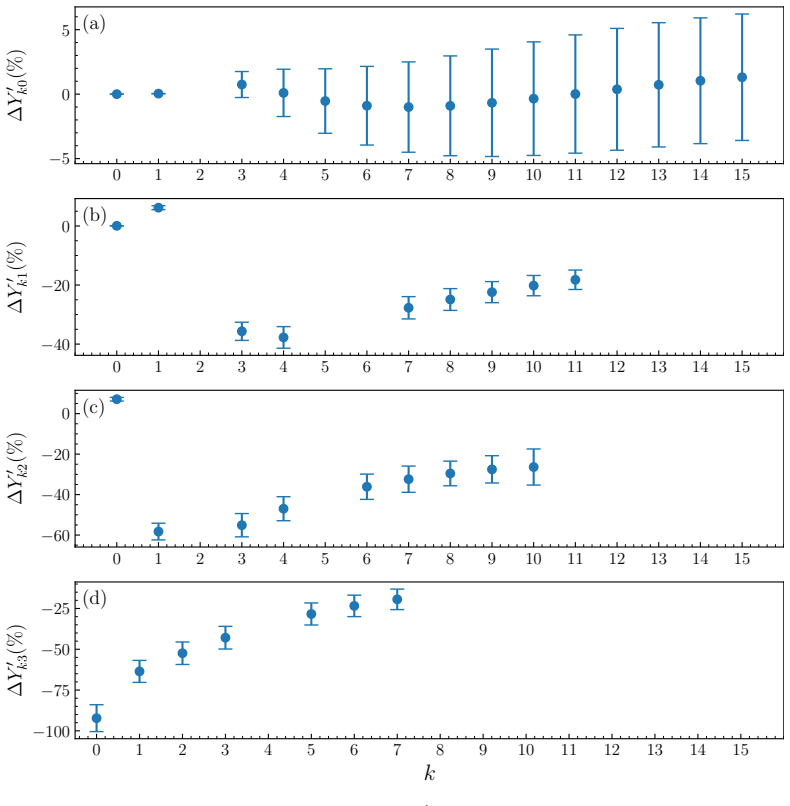
- [Section 5] The 611 excited-state levels included in the global fit are not measured data: they were extracted from Fig. 5 of Ref. [18] and reconstructed using the Dunham coefficients reported in that same paper. These are therefore model-generated points that already encode the Amiot–Vergès parameterization. Including such noiseless pseudo-levels in the least-squares objective acts as a regularizing penalty that pulls the fitted coefficients toward the Amiot–Vergès values; Table 5's relative deviations, such as ΔY'₁₁ = +6.2 ± 0.7% and ΔY'₁₂ = −58.3 ± 4.1%, are not independent evidence of improvement. The abstract's statement that 'a global least-squares analysis combining the new and published data yields improved Dunham coefficients' is therefore not supported. The authors should either obtain and use the original measured transitions/levels of Ref. [18], or explicitly reframe Section 5 as a constrained fit that inherits the high-v' behavior from the Amiot–Vergès model and remove the claim of independent improvement.
- [Section 4, Tables 3 and 4] The quoted statistical uncertainties do not include any systematic error budget, despite a linewidth of about 60 MHz, a spectral step of 10 MHz, and a wavelength calibration based on a wavemeter and iodine cell. For example, Y'₀₁ is reported as (1.955797 ± 0.000018) cm⁻¹, i.e. about ±0.54 MHz; with 60 MHz-wide lines and 10 MHz steps, such a claim requires a careful discussion of peak-center determination and absolute calibration accuracy. The authors should provide an explicit error budget, including the iodine-cell calibration uncertainty, and state whether the reported 2.8 × 10⁻⁴ cm⁻¹ residual scatter is a precision or an accuracy statement.
- [Section 5, Fig. 7] The global fit weights the reconstructed Amiot–Vergès levels with σ_A = 4.9 × 10⁻³ cm⁻¹ as though they were independent experimental measurements. Since these points are noiseless model outputs reconstructed from Dunham coefficients, this weighting is not a measurement-noise weighting; it is an arbitrary choice that controls how strongly the fit is pulled toward the old model. Consequently, the reported global standard deviation σ = 6.6 × 10⁻⁴ cm⁻¹ and the residual plot in Fig. 7 are not meaningful goodness-of-fit diagnostics for the combined data set, and the interpretation in terms of 'agreement' between data sets is not justified.
- [Section 6 and Abstract] The conclusion that the global fit 'provides a more complete and accurate description of the excited-state structure' is overstated. The high-v' pure-vibrational and high-order rotational parameters in Table 5 are essentially inherited from the Amiot–Vergès model because the pseudo-levels are generated from that model. The independently supported new results are the Section 4 parameters and p₀; the manuscript should be revised so that the abstract, highlights, and conclusion are limited to what the new data actually establish unless the original data of Ref. [18] become available.
minor comments (4)
- [Table 5] Many entries in Table 5 report far more digits than the uncertainties justify (e.g., Y'₁₅,₀ = −(1.0962854880 ± 0.00173806) × 10⁻²¹ cm⁻¹); the values and uncertainties should be rounded consistently to the last significant digit.
- [Section 3] The 'spectral resolution' of 3.3 × 10⁻⁴ cm⁻¹ is the 10 MHz scan step, while the observed linewidth is about 60 MHz; the manuscript should clarify how the central positions of peaks were determined and whether the quoted resolution represents the step size or the actual line-position uncertainty.
- [Eq. (1)] The sentence 'The terms l > 1 account for high-order anharmonic corrections' is imprecise: l = 2 and higher terms in X'' are centrifugal-distortion terms, not anharmonic corrections; the wording should be corrected.
- [Section 5, Fig. 6] The caption of Fig. 6 says that the 112 red squares are 'levels experimentally accessed in the present work for ⁸⁵Rb₂', but Table 2 shows additional levels for ⁸⁵Rb⁸⁷Rb and ⁸⁷Rb₂; the figure should either include all isotopologues or explain why only one isotopologue is shown.
Circularity Check
The global fit of Section 5 is partly circular: the 'Amiot-Vergès data' are synthetic levels reconstructed from Ref. [18]'s own Dunham coefficients, so Table 5's claimed improvement over Ref. [18] is partly forced by construction; the Section 4 determination of p0 and the standalone new-data fit remain independent.
-
self definitional
[Section 5 (Global Determination of Molecular Parameters Using Present and Literature Data), paragraph beginning 'Since the transition frequencies and rovibronic states reported in Ref.]
"Since the transition frequencies and rovibronic states reported in Ref. [18] are not publicly available, the excited-state rovibronic levels included in their analysis were extracted from Fig. 5 of that work. The corresponding energy levels were then reconstructed using the Dunham coefficients reported therein."
The 611 'Amiot and Vergès levels' used as literature data in the global fit are not measured levels: the paper says they were extracted from Fig. 5 and reconstructed using the Dunham coefficients reported therein. So the input 'published data' are functions of the very Ref. [18] coefficients that Table 5 compares against. Least-squares fitting these noiseless, model-generated points with the same Dunham expansion (Eq. 3) pulls the fitted coefficients back toward the generating model; the global fit is a regularized blend of new data and old model, not an independent combination of data sets.
full rationale
The paper contains two distinct analyses. Section 4 is self-contained: it fits 709 genuinely new, measured transitions and determines the Lambda-doubling constant p0 = (4.27±0.21)×10^-7 cm^-1 with a standalone standard deviation of 2.8×10^-4 cm^-1. This part does not rely on any reconstructed or self-generated data, and its low-order rotational and rovibrational coefficients are independent experimental results. The circularity is confined to Section 5, where the 'published data' of Amiot and Vergès are not original transition frequencies but 611 energy levels reconstructed from Ref. [18]'s own Dunham coefficients. Including these synthetic levels in the global least-squares objective means the fitted high-order coefficients are partly a restatement of the input model, so the global fit's comparison with Ref. [18] in Table 5 does not provide independent validation of improvement. Nevertheless, the p0 determination is unaffected: it is obtained from the new transitions alone in Section 4 and is unchanged within uncertainty in the alternative fitting strategy of Table 4. The score of 6 reflects the partial circularity in the global-fit claim, while acknowledging that the central Lambda-doubling constant and the new-data fit stand on their own.
Assumptions & free parameters
free parameters (6)
- p0 =
4.28e-7 cm^-1 (Table 4)
- Y'0,1 =
1.955797e-2 cm^-1 (Table 4)
- Y'1,1 =
-5.9763e-5 cm^-1 (Table 4)
- Y'0,2 =
-1.3273e-8 cm^-1 (Table 4)
- Y'1,2 =
-1.81e-10 cm^-1 (Table 4)
- Six band origins =
e.g., nu(1)(0,1) = 14707.31751 cm^-1 (Table 4)
assumptions (4)
- standard math The Dunham expansion (Eqs. 1-3) provides an adequate description of the rovibrational energies of Rb2 in the X and B states.
- domain assumption Ground-state Dunham coefficients of Seto et al. [26] are exact and held fixed throughout.
- domain assumption Lambda-doubling can be described by a single zeroth-order constant p0; q0 is negligible.
- ad hoc to paper The 611 levels reconstructed from the Amiot-Verges Dunham coefficients faithfully represent the original experimental dataset of [18].
Cite this review
Pith. "Pith review of Rotational laser spectroscopy of the $X^1\Sigma_g^+\rightarrow B^1\Pi_u$ transition of $\text{Rb}_2$ molecule in a supersonic beam: As good as it gets." pith.science (2026). https://pith.science/paper/6NRHQDMZ
@misc{pith2026260808912,
  author       = {Pith},
  title        = {Pith review of: Rotational laser spectroscopy of the $X^1\Sigma_g^+\rightarrow B^1\Pi_u$ transition of $\textRb_2$ molecule in a supersonic beam: As good as it gets},
  year         = {2026},
  howpublished = {\url{https://pith.science/paper/6NRHQDMZ}},
  note         = {Machine review of arXiv:2608.08912}
}
abstract
High-resolution laser spectroscopy of the $^{85}\mathrm{Rb}_2$, $^{85}\mathrm{Rb}^{87}\mathrm{Rb}$, and $^{87}\mathrm{Rb}_2$ isotopologues has been performed in a supersonic molecular beam using a continuous-wave (cw) tunable diode laser. A total of 958 rovibronic transitions were recorded up to $7~\mathrm{cm}^{-1}$ below the vibrational band heads of the $X^1\Sigma_g^+(v''=0)\rightarrow B^1\Pi_u(v'=1,2)$ and $X^1\Sigma_g^+(v''=1)\rightarrow B^1\Pi_u(v'=1)$ bands, with a spectral resolution of $3.3\times10^{-4}$~cm$^{-1}$. Although restricted to the $v'=1$ and $v'=2$ vibrational levels of the excited $B^1\Pi_u$ state, the measurements extend previous work by Amiot and Verg\`es [Chemical Physics Letters 274, 91 (1997)] through substantially higher resolution and dense low-$J'$ rotational data for all three isotopologues. A global least-squares analysis combining the new and published data, yields improved Dunham coefficients for the excited $B^1\Pi_u$ state, significantly refines rotational and rovibrational coupling constants. In addition, the $\Lambda$-doubling constants of $B^1\Pi_u$ state were determined for the three isotopologues.
Figures


Figures from the paper (5 more)


Reference graph
Works this paper leans on
-
[18]
C. Amiot and J. Vergès. Optical-optical double resonance and fourier transform spectroscopy: TheRb 2 B1Πu electronic state up to the qua- sibound energy levels.Chemical Physics Letters, 274:91–98, 8 1997
work page 1997
-
[1]
N. Ramsey.Molecular Beams. Oxford University Press, Oxford, 1956
work page 1956
- [2]
-
[3]
W.C. Stwalley and H. Wang. Photoassociation of ultracold atoms: a new spectroscopic technique.J. Mol. Spectrosc., 195:194, 1999
work page 1999
-
[4]
Stwalley, Michael Bellos, Ryan Carollo, Jayita Banerjee, and Matthew Bermudez
William C. Stwalley, Michael Bellos, Ryan Carollo, Jayita Banerjee, and Matthew Bermudez. Shortcuts for understanding rovibronic spec- troscopy of ultracold alkali metal diatomic molecules.Molecular Physics, 110(15-16):1739–1755, 2012. 21
work page 2012
-
[5]
Laser synthesis of ultracold alkali metal dimers: optimization and con- trol.Russ
E.A.Pazyuk, A.V.Zaitsevskii, A.V.Stolyarov, M.Tamanis, and R.Ferber. Laser synthesis of ultracold alkali metal dimers: optimization and con- trol.Russ. Chem. Rev., 84:1001–1020, 2015
work page 2015
-
[6]
C. Amiot. Analysis of the spectra obtained by cold-atom photoassocia- tionspectroscopy: the Rb2 1g and0 − g electronic state up to 100 å.Chem. Phys. Lett., 241:133, 1995
work page 1995
- [7]
Show all 30 references
-
[8]
J. Bai, E. H. Ahmed, B. Beser, Y. Guan, S. Kotochigova, , A. M. Lyyra, S. Ashman, C. M. Wolfe, J. Huennekens, F. Xie, D. Li, L. Li, M. Tama- nis, R. Ferber, A. Drozdova, E. Pazyuk, A. V. Stolyarov, J. G. Danzl, H.- C. Nägerl, N. Bouloufa, O. Dulieu, C. Amiot, H. Salami, and T....
2011
-
[9]
TheC(2) 1Πu state in Rb2
Asen Pashov, Pawel Kowalczyk, Jacek Szczepkowski, and Wlodzimierz Jastrzebski. TheC(2) 1Πu state in Rb2. observation and deperturbation. Spectrochimica Acta Part A: Molecular and Biomolecular Spectroscopy, 281:121624, 2022
2022
-
[10]
P. T. Arndt, V. B. Sovkov, J. Ma, X. Pan, D. S. Beecher, J. Y. Tsai, R. Livingston, V. M. Marcune, A. M. Lyyra, and E. H. Ahmed. Experi- mental study of the33Πg and4 3Σ+ g states of the rubidium dimer.Phys. Rev. A, 105:032823, Mar 2022
2022
-
[11]
J. T. Stahovich, B. A. Rowe, P. T. Arndt, A. D. Hersh, P. L. Wardach, J. P. Huennekens, V. B. Sovkov, A. M. Lyyra, and E. H. Ahmed. Exper- imental study of the31∆g and4 1∆g states of the Rb2 molecule.Phys. Rev. A, 109:012805, Jan 2024
2024
-
[12]
PhD thesis, L’Université Claude Bernard Lyon 1 en cotutelle avec Lomonosov Moscow State University, 9 2012
Anastasia Drozdova.Study of spin-orbit coumed electronics states of Rb2, NaCs and Nak molecules laser spectroscopy and accurate coupled- channel deperturbation analysis. PhD thesis, L’Université Claude Bernard Lyon 1 en cotutelle avec Lomonosov Moscow State University, 9 2012. 22
2012
-
[13]
Proposal for zeeman slowing of Rb2 molecules in a su- personic beam, inducing internal cooling.Journal of Physics B: Atomic, Molecular and Optical Physics, 56(6):065301, mar 2023
Manuel Alejandro Lefrán Torres, Henry Fernandes Passagem, David Rodríguez Fernández, Eduardo da Costa Paul, Cristian Adan Mo- jica Casique, Olivier Dulieu, Nadia Bouloufa-Maafa, and Luis Gus- tavo Marcassa. Proposal for zeeman slowing of Rb2 molecules in a su- personic beam, i...
2023
-
[14]
Ionization energy of Rb2 by electric field ionization of molecular rydberg states.Phys
Manuel Alejandro Lefrán Torres, David Rodríguez Fernández, Jaime Javier Borges Márquez, Marcos Roberto Cardoso, Luis Gustavo Mar- cassa, Amrendra Pandey, Romain Vexiau, Olivier Dulieu, and Nadia Bouloufa-Maafa. Ionization energy of Rb2 by electric field ionization of molecular...
2025
-
[15]
Nichols, Lingbang Zhu, Goulven Quéméner, Olivier Dulieu, and Kang-Kuen Ni
Ming-Guang Hu, Yu Liu, Matthew A. Nichols, Lingbang Zhu, Goulven Quéméner, Olivier Dulieu, and Kang-Kuen Ni. Nuclear spin conser- vation enables state-to-state control of ultracold molecular reactions. Nature Chemistry, 13:435–440, 2021
2021
-
[16]
Nichols, Dongzheng Yang, Daiqian Xie, Hua Guo, and Kang-Kuen Ni
Yu Liu, Ming-Guang Hu, Matthew A. Nichols, Dongzheng Yang, Daiqian Xie, Hua Guo, and Kang-Kuen Ni. Precision test of statistical dynamics with state-to-state ultracold chemistry.Nature, 593:379–384, 2021
2021
-
[17]
Highresolutionspectroscopyin supersonic nozzle beams: TheRb2 B1Πu−X 1Σ+ g band system.Chemical Physics, 54:21–31, 12 1980
C.D.Caldwell, F.Engelke, andH.Hage. Highresolutionspectroscopyin supersonic nozzle beams: TheRb2 B1Πu−X 1Σ+ g band system.Chemical Physics, 54:21–31, 12 1980
1980
-
[19]
Drozdova, X
A.N. Drozdova, X. Han, X. Dai, G. Wannous, P. Crozet, and A.J. Ross. On the2 1Πg state of the rubidium dimer.Journal of Molecular Spec- troscopy, 299:25–30, 2014
2014
-
[20]
Rubidium 85 d line data.University of Oregon, 2008
Daniel Adam Steck. Rubidium 85 d line data.University of Oregon, 2008
2008
-
[21]
High resolution laser 23 spectroscopy of iodine molecule in the14600−14710cm−1 range.Jour- nal of Molecular Spectroscopy, 387:111668, 5 2022
Manuel Alejandro Lefrán Torres, David Rodríguez Fernández, Mar- cos Roberto Cardoso, and Luis Gustavo Marcassa. High resolution laser 23 spectroscopy of iodine molecule in the14600−14710cm−1 range.Jour- nal of Molecular Spectroscopy, 387:111668, 5 2022
2022
-
[22]
High resolution laser spectroscopy of iodine molecule in the 14400-14600 cm−1 range.Journal of Molecular Spectroscopy, 395, 5 2023
David Rodríguez Fernández, Manuel Alejandro Lefrán Torres, Mar- cos Roberto Cardoso, Jorge Douglas Massayuki Kondo, and Luis Gus- tavo Marcassa. High resolution laser spectroscopy of iodine molecule in the 14400-14600 cm−1 range.Journal of Molecular Spectroscopy, 395, 5 2023
2023
-
[23]
See supplemental material at [url] for spectra and transition tables., 2026
2026
-
[24]
Virtanen and SciPy 1.0 Contributors
P. Virtanen and SciPy 1.0 Contributors. Scipy 1.0: fundamental algo- rithms for scientific computing in python.Nature Methods 2020 17:3, 17:261–272, 2 2020
2020
-
[25]
Atomic weights of the elements: Review 2000 (iupac technical report).Pure Appl
J R De Laeter, J K Böhlke, P De Bièvre, H Hidaka, H S Peiser, K J R Rosman, and P D P Taylor. Atomic weights of the elements: Review 2000 (iupac technical report).Pure Appl. Chem, 75:683–800, 2003
2000
-
[26]
Direct potential fit analysis of theX1Σ+ g state of Rb2: Nothing else will do!Journal of Chemical Physics, 113, 8 2000
Jenning Y Seto, Robert J Le Roy, Jean Vergès, and Claude Amiot. Direct potential fit analysis of theX1Σ+ g state of Rb2: Nothing else will do!Journal of Chemical Physics, 113, 8 2000
2000
-
[27]
Aldegunde and Jeremy M
J. Aldegunde and Jeremy M. Hutson. Hyperfine energy levels of alkali- metal dimers: Ground-state homonuclear molecules in magnetic fields. Physical Review A, 79:013401, 1 2009
2009
-
[28]
R. J. Le Roy. Uncertainty, sensitivity, convergence, and rounding in performing and reporting least-squares fits.Journal of Molecular Spec- troscopy, 191:223–231, 10 1998
1998
-
[29]
Robert J. Le Roy. Improved parameterization for combined isotopomer analysis of diatomic spectra and its application to HF and DF.Journal of Molecular Spectroscopy, 194:189–196, 4 1999
1999
-
[30]
Bouloufa, P
N. Bouloufa, P. Cacciani, R. Vetter, and A. Yiannopoulou. Sub-doppler spectroscopy of the LiH molecule: The A–X system.Journal of Molec- ular Spectroscopy, 202:37–43, 7 2000. 24 0 1 2 3 4 5 6 7 8 9 10 11 12 13 14 15 −5 0 5 ∆Y ′ k0(%) (a) 0 1 2 3 4 5 6 7 8 9 10 11 12 13 14 15 −...
2000
Reviewed August 14, 2026 · model on record in the stance chip above.
Discussion (0). Continue with ORCID to comment.