REVIEW 3 major objections 3 minor 33 references
Legendrian DGA Representations and the Colored Kauffman Polynomial
T0 review · 3 major / 3 minor · reviewed 2026-08-14 · deepseek-v4-flash
Pith's one-line read For any Legendrian knot, the ungraded n-dimensional DGA representation count equals the n-colored Kauffman polynomial at $a^{-1}=0$, so it depends only on the framed knot type.
desk verdict Genuinely closes the ungraded DGA-representation/Kauffman problem; the main counting lemma is plausible but needs expansion. read the letter →
The pith
A machine-rendered reading of the paper's core claim, the machinery that carries it, and where it could break.
The reading
What carries the argument
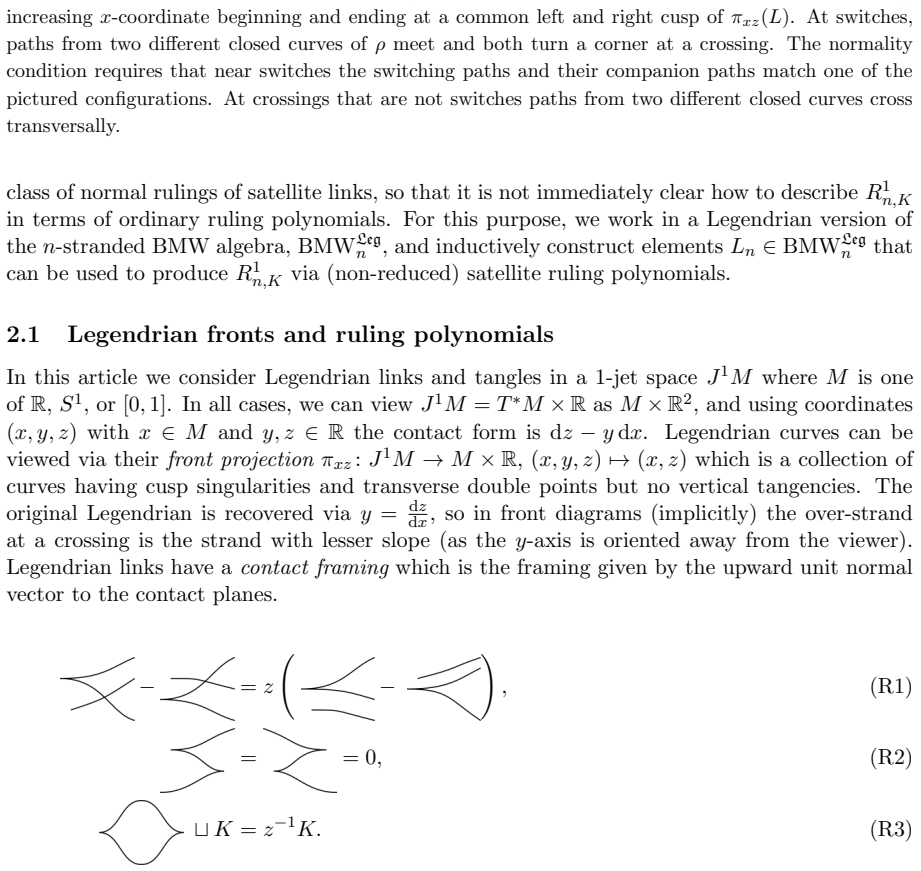
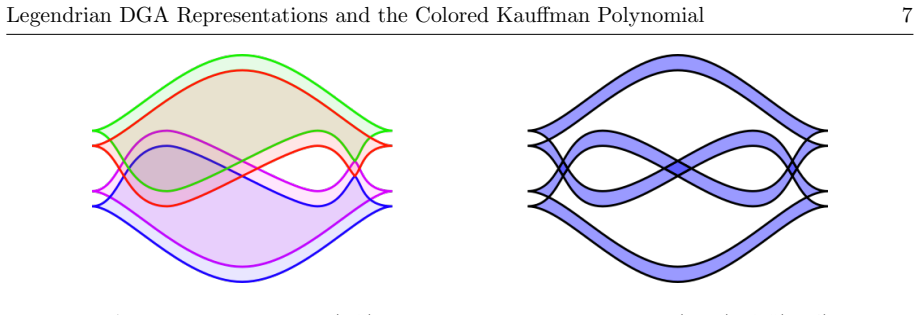
The load-bearing object is the ungraded n-colored ruling polynomial $R^1_{n,K}(z)$, defined as a normalized sum over permutations $\beta\in S_n$ of reduced ruling polynomials of the Legendrian satellites $S(K,\beta)$, where $\lambda(\beta)$ is the braid length and $c_n$ is a quantum-factorial constant. A reduced ruling is a normal ruling of a satellite that never pairs the parallel strands coming from a single strand of the companion knot. The proof that this polynomial is the $a^{-1}=0$ specialization of the n-colored Kauffman polynomial runs through the Legendrian BMW algebra: an element $L_n$, built inductively from braid crossings and hook elements, satisfies $R^1_{S(K,L_n)}=c_nR^1_{n,K}$, and under specialization $L_n$ becomes the BMW symmetrizer $Y_n$. The proof that this equals the representation number runs through four xy- and xz-diagrams of the satellite: DGA isomorphisms and a unique-extension claim identify augmentations vanishing on the $Y$-generators with reduced rulings, and the path subsets $B_\beta$ from the Bruhat decomposition of $GL(n,\mathbb{F}_q)$ organize the sum over permutations.
What would settle it
Choose any Legendrian knot $K$, set $n=2$ and $q=4$, list all DGA homomorphisms $(\mathcal{A}(K),\partial)\to(\operatorname{End}(\mathbb{F}_4^2),0)$, normalize the count by the formula in Definition 4.1, and compare with $R^1_{2,K}(z)$ at $z=2-1/2=3/2$, equivalently with $F_{2,K}(a,4)|_{a^{-1}=0}$. A single mismatch would refute Lemma 4.3 and Theorem 1.1.
Extended reading notes
Core claim
The central claim is that the ungraded representation theory of the Legendrian contact homology DGA is a topological invariant in a strong sense. Theorem 1.1 states that for any Legendrian knot $K\subset\mathbb{R}^3$ and any $n\geq 1$, the normalized count $\operatorname{Rep}^1(K,\mathbb{F}_q^n)$ of DGA homomorphisms $(\mathcal{A}(K),\partial)\to(\operatorname{End}(\mathbb{F}_q^n),0)$ equals $R^1_{n,K}(z)$, the ungraded n-colored ruling polynomial obtained by summing reduced ruling polynomials of Legendrian satellites $S(K,\beta)$ over all positive permutation braids $\beta\in S_n$, and this polynomial is exactly the specialization of the n-colored Kauffman polynomial at $a^{-1}=0$. The paper proves both equalities: the algebraic equality $R^1_{n,K}(z)=F_{n,K}(a,q)|_{a^{-1}=0}$ by identifying the Legendrian BMW element $L_n$ with the BMW symmetrizer $Y_n$ after specialization, and the counting equality $\operatorname{Rep}^1(K,\mathbb{F}_q^n)=R^1_{n,K}(z)$ by a chain of DGA isomorphisms between four diagrams of the satellite that identifies zero-differential representations with reduced rulings. The immediate corollary is that the total ungraded n-dimensional representation number depends only on the underlying framed knot type of $K$.
Load-bearing premise
The load-bearing premise is the unique-filling step in the proof of Lemma 4.3: after moving the satellite diagram around, a partial choice of generator values extends to exactly one full augmentation because the differential is assumed to have a particular linear form, and if that step fails the counting factor and the equality with reduced rulings break.
Editorial extensions
If this is right
- The total ungraded n-dimensional representation number $\operatorname{Rep}^1(K,\mathbb{F}_q^n)$ is a topological invariant of the underlying framed knot, not a sensitive Legendrian invariant.
- The ungraded n-colored ruling polynomial can be computed from the n-colored Kauffman polynomial by setting $a^{-1}=0$, so representation counts are accessible without constructing the DGA.
- At $q$ a power of two, normalized representation counts are given by a finite sum over permutations of reduced ruling polynomials, making them effective to compute from front diagrams.
- The result reduces the ungraded case to the same pattern already known for $m$-graded colors with $m\neq 1$, completing a uniform picture for colored ruling polynomials.
- For multi-component links, a vector-colored version holds for the Kauffman specialization, and with the composable algebra version of the DGA the representation-number equality is expected to hold as well.
Reading between the lines
- The theorem proves only that the normalized total representation number is fixed by the framed knot; it leaves open whether finer data of the ungraded representation theory, such as the dimension of the full representation variety, also collapse to framed-knot invariants.
- The same Legendrian BMW comparison suggests that the paper's Conjecture 3.6, an isomorphism between the Legendrian BMW algebra and the $a^{-1}=0$ reduction of the BMW algebra, would explain the polynomial identity at the skein-module level and could extend to other contact manifolds.
- Since both sides are finite enumerations for small $n$, a direct computer check at $n=2$ over $\mathbb{F}_4$ would either confirm the counting chain or locate the first failing step; this is the most economical test of the main equality.
- The vector-colored formulation for links suggests that representation numbers with component-wise dimensions should also be framed-link invariants once the composable DGA is used.
Signed reviews
Editorial analysis
A structured set of objections, weighed in public.
Referee Report
Summary. The paper proves that for any Legendrian knot K in standard contact R^3 and any n≥1, the ungraded n-dimensional representation number Rep^1(K, F_q^n) over a finite field of characteristic 2 equals a newly defined ungraded n-colored ruling polynomial R^1_{n,K}(q), and that this ruling polynomial is the specialization at a^{-1}=0 of the n-colored Kauffman polynomial F_{n,K}(a,q). The proof has two main parts: an inductive characterization of R^1_{n,K} via Legendrian BMW algebra elements L_n (Section 2), a comparison of ϕ(L_n/c_n) with the BMW symmetrizer using Heckenberger-Schüler's formula (Section 3), and a DGA computation relating Y=0 augmentations of four satellite diagrams to reduced rulings (Section 4). A corollary is that these higher-dimensional representation numbers depend only on the underlying framed knot type. Section 5 sketches a multi-component generalization.
Significance. Assuming the main theorem, this is a substantial result: it extends the Fuchs-type relation between ungraded augmentations and the Kauffman polynomial to higher-dimensional representations, and it shows that DGA representation counts are topological invariants of the framed knot type. This complements the m≠1 cases treated in [20], and the ungraded case is genuinely more subtle because nonzero differentials appear. The paper's use of the Legendrian BMW algebra and the inductive comparison with the Heckenberger-Schüler symmetrizer is elegant and largely explicit; Theorem 2.8 and Proposition 3.13 are proved in detail, and the algebra computations are checkable. The representation-theoretic half, however, is more compressed and contains the main technical gaps that need attention.
major comments (3)
- [Section 4.5, Step 3 of Lemma 4.3] The unique-extension Claim that proves equation (4.6) is load-bearing for Lemma 4.3 and therefore for Theorem 4.2, but it is only asserted. The formula ∂C_k = (I+X_k)^{±1}+W_k and the statement that ∂x^k_{i,j} lies in the ideal generated by the Y-generators are not derived, and the bijectivity of the map from the X-values to the upper-triangular part of (I+X_k)^{±1} is not demonstrated. Please expand this step, either by giving the relevant differential computations or by pointing to precise statements in [20] or [25] that cover general β; as written, the sentence "it is not hard to check" together with a reference for the identity braid does not suffice for a general positive permutation braid.
- [Section 4.5, Lemma 4.8 and Step 5] The restriction of the [19] bijections to the Y=0 locus is justified by two assertions: that i(Ψ(C))=i(C), and that an SR-form MCS lies in MCSSR^{Y=0} if and only if its associated ruling is reduced. The first is called "straightforward" and the second invokes [24, Lemma 3.2] together with an unstated argument about returns. These assertions are exactly what identifies the Y=0 augmentation count with the reduced ruling polynomial, so they need a fuller proof.
- [Section 4.5, Step 2 of Lemma 4.3] The handleslide DGA isomorphisms between A(S^1_xy(K,β)) and A(S^2_xy(K,β)) are asserted to restrict to the identity on all Y-generators. Since the described triple-point move involves three Reeb chords of which one is a crossing of β, it is not evident that the Y-generators are fixed rather than transformed among themselves; please clarify why the Y=0 locus is preserved and why the isomorphism has the stated form.
minor comments (3)
- [Theorem 4.2] In the statement of Theorem 4.2, the right-hand side should be Rep^1(K, F_q^n), not Rep^1(K, F_q); as written the equality is dimensionally inconsistent with Definition 4.1.
- [Step 6 of Lemma 4.3] The displayed exponent "qn2rb(K)/2" should be q^{n^2 rb(K)/2}; the current formatting makes the formula ambiguous.
- [Remark 4.6] Remark 4.6 explicitly leaves the full differential formulas to other papers; for the Step 3 claim, at least the specific identities involving ∂C_k and ∂x^k_{i,j} should be stated, since they are not immediate from the cited sources for general β.
Circularity Check
No significant circularity: the main equalities are proved by matching both sides to independent inductive characterizations, with prior results used as external tools.
full rationale
The paper's two central equalities are established by independent routes, not by assuming the target result. The equality R^1_{n,K}(z) = F_{n,K}(a,q)|_{a^{-1}=0} is proved by showing that the combinatorially defined element L_n in the Legendrian BMW algebra satisfies the same inductive relation as the BMW symmetrizer Y_n, using the externally published inductive formula of Heckenberger and Schuler [17]. The equality Rep^1(K, F_q^n) = R^1_{n,K}(q) is proved by comparing counts of Y=0 augmentations of the satellite with representation numbers, relying on previously published results [19, 20] that relate augmentations to rulings and representations to augmentations. These prior results are cited as established theorems with independent content, not as restatements of the present theorem. The only self-citations appear as technical tools (e.g., [19] for the MCS decomposition, [20] for the satellite DGA bijection, [24] for reduced rulings), and using them does not make the derivation circular: the paper's contribution is the new reduction of the ungraded n-dimensional case to these tools, plus the Kauffman-polynomial identification. The skeptic's concern about the unique-extension Claim in Step 3 of Lemma 4.3 is a question of proof completeness or correctness, not circularity: the claim is asserted rather than fully expanded, but nothing indicates that the paper's conclusion is equivalent to its input by construction. Therefore no circular step meeting the required evidentiary standard is present.
Assumptions & free parameters
assumptions (5)
- domain assumption Legendrian contact homology DGA is a Legendrian isotopy invariant (stable tame isomorphism).
- domain assumption Decomposition of augmentations by normal rulings ([19, Theorem 3.2]).
- domain assumption Bijection between ungraded representations of K and augmentations of satellite, with upper triangular differentials ([20, Theorem 6.1]).
- standard math Heckenberger-Schüler inductive formula for the BMW symmetrizer Y_n ([17]).
- domain assumption Reduced ruling polynomial properties and identification of reduced rulings with no Y-switches ([24]).
Cite this review
Pith. "Pith review of Legendrian DGA Representations and the Colored Kauffman Polynomial." pith.science (2026). https://pith.science/paper/6NSWO5E7
@misc{pith2026190808978,
  author       = {Pith},
  title        = {Pith review of: Legendrian DGA Representations and the Colored Kauffman Polynomial},
  year         = {2026},
  howpublished = {\url{https://pith.science/paper/6NSWO5E7}},
  note         = {Machine review of arXiv:1908.08978}
}
abstract
For any Legendrian knot $K$ in standard contact ${\mathbb R}^3$ we relate counts of ungraded ($1$-graded) representations of the Legendrian contact homology DG-algebra $(\mathcal{A}(K),\partial)$ with the $n$-colored Kauffman polynomial. To do this, we introduce an ungraded $n$-colored ruling polynomial, $R^1_{n,K}(q)$, as a linear combination of reduced ruling polynomials of positive permutation braids and show that (i) $R^1_{n,K}(q)$ arises as a specialization $F_{n,K}(a,q)\big|_{a^{-1}=0}$ of the $n$-colored Kauffman polynomial and (ii) when $q$ is a power of two $R^1_{n,K}(q)$ agrees with the total ungraded representation number, $\operatorname{Rep}_1\big(K, \mathbb{F}_q^n\big)$, which is a normalized count of $n$-dimensional representations of $(\mathcal{A}(K),\partial)$ over the finite field $\mathbb{F}_q$. This complements results from [Leverson C., Rutherford D., Quantum Topol. 11 (2020), 55-118, arXiv:1802.10531] concerning the colored HOMFLY-PT polynomial, $m$-graded representation numbers, and $m$-graded ruling polynomials with $m \neq 1$.
Figures


Figures from the paper (9 more)





Reference graph
Works this paper leans on
-
[20]
11 (2020), 55–118, arXiv:1802.10531
Leverson C., Rutherford D., Satellite ruling polynomials, DGA representations, and the colored HOMFLY- PT polynomial, Quantum Topol. 11 (2020), 55–118, arXiv:1802.10531
arXiv 2020
-
[25]
Ng L., Rutherford D., Shende V., Sivek S., Zaslow E., Augmentations are sheaves, arXiv:1502.04939
-
[19]
Henry M.B., Rutherford D., Ruling polynomials and augmentations over finite fields, J. Topol. 8 (2015), 1–37, arXiv:1308.4662
work page Pith review arXiv 2015
- [1]
-
[2]
Bennequin D., Entrelacements et ´ equations de Pfaff, Ast´ erisque107 (1983), 87–161
work page 1983
-
[3]
Birman J.S., Wenzl H., Braids, link polynomials and a new algebra, Trans. Amer. Math. Soc. 313 (1989), 249–273
work page 1989
-
[4]
Bourgeois F., Ekholm T., Eliashberg Y., Effect of Legendrian surgery, Geom. Topol. 16 (2012), 301–389, arXiv:0911.0026
work page Pith review arXiv 2012
-
[5]
Brion M., Representations of quivers, in Geometric Methods in Representation Theory. I, S´ emin. Congr., Vol. 24, Soc. Math. France, Paris, 2012, 103–144
work page 2012
Show all 33 references
-
[6]
Chekanov Yu., Differential algebra of Legendrian links, Invent. Math. 150 (2002), 441–483, arXiv:math.GT/9709233
2002
-
[7]
Surveys 60 (2005), 95–149
Chekanov Yu., Pushkar’ P., Combinatorics of fronts of Legendrian links and the Arnol’d 4-conjectures, Russian Math. Surveys 60 (2005), 95–149
2005
-
[8]
Algebra Appl
Dipper R., Hu J., Stoll F., Symmetrizers and antisymmetrizers for the BMW-algebra, J. Algebra Appl. 12 (2013), 1350032, 22 pages, arXiv:1109.0342
2013 arXiv
-
[9]
Ekholm T., Etnyre J.B., Ng L., Sullivan M.G., Knot contact homology, Geom. Topol. 17 (2013), 975–1112, arXiv:1109.1542
2013 arXiv
-
[10]
Etnyre J.B., Ng L., Legendrian contact homology in R3, arXiv:1811.10966
-
[11]
Symplectic Geom
Etnyre J.B., Ng L., Sabloff J.M., Invariants of Legendrian knots and coherent orientations, J. Symplectic Geom. 1 (2002), 321–367, arXiv:math.SG/0101145
2002
-
[12]
Franks J., Williams R.F., Braids and the Jones polynomial, Trans. Amer. Math. Soc. 303 (1987), 97–108
1987
-
[13]
Fuchs D., Chekanov–Eliashberg invariant of Legendrian knots: existence of augmentations, J. Geom. Phys. 47 (2003), 43–65
2003
-
[14]
Fuchs D., Ishkhanov T., Invariants of Legendrian knots and decompositions of front diagrams,Mosc. Math. J. 4 (2004), 707–717. Legendrian DGA Representations and the Colored Kauffman Polynomial 33
2004
-
[15]
Fuchs D., Tabachnikov S., Invariants of Legendrian and transverse knots in the standard contact space, Topology 36 (1997), 1025–1053
1997
-
[16]
109, Cambridge University Press, Cambridge, 2008
Geiges H., An introduction to contact topology, Cambridge Studies in Advanced Mathematics , Vol. 109, Cambridge University Press, Cambridge, 2008
2008
-
[17]
Heckenberger I., Sch¨ uler A., Symmetrizer and antisymmetrizer of the Birman–Wenzl–Murakami algebras, Lett. Math. Phys. 50 (1999), 45–51, arXiv:math.QA/0002170
1999
-
[18]
Henry M.B., Connections between Floer-type invariants and Morse-type invariants of Legendrian knots, Pacific J. Math. 249 (2011), 77–133, arXiv:0911.1735
2011 arXiv
-
[21]
Murakami J., The representations of the q-analogue of Brauer’s centralizer algebras and the Kauffman polynomial of links, Publ. Res. Inst. Math. Sci. 26 (1990), 935–945
1990
-
[22]
Ng L., Computable Legendrian invariants, Topology 42 (2003), 55–82, arXiv:math.GT/0011265
2003
-
[23]
Ng L., A skein approach to Bennequin-type inequalities, Int. Math. Res. Not. 2008 (2008), rnn116, 18 pages, arXiv:0709.2141
2008 arXiv
-
[24]
Ng L., Rutherford D., Satellites of Legendrian knots and representations of the Chekanov–Eliashberg algebra, Algebr. Geom. Topol. 13 (2013), 3047–3097, arXiv:1206.2259
2013 arXiv
-
[26]
Ng L., Sabloff J.M., The correspondence between augmentations and rulings for Legendrian knots, Pacific J. Math. 224 (2006), 141–150, arXiv:math.SG/0503168
2006
-
[27]
Symplectic Geom
Ng L., Traynor L., Legendrian solid-torus links, J. Symplectic Geom. 2 (2004), 411–443, arXiv:math.SG/0407068
2004
-
[28]
Rudolph L., A congruence between link polynomials, Math. Proc. Cambridge Philos. Soc. 107 (1990), 319– 327
1990
-
[29]
Rutherford D., Thurston–Bennequin number, Kauffman polynomial, and ruling invariants of a Legen- drian link: the Fuchs conjecture and beyond, Int. Math. Res. Not. 2006 (2006), 78591, 15 pages, arXiv:math.GT/0511097
2006
-
[30]
2 (2011), 183–215, arXiv:1006.3285
Rutherford D., HOMFLY-PT polynomial and normal rulings of Legendrian solid torus links, Quantum Topol. 2 (2011), 183–215, arXiv:1006.3285
2011 arXiv
-
[31]
Sabloff J.M., Augmentations and rulings of Legendrian knots, Int. Math. Res. Not. 2005 (2005), 1157–1180, arXiv:math.SG/0409032
2005
-
[32]
Tabachnikov S., Estimates for the Bennequin number of Legendrian links from state models for knot poly- nomials, Math. Res. Lett. 4 (1997), 143–156
1997
-
[33]
Traynor L., Generating function polynomials for Legendrian links, Geom. Topol. 5 (2001), 719–760, arXiv:math.GT/0110229
2001
Reviewed August 14, 2026 · model on record in the stance chip above.
Discussion (0). Continue with ORCID to comment.