REVIEW 2 major objections 3 minor 1 cited by
The spectrum of global representations for families of bounded rank and VI-modules
T0 review · 2 major / 3 minor · reviewed 2026-08-06 · deepseek-v4-flash
Pith's one-line read For r-submultiplicative families of finite groups, the Balmer spectrum of global representations is homeomorphic to the space of profinite groups built from the family, classifying derived VI-modules by cofinite support sets.
desk verdict A carefully built non-rigid tt-geometry computation whose headline VI-module classification rests on a growth theorem imported from the authors' companion paper; the bounded-rank spectral computations stand on their own. read the letter →
The pith
A machine-rendered reading of the paper's core claim, the machinery that carries it, and where it could break.
The reading
What carries the argument
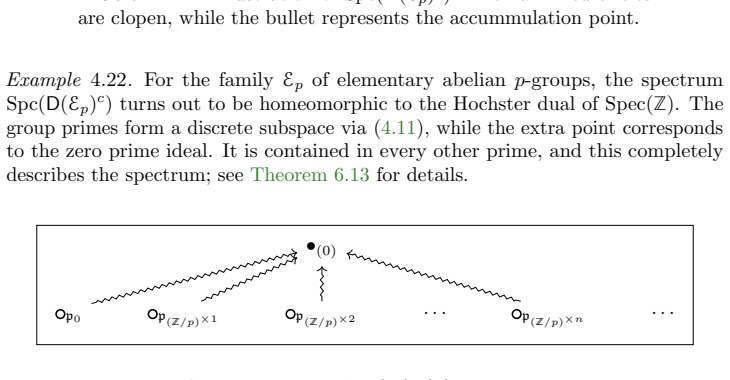
The load-bearing construction is the profinite group prime: to each finitely generated profinite group $G$ in the profinite extension $\widehat{\mathscr{U}}$ of a family $\mathscr{U}$, the paper assigns the thick ideal $p_G = \{X \in \mathsf{D}(\mathscr{U})^c \mid \operatorname{colim}_{N \in \mathcal{N}(G;\mathscr{U})} H^*(X(G/N)) = 0\}$, which is prime by construction, and shows that the map $G \mapsto p_G$ is injective whenever $\mathscr{U}$ admits a profinite reflective filtration. Surjectivity and the homeomorphism are proven by writing $\widehat{\mathscr{U}}$ as an inverse limit of essentially finite families $\mathscr{U}[n]$ through the reflections $q_n$, invoking a continuity theorem for filtered colimits of tensor-triangulated categories to compute $\operatorname{Spc}(\mathsf{D}(\mathscr{U})^c)$ as the inverse limit of the discrete spectra $\operatorname{Spc}(\mathsf{D}(\mathscr{U}[n])^c)$, equipped with the profinite topology. The second engine is a growth theorem imported from the companion paper: for a multiplicative global family and any nonzero compact object $X$, the homology $H^*(X)$ contains a torsion-free element that forces $e_G$ into $\operatorname{thick}_{\otimes}\langle X\rangle$; this yields primeness of the zero ideal, cofinite homological support in $\mathsf{D}(\mathcal{E}_p)^c$, and standardness of all the computed categories.
What would settle it
Compute, for each integer $s \ge 0$, the thick tensor ideal generated by $m_s = \operatorname{cof}(e_{(\mathbb{Z}/p)^{\oplus s}} \to \mathbf{1})$ in $\mathsf{D}(\mathcal{E}_p)^c$ and its Balmer support. The theorem predicts the support is exactly the complement of the single prime $p_{(\mathbb{Z}/p)^{\oplus s}}$ and that every prime ideal is generated by a single object; exhibiting a nonzero compact object whose homological support is finite rather than cofinite, or a thick ideal that is not radical, would falsify the classification of derived VI-modules.
Extended reading notes
Core claim
The central claim is Theorem 12.5 (Theorem H): if $\mathscr{U}$ is an $r$-submultiplicative family of finite groups, then the profinite group prime map sends each finitely generated profinite group $G$ built from quotients in $\mathscr{U}$ to the prime ideal $p_G = \{X \in \mathsf{D}(\mathscr{U})^c \mid \operatorname{colim}_{N \in \mathcal{N}(G;\mathscr{U})} H^*(X(G/N)) = 0\}$, and this map is a homeomorphism from $\pi_0(\widehat{\mathscr{U}})$ onto the Balmer spectrum $\operatorname{Spc}(\mathsf{D}(\mathscr{U})^c)$. Equivalently, the homological support extended to profinite groups is the universal support datum: it bijects thick ideals of $\mathsf{D}(\mathscr{U})^c$ with open subsets of $\pi_0(\widehat{\mathscr{U}})$, finitely generated thick ideals with clopen subsets, and prime ideals with complements of points, and every thick ideal is radical. The special case $\mathscr{U} = \mathcal{E}_p$, the elementary abelian $p$-groups, yields Theorem A: compact derived VI-modules are classified up to tt-equivalence by the cofinite subsets of $\mathbb{N}$ together with the empty set, via the type map $M \mapsto \{n \mid M(\mathbb{F}_p^{\oplus n}) \neq 0\}$.
Load-bearing premise
The paper depends on a growth theorem proven in its companion paper: for a multiplicative global family, the homology of any nonzero compact object contains an element that stays nonzero under pullback along any epimorphism and forces a generator into the object's thick tensor ideal; if that theorem were false, the standardness of $\mathsf{D}(\mathcal{E}_p)^c$, the cofinite-support result, and the primeness of family primes would all collapse.
Editorial extensions
If this is right
- Compact derived VI-modules over a characteristic-zero field are completely classified up to tt-equivalence by their type: a cofinite subset of the natural numbers, or the empty set.
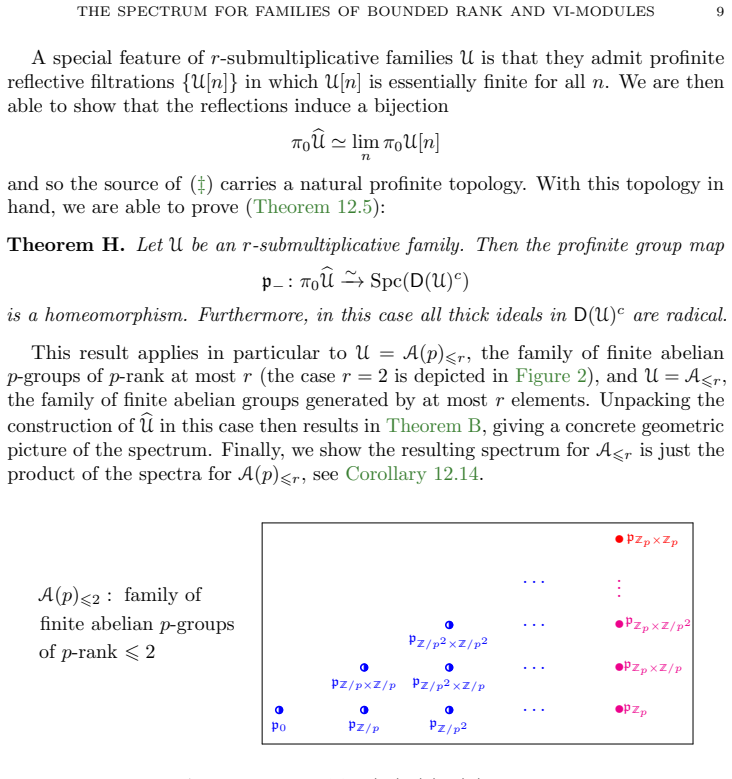
- For the family of abelian $p$-groups of $p$-rank at most $r$, the Balmer spectrum is the explicit profinite space $bS_{\le r} = \{v \in (\mathbb{N}^+)^r \mid \infty \ge v_1 \ge \cdots \ge v_r \ge 0\}$, with Cantor-Bendixson rank exactly $r$.
- Every thick ideal in the compact derived category of an $r$-submultiplicative family is radical, so homological support gives a complete classification of thick ideals by open subsets of $\pi_0(\widehat{\mathscr{U}})$.
- The spectrum for all finite abelian $p$-groups has infinite Krull dimension and infinite Cantor-Bendixson rank, witnessed by strict descending chains of family primes and by embeddings of the bounded-rank spectra.
- For the family of $r$-generated finite abelian groups, the spectrum decomposes as a product over all primes $p$ of the spectra for the corresponding $p$-parts.
Reading between the lines
- The profinite-compactification template — replace the discrete indexing set of group primes by an inverse limit of essentially finite pieces — suggests a general strategy for computing Balmer spectra in other non-rigid tensor-triangulated categories, such as functor categories of FI-modules or twisted commutative algebras.
- Theorem E isolates a sharp failure of rigidity: jointly conservative evaluation functors are never jointly surjective on spectra for infinite families of $p$-groups, so any non-rigid analogue of the standard surjectivity criterion must be phrased in terms of profinite completions rather than the original indexing set.
- The infinite Krull dimension of the abelian $p$-group spectrum is generated by the $p$-exponent filtration of family primes; tracking the same filtration transfinitely could yield a full description of $\operatorname{Spc}(\mathsf{D}(\mathcal{A}(p))^c)$, a problem the paper states it plans to return to.
- Via the equivalence with rational global spectra, the computed tt-geometry furnishes a classification of thick subcategories of rational global spectra for submultiplicative families, a consequence the paper leaves implicit.
Editorial analysis
A structured set of objections, weighed in public.
Referee Report
Summary. This paper develops tensor-triangular geometry for derived categories of global representations over fields of characteristic zero, indexed by families of finite groups. It introduces homological support, group primes, family primes, profinite group primes, and reflective filtrations, and uses them to compute Balmer spectra in several important cases. The main results are: a complete tt-theoretic classification of compact derived VI-modules (Theorem A); the spectrum for abelian p-groups of p-rank at most r (Theorem B); infinite Krull dimension and infinite Cantor–Bendixson rank for the family of all finite abelian p-groups (Theorem C); an equivalence with rational global spectra (Theorem D); a surjectivity criterion for group primes in p-group families (Theorem E); primeness of family primes for multiplicative global families (Theorem F); the spectrum for elementary abelian p-groups (Theorem G); and a general homeomorphism between the profinite group prime space and the Balmer spectrum for r-submultiplicative families (Theorem H). The framework also yields standardness and classification of thick ideals in the computed cases.
Significance. If the main results hold, this is a substantial and original contribution to the tensor-triangular geometry of non-rigid categories. The classification of derived VI-modules is a concrete and striking application, and the construction of profinite group primes together with the use of reflective filtrations and inverse limits is a novel method likely to be influential. The proof of Theorem H is elegant and largely independent of the heavier homological input. The paper is carefully structured, with explicit references to earlier results and no fitting parameters. However, some headline results—Theorem A, the infinite Krull dimension half of Theorem C, and Theorem F—depend on a growth theorem imported from a companion paper, and one supporting lemma contains a confusing functorial identification that appears to be a typo. These points need to be resolved before the paper can be fully verified.
major comments (2)
- [§4, Theorem 4.16] Theorem 4.16 is quoted from the companion paper [BBP+25, Thm 7.7 and Cor 7.11] and is load-bearing for several central results. It is used in Proposition 4.17 to prove that the zero ideal is prime, in Corollary 4.19 to prove that the family primes form a strictly descending infinite chain, and in the proof of Theorem 6.13 to establish properties (1) and (2) that yield the standardness of D(Ep)^c and the classification of derived VI-modules. The present paper provides no proof, no special-case verification, and no alternative route; Theorem 6.13 explicitly says that both properties rely on Theorem 4.16. Consequently, if the companion statement is false or has an unstated hypothesis, Theorem A, Theorem F, and the first part of Theorem C collapse. The authors should either include a proof of Theorem 4.16 (or a detailed outline) or make the dependence on the companion paper a clearly stated hypothesis, so that the reader can assess the validity of the main claims.
- [§7, Lemma 7.15] The proof of Lemma 7.15 asserts that 'q_* ≃ i!' and later that 'q_* moreover preserves coproducts'. With the conventions of Construction 2.12, q_* is the right Kan extension along q, and for a reflective inclusion q ⊣ i the correct identifications are q^* ≃ i_! and q_* ≃ i^*, not q_* ≃ i_!. Moreover, i^* is not generally fully faithful, so the argument as written is not correct. The intended argument likely uses q^*: since q^*(1) ≃ 1 and q^* preserves coproducts, the compactness claim follows from Hom_D(U)(1, −) ≃ Hom_D(V)(1, q^*(−)). This is a local and fixable issue, but the current text contains a genuine error in a proof.
minor comments (3)
- [Example 7.7(d)] The claim that the category of finite groups expressible as products of simple groups is reflective is stated without proof, with the note that the details are omitted. Since this example is not used in the rest of the paper, the omission is acceptable, but it should be flagged as unproved or moved to a remark to avoid giving the impression of a fully verified assertion.
- [Throughout] There are several minor typographical issues, including 'accommulation' in Figure 4, 'F amily' in the title, and 'choose Gn maximal among the Gis' in the proof of Proposition 5.2. These should be corrected in a final revision.
- [Part 4] It would improve readability to add a short paragraph at the beginning of Part 4 explicitly listing which of the paper's main results depend on the imported Theorem 4.16 and which do not. The reader currently has to infer this from the proofs, and the distinction matters for assessing the robustness of the different theorems.
Circularity Check
No significant circularity; load-bearing inputs are hypothesis-disjoint prior theorems, not restatements of the target classifications.
full rationale
The paper's derivation chain is not circular. The headline classifications (Theorems A, B, C, F, G, H) are assembled from stated inputs: Theorem 4.16, imported from the same authors' companion paper [BBP+25, Thm 7.7 & Cor 7.11], supplies the growth statement that any nonzero compact X has a torsion-free cohomology element forcing e_G into thick^⊗<X>; Theorem 5.3 computes spectra of essentially finite pieces; Proposition 4.4 and Theorem 9.4 pass standardness through filtered colimits; Corollary 9.5 and Gallauer's continuity theorem pass spectra to inverse limits; Theorem 11.13 identifies pi_0 of the profinite extension; Theorem 12.5 then assembles these inputs. No parameter is fitted from the data being 'predicted', and no object or prime is defined in terms of the target classification. The dependence on Theorem 4.16 is genuine and load-bearing: the proof of Theorem 6.13 explicitly says that the two auxiliary properties 'both rely on Theorem 4.16', and Theorem A and the infinite Krull dimension part of Theorem C would indeed collapse if that growth theorem failed. However, Theorem 4.16 is a parameter-free statement about multiplicative global families and nonzero compact objects whose hypotheses do not include any Balmer spectrum or the VI-module classification; it is independent support under the self-citation rule even though the cited paper is by the same authors and is not reproved here. The paper also transparently advertises this reliance ('Our proofs rely on subtle information about the growth behaviour of global representations studied in a companion paper'). No equation-level reduction of a claimed output to an input, no fitted-input-called-prediction, and no uniqueness theorem imported to forbid alternatives occurs. The omitted proof of Theorem 4.16 is a correctness-robustness concern external to circularity, not a circular step.
Assumptions & free parameters
assumptions (6)
- domain assumption The derived category D(U) is compactly generated by {e_G | G ∈ U}, and D(U)^c is symmetric monoidal when the unit is compact (Propositions 2.2 and 2.4, Hypothesis 4.0).
- domain assumption Growth and torsion-free theorem for multiplicative global families (Theorem 4.16, from [BBP+25, Theorem 7.7 and Corollary 7.11]).
- standard math Nikolov-Segal theorem: open subgroups of finitely generated profinite groups have finite index and all homomorphisms are continuous (Remark 10.2).
- standard math Gallauer continuity: Balmer spectrum sends filtered colimits of tt-categories to inverse limits of spectral spaces (Corollary 9.5, [Gal18, Proposition 8.2]).
- standard math Neeman-Thomason localization theorem for compact objects in Verdier quotients (used in Corollary 2.20, Proposition 6.3, and Lemma 5.5).
- domain assumption The base field k is of characteristic zero throughout.
invented entities (2)
-
Family primes p_V for a subfamily V ⊆ U
-
Profinite group primes p_G for G ∈ bU
Cite this review
Pith. "Pith review of The spectrum of global representations for families of bounded rank and VI-modules." pith.science (2026). https://pith.science/paper/6O4JNIKK
@misc{pith2026250621525,
  author       = {Pith},
  title        = {Pith review of: The spectrum of global representations for families of bounded rank and VI-modules},
  year         = {2026},
  howpublished = {\url{https://pith.science/paper/6O4JNIKK}},
  note         = {Machine review of arXiv:2506.21525}
}
abstract
A global representation is a compatible collection of representations of the outer automorphism groups of the finite groups belonging to a family $\mathscr{U}$. These arise in classical representation theory, in the study of representation stability, as well as in global homotopy theory. In this paper we begin a systematic study of the derived category $\mathsf{D}(\mathscr{U};k)$ of global representations over fields $k$ of characteristic zero, from the point-of-view of tensor-triangular geometry. We calculate its Balmer spectrum for various infinite families of finite groups including elementary abelian $p$-groups, cyclic groups, and finite abelian $p$-groups of bounded rank. We then deduce that the Balmer spectrum associated to the family of finite abelian $p$-groups has infinite Krull dimension and infinite Cantor--Bendixson rank, illustrating the complex phenomena we encounter. As a concrete application, we provide a complete tt-theoretic classification of finitely generated derived VI-modules. Our proofs rely on subtle information about the growth behaviour of global representations studied in a companion paper, as well as novel methods from non-rigid tt-geometry.
Figures


Figures from the paper (4 more)



Forward citations
Cited by 1 Pith paper
-
The Telescope Conjecture for Global Representations and FI-modules
The localizing tensor ideals of D(U) for cyclic p-groups, elementary abelian p-groups, and FI-modules are classified by homological support, yielding the telescope conjecture.
Reference graph
Works this paper leans on
-
[1]
The spectrum of prime ideals in tensor triangulated categories
Paul Balmer. The spectrum of prime ideals in tensor triangulated categories. J. Reine Angew. Math. , 588:149--168, 2005
2005
-
[2]
Paul Balmer. Tensor triangular geometry. In Proceedings of the I nternational C ongress of M athematicians. V olume II , pages 85--112. Hindustan Book Agency, New Delhi, 2010
work page 2010
-
[3]
On the surjectivity of the map of spectra associated to a tensor-triangulated functor
Paul Balmer. On the surjectivity of the map of spectra associated to a tensor-triangulated functor. Bull. Lond. Math. Soc. , 50(3):487--495, 2018
2018
-
[4]
Homological support of big objects in tensor-triangulated categories
Paul Balmer. Homological support of big objects in tensor-triangulated categories. J. \' E c. polytech. Math. , 7:1069--1088, 2020
work page 2020
-
[5]
Cohen's theorem in tensor triangular geometry
Tobias Barthel . Cohen's theorem in tensor triangular geometry . arXiv e-prints , page arXiv:2505.15786, May 2025
work page Pith review arXiv 2025
-
[6]
Global representation theory: Homological foundations
Miguel Barrero , Tobias Barthel , Luca Pol , Neil Strickland , and Jordan Williamson . Global representation theory: Homological foundations . arXiv e-prints , page arXiv:2505.21449, May 2025
work page Pith review arXiv 2025
-
[7]
Quillen stratification in equivariant homotopy theory
Tobias Barthel, Nat\`alia Castellana, Drew Heard, Niko Naumann, and Luca Pol. Quillen stratification in equivariant homotopy theory. Invent. Math. , 239(1):219--285, 2025
work page 2025
-
[8]
On surjectivity in tensor triangular geometry
Tobias Barthel, Nat\`alia Castellana, Drew Heard, and Beren Sanders. On surjectivity in tensor triangular geometry. Math. Z. , 308(4):Paper No. 65, 7, 2024
work page 2024
Show all 39 references
-
[9]
John D. Berman. On lax limits in -categories. Proc. Amer. Math. Soc. , 152(12):5055--5066, 2024
2024
-
[10]
Tobias Barthel, J. P. C. Greenlees, and Markus Hausmann. On the B almer spectrum for compact L ie groups. Compos. Math. , 156(1):39--76, 2020
2020
-
[11]
Blumberg, David Gepner, and Gon c alo Tabuada
Andrew J. Blumberg, David Gepner, and Gon c alo Tabuada. A universal characterization of higher algebraic K -theory. Geom. Topol. , 17(2):733--838, 2013
2013
-
[12]
The B almer spectrum of the equivariant homotopy category of a finite abelian group
Tobias Barthel, Markus Hausmann, Niko Naumann, Thomas Nikolaus, Justin Noel, and Nathaniel Stapleton. The B almer spectrum of the equivariant homotopy category of a finite abelian group. Invent. Math. , 216(1):215--240, 2019
2019
-
[13]
The spectrum of the equivariant stable homotopy category of a finite group
Paul Balmer and Beren Sanders. The spectrum of the equivariant stable homotopy category of a finite group. Invent. Math. , 208(1):283--326, 2017
2017
-
[14]
Spectral spaces , volume 35 of New Mathematical Monographs
Max Dickmann, Niels Schwartz, and Marcus Tressl. Spectral spaces , volume 35 of New Mathematical Monographs . Cambridge University Press, Cambridge, 2019
2019
-
[15]
Tensor triangular geometry of filtered modules
Martin Gallauer. Tensor triangular geometry of filtered modules. Algebra and Number Theory , 12(8):1975--2003, 2018
1975
-
[16]
Lax colimits and free fibrations in -categories
David Gepner, Rune Haugseng, and Thomas Nikolaus. Lax colimits and free fibrations in -categories. Doc. Math. , 22:1225--1266, 2017
2017
-
[17]
Global 2-rings and genuine refinements
David Gepner , Sil Linskens , and Luca Pol . Global 2-rings and genuine refinements . arXiv e-prints , page arXiv:2407.05124, July 2024
2024 arXiv
-
[18]
J. P. C. Greenlees. The B almer spectrum of rational equivariant cohomology theories. J. Pure Appl. Algebra , 223(7):2845--2871, 2019
2019
-
[19]
A comparison of two models of orbispaces
Alexander K \"o rschgen. A comparison of two models of orbispaces. Homology Homotopy Appl. , 20(1):329--358, 2018
2018
-
[20]
Hochster duality in derived categories and point-free reconstruction of schemes
Joachim Kock and Wolfgang Pitsch. Hochster duality in derived categories and point-free reconstruction of schemes. Trans. Amer. Math. Soc. , 369(1):223--261, 2017
2017
-
[21]
Global algebraic K-theory is Swan K-theory
Tobias Lenz . Global algebraic K-theory is Swan K-theory . arXiv e-prints , page arXiv:2202.07272, February 2022
2022 arXiv
-
[22]
L. G. Lewis, Jr., J. P. May, M. Steinberger, and J. E. McClure. Equivariant stable homotopy theory , volume 1213 of Lecture Notes in Mathematics . Springer-Verlag, Berlin, 1986. With contributions by J. E. McClure
1986
-
[23]
Global homotopy theory via partially lax limits
Sil Linskens, Denis Nardin, and Luca Pol. Global homotopy theory via partially lax limits. Geom. Topol. , 29(3):1345--1440, 2025
2025
-
[24]
Yu-Han Liu and Susan J. Sierra. Recovering quivers from derived quiver representations. Comm. Algebra , 41(8):3013--3031, 2013
2013
-
[25]
Higher topos theory , volume 170 of Annals of Mathematics Studies
Jacob Lurie. Higher topos theory , volume 170 of Annals of Mathematics Studies . Princeton University Press, Princeton, NJ, 2009
2009
-
[26]
Higher algebra
Jacob Lurie. Higher algebra. 1553 pages, available from the author's website, 2017
2017
-
[27]
M. A. Mandell and J. P. May. Equivariant orthogonal spectra and S -modules. Mem. Amer. Math. Soc. , 159(755):x+108, 2002
2002
-
[28]
Nilpotence and descent in equivariant stable homotopy theory
Akhil Mathew, Niko Naumann, and Justin Noel. Nilpotence and descent in equivariant stable homotopy theory. Adv. Math. , 305:994--1084, 2017
2017
-
[29]
V I -modules in nondescribing characteristic, part I
Rohit Nagpal. V I -modules in nondescribing characteristic, part I . Algebra Number Theory , 13(9):2151--2189, 2019
2019
-
[30]
V I -modules in non-describing characteristic, part II
Rohit Nagpal. V I -modules in non-describing characteristic, part II . J. Reine Angew. Math. , 781:187--205, 2021
2021
-
[31]
The connection between the K -theory localization theorem of T homason, T robaugh and Y ao and the smashing subcategories of B ousfield and R avenel
Amnon Neeman. The connection between the K -theory localization theorem of T homason, T robaugh and Y ao and the smashing subcategories of B ousfield and R avenel. Ann. Sci. \'Ecole Norm. Sup. (4) , 25(5):547--566, 1992
1992
-
[32]
On finitely generated profinite groups
Nikolay Nikolov and Dan Segal. On finitely generated profinite groups. I . S trong completeness and uniform bounds. Ann. of Math. (2) , 165(1):171--238, 2007
2007
-
[33]
On finitely generated profinite groups
Nikolay Nikolov and Dan Segal. On finitely generated profinite groups. II . P roducts in quasisimple groups. Ann. of Math. (2) , 165(1):239--273, 2007
2007
-
[34]
Andrew Putman and Steven V. Sam. Representation stability and finite linear groups. Duke Math. J. , 166(13):2521--2598, 2017
2017
-
[35]
Strickland
Luca Pol and Neil P. Strickland. Representation stability and outer automorphism groups. Doc. Math. , 27:17--87, 2022
2022
-
[36]
Global homotopy theory , volume 34 of New Mathematical Monographs
Stefan Schwede. Global homotopy theory , volume 34 of New Mathematical Monographs . Cambridge University Press, Cambridge, 2018
2018
-
[37]
The spectrum of the singularity category of a category algebra
Ren Wang. The spectrum of the singularity category of a category algebra. Appl. Categ. Structures , 27(4):427--433, 2019
2019
-
[38]
Rational global homotopy theory and geometric fixed points
Christian Wimmer. Rational global homotopy theory and geometric fixed points. PhD thesis, Universit \"a t Bonn, 2017
2017
-
[39]
Spectra of tensor triangulated categories over category algebras
Fei Xu. Spectra of tensor triangulated categories over category algebras. Arch. Math. (Basel) , 103(3):235--253, 2014
2014
Reviewed August 6, 2026 · model on record in the stance chip above.
Discussion (0). Continue with ORCID to comment.