REVIEW 3 major objections 5 minor 2 cited by
Data-Driven Certificate Synthesis
T0 review · 3 major / 5 minor · reviewed 2026-08-08 · deepseek-v4-flash
Pith's one-line read Sampled trajectories alone can yield reachability, safety, and reach-while-avoid certificates whose PAC risk is set by a compression set, not state dimension.
desk verdict The compression-set construction is genuinely new, but the missing grid-error analysis leaves the PAC certificate guarantee unsupported for the implemented method. read the letter →
The pith
A machine-rendered reading of the paper's core claim, the machinery that carries it, and where it could break.
The reading
What carries the argument
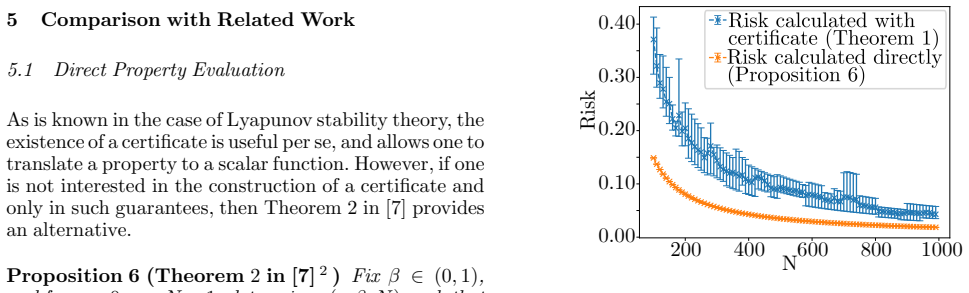
The central object is the compression set: a subset $C_N$ of the training trajectories which, when used as the algorithm's input, returns the same certificate $V_N$ as the full dataset. Its cardinality $C_N = |C_N|$ enters the risk formula (19), so smaller compression sets give tighter PAC guarantees. Algorithm 1 is the constructive mechanism: it performs subgradient descent on the worst-case loss and, when it finds a training sample whose subgradient is misaligned with the current descent direction, it 'jumps' along that subgradient and adds the sample to $C_N$; the paper proves that this creates a genuine compression set. Algorithm 2 wraps Algorithm 1, discarding each returned compression set from the training pool until the worst-case loss reaches zero, at the cost of a larger final compression set. The loss functions (25)–(27) translate the certificate conditions—initial-set, goal-set, unsafe-set, outside-domain, and along-trajectory decrease constraints—into integrals over the relevant regions, with the integrals approximated in implementation by sums over deterministic grids.
What would settle it
Construct a smooth scalar function whose sampled loss (26) is zero on the deterministic grids described in Section 4.3 but whose true value violates one of the continuous conditions, for example a sublevel well inside $X_G$ that sits between grid points and dips below $-\delta$; existence of such a function would refute the dense-grid implication and hence the premise of Theorem 1. Concretely, one can run the method and then check the returned certificate with a dense adaptive search or global optimizer; any violation found outside the training grid is a direct falsifier.
Extended reading notes
Core claim
On the paper's own terms, the central claim is a theorem about any certificate-synthesis algorithm that satisfies two structural properties: preference and non-associativity (Assumption 2). Theorem 1 states that if such an algorithm returns a certificate $V_N$ satisfying the certificate conditions on all $N$ sampled trajectories, then, with confidence at least $1-\beta$, the probability that a new trajectory violates those conditions—and therefore the property $\varphi$—is bounded by $\epsilon(C_N,\beta,N)$, the solution of equation (19) evaluated at the compression-set cardinality. The proof routes the violation probability through the probability that a new sample changes the compression set, which the paper controls via a compression-generalization result. The paper then claims that its own Algorithm 1, a subgradient-descent scheme with deliberate jumps triggered by misaligned subgradients, terminates, returns a compression set, and satisfies Assumption 2 (Proposition 4), and that Algorithm 2, which discards compression sets until the loss reaches zero, does the same (Proposition 5). If these propositions hold, the PAC bound applies to the certificates actually constructed in the numerical studies, including the partially unsafe example where classical exact methods cannot give a certificate.
Load-bearing premise
The argument stands on the assumption that a certificate whose discretized loss (26) is zero on a finite grid, with the outside-domain condition checked only on the boundary of $X$, satisfies the exact continuous certificate conditions over the whole state space; the paper states the grid is 'dense enough' but offers no error bound or verification step for that implication.
Editorial extensions
If this is right
- A direct corollary is that property verification becomes model-free: only sampled trajectories are needed, not the system equations, so the method applies to black-box or simulation-only systems.
- Because the risk bound depends on compression-set size rather than exponentially on state-space dimension, the guarantees can remain informative for higher-dimensional systems where grid-based and Lipschitz-based scenario bounds become vacuous.
- The discarding mechanism lets the method produce a probabilistic certificate even when some sampled trajectories enter the unsafe set, a case in which exact certificate synthesis would simply fail.
- The certificate itself, not just a yes/no property answer, is made available, which the paper identifies as a step toward control synthesis.
- The compression-set computation is constructive for a non-convex optimization program, extending a mechanism that was previously a general meta-algorithm to a concrete subgradient-descent instance.
Reading between the lines
- The paper leaves implicit that the 'dense enough' grid in Section 4.3 is doing logical work: if a counterexample could hide between grid points, the validity implication from the discretized loss (26) to the continuous conditions (3)–(6) would break, so an error bound or post-hoc verification would turn the method into a fully rigorous one.
- A testable extension suggested by the framework is to use the learned certificate itself to search for violations: since the certificate defines level sets, one can run a global optimizer over $V$ on each region and check the continuous conditions, converting the grid assumption into a verifiable certificate.
- The same compression-set construction should transfer to other non-convex learning-with-guarantees tasks beyond dynamical-system verification, because Algorithm 1 only relies on subgradients and a worst-case loss over samples.
- The PAC guarantee is relative to the distribution of initial conditions used for sampling; an adversarial or unknown initial-state distribution would require additional robustness machinery not present in the paper.
Editorial analysis
A structured set of objections, weighed in public.
Referee Report
Summary. The paper proposes a data-driven method for synthesizing neural-network certificates for reachability, safety, and reach-while-avoid properties of deterministic discrete-time systems. It encodes certificate conditions as a loss function, introduces Algorithm 1 as a subgradient-descent procedure that simultaneously builds a compression set, and Algorithm 2 as a discarding mechanism to drive the loss to zero. The main theoretical result, Theorem 1, uses compression-based scenario theory to give a PAC-style bound on the probability that a new trajectory violates the certificate conditions and thereby the underlying property. The paper reports numerical experiments on benchmark systems, including a comparison with the scenario-optimization approach of [34], and states that code is publicly available.
Significance. If fully established, the contribution would be significant: it aims to provide model-free probabilistic verification guarantees without requiring Lipschitz constants of the dynamics, and it gives a constructive, iterative mechanism for computing compression sets in a non-convex setting. The explicit comparison with [34] and the availability of code are strengths. The value of the paper is, however, conditional on closing the gap between the continuous certificate conditions used in the theory and the finite, grid-based loss actually minimized in the implementation, and on a correct proof that the discarding algorithm indeed produces a compression set.
major comments (3)
- [Section 4.3, Eq. (26)] The replacement of the integrals in (25) by the finite sums in (26), with the exterior-positivity condition checked only on the boundary ∂X, is not supported by any error analysis. The text states that the grid is 'dense enough' but gives no Lipschitz estimate for V_θ and no post-verification step. A continuous function can satisfy (26) and yet violate (5) between grid points, or violate (6) in an arbitrarily thin layer just outside X. Since Theorem 1 and Definition 1 require V to satisfy the continuous conditions ψ_s and ψ_Δ, the implication 'zero discretized loss ⇒ property φ' is not established for the implemented algorithm.
- [Section 4.2 and Appendix A.3, Proposition 5(2)] The proof that R_N is a compression set for Algorithm 2 is not valid as written. To show A_2(R_N)=A_2({ξ_i}), the proof re-runs Algorithm 2 on R_N and asserts that the first call to Algorithm 1 returns C_1; however, that first call is fed with R_N rather than the original multiset, and Proposition 4 only guarantees that C_1 is a compression set for the original invocation. No argument is given that Algorithm 1 on R_N produces the same sequence of sets C_i and the same final parameter vector. Without a correct proof that R_N is a compression set, Theorem 1 cannot be invoked with R_N for Algorithm 2.
- [Section 3.2, Theorem 1 and Eq. (21)] Theorem 1 is stated under the hypothesis V_N = A({ξ_i}) satisfies ψ_s and all sampled conditions ψ_Δ(ξ_i). Algorithm 2, however, terminates when the loss is zero only on the remaining set D, and samples in R_N are removed precisely because their loss may be positive. The paper does not explain how the final certificate satisfies the theorem's hypothesis, nor why the first inclusion in (21) remains valid for an algorithm that discards violating samples. A separate argument is needed to justify that a new violating trajectory still implies a change of the compression set.
minor comments (5)
- [Theorem 1 statement] The notation '⋀_{i=0}^N ψ_Δ(ξ_i)' appears to have an indexing typo; it should presumably be i=1,...,N.
- [Section 2.1 and Property 2] Section 2.1 states that X is bounded, while Property 2 says the safety property may be constructed for unbounded X; these statements should be reconciled.
- [Section 4.3, Eq. (27)] The sample-dependent loss l_Δ contains the term sup_{x∈X_I} V_θ(x), but the implementation of this supremum over a continuous set is not discussed; presumably it is also discretized, and this should be stated explicitly.
- [Section 6.4] The sentence 'the approach of [34] with 10^19 samples results in a confidence of at least 10^{-30}' appears to invert the intended statement; a confidence should be close to one, while a risk level would be small.
- [Section 4.3] The phrase 'by Certificate 1' should presumably read 'by Proposition 1'.
Circularity Check
No circular reduction; the PAC guarantee is an external compression/scenario application, with the main caveat being a discretization soundness gap rather than circularity.
full rationale
The claimed derivation chain is not circular. Theorem 1 is a direct application of the external compression/scenario bound of Campi and Garatti [14, Thm. 7]; Assumption 2 is explicitly 'adapted from [14]', and Proposition 4(3) proves that Algorithm 1 satisfies those properties from the algorithm's own deterministic update rule, not by invoking the target guarantee. The compression set follows the standard Definition 2 (a subset reproducing the same output), and the reported risk ε(C_N,β,N) is a posteriori in the observed cardinality; it is not a fitted parameter relabelled as a prediction. The self-citations that appear ([1], [3], [8], [21], [42], [43], [46], among others) occur in related-work, benchmark, or extension contexts and do not carry the load-bearing argument. The principal caveat is a soundness gap, not circularity: Section 4.3 replaces the continuous integrals in (25) with the finite deterministic grid sum (26) and asserts the grid is 'generated densely enough' with no error bound or continuous verification step, while the outside-domain condition is checked only on ∂X; zero value of (26) therefore does not formally certify V|=ψ_s over the whole space, which is the precondition for Theorem 1. That is a missing-support/correctness issue and should be weighed in a correctness review, but it is not an equivalence-by-construction or a self-citation chain, so it does not raise the circularity score beyond the minor self-citation level.
Assumptions & free parameters
free parameters (4)
- delta (sublevel threshold) =
chosen by hand, no value given
- Finite grid for state-dependent loss =
not specified
- Algorithm hyperparameters alpha and eta =
not specified
- Neural network architecture =
e.g., 2 hidden layers, 5 or 10 neurons, sigmoid activation
assumptions (5)
- domain assumption Assumption 1: P{xi}=0 for any xi in Xi
- domain assumption Assumption 2: Algorithm A satisfies Preference and Non-associativity
- domain assumption Assumption 3: Minimizers of max_{xi in D} L(theta,xi) exist for any non-empty D
- standard math Theorem 7 of Campi and Garatti [14] bounding the probability that the compression set changes
- ad hoc to paper The discretized loss (26) accurately represents the continuous loss (25), so zero discrete loss implies the continuous state conditions hold
Cite this review
Pith. "Pith review of Data-Driven Certificate Synthesis." pith.science (2026). https://pith.science/paper/6PDUVPCD
@misc{pith2026250205510,
  author       = {Pith},
  title        = {Pith review of: Data-Driven Certificate Synthesis},
  year         = {2026},
  howpublished = {\url{https://pith.science/paper/6PDUVPCD}},
  note         = {Machine review of arXiv:2502.05510}
}
read the original abstract
We investigate the problem of verifying different properties of discrete time dynamical systems, namely, reachability, safety and reach-while-avoid. To achieve this, we adopt a data driven perspective and, using past system trajectories as data, we aim at learning a specific function termed certificate for each property we wish to verify. We seek to minimize a loss function, designed to encompass conditions on the certificate to be learned that encode the satisfaction of the associated property. Besides learning a certificate, we quantify probabilistically its generalization properties, namely, how likely it is for a certificate to be valid (and hence for the associated property to be satisfied) when it comes to a new system trajectory not included in the training data set. We view this problem under the realm of probably approximately correct (PAC) learning under the notion of compression, and use recent advancements of the so-called scenario approach to obtain scalable generalization bounds on the learned certificates. To achieve this, we design a novel algorithm that minimizes the loss function and hence constructs a certificate, and at the same time determines a quantity termed compression, which is instrumental in obtaining meaningful probabilistic guarantees. This process is novel per se and provides a constructive mechanism for compression set calculation, thus opening the road for its use to more general non-convex optimization problems. We verify the efficacy of our methodology on several numerical case studies, and compare it (both theoretically and numerically) with closely related results on data-driven property verification.
Figures


Figures from the paper (5 more)



Forward citations
Cited by 2 Pith papers
-
Robustness Certificates for Neural Networks Against Data Poisoning and Evasion Attacks
A neural-network barrier certificate over training trajectories certifies ℓ_p-bounded data-poisoning and evasion budgets, with PAC-style confidence, on MNIST, SVHN, and CIFAR-10.
-
Multi-Object Sketch Animation with Grouping and Motion Trajectory Priors
GroupSketch animates multi-object vector sketches in two stages: user-guided grouping and keyframes, then a group-based displacement network that uses text-to-video priors for consistent motion.
Reference graph
Works this paper leans on
-
[34]
Formal Verification of Unknown Discrete- and Continuous-Time Systems: A Data- Driven Approach
Ameneh Nejati, Abolfazl Lavaei, Pushpak Jagtap, Sadeg h Soudjani, and Majid Zamani. Formal Verification of Unknown Discrete- and Continuous-Time Systems: A Data- Driven Approach. IEEE Trans. Autom. Control., 68(5):3011– 3024, 2023
work page 2023
-
[35]
Dario Paccagnan, Marco C. Campi, and Simone Garatti. The Pick-to-Learn Algorithm: Empowering Compression for Tight Generalization Bounds and Improved Post-Training Performance. In NeurIPS, 2023
work page 2023
-
[1]
Alessandro Abate, Daniele Ahmed, Alec Edwards, Mirco Giacobbe, and Andrea Peruffo. FOSSIL: A Software Tool for the Formal Synthesis of Lyapunov Functions and Barrier Certificates Using Neural Networks. In HSCC, pages 24:1– 24:11. ACM, 2021
work page 2021
-
[2]
Stochastic Omega-Regular Verification and Control with Supermartingales
Alessandro Abate, Mirco Giacobbe, and Diptarko Roy. Stochastic Omega-Regular Verification and Control with Supermartingales. In Arie Gurfinkel and Vijay Ganesh, editors, Computer Aided Verification , pages 395–419, 2024
work page 2024
-
[3]
Model Checking and Strategy Synthesis with Abstractions and Certificates , pages 360–391
Alessandro Abate, Mirco Giacobbe, Diptarko Roy, and Yannik Schnitzer. Model Checking and Strategy Synthesis with Abstractions and Certificates , pages 360–391. 2025
work page 2025
- [4]
-
[5]
Ames, Samuel Coogan, Magnus Egerstedt, Gennaro Notomista, Koushil Sreenath, and Paulo Tabuada
Aaron D. Ames, Samuel Coogan, Magnus Egerstedt, Gennaro Notomista, Koushil Sreenath, and Paulo Tabuada. Control Barrier Functions: Theory and Applications. In ECC, pages 3420–3431. IEEE, 2019
work page 2019
-
[6]
Formally Verified Neural Network Control Barrier Certificates for Unknown Systems
Mahathi Anand and Majid Zamani. Formally Verified Neural Network Control Barrier Certificates for Unknown Systems. IF AC-PapersOnLine, 56(2):2431–2436, 2023
work page 2023
Show all 49 references
-
[7]
Badings, Murat Cubuktepe, Nils Jansen, Sebastia n Junges, Joost-Pieter Katoen, and Ufuk Topcu
Thom S. Badings, Murat Cubuktepe, Nils Jansen, Sebastia n Junges, Joost-Pieter Katoen, and Ufuk Topcu. Scenario- Based Verification of Uncertain Parametric MDPs. Int. J. Softw. Tools Technol. Transf. , 24(5):803–819, 2022
2022
-
[8]
Badings, Licio Romao, Alessandro Abate, David Parker, Hasan A
Thom S. Badings, Licio Romao, Alessandro Abate, David Parker, Hasan A. Poonawala, Mari¨ elle Stoelinga, and Nils Jansen. Robust Control for Dynamical Systems with Non- Gaussian Noise via Formal Abstractions. Journal of Artificial Intelligence Research, 76:341–391, 2023
2023
-
[9]
Boyd and Lieven Vandenberghe
Stephen P. Boyd and Lieven Vandenberghe. Convex Optimization. Cambridge University Press, 2014
2014
-
[10]
Introduction to the Scenario Approach
Marco Campi and Simone Garatti. Introduction to the Scenario Approach. SIAM Series on Optimization, 2018
2018
-
[11]
Campi and Simone Garatti
Marco C. Campi and Simone Garatti. The Exact Feasibilit y of Randomized Solutions of Uncertain Convex Programs. SIAM J. Optim. , 19(3):1211–1230, 2008
2008
-
[12]
Campi and Simone Garatti
Marco C. Campi and Simone Garatti. A Sampling-and- Discarding Approach to Chance-Constrained Optimization: Feasibility and Optimality. Journal of Optimization Theory and Applications , 148(2):257–280, 2011
2011
-
[13]
Campi and Simone Garatti
Marco C. Campi and Simone Garatti. W ait-and-judge scenario optimization. Math. Program. , 167(1):155–189, 2018
2018
-
[14]
Campi and Simone Garatti
Marco C. Campi and Simone Garatti. Compression, Generalization and Learning. J. Mach. Learn. Res., 24:339:1– 339:74, 2023
2023
-
[15]
A General Scenario Theory for Nonconvex Optimization and Decision Making
Marco Claudio Campi, Simone Garatti, and Federico Alessandro Ramponi. A General Scenario Theory for Nonconvex Optimization and Decision Making. IEEE Trans. Autom. Control. , 63(12):4067–4078, 2018
2018
-
[16]
Neural Lyapunov Control
Ya-Chien Chang, Nima Roohi, and Sicun Gao. Neural Lyapunov Control. In NeurIPS, pages 3240–3249, 2019
2019
-
[17]
A Measure of Asymptotic Efficiency for Tests of a Hypothesis Based on the sum of Observations
Herman Chernoff. A Measure of Asymptotic Efficiency for Tests of a Hypothesis Based on the sum of Observations. The Annals of Mathematical Statistics , 23(4):493 – 507, 1952
1952
-
[18]
Frank H. Clarke. Optimization and Nonsmooth Analysis . Society for Industrial and Applied Mathematics, 1990
1990
-
[19]
Counter-example guided synthesis of neural network Lyapunov functions for piecewise linear systems
Hongkai Dai, Benoit Landry, Marco Pavone, and Russ Tedrake. Counter-example guided synthesis of neural network Lyapunov functions for piecewise linear systems. In CDC, pages 1274–1281. IEEE, 2020
2020
-
[20]
Safe Control With Learned Certificates: A Survey of Neural Lyapunov, Barrier, and Contraction Methods for Robotics and Control
Charles Dawson, Sicun Gao, and Chuchu Fan. Safe Control With Learned Certificates: A Survey of Neural Lyapunov, Barrier, and Contraction Methods for Robotics and Control. IEEE Trans. Robotics , 39(3):1749–1767, 2023
2023
-
[21]
Fos sil 2.0: Formal Certificate Synthesis for the Verification and Control of Dynamical Models
Alec Edwards, Andrea Peruffo, and Alessandro Abate. Fos sil 2.0: Formal Certificate Synthesis for the Verification and Control of Dynamical Models. In HSCC, pages 26:1–26:10. ACM, 2024
2024
-
[22]
W armuth
Sally Floyd and Manfred K. W armuth. Sample Compression , Learnability, and the Vapnik-Chervonenkis Dimension. Mach. Learn., 21(3):269–304, 1995
1995
-
[23]
Simone Garatti and Marco C. Campi. Risk and complexity in scenario optimization. Math. Program., 191(1):243–279, 2022
2022
-
[24]
Garcia, David M
Carlos E. Garcia, David M. Prett, and Manfred Morari. Model predictive control: Theory and practice - A survey. Autom., 25(3):335–348, 1989
1989
-
[25]
Hirsch, Stephen Smale, and Robert L
Morris W. Hirsch, Stephen Smale, and Robert L. Devaney. Differential Equations, Dynamical Systems, and an Introduction to Chaos. 2003
2003
-
[26]
Probability Inequalities for Sums o f Bounded Random Variables
W assily Hoeffding. Probability Inequalities for Sums o f Bounded Random Variables. Journal of the American Statistical Association, 58(301):13–30, 1963
1963
-
[27]
Stinchcombe, and Halbert White
Kurt Hornik, Maxwell B. Stinchcombe, and Halbert White . Multilayer feedforward networks are universal approximators. Neural Networks , 2(5):359–366, 1989
1989
-
[28]
Formal Synthesis of Stochastic Systems via Control Barrier Certificates
Pushpak Jagtap, Sadegh Soudjani, and Majid Zamani. Formal Synthesis of Stochastic Systems via Control Barrier Certificates. IEEE Trans. Autom. Control., 66(7):3097–3110, 2021
2021
-
[29]
Neural Certificates for Safe Control Policies
W anxin Jin, Zhaoran W ang, Zhuoran Yang, and Shaoshuai Mou. Neural Certificates for Safe Control Policies. CoRR, abs/2006.08465, 2020
2006 arXiv
-
[30]
Kingma and Jimmy Ba
Diederik P. Kingma and Jimmy Ba. Adam: A Method for Stochastic Optimization. In ICLR (Poster) , 2015
2015
-
[31]
The General Problem of the Stability of Motion
Alexander Mikhailovich Lyapunov. The General Problem of the Stability of Motion. 1994
1994
-
[32]
On the Connection Between Compression Learning and Scenario Based Single-Stage and Cascading Optimization Problems
Kostas Margellos, Maria Prandini, and John Lygeros. On the Connection Between Compression Learning and Scenario Based Single-Stage and Cascading Optimization Problems. IEEE Trans. Autom. Control. , 60(10):2716–2721, 2015
2015
-
[33]
Performance Bounds for the Scenario Approach and an Extension to a Class of Non-Convex Programs
Peyman Mohajerin Esfahani, Tobias Sutter, and John Lygeros. Performance Bounds for the Scenario Approach and an Extension to a Class of Non-Convex Programs. IEEE Transactions on Automatic Control , 60(1):46–58, 2015
2015
-
[36]
On the Construction of Lyapunov Functions Using the Sum of Squares Decomposition
Antonis Papachristodoulou and Stephen Prajna. On the Construction of Lyapunov Functions Using the Sum of Squares Decomposition. In CDC, pages 3482–3487. IEEE, 2002. 15
2002
-
[37]
Safety Verification o f Hybrid Systems Using Barrier Certificates
Stephen Prajna and Ali Jadbabaie. Safety Verification o f Hybrid Systems Using Barrier Certificates. In HSCC, volume 2993 of Lecture Notes in Computer Science , pages 477–492. Springer, 2004
2004
-
[38]
Stephen Prajna, Ali Jadbabaie, and George J. Pappas. Stochastic safety verification using barrier certificates. In CDC, pages 929–934. IEEE, 2004
2004
-
[39]
Stephen Prajna, Ali Jadbabaie, and George J. Pappas. A Framework for W orst-Case and Stochastic Safety Verification Using Barrier Certificates. IEEE Trans. Autom. Control. , 52(8):1415–1428, 2007
2007
-
[40]
Model Predictive Control with Reach-avoid Analysis
Dejin Ren, W anli Lu, Jidong Lv, Lijun Zhang, and Bai Xue. Model Predictive Control with Reach-avoid Analysis. In IJCAI, pages 5437–5445. ijcai.org, 2023
2023
-
[41]
Learning Robust Policies for Uncertain Parametric Markov Decision Processes
Luke Rickard, Alessandro Abate, and Kostas Margellos. Learning Robust Policies for Uncertain Parametric Markov Decision Processes. In L4DC, volume 242 of Proceedings of Machine Learning Research, pages 876–889. PMLR, 2024
2024
-
[42]
Continuous-time Data-driven Barrier Certificate Synthesi s
Luke Rickard, Alessandro Abate, and Kostas Margellos. Continuous-time Data-driven Barrier Certificate Synthesi s. CoRR, abs/2503.13392, 2025
2025 arXiv
-
[43]
Badings, Licio Romao, and Alessandro Abate
Luke Rickard, Thom S. Badings, Licio Romao, and Alessandro Abate. Formal Controller Synthesis for Markov Jump Linear Systems with Uncertain Dynamics. In QEST, volume 14287 of Lecture Notes in Computer Science , pages 10–29. Springer, 2023
2023
-
[44]
On the Exact Feasibility of Convex Scenario Programs With Discarded Constraints
Licio Romao, Antonis Papachristodoulou, and Kostas Margellos. On the Exact Feasibility of Convex Scenario Programs With Discarded Constraints. IEEE Trans. Autom. Control., 68(4):1986–2001, 2023
1986
-
[45]
Data-Driven Verification and Synthesis of Stochast ic Systems via Barrier Certificates
Ali Salamati, Abolfazl Lavaei, Sadegh Soudjani, and Ma jid Zamani. Data-Driven Verification and Synthesis of Stochast ic Systems via Barrier Certificates. Autom., 159:111323, 2024
2024
-
[46]
Certified Approximate Reachability (CARe): Formal Error Bounds on Deep Learning of Reachable Sets, 2025
Prashant Solanki, Nikolaus Vertovec, Yannik Schnitze r, Jasper Van Beers, Coen de Visser, and Alessandro Abate. Certified Approximate Reachability (CARe): Formal Error Bounds on Deep Learning of Reachable Sets, 2025
2025
-
[47]
Learning Certifie d Control Using Contraction Metric
Dawei Sun, Susmit Jha, and Chuchu Fan. Learning Certifie d Control Using Contraction Metric. In CoRL, volume 155 of Proceedings of Machine Learning Research, pages 1519–1539. PMLR, 2020
2020
-
[48]
W ood and B
Graham R. W ood and B. P. Zhang. Estimation of the Lipschitz Constant of a Function. 8(1):91–103, 1996
1996
-
[49]
Scalable Synthesis of Formally Verified Neural Value Function for Hamilton-Jacobi Reachability Analysis
Yujie Yang, Hanjiang Hu, Tianhao W ei, Shengbo Eben Li, and Changliu Liu. Scalable Synthesis of Formally Verified Neural Value Function for Hamilton-Jacobi Reachability Analysis. CoRR, abs/2407.20532, 2024. A Proofs A.1 Certificate Proofs A.1.1 Proof of Proposition 1 – Reachabil...
2024 arXiv
Reviewed August 8, 2026 · model on record in the stance chip above.
Discussion (0). Continue with ORCID to comment.