John Transform and Ultrahyperbolic Equation for Lightfields
Pith reviewed 2026-05-25 11:06 UTC · model grok-4.3
The pith
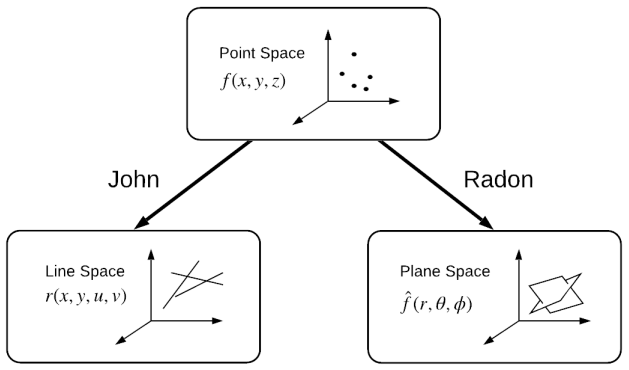
Lightfields satisfy the ultrahyperbolic PDE first proposed by F. John, from which the dimensionality gap and exact focal-stack rendering follow.
A machine-rendered reading of the paper's core claim, the machinery that carries it, and where it could break.
Core claim
Lightfields satisfy the ultrahyperbolic PDE proposed by F. John. Consequently the dimensionality gap follows directly, and the inverse John transform together with Asgeirsson kernels yield rigorous focal-stack rendering, arbitrary-angle viewing, and depth computation.
What carries the argument
The John transform applied to lightfields that satisfy the ultrahyperbolic PDE.
If this is right
- The dimensionality gap in lightfield representation is a direct consequence of the PDE.
- Focal stacks can be rendered exactly using the inverse John transform.
- Viewing lightfields from arbitrary angles becomes rigorous.
- Asgeirsson kernels enable new depth computation methods.
Where Pith is reading between the lines
- Deviations from the PDE in real captures would introduce errors in the derived rendering and depth methods.
- The same PDE approach could apply to other ray-based or wave imaging systems that obey similar equations.
- Enforcing the PDE constraint during lightfield acquisition might reduce processing artifacts.
Load-bearing premise
Real captured lightfields exactly satisfy John's ultrahyperbolic PDE without deviations from capture imperfections.
What would settle it
Capture a real lightfield and compute the residual of the ultrahyperbolic operator on its data values; consistent nonzero residuals would falsify the claim that lightfields satisfy the PDE.
Figures
read the original abstract
This paper explores possibilities for new uses of the Radon transform for imaging and analysis of lightfields. We show that the previously reported Dimansionality Gap can be derived from an ultrahyperbolic PDE, first proposed by F. John, which is satisfied by lightfields. Based on inverse John transform we demonstrate rigorous Focal Stack rendering and viewing from arbitrary angles. Based on Asgeirsson's theorems for the ultrahyperbolic PDE we derive new kernels for processing lightfields. Our kernels provide alternative methods for depth computation and other image processing in lightfields.
Editorial analysis
A structured set of objections, weighed in public.
Referee Report
Summary. The paper claims that lightfields satisfy F. John's ultrahyperbolic PDE, from which the Dimensionality Gap is derived. It further proposes using the inverse John transform to achieve rigorous focal-stack rendering and arbitrary-angle viewing, and applies Asgeirsson's theorems to derive new kernels for depth computation and other lightfield processing tasks.
Significance. If the central PDE assumption holds for captured lightfields, the work could supply a unified PDE-based framework linking the John transform to practical lightfield operations, potentially improving the rigor of rendering and depth-estimation algorithms. The approach draws on established integral-transform theory and could stimulate further cross-fertilization between microlocal analysis and computational imaging.
major comments (1)
- [Abstract / §2 (PDE introduction)] The manuscript treats satisfaction of the ultrahyperbolic PDE by the 4-D lightfield function as an axiom (stated in the abstract and used as the starting point for all derivations). No derivation from the geometry of ray space or from the definition of the lightfield integral is supplied; any deviation (e.g., occlusions, finite aperture) would invalidate the subsequent Dimensionality Gap, inverse-John rendering, and Asgeirsson-kernel results. This assumption is load-bearing for the central claims.
minor comments (2)
- [Abstract] The abstract contains the typographical error 'Dimansionality Gap' (should be 'Dimensionality Gap').
- [§2] Notation for the lightfield function and the precise statement of the ultrahyperbolic operator should be introduced with an equation number in the first section that defines the PDE.
Simulated Author's Rebuttal
We thank the referee for the careful reading and for identifying the load-bearing nature of the PDE assumption. We address the single major comment below and will revise the manuscript to strengthen the presentation.
read point-by-point responses
-
Referee: [Abstract / §2 (PDE introduction)] The manuscript treats satisfaction of the ultrahyperbolic PDE by the 4-D lightfield function as an axiom (stated in the abstract and used as the starting point for all derivations). No derivation from the geometry of ray space or from the definition of the lightfield integral is supplied; any deviation (e.g., occlusions, finite aperture) would invalidate the subsequent Dimensionality Gap, inverse-John rendering, and Asgeirsson-kernel results. This assumption is load-bearing for the central claims.
Authors: We agree that the current manuscript presents the ultrahyperbolic PDE as satisfied by lightfields without an explicit derivation from the ray-space geometry or the lightfield integral definition. This is a valid criticism; the assumption is indeed central. In the revised version we will insert a new subsection in §2 that derives the PDE directly: starting from the 4-D lightfield L(x,y,s,t) as the integral of radiance along straight rays in 3-D space (under the ideal pinhole, occlusion-free model), we show that the mixed second derivatives satisfy the ultrahyperbolic equation of John. We will also add a short paragraph discussing the scope of validity, explicitly noting that real data with occlusions or finite apertures only approximately obey the PDE and that the derived rendering and kernel results therefore apply rigorously only in the ideal case. revision: yes
Circularity Check
No circularity; derivations start from external PDE assumption
full rationale
The abstract states that lightfields satisfy John's ultrahyperbolic PDE (an external fact from F. John) and derives the Dimensionality Gap, inverse John transform for focal stacks, and Asgeirsson kernels from it. No quoted step reduces a claimed result to a self-defined quantity, fitted parameter, or self-citation chain. The PDE is treated as an independent given rather than constructed from the paper's outputs, making the chain self-contained against external benchmarks.
Axiom & Free-Parameter Ledger
axioms (1)
- domain assumption Lightfields satisfy the ultrahyperbolic PDE proposed by F. John
Lean theorems connected to this paper
-
IndisputableMonolith/Foundation/AlexanderDuality.leanalexander_duality_circle_linking unclear?
unclearRelation between the paper passage and the cited Recognition theorem.
lightfields satisfy the ultrahyperbolic PDE first proposed by F. John... Dimensionality Gap... Asgeirsson kernels
What do these tags mean?
- matches
- The paper's claim is directly supported by a theorem in the formal canon.
- supports
- The theorem supports part of the paper's argument, but the paper may add assumptions or extra steps.
- extends
- The paper goes beyond the formal theorem; the theorem is a base layer rather than the whole result.
- uses
- The paper appears to rely on the theorem as machinery.
- contradicts
- The paper's claim conflicts with a theorem or certificate in the canon.
- unclear
- Pith found a possible connection, but the passage is too broad, indirect, or ambiguous to say the theorem truly supports the claim.
Reference graph
Works this paper leans on
-
[1]
A. Agarwala, M. Dontcheva, M. Agrawala, S. Drucker, A. Colburn, B. Curless, D. Salesin, and M. Cohen , Interactive digital photomontage , ACM Transactions on Graphics, (July 2004)
work page 2004
-
[2]
T. M. Buzug , Computed tomography, Springer, 2012
work page 2012
-
[3]
R. Courant and D. Hilbert , Methods of Mathematical Physics: Partial Differen- tial Equations, John Wiley & Sons, 2008
work page 2008
-
[4]
S. R. Deans , The Radon transform and some of its applications , Dower, 1983
work page 1983
-
[5]
I. M. Gelfand, M. I. Graev, and N. I. Vilenkin , Generalized Functions-Volume
-
[6]
Integral Geometry and Representation Theory , Academic Press, 1966
work page 1966
- [7]
-
[8]
B. Horn, B. Klaus, and P. Horn , Robot vision, MIT press, 1986
work page 1986
-
[9]
F. John , The ultrahyperbolic differential equation with four independent variables , Fritz John: Collected Papers, 1 (1985), p. 79
work page 1985
-
[10]
A. Levin and F. Durand , Linear view synthesis using a dimensionality gap light field prior, in 2010 IEEE Computer Society Conference on Computer Vision and Pattern Recognition, June 2010, pp. 1831–1838
work page 2010
- [11]
-
[12]
Macovski, Medical imaging systems, Prentice-Hall, Inc., Upper Saddle River, NJ 07458, 1983
A. Macovski, Medical imaging systems, Prentice-Hall, Inc., Upper Saddle River, NJ 07458, 1983
work page 1983
-
[13]
Ng , Fourier slice photography, ACM Trans
R. Ng , Fourier slice photography, ACM Trans. Graph., 24 (2005), pp. 735–744. 18
work page 2005
discussion (0)
Sign in with ORCID, Apple, or X to comment. Anyone can read and Pith papers without signing in.