On homological properties of conic-line arrangements with simple singularities
Pith reviewed 2026-07-01 03:20 UTC · model grok-4.3
The pith
Numerical bounds limit the numbers of conics in plus-one generated arrangements with defect 3
A machine-rendered reading of the paper's core claim, the machinery that carries it, and where it could break.
Core claim
For plus-one generated conic arrangements with defect ν(C)=3 the possible numbers of conics are bounded by the interaction of Bézout's theorem, the Dimca-Sernesi bound, and Hirzebruch-type inequalities, separating exceptional low-degree cases from those that remain open; all weak and strong Ziegler pairs for total degree at most 6 are identified in the database.
What carries the argument
The defect ν(C)=3 for plus-one generated arrangements, which interacts with Bézout's theorem and related inequalities to produce explicit bounds on the number of conics.
If this is right
- The number of conics in a plus-one generated arrangement with defect 3 cannot exceed certain explicit limits derived from the classical inequalities.
- Only a few low-degree cases escape the general bound and must be examined individually.
- All weak and strong Ziegler pairs for arrangements of total degree at most 6 are completely classified.
- The allowed singularity types constrain the possible homological properties of the arrangements.
Where Pith is reading between the lines
- The bounds could serve as a filter when searching computationally for examples in degrees higher than 6.
- The classification of Ziegler pairs may help test conjectures about freeness or other invariants in conic-line arrangements.
- Removing the restriction to the listed singularity types would require new versions of the inequalities used here.
Load-bearing premise
The singularities of the arrangements are limited to nodes, tacnodes, and ordinary triple points.
What would settle it
An explicit plus-one generated conic arrangement with defect 3 whose number of conics exceeds one of the derived numerical bounds, or a weak or strong Ziegler pair of total degree at most 6 that is missing from the database.
Figures
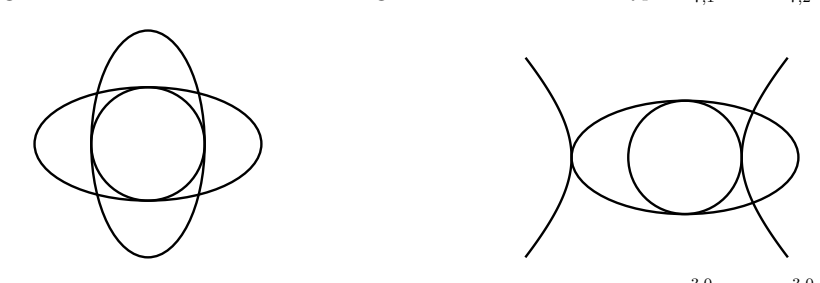
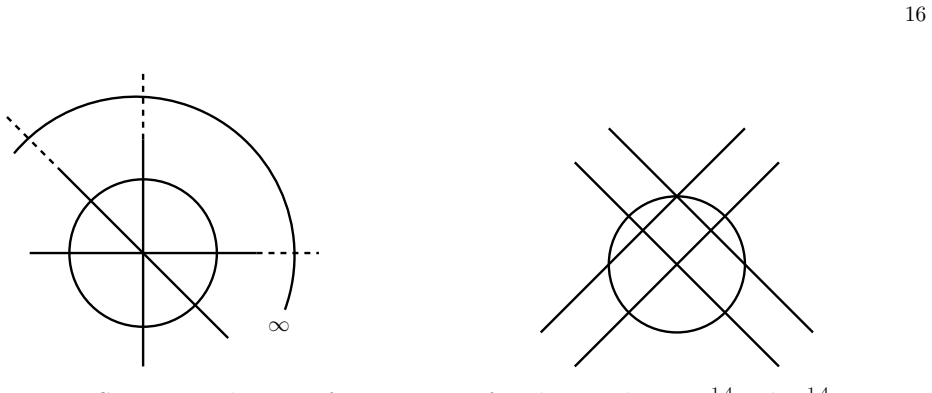
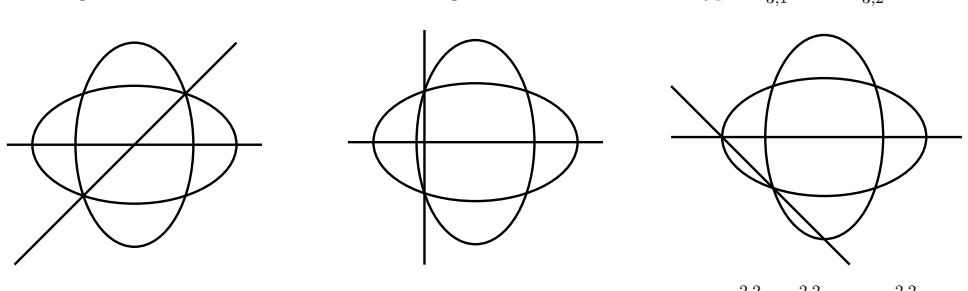
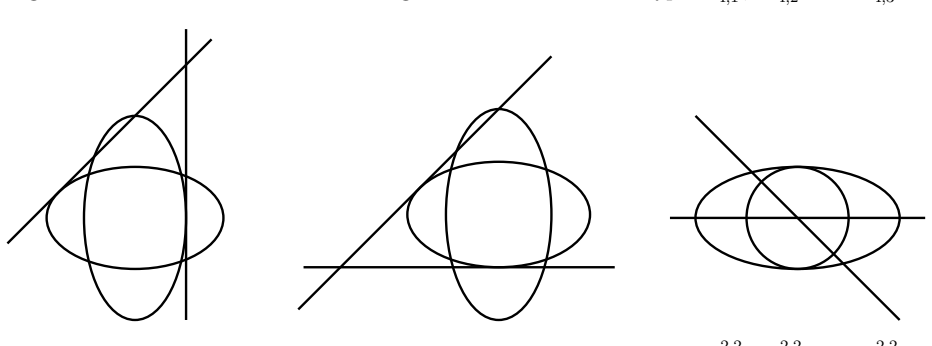
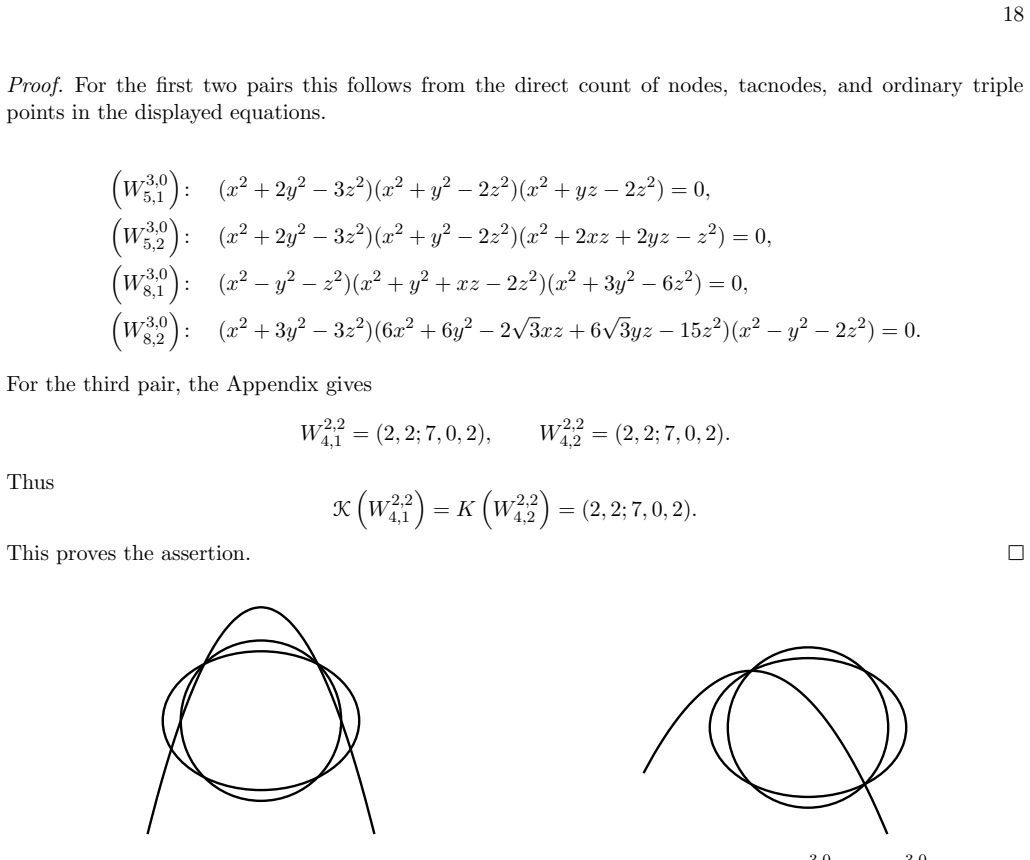
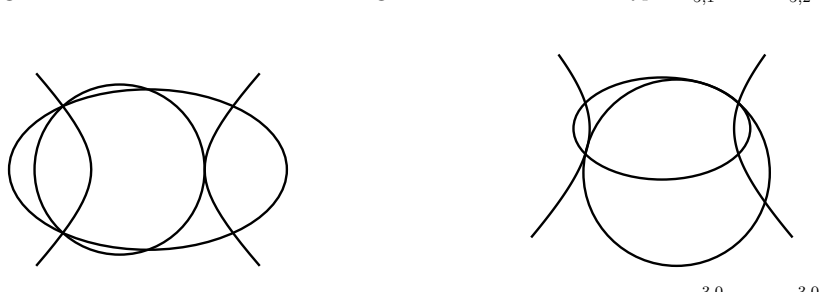
read the original abstract
We study arrangements of smooth conics and lines in the complex projective plane whose singularities are limited to nodes, tacnodes, and ordinary triple points. The first part of the paper gives numerical restrictions for plus-one generated conic arrangements with defect $\nu(C)=3$ and explains how these restrictions interact with B\'ezout's theorem, the Dimca--Sernesi bound for the minimal degree of a Jacobian syzygy, and Hirzebruch-type inequalities. In particular, the possible numbers of conics are bounded, and the exceptional low-degree cases are separated from those that remain open. The second part concerns arrangements of total degree at most $6$. We identify the weak and strong Ziegler pairs occurring in the database recorded in the Appendix.
Editorial analysis
A structured set of objections, weighed in public.
Referee Report
Summary. The manuscript studies arrangements of smooth conics and lines in the complex projective plane whose singularities are restricted to nodes, tacnodes, and ordinary triple points. It derives numerical restrictions on plus-one generated conic arrangements with defect ν(C)=3 by combining Bézout's theorem, the Dimca-Sernesi bound on the minimal degree of a Jacobian syzygy, and Hirzebruch-type inequalities; these bounds limit the possible numbers of conics and separate exceptional low-degree cases from those remaining open. For arrangements of total degree at most 6 the paper identifies the weak and strong Ziegler pairs occurring in an enumerated database recorded in the Appendix.
Significance. If the bounds and database enumeration hold, the work supplies concrete numerical restrictions and a low-degree classification of Ziegler pairs that can serve as a reference point for further study of homological properties of conic-line arrangements. The explicit use of standard external theorems together with a finite enumeration whose output is recorded in the Appendix constitutes a verifiable contribution within the manuscript's scope.
major comments (2)
- [Section deriving the numerical restrictions (referenced in the abstract)] The central claim that the numerical restrictions bound the possible numbers of conics for ν(C)=3 and separate exceptional cases rests on the interaction of Bézout, Dimca-Sernesi, and Hirzebruch inequalities; the manuscript must exhibit the precise derivation of these bounds (including any degree or multiplicity assumptions) so that the separation into exceptional versus open cases can be checked directly.
- [Appendix containing the database] The identification of weak and strong Ziegler pairs up to total degree 6 is obtained from the database in the Appendix; the enumeration method, the completeness criterion for the database, and the explicit list of pairs found must be stated so that the classification claim is reproducible from the given data.
minor comments (2)
- Notation for the defect ν(C) and the plus-one generated condition should be defined at first use with a forward reference to the relevant section.
- The abstract states that singularities are limited to nodes, tacnodes, and ordinary triple points; confirm that this restriction is maintained uniformly in all statements and examples.
Simulated Author's Rebuttal
We thank the referee for the detailed report and constructive suggestions. We agree that greater explicitness is needed in both the derivation of the numerical bounds and the description of the database enumeration to ensure the claims are fully verifiable. We will revise the manuscript to address these points directly.
read point-by-point responses
-
Referee: [Section deriving the numerical restrictions (referenced in the abstract)] The central claim that the numerical restrictions bound the possible numbers of conics for ν(C)=3 and separate exceptional cases rests on the interaction of Bézout, Dimca-Sernesi, and Hirzebruch inequalities; the manuscript must exhibit the precise derivation of these bounds (including any degree or multiplicity assumptions) so that the separation into exceptional versus open cases can be checked directly.
Authors: We agree that the current presentation of the bounds can be made more self-contained. In the revised manuscript we will add a dedicated subsection that spells out the precise chain of inequalities: first applying Bézout to the conic-line configuration, then invoking the Dimca–Sernesi lower bound on the degree of the Jacobian syzygy under the stated multiplicity assumptions (nodes, tacnodes, ordinary triple points), and finally combining these with the Hirzebruch-type inequality to obtain the explicit upper bounds on the number of conics. All degree and multiplicity hypotheses will be stated at each step, allowing the reader to verify the separation into exceptional low-degree cases and the remaining open cases. revision: yes
-
Referee: [Appendix containing the database] The identification of weak and strong Ziegler pairs up to total degree 6 is obtained from the database in the Appendix; the enumeration method, the completeness criterion for the database, and the explicit list of pairs found must be stated so that the classification claim is reproducible from the given data.
Authors: We accept that the Appendix currently records the database without sufficient accompanying documentation. In the revision we will expand the Appendix to include: (i) a concise description of the enumeration algorithm (exhaustive generation of conic-line arrangements of total degree ≤6 with the allowed singularity types), (ii) the completeness criterion (all configurations satisfying the singularity restrictions up to projective equivalence are generated and checked for the Ziegler property), and (iii) an explicit tabulated list of every weak and strong Ziegler pair discovered, together with their defining equations or incidence data. This will make the classification fully reproducible from the published material. revision: yes
Circularity Check
No significant circularity
full rationale
The paper derives numerical bounds on conic arrangements by combining Bézout's theorem, the external Dimca-Sernesi bound on Jacobian syzygies, and Hirzebruch-type inequalities, then classifies Ziegler pairs via finite database enumeration up to degree 6. All load-bearing steps invoke independent external results or exhaustive search outside the paper's fitted values; no self-definitional reductions, fitted inputs renamed as predictions, or load-bearing self-citation chains appear. The singularity scope is stated explicitly as the study's boundary rather than derived internally.
Axiom & Free-Parameter Ledger
axioms (3)
- standard math Bézout's theorem
- domain assumption Dimca--Sernesi bound for the minimal degree of a Jacobian syzygy
- domain assumption Hirzebruch-type inequalities
Reference graph
Works this paper leans on
-
[1]
T. Abe, A. Dimca, P. Pokora, A new hierarchy for complex plane curves.Canad. Math. Bull.Advance Publication 1–24 (2025),https://doi.org/10.4153/S0008439525101422
-
[2]
V. I. Arnold, Local normal forms of functions.Invent. Math.35: 87–109 (1976)
1976
-
[3]
Bromboszcz, B
A. Bromboszcz, B. Jaros lawski, P. Pokora, On plus-one generated arrangements of plane conics. Geometriae Dedicata220: Art. Id. 10 (2026)
2026
-
[4]
Decker, G.-M
W. Decker, G.-M. Greuel, G. Pfister, H. Sch¨ onemann, Singular 4-1-1 — A computer algebra system for polynomial computations,http://www.singular.uni-kl.de(2018)
2018
-
[5]
Dimca, E
A. Dimca, E. Sernesi, Syzygies and logarithmic vector fields along plane curves. (Syzygies et champs de vecteurs logarithmiques le long de courbes planes.)J. ´Ec. Polytech., Math.1: 247–267 (2014)
2014
- [6]
-
[7]
Dimca, G
A. Dimca, G. Sticlaru, Plane curves with three syzygies, minimal Tjurina curves, and nearly cuspidal curves.Geom. Dedicata207: 29–49 (2020)
2020
-
[8]
S. H. Hassanzadeh, A. Simis, Plane Cremona maps: Saturation and regularity of the base ideal.J. Algebra371: 620–652 (2012). 21
2012
-
[9]
Jaros lawski, On a Poincar´ e-type polynomial for plus-one generated plane curves.Ann
B. Jaros lawski, On a Poincar´ e-type polynomial for plus-one generated plane curves.Ann. Univ. Ferrara 72: Art. Id 15 (2026)
2026
-
[10]
Megyesi, Configurations of conics with many tacnodes.Tohoku Math
G. Megyesi, Configurations of conics with many tacnodes.Tohoku Math. J.52(4): 555–577 (2000)
2000
-
[11]
M˘ acinic and P
A. M˘ acinic and P. Pokora, On plus–one generated conic-line arrangements with simple singularities. Atti Accad. Naz. Lincei, Cl. Sci. Fis. Mat. Nat., IX. Ser., Rend. Lincei, Mat. Appl.35(3): 349–364 (2024)
2024
-
[12]
Pokora, On Poincar´ e polynomials for plane curves with quasi-homogeneous singularities.Bull
P. Pokora, On Poincar´ e polynomials for plane curves with quasi-homogeneous singularities.Bull. Lond. Math. Soc.57(8): 2549–2560 (2025)
2025
-
[13]
Pokora,Q–conic arrangements in the complex projective plane.Proc
P. Pokora,Q–conic arrangements in the complex projective plane.Proc. Amer. Math. Soc.,151(7): 2873–2880 (2023). Artur Bromboszcz, Department of Mathematics, University of the National Education Commission Krakow, Podchor¸ a˙ zych 2, PL-30-084 Krak´ ow, Poland. E-mail address:artur.bromboszcz@uken.krakow.pl Appendix The table below records conic-line arran...
2023
discussion (0)
Sign in with ORCID, Apple, or X to comment. Anyone can read and Pith papers without signing in.