REVIEW 3 major objections 4 minor 57 references
Early black-hole seeds in the first billion years
T0 review · 3 major / 4 minor · reviewed 2026-08-14 · deepseek-v4-flash
Pith's one-line read This paper argues that ordinary stellar black holes cannot grow into the billion-solar-mass black holes seen by redshift 7.5, so the early Universe needs heavier seeds formed by direct collapse of pristine gas, which requires extreme…
desk verdict A clear and honest proceedings summary of the author's simulation results, whose main new element is the powerful-vs-weak Pop III comparison; the DCBH conclusion rests on a single, untested assumption and should be treated as conditional. read the letter →
The pith
A machine-rendered reading of the paper's core claim, the machinery that carries it, and where it could break.
The reading
What carries the argument
The machinery is a cosmological hydrodynamic simulation that couples multifrequency radiative transfer over 150 frequency bins to non-equilibrium primordial chemistry, atomic and molecular cooling, star formation, feedback, stellar evolution, and metal spreading from SNII, AGB and SNIa phases for both popIII and popII-I stellar generations. The named object carrying the direct-collapse argument is the DCBH candidate selection: halos with virial temperature around $10^4$ K and dark-matter mass $\gtrsim 2\times 10^6\,M_\odot$, exposed to Lyman-Werner fluxes in the $J_{\rm LW}=1$--$1000\,J_{21}$ range, hosting pristine gas whose H$_2$ has been dissociated so it cannot cool and fragment into stars. Comparing a powerful popIII SED ($10^5$ K) with a weak one ($10^4$ K) is what isolates the role of the first stellar populations: the radiation field must be hot enough to destroy molecular cooling, yet not so strong or so close that metal enrichment or photo-evaporation ruins the halo.
What would settle it
Rerun the same simulation with the first stars' spectrum at $10^4$ K while keeping the top-heavy initial mass function: the paper reports zero direct-collapse candidates in that case, so finding candidates there would falsify the claimed environmental selectivity. Observationally, a supermassive black hole at redshift above 7 located far from any massive star-forming region, in gas without strong Lyman-Werner radiation, would show that heavy seeds can form without the powerful-radiation condition.
Extended reading notes
Core claim
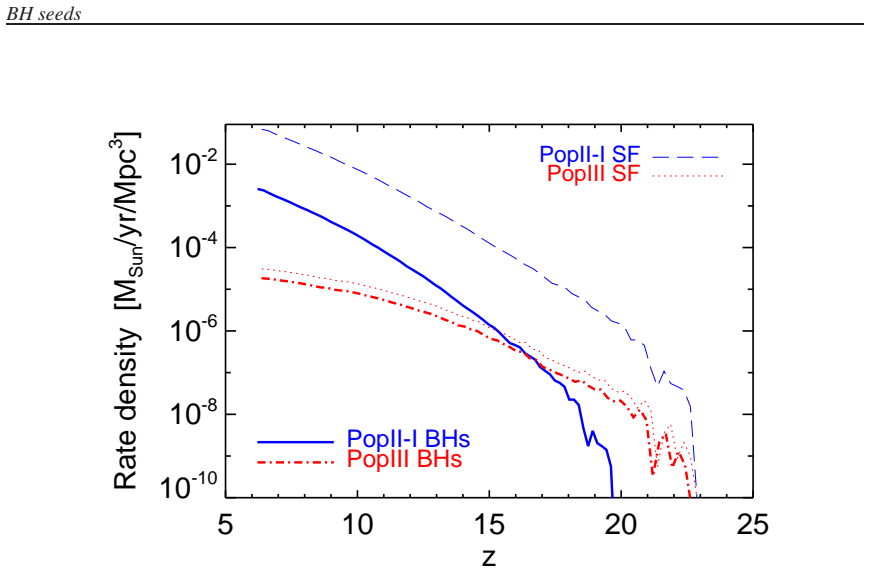
The central claim is that stellar-origin black holes cannot serve as the seeds of the highest-redshift supermassive black holes, because the simulated population of light seeds is dominated by $1$--$10\,M_\odot$ remnants after $z\simeq 16$, and even the most favorable accretion studied in the literature does not let $\sim 10^2\,M_\odot$ seeds grow within a few hundred million years. The paper instead identifies direct-collapse black holes as a plausible heavy-seed channel. In a simulation box evolved from $z=100$ to $z=6$ with non-equilibrium atomic and molecular chemistry, metal enrichment from SNII, AGB and SNIa phases, and 150-frequency radiative transfer, only the powerful population III case, a top-heavy IMF over $100$--$500\,M_\odot$ and a $10^5$ K black-body spectrum, produces halos meeting the direct-collapse criteria. Three candidates, labelled A, B and C, lie at $z=9$ with gas masses of $1$--$3\times 10^5\,M_\odot$, Lyman-Werner fluxes $J_{\rm LW}\approx 1$--$50$ in units of $10^{-21}$ erg s${}^{-1}$ cm${}^{-2}$ Hz${}^{-1}$ sr${}^{-1}$, pristine composition, fully dissociated H$_2$, and distances larger than 5 physical kpc from the irradiating star-forming source; the weaker $10^4$ K SED case yields no candidates at all. The paper concludes that direct collapse can explain at least part of the supermassive black hole population, but only under peculiar environmental conditions.
Load-bearing premise
The argument depends on assuming that the first stars were extremely massive, 100 to 500 solar masses, with a very hot $10^5$ K spectrum; if the first stellar population instead resembled ordinary cooler $10^4$ K stars, the simulated direct-collapse candidates disappear and the heavy-seed channel as described would not operate.
Editorial extensions
If this is right
- If the central claim is right, the $1$--$10\,M_\odot$ remnants that dominate stellar black-hole production after $z\simeq 16$ cannot by themselves account for $z\simeq 7.5$ supermassive black holes, so some heavier seed or faster growth channel is required.
- Direct-collapse seeds should be rare and located in pristine mini-haloes a few kiloparsecs away from intensely star-forming regions, so searches for the first supermassive black holes should target metal-free, H$_2$-free gas pockets near strong ultraviolet sources at $z\gtrsim 10$.
- The transition redshift $z\simeq 16$ separates a popIII-dominated light-seed epoch from a popII-I-dominated one, meaning the usefulness of light seeds depends sensitively on when and how the first stellar populations gave way to ordinary star formation.
- Because only the powerful popIII SED case yields candidates, the cosmic abundance of direct-collapse black holes depends directly on the IMF and spectra of the first stars; measuring those would turn this scenario into a quantitative prediction.
Reading between the lines
- An implicit threshold sits between the two SED cases: if the true first-star spectrum lies between $10^4$ and $10^5$ K, the number of direct-collapse seeds could be highly sensitive to the exact spectral shape, so a wider grid of SEDs would map where the channel switches on.
- A natural extension is to follow the three identified candidates with zoom-in simulations that actually resolve the final collapse; this paper checks literature-based criteria but does not simulate the collapse itself, leaving open what fraction of such candidates become black holes.
- If heavy seeds are as environmentally selective as this paper argues, supermassive black holes at $z\gtrsim 7$ should be spatially clustered near the most massive early star-forming regions rather than uniformly distributed, a signature future surveys could test.
- The light-seed argument also implies that a $z\simeq 7$ supermassive black hole found in a halo with no nearby massive star-forming region would require an alternative channel, such as super-Eddington accretion onto light seeds or primordial black holes, because the simulated environment would not produce a heavy seed there.
Signed reviews
Editorial analysis
A structured set of objections, weighed in public.
Referee Report
Summary. The paper argues that standard stellar-origin (light) black holes are unlikely to serve as seeds for the supermassive black holes observed at z ≳ 7, because their masses (∼1–10 M⊙, or ∼100 M⊙ for Pop III remnants) are too small to grow substantially within the first billion years. It then argues that direct-collapse black holes (DCBHs) forming in pristine mini-haloes exposed to Lyman–Werner radiation from nearby star-forming regions provide a plausible alternative. The evidence comes from N-body hydrodynamic simulations with non-equilibrium atomic/molecular chemistry, cooling, star formation, feedback, stellar evolution, metal spreading, and multifrequency radiative transfer. In the simulation with a 'powerful' Pop III model (top-heavy IMF, 100–500 M⊙, and a 10^5 K black-body SED), three haloes satisfy literature-based DCBH criteria (JLW ∼ 1–50 J21, H2 dissociated, gas near 10^4 K, at distances ≳5 physical kpc from the irradiating source); in the 'weak' Pop III case, no candidates are found. The paper concludes that DCBHs could explain at least part of the high-redshift SMBH population, while acknowledging that local substructure may inhibit formation in two of the three candidates.
Significance. If the central claim holds, the paper would strengthen the case that the formation of early SMBH seeds is extremely sensitive to the assumed spectral energy distribution and initial mass function of the first stellar populations, and that direct collapse requires a fine balance between radiative and chemical feedback. The simulations are genuinely comprehensive in their treatment of chemistry, feedback, stellar evolution, and radiative transfer, and the comparison of the powerful and weak Pop III cases is a real parameter study rather than a fit to a desired conclusion. The paper also honestly reports the fragility of its candidate sample: only one of the three haloes is a structurally clean DCBH candidate, and no simulation follows the gas to actual collapse. The main limitation is that the positive DCBH signal rests entirely on the 'powerful' Pop III assumption, which is plausible but not independently tested or quantified in this manuscript.
major comments (3)
- [§3, Fig. 4] The entire DCBH candidate signal is conditional on the 'powerful' Pop III model: a top-heavy IMF over 100–500 M⊙ and a 10^5 K black-body SED. The paper states that in the weak case (Salpeter IMF, 10^4 K black-body) there are no candidates, so the powerful-Pop III assumption is the decisive input that produces all three haloes. No independent evidence or uncertainty quantification is given for this extreme SED/IMF being representative of the first stellar populations. This is load-bearing because §2 argues that the Pop III-to-Pop II-I transition is fast at z > 15 and that Pop II-I remnants dominate at most times, so the prevalence of nearby powerful Pop III sources at the epochs of interest is not established. Please either provide a quantitative estimate of the fraction of the cosmic volume or of candidate haloes that are exposed to such powerful radiation, or explicitly reframe the result as an existence proof under a stated assumption.
- [§3, candidates A, B, C] The candidates are identified only by checking literature-based criteria (JLW ∼ 1–50 J21, H2 dissociated, gas temperature near 10^4 K, halo mass constraints); the simulation does not follow the collapse of the gas in these haloes into a black hole. The paper itself notes that candidate B has an irregular interacting shape and candidate C consists of two distinct sub-clumps that may inhibit DCBH formation, leaving candidate A as the only potentially viable object. Thus the conclusion that DCBHs 'could explain at least part of the SMBH population' rests on a single candidate whose actual collapse is not simulated. Please clarify whether this is intended as an existence proof, and if so, state that explicitly; or, if a statistical claim is intended, provide an estimate of the number density or probability of such configurations.
- [§2, Fig. 3] The conclusion that light seeds cannot grow significantly in less than a billion years is not derived in this paper; the growth argument is cited from Hirano et al. (2014) and other external studies. Within this manuscript, Fig. 3 only shows that Pop II-I remnants dominate the BH formation rate density after z ≃ 16 and that their masses are ∼1–10 M⊙. This is a reasonable and clearly attributed use of the literature, but the strength of the light-seed claim depends on assumptions about accretion efficiency and radiative feedback that are not tested here. Please state more precisely which parts of the light-seed argument are new simulation results and which parts rest on external calculations, so the reader can weigh the evidence.
minor comments (4)
- [Throughout] There are several typographical and formatting issues: 'in pl ace' in the abstract, 'z /greaterorsimilar10' and similar broken glyphs in the main text, and 'We acknowledge detailed comments by the the referee' in the Acknowledgments. These should be cleaned up.
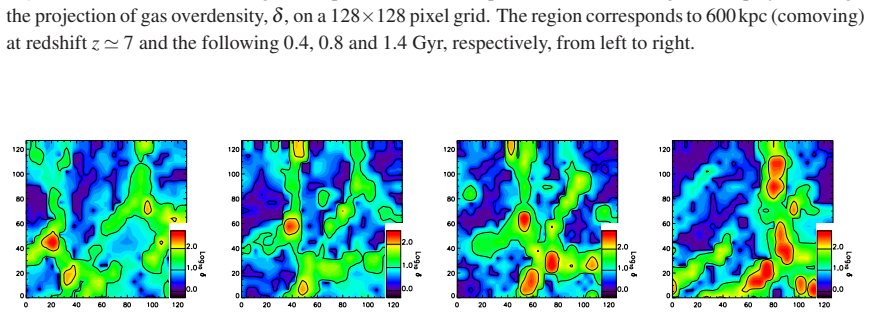
- [Fig. 4] The right panel of Fig. 4 uses yellow bullets to denote 'the same objects' as the DCBH candidates in the left panel, but in the weak case there are no candidates. Please clarify whether these are the same physical haloes now hosting cold gas, and distinguish more clearly between 'candidate haloes' and 'the same positions in a different run'.
- [§3, resolution and numerical convergence] The paper reports Reynolds numbers around 10^4–10^8 in the candidate haloes, which seems extraordinarily high for a simulation with 256^3 particles per species in a 0.5 Mpc/h box. Please either justify this estimate or soften the claim, and add a comment on numerical resolution and convergence for the identification of DCBH candidates.
- [§4, generality] The discussion of alternative cosmological models, non-Gaussianities, warm dark matter, and streaming motions is appropriately brief, but the statement that these are 'unlikely to change substantially our conclusions' is asserted without quantitative support. A single sentence citing the relevant sensitivity tests would be sufficient.
Circularity Check
No circularity found: simulation outputs are conditional on stated inputs, not equivalent to them.
full rationale
The paper's derivation chain is self-contained with respect to circularity. The light-seed BH formation rates (Fig. 3) are computed from simulated star-formation-rate densities using fixed stellar lifetimes and IMF prescriptions; these are input quantities, and the BH rates are a straightforward convolution, not a fit to the conclusion that light seeds cannot grow. The claim that popII-I BHs dominate at z <~ 16 follows from the simulated SFR densities and the assumed IMF, and it is not used to define the SFR. The heavy-seed DCBH analysis is explicitly a parameter comparison: the simulation is run with a powerful popIII SED (top-heavy IMF, 10^5 K black body) and a weak popIII SED (Salpeter IMF, 10^4 K black body), and haloes are checked against literature-based criteria (JLW ~ 1-1000 J21, H2 dissociation, virial temperature ~10^4 K, pristine gas, no star formation). The appearance of three candidates only in the powerful case and zero in the weak case is a genuine conditional result of the radiative-transfer calculation, not a quantity fitted to the paper's own conclusions. The paper explicitly hedges the final claim as 'could explain at least part of the SMBH population' and notes limitations, including the lack of a simulated collapse and the possible disruption of candidates B and C by substructure. The heavy reliance on self-citations is for numerical methods and earlier published implementations (e.g., Maio et al. 2007, 2010, 2019); none of these citations is invoked as a uniqueness theorem or as a substitute for the simulation results presented here. The powerful-popIII assumption is real and load-bearing for the DCBH candidate signal, but an untested or uncertain assumption is a correctness risk, not a circular step: the paper does not define the assumption in terms of the DCBH conclusion, nor does it fit the SED to the candidate haloes. Accordingly, no self-definitional step, fitted-input-called-prediction, or author-imported uniqueness argument is present.
Assumptions & free parameters
free parameters (6)
- Critical metallicity Zcrit =
10^-4 Z_sun
- PopIII IMF =
Top-heavy, 100-500 M_sun, Salpeter slope
- PopII-I IMF =
Salpeter, 0.1-100 M_sun
- PopIII SED in powerful case =
10^5 K black body
- PopIII SED in weak case =
10^4 K black body
- Kinetic wind velocity =
500 km/s
assumptions (5)
- domain assumption The Lambda CDM cosmological model with the adopted parameters is correct.
- domain assumption The sub-grid models for star formation, feedback, and metal spreading capture the essential physics of the early universe.
- domain assumption The Eddington tensor radiative transfer approximation is accurate enough for the DCBH problem.
- domain assumption The literature criteria for DCBH formation (virial temperature ~10^4 K, JLW in 1-1000 J21) are applicable to the simulated halos.
- domain assumption The simulation resolution (2 x 256^3 particles in a 0.5 Mpc/h box) is sufficient to resolve the halos relevant for DCBH.
Cite this review
Pith. "Pith review of Early black-hole seeds in the first billion years." pith.science (2026). https://pith.science/paper/6QMP5RRO
@misc{pith2026190804823,
  author       = {Pith},
  title        = {Pith review of: Early black-hole seeds in the first billion years},
  year         = {2026},
  howpublished = {\url{https://pith.science/paper/6QMP5RRO}},
  note         = {Machine review of arXiv:1908.04823}
}
read the original abstract
Supermassive black holes with billion solar masses are in place already within the first Gyr, however, their origin and growth in such a short lapse of time is extremely challenging to understand. Here, we discuss the formation paths of early black-hole seeds, showing the limits of light black-hole seeds from stellar origin and the expected characteristics of heavy/massive black-hole seeds originated by gas direct collapse in peculiar primordial conditions. To draw conclusions on the possible candidates and the role of the ambient medium, we use results from N-body hydrodynamic simulations including atomic and molecular non-equilibrium abundance calculations, cooling, star formation, feedback mechanisms, stellar evolution, metal spreading of several heavy elements from SNII, AGB and SNIa, and multifrequency radiative transfer over 150 frequencies coupled to chemistry and SED emission for popII-I and popIII stellar sources. Standard stellar-origin light black holes are unlikely to be reliable seeds of early supermassive black holes, because, under realistic assumptions, they cannot grow significantly in less than a billion years. Alternatively, massive black-hole seeds might originate from direct collapse of pristine gas in primordial quiescent mini-haloes that are exposed to stellar radiation from nearby star forming regions. The necessary conditions required to form these heavy seeds must be complemented with information on the complex features of local environments and the fine balance between chemistry evolution and radiative transfer.
Figures

Figures from the paper (1 more)

Reference graph
Works this paper leans on
-
[1]
[Rees(1984)] Rees, M. J
work page 1984
-
[11]
Monthly Notices of the Royal Astronomical Society 412, L40
The impact of primordial supersonic flows on early structure formation, reionization and the low est-mass dwarf galaxies. Monthly Notices of the Royal Astronomical Society 412, L40. [Maio et al.(2011)] Maio, U., Khochfar, S., Johnson, J. L., C iardi, B
work page 2011
-
[12]
[Hutter et al.(2019)] Hutter, A., and 28 colleagues
work page 2019
-
[17]
Astronomy and Astrophysics 601, A138
Enhanced direct collapse due to Lyman α feedback. Astronomy and Astrophysics 601, A138. [Ma et al.(2017)] Ma, Q., Maio, U., Ciardi, B., Salvaterra, R
work page 2017
-
[34]
[Thielemann et al.(2003)] Thielemann, F.-K., and 9 colleag ues
work page 2003
-
[37]
[Maio and Tescari(2015)] Maio, U., Tescari, E
work page 2015
-
[40]
Monthly Notices of the Royal Astronomical Socie ty 451, L70
T he dust mass in z > 6 normal star-forming galaxies.. Monthly Notices of the Royal Astronomical Socie ty 451, L70. [Habouzit et al.(2016)] Habouzit, M., V olonteri, M., Latif , M., Dubois, Y ., Peirani, S
work page 2016
-
[49]
A., Maio, U., Salvaterra , R., Ciardi, B
[Campisi et al.(2011)] Campisi, M. A., Maio, U., Salvaterra , R., Ciardi, B
work page 2011
Show all 57 references
-
[57]
E., Sartori, L
[Buchner et al.(2019)] Buchner, J., Treister, E., Bauer, F. E., Sartori, L. F., Schawinski, K
2019
-
[58]
Detecting galaxies with Euclid, JWST, W FIRST and ELT within ionized bubbles in the intergalactic medium at z>6
Bubble mapping with the Square Kilometer Array - I. Detecting galaxies with Euclid, JWST, W FIRST and ELT within ionized bubbles in the intergalactic medium at z>6. arXiv e-prints arXiv :1905.00437. 12
1905 arXiv
-
[60]
[Sugimura et al.(2014)] Sugimura, K., Omukai, K., Inoue, A. K
2014
-
[73]
[Graziani et al.(2019)] Graziani, L., Maselli, A., Maio, U
2019
-
[115]
[V aliante et al.(2018)] V aliante, R., Schneider, R., Graziani, L., Zappacosta, L
2018
-
[117]
[Zackrisson et al.(2019)] Zackrisson, E., and 18 colleague s
2019
-
[139]
Y ., Rubin, S
[Khlopov et al.(2005)] Khlopov, M. Y ., Rubin, S. G., Sakharo v, A. S
2005
-
[181]
B., Gro enewegen, M
[van den Hoek and Groenewegen(1997)] van den Hoek, L. B., Gro enewegen, M. A. T
1997
-
[246]
[Haiman et al.(2019)] Haiman, Z., and 20 colleagues
2019
-
[289]
9 BH seeds [Maio et al.(2006)] Maio, U., and 7 colleagues
2006
-
[305]
[Fan et al.(2001)] Fan, X., and 33 colleagues
2001
-
[471]
[Dolgov and Silk(1993)] Dolgov, A., Silk, J
1993
-
[473]
11 BH seeds [Dolgov(2018)] Dolgov, A. D
2018
-
[495]
[Maio et al.(2010)] Maio, U., Ciardi, B., Dolag, K., Tornato re, L., Khochfar, S
2010
-
[529]
[Maio et al.(2016)] Maio, U., Petkova, M., De Lucia, G., Borg ani, S
2016
-
[532]
[Bromm and Loeb(2003)] Bromm, V ., Loeb, A
2003
-
[544]
[Koopmans et al.(2015)] Koopmans, L., and 43 colleagues 201
2015
-
[557]
[Maio et al.(2019)] Maio, U., Borgani, S., Ciardi, B., Petko va, M
2019
-
[616]
[Wolcott-Green et al.(2011)] Wolcott-Green, J., Haiman, Z ., Bryan, G. L
2011
-
[838]
[Maio and Khochfar(2012)] Maio, U., Khochfar, S
2012
-
[869]
[Maio et al.(2007)] Maio, U., Dolag, K., Ciardi, B., Tornato re, L
2007
-
[921]
[Heger and Woosley(2002)] Heger, A., Woosley, S. E
2002
-
[963]
[Tornatore et al.(2007)] Tornatore, L., Borgan, S., Dolag, K., Matteucci, F
2007
-
[1003]
L., Haiman, Z
[Shang et al.(2010)] Shang, C., Bryan, G. L., Haiman, Z. 2010 . Supermassive black hole formation by direct collapse: keeping protogalactic gas H 2 free in dark matter haloes with virial temperatures Tvir /greaterorsimilar104 K. Monthly Notices of the Royal Astronomical Societ...
2010
-
[1105]
C., V olonteri, M., Ree s, M
[Begelman et al.(2006)] Begelman, M. C., V olonteri, M., Ree s, M. J
2006
-
[1113]
[Maio et al.(2012)] Maio, U., Salvaterra, R., Moscardini, L ., Ciardi, B
2012
-
[1140]
[Ma et al.(2017)] Ma, Q., Maio, U., Ciardi, B., Salvaterra, R
2017
-
[1145]
[Maio and Iannuzzi(2011)] Maio, U., Iannuzzi, F
2011
-
[1443]
[Salvaterra et al.(2013)] Salvaterra, R., Maio, U., Ciardi , B., Campisi, M. A
2013
-
[1486]
[Maio et al.(2013)] Maio, U., Ciardi, B., Müller, V
2013
-
[1621]
S., Maio, U., Ciar di, B
[Dayal et al.(2013)] Dayal, P ., Dunlop, J. S., Maio, U., Ciar di, B
2013
-
[2005]
Astroparticle Physics 23, 265
Primordial structure of massive black hole clusters. Astroparticle Physics 23, 265 . [Springel(2005)] Springel, V
2005
-
[2007]
Monthly N otices of the Royal Astronomical Society 382,1050
Chemical enrichment of galaxy clusters from hydrodynamical simulation. Monthly N otices of the Royal Astronomical Society 382,1050. [Khlopov(2010)] Khlopov, M. Y
2010
-
[2011]
Classical and Quantum Gravity 28, 225015
Gas distribution, metal enrich ment and baryon fraction in Gaussian and non-Gaussian universes. Classical and Quantum Gravity 28, 225015. [Mortlock et al.(2011)] Mortlock, D. J., and 16 colleagues 2
2011
-
[2013]
The Astrophysical Journal 762, L6
S eeing the First Supernovae at the Edge of the Universe with JWST. The Astrophysical Journal 762, L6. [Hirano et al.(2014)] Hirano, S., and 6 colleagues
2014
-
[2015]
Monthly Notices of the Royal Astronomical Society 446, 2760
The first billi on years of a warm dark matter universe. Monthly Notices of the Royal Astronomical Society 446, 2760 . [Mancini et al.(2015)] Mancini, M., and 7 colleagues
2015
-
[2019]
Pu blications of the Astronomical Society of Australia 36, e020
The seeds of supermassive black holes and the role of local radiation and metal spreading. Pu blications of the Astronomical Society of Australia 36, e020. [Natarajan et al.(2019)] Natarajan, P ., and 16 colleagues 2
2019
-
[2078]
[Petkova and Maio(2012)] Petkova, M., Maio, U
2012
-
[2718]
J., and 7 colleagues
[Whalen et al.(2013)] Whalen, D. J., and 7 colleagues
2013
-
[2760]
[Maio et al.(2011)] Maio, U., Koopmans, L. V . E., Ciardi, B. 2
2011
-
[2833]
G., Sakharov, A
[Rubin et al.(2001)] Rubin, S. G., Sakharov, A. S., Khlopov, M. Y
2001
-
[3021]
[Maio(2011)] Maio, U
2011
-
[3067]
10 BH seeds [Biffi and Maio(2013)] Biffi, V ., Maio, U
2013
-
[3130]
L., Dijkstra, M
[Johnson and Dijkstra(2017)] Johnson, J. L., Dijkstra, M. 2
2017
-
[3532]
[Bañados et al.(2018)] Bañados, E., and 17 colleagues
2018
-
[3733]
[Mancini et al.(2016)] Mancini, M., and 6 colleagues
2016
-
[3798]
[Maio and Viel(2015)] Maio, U., Viel, M
2015
-
[3825]
M., and 9 colleagues 20
[Belotsky et al.(2019)] Belotsky, K. M., and 9 colleagues 20
2019
-
[4244]
E., Weaver, T
[Woosley and Weaver(1995)] Woosley, S. E., Weaver, T. A. 199
1995
Reviewed August 14, 2026 · model on record in the stance chip above.
Discussion (0). Continue with ORCID to comment.