REVIEW 3 major objections 6 minor 1 cited by
Vessel Detection and Localization Using Distributed Acoustic Sensing in Submarine Optical Fiber Cables
T0 review · 3 major / 6 minor · reviewed 2026-08-04 · deepseek-v4-flash
Pith's one-line read A submarine telecom cable, repurposed as a distributed acoustic sensor, can detect vessels within 1 km at over 90% F1-score and estimate their distance to about 141 meters.
desk verdict Large-scale DAS vessel detection with a released dataset and credible detection results, but the headline 141 m localization MAE is undermined by AIS interpolation uncertainty larger than the reported error. read the letter →
The pith
A machine-rendered reading of the paper's core claim, the machinery that carries it, and where it could break.
The reading
What carries the argument
The key machinery is a DAS-plus-ML pipeline built on logarithmically spaced frequency-band energy features. Each 10-second frame from each sensing position is reduced to 100 band energies over 4–98 Hz (with the 49–51 Hz band removed to suppress interrogator harmonics), then averaged across up to 250 channels and concatenated in 50-second temporal contexts; XGBoost classifiers/regressors consume these features, with majority voting over five windows. AIS trajectories linearly interpolated to 1-second resolution provide the labels. This feature design follows from a spectral analysis showing a clear vessel-vs-noise contrast below 100 Hz and from the gauge-length Nyquist argument that caps reso
What would settle it
Run a controlled vessel with a high-rate GPS receiver (e.g. 1 Hz or better) past a DAS-instrumented cable for a few hours, compute the model's distance errors against those GPS positions instead of interpolated AIS, and compare with 141 m. If the error against high-rate GPS is substantially above 141 m—or if the model misses a vessel whose AIS is off—the paper's central deployment claim does not survive.
Extended reading notes
Core claim
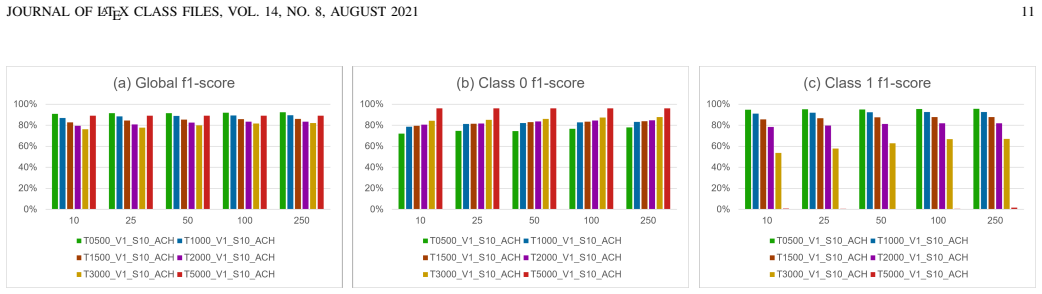
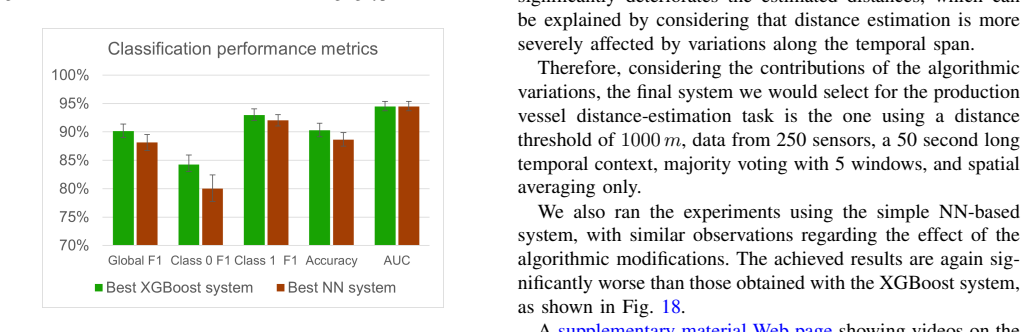
The central discovery claim is that vessel proximity to a buried submarine cable can be learned directly from DAS spectral energy. The authors select a 1000 m protection threshold, integrate spectral features from 250 channels spanning ~2.5 km, use 50-second contexts and majority voting, and train XGBoost models under a day-based 10-fold cross-validation that avoids temporal leakage. On unseen days, detection achieves >90% overall F1 with balanced class-wise scores, and vessel distance regression achieves 141 m MAE; the same ML regression beats an SRP beamforming implementation (225 m MAE) on vessels within 1 km. The paper also identifies a physical limitation: with a 10 m gauge length and ~
Load-bearing premise
The load-bearing assumption is that AIS positions linearly interpolated to 1-second intervals are an accurate ground truth for vessel-to-cable distance; if those labels are off by hundreds of meters, the detection and localization numbers are measuring label noise as much as physical accuracy.
Editorial extensions
If this is right
- Cable operators can deploy a protection alarm on an existing fiber with no new underwater hardware, only an interrogator and trained models.
- Because detection does not rely on cooperative AIS transmissions, the method could flag vessels that have switched off or spoofed AIS—dark ships.
- The ML distance estimator is both more accurate and computationally lighter than grid-search beamforming, making continuous real-time surveillance feasible along long cables.
- The released dataset enables other groups to reproduce the 141 m/90% figures and benchmark alternative models on the same real-world conditions.
- The 10-minute early response seen in examples implies warnings can be raised before a vessel actually crosses the cable, leaving time for intervention.
Reading between the lines
- The reported 141 m MAE is measured against AIS positions interpolated at 1-second resolution from updates that arrive every 1–3 minutes for 88% of vessels. Since the authors quote ~315 m of positional uncertainty per minute, the true physical localization error could be lower or higher than 141 m; a high-rate GPS validation would settle it.
- Because useful energy concentrates below 100 Hz, the same features may carry information about vessel speed, size, and type, so extending the pipeline to those tasks is a natural next step that the authors flag as future work.
- A model trained on one cable segment with a particular burial depth, bathymetry, and traffic mix may not transfer directly to other deployments; testing on diverse public DAS datasets would show how much retraining is needed.
- If the method generalizes, fused DAS-AIS monitoring could shift from reaction to prediction: cable-protection systems could issue proximity alerts minutes before crossing rather than after radar/AIS contact.
Signed reviews
Editorial analysis
A structured set of objections, weighed in public.
Referee Report
Summary. This paper presents a DAS-based vessel detection and distance-estimation system using 10 days of continuous recordings from a 28 km submarine fiber-optic cable in the Southern Bight of the North Sea, with AIS as ground truth. The pipeline computes 100 log-spaced spectral-band energies (4–98 Hz, excluding 49–51 Hz) from 10-second windows, optionally integrates 10–250 sensors and 10–50 s temporal contexts, and trains XGBoost or feed-forward NN classifiers/regressors. A 10-fold, day-level cross-validation is used. The authors report an overall F1-score above 90% for detecting a vessel within 1000 m of the cable and a mean absolute error of 141 m for distance estimation, and they compare the regressor with SRP beamforming. The processed feature dataset is publicly released. The central numerical claims are weakened by the fact that the AIS labels are linearly interpolated to 1-second resolution from updates that are 1–3 minutes apart for 88% of vessels, with a stated positional uncertainty of about 315 m per minute, which exceeds the reported 141 m MAE.
Significance. If the quantitative claims hold, this would be a practically valuable result: it would show that an existing telecom cable, a commercial DAS interrogator, and gradient-boosted trees can serve as an all-weather, near-real-time cable-protection monitor in open-water conditions, and the released processed dataset would be a useful community resource. The paper has real strengths: the temporal split into day-level folds is a serious attempt to avoid leakage, the class-imbalance issues are acknowledged and handled in the metric reporting, bootstrap confidence intervals are provided, and the comparison with a classical SRP beamformer grounds the ML claims. The qualitative match between DAS feature energy and AIS-derived vessel proximity (Figs. 8d–e) is convincing evidence that the signal is physically present. However, two load-bearing issues—label uncertainty larger than the claimed precision, and model/feature selection performed on the same data used for testing—prevent the headline F1 and MAE from being accepted as unbiased estimates of operational performance.
major comments (3)
- [Section IV-B.1 and Eq. (1), Section VI-F] The reported 141 m MAE is smaller than the uncertainty of the labels against which it is computed. Section IV-B.1 states that 88% of vessels report every 1–3 minutes and that linear interpolation introduces 'significant positional uncertainty (approximately 315 meters per minute in average).' A linearly interpolated AIS trajectory is a smooth curve, and the final system uses 50 s temporal context plus 5-window voting, so the model can learn to reproduce that smoothed curve rather than estimate true physical distance. The MAE in Eq. (1) therefore conflates model error with label-placement error. Please compute the MAE only on frames coinciding with raw AIS messages (or within a short, stated tolerance), stratify the error by time since last AIS update, and report an uncertainty bound on the labels. Without such an evaluation, the 141 m precision claim is not supported. The detection F1 is
- [Sections VI-C, VI-E, VI-F] The day-level 10-fold CV prevents temporal leakage for a fixed processing pipeline, but the pipeline is not fixed. The spectral feature bands (Section VI-C), distance threshold, number of sensors, temporal context, majority-voting length, and averaging strategy (Sections VI-E and VI-F) were all selected after inspecting results on the full dataset, including the test folds. This selection-on-test makes the reported F1 and MAE optimistic estimates of generalization. Please hold out at least one full day (or use nested cross-validation) for all configuration choices and report the performance of the frozen pipeline. At minimum, state clearly that the quoted numbers are post-model-selection and therefore not unbiased.
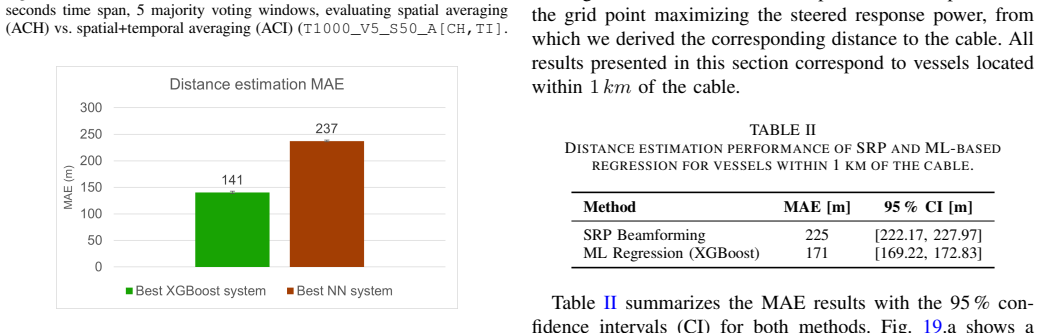
- [Abstract/Conclusions vs. Table II and Section VI-H] There is an apparent inconsistency in the headline localization numbers. The abstract and conclusions quote 141 m MAE, while Table II reports 171 m for the XGBoost regressor in the beamformer comparison, and Section VI-H says the 1000 m task with 10-second windows 'achieved a MAE of 171m.' If 141 m is obtained only with the final 50 s / 5-vote configuration, that configuration should be stated wherever the number appears, and the beamforming comparison should be run on the same configuration. As written, a reader cannot tell whether the methods are being compared on equal terms.
minor comments (6)
- [Abstract] 'mean average error' should be 'mean absolute error' (also in the conclusions).
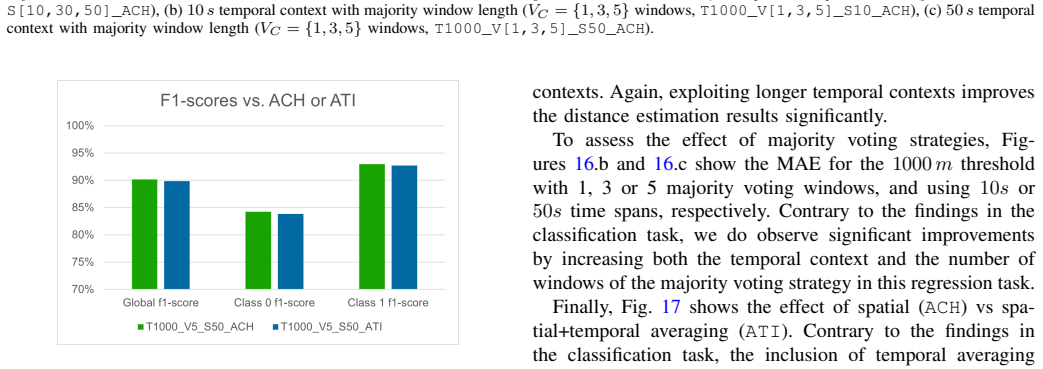
- [Figure 17 caption] 'ACI' appears to be a typo for 'ATI' (spatial+temporal averaging), and the notation 'A[CH,TI' is incomplete.
- [Index Terms] 'V essel' has a spacing typo.
- [Introduction and Section IV-D] The Introduction motivates the method by the ability to detect non-cooperative 'dark' ships without AIS, but the supervised labels are entirely AIS-derived, so the evaluation cannot measure dark-ship detection. Please add an explicit limitation statement that the reported results apply to AIS-cooperative vessels.
- [Section V-C / data labeling] The label is described as the distance from the cable to the closest vessel. For the 250-sensor (2.5 km) configuration, clarify whether this is the minimum distance over the whole segment and discuss how a vessel near one end of the segment is labeled for sensors far from it. This affects the interpretation of the regression target and of the spatial-averaging results.
- [Section VI-G] State explicitly whether the SRP comparison uses the same temporal context and majority voting as the final ML system. As written, Table II compares a 10-second-window regressor with a 10-second-window beamformer, while the final system uses 50 s context and voting.
Circularity Check
No significant circularity: supervised ML evaluation is self-contained; the headline metrics are validation issues (label noise, post-selection), not reductions to inputs.
full rationale
This is an empirical supervised-learning paper, not a derivation. DAS spectral features (band energies) are mapped to vessel-distance labels obtained from AIS, and the models are evaluated with day-level 10-fold cross-validation. The central detection and localization claims are additionally benchmarked against an independent SRP beamforming baseline following Paap et al. No equation in the paper reduces to its own input, and no fitted parameter is renamed as a prediction. The feature band choice (4–98 Hz excluding 49–51 Hz) is informed by dataset-wide spectral averages, and the final system configuration is selected after inspecting many experimental variants; this is a model-selection / data-snooping concern that can inflate reported performance, but it is not circular because the DAS features are not constructed from the AIS labels and the evaluation still uses held-out days. The reported 141 m MAE is computed against linearly interpolated AIS positions, and the paper itself states that 88% of vessels report only every 1–3 minutes with roughly 315 m per minute positional uncertainty; that is a serious label-noise threat to the validity of the absolute error, but it is not an instance of the prediction being equivalent to the training input by construction. Self-citations (e.g., refs. [45], [48], [50]) appear only in literature-review or methodological context and are not load-bearing for the main result. Overall, the derivation chain is self-contained and the central claims do not reduce to the inputs; the honest finding is no significant circularity.
Assumptions & free parameters
free parameters (6)
- Final distance threshold =
1000 m
- Number of integrated sensors =
250 channels (~2.5 km)
- Temporal context and voting window =
50 s context, 5-window majority voting
- Spectral feature bands =
100 log-spaced bands, 4-98 Hz, excluding 49-51 Hz
- SRP sound speed =
1750 m/s
- XGBoost hyperparameters =
eta=0.05, max_depth=10, n_estimators=500
assumptions (5)
- domain assumption Linearly interpolated AIS positions are an adequate ground truth for vessel-to-cable distance.
- domain assumption Vessel acoustic signatures reach the buried cable and are separable in the 4-98 Hz band.
- domain assumption Owner-provided cable geometry and bathymetry are accurate enough for georeferencing DAS channels.
- standard math Strain and strain-rate are linearly related in frequency, so choosing either does not change model ranking.
- domain assumption The SRP propagation model with constant effective sound speed (1750 m/s) approximates seabed wavefronts.
Cite this review
Pith. "Pith review of Vessel Detection and Localization Using Distributed Acoustic Sensing in Submarine Optical Fiber Cables." pith.science (2026). https://pith.science/paper/6ROSRYNH
@misc{pith2026250911614,
  author       = {Pith},
  title        = {Pith review of: Vessel Detection and Localization Using Distributed Acoustic Sensing in Submarine Optical Fiber Cables},
  year         = {2026},
  howpublished = {\url{https://pith.science/paper/6ROSRYNH}},
  note         = {Machine review of arXiv:2509.11614}
}
read the original abstract
Submarine cables play a critical role in global internet connectivity, energy transmission, and communication but remain vulnerable to accidental damage and sabotage. Recent incidents in the Baltic Sea highlighted the need for enhanced monitoring to protect this vital infrastructure. Traditional vessel detection methods, such as synthetic aperture radar, video surveillance, and multispectral satellite imagery, face limitations in real-time processing, adverse weather conditions, and coverage range. This paper explores Distributed Acoustic Sensing (DAS) as an alternative by repurposing submarine telecommunication cables as large-scale acoustic sensor arrays. DAS offers continuous real-time monitoring, operates independently of cooperative systems like the "Automatic Identification System" (AIS), being largely unaffected by lighting or weather conditions. However, existing research on DAS for vessel tracking is limited in scale and lacks validation under real-world conditions. To address these gaps, a general and systematic methodology is presented for vessel detection and distance estimation using DAS. Advanced machine learning models are applied to improve detection and localization accuracy in dynamic maritime environments. The approach is evaluated over a continuous ten-day period, covering diverse ship and operational conditions, representing one of the largest-scale DAS-based vessel monitoring studies to date, and for which we release the full evaluation dataset. Results demonstrate DAS as a practical tool for maritime surveillance, with an overall F1-score of over 90% in vessel detection, and a mean average error of 141 m for vessel distance estimation, bridging the gap between experimental research and real-world deployment.
Figures


Figures from the paper (17 more)








Forward citations
Cited by 1 Pith paper
-
Sea-Scan: High-Accuracy, ML-based Dark Vessel Detection and Localisation via Weakly Supervised DAS Monitoring
ML-based dark vessel detection system using weakly supervised learning on DAS data achieves 97.8% detection rate at 1.98% false-trigger rate.
Reference graph
Works this paper leans on
-
[1]
Finland-Germany submarine cable damaged again in Baltic Sea in possible sabotage act,
Y . Zoria, “Finland-Germany submarine cable damaged again in Baltic Sea in possible sabotage act,” Online, accessed march 2025, 2025
2025
-
[2]
Undersea cables cut or damaged, leading European nations to
CBS News, “Undersea cables cut or damaged, leading European nations to ...” Online, accessed june 2025, 2024
2025
-
[3]
Seabed Cable Damaged in Latest Baltic CUI Incident,
Naval News, “Seabed Cable Damaged in Latest Baltic CUI Incident,” Online, accessed june 2025, 2024
2025
-
[4]
Joint Communication: Strengthen Security and Resilience of Submarine Cables,
European Commission, “Joint Communication: Strengthen Security and Resilience of Submarine Cables,” Online, accessed june 2025, 2025
2025
-
[5]
A Moving Ship Detection and Tracking Method Based on Optical Remote Sensing Images from the Geostationary Satellite,
W. Yu, H. You, P. Lv, Y . Hu, and B. Han, “A Moving Ship Detection and Tracking Method Based on Optical Remote Sensing Images from the Geostationary Satellite,”Sensors, vol. 21, no. 22, p. 7547, 2021
2021
-
[6]
Vessel Detection and Tracking Method Based on Video Surveillance,
N. Wawrzyniak, T. Hyla, and A. Popik, “Vessel Detection and Tracking Method Based on Video Surveillance,”Sensors, vol. 19, no. 23, p. 5230, 2019
2019
-
[7]
Ship Detection in Multispectral Satellite Images Under Complex Environment,
X. Xie, B. Li, and X. Wei, “Ship Detection in Multispectral Satellite Images Under Complex Environment,”Remote Sensing, vol. 12, no. 5, p. 792, 2020
2020
-
[8]
Photonic seismology: A new decade of distributed acoustic sensing in geophysics from 2012 to 2023,
F. Cheng, “Photonic seismology: A new decade of distributed acoustic sensing in geophysics from 2012 to 2023,”Surveys in Geophysics, vol. 45, no. 4, pp. 1205–1243, 2024
2012
Show all 59 references
-
[9]
Sensing whales, storms, ships and earthquakes using an Arctic fibre optic cable,
M. Landrø, L. Bouffaut, H. J. Kriesell, J. R. Potter, R. A. Rørstadbotnen, K. Taweesintananon, S. E. Johansen, J. K. Brenne, A. Haukanes, O. Schjelderup, and F. Storvik, “Sensing whales, storms, ships and earthquakes using an Arctic fibre optic cable,”Scientific Reports, vol. ...
2022
-
[10]
Ship noise characterization for marine traffic monitoring using dis- tributed acoustic sensing,
L. Thiem, S. Wienecke, K. Taweesintananon, M. Vaupel, and M. Landrø, “Ship noise characterization for marine traffic monitoring using dis- tributed acoustic sensing,” in2023 IEEE International Workshop on Metrology for the Sea; Learning to Measure Sea Health Parameters. IEEE, ...
2023
-
[11]
Toward Detecting Ship Char- acteristics and Movements using DAS and Machine Learning,
J. Malaprade, R. Hunt, and G. Lees, “Toward Detecting Ship Char- acteristics and Movements using DAS and Machine Learning,” in Proceedings of the 10th International Conference on Insulated Power Cables (Jicable’19), Versailles, France, June 2019
2019
-
[12]
Underwater Noise Characteristics of Small Ships,
S. Malinowski and I. Gloza, “Underwater Noise Characteristics of Small Ships,”Acta Acustica united with Acustica, vol. 88, pp. 718–721, 2002
2002
-
[13]
Design and evaluation of real-time data storage and signal processing in a long-range distributed acoustic sensing (das) using cloud-based services,
A. Nur and Y . Muanenda, “Design and evaluation of real-time data storage and signal processing in a long-range distributed acoustic sensing (das) using cloud-based services,”Sensors, vol. 24, no. 18, 2024
2024
-
[14]
DASSA: Parallel DAS data storage and analysis for subsurface event detection,
B. Dong, V . R. Tribaldos, X. Xing, S. Byna, J. Ajo-Franklin, and K. Wu, “DASSA: Parallel DAS data storage and analysis for subsurface event detection,” in2020 IEEE International Parallel and Distributed Processing Symposium (IPDPS). IEEE, 2020, pp. 254–263
2020
-
[15]
Preliminary assessment of ship detection and trajectory evaluation using distributed acoustic sensing on an optical fiber telecom cable,
D. Rivet, B. de Cacqueray, A. Sladen, A. Roques, and G. Calbris, “Preliminary assessment of ship detection and trajectory evaluation using distributed acoustic sensing on an optical fiber telecom cable,”The Journal of the Acoustical Society of America, vol. 149, no. 4, pp. 261...
2021
-
[16]
Application of machine learning to microseismic event detection in distributed acoustic sensing data,
A. L. Stork, A. F. Baird, S. A. Horne, G. Naldrett, S. Lapins, J.- M. Kendall, J. Wookey, J. P. Verdon, A. Clarke, and A. Williams, “Application of machine learning to microseismic event detection in distributed acoustic sensing data,”GEOPHYSICS, vol. 85, no. 5, p. KS149–KS160...
2020
-
[17]
Source detection and tracking for underwater distributed acoustic sens- ing,
K. T. Drylerakis, M. Belal, R. Mestre, T. J. Norman, and C. Evers, “Source detection and tracking for underwater distributed acoustic sens- ing,” in2024 32nd European Signal Processing Conference (EUSIPCO), 2024, pp. 1292–1296
2024
-
[18]
Application of machine learning for signal recognition in distributed fibre optic acoustic sensing technology,
Y . Zhan, L. Liu, and K. Li, “Application of machine learning for signal recognition in distributed fibre optic acoustic sensing technology,”IET Optoelectronics, vol. 18, no. 4, pp. 81–95, 2024
2024
-
[19]
Photonic Integrated Sensing and Communication System Harnessing Submarine Fiber Optic Cables for Coastal Event Monitoring,
S. Chen, K. Zhu, J. Han, Q. Sui, and Z. Li, “Photonic Integrated Sensing and Communication System Harnessing Submarine Fiber Optic Cables for Coastal Event Monitoring,”IEEE Communications Magazine, vol. 60, no. 12, pp. 110–116, 2022
2022
-
[20]
New advances in fiber optic technology for environmental monitoring, safety, and risk management applica- tions,
S. Wienecke and J. K. Brenne, “New advances in fiber optic technology for environmental monitoring, safety, and risk management applica- tions,” in2023 IEEE International Workshop on Metrology for the Sea; Learning to Measure Sea Health Parameters, 2023, pp. 316–321
2023
-
[21]
Acoustic Technology for Mar- itime Surveillance: Insights from Experimental Exercises,
A. R. Dias, N. P. Santos, and V . Lobo, “Acoustic Technology for Mar- itime Surveillance: Insights from Experimental Exercises,” inOCEANS 2024 - Singapore, 2024, pp. 1–7
2024
-
[22]
Distributed acoustic sensing for detecting near surface hydroacoustic signals,
A. S. Douglass, S. Abadi, and B. P. Lipovsky, “Distributed acoustic sensing for detecting near surface hydroacoustic signals,”JASA Express Letters, vol. 3, no. 6, p. 066005, 2023
2023
-
[23]
Leveraging Distributed Acoustic Sensing for monitoring vessels using submarine fiber-optic cables,
B. Paap, V . Vandeweijer, J.-D. van Wees, and D. Kraaijpoel, “Leveraging Distributed Acoustic Sensing for monitoring vessels using submarine fiber-optic cables,”Applied Ocean Research, vol. 154, p. 104422, 2025
2025
-
[24]
Tracking Moving Ships Using Distributed Acoustic Sensing Data,
J. Shao, Y . Wang, Y . Zhang, X. Zhang, and C. Zhang, “Tracking Moving Ships Using Distributed Acoustic Sensing Data,”IEEE Geoscience and Remote Sensing Letters, vol. 22, pp. 1–5, 2025
2025
-
[25]
DAShip: A Large-Scale Annotated Dataset for Ship Detection Using Distributed Acoustic Sensing Technique,
W. Huang, S. Chen, Y . Wu, R. Li, T. Li, Y . Huang, X. Cao, and Z. Li, “DAShip: A Large-Scale Annotated Dataset for Ship Detection Using Distributed Acoustic Sensing Technique,”IEEE Journal of Selected Topics in Applied Earth Observations and Remote Sensing, vol. 18, pp. 4093–...
2025
-
[26]
Estimates of Source Spectra of Ships from Long Term Recordings in the Baltic Sea,
I. Karasalo, M. ¨Ostberg, P. Sigray, J.-P. Jalkanen, L. Johansson, M. Liefvendahl, and R. Bensow, “Estimates of Source Spectra of Ships from Long Term Recordings in the Baltic Sea,”Frontiers in Marine Science, vol. 4, p. 164, 2017
2017
-
[27]
Distributed Acoustic Sensing Turns Fiber-Optic Cables into Sensitive Seismic Antennas,
Z. Zhan, “Distributed Acoustic Sensing Turns Fiber-Optic Cables into Sensitive Seismic Antennas,”Seismological Research Letters, vol. 91, no. 1, pp. 1–15, 2020
2020
-
[28]
On the sensitivity of distributed acoustic sensing,
H. Gabai and A. Eyal, “On the sensitivity of distributed acoustic sensing,”Optics letters, vol. 41, no. 24, pp. 5648–5651, 2016
2016
-
[29]
Optical pulse compression re- flectometry: proposal and proof-of-concept experiment,
W. Zou, S. Yang, X. Long, and J. Chen, “Optical pulse compression re- flectometry: proposal and proof-of-concept experiment,”Optics Express, vol. 23, no. 1, p. 512, 2015
2015
-
[30]
Real-time phase-recording DAS in 171 km low-loss fiber,
O. H. Waagaard, E. Rønnekleiv, A. Haukanes, F. Stabo-Eeg, D. Thingbø, S. Forbord, S. E. Aasen, and J. K. Brenne, “Real-time phase-recording DAS in 171 km low-loss fiber,” inOptical Fiber Sensors Conference 2020 Special Edition, ser. OFS. Optica Publishing Group, 2021, p. T2A.3
2020
-
[31]
Enhancing fibre-optic distributed acoustic sensing capabilities with blind near-field array signal processing,
F. Mu ˜noz and M. A. Soto, “Enhancing fibre-optic distributed acoustic sensing capabilities with blind near-field array signal processing,”Nature Communications, vol. 13, no. 1, p. 4019, 2022
2022
-
[32]
Distributed Acoustic Sensing for Submarine Cable Protection,
O. Brenne, S. Besanger, and P. Travers, “Distributed Acoustic Sensing for Submarine Cable Protection,” inSubOptic 2019 Conference Proceedings, New Orleans, USA, 2019. [Online]. Available: https: //suboptic.org
2019
-
[33]
OptoDAS interrogator,
Alcatel Submarine Networks, “OptoDAS interrogator,” Online, accessed march 2025
2025
-
[34]
The promises and perils of Automatic Identification System data,
T. Emmens, C. Amrit, A. Abdi, and M. Ghosh, “The promises and perils of Automatic Identification System data,”Expert Systems with Applications, vol. 178, p. 114975, 2021
2021
-
[35]
Automatic Identi- fication System (AIS): Data Reliability and Human Error Implications,
A. Harati-Mokhtari, A. Wall, P. Brooks, and J. Wang, “Automatic Identi- fication System (AIS): Data Reliability and Human Error Implications,” Journal of Navigation, vol. 60, no. 3, p. 373–389, 2007
2007
-
[36]
Technical Characteristics for an Automatic Identification System Using Time Division Multiple Access in the VHF Maritime Mobile Band (Recommendation ITU-R M.1371-5),
International Telecommunication Union, “Technical Characteristics for an Automatic Identification System Using Time Division Multiple Access in the VHF Maritime Mobile Band (Recommendation ITU-R M.1371-5),” International Telecommunication Union, Geneva, Switzer- land, Technica...
2014
-
[37]
Improved kinematic interpolation for AIS trajectory reconstruction,
S. Guo, J. Mou, L. Chen, and P. Chen, “Improved kinematic interpolation for AIS trajectory reconstruction,”Ocean Engineering, vol. 234, p. 109256, 2021
2021
-
[38]
Distributed sensing of earthquakes and ocean-solid Earth interactions on seafloor telecom cables,
A. Sladen, D. Rivet, J. P. Ampuero, L. De Barros, Y . Hello, G. Calbris, and P. Lamare, “Distributed sensing of earthquakes and ocean-solid Earth interactions on seafloor telecom cables,”Nature communications, vol. 10, no. 1, p. 5777, 2019
2019
-
[39]
Identification of two vibration regimes of underwater fibre optic cables by distributed acoustic sensing,
D. Mata Flores, E. D. Mercerat, J. P. Ampuero, D. Rivet, and A. Sladen, “Identification of two vibration regimes of underwater fibre optic cables by distributed acoustic sensing,”Geophysical Journal International, vol. 234, no. 2, pp. 1389–1400, 2023
2023
-
[40]
EMODnet Digital Bathymetry (DTM 2024),
EMODnet Bathymetry Consortium, “EMODnet Digital Bathymetry (DTM 2024),” 2024. [Online]. Available: https://dx.doi.org/10.12770/ cf51df64-56f9-4a99-b1aa-36b8d7b743a1
2024
-
[41]
Marlinks-NS DAS: Dataset for Vessel Detection and Distance Estimation Using Distributed Acoustic Sensing in Submarine Cables,
E. E. Ramirez-Torres, J. Macias-Guarasa, D. Pizarro-Perez, J. Tejedor, S. E. Palazuelos-Cagigas, P. J. Vidal-Moreno, S. Martin-Lopez, M. Gonzalez-Herraez, and R. Vanthillo, “Marlinks-NS DAS: Dataset for Vessel Detection and Distance Estimation Using Distributed Acoustic Sensin...
2025 doi
-
[42]
Long-range sound propagation in the central region of the Baltic Sea,
R. Vadov, “Long-range sound propagation in the central region of the Baltic Sea,”Acoustical Physics, vol. 47, no. 2, pp. 150–159, 2001
2001
-
[43]
Precise and low-complexity method for underwater Doppler estimation based on acoustic frequency comb waveforms,
J. Li, Z. Qian, D. Hong, and J. Zhai, “Precise and low-complexity method for underwater Doppler estimation based on acoustic frequency comb waveforms,”Frontiers in Marine Science, vol. 11, p. 1365095, 2024
2024
-
[44]
On the Detection Capabilities of Underwater Distributed Acoustic Sensing,
I. Lior, A. Sladen, D. Rivet, J. Ampuero, Y . Hello, C. Becerril, H. F. Martins, P. Lamare, C. Jestin, S. Tsagkli, and C. Markou, “On the Detection Capabilities of Underwater Distributed Acoustic Sensing,” Journal of Geophysical Research: Solid Earth, vol. 126, no. 3, p. e2020...
2021
-
[45]
Toward prevention of pipeline integrity threats using a smart fiber-optic surveillance system,
J. Tejedor, H. F. Martins, D. Piote, J. Macias-Guarasa, J. Pastor- Graells, S. Martin-Lopez, P. C. Guill ´en, F. De Smet, W. Postvoll, and M. Gonzalez-Herraez, “Toward prevention of pipeline integrity threats using a smart fiber-optic surveillance system,”Journal of Lightwave ...
2016
-
[46]
A. H. Hartog,An introduction to distributed optical fibre sensors. CRC press, 2017
2017
-
[47]
XGBoost: A Scalable Tree Boosting System,
T. Chen and C. Guestrin, “XGBoost: A Scalable Tree Boosting System,” inProceedings of the 22nd ACM SIGKDD International Conference on Knowledge Discovery and Data Mining, ser. KDD ’16. New York, NY , USA: Association for Computing Machinery, 2016, p. 785–794
2016
-
[48]
Machine learning methods for pipeline surveillance systems based on distributed acoustic sensing: A review,
J. Tejedor, J. Macias-Guarasa, H. F. Martins, J. Pastor-Graells, P. Corred- era, and S. Martin-Lopez, “Machine learning methods for pipeline surveillance systems based on distributed acoustic sensing: A review,” Applied Sciences, vol. 7, no. 8, p. 841, 2017
2017
-
[49]
The great time series classification bake off: a review and experimental evaluation of recent algorithmic advances,
A. Bagnall, J. Lines, A. Bostrom, J. Large, and E. Keogh, “The great time series classification bake off: a review and experimental evaluation of recent algorithmic advances,”Data mining and knowledge discovery, vol. 31, pp. 606–660, 2017
2017
-
[50]
A contextual GMM-HMM smart fiber optic surveillance system for pipeline integrity threat detection,
J. Tejedor, J. Macias-Guarasa, H. F. Martins, S. Martin-Lopez, and M. Gonzalez-Herraez, “A contextual GMM-HMM smart fiber optic surveillance system for pipeline integrity threat detection,”Journal of Lightwave Technology, vol. 37, no. 18, pp. 4514–4522, 2019
2019
-
[51]
A real scale application of a novel set of spatial and similarity features for detection and classification of natural seismic sources from distributed acoustic sensing data,
C. Huynh, C. Hibert, C. Jestin, J.-P. Malet, and V . Lanticq, “A real scale application of a novel set of spatial and similarity features for detection and classification of natural seismic sources from distributed acoustic sensing data,”Geophysical Journal International, vol....
2025
-
[52]
Reliable Accuracy Estimates from k- Fold Cross Validation,
T.-T. Wong and P.-Y . Yeh, “Reliable Accuracy Estimates from k- Fold Cross Validation,”IEEE Transactions on Knowledge and Data Engineering, vol. 32, no. 8, pp. 1586–1594, 2020
2020
-
[53]
Efron and R
B. Efron and R. J. Tibshirani,An Introduction to the Bootstrap. Boca Raton, FL: Chapman & Hall/CRC, 1994
1994
-
[54]
Confidence Interval Estimation for Machine Learning Models in Fore- casting Infectious Diseases,
T. Goo, K. Han, H. Song, J. Park, Z. Liu, J. Oh, S. A. Jose, and T. Park, “Confidence Interval Estimation for Machine Learning Models in Fore- casting Infectious Diseases,” in2024 IEEE International Conference on Bioinformatics and Biomedicine (BIBM). IEEE, 2024, pp. 5914–5919
2024
-
[55]
Estimation of Prediction Intervals for Performance Assessment of Building Using Machine Learning,
K. Shabbir, M. Umair, S.-H. Sim, U. Ali, and M. Noureldin, “Estimation of Prediction Intervals for Performance Assessment of Building Using Machine Learning,”Sensors, vol. 24, no. 13, p. 4218, 2024
2024
-
[56]
Array signal processing on distributed acoustic sensing data: Directivity effects in slowness space,
S. P. N ¨asholm, K. Iranpour, A. Wuestefeld, B. D. Dando, A. F. Baird, and V . Oye, “Array signal processing on distributed acoustic sensing data: Directivity effects in slowness space,”Journal of Geophysical Research: Solid Earth, vol. 127, no. 2, p. e2021JB023587, 2022
2022
-
[57]
Robust local- ization in reverberant rooms,
J. H. DiBiase, H. F. Silverman, and M. S. Brandstein, “Robust local- ization in reverberant rooms,” inMicrophone arrays: signal processing techniques and applications. Springer, 2001, pp. 157–180
2001
-
[58]
DAS data for submarine cable detection,
Q. Wang, “DAS data for submarine cable detection,” 2025. [Online]. Available: https://dx.doi.org/10.21227/1308-8605
2025 doi
-
[59]
Real-time processing of distributed acoustic sensing data for earthquake monitoring operations,
E. Biondi, G. Tepp, E. Yu, J. K. Saunders, V . Yartsev, M. Black, M. Watkins, A. Bhaskaran, R. Bhadha, Z. Zhanet al., “Real-time processing of distributed acoustic sensing data for earthquake monitoring operations,”arXiv preprint arXiv:2505.24077, 2025
2025 arXiv
Reviewed August 4, 2026 · model on record in the stance chip above.
Discussion (0). Continue with ORCID to comment.