REVIEW 2 major objections 5 minor 12 references
Mixed-transform based codec for 2D compression of ECG signals
T0 review · 2 major / 5 minor · reviewed 2026-08-14 · deepseek-v4-flash
Pith's one-line read An ECG codec that applies a wavelet transform along aligned heartbeats and a cosine transform across them reaches mean compression ratio 58 versus 31 for the 1D version and 30 for a SPIHT benchmark at equal distortion.
desk verdict Plausible 2D ECG codec extension with reproducible results, but the headline 'significant improvement' rests on a mean with enormous std and no significance test — deserves review, needs revision. read the letter →
The pith
A machine-rendered reading of the paper's core claim, the machinery that carries it, and where it could break.
The reading
What carries the argument
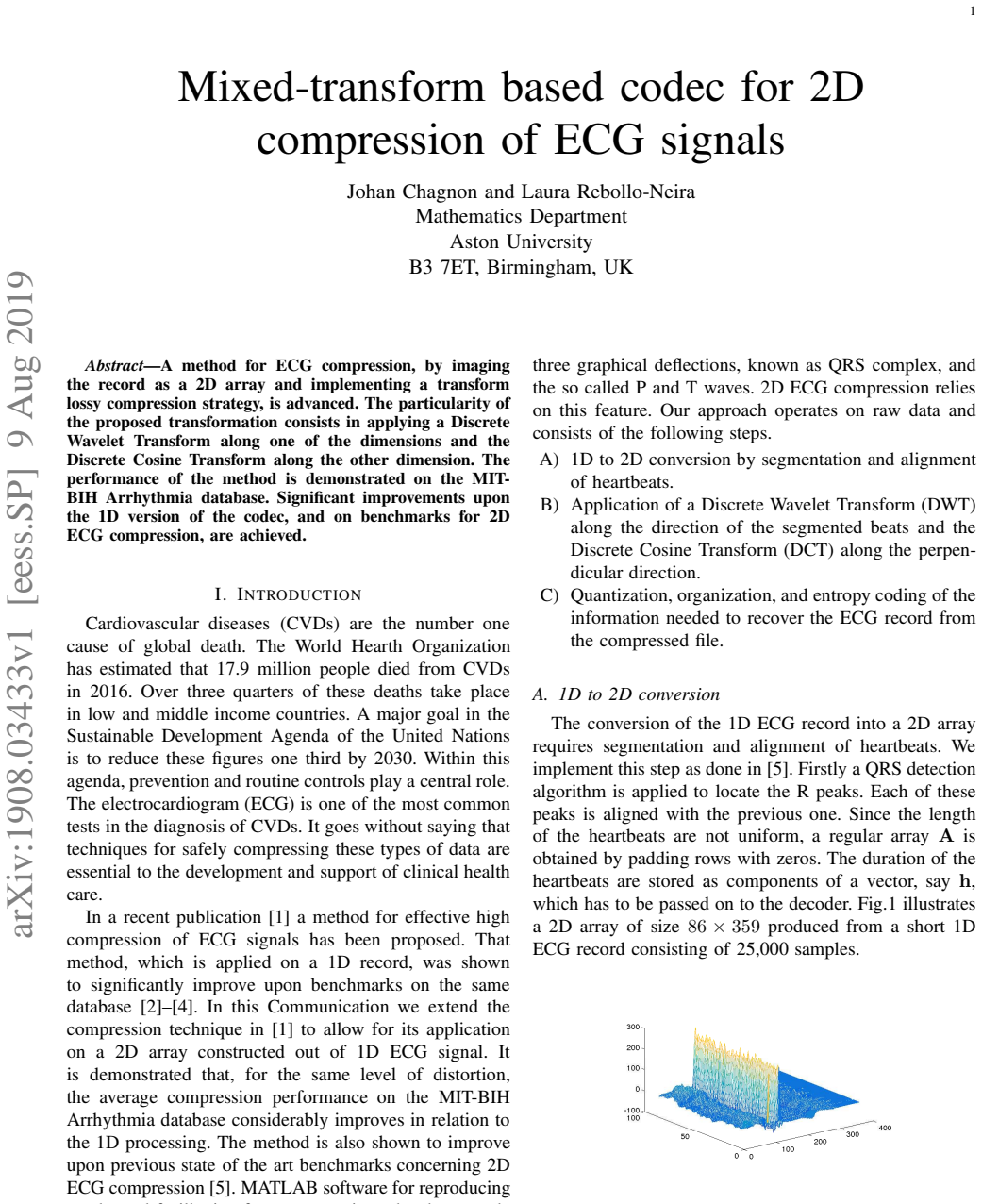
The central object is the mixed transform $B=\hat W_{1r}\hat C_{1c}A$, in which the 1D cdf97 discrete wavelet transform acts along the rows of the heartbeat-aligned array and the 1D discrete cosine transform acts along the columns. This object carries the argument because it determines where the large coefficients sit: in column-major order the significant entries cluster, so after quantization the vector of nonzero coefficients is shorter and its position deltas are smaller, making Huffman coding cheaper. The same choice fixes other design decisions, such as using six wavelet decomposition levels instead of the four that are optimal for the 1D codec.
What would settle it
Take one record with a high ectopic-beat count, run the full pipeline with the published software, and inspect the aligned array: if any R peak is not correctly aligned, the column-major zero runs shorten and the mean compression ratio of 58 at PRD_B=6.82 is not reproduced.
Extended reading notes
Core claim
The paper's central claim is that the mixed transform—a cdf97 discrete wavelet transform on the rows of the heartbeat-aligned array and a discrete cosine transform on the columns, $B=\hat W_{1r}\hat C_{1c}A$—produces a coefficient layout better suited to entropy coding than either the 1D version of the codec or a 2D wavelet/SPIHT codec. With uniform mid-tread quantization, zero removal, sign separation, delta-index storage of nonzero positions, and Huffman coding, the 2D codec reports a mean compression ratio of 58 (standard deviation 63) at $PRD_B=6.82$ on all 48 records of the database, compared with 31 for the 1D codec and 30 for the benchmark; at $PRD_B=3.81$ the corresponding numbers are 26, 19, and 20. The authors attribute the gain to two effects: the mixed transform concentrates the significant coefficients, and six-level wavelet decomposition works better in 2D than the four-level optimum for 1D. They also report that the benefit is uneven, with large dispersion in compression ratio because only records with regular beat morphology compress well, and that the method is not effective below $PRD\approx 0.4$, where reproducing the signal means reproducing sensor noise.
Load-bearing premise
The load-bearing premise is that the heartbeat detector finds every R peak correctly; a single misaligned beat corrupts a row of the 2D array and the reported compression-ratio gains would not be reproduced.
Editorial extensions
If this is right
- At the same distortion level, the 2D codec roughly doubles the mean compression ratio of the 1D version on regular-morphology records, so long-term ECG storage and telemetry can carry more data per bit.
- The single quantization parameter $\Delta$ lets an encoder target a desired PRD without changing the decoder, which simplifies rate control in practical devices.
- Because the codec operates on raw data, it fails at very low distortion (PRD below about 0.4), where it would need to reproduce sensor noise; usable operation is limited to moderate and higher distortion levels.
- The method requires QRS detection and heartbeat alignment, so its compression gain is conditional on beat regularity; records with irregular morphology show much lower compression ratios and larger dispersion.
Reading between the lines
- A practical encoder could classify beats by morphology and route regular beats to the 2D path and irregular beats to the 1D path; this would likely shrink the large dispersion (standard deviation 63 at mean compression ratio 58) that the paper reports.
- The fixed transform orientation—wavelet on rows, cosine on columns—is one choice; adapting the orientation per record, or choosing which dimension gets the wavelet by measuring coefficient concentration, is a natural testable improvement not explored in the paper.
- The same segmentation-and-alignment construction applies to other quasi-periodic biological signals, so the codec could transfer to pulse oximetry or respiratory waveforms with only the beat detector swapped out.
Signed reviews
Editorial analysis
A structured set of objections, weighed in public.
Referee Report
Summary. The manuscript proposes a 2D ECG compression codec in which the 1D record is segmented into heartbeats, aligned into a 2D array, transformed with a 1D cdf97 DWT along the row direction and a 1D DCT along the column direction, then quantized, thresholded, and entropy-coded with Huffman coding. The method is tested on all 48 records of the MIT-BIH Arrhythmia database. The authors report that at a fixed distortion level (e.g., PRDB = 6.82) the 2D codec achieves a mean compression ratio of 58 with standard deviation 63, compared with 31 for their 1D codec and 30 for the SPIHT-based benchmark of Tai et al. They conclude that the 2D extension yields significant improvements over the 1D version and over prior 2D benchmarks, while acknowledging that the benefit is concentrated in records with very regular morphology.
Significance. If the claims are substantiated, the proposed codec is a simple and inexpensive way to exploit the regularity of ECG morphology for compression, with the notable strengths of being evaluated on the full MIT-BIH database and of providing MATLAB software for reproducibility. The mixed DWT/DCT transform is clearly described and the coding pipeline is standard. However, the headline claim of 'significant improvements' is currently supported only by mean values with very large dispersion, and the dependence on QRS detection is not validated. These issues are fixable, but they are central to the paper's main conclusion.
major comments (2)
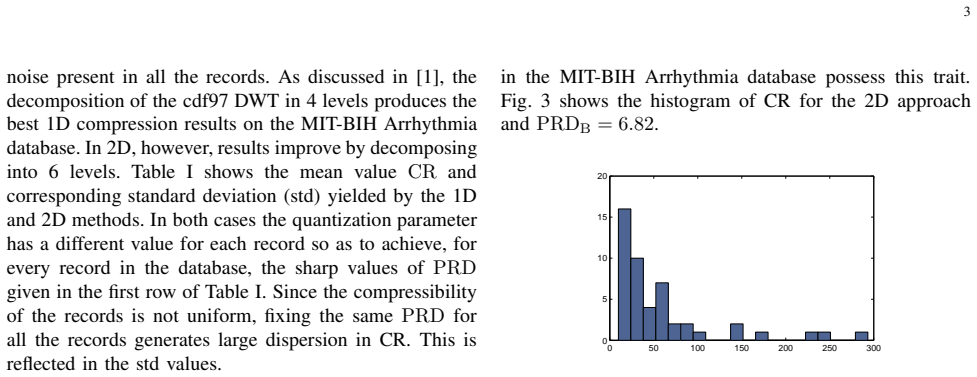
- [Abstract; Table II; Section V] The abstract's claim of 'significant improvements' over the 1D codec and over 2D benchmarks is not statistically supported by the reported results. At PRDB = 6.82, Table II gives a mean CR of 58 with std 63 for the 2D method versus 31 with std 14 for the 1D method, over n = 48 records. Section V itself states that 2D compression is 'greatly beneficial for records of very regular morphology' and that 'only some' MIT-BIH records possess this trait, and Fig. 3 shows a strongly right-skewed distribution. A mean of 58 with std 63 can be driven by a small number of very compressible records, so the improvement may not hold for a typical record. The authors should report the median and interquartile range of per-record CR, present a paired per-record comparison between the 2D and 1D methods, and apply a paired significance test (e.g., Wilcoxon signed-rank on the per-record CR differences). The abstract and conclusions should be reworded to describe the improvement as holding for a subset of regular-morphology records unless the whole-database claim is justified by such evidence.
- [Section IV; Section II.A] The method's dependence on QRS detection is not validated. The paper states only that a MATLAB implementation of the Pan-Tompkins algorithm [8] was applied, but it reports no detection accuracy, no count of missed or false R peaks for the 48 records, and no sensitivity analysis. Because the 2D array is formed by aligning rows to detected R peaks, any detection failure changes the array content and hence the compressed file and reconstruction. The reported numerical results may therefore not be reproducible on other ECG databases or even on all MIT-BIH records if detection failures occurred. The authors should report per-record detection statistics and, if any records show misalignment, either exclude them with justification or analyze how the CR and PRD change. At minimum, the scope of the claims should be limited to signals for which reliable QRS detection is available.
minor comments (5)
- [Section I] The phrase 'World Hearth Organization' should read 'World Health Organization'.
- [Section V] The typo 'in oder' should be corrected to 'in order'.
- [Throughout] The formatting 'MA TLAB' in Section IV should be 'MATLAB', and 'over-perform' in Section IV should be 'outperform'.
- [Section II.C] The notation 'ℓi → ˜ℓi' is unclear; it would be clearer to state that the indices are reordered and the reordered sequence is denoted by tilde symbols.
- [Table II] The table reports no standard deviation for the benchmark method [5] because the original publication does not provide it; this should be stated explicitly in the text so that the large dispersion of the 2D results is not read as directly comparable.
Circularity Check
No circularity: the 2D codec claim is supported by direct measured comparisons, with the sole self-citation used only as a baseline.
full rationale
The paper is an empirical rate-distortion study rather than a derivation from first principles. Its central claim, that the 2D mixed DWT/DCT codec improves compression ratio over the 1D version and over the SPIHT benchmark [5] at matched distortion, is supported by direct measurements reported in Tables I and II on the full MIT-BIH database. The 1D baseline is not imported from [1] as an unverified input; the same paper runs the 1D strategy and reports its CR, so the self-citation is descriptive and not load-bearing. The per-record quantization parameter is set to reproduce target PRD values, which is standard practice for comparing lossy codecs at matched distortion, not a fitted parameter later presented as a prediction. The mixed transform is defined by Eq. (1) independently of the reported outcomes, and no uniqueness theorem, ansatz-via-citation, or renaming of a known result is invoked. The remaining weaknesses, such as the large standard deviation (mean CR 58 with std 63 at PRD_B 6.82), the absence of median or significance tests, and the unvalidated QRS detection step, are statistical robustness and generalization concerns rather than circularity. Therefore the derivation chain is self-contained against the external benchmark and the score is 0.
Assumptions & free parameters
free parameters (2)
- Quantization step Δ (per record) =
not reported; tuned per record
- cdf97 DWT decomposition level =
6 for 2D, 4 for 1D
assumptions (3)
- standard math DWT (cdf97) and DCT are invertible transforms, allowing lossless recovery of coefficients when retained exactly.
- domain assumption The Pan-Tompkins QRS detector reliably detects R peaks in all 48 MIT-BIH records.
- domain assumption The MIT-BIH Arrhythmia database is a suitable benchmark for evaluating ECG compression methods.
Cite this review
Pith. "Pith review of Mixed-transform based codec for 2D compression of ECG signals." pith.science (2026). https://pith.science/paper/6RXMWJVR
@misc{pith2026190803433,
  author       = {Pith},
  title        = {Pith review of: Mixed-transform based codec for 2D compression of ECG signals},
  year         = {2026},
  howpublished = {\url{https://pith.science/paper/6RXMWJVR}},
  note         = {Machine review of arXiv:1908.03433}
}
read the original abstract
A method for ECG compression, by imaging the record as a 2D array and implementing a transform lossy compression strategy, is advanced. The particularity of the proposed transformation consists in applying a Discrete Wavelet Transform along one of the dimensions and the Discrete Cosine Transform along the other dimension. The performance of the method is demonstrated on the MIT-BIH Arrhythmia database. Significant improvements upon the 1D version of the codec, and on benchmarks for 2D ECG compression, are achieved.
Figures
Reference graph
Works this paper leans on
-
[5]
on Biomedical Engineering , 52 , pp 999 -- 1008 (2005)
\, S-C Tai, C-C Sun, and W-G Yan, ``A 2-D ECG Compression Method Based on Wavelet Transform and Modified SPIHT'', IEEE Trans. on Biomedical Engineering , 52 , pp 999 -- 1008 (2005)
work page 2005
-
[8]
https://physionet.org/physiobank/database/\ /
-
[1]
\, L. Rebollo-Neira, ``Effective high compression of ECG signals at low level distortion'', Scientific Reports, 9 , No 4564 (2019)
work page 2019
-
[2]
\, S.J. Lee, J. Kim, and M. Lee,``A Real-Time ECG Data Compression and Transmission Algorithm for an e-Health Device'', IEEE Trans. on Biomedical Engineering , 58, 2448 -- 2455 (2011)
work page 2011
-
[3]
\, J.L. Ma, T.T. Zhang, and M. C. Dong, ``A Novel ECG Data Compression Method Using Adaptive Fourier Decomposition With Security Guarantee in e-Health Applications'', IEEE Journal of Biomedical and Health Informatics, 19 , 986 -- 994 (2015)
work page 2015
-
[4]
\, C. Tan, L. Zhang and H. Wu,``A Novel Blaschke Unwinding Adaptive Fourier Decomposition based Signal Compression Algorithm with Application on ECG Signals'', IEEE Journal of Biomedical and Health Informatics 23 , pp 672 -- 682 (2018)
work page 2018
-
[6]
http://www.nonlinear-approx.info/examples/\ 014.html
- [7]
Show all 12 references
-
[9]
H. Sedghamiz, ``Matlab Implementation of Pan Tompkins ECG QRS detector''., https://www.researchgate.net/publication/\\313673153\_Matlab\_Implementation\_of\_Pan\_Tompkins\_ECG\_QRS\\\_detect (2014)
2014
-
[10]
Pan and W.J
J. Pan and W.J. Tompkins,``A Real-Time QRS Detection Algorithm'', IEEE Trans. on Biomedical Engineering , BME-32 , pp 230--236 (1985)
1985
-
[11]
IEEEtran_HOWTO
document HistCR_B.eps0000664000000000000000000002272013523261240011665 0ustar rootroot /MathWorks 160 dict begin /bdef bind def bind def /ldef load def bind def /xdef exch def bdef /xstore exch store bdef /c /clip ldef /cc /concat ldef /cp /closepath ldef /gr /grestore ldef /g...
1942
-
[12]
P!X0/:"9o,5 j?nO
11em plus .33em minus .07em 4000 4000 100 4000 4000 500 `\.=1000 = #1 \@IEEEnotcompsoconly \@IEEEcompsoconly #1 * [1] 0pt [0pt][0pt] #1 * [1] 0pt [0pt][0pt] #1 * \| ** #1 \@IEEEauthorblockNstyle \@IEEEcompsocnotconfonly \@IEEEauthorblockAstyle \@IEEEcompsocnotconfonly \@IEEEco...
2000
Reviewed August 14, 2026 · model on record in the stance chip above.
Discussion (0). Continue with ORCID to comment.