Transverse spin texture in optical non-Hermitian skin modes
Pith reviewed 2026-06-28 13:03 UTC · model grok-4.3
The pith
Optical skin modes tied to the non-Hermitian skin effect carry a transverse circular-polarization texture that deviates from the lossless spin-flow picture.
A machine-rendered reading of the paper's core claim, the machinery that carries it, and where it could break.
Core claim
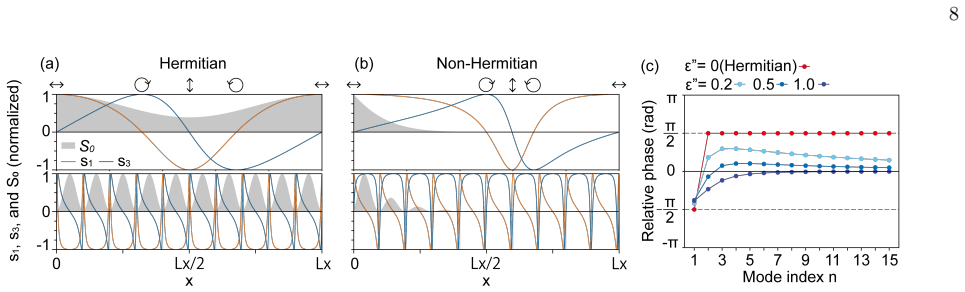
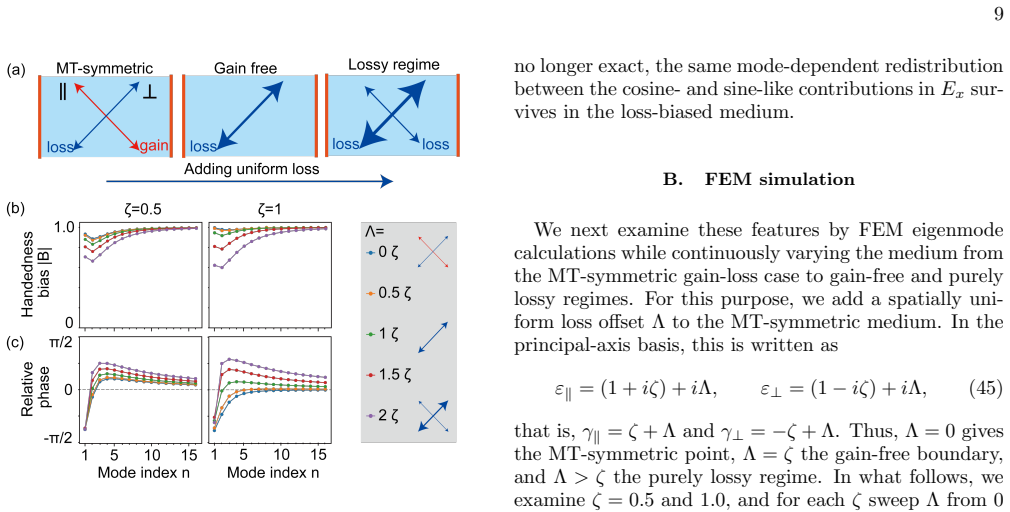
Optical skin modes associated with the non-Hermitian skin effect carry a finite transverse circular-polarization texture. The accompanying in-plane electric-field spin texture deviates from the familiar lossless spin-flow picture. Using exact TE mode solutions, we separate the common exponential skin envelope from the oscillatory component. This decomposition shows that the circular-polarization texture is not generated by the skin envelope itself but by the oscillatory interference component modified by non-Hermiticity. It also reveals a handedness bias and a reshaped spatial relation between circularity and intensity. Finite-element calculations confirm that these features remain robust in
What carries the argument
Decomposition of exact TE mode solutions into a common exponential skin envelope and an oscillatory component, demonstrating that the circular-polarization texture arises from non-Hermitian modification of the oscillatory interference.
Load-bearing premise
The decomposition of exact TE mode solutions into a common exponential skin envelope and an oscillatory component is valid, and the circular-polarization texture arises specifically from the non-Hermitian modification of the oscillatory interference rather than from the skin envelope.
What would settle it
A measurement or calculation of the transverse circular polarization in the skin mode that fails to match the value predicted solely from the oscillatory component after removing the exponential envelope would falsify the central claim.
Figures
read the original abstract
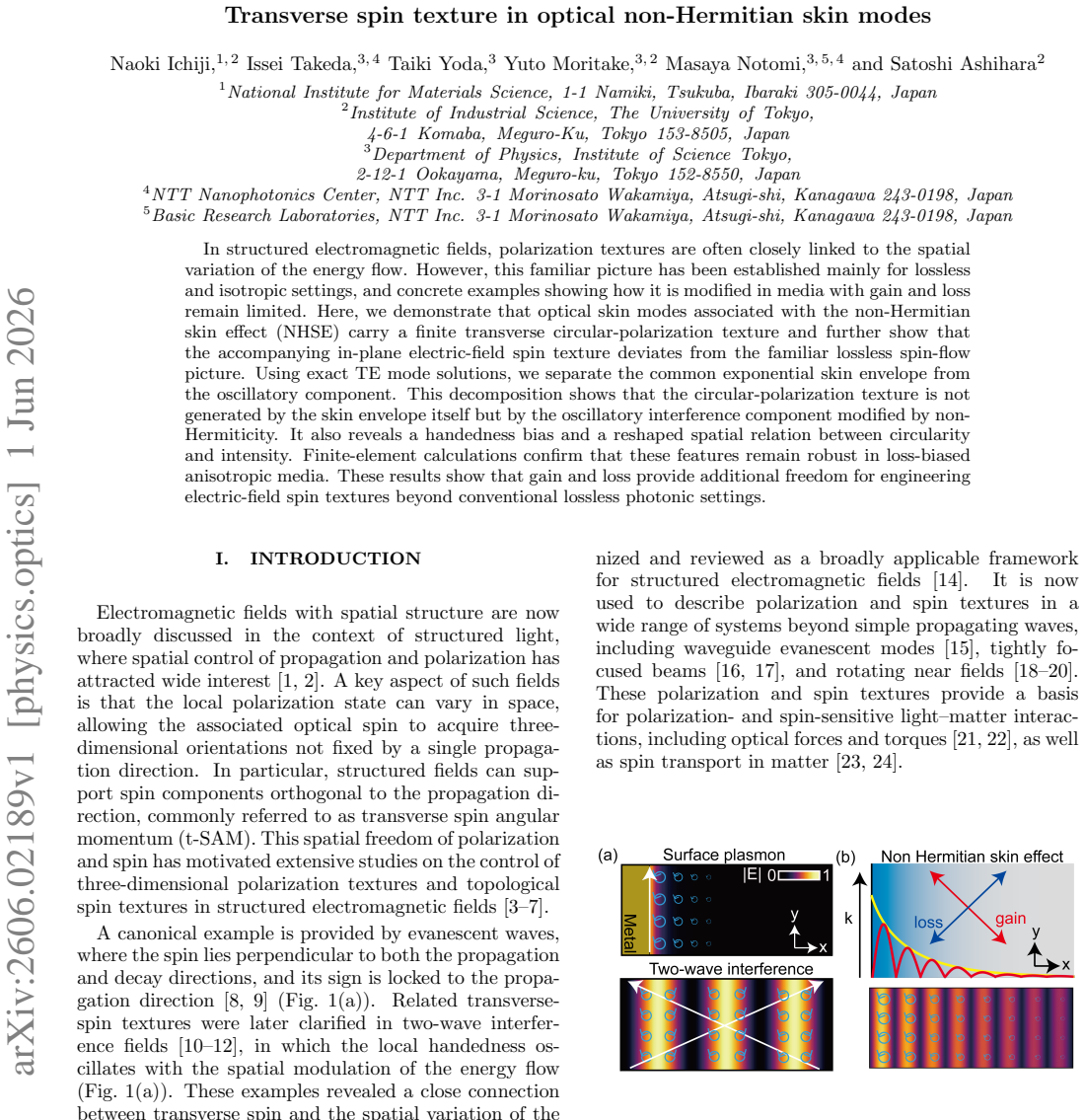
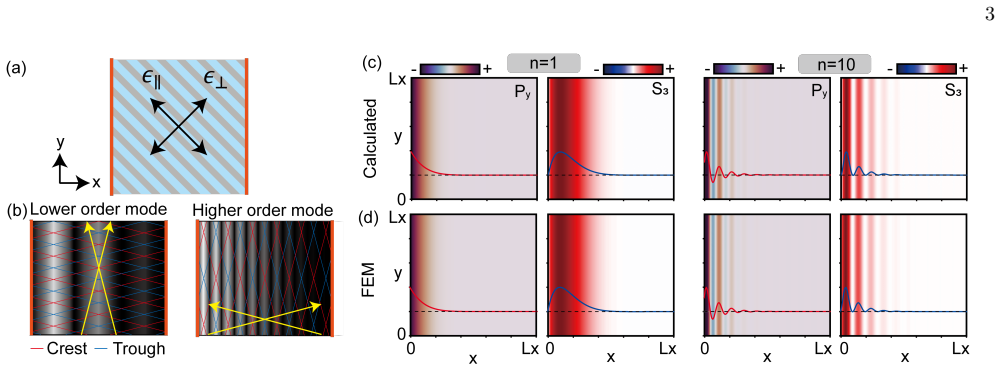
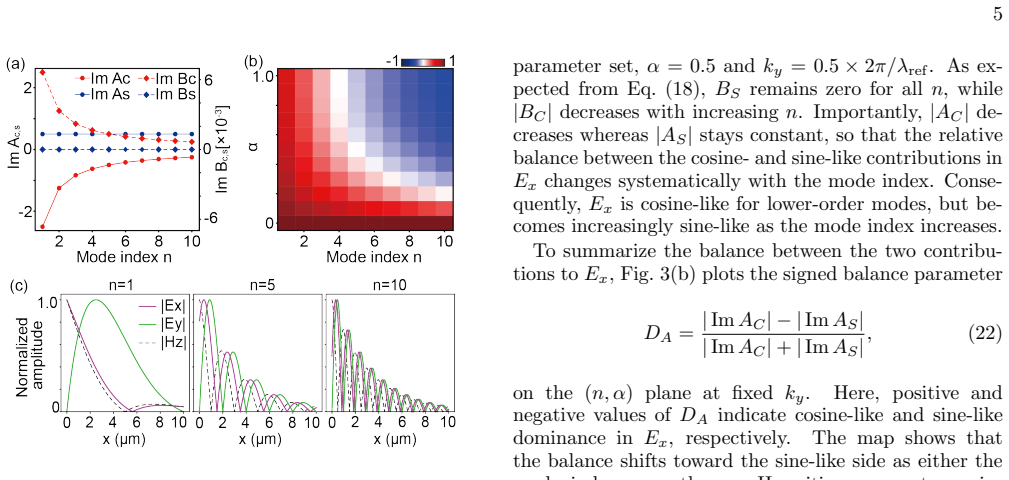
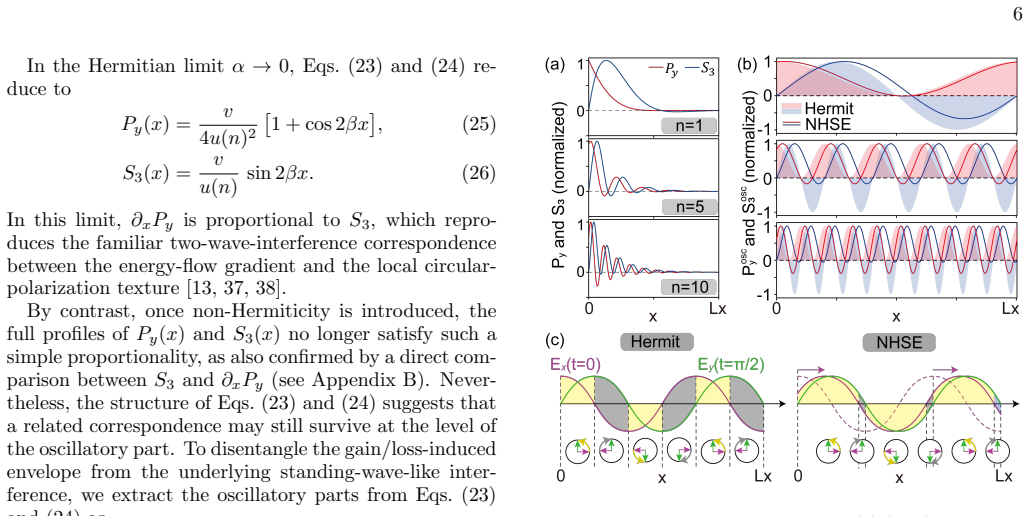
In structured electromagnetic fields, polarization textures are often closely linked to the spatial variation of the energy flow. However, this familiar picture has been established mainly for lossless and isotropic settings, and concrete examples showing how it is modified in media with gain and loss remain limited. Here, we demonstrate that optical skin modes associated with the non-Hermitian skin effect (NHSE) carry a finite transverse circular-polarization texture and further show that the accompanying in-plane electric-field spin texture deviates from the familiar lossless spin-flow picture. Using exact TE mode solutions, we separate the common exponential skin envelope from the oscillatory component. This decomposition shows that the circular-polarization texture is not generated by the skin envelope itself but by the oscillatory interference component modified by non-Hermiticity. It also reveals a handedness bias and a reshaped spatial relation between circularity and intensity. Finite-element calculations confirm that these features remain robust in loss-biased anisotropic media. These results show that gain and loss provide additional freedom for engineering electric-field spin textures beyond conventional lossless photonic settings.
Editorial analysis
A structured set of objections, weighed in public.
Referee Report
Summary. The manuscript claims that optical skin modes associated with the non-Hermitian skin effect carry a finite transverse circular-polarization texture. Using exact TE mode solutions, the authors decompose the fields into a common exponential skin envelope and an oscillatory component, attributing the circularity and handedness bias to non-Hermitian modification of the oscillatory interference rather than the envelope itself. This produces a reshaped spatial relation between circularity and intensity that deviates from the lossless spin-flow picture. Finite-element calculations in loss-biased anisotropic media are reported to reproduce the same features.
Significance. If the central claims hold, the work provides a concrete demonstration that gain and loss supply additional control over electric-field spin textures beyond conventional lossless photonic settings. Credit is due for the algebraic decomposition enabled by exact TE solutions and for the numerical confirmation of robustness in anisotropic media; these elements make the attribution of the texture to the oscillatory component falsifiable and reproducible.
major comments (1)
- [TE mode solutions and decomposition] The decomposition into envelope and oscillatory parts is load-bearing for the central claim that circularity originates exclusively from the non-Hermitian oscillatory factor. The manuscript should display the explicit algebraic separation (including the form of the non-Hermitian term in the oscillatory factor) in the main text or an appendix so that readers can verify the envelope carries zero circular polarization by construction.
minor comments (2)
- Figure captions should explicitly distinguish the lossless reference case from the non-Hermitian case when plotting the spin texture or circularity profiles.
- Notation for the transverse circular polarization (e.g., the Stokes parameter or helicity density) should be defined once at first use with a reference to the standard definition in the optics literature.
Simulated Author's Rebuttal
We thank the referee for the positive assessment and constructive comment. We address the point below.
read point-by-point responses
-
Referee: [TE mode solutions and decomposition] The decomposition into envelope and oscillatory parts is load-bearing for the central claim that circularity originates exclusively from the non-Hermitian oscillatory factor. The manuscript should display the explicit algebraic separation (including the form of the non-Hermitian term in the oscillatory factor) in the main text or an appendix so that readers can verify the envelope carries zero circular polarization by construction.
Authors: We agree that displaying the explicit algebraic separation will make the central claim more verifiable. In the revised manuscript we will add the explicit form of the exact TE mode solutions together with the decomposition into the common exponential skin envelope and the oscillatory component (including the non-Hermitian term appearing in the oscillatory factor) to the main text. A short derivation will be included to show that the envelope contributes zero circular polarization by construction. revision: yes
Circularity Check
No significant circularity detected
full rationale
The derivation rests on exact TE mode solutions whose algebraic decomposition into a shared exponential skin envelope plus oscillatory component is used to attribute the circular-polarization texture to the non-Hermitian modification of the oscillatory part. This separation is presented as a direct algebraic consequence of the exact solutions, not an ansatz, fit, or imported uniqueness result. No self-citation chains, fitted inputs renamed as predictions, or self-definitional steps appear in the load-bearing argument. The finite-element checks in anisotropic media are reported as independent numerical confirmation rather than circular validation. The central claim therefore remains self-contained against external benchmarks.
Axiom & Free-Parameter Ledger
axioms (1)
- standard math Maxwell equations govern electromagnetic fields in linear non-Hermitian media
Reference graph
Works this paper leans on
-
[1]
Rubinsztein-Dunlop, A
H. Rubinsztein-Dunlop, A. Forbes, M. V. Berry, M. R. Dennis, D. L. Andrews, M. Mansuripur, C. Denz, C. Alp- mann, P. Banzer, T. Bauer, E. Karimi, L. Marrucci, M. Padgett, M. Ritsch-Marte, N. M. Litchinitser, N. P. Bigelow, C. Rosales-Guzman, A. Belmonte, J. P. Tor- res, T. W. Neely, M. Baker, R. Gordon, A. B. Stil- goe, J. Romero, A. G. White, R. Fickler,...
2017
-
[2]
Forbes, M
A. Forbes, M. de Oliveira, and M. R. Dennis, Structured light, Nat. Photonics15, 253 (2021)
2021
-
[3]
A. S. Rao, Optical skyrmions in the Bessel profile, J. Opt. Soc. Am. A41, 1059 (2024)
2024
-
[4]
W. Lin, Y. Ota, Y. Arakawa, and S. Iwamoto, Microcavity-based generation of full poincar´ e beams with arbitrary skyrmion numbers, Phys. Rev. Res.3, 10.1103/PhysRevResearch.3.023055 (2021)
-
[5]
Tsesses, E
S. Tsesses, E. Ostrovsky, K. Cohen, B. Gjonaj, N. H. Lindner, and G. Bartal, Optical skyrmion lattice in evanescent electromagnetic fields, Science361, 993 (2018)
2018
-
[6]
L. Du, A. Yang, A. V. Zayats, and X. Yuan, Deep- subwavelength features of photonic skyrmions in a con- fined electromagnetic field with orbital angular momen- tum, Nat. Phys.15, 650 (2019)
2019
-
[7]
Y. Dai, Z. Zhou, A. Ghosh, R. S. K. Mong, A. Kubo, C.-B. Huang, and H. Petek, Plasmonic topological quasi- particle on the nanometre and femtosecond scales, Na- ture588, 616 (2020)
2020
-
[8]
K. Y. Bliokh and F. Nori, Transverse spin of a surface polariton, Phys. Rev. A85, 061801(R) (2012)
2012
-
[9]
K. Y. Bliokh, A. Y. Bekshaev, and F. Nori, Extraordinary momentum and spin in evanescent waves, Nat. Commun. 5, 3300 (2014)
2014
-
[10]
Neugebauer, T
M. Neugebauer, T. Bauer, A. Aiello, and P. Banzer, Mea- suring the transverse spin density of light, Phys. Rev. Lett.114, 063901 (2015)
2015
-
[11]
A. Y. Bekshaev, K. Y. Bliokh, and F. Nori, Transverse spin and momentum in two-wave interference, Phys. Rev. X5, 011039 (2015)
2015
-
[12]
K. Y. Bliokh and F. Nori, Transverse and longitudinal angular momenta of light, Phys. Rep.592, 1 (2015)
2015
-
[13]
P. Shi, L. Du, C. Li, A. V. Zayats, and X. Yuan, Trans- verse spin dynamics in structured electromagnetic guided waves, Proc. Natl. Acad. Sci. (USA)118, e2018816118 (2021)
2021
-
[14]
P. Shi, L. Du, and X. Yuan, Spin photonics: from trans- verse spin to photonic skyrmions, Nanophotonics10, 3927 (2021)
2021
-
[15]
Z. Shao, J. Zhu, Y. Chen, Y. Zhang, and S. Yu, Spin-orbit interaction of light induced by transverse spin angular momentum engineering, Nat. Commun.9, 926 (2018)
2018
-
[16]
Winnerl, R
S. Winnerl, R. Hubrich, M. Mittendorff, H. Schneider, and M. Helm, Universal phase relation between longitu- dinal and transverse fields observed in focused terahertz beams, New J. Phys.14, 103049 (2012)
2012
-
[17]
Aiello, P
A. Aiello, P. Banzer, M. Neugebauer, and G. Leuchs, From transverse angular momentum to photonic wheels, Nat. Photonics9, 789 (2015)
2015
-
[18]
Triolo, A
C. Triolo, A. Cacciola, S. Patane, R. Saija, S. Savasta, and F. Nori, Spin-momentum locking in the near field of metal nanoparticles, ACS Photon.4, 2242 (2017)
2017
-
[19]
T. Fu, J. Lin, Y. Xu, J. Jia, Y. Wang, S. Zhang, and H. Xu, Transverse spin-orbit interaction of light, Nano Lett.24, 10783 (2024)
2024
-
[20]
Ichiji, T
N. Ichiji, T. Ishida, I. Morichika, D. Daigo, T. Tatsuma, and S. Ashihara, Selective enhancement of the optical chirality and spin angular momentum in plasmonic near- fields, Nano Lett.25, 12578 (2025)
2025
-
[21]
Y. Shi, T. Zhu, J. Liu, D. P. Tsai, H. Zhang, S. Wang, C. T. Chan, P. C. Wu, A. V. Zayats, F. Nori, and A. Q. Liu, Stable optical lateral forces from inhomogeneities of the spin angular momentum, Sci. Adv.8, eabn2291 (2022)
2022
-
[22]
J. Lu, V. Ginis, C.-W. Qiu, and F. Capasso, Polarization- dependent forces and torques at resonance in a microfiber-microcavity system, Phys. Rev. Lett.130, 183601 (2023)
2023
-
[23]
Oue and M
D. Oue and M. Matsuo, Electron spin transport driven by surface plasmon polaritons, Phys. Rev. B101, 161404(R) (2020)
2020
-
[24]
A. Y. Bekshaev, Spin-accumulation and spin-transport effects induced by surface plasmon-polariton waves, J. Opt. Soc. Am. B39, 3187 (2022)
2022
-
[25]
Yao and Z
S. Yao and Z. Wang, Edge states and topological invari- ants of Non-Hermitian systems, Phys. Rev. Lett.121, 086803 (2018)
2018
-
[26]
Okuma, K
N. Okuma, K. Kawabata, K. Shiozaki, and M. Sato, Topological origin of Non-Hermitian skin effects, Phys. Rev. Lett.124, 086801 (2020)
2020
-
[27]
T. Yoda, Y. Moritake, K. Takata, K. Yokomizo, S. Mu- rakami, and M. Notomi, Optical Non-Hermitian skin ef- fect in uniform media, Phys. Rev. Res.7, 033214 (2025)
2025
-
[28]
Takeda, T
I. Takeda, T. Yoda, Y. Moritake, K. Takata, and M. No- tomi, Propagation and circulating modes of the recipro- cal Non-Hermitian skin effect, Phys. Rev. A112, 053501 (2025)
2025
-
[29]
K. Y. Bliokh, A. Y. Bekshaev, and F. Nori, Optical mo- mentum, spin, and angular momentum in dispersive me- dia, Phys. Rev. Lett.119, 073901 (2017)
2017
-
[30]
K. Y. Bliokh, A. Y. Bekshaev, and F. Nori, Optical mo- mentum and angular momentum in complex media: from the Abraham-Minkowski debate to unusual properties of surface plasmon-polaritons, New J. Phys.19(2017)
2017
-
[31]
T. G. Philbin and O. Allanson, Optical angular momen- tum in dispersive media, Phys. Rev. A86, 055802 (2012)
2012
-
[32]
Yamashita, Spin and orbital angular momenta defined for electromagnetic fields in planar anisotropic media, Opt
O. Yamashita, Spin and orbital angular momenta defined for electromagnetic fields in planar anisotropic media, Opt. Commun.284, 2532 (2011)
2011
-
[33]
Hashiyada and Y
S. Hashiyada and Y. Y. Tanaka, Conservation law for an- 13 gular momentum based on optical field derivatives: Anal- ysis of optical spin-orbit conversion, Phys. Rev. Res.7, L022052 (2025)
2025
-
[34]
Yokomizo and S
K. Yokomizo and S. Murakami, Non-Bloch band theory of Non-Hermitian systems, Phys. Rev. Lett.123, 066404 (2019)
2019
-
[35]
L. Peng, L. Duan, K. Wang, F. Gao, L. Zhang, G. Wang, Y. Yang, H. Chen, and S. Zhang, Transverse photon spin of bulk electromagnetic waves in bianisotropic media, Nat. Photons.13, 878 (2019)
2019
-
[36]
Born and E
M. Born and E. Wolf,Principles of Optics: Electromag- netic Theory of Propagation, Interference and Diffrac- tion of Light, 7th ed. (Cambridge University Press, Cam- bridge, 1999)
1999
-
[37]
Ichiji, D
N. Ichiji, D. Oue, M. Yessenov, K. L. Schepler, A. F. Abouraddy, and A. Kubo, Transverse spin angular mo- mentum of a space-time surface plasmon polariton wave packet, Phys. Rev. A107, 063517 (2023)
2023
-
[38]
Kihara, K
K. Kihara, K. Motoi, N. Ichiji, and A. Kubo, Spin angu- lar momentum of femtosecond striped space-time surface plasmon polaritons, Opt. Commun.593, 132217 (2025)
2025
-
[39]
A. B. Young, A. C. T. Thijssen, D. M. Beggs, P. An- drovitsaneas, L. Kuipers, J. G. Rarity, S. Hughes, and R. Oulton, Polarization engineering in photonic crystal waveguides for spin-photon entanglers, Phys. Rev. Lett. 115, 153901 (2015)
2015
-
[40]
S¨ ollner, S
I. S¨ ollner, S. Mahmoodian, S. L. Hansen, L. Midolo, A. Javadi, G. Kirˇ sansk˙ e, T. Pregnolato, H. El-Ella, E. H. Lee, J. D. Song, S. Stobbe, and P. Lodahl, Deterministic photon–emitter coupling in chiral photonic circuits, Nat. Nanotechnol.10, 775 (2015)
2015
-
[41]
W. Dai, T. Yoda, Y. Moritake, M. Ono, E. Kuramochi, and M. Notomi, High transmission in 120-degree sharp bends of inversion-symmetric and inversion-asymmetric photonic crystal waveguides, Nat. Commun.16, 796 (2025)
2025
-
[42]
Shevchenko and T
A. Shevchenko and T. Set¨ al¨ a, Interference and polariza- tion beating of independent arbitrarily polarized poly- chromatic optical waves, Phys. Rev. A100, 023842 (2019)
2019
-
[43]
P. Li, Y. Zhang, S. Liu, H. Cheng, L. Han, D. Wu, and J. Zhao, Generation and self-healing of vector Bessel- Gauss beams with variant state of polarizations upon propagation, Opt. Express25, 5821 (2017)
2017
-
[44]
Arikawa, T
T. Arikawa, T. Hiraoka, S. Morimoto, F. Blanchard, S. Tani, T. Tanaka, K. Sakai, H. Kitajima, K. Sasaki, and K. Tanaka, Transfer of orbital angular momentum of light to plasmonic excitations in metamaterials, Sci. Adv.6, eaay1977 (2020)
2020
-
[45]
Tanaka, S
D. Tanaka, S. Harajiri, Y. Fujita, K. A. Forbes, T. T. Pham, and D. L. Andrews, Multipole excitation of local- ized plasmon resonance in asymmetrically coated core- shell nanoparticles using optical vortices, Laser & Pho- ton. Rev.18, 2300536 (2024)
2024
-
[46]
Ichiji, T
N. Ichiji, T. Ishida, I. Morichika, D. Oue, T. Tatsuma, and S. Ashihara, Designing rotational motion of charge densities on plasmonic nanostructures excited by circu- larly polarized light, Nanophotonics13, 4751 (2024)
2024
discussion (0)
Sign in with ORCID, Apple, or X to comment. Anyone can read and Pith papers without signing in.