Corotating Interaction Regions (CIRs): evolution over a solar lifetime
Pith reviewed 2026-06-26 07:05 UTC · model grok-4.3
The pith
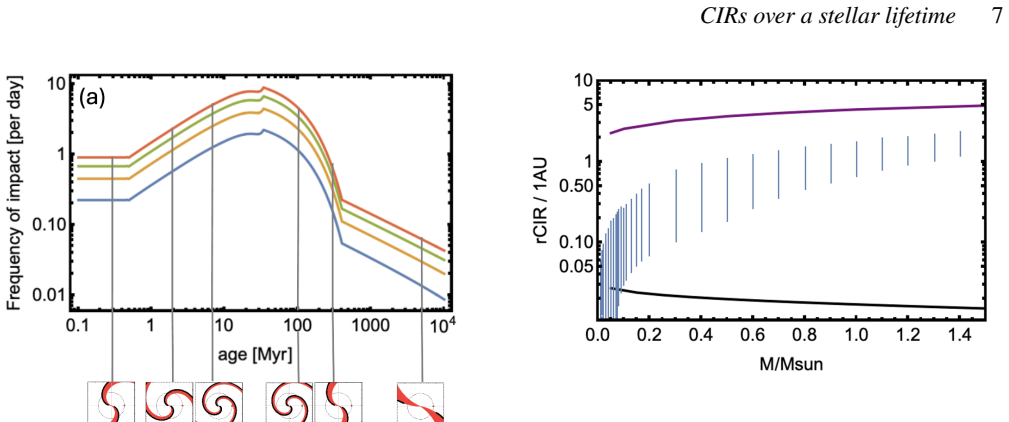
CIRs formed closer to the young Sun and generated 10^3 to 10^7 times more energetic particles during the Hadean than today.
A machine-rendered reading of the paper's core claim, the machinery that carries it, and where it could break.
Core claim
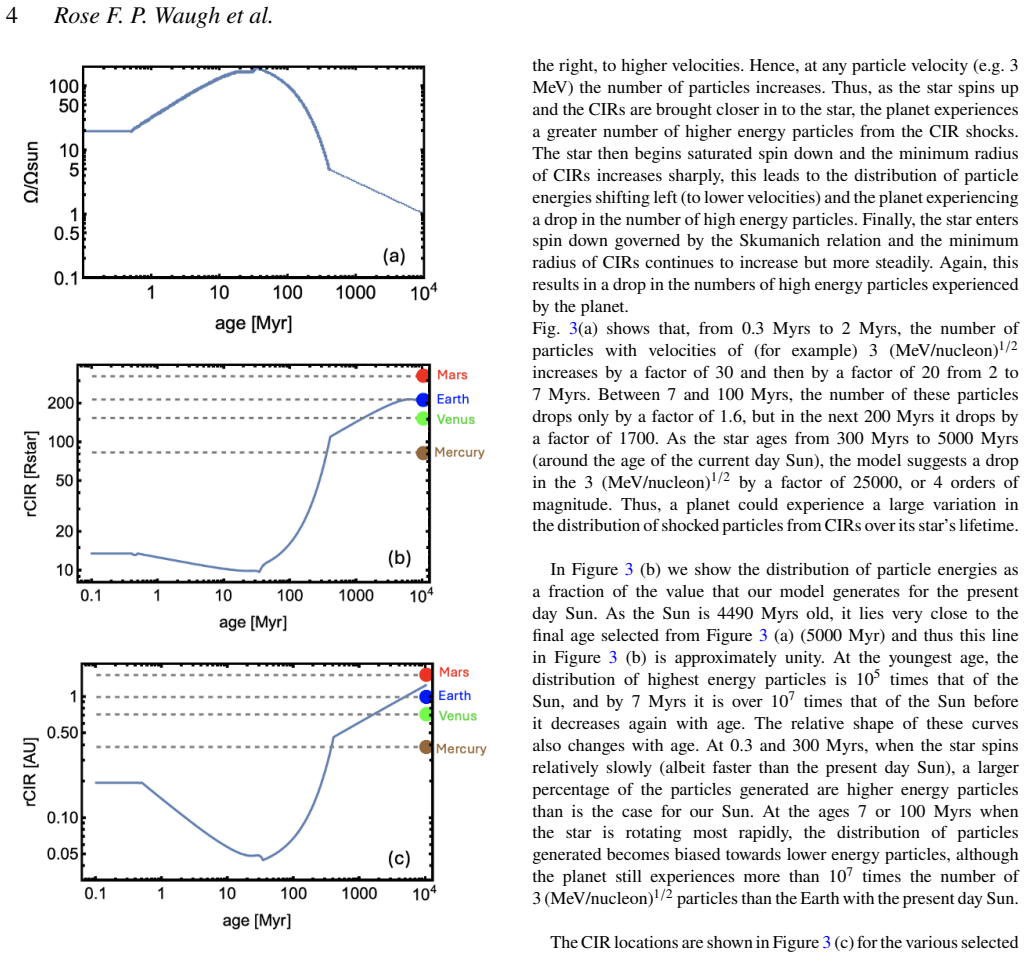
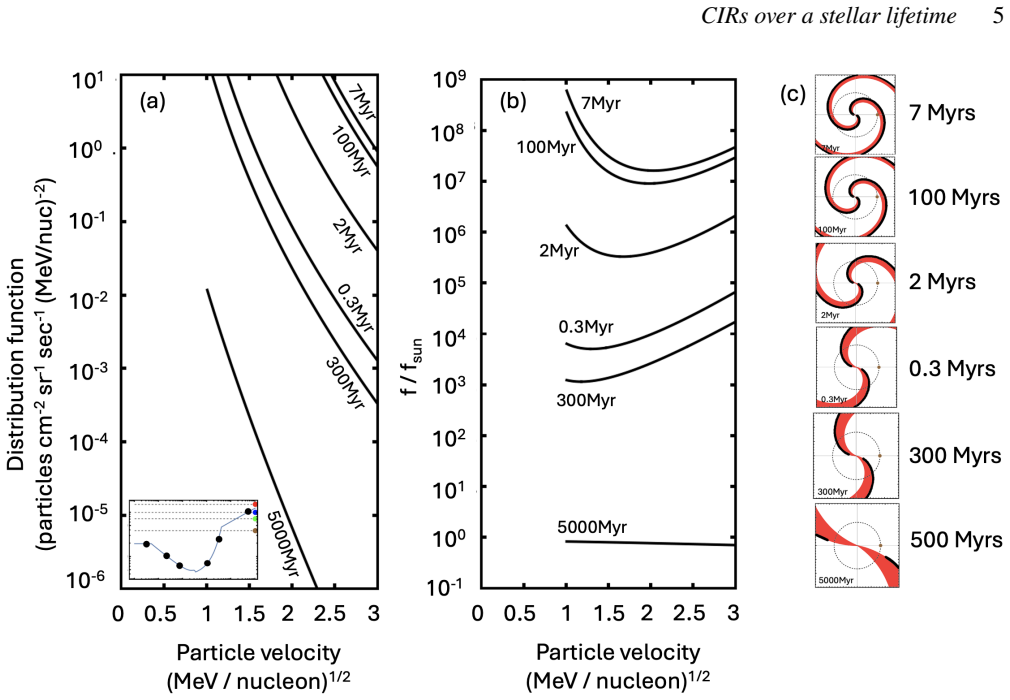
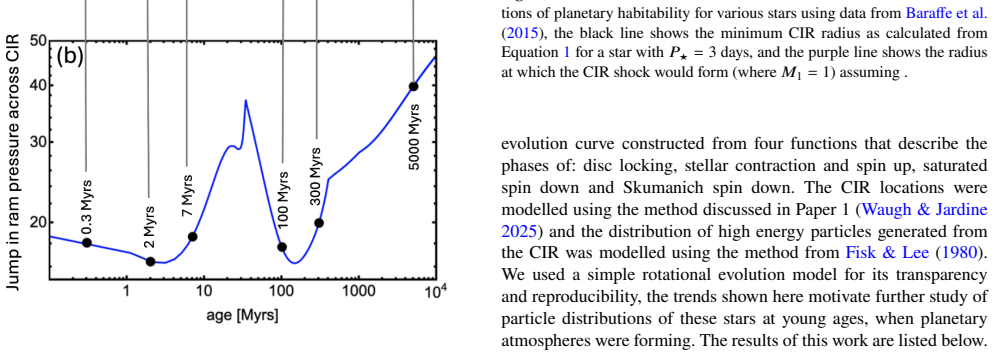
CIRs form closer to the star during early spin-up phases and migrate outward during spin down, with the minimum CIR radius inversely related to rotation rate. The distribution of high-energy particles produced in CIR shocks varies significantly with age. During the Hadean period CIRs may have generated a number of energetic particles that is 10^3 to 10^7 times greater than for the present-day Sun. The frequency and strength of CIR-planet interactions also peak during early rapid rotation phases. For stars with mass less than 1.4 Msun, whilst CIRs can form within the habitable zone, their shocks always form beyond it.
What carries the argument
The minimum CIR radius, which scales inversely with stellar rotation rate and is tracked through a rotational evolution framework that updates wind speeds with stellar age.
If this is right
- The number and energy of particles reaching planets from CIR shocks was orders of magnitude higher in the first billion years than at present.
- CIR-planet interaction frequency and intensity reached a maximum during the star's rapid rotation phase.
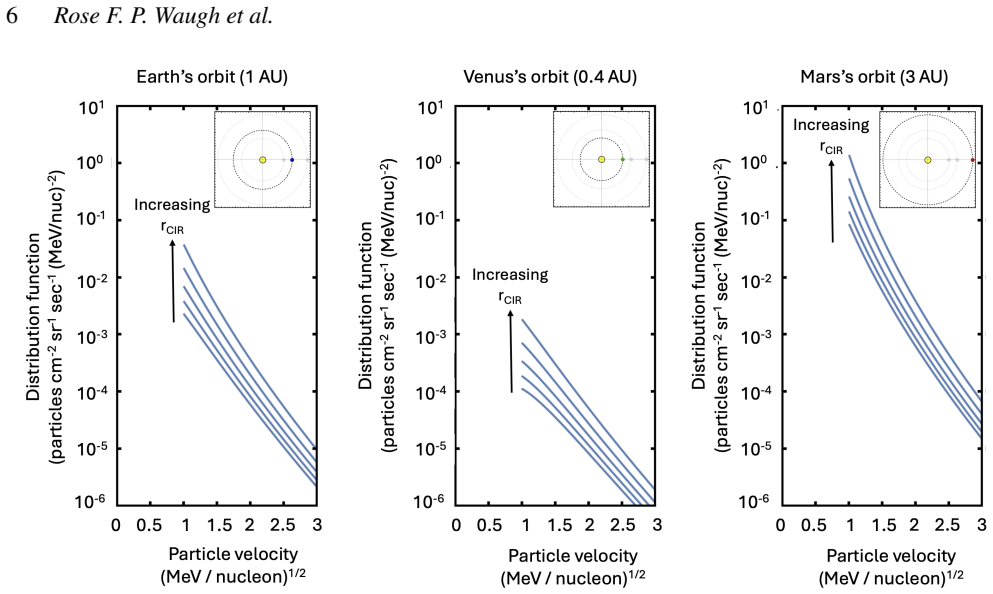
- Energetic particles can still reach planets inside the habitable zone even though the shocks that accelerate them form farther out.
- Atmospheric chemistry and escape rates on terrestrial planets were more strongly influenced by stellar-wind structures when the host star was young.
Where Pith is reading between the lines
- The same scaling of minimum CIR radius with rotation rate could be used to estimate particle environments around other solar-type stars at different ages.
- Records of ancient cosmic-ray exposure in lunar or meteoritic material might provide an independent check on the predicted early particle flux.
- For stars that remain rapid rotators longer than the Sun, the period of elevated CIR-driven particle bombardment would extend to later times in planetary evolution.
Load-bearing premise
The rotational evolution framework correctly predicts wind speeds and CIR positions even in the fast-rotation regime without extra effects from magnetic field changes or varying mass loss.
What would settle it
A measurement of the actual formation distance of CIRs around a young solar analog, or a reconstruction of early solar energetic particle flux from geological or meteoritic records, that falls outside the predicted 10^3 to 10^7 enhancement range.
Figures
read the original abstract
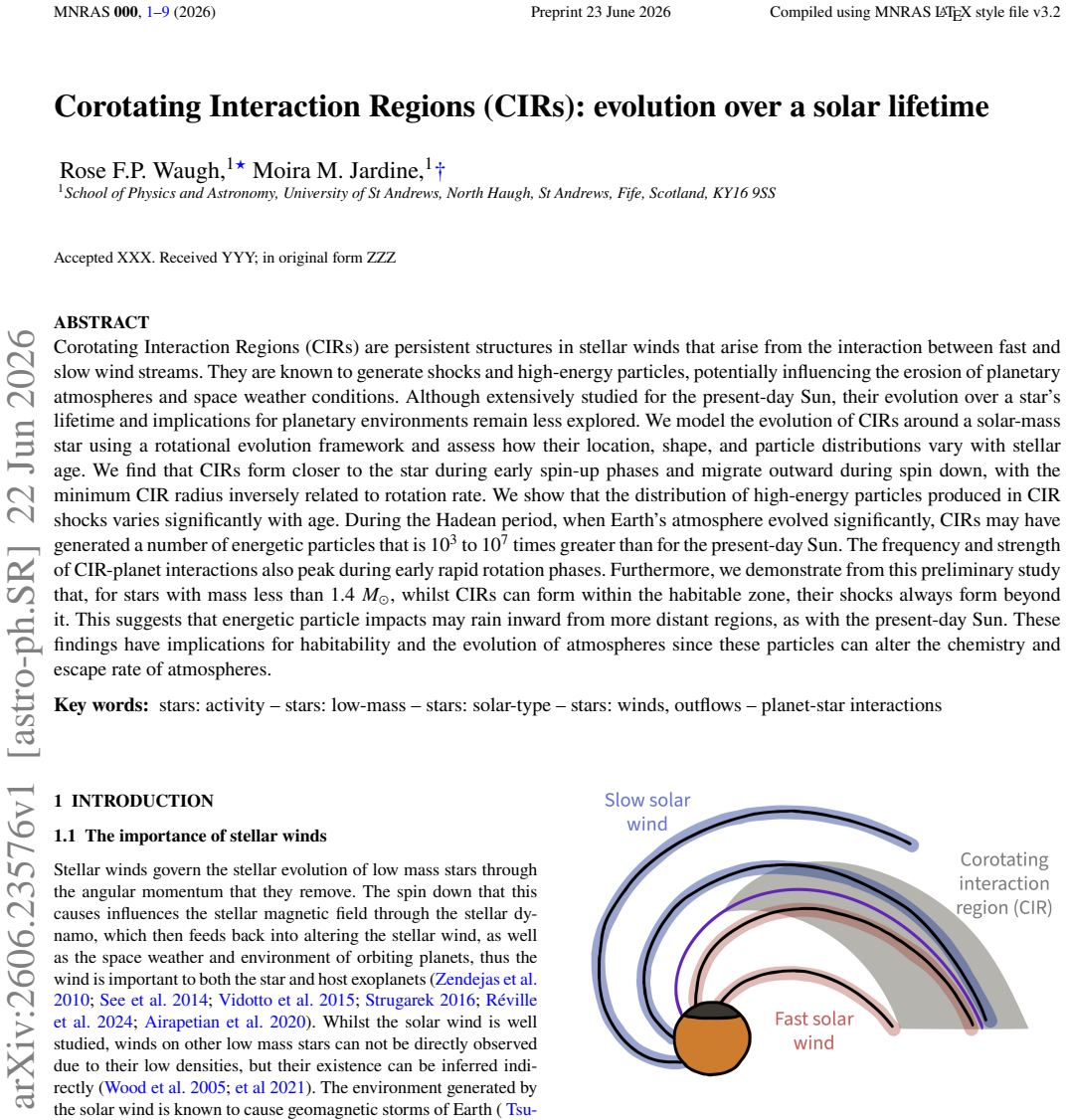
Corotating Interaction Regions (CIRs) are persistent structures in stellar winds that arise from the interaction between fast and slow wind streams. They are known to generate shocks and high-energy particles, potentially influencing the erosion of planetary atmospheres and space weather conditions. Although extensively studied for the present-day Sun, their evolution over a star's lifetime and implications for planetary environments remain less explored. We model the evolution of CIRs around a solar-mass star using a rotational evolution framework and assess how their location, shape, and particle distributions vary with stellar age. We find that CIRs form closer to the star during early spin-up phases and migrate outward during spin down, with the minimum CIR radius inversely related to rotation rate. We show that the distribution of high-energy particles produced in CIR shocks varies significantly with age. During the Hadean period, when Earth's atmosphere evolved significantly, CIRs may have generated a number of energetic particles that is \(10^3\) to \(10^7\) times greater than for the present-day Sun. The frequency and strength of CIR-planet interactions also peak during early rapid rotation phases. Furthermore, we demonstrate from this preliminary study that, for stars with mass less than 1.4 Msun, whilst CIRs can form within the habitable zone, their shocks always form beyond it. This suggests that energetic particle impacts may rain inward from more distant regions, as with the present-day Sun. These findings have implications for habitability and the evolution of atmospheres since these particles can alter the chemistry and escape rate of atmospheres.
Editorial analysis
A structured set of objections, weighed in public.
Referee Report
Summary. The manuscript models the evolution of Corotating Interaction Regions (CIRs) in the stellar wind of a solar-mass star over its lifetime by evolving wind properties within a rotational evolution framework. It reports that the minimum CIR radius scales inversely with rotation rate, with CIRs forming closer to the star during early rapid spin-up and migrating outward as the star spins down; high-energy particle distributions from CIR shocks vary strongly with age, yielding 10^3 to 10^7 times more energetic particles during the Hadean epoch than at present; and, for stars below 1.4 solar masses, CIRs can form inside the habitable zone while their shocks remain outside it.
Significance. If the modeling framework and extrapolations hold, the quantitative scaling of CIR location and particle production with stellar age would provide a concrete link between stellar rotational evolution and the energetic particle environment experienced by early planetary atmospheres, with direct relevance to Hadean-era atmospheric chemistry and escape. The inverse-radius relation and the stated particle-multiplication factor constitute falsifiable predictions that could be tested against observations of young solar analogs or exoplanet atmospheric signatures.
major comments (2)
- [Abstract] Abstract: the central quantitative claim that CIR shocks produced 10^3–10^7 times more energetic particles during the Hadean rests on the rotational-evolution framework correctly mapping rotation rate to wind-speed contrast, Alfvén radius, and shock Mach number in the fast-rotator regime; no sensitivity tests, comparisons to alternative wind-acceleration prescriptions, or discussion of possible saturation effects (e.g., mass-loss or magnetic topology changes above ~10–20 times solar rotation) are indicated, rendering the particle-enhancement factor an unvalidated extrapolation.
- [Abstract] Abstract: the statement that “CIRs can form within the habitable zone” while “their shocks always form beyond it” for stars <1.4 M⊙ is presented as a general result, yet the manuscript provides no explicit calculation of habitable-zone boundaries, no tabulation of shock-formation radii versus stellar mass and age, and no error propagation from the underlying wind model, making the claim difficult to assess or reproduce.
minor comments (2)
- [Abstract] The abstract refers to “a preliminary study” but does not specify which parameters were varied or held fixed; a brief methods paragraph or table listing the adopted wind-acceleration law, magnetic-field scaling, and rotation-period evolution prescription would improve clarity.
- [Abstract] Notation for the minimum CIR radius and the particle-multiplication factor is introduced without symbols or units; consistent use of defined symbols (e.g., R_CIR,min(Ω)) would aid readability.
Simulated Author's Rebuttal
We thank the referee for their constructive comments on our manuscript. We respond point-by-point to the major comments below and indicate the revisions that will be incorporated.
read point-by-point responses
-
Referee: [Abstract] Abstract: the central quantitative claim that CIR shocks produced 10^3–10^7 times more energetic particles during the Hadean rests on the rotational-evolution framework correctly mapping rotation rate to wind-speed contrast, Alfvén radius, and shock Mach number in the fast-rotator regime; no sensitivity tests, comparisons to alternative wind-acceleration prescriptions, or discussion of possible saturation effects (e.g., mass-loss or magnetic topology changes above ~10–20 times solar rotation) are indicated, rendering the particle-enhancement factor an unvalidated extrapolation.
Authors: We agree that the abstract does not explicitly address uncertainties in the fast-rotator regime. The underlying rotational-evolution framework follows standard prescriptions calibrated against solar analogs, but we acknowledge the value of additional validation. In the revised manuscript we will add a dedicated subsection in the discussion that presents sensitivity tests to alternative wind-acceleration models, examines the impact of saturation effects above ~10–20 times solar rotation, and quantifies how these affect the reported particle-enhancement range. This will strengthen the robustness of the 10^3–10^7 factor without altering the central result. revision: yes
-
Referee: [Abstract] Abstract: the statement that “CIRs can form within the habitable zone” while “their shocks always form beyond it” for stars <1.4 M⊙ is presented as a general result, yet the manuscript provides no explicit calculation of habitable-zone boundaries, no tabulation of shock-formation radii versus stellar mass and age, and no error propagation from the underlying wind model, making the claim difficult to assess or reproduce.
Authors: We accept that the claim requires more explicit supporting material to be reproducible. The revised version will include: (i) explicit habitable-zone boundaries calculated with the Kopparapu et al. (2013) prescription for a range of stellar masses and ages, (ii) a table or supplementary figure tabulating minimum CIR and shock radii versus mass and age, and (iii) a short discussion of error propagation arising from the wind-model parameters. These additions will allow readers to assess the statement directly. revision: yes
Circularity Check
No circularity identified; abstract provides no equations or self-citations for inspection.
full rationale
The provided text consists solely of the abstract, which states that CIR location, shape and particle distributions are obtained by evolving wind properties inside a rotational-evolution framework, yielding minimum CIR radius inversely proportional to rotation rate and particle numbers 10^3–10^7 times larger at early ages. No equations, parameter fits, self-citations, or derivation steps are quoted. Hard rules require explicit quotes exhibiting reduction by construction (e.g., fitted input renamed as prediction or self-citation load-bearing the central claim); none exist here. The derivation chain therefore cannot be walked and is treated as self-contained within the model framework.
Axiom & Free-Parameter Ledger
Reference graph
Works this paper leans on
-
[1]
Geophysical Monograph Series , year = 1997, month = jan, volume =
The Interplanetary causes of magnetic storms: A review. Geophysical Monograph Series , year = 1997, month = jan, volume =. doi:10.1029/GM098p0077 , adsurl =
-
[2]
AGU Fall Meeting Abstracts , year = 2019, volume =
A Comparative Study of 2017 July and 2012 July Complex Eruptions: Are Solar Superstorms ``Perfect Storms'' in Nature?. AGU Fall Meeting Abstracts , year = 2019, volume =
2017
-
[3]
Earth, Planets and Space , keywords =
Solar events and solar wind conditions associated with intense geomagnetic storms. Earth, Planets and Space , keywords =. doi:10.1186/s40623-023-01843-2 , adsurl =
-
[4]
Stellar Winds Drive Strong Variations in Exoplanet Evaporative Outflow Patterns and Transit Absorption Signatures. , keywords =. doi:10.3847/1538-4357/abf63a , archivePrefix =. 2012.05922 , primaryClass =
-
[5]
Energetic neutral atoms as the explanation for the high velocity hydrogen around HD 209458b
Energetic neutral atoms as the explanation for the high-velocity hydrogen around HD 209458b. , keywords =. doi:10.1038/nature06600 , archivePrefix =. 0802.2764 , primaryClass =
work page internal anchor Pith review Pith/arXiv arXiv doi:10.1038/nature06600
-
[8]
Validation based on modern Earth
A new model suite to determine the influence of cosmic rays on (exo)planetary atmospheric biosignatures. Validation based on modern Earth. , keywords =. doi:10.1051/0004-6361/201935888 , archivePrefix =. 1909.11632 , primaryClass =
-
[9]
Impact of Cosmic Rays on Atmospheric Ion Chemistry and Spectral Transmission Features of TRAPPIST-1e. , keywords =. doi:10.3847/1538-4357/ad0895 , archivePrefix =. 2311.04684 , primaryClass =
-
[10]
Magnetospheres of ``Hot Jupiters'': The Importance of Magnetodisks in Shaping a Magnetospheric Obstacle. , keywords =. doi:10.1088/0004-637X/744/1/70 , adsurl =
-
[11]
Stellar wind interaction and pick-up ion escape of the Kepler-11 "super-Earths"
Stellar wind interaction and pick-up ion escape of the Kepler-11 ``super-Earths''. , keywords =. doi:10.1051/0004-6361/201322933 , archivePrefix =. 1312.4721 , primaryClass =
work page internal anchor Pith review Pith/arXiv arXiv doi:10.1051/0004-6361/201322933
-
[12]
Simulating the environment around planet-hosting stars. II. Stellar winds and inner astrospheres. , keywords =. doi:10.1051/0004-6361/201628988 , archivePrefix =. 1607.08405 , primaryClass =
work page internal anchor Pith review Pith/arXiv arXiv doi:10.1051/0004-6361/201628988
-
[13]
Three-dimensional Hydrodynamical Simulation of the Exoplanet HD 209458b. , keywords =. doi:10.1086/524945 , adsurl =
-
[14]
On the sensitivity of extrasolar mass-loss rate ranges: HD 209458b a case study
On the sensitivity of extrasolar mass-loss rate ranges: HD 209458b a case study. , keywords =. doi:10.1093/mnras/stt2303 , archivePrefix =. 1312.6126 , primaryClass =
work page internal anchor Pith review Pith/arXiv arXiv doi:10.1093/mnras/stt2303
-
[15]
Interacting Fields and Flows: Magnetic Hot Jupiters
Interacting fields and flows: Magnetic hot Jupiters. Astronomische Nachrichten , keywords =. doi:10.1002/asna.201713395 , archivePrefix =. 1711.11282 , primaryClass =
work page internal anchor Pith review Pith/arXiv arXiv doi:10.1002/asna.201713395
-
[16]
Morphology of Hydrodynamic Winds: A Study of Planetary Winds in Stellar Environments
Morphology of Hydrodynamic Winds: A Study of Planetary Winds in Stellar Environments. , keywords =. doi:10.3847/1538-4357/ab05b8 , archivePrefix =. 1811.09276 , primaryClass =
work page internal anchor Pith review Pith/arXiv arXiv doi:10.3847/1538-4357/ab05b8
-
[17]
Stellar wind effects on the atmospheres of close-in giants: a possible reduction in escape instead of increased erosion. , keywords =. doi:10.1093/mnras/staa852 , archivePrefix =. 2003.10272 , primaryClass =
-
[18]
J. Linsky , title =. doi:10.1007/978-3-030-11452-7 , publisher=
-
[19]
International Journal of Astrobiology , keywords =
Impact of space weather on climate and habitability of terrestrial-type exoplanets. International Journal of Astrobiology , keywords =. doi:10.1017/S1473550419000132 , archivePrefix =. 1905.05093 , primaryClass =
-
[20]
Large-amplitude Alfv \'e n waves in the interplanetary medium, 2. , keywords =. doi:10.1029/JA076i016p03534 , adsurl =
-
[21]
Fields and Plasmas in the Outer Solar System (Article published in the special issues: Proceedings of the Symposium on Solar Terrestrial Physics held in Innsbruck, May- June 1978. (pp. 137-538)). , keywords =. doi:10.1007/BF00173811 , adsurl =
-
[22]
J. T. Gosling, A. J. Hundhausen, S. J. Bame. Solar wind stream evolution at large heliocentric distances: Experimental demonstration and the test of a model. JGR. 1976. doi:https://doi.org/10.1029/JA081i013p02111
-
[23]
P. R. Gazis and A. J. Lazarus. The radial evolution of the solar wind, 1 - 10 AU. NASA Conf. Publ. 2280. 1983
1983
-
[24]
Low energy ions in corotating interaction regions at 1 AU: Observations. , keywords =. doi:10.1016/0032-0633(84)90143-0 , adsurl =
-
[25]
Interplanetary fast shocks and associated drivers observed through the 23rd solar minimum by Wind over its first 2.5 years. , keywords =. doi:10.1029/1999JA000367 , adsurl =
-
[26]
Thomas E. Cravens. Physics of Solar System Plasmas
-
[27]
Properties of Stream Interactions at One AU During 1995 2004. , keywords =. doi:10.1007/s11207-006-0132-3 , adsurl =
-
[28]
Physics of the Inner Heliosphere I , year = 1990, editor =
Large-Scale Structure of the Interplanetary Medium. Physics of the Inner Heliosphere I , year = 1990, editor =. doi:10.1007/978-3-642-75361-9_3 , adsurl =
-
[29]
Living Reviews in Solar Physics , keywords =
Solar wind stream interaction regions throughout the heliosphere. Living Reviews in Solar Physics , keywords =. doi:10.1007/s41116-017-0011-z , adsurl =
-
[30]
Geophysical Monograph Series , keywords =
Review of interplanetary shock phenomena near and within 1 AU. Geophysical Monograph Series , keywords =. doi:10.1029/GM035p0033 , adsurl =
-
[31]
Energetic Particles and Corotating Interaction Regions in the Solar Wind. , keywords =. doi:10.1023/B:SPAC.0000032689.52830.3e , adsurl =
-
[32]
Evidence for interplanetary acceleration of nucleons in corotating interaction regions. , keywords =. doi:10.1086/182311 , adsurl =
-
[33]
Journal of Geophysical Research (Space Physics) , keywords =
Solar wind drivers of energetic electron precipitation. Journal of Geophysical Research (Space Physics) , keywords =. doi:10.1002/2015JA022215 , adsurl =
-
[34]
Stellar Differential Rotation and Coronal Timescales
Stellar differential rotation and coronal time-scales. , keywords =. doi:10.1093/mnras/stu1415 , archivePrefix =. 1407.3388 , primaryClass =
work page internal anchor Pith review Pith/arXiv arXiv doi:10.1093/mnras/stu1415
-
[35]
Stellar Coronal Response to Differential Rotation and Flux Emergence
Stellar coronal response to differential rotation and flux emergence. , keywords =. doi:10.1093/mnras/stv2920 , archivePrefix =. 1603.03419 , primaryClass =
work page internal anchor Pith review Pith/arXiv arXiv doi:10.1093/mnras/stv2920
-
[36]
Astronomische Nachrichten , keywords =
Coronal mass ejections and exoplanets: A numerical perspective. Astronomische Nachrichten , keywords =. doi:10.1002/asna.20210100 , archivePrefix =. 2111.09704 , primaryClass =
-
[37]
Arkiv for Matematik, Astronomi och Fysik , keywords =
On the Existence of Electromagnetic-Hydrodynamic Waves. Arkiv for Matematik, Astronomi och Fysik , keywords =
-
[38]
Shock acceleration of energetic particles in corotating interaction regions in the solar wind. , keywords =. doi:10.1086/157907 , adsurl =
-
[39]
Gallet, F. and Bouvier, J. , year=. Improved angular momentum evolution model for solar-like stars: II. Exploring the mass dependence , volume=. doi:10.1051/0004-6361/201525660 , journal=
-
[40]
Frequency of Coronal Mass Ejection Impacts with Early Terrestrial Planets and Exoplanets around Active Solar-like Stars. , keywords =. doi:10.3847/2041-8213/ab551f , archivePrefix =. 1911.02701 , primaryClass =
-
[41]
Ionospheric storms on Mars: Impact of the corotating interaction region. , keywords =. doi:10.1029/2008GL036559 , adsurl =
-
[42]
Pumping out the atmosphere of Mars through solar wind pressure pulses. , keywords =. doi:10.1029/2009GL041814 , adsurl =
-
[43]
Journal of Geophysical Research (Planets) , keywords =
A Comparison of the Impacts of CMEs and CIRs on the Martian Dayside and Nightside Ionospheric Species. Journal of Geophysical Research (Planets) , keywords =. doi:10.1029/2022JE007649 , archivePrefix =. 2207.09832 , primaryClass =
-
[44]
Magnetic Braking Revisited. , keywords =. doi:10.1086/379192 , archivePrefix =. astro-ph/0308361 , primaryClass =
work page internal anchor Pith review Pith/arXiv arXiv doi:10.1086/379192
-
[45]
Astronomische Nachrichten , keywords =
Formation of polar starspots through meridional circulation. Astronomische Nachrichten , keywords =. doi:10.1002/asna.200710854 , adsurl =
-
[46]
From stellar coronae to gyrochronology: A theoretical and observational exploration. , keywords =. doi:10.1051/0004-6361/201936974 , archivePrefix =. 2002.00696 , primaryClass =
-
[47]
The effects of stellar winds on the magnetospheres and potential habitability of exoplanets
The effects of stellar winds on the magnetospheres and potential habitability of exoplanets. , keywords =. doi:10.1051/0004-6361/201424323 , archivePrefix =. 1409.1237 , primaryClass =
work page internal anchor Pith review Pith/arXiv arXiv doi:10.1051/0004-6361/201424323
-
[48]
, year = 1958, month = nov, volume =
Dynamics of the Interplanetary Gas and Magnetic Fields. , year = 1958, month = nov, volume =. doi:10.1086/146579 , adsurl =
-
[49]
Blackman and J.E
E.G. Blackman and J.E. Owen. Minimalist coupled evolution model for stellar X-ray activity, rotation, mass loss, and magnetic field. MNRAS. 2016
2016
-
[50]
The Modulation of Galactic Cosmic Rays in the Heliosphere: Theory and Models , volume=
Potgieter, Marius , year=. The Modulation of Galactic Cosmic Rays in the Heliosphere: Theory and Models , volume=. doi:10.1023/A:1005014722123 , journal=
-
[51]
Potgieter, Marius , year=. Solar Modulation of Cosmic Rays , volume=. doi:10.12942/lrsp-2013-3 , journal=
-
[52]
Lockwood, J. A. and Webber, W. R. , title =. Journal of Geophysical Research: Space Physics , volume =. doi:https://doi.org/10.1029/96JA01821 , url =. https://agupubs.onlinelibrary.wiley.com/doi/pdf/10.1029/96JA01821 , year =
-
[53]
Lockwood, John A. , title =. Journal of Geophysical Research (1896-1977) , volume =. doi:https://doi.org/10.1029/JZ065i012p03859 , url =. https://agupubs.onlinelibrary.wiley.com/doi/pdf/10.1029/JZ065i012p03859 , year =
-
[54]
Iucci, N. and Parisi, M. and Storini, M. and Villoresi, G. , title =. Il Nuovo Cimento C , volume =. doi:https://doi.org/10.1007/BF02558283 , year =
-
[55]
Duggal, S. P. and Tsurutani, B. T. and Pomerantz, M. A. and Tsao, C. H. and Smith, E. J. , title =. Journal of Geophysical Research: Space Physics , volume =. doi:https://doi.org/10.1029/JA086iA09p07473 , url =. https://agupubs.onlinelibrary.wiley.com/doi/pdf/10.1029/JA086iA09p07473 , year =
-
[56]
Venkatesan, D. and Shukla, A. K. and Agrawal, S. P. , title =. Sol. Phys. , volume =. doi:https://doi.org/10.1007/BF00151310 , url =
-
[57]
Burlaga, L. F. and Klein, L. W. and Lepping, R. P. and Behannon, K. W. , title =. Journal of Geophysical Research: Space Physics , volume =. doi:https://doi.org/10.1029/JA089iA12p10659 , url =. https://agupubs.onlinelibrary.wiley.com/doi/pdf/10.1029/JA089iA12p10659 , year =
-
[58]
Newkirk Jr., Gordon and Fisk, Lennard A. , title =. Journal of Geophysical Research: Space Physics , volume =. doi:https://doi.org/10.1029/JA090iA04p03391 , url =. https://agupubs.onlinelibrary.wiley.com/doi/pdf/10.1029/JA090iA04p03391 , year =
-
[59]
Richardson, I. G. and Wibberenz, G. and Cane, H. V. , title =. Journal of Geophysical Research: Space Physics , volume =. doi:https://doi.org/10.1029/96JA00547 , url =. https://agupubs.onlinelibrary.wiley.com/doi/pdf/10.1029/96JA00547 , year =
-
[60]
Richardson, I. G. and Cane, H. V. and Wibberenz, G. , title =. Journal of Geophysical Research: Space Physics , volume =. doi:https://doi.org/10.1029/1999JA900130 , url =. https://agupubs.onlinelibrary.wiley.com/doi/pdf/10.1029/1999JA900130 , year =
-
[61]
Cosmic ray modulation by solar wind disturbances , DOI= "10.1051/0004-6361/201016006", url= "https://doi.org/10.1051/0004-6361/201016006", journal =
-
[62]
Badruddin and Kumar, Anand , title =. doi:10.1007/s11207-015-0843-4
-
[63]
Physical Review , year = 1937, month = jun, volume =
On the Effects in Cosmic-Ray Intensity Observed During the Recent Magnetic Storm. Physical Review , year = 1937, month = jun, volume =. doi:10.1103/PhysRev.51.1108.3 , adsurl =
-
[64]
Astrophysical Ionizing Radiation and Earth: A Brief Review and Census of Intermittent Intense Sources. Astrobiology , keywords =. doi:10.1089/ast.2010.0603 , archivePrefix =. 1102.2830 , primaryClass =
-
[65]
Health Physics , year = 2003, month = march, volume =
Inconstant sun: How solar evolution has affected cosmic and ultraviolet radiation exposure over the history of life on earth. Health Physics , year = 2003, month = march, volume =
2003
-
[66]
Astrobiology , year = 2011, month = jul, volume =
Ionizing Radiation and Life. Astrobiology , year = 2011, month = jul, volume =. doi:10.1089/ast.2010.0528 , adsurl =
-
[67]
Cosmic rays and terrestrial life: A brief review , journal =. 2014 , note =. doi:https://doi.org/10.1016/j.astropartphys.2013.03.001 , url =
-
[68]
Cosmic Rays at Earth , publisher =
Chapter 6 - Heliospheric Phenomena , editor =. Cosmic Rays at Earth , publisher =. 2001 , isbn =. doi:https://doi.org/10.1016/B978-044450710-5/50008-7 , url =
-
[69]
Cold Spring Harb Perspect Biol
K Zahnle, L Schaefer and B Fegley , title = ". Cold Spring Harb Perspect Biol. , year = 2010, month = oct, volume =
2010
-
[70]
Earth's melting due to the blanketing effect of the primordial dense atmosphere , journal =. 1979 , issn =. doi:https://doi.org/10.1016/0012-821X(79)90152-3 , url =
-
[71]
Orlando FL Academic Press Inc International Geophysics Series , keywords =
Planets and their atmospheres : origin and evolution. Orlando FL Academic Press Inc International Geophysics Series , keywords =
-
[72]
T. Van Hoolst, L. Noack and A. Rivoldini , title =. Advances in Physics: X , volume =. 2019 , publisher =. doi:10.1080/23746149.2019.1630316 , URL =
-
[73]
The Astrophysical Journal , volume=
Constraints on the mass of a habitable planet with water of nebular origin , author=. The Astrophysical Journal , volume=. 2006 , publisher=
2006
-
[74]
Space Science Reviews , volume=
Emergence of a habitable planet , author=. Space Science Reviews , volume=. 2007 , publisher=
2007
-
[75]
Progress of Theoretical Physics , volume=
Dissipation of the primordial terrestrial atmosphere due to irradiation of the solar EUV , author=. Progress of Theoretical Physics , volume=. 1980 , publisher=
1980
-
[76]
Progress of theoretical physics , volume=
Dissipation of the primordial terrestrial atmosphere due to irradiation of the solar far-UV during T Tauri stage , author=. Progress of theoretical physics , volume=. 1981 , publisher=
1981
-
[77]
Gronoff, G. and Arras, P. and Baraka, S. and Bell, J. M. and Cessateur, G. and Cohen, O. and Curry, S. M. and Drake, J. J. and Elrod, M. and Erwin, J. and Garcia-Sage, K. and Garraffo, C. and Glocer, A. and Heavens, N. G. and Lovato, K. and Maggiolo, R. and Parkinson, C. D. and Simon Wedlund, C. and Weimer, D. R. and Moore, W. B. , title =. Journal of Geo...
-
[78]
Lammer, Helmut and Zerkle, Aubrey L. and Gebauer, Stefanie and Tosi, Nicola and Noack, Lena and Scherf, Manuel and Pilat-Lohinger, Elke and Güdel, Manuel and Grenfell, John Lee and Godolt, Mareike and Nikolaou, Athanasia , title =. The Astronomy and Astrophysics Review , volume =. doi:https://doi.org/10.1007/s00159-018-0108-y , year =
-
[79]
Amerstorfer, U. V. and Gröller, H. and Lichtenegger, H. and Lammer, H. and Tian, F. and Noack, L. and Scherf, M. and Johnstone, C. and Tu, L. and Güdel, M. , title =. Journal of Geophysical Research: Planets , volume =. doi:https://doi.org/10.1002/2016JE005175 , url =. https://agupubs.onlinelibrary.wiley.com/doi/pdf/10.1002/2016JE005175 , year =
-
[80]
Barabash, S. and Fedorov, A. and Sauvaud, J. J. and Lundin, R. and Russell, C. T. and Futaana, Y. and Zhang, T. L. and Andersson, H. and Brinkfeldt, K. and Grigoriev, A. and Holmström, M. and Yamauchi, M. and Asamura, K. and Baumjohann, W. and Lammer, H. and Coates, A. J. and Kataria, D. O. and Linder, D. R. and Curtis, C. C. and Hsieh, K. C. and Sandel, ...
-
[81]
Why an intrinsic magnetic field does not protect a planet against atmospheric escape , DOI= "10.1051/0004-6361/201832934", url= "https://doi.org/10.1051/0004-6361/201832934", journal =
-
[82]
Haaland, S. and Eriksson, A. and André, M. and Maes, L. and Baddeley, L. and Barakat, A. and Chappell, R. and Eccles, V. and Johnsen, C. and Lybekk, B. and Li, K. and Pedersen, A. and Schunk, R. and Welling, D. , title =. Journal of Geophysical Research: Space Physics , volume =. doi:https://doi.org/10.1002/2015JA021810 , url =
discussion (0)
Sign in with ORCID, Apple, or X to comment. Anyone can read and Pith papers without signing in.