REVIEW 3 major objections 5 minor 20 references
Day-ahead Operation of an Aggregator of Electric Vehicles via Optimization under Uncertainty
T0 review · 3 major / 5 minor · reviewed 2026-08-14 · deepseek-v4-flash
Pith's one-line read A bilevel EV fleet schedule cuts real-time energy deviations by half while staying solvable as one mixed-integer program.
desk verdict A competent robust-MILP for EV aggregators, but the 'robustness' only covers total daily energy, not per-period SOC feasibility; the central claim is overstated. read the letter →
The pith
A machine-rendered reading of the paper's core claim, the machinery that carries it, and where it could break.
The reading
What carries the argument
The central object is total unimodularity of the lower-level constraint matrix, a matrix property under which every square submatrix has determinant $0$, $+1$, or $-1$, so that linear-programming relaxations of the integer program have integral extreme points. This property lets the paper relax the binary availability variables $\alpha_{v,t}$ to the interval $[0,1]$, replace each lower-level problem by its primal and dual feasibility constraints plus the strong-duality equality, and then restore integrality. The uncertainty set itself is a budget-type set: for each vehicle, at least $K_v$ periods must be available and each period's availability is box-constrained, and the lower-level objective is the total energy received. The proof machinery is the duality-based reformulation, which turns the bilevel robust problem into a single mixed-integer linear program.
What would settle it
Run the RO-EV schedule against the realized availability patterns from the travel-survey data and check, period by period, whether any battery's state of charge falls below its minimum or exceeds its maximum while the total-energy constraint (7) is satisfied; a single violation would show that the robustness claim, as stated, does not hold for all realizations in the uncertainty set. Because the case study reports only aggregate energy deviations, this per-period check is a concrete test the paper does not carry out.
Extended reading notes
Core claim
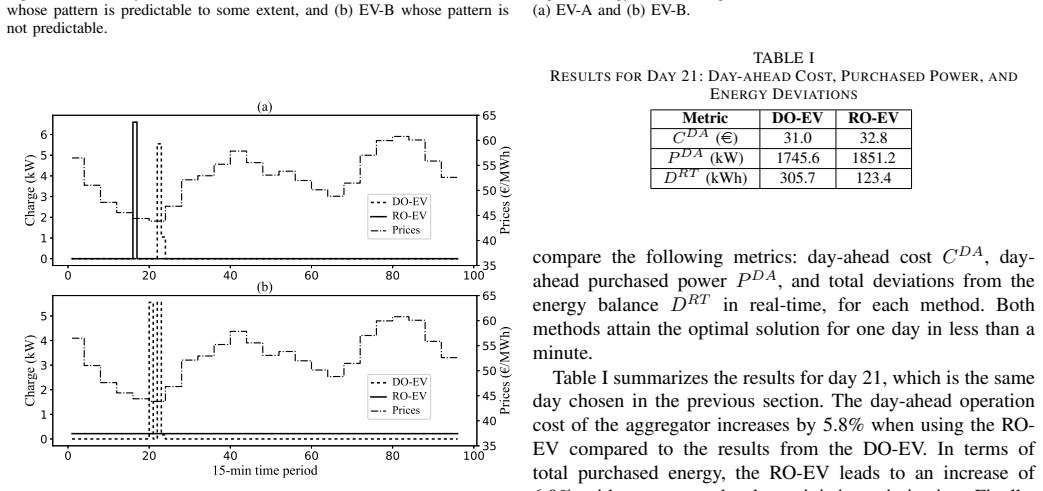
For each vehicle, uncertainty is represented by a set of possible availability patterns: the vehicle must be available in at least $K_v$ time periods, and availability in each period lies between given bounds. The lower-level problem minimizes the total energy the vehicle can receive over the horizon under those constraints, and constraint (7) requires that this worst-case energy at least covers the vehicle's total expected transportation energy. The paper shows that, thanks to the total unimodularity of the lower-level constraint matrix, the bilevel model can be replaced by an equivalent single-level mixed-integer linear program using dual feasibility and strong duality, with the bilinear terms $c_{v,t}\alpha_{v,t}$ linearized through auxiliary variables. In the case study, the robust model's monthly day-ahead cost is about 9.6% higher than the deterministic model's, while total real-time energy deviations fall from 4548.9 kWh to 2404.3 kWh, with the maximum daily deviation dropping from 305.7 kWh to 190.5 kWh.
Load-bearing premise
The load-bearing premise is that guaranteeing the worst-case total charging energy over the horizon covers total transportation energy (constraint (7)) is enough to make the schedule robust, even though this condition does not by itself keep each battery's state of charge within its bounds in every time period for every availability realization.
Editorial extensions
If this is right
- An aggregator can solve a robust day-ahead schedule for a fleet of several hundred vehicles in routine optimization time (under a minute per day in the case study).
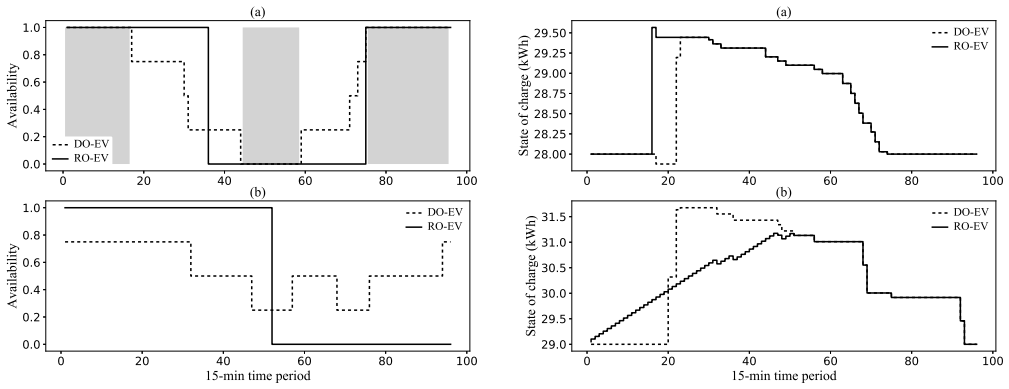
- The robust schedule hedges by moving charging into periods where availability is certain and prices are low, while vehicles with unpredictable routines receive a nearly flat charging profile.
- The documented trade-off is concrete: roughly a 10% increase in day-ahead energy cost buys a roughly 50% reduction in real-time energy-balance deviations, with the largest daily reduction reaching 83%.
- Because each vehicle's battery state-of-charge bounds are enforced individually in the formulation, the method does not rely on aggregating the fleet into a single virtual battery.
- The formulation provides a benchmark against which deterministic and scenario-based charging strategies can be compared on both cost and real-time deviation metrics.
Reading between the lines
- Inference: Constraint (7) is a total-energy guarantee; it does not by itself certify that battery state of charge stays within bounds at every period for every availability pattern in the uncertainty set, so a sharper per-period robust guarantee would require additional constraints or a richer uncertainty set.
- Inference: The same totally-unimodular duality reformulation should transfer to other flexible resources with binary availability patterns, such as battery storage or interruptible demand, whenever their lower-level availability sets share the same structure.
- Inference: The flat-charging behavior observed for unpredictable vehicles suggests a general design rule: when no time slot is certain, spreading charge uniformly over the horizon is near-optimal; this could be tested as a heuristic without solving the mixed-integer program.
- Inference: The robust plan is only as good as the uncertainty-set parameters ($K_v$ and the per-period bounds); tuning them to measured availability records offers a direct, testable path to controlling the cost-versus-deviation trade-off.
Signed reviews
Editorial analysis
A structured set of objections, weighed in public.
Referee Report
Summary. The paper proposes a day-ahead operation model for an aggregator of electric vehicles (EVs) formulated as a bilevel program. The upper level minimizes day-ahead energy purchase and battery-balance penalty costs, while each lower-level problem minimizes the total energy available to a single EV over the horizon, subject to an availability uncertainty set described by bounds and a cardinality constraint. The authors exploit total unimodularity of the lower-level constraint matrices, apply LP duality and linearize the resulting bilinear products to obtain a single-level MILP, called RO-EV. They compare RO-EV against a deterministic counterpart DO-EV on a synthetic case study built from NHTS 2017 data and Spanish electricity prices, reporting about a 10% increase in day-ahead costs and a reduction of real-time energy deviations to roughly half.
Significance. If fully valid, the paper would make a useful methodological contribution: the TU-based duality reformulation is elegant, avoids scenario enumeration, and the resulting MILP is solved quickly on a 100-EV case. The authors also make a clear effort to use publicly available data and to compare robust and deterministic approaches on an out-of-sample rolling basis. However, the central robustness claim is weaker than the abstract suggests. The robust condition (7) only enforces a horizon-total energy sufficiency guarantee, not per-period state-of-charge feasibility for every availability realization. The reported deviation reductions are measured on a single historical realization and therefore do not constitute a robustness certificate. These issues are load-bearing for the paper's central claim, though the underlying mathematical reformulation itself appears sound.
major comments (3)
- [Section III, constraints (7)-(10)] The robust guarantee implemented by the lower-level problem is only a total-energy condition over the horizon, not a per-period feasibility condition on the state of charge. Constraint (7) requires that the worst-case total available charging energy be at least the total transportation energy, but it does not ensure that the battery energy limits (4) are satisfied for every availability realization in the uncertainty set (9)-(10). For example, consider one EV with E_min=0, E_max=10 kWh, C=10 kW, Delta t=1 h, eta=1, xi=(5,5) kWh, K_v=1, and alpha bounds [0,1]. Constraint (7) forces c1=c2=10 kW, so the schedule meets the total-energy condition, but the realization alpha=(0,1) lies in the uncertainty set and gives SOC_1 = -5 kWh, violating (4). Thus the schedule is not robust in the per-period sense. The paper should either strengthen the formulation to enforce per-period robust feasibility of SOC bounds or clearly qualify the statement that the schedule is 'robust against the uncertain availability of the EVs.'
- [Section VI-C, Tables I-II] The empirical comparison evaluates the two methods on a single historical availability realization per day. The reported 50-83% reduction in energy deviations is therefore an out-of-sample performance measure, not a verification that the RO-EV schedule avoids violations for all realizations in the uncertainty set. To support the robustness claim, the authors should test the schedule against adversarial or multiple realizations inside the uncertainty set, or explicitly frame the reduction as a statistical performance gain rather than a robustness certificate. This distinction matters because the deterministic schedule might also satisfy the total-energy condition by purchasing more energy, without any guarantee of per-period feasibility.
- [Section V, comparison methodology] The deterministic comparator DO-EV uses the same expected values of availability and consumption as the robust model, but it does not include any mechanism for accounting for uncertainty, such as reserve margins or scenario-based constraints. The comparison is therefore not surprising: the robust model buys more energy and reduces deviations on a typical day. The paper would benefit from a clearer statement of what 'fair comparison' means here, e.g., by reporting the full distribution of deviations, not only averages and maxima, and by discussing whether the cost increase buys a meaningful reduction in the tail risk of violations.
minor comments (5)
- [Nomenclature and equations] The lower and upper bound dual variables are both denoted beta_{v,t}, with only an overbar/underbar distinction that is lost in several places in the text. This makes equations (12)-(14) and the strong-duality expression (20) confusing. Please use distinct symbols such as beta_{v,t}^{lo} and beta_{v,t}^{up}.
- [Section VII] The conclusion states that the daily purchase cost increases by 'around 15%', whereas Table II reports a 9.6% monthly cost increase and Table I reports a 5.8% increase for day 21. Please reconcile these numbers.
- [Figures] Several figure captions and axis labels contain garbled font encoding (e.g., in Figures 3-5), making the plots difficult to read. The source PDF or fonts should be fixed before publication.
- [Section VI] The paper does not provide code or data for the case study. Given that the authors already rely on public data, releasing the Pyomo/CPLEX implementation would improve reproducibility and help readers verify the computational claims.
- [Section VI] The text says the simulations use 'one CPU clocking at 2.8 GHz, 6 cores and 8 GB of RAM'. This is ambiguous (one CPU with six cores, or a six-core machine?) and should be stated as a single machine specification.
Circularity Check
No circularity: the robust MILP is a standard duality reformulation and the reported deviation reductions are out-of-sample measurements.
full rationale
The paper's derivation chain is self-contained and non-circular. The robust model RO-EV is explicitly constructed by imposing the min-max condition (7)-(10), and the lower-level minimization is then converted to a single-level MILP via total unimodularity and LP duality in Section IV. That reformulation is mathematical: the TU argument, dual feasibility constraints (12)-(14), strong-duality equality (20), and the linearization (22)-(25) do not assume the conclusion they are used to prove. The uncertainty-set parameters Kv, alpha_vt, and alpha_vt are estimated from NHTS 2017 historical data, and the 29-day comparison with DO-EV is evaluated on the same historical availability and consumption realizations in a rolling out-of-sample fashion (Section VI). The reported 50-83% deviation reductions are measured simulation outcomes, not parameters fitted to match those reductions. The paper's own limitation is a modeling-adequacy concern, not circularity: constraint (7) certifies only worst-case total charging energy over the horizon, not per-period state-of-charge feasibility for every alpha in (9)-(10), so the abstract's phrase "robust against the uncertain availability of the EVs" overstates what the constraint actually guarantees. This is acknowledged indirectly in the conclusion, which says the model ensures "the total energy required for transportation throughout the optimization horizon must be satisfied," and in the future-work remark about "refining the uncertainty set of the driving patterns." That gap is a correctness/validation issue, not an equation reducing to its own input. The only self-citation, reference [7] in the introduction, is a background pointer to prior work by one of the authors on Markov-decision-process charging of a single EV; it is not load-bearing for the bilevel derivation, the TU argument, or the case-study claims. No circular step can be exhibited from the paper's equations or citations.
Assumptions & free parameters
free parameters (3)
- K_v (minimum number of available periods for each EV) =
57 for EV-A, 52 for EV-B; not specified for others
- Availability bounds αv,t and αv,t =
0 or 1 per period for fixed/unavailable periods
- Penalty cost P =
1000 EUR/kWh
assumptions (5)
- standard math The constraint matrix of the lower-level problem (8)-(10) is totally unimodular, so the LP relaxation has integral optimal solutions when the RHS parameters are integer.
- standard math Strong duality holds for the relaxed lower-level linear program, so primal and dual objective values coincide at optimality.
- domain assumption The uncertainty in EV availability is fully captured by the set {Σα ≥ K_v, α_v,t ≤ α_v,t ≤ α̅_v,t} for each EV.
- ad hoc to paper Satisfying the total energy requirement (7) over the horizon is sufficient for meeting transportation needs; per-trip energy timing is not explicitly enforced.
- domain assumption NHTS 2017 and ENTSO-e data are suitable proxies for real EV behavior and market prices.
Cite this review
Pith. "Pith review of Day-ahead Operation of an Aggregator of Electric Vehicles via Optimization under Uncertainty." pith.science (2026). https://pith.science/paper/6SXU36NU
@misc{pith2026190800787,
  author       = {Pith},
  title        = {Pith review of: Day-ahead Operation of an Aggregator of Electric Vehicles via Optimization under Uncertainty},
  year         = {2026},
  howpublished = {\url{https://pith.science/paper/6SXU36NU}},
  note         = {Machine review of arXiv:1908.00787}
}
read the original abstract
We pose the aggregator's problem as a bilevel model, where the upper level minimizes the total operation costs of the fleet of EVs, while each lower level minimizes the energy available to each vehicle for transportation given a certain charging plan. Thanks to the totally unimodular character of the constraint matrix in the lower-level problems, the model can be mathematically recast as a computationally efficient mixed-integer program that delivers charging schedules that are robust against the uncertain availability of the EVs. Finally, we use synthetic data from the National Household Travel Survey 2017 to analyze the behavior of the EV aggregator from both economic and technical viewpoints and compare it with the results from a deterministic approach.
Figures

Figures from the paper (1 more)

Reference graph
Works this paper leans on
-
[1]
Directive (EU) 2018/844 of the European Parliament and of the Council of 30 May 2018
“Directive (EU) 2018/844 of the European Parliament and of the Council of 30 May 2018.” [Online]. Available: https://eur-lex.europa.eu/legal- content/EN/TXT/PDF/?uri=CELEX:32018L0844&from=ES
work page 2018
-
[2]
Global ev outlook 2018: Towards cross-modal electrification,
T. Bunsen, P. Cazzola, M. Gorner, L. Paoli, S. Scheffer, R. Schuitmaker, J. Tattini, and J. Teter, “Global ev outlook 2018: Towards cross-modal electrification,” 2018
work page 2018
-
[3]
P. M. de Quevedo, G. Mu ˜noz-Delgado, and J. Contreras, “Impact of electric vehicles on the expansion planning of distribution systems considering renewable energy, storage and charging stations,” IEEE Transactions on Smart Grid , vol. 10, no. 1, pp. 794–804, 2019
work page 2019
-
[4]
Assessment of the impact of plug-in electric vehicles on distribution networks,
L. P. Fernandez, T. G. San Rom ´an, R. Cossent, C. M. Domingo, and P. Frias, “Assessment of the impact of plug-in electric vehicles on distribution networks,” IEEE Transactions on Power Systems , vol. 26, no. 1, pp. 206–213, 2011
work page 2011
-
[5]
The impact of electric vehicle deployment on load management straregies,
G. T. Heydt, “The impact of electric vehicle deployment on load management straregies,” IEEE transactions on power apparatus and systems, no. 5, pp. 1253–1259, 1983
work page 1983
-
[6]
Electric vehicle charge planning using economic model predictive control,
R. Halvgaard, N. K. Poulsen, H. Madsen, J. B. Jørgensen, F. Marra, and D. E. M. Bondy, “Electric vehicle charge planning using economic model predictive control,” in 2012 IEEE International Electric V ehicle Conference, pp. 1–6, IEEE, 2012
work page 2012
-
[7]
Optimal charging of an electric vehicle using a markov decision process,
E. B. Iversen, J. M. Morales, and H. Madsen, “Optimal charging of an electric vehicle using a markov decision process,” Applied Energy , vol. 123, pp. 1–12, 2014
work page 2014
-
[8]
Optimal operation of aggregated electric vehicle charging stations coupled with energy storage,
M. R. Sarker, H. Pand ˇzi´c, K. Sun, and M. A. Ortega-Vazquez, “Optimal operation of aggregated electric vehicle charging stations coupled with energy storage,” IET Generation, Transmission & Distribution , vol. 12, no. 5, pp. 1127–1136, 2017
work page 2017
Show all 20 references
-
[9]
Optimal scheduling of electric vehicle charg- ing and vehicle-to-grid services at household level including battery degradation and price uncertainty,
M. A. Ortega-Vazquez, “Optimal scheduling of electric vehicle charg- ing and vehicle-to-grid services at household level including battery degradation and price uncertainty,” IET Generation, Transmission & Distribution, vol. 8, no. 6, pp. 1007–1016, 2014
2014
-
[10]
A stochastic robust optimization approach for the bidding strategy of an electric vehicle aggregator,
L. Baringo and R. S. Amaro, “A stochastic robust optimization approach for the bidding strategy of an electric vehicle aggregator,”Electric Power Systems Research, vol. 146, pp. 362–370, 2017
2017
-
[11]
Integration of pevs into power markets: a bidding strategy for a fleet aggregator,
M. Gonz ´alez Vay´a, L. Baringo, and G. Andersson, “Integration of pevs into power markets: a bidding strategy for a fleet aggregator,” in Plug In Electric V ehicles in Smart Grids , pp. 233–260, Springer, 2015
2015
-
[12]
Contingency-constrained unit commitment with n − k security criterion: A robust optimization ap- proach,
A. Street, F. Oliveira, and J. M. Arroyo, “Contingency-constrained unit commitment with n − k security criterion: A robust optimization ap- proach,” IEEE Transactions on Power Systems , vol. 26, no. 3, pp. 1581– 1590, 2011
2011
-
[13]
Schrijver, Theory of linear and integer programming
A. Schrijver, Theory of linear and integer programming . John Wiley & Sons, 1998
1998
-
[14]
D. G. Luenberger, Linear and nonlinear programming . USA, MA, Reading:Addison-Wesley, 1989
1989
-
[15]
C. A. Floudas, Nonlinear and mixed-integer optimization: fundamentals and applications . Oxford University Press, 1995
1995
-
[16]
Data Sheet Renault ZE ZOE
“Data Sheet Renault ZE ZOE.” [Online]. Available: http://electromovilidad.net/renault/ficha-tecnica-renault-zoe/, 2019
2019
-
[17]
National Household Travel Survey (NHTS) data
“National Household Travel Survey (NHTS) data.” [Online]. Available: https://nhts.ornl.gov/, 2019
2019
-
[18]
European Network of Transmission System Operators (ENTSO-e)
“European Network of Transmission System Operators (ENTSO-e).” [Online]. Available: https://www.entsoe.eu/, 2019
2019
-
[19]
IBM ILOG CPLEX Optimisation Studio
“IBM ILOG CPLEX Optimisation Studio.” [Online]. Available: https://www.ibm.com/analytics/cplex-optimizer, 2019
2019
-
[20]
Pyomo: Modeling and solving mathematical programs in Python,
W. E. Hart, J. P. Watson, and D. L. Woodruff, “Pyomo: Modeling and solving mathematical programs in Python,” Mathematical Programming Computation, vol. 3, no. 3, pp. 219–260, 2011
2011
Reviewed August 14, 2026 · model on record in the stance chip above.
Discussion (0). Continue with ORCID to comment.