REVIEW 4 major objections 4 minor 57 references
High sensitivity molecular line observations towards the L1544 pre-stellar core challenge current models
T0 review · 4 major / 4 minor · reviewed 2026-08-15 · deepseek-v4-flash
Pith's one-line read High-sensitivity spectra of L1544 show sulphur abundances that differ from chemical models by up to a factor of 20, and single-line fits are degenerate.
desk verdict Valuable data and an honest account of fitting degeneracy, but the sulphur-chemistry 'challenge' rests on abundance profiles the authors themselves show are not unique. read the letter →
The pith
A machine-rendered reading of the paper's core claim, the machinery that carries it, and where it could break.
The reading
What carries the argument
The machinery is the combination of a non-LTE radiative transfer solver and a Monte Carlo sampler over a deliberately simple abundance model. The LOC code solves the statistical equilibrium equations with an accelerated $\lambda$ iteration and computes 1D line radiative transfer through the contracting Bonnor-Ebert sphere model of L1544; the MCMC sampler then explores five parameters: inner abundance $a_\mathrm{in}$, outer abundance $a_\mathrm{out}$, depletion radius $r$, velocity scaling $f_v$, and turbulent velocity dispersion $\sigma_\mathrm{turb}$, with the prior constraint $a_\mathrm{in} < a_\mathrm{out}$. The 'extended' variant adds a constant-abundance envelope between 0.32 and 1 pc. The abundance profiles that emerge are compared with pyRate, a pseudo-time-dependent chemical model run in concentric shells of the same physical model; this comparison is what carries the paper's challenge to sulphur chemistry.
What would settle it
Fit several rotational lines of CS, C$^{34}$S, SO and $^{34}$SO (for example J = 1-0, 2-1 and 3-2 for CS and SO) jointly toward the L1544 dust peak with the same LOC + MCMC machinery. If the joint fit converges to outer abundances within a factor of 2 of the pyRate predictions, the single-line sulphur discrepancy is an artefact of degeneracy rather than a chemical-network failure.
Extended reading notes
Core claim
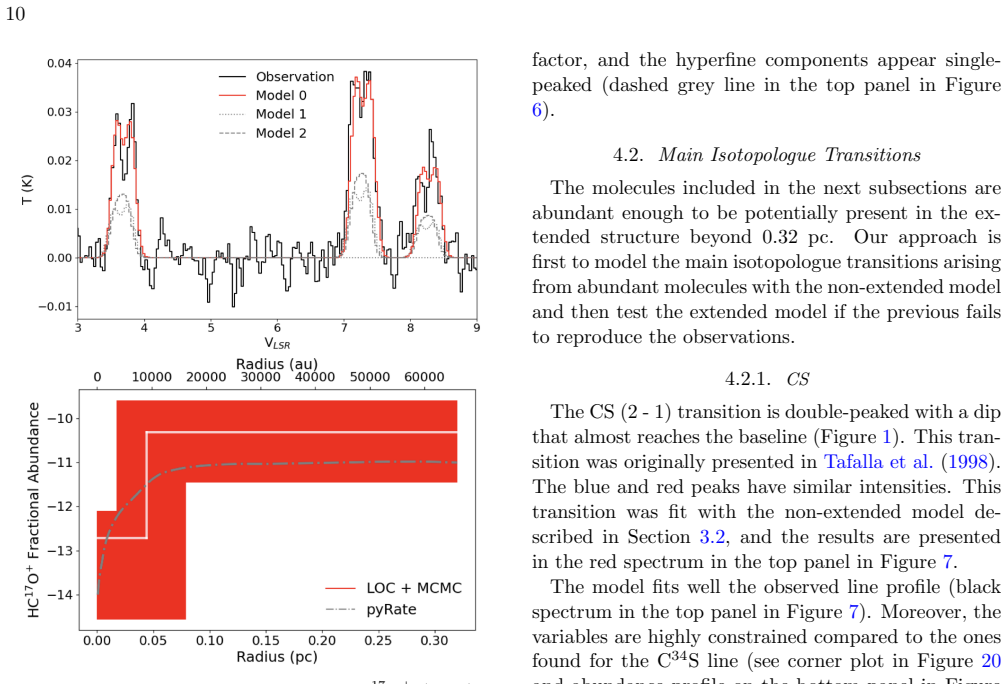
On the authors' own terms, the central discovery is a mismatch between what the observations require and what the chemistry predicts. The observed C$^{34}$S and CS lines toward the L1544 dust peak are best matched by step abundance profiles whose outer abundances are roughly 9 and 20 times higher, respectively, than the peak abundances produced by the pyRate chemical model; for $^{34}$SO the fitted outer abundance is about 3 times higher, though within errors, and for SO it is about 2 times lower. In all sulphur-bearing species the depletion radius is shifted outward relative to the model's abundance drop, though with large uncertainties for the SO species. For C$^{34}$S and CS, the fitted abundances are so high that the inferred optical depths reach $\tau \sim 4$ and $\tau \sim 10^5$, unusually large for a rare isotopologue and for a supposedly optically thinner line. The paper also establishes that fitting a single transition per isotopologue leaves most parameters unconstrained, with flat or multi-peaked posteriors, so the fitted profiles are degenerate; Appendix A explicitly cautions that the result 'may not be the correct or a physically accurate result.' These findings are interpreted as a challenge to current chemical networks, specifically their sulphur depletion treatment, which typically begins from a reduced elemental sulphur abundance to solve the so-called sulphur depletion problem.
Load-bearing premise
The load-bearing premise is that the MCMC-fitted step abundance profiles are a faithful empirical benchmark; the paper itself notes the fits can be degenerate, with flat or multi-peaked corner plots and parameters sitting at prior boundaries, and that the result may not be physically accurate.
Editorial extensions
If this is right
- Sulphur chemical networks for dense cores need to be revisited: the paper argues that starting from the elemental cosmic abundance of sulphur with a consistent S-depletion process would reproduce the observed CS, C$^{34}$S, SO and $^{34}$SO abundances better than the currently 'depleted' initial-S assumption.
- Single-line fits to pre-stellar core spectra should not be used to claim a unique abundance structure; multi-line fits per species are necessary to break the degeneracies the corner plots reveal, and combined fits of isotopologue pairs do not by themselves add enough constraints.
- H$_{2}$CO, like HCO$^{+}$, must be present in the diffuse envelope beyond 0.32 pc to reproduce deep self-absorption, so radiative transfer models of such lines cannot stop at the traditional core boundary.
- The layering inferred from line morphologies — HCO$^{+}$/H$_{2}$CO outermost, CS and c-C$_{3}$H$_{2}$ in a static middle layer, SO in a contracting intermediate layer, C$^{34}$S and HC$^{17}$O$^{+}$ deepest — is a concrete prediction that mapping the core in these lines can test.
- The high fitted optical depths for C$^{34}$S ($\tau\sim4$) and CS ($\tau\sim10^5$) imply that even rare-isotopologue lines toward L1544 may be optically thick, complicating simple column-density estimates.
Reading between the lines
- Editorial inference: if the pyRate under-prediction is caused by the 'depleted' initial sulphur abundance assumption, then a testable fix is to rerun the same radiative transfer comparison with a network that begins from cosmic sulphur and follows freeze-out self-consistently; that would distinguish a missing reaction set from a wrong boundary condition.
- Editorial inference: the degeneracy seen here implies that published abundance profiles of pre-stellar cores derived from single molecular transitions may carry systematic uncertainties of order the factors quoted, and comparisons between species should treat them as correlated rather than independent constraints.
- Editorial inference: the newly measured $^{34}$SO rest frequency (97715.395 MHz) shifts the line velocity by 0.23 km/s relative to the old value; re-observing the 6.9 km/s blue shoulder at higher angular resolution could reveal whether it is an unresolved second component or a genuinely new kinematic feature.
- Editorial inference: if sulphur is indeed more abundant in the outer core than chemical models predict, the standard 'sulphur depletion problem' may be at least partly a network completeness problem; the same comparison could be applied to other cores such as L183, where SO emission is extended, to see whether the mismatch is generic.
Signed reviews
Editorial analysis
A structured set of objections, weighed in public.
Referee Report
Summary. The paper presents new high-sensitivity, high-spectral-resolution IRAM 30m observations of HCO+, CS, C34S, H2CO, c-C3H2, SO, and 34SO toward the L1544 pre-stellar core, together with the HC17O+ line from an earlier work. The authors couple the LOC non-LTE radiative transfer code with an MCMC sampler and fit simple two-step abundance profiles (ain, aout, r, fv, sigma_turb) to each transition. They then compare the fitted abundance profiles with the pyRate chemical model and conclude that current chemical models, particularly for sulphur chemistry, poorly reproduce the observations. They also argue that single-transition fits cannot find a unique global minimum, that the lines trace distinct layers with different kinematics, and that an extended envelope is needed for HCO+ and H2CO. The paper includes optical depth estimates, corner plots, and combined isotopologue fits in the appendices.
Significance. If the fitted abundance profiles were robust, the reported factor-of-2 to factor-of-20 discrepancies for CS and C34S and the outward-shifted depletion radii would be an important challenge to sulphur chemical networks and would motivate a more consistent treatment of sulphur depletion. The observational dataset is genuinely valuable, and the paper is commendably transparent about degeneracies: it explicitly states that single-line fits cannot locate a global minimum, shows flat and multi-peaked posteriors, and warns in Appendix A that the LOC+MCMC result 'may not be the correct or a physically accurate result.' This honesty is a strength. However, for the reasons developed in the major comments, the empirical benchmark used to evaluate pyRate is not robust enough to carry the central sulphur-chemistry conclusion as stated. The paper is best viewed as a careful presentation of new data and a demonstration of the limitations of single-line abundance fitting, rather than as a definitive falsification of current sulphur chemistry models.
major comments (4)
- [Section 5 and Appendix A] The central claim that pyRate poorly reproduces sulphur chemistry depends on using the LOC+MCMC step-abundance fits as the empirical benchmark, but the paper itself establishes that these fits are non-unique. Section 5 states that high-resolution single lines do not provide enough information to converge to one solution, and Appendix A concedes that the fit may not be physically accurate. This is the load-bearing logical gap: the abundance profiles are then compared quantitatively with pyRate (e.g., the factor-of-9 and factor-of-20 excesses for C34S and CS), despite the fact that the profiles themselves are admitted to be underconstrained. The conclusion 'poor reproduction of sulphur chemistry' therefore needs either multi-line constraints for the relevant species or a substantial softening of the claim.
- [Section 4.2.1 and Appendix A, Figs. 16 and 20] The CS fit, which provides the largest abundance discrepancy (a factor of about 20) and the highest optical depth (about 10^5), is the least trustworthy of the fits. The MCMC drives fv to 1.99 and sigma_turb to 0.01, both at the edges of the priors, and the authors themselves call the resulting optical depth 'unexpectedly high.' A fit that only succeeds by pinning two parameters to the prior boundaries and producing a pathological optical depth cannot alone support the conclusion that pyRate underestimates the outer CS abundance by two orders of magnitude. This point needs to be addressed with additional transitions or with an explicit demonstration that the inferred aout is insensitive to the prior boundaries.
- [Section 4.1.2 and Fig. 18] The 34SO fit has a flat inner-abundance posterior and only weak constraints on r, fv, and sigma_turb. Despite these broad uncertainties, Section 5.1 describes the depletion radius as 'significantly displaced' from the pyRate prediction. The paper's own criterion in Section 3.1 is that flat histograms indicate that the parameter is not constrained; under that criterion, the 34SO depletion-radius shift is not statistically established. The qualitative discussion of a sulphur-chemistry problem should be separated from the parts of the analysis that are actually constrained, such as the better-determined aout value.
- [Sections 4.2.2 and 5.2, Fig. 8] The abundance comparison is not uniformly in one direction: for SO the fitted aout is a factor of about 2 lower than the pyRate maximum, while for CS and C34S the fitted values are higher than pyRate, and for 34SO the values agree within errors. The abstract and conclusions frame the result as 'a poor reproduction of sulphur chemistry,' but the heterogeneous pattern of over- and underproduction does not point to a single missing depletion process without a more specific mechanistic test. The discussion of SO + C+ destruction and the initial sulphur abundance assumption in Section 5.2 is plausible, but it is not quantitatively connected to the fitted profiles. The conclusions should be reframed as a demonstration that current models fail to match the shape and normalization of the sulphur-bearing profiles in a species-dependent way, rather than as a global sulphur-chemistry failure.
minor comments (4)
- [Section 2, Table 1] The rest frequency of 34SO is given as a private communication from the CAS laboratory; for reproducibility, this measurement should be published in a refereed context or documented in an accessible form before the paper is final.
- [Section 1] There is a typo in the introduction: 'the the ionization fraction' should read 'the ionization fraction.'
- [Section 5.3, Figure 14] The layered schematic of L1544 is based on line-profile morphology and fits with several poorly constrained radii; it would be helpful to label the figure explicitly as an illustrative stack rather than a quantitatively determined radial stratification.
- [Appendix C, Table 3] The combined isotopologue fits report sigma_turb = 0.00 with zero uncertainty in some cases, which likely indicates a poor exploration or a prior-boundary issue rather than a precise constraint; a brief comment on this would prevent readers from misinterpreting the reported precision.
Circularity Check
No significant circularity: the LOC+MCMC abundance fits are constrained by observed spectra, and the pyRate comparison is an external model benchmark.
full rationale
The paper's derivation chain is empirical rather than circular. The step-abundance parameters (ain, aout, r, fv, sigma_turb) are fitted by MCMC directly to IRAM 30m observed line profiles through the LOC non-LTE radiative transfer code; no quantity is fitted to a subset of data and then renamed as a prediction of the same quantity. The pyRate fractional abundance profiles compared in Section 4 are produced by an independent astrochemical network (Sipilä et al. 2015) under stated elemental-abundance assumptions, so the comparison is a genuine model-vs-data test. The authors' Appendix A caveat that 'with the lack of enough constraints, the result found by LOC + MCMC may not be the "correct" or a physically accurate result' is a robustness limitation, not evidence that a result reduces by construction to its inputs. Self-citations to Keto et al. (2015) for the 1D physical model and to Sipilä et al. (2015) for pyRate involve overlapping authors, but these models are used as the framework and benchmark and are checked against external observed spectra; no load-bearing argument depends on an unverified self-citation. The paper's own warning that single-transition fits cannot find a unique global minimum weakens the strength of the model comparison, but that is a correctness and robustness concern rather than circularity.
Assumptions & free parameters
free parameters (6)
- ain (inner fractional abundance, per species fit) =
1e-14 to 1e-9 (median values per species, Table 2)
- aout (outer fractional abundance, per species fit) =
1e-11 to 1e-7 (Table 2)
- r (depletion radius, per species fit) =
884 to 19876 au (Table 2)
- fv (velocity profile scaling, per species fit) =
0.56 to 1.99 (Table 2)
- sigma_turb (turbulent velocity dispersion, per species fit) =
0.01 to 0.12 km/s (Table 2)
- aext (external layer abundance) =
3.7e-9 (H2CO), 6.4e-10 (c-C3H2), pyRate value at 0.32 pc (HCO+)
assumptions (6)
- domain assumption 1D spherically symmetric Bonnor-Ebert physical model of L1544 from Keto et al. (2015)
- domain assumption Step abundance profile parameterization with ain <= aout
- domain assumption External layer beyond 0.32 pc has constant physical properties equal to edge values
- domain assumption Collisional rate coefficients of main isotopologues apply to C34S and 34SO
- domain assumption pyRate chemical network with depleted initial sulphur abundance
- ad hoc to paper Uniform priors and parameter bounds for MCMC
Cite this review
Pith. "Pith review of High sensitivity molecular line observations towards the L1544 pre-stellar core challenge current models." pith.science (2026). https://pith.science/paper/6UHADFXO
@misc{pith2026250820355,
  author       = {Pith},
  title        = {Pith review of: High sensitivity molecular line observations towards the L1544 pre-stellar core challenge current models},
  year         = {2026},
  howpublished = {\url{https://pith.science/paper/6UHADFXO}},
  note         = {Machine review of arXiv:2508.20355}
}
read the original abstract
The increased sensitivity and spectral resolution of observed spectra towards the pre-stellar core L1544 are challenging the current physical and chemical models. With the aim of further constraining the structure of L1544 as well as assessing the completeness of chemical networks, we turn to radiative transfer modelling of observed molecular lines towards this source. We obtained high-sensitivity and high-spectral resolution observations of HCO+ (J = 1 - 0), CS (J = 2 - 1), C34S (J = 2 - 1), H2CO (J ,Ka,Kc = 2,1,2 - 1,1,1), c-C3H2 (J,Ka,Kc = 2,1,2 - 1,0,1), SO (N,J = 2,3 - 1,2) and 34SO (N,J = 2,3 - 1,2) with the IRAM 30m telescope towards the dust peak of L1544. A non-Local Thermodynamic Equilibrium radiative transfer code is coupled to the Markov Chain Monte Carlo method to model the observations. We find that with just one transition for each isotope, the modelling cannot find a global minimum that fits the observations. The derived fractional abundance profiles are compared to those computed with chemical models. The observed transitions trace gas components with distinct dynamics at different distances along the radius of the core. Moreover, the results evidence a poor reproduction of sulphur chemistry by chemical modelling and stresses the need to include a more consistent S-depletion process to accurately reproduce the S-chemistry towards dense cores.
Figures


Figures from the paper (22 more)







Reference graph
Works this paper leans on
-
[1]
2014, in Protostars and Planets VI, ed
Andr \'e , P., Di Francesco , J., Ward-Thompson , D., et al. 2014, in Protostars and Planets VI, ed. H. Beuther , R. S. Klessen , C. P. Dullemond , & T. Henning , 27, 10.2458/azu\_uapress\_9780816531240-ch002
doi:10.2458/azu 2014
-
[2]
2013, A&A, 555, A109, 10.1051/0004-6361/201321276
Bizzocchi , L., Caselli , P., Leonardo , E., & Dore , L. 2013, A&A, 555, A109, 10.1051/0004-6361/201321276
-
[3]
Bogey , M., Demuynck , C., & Destombes , J. L. 1981, Chemical Physics Letters, 81, 256, 10.1016/0009-2614(81)80247-3
-
[4]
1986, Chemical Physics Letters, 125, 383, 10.1016/0009-2614(86)85177-6
---. 1986, Chemical Physics Letters, 125, 383, 10.1016/0009-2614(86)85177-6
-
[5]
Br \"u nken , S., M \"u ller , H. S. P., Lewen , F., & Winnewisser , G. 2003, Physical Chemistry Chemical Physics (Incorporating Faraday Transactions), 5, 1515, 10.1039/B301657A
-
[6]
1999, ApJ, 523, L165, 10.1086/312280
Caselli , P., Walmsley , C., Tafalla , M., Dore , L., & Myers , P. 1999, ApJ, 523, L165, 10.1086/312280
doi:10.1086/312280 1999
-
[7]
2002 a , ApJ, 565, 331, 10.1086/324301
Caselli , P., Walmsley , C., Zucconi , A., et al. 2002 a , ApJ, 565, 331, 10.1086/324301
doi:10.1086/324301 2002
-
[8]
Caselli , P., Walmsley , C. M., Zucconi , A., et al. 2002 b , , 565, 344, 10.1086/324302
doi:10.1086/324302 2002
Show all 57 references
-
[9]
2012, ApJ, 759, L37, 10.1088/2041-8205/759/2/L37
Caselli , P., Keto , E., Bergin , E., et al. 2012, ApJ, 759, L37, 10.1088/2041-8205/759/2/L37
2012 doi
-
[10]
2017, A&A, 603, L1, 10.1051/0004-6361/201731121
Caselli , P., Bizzocchi , L., Keto , E., et al. 2017, A&A, 603, L1, 10.1051/0004-6361/201731121
2017 doi
-
[11]
E., Sipil \"a , O., et al
Caselli , P., Pineda , J. E., Sipil \"a , O., et al. 2022, , 929, 13, 10.3847/1538-4357/ac5913
2022 doi
-
[12]
E., Caselli , P., et al
Choudhury , S., Pineda , J. E., Caselli , P., et al. 2021, , 648, A114, 10.1051/0004-6361/202039897
2021 doi
-
[13]
W., & De Lucia , F
Clark , W. W., & De Lucia , F. C. 1976, Journal of Molecular Spectroscopy, 60, 332, 10.1016/0022-2852(76)90136-3
1976 doi
-
[14]
2007, A&A, 470, 221, 10.1051/0004-6361:20077613
Crapsi , A., Caselli , P., Malcolm , C., & Tafalla , M. 2007, A&A, 470, 221, 10.1051/0004-6361:20077613
2007 doi
-
[15]
M., et al
Crapsi , A., Caselli , P., Walmsley , C. M., et al. 2005, , 619, 379, 10.1086/426472
2005 doi
-
[16]
E., Irvine , W
Dickens , J. E., Irvine , W. M., Snell , R. L., et al. 2000, , 542, 870, 10.1086/317040
2000 doi
-
[17]
2001, Canadian Journal of Physics, 79, 359, 10.1139/p01-013
Dore , L., Puzzarini , C., & Cazzoli , G. 2001, Canadian Journal of Physics, 79, 359, 10.1139/p01-013
2001 doi
-
[18]
2022, , 667, A119, 10.1051/0004-6361/202243927
Ferrer Asensio , J., Spezzano , S., Caselli , P., et al. 2022, , 667, A119, 10.1051/0004-6361/202243927
2022 doi
-
[19]
W., Lang, D., & Goodman, J
Foreman-Mackey, D., Hogg, D. W., Lang, D., & Goodman, J. 2013, Publications of the Astronomical Society of the Pacific, 125, 306–312, 10.1086/670067
2013 doi
- [20]
-
[21]
Galli , P. A. B., Loinard , L., Bouy , H., et al. 2019, , 630, A137, 10.1051/0004-6361/201935928
2019 doi
-
[22]
2022, , 664, A119, 10.1051/0004-6361/202243422
Giers , K., Spezzano , S., Alves , F., et al. 2022, , 664, A119, 10.1051/0004-6361/202243422
2022 doi
-
[23]
A., Barranco , J
Goodman , A. A., Barranco , J. A., Wilner , D. J., & Heyer , M. H. 1998, , 504, 223, 10.1086/306045
1998 doi
-
[24]
2022, Initial Conditions for Star Formation: A Physical Description of the Filamentary ISM
Hacar, A., Clark, S., Heitsch, F., et al. 2022, Initial Conditions for Star Formation: A Physical Description of the Filamentary ISM. 2203.09562
2022 arXiv
- [25]
-
[26]
2020, , 644, A151, 10.1051/0004-6361/202039456
Juvela , M. 2020, , 644, A151, 10.1051/0004-6361/202039456
2020 doi
-
[27]
2008, ApJ, 683, 238, 10.1086/58914
Keto , E., & Caselli , P. 2008, ApJ, 683, 238, 10.1086/58914
2008 doi
-
[28]
2010, , 402, 1625, 10.1111/j.1365-2966.2009.16033.x
---. 2010, , 402, 1625, 10.1111/j.1365-2966.2009.16033.x
2010
-
[29]
2015, MNRAS, 446, 3713, 10.1093/mnras/stu2247
Keto , E., Caselli , P., & Rawlings , J. 2015, MNRAS, 446, 3713, 10.1093/mnras/stu2247
2015 doi
-
[30]
2005, , 635, 1151, 10.1086/497566
Keto , E., & Field , G. 2005, , 635, 1151, 10.1086/497566
2005 doi
-
[31]
2010, ApJ, 716, 1315, 10.1088/0004-637X/716/2/1315
Keto , E., & Rybicki , G. 2010, ApJ, 716, 1315, 10.1088/0004-637X/716/2/1315
2010 doi
-
[32]
2022, , 665, A131, 10.1051/0004-6361/202243657
Lin , Y., Spezzano , S., Sipil \"a , O., Vasyunin , A., & Caselli , P. 2022, , 665, A131, 10.1051/0004-6361/202243657
2022 doi
-
[33]
R., Apponi , A
Pagani , L., Pardo , J. R., Apponi , A. J., Bacmann , A., & Cabrit , S. 2005, , 429, 181, 10.1051/0004-6361:20041044
2005 doi
-
[34]
2013, , 550, A38, 10.1051/0004-6361/201220500
Palmeirim , P., Andr \'e , P., Kirk , J., et al. 2013, , 550, A38, 10.1051/0004-6361/201220500
2013 doi
- [35]
-
[36]
2005, in SF2A-2005: Semaine de l'Astrophysique Francaise, ed
Pety , J. 2005, in SF2A-2005: Semaine de l'Astrophysique Francaise, ed. F. Casoli , T. Contini , J. M. Hameury , & L. Pagani , 721
2005
-
[37]
Pineda , J. E. 2010, PhD thesis, Harvard University, Massachusetts
2010
-
[38]
E., Schmiedeke , A., Caselli , P., et al
Pineda , J. E., Schmiedeke , A., Caselli , P., et al. 2021, , 912, 7, 10.3847/1538-4357/abebdd
2021 doi
-
[39]
2018, A&A, 617, A7, 10.1051/0004-6361/201833065
Redaelli , E., Bizzocchi , L., Caselli , P., et al. 2018, A&A, 617, A7, 10.1051/0004-6361/201833065
2018 doi
-
[40]
2019, A&A, 629, A15, 10.1051/0004-6361/201935314
---. 2019, A&A, 629, A15, 10.1051/0004-6361/201935314
2019 doi
-
[41]
2022, , 941, 168, 10.3847/1538-4357/ac9d8b
Redaelli , E., Chac \'o n-Tanarro , A., Caselli , P., et al. 2022, , 941, 168, 10.3847/1538-4357/ac9d8b
2022 doi
-
[42]
2021, , 656, A109, 10.1051/0004-6361/202141776
Redaelli , E., Sipil \"a , O., Padovani , M., et al. 2021, , 656, A109, 10.1051/0004-6361/202141776
2021 doi
-
[44]
1991, A&A, 245, 171
Rybicki , G., & Hummer , D. 1991, A&A, 245, 171
1991
-
[45]
2015, A&A, 578, A55, 10.1051/0004-6361/201424364
Sipil \"a , O., Caselli , P., & Harju , J. 2015, A&A, 578, A55, 10.1051/0004-6361/201424364
2015 doi
-
[46]
P., & McCall , B
Snow , T. P., & McCall , B. J. 2006, , 44, 367, 10.1146/annurev.astro.43.072103.150624
2006 arXiv
-
[47]
W., Park , Y.-S., et al
Sohn , J., Lee , C. W., Park , Y.-S., et al. 2007, ApJ, 664, 928, 10.1086/519159
2007 doi
-
[48]
M., & Lattanzi , V
Spezzano , S., Caselli , P., Bizzocchi , L., Giuliano , B. M., & Lattanzi , V. 2017, A&A, 606, A82, 10.1051/0004-6361/201731262
2017 doi
-
[49]
2025, , 694, A27, 10.1051/0004-6361/202452625
Spezzano , S., Redaelli , E., Caselli , P., et al. 2025, , 694, A27, 10.1051/0004-6361/202452625
2025 doi
-
[50]
Swade , D. A. 1989, , 345, 828, 10.1086/167954
1989 doi
-
[51]
1998, ApJ, 504, 900, 10.1086/306115
Tafalla , M., Mardones , D., Myers , P., et al. 1998, ApJ, 504, 900, 10.1086/306115
1998 doi
-
[52]
1974, Journal of Physical and Chemical Reference Data, 3, 259, 10.1063/1.3253141
Tiemann , E. 1974, Journal of Physical and Chemical Reference Data, 3, 259, 10.1063/1.3253141
1974 doi
-
[53]
2007, , 669, L113, 10.1086/523850
Tinti , F., Bizzocchi , L., Degli Esposti , C., & Dore , L. 2007, , 669, L113, 10.1086/523850
2007 doi
-
[54]
1999, MNRAS, 305, 143, 10.1046/j.1365-8711.1999.02412.x
Ward-Thompson , D., Motte , F., & Andre , P. 1999, MNRAS, 305, 143, 10.1046/j.1365-8711.1999.02412.x
1999
-
[55]
1994, ARA&A, 32, 191, 10.1146/annurev.aa.32.090194.001203
Wilson , T., & Rood , R. 1994, ARA&A, 32, 191, 10.1146/annurev.aa.32.090194.001203
1994
-
[56]
, " * write output.state after.block = add.period write newline
ENTRY address archivePrefix author booktitle chapter doi edition editor eprint howpublished institution journal key month number organization pages publisher school series title misctitle type volume year version url label extra.label sort.label short.list INTEGERS output.stat...
-
[57]
write newline
" write newline "" before.all 'output.state := FUNCTION format.url url empty "" new.block "" url * "" * if FUNCTION format.eprint eprint empty "" archivePrefix empty "" archivePrefix "arXiv" = new.block " " eprint * " " * new.block " " eprint * " " * if if if FUNCTION format.d...
-
[58]
\'70 @ @ @ @ @ @ @@ ɍ4 @ @ @ @ @ @ P' ur# @ @ @ @ @ @ ԉpH @ @ @ @g @ @ @ u
thebibliography [1] 20pt to REFERENCES 6pt =0pt -12pt 10pt plus 3pt =0pt =0pt =1pt plus 1pt =0pt =0pt -12pt =13pt plus 1pt =20pt =13pt plus 1pt \@M =10000 =-1.0em =0pt =0pt 0pt =0pt =1.0em @enumiv\@empty 10000 10000 `\.\@m \@noitemerr \@latex@warning Empty `thebibliography' en...
2021
Reviewed August 15, 2026 · model on record in the stance chip above.
Discussion (0). Continue with ORCID to comment.