Robust Network Flow Interdiction Problems with Applications to Counter-Narcotics
Pith reviewed 2026-07-02 22:15 UTC · model grok-4.3
The pith
Robust interdiction strategies reduce drug flows consistently across uncertain network scenarios.
A machine-rendered reading of the paper's core claim, the machinery that carries it, and where it could break.
Core claim
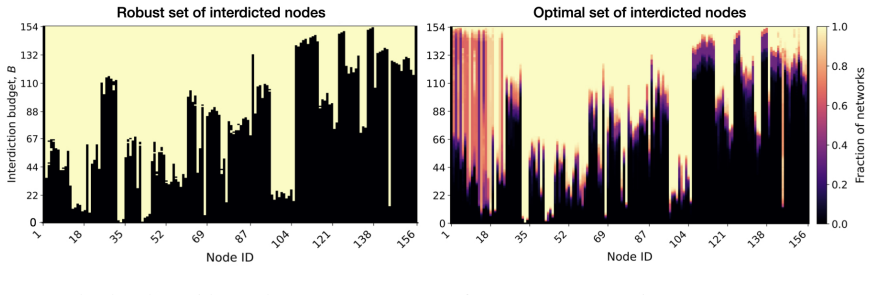
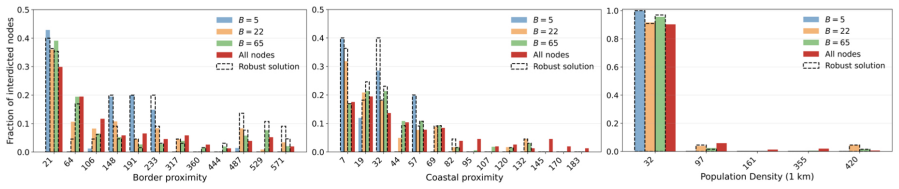
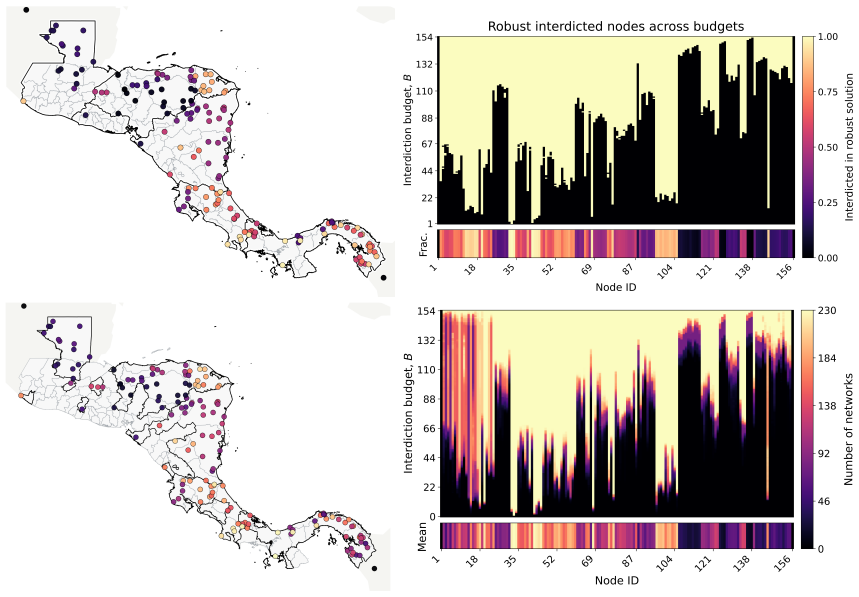
The central claim is that solving the robust network flow interdiction problem over an ensemble of data-consistent network realizations produces interdiction strategies that achieve near-optimal flow reduction in each realization while exhibiting stability under changes to the network structure.
What carries the argument
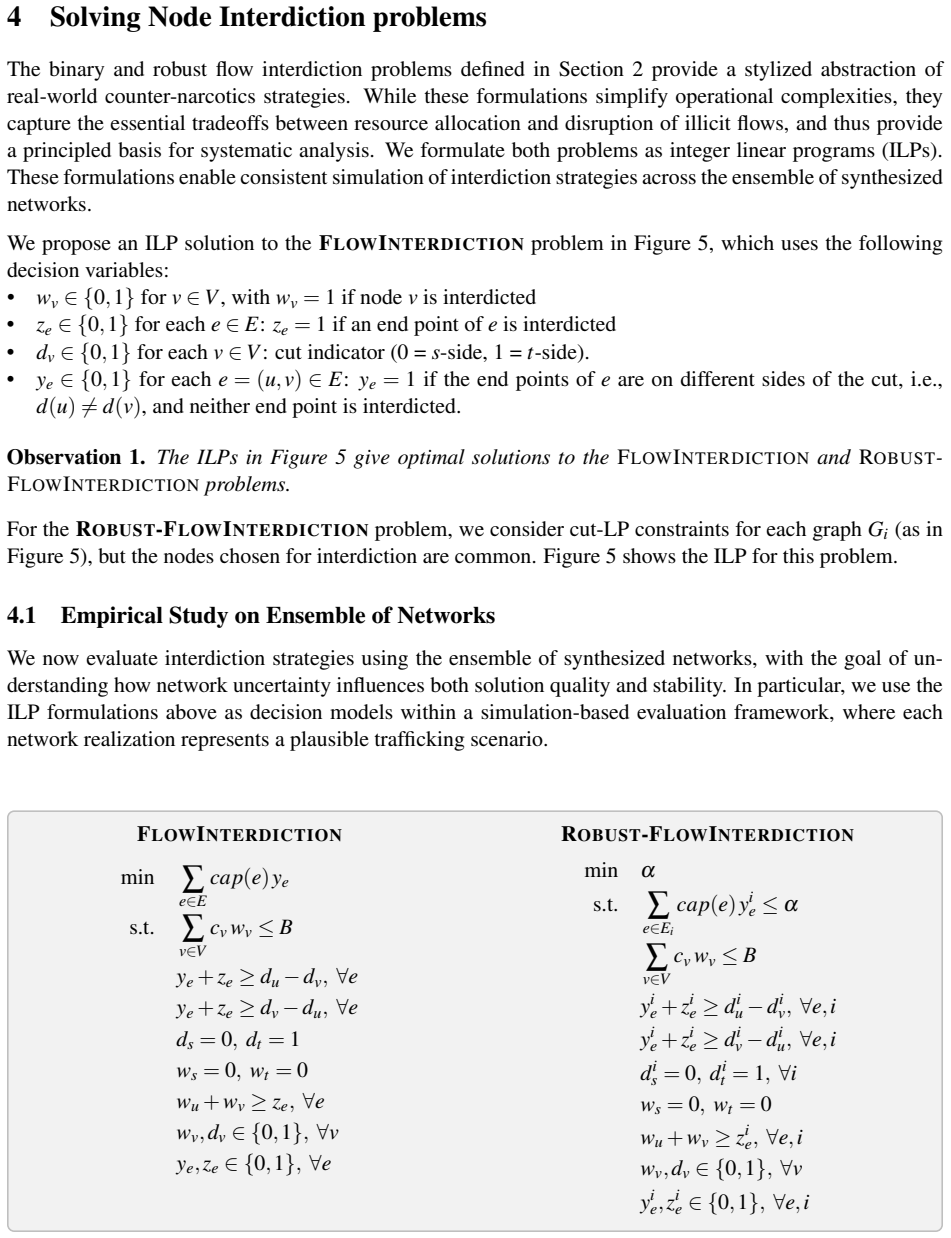
The integer linear program formulation of the robust network flow interdiction problem that selects a fixed set of interdictions to optimize performance across the generated ensemble of trafficking networks.
If this is right
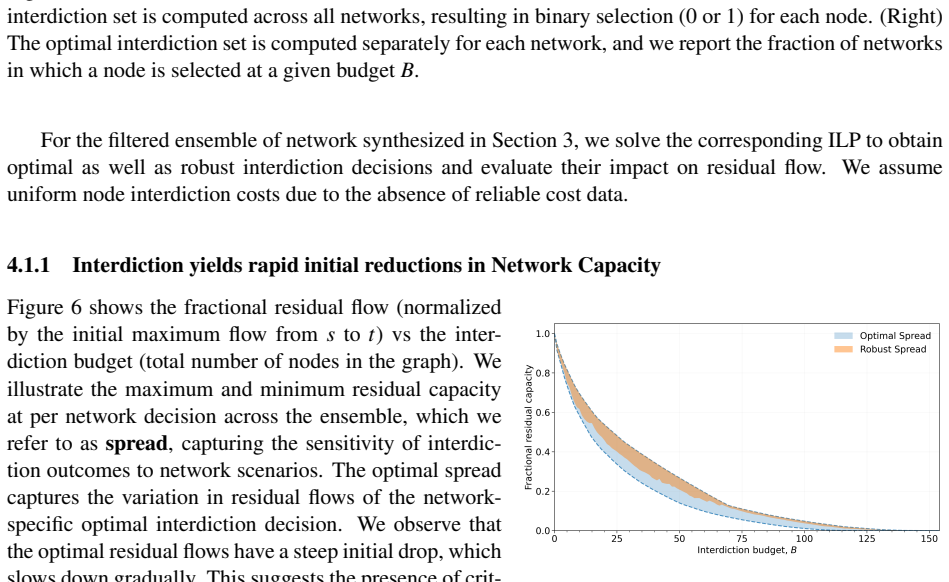
- Modest interdiction budgets can achieve significant reductions in illicit drug flow.
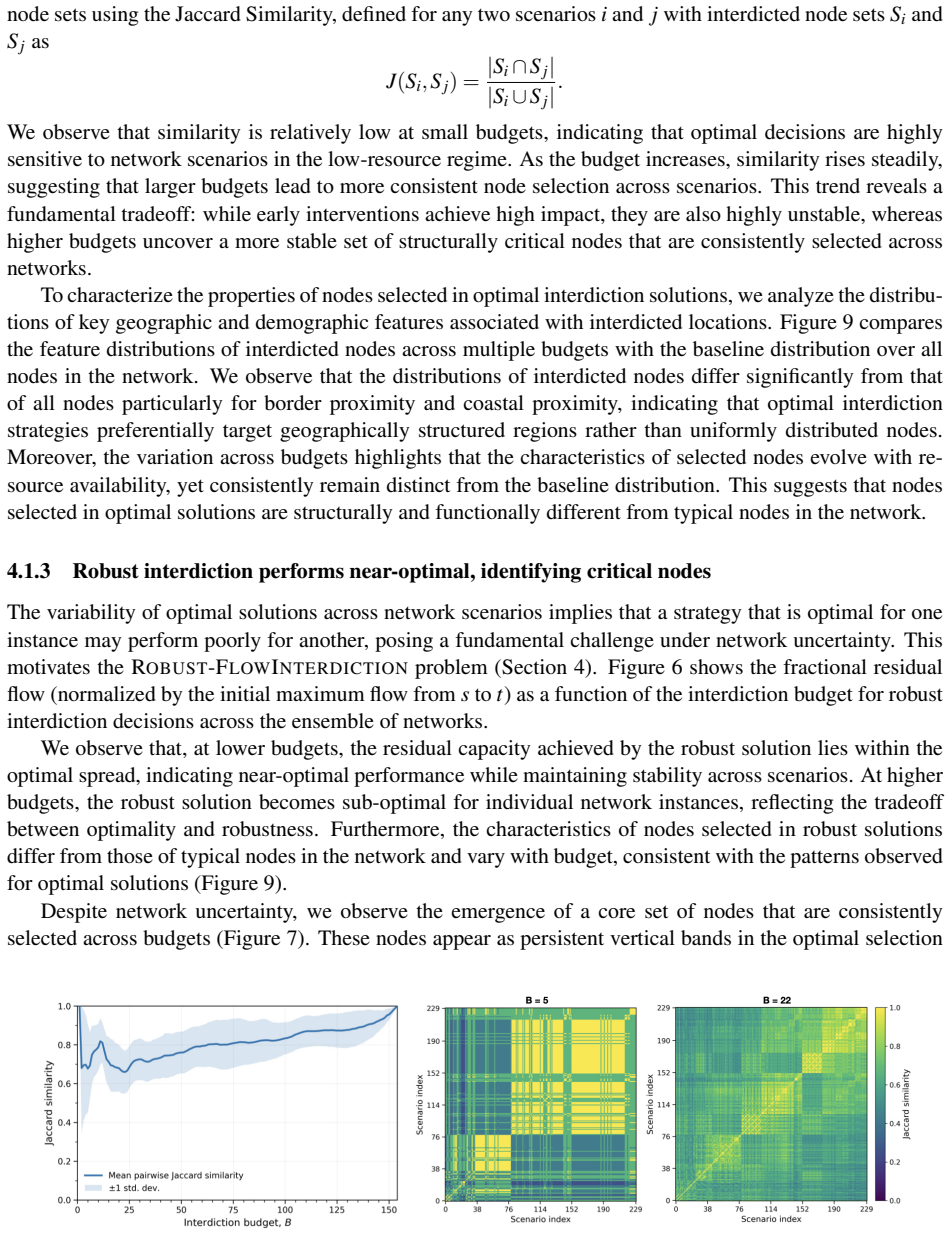
- Optimal interdiction plans for individual scenarios differ substantially, highlighting the need for robustness.
- The robust strategy maintains good performance across all scenarios in the ensemble.
- This framework enables policy analysis in environments with high structural uncertainty.
Where Pith is reading between the lines
- Similar ensemble generation techniques might help in other domains with partial network data, such as infrastructure protection.
- Improving the ensemble generation could lead to even more reliable robust strategies if additional data sources become available.
- Decision makers could test the sensitivity of the robust plan by varying the ensemble generation parameters.
Load-bearing premise
The ensemble of network realizations created from the limited dataset accurately reflects the variety of possible real trafficking networks.
What would settle it
Finding an actual drug trafficking network whose structure leads to substantially higher residual flow under the computed robust strategy than under scenario-specific optima would falsify the practical value of the approach.
Figures


read the original abstract
Interdiction problems arise in a number of application areas, including global security, supply chains, and critical infrastructure protection - the goal is inhibit the movement of goods, people or information. An area of particular interest is counter-narcotics, where nodes or edges in a network are placed under surveillance or blocked to minimize the flow of illicit drugs from source to the destination. A fundamental challenge in this narco-traffic interdiction is data scarcity: available datasets are limited by the very nature of the problem and provide only partial and uncertain views of trafficking networks. Thus, developing robust interdiction methods that take this inherent lack of information is critical. In this paper we initiate the study of network flow interdiction problems under network uncertainty. First, using a limited real-world dataset, we generate an ensemble of plausible network realizations representing alternative trafficking scenarios. The method combines simulations with mathematical programming techniques to generate network ensembles that are consistent with the observed data. Second, we formulate the robust network flow interdiction problem and develop an integer linear program to solve the problem. We evaluate the optimal interdiction strategy and obtain the residual flows over the scenarios. Our analysis reveals that even modest budgets can yield significant flow reductions. However, optimal solutions vary substantially across scenarios, motivating the need for robust solutions. We show that the robust strategy achieves near-optimal performance across all near-real world realizations while remaining stable under structural uncertainty. This simulation-driven approach provides a principled basis for policy analysis and supports maximizing the return on interdiction investments in uncertain, data-limited environments.
Editorial analysis
A structured set of objections, weighed in public.
Referee Report
Summary. The paper initiates the study of robust network flow interdiction under structural uncertainty for counter-narcotics. Using a limited real-world dataset, it generates an ensemble of plausible network realizations via simulations combined with mathematical programming to ensure consistency with observed data. It then formulates the robust interdiction problem as an integer linear program, solves for the optimal robust strategy, and evaluates residual flows across the ensemble, claiming that modest interdiction budgets yield significant flow reductions, that optimal solutions vary across scenarios, and that the robust strategy achieves near-optimal performance while remaining stable under uncertainty.
Significance. If the central claims hold with proper validation, the work could offer a practical simulation-based framework for policy analysis in data-scarce interdiction settings, extending classical network interdiction models to account for network uncertainty and supporting investment decisions. The combination of real data, ensemble generation, and ILP formulation represents a reasonable technical contribution in the area of robust optimization for security applications.
major comments (2)
- [Abstract] The abstract states that an ILP is developed and that the robust strategy achieves near-optimal performance with quantitative claims of flow reductions, yet provides no formulation details, validation metrics, error analysis, or numerical results. This prevents assessment of whether the central claims are supported.
- [Abstract (ensemble generation and evaluation)] The central robustness claim requires that the simulation-plus-MP ensemble spans the relevant range of trafficking networks, but the generation procedure is described only as producing realizations 'consistent with the observed data' with no external hold-out validation, comparison to independent observations, or sensitivity results when generation constraints or simulation parameters are altered. This is load-bearing for the claim that performance is stable under structural uncertainty.
minor comments (1)
- [Abstract] Notation for the network, flow, and interdiction variables is not introduced in the abstract, making it difficult to follow the high-level claims without the full formulation.
Simulated Author's Rebuttal
We thank the referee for the detailed and constructive report. The comments highlight important aspects of presentation and validation that we will address in revision. Below we respond point-by-point to the major comments.
read point-by-point responses
-
Referee: [Abstract] The abstract states that an ILP is developed and that the robust strategy achieves near-optimal performance with quantitative claims of flow reductions, yet provides no formulation details, validation metrics, error analysis, or numerical results. This prevents assessment of whether the central claims are supported.
Authors: The abstract is a high-level summary; the complete ILP formulation appears in Section 3, the ensemble generation procedure in Section 4, and all quantitative results (flow reductions, performance gaps, stability metrics) with tables and figures in Section 5. We will revise the abstract to include a small number of key quantitative highlights drawn directly from the experimental results while preserving length constraints. revision: yes
-
Referee: [Abstract (ensemble generation and evaluation)] The central robustness claim requires that the simulation-plus-MP ensemble spans the relevant range of trafficking networks, but the generation procedure is described only as producing realizations 'consistent with the observed data' with no external hold-out validation, comparison to independent observations, or sensitivity results when generation constraints or simulation parameters are altered. This is load-bearing for the claim that performance is stable under structural uncertainty.
Authors: The ensemble is generated by coupling Monte-Carlo simulation with mathematical-programming feasibility constraints that enforce consistency with the observed partial data (Section 4). Because the underlying real-world dataset is limited and no independent observations exist, external hold-out validation or comparison to separate data sources is not possible. We will, however, add a new sensitivity study that systematically varies simulation parameters and MP constraint tightness, recomputes the robust interdiction solution, and reports the resulting variation in residual flows; these results will be included in the revised Section 5 to support the stability claim. revision: partial
Circularity Check
No significant circularity detected
full rationale
The derivation begins with an external limited real-world dataset, generates an ensemble via simulations and mathematical programming that are constrained to be consistent with the data, then formulates an ILP for the robust interdiction problem and evaluates residual flows and performance on that same ensemble. No step reduces a claimed prediction or result to a fitted parameter or definition taken from the result itself; the ensemble generation and interdiction optimization are distinct operations with no self-definitional loop, no fitted-input-called-prediction, and no load-bearing self-citation chain. The central robustness claim is an empirical evaluation on the generated scenarios rather than a tautological re-statement of the inputs.
Axiom & Free-Parameter Ledger
Reference graph
Works this paper leans on
-
[1]
Network interdiction models., 1991
Robert L Steinrauf. Network interdiction models., 1991
1991
-
[2]
Removing arcs from a network.Operations Research, 12(6):934–940, 1964
Richard Wollmer. Removing arcs from a network.Operations Research, 12(6):934–940, 1964
1964
-
[3]
The network inhibition problem
Cynthia A Phillips. The network inhibition problem. InProceedings of the twenty-fifth annual ACM symposium on Theory of computing, pages 776–785, 1993
1993
-
[4]
A decomposition-based pseudoapproximation algorithm for network flow inhibition
Carl Burch, Robert Carr, et al. A decomposition-based pseudoapproximation algorithm for network flow inhibition. InNetwork Interdiction and Stochastic Integer Programming, pages 51–68. Springer, 2003. 13
2003
-
[5]
Hardness and approximation for network flow interdiction
Stephen R Chestnut and Rico Zenklusen. Hardness and approximation for network flow interdiction. Networks, 69(4):378–387, 2017
2017
-
[6]
Network flow interdiction on planar graphs.Discrete Applied Mathematics, 158(13): 1441–1455, 2010
Rico Zenklusen. Network flow interdiction on planar graphs.Discrete Applied Mathematics, 158(13): 1441–1455, 2010
2010
-
[7]
Interdiction problems on planar graphs.Discrete Applied Mathematics, 198:215–231, 2016
Feng Pan and Aaron Schild. Interdiction problems on planar graphs.Discrete Applied Mathematics, 198:215–231, 2016
2016
-
[8]
Protection of flows under targeted attacks.Operations Research Letters, 45(1):53–59, 2017
Jannik Matuschke, S Thomas McCormick, et al. Protection of flows under targeted attacks.Operations Research Letters, 45(1):53–59, 2017
2017
-
[9]
In- terdiction in network maximum flow and related problems: A survey.Computer Science Review, 60: 100867, 2026
Giorgio Ausiello, Lorenzo Balzotti, Paolo Giulio Franciosa, Isabella Lari, and Andrea Ribichini. In- terdiction in network maximum flow and related problems: A survey.Computer Science Review, 60: 100867, 2026
2026
-
[10]
A survey of network interdiction models and algorithms.European Journal of Operational Research, 283(3):797–811, 2020
J Cole Smith and Yongjia Song. A survey of network interdiction models and algorithms.European Journal of Operational Research, 283(3):797–811, 2020
2020
-
[11]
Deterministic network interdiction.Mathematical and Computer Modelling, 17(2): 1–18, 1993
R Kevin Wood. Deterministic network interdiction.Mathematical and Computer Modelling, 17(2): 1–18, 1993
1993
-
[12]
Deployed armor protection: the application of a game theoretic model for security at the los angeles international airport
James Pita, Manish Jain, Janusz Marecki, Fernando Ordóñez, Christopher Portway, Milind Tambe, Craig Western, Praveen Paruchuri, and Sarit Kraus. Deployed armor protection: the application of a game theoretic model for security at the los angeles international airport. InProceedings of the 7th international joint conference on Autonomous agents and multiag...
2008
-
[13]
Iris-a tool for strategic security allocation in transportation networks.AAMAS (Industry Track), pages 37–44, 2009
Jason Tsai, Shyamsunder Rathi, Christopher Kiekintveld, Fernando Ordonez, and Milind Tambe. Iris-a tool for strategic security allocation in transportation networks.AAMAS (Industry Track), pages 37–44, 2009
2009
-
[14]
Optimal interdiction policy for a flow network.Naval Research Logistics Quarterly, 18(1):37–45, 1971
Prabhakar M Ghare, Douglas C Montgomery, and Wayne C Turner. Optimal interdiction policy for a flow network.Naval Research Logistics Quarterly, 18(1):37–45, 1971
1971
-
[15]
Solving the bi-objective maximum-flow network-interdiction problem.INFORMS Journal on Computing, 19(2):175–184, 2007
Johannes O Royset and R Kevin Wood. Solving the bi-objective maximum-flow network-interdiction problem.INFORMS Journal on Computing, 19(2):175–184, 2007
2007
-
[16]
transit zone
Kendra McSweeney. Reliable drug war data: The consolidated counterdrug database and cocaine interdiction in the “transit zone”.International Journal of Drug Policy, 80:102719, 2020
2020
-
[17]
Modeling cocaine traffickers and counterdrug inter- diction forces as a complex adaptive system.Proceedings of the National Academy of Sciences, 116 (16):7784–7792, 2019
Nicholas R Magliocca, Kendra McSweeney, et al. Modeling cocaine traffickers and counterdrug inter- diction forces as a complex adaptive system.Proceedings of the National Academy of Sciences, 116 (16):7784–7792, 2019
2019
-
[18]
Comparative analysis of illicit supply network structure and operations: Cocaine, wildlife, and sand.Journal of Illicit Economies and Development, 3(1), 2021
NR Magliocca, Aurora Torres, JD Margulies, NH Carter, M Gore, I Arroyo-Quiroz, KM Curtin, TS Easter, A Hübschle, F Massé, et al. Comparative analysis of illicit supply network structure and operations: Cocaine, wildlife, and sand.Journal of Illicit Economies and Development, 3(1), 2021
2021
-
[19]
How do illicit drugs move across countries? a network analysis of the heroin supply to europe.Journal of Drug Issues, 47(2):217–240, 2017
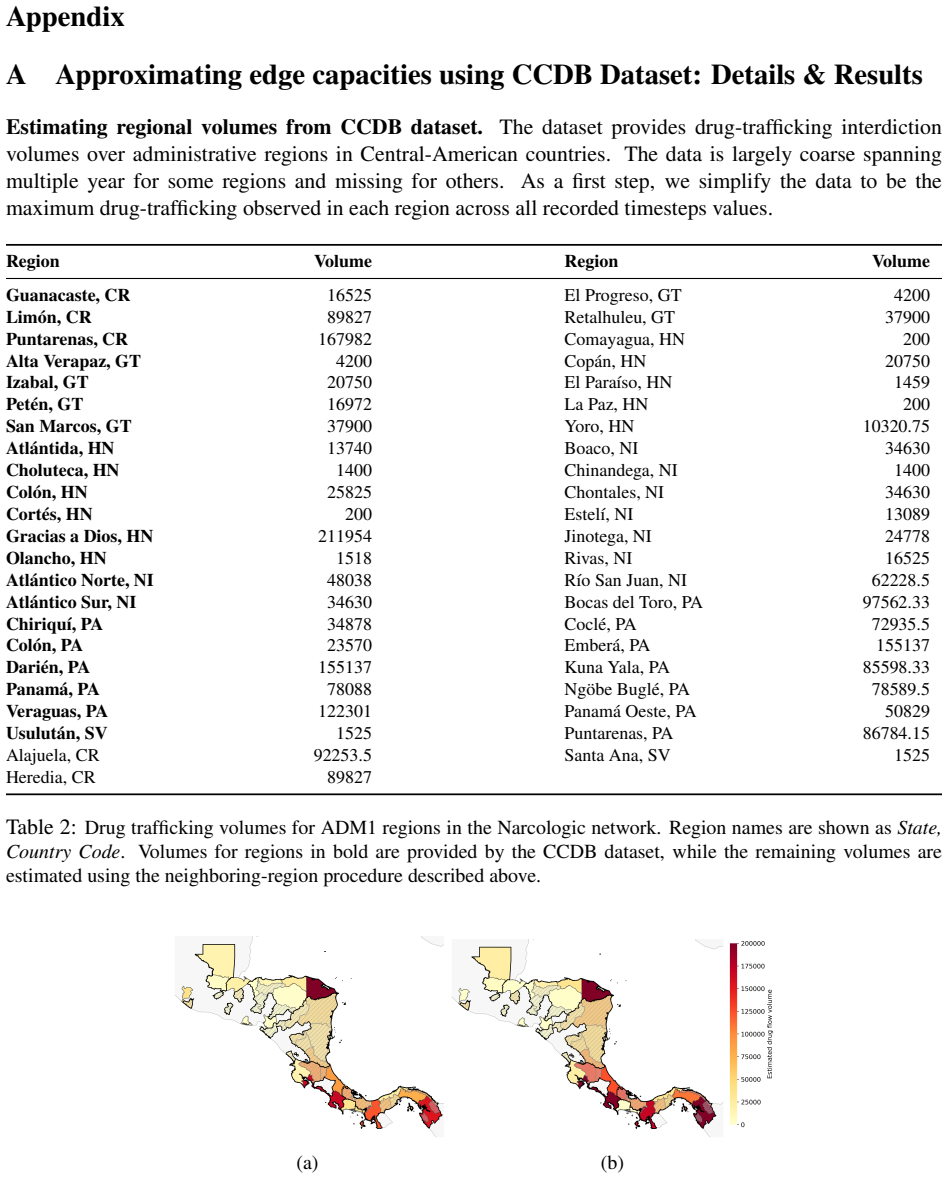
Luca Giommoni, Alberto Aziani, and Giulia Berlusconi. How do illicit drugs move across countries? a network analysis of the heroin supply to europe.Journal of Drug Issues, 47(2):217–240, 2017. 14 Appendix A Approximating edge capacities using CCDB Dataset: Details & Results Estimating regional volumes from CCDB dataset.The dataset provides drug-traffickin...
2017
discussion (0)
Sign in with ORCID, Apple, or X to comment. Anyone can read and Pith papers without signing in.