REVIEW 3 major objections 5 minor 1 cited by
A CFL-type Condition and Theoretical Insights for Discrete-Time Sparse Full-Order Model Inference
T0 review · 3 major / 5 minor · reviewed 2026-08-16 · deepseek-v4-flash
Pith's one-line read The paper derives a sampling CFL condition, $\Delta t/\Delta x \le (m+1)/(3c)$, that governs whether a sparse full-order model inferred from snapshots of 1D linear advection will be stable.
desk verdict The sampling CFL condition is a genuinely new and useful heuristic, but the proof only covers a Taylor surrogate of the LS problem, not the exact problem. read the letter →
The pith
A machine-rendered reading of the paper's core claim, the machinery that carries it, and where it could break.
The reading
What carries the argument
The machinery is the local least-squares inference problem equipped with an adjacency-based sparse stencil, together with the SVD closed-form solution $\beta_i = \Phi_i\Sigma_i^\dagger\Psi_i^T\psi_{S_i}\sigma_{S_i}\phi_{S_i}^T$ and its rank-2 Taylor reduction, which replaces each stencil by the pair $(u_i, \partial u/\partial x)$ and the time shift by an explicit Euler step. The Gershgorin circle theorem turns the requirement that all eigenvalues of the inferred operator lie in the unit disk into the sufficient row-sum condition $\|\beta_i\|_1 \le 1$, and applying that condition to the approximated solution produces the sampling CFL bound. The coefficients $c_1, c_2, c_3$ encode the stencil geometry, so widening the stencil changes the allowed sampling ratio.
What would settle it
Solve the exact least-squares problem for 1D linear advection over a sweep of $\Delta x$ and $\Delta t$, first with the smooth cosine initial condition and then with a sharp or non-smooth profile, and compare the empirical instability boundary of the inferred sFOM with $\Delta t/\Delta x \le (m+1)/(3c)$. A systematic discrepancy for non-smooth data, or an exact-solution threshold that differs from the Taylor-based bound even for smooth data, would show that the sampling CFL condition is only an approximation, not the true stability threshold of the inference problem.
Extended reading notes
Core claim
The paper's central claim is that the least-squares inference problem has a closed-form solution expressible through the SVD of the snapshot data, and that for fine enough data this solution can be approximated analytically. For 1D linear advection with a symmetric stencil of half-width $m$, substituting that approximation into the Gershgorin sufficient stability condition yields the explicit sampling CFL bound $\Delta t/\Delta x \le (m+1)/(3c)$. The paper also argues that the commonly used $\ell_2$ regularization is stability-promoting in discrete time, because it shrinks $\|\beta_i\|_2$ and hence the $\ell_1$ norm that enters the sufficient stability condition $\|\beta_i\|_1 \le 1$. These results are validated numerically on smooth advection data and used to interpret instabilities in 2D Burgers and oscillating lid-driven cavity sFOMs.
Load-bearing premise
The bound is derived from a first-order Taylor approximation of the training data; if the snapshots are not smooth or $\Delta x$ and $\Delta t$ are not small enough for that approximation, the actual least-squares solution can have a different stability threshold.
Editorial extensions
If this is right
- Training data for advection-dominated sFOM inference can be planned: choose $\Delta x$ and $\Delta t$ satisfying the bound to guarantee a stable model without extra stabilization.
- Wider stencils raise the allowed ratio, so using larger local supports makes discrete-time sFOM inference more forgiving of coarse temporal sampling.
- The stabilizing role of $\ell_2$ regularization in discrete-time inference is quantified: it acts on the $\ell_1$ row sums that the sufficient stability condition controls.
- The same sampling mechanism plausibly explains the Burgers' instabilities at high advection speed, where the effective wave speed $c$ in the bound grows.
- Instability of an inferred sFOM can signal an ill-sampled training set rather than a wrong model structure or insufficient regularization.
Reading between the lines
- If the bound reflects the data's information content rather than the specific Taylor argument, then other discrete-map learners, such as learned stencils or convolutional surrogates, should show a similar $\Delta t/\Delta x$ threshold for advection; this is directly testable.
- The Taylor derivation assumes smoothness, so for shock-like or under-resolved data the exact least-squares threshold likely differs, and a higher-order Taylor reduction or a data-dependent correction may be needed.
- Data augmentation changes the effective stencil width $m$, so the bound should be recomputed for augmented problems; this could explain the diffusion-case instability at very small $\Delta t$ reported in the paper.
- An analogous sampling condition should hold for continuous-time operator inference, with the time-derivative discretization playing the role of $\Delta t$; the paper hints at this connection.
Signed reviews
Editorial analysis
A structured set of objections, weighed in public.
Referee Report
Summary. The paper investigates the inference of discrete-time sparse full-order models (sFOMs) from snapshot data by solving a local least-squares problem (7). It reviews the SVD-based closed-form solution, discusses how l2 regularization relates to the Gershgorin sufficient stability condition (12), and analyzes the 1D linear diffusion example analytically. The central contribution is a 'sampling CFL' condition for 1D linear advection: for a symmetric stencil with m neighbors on each side, the training-data discretization should satisfy Δt/Δx ≤ (m+1)/(3c) (Eq. (39)) for the inferred sFOM to be stable. The condition is validated on a smooth cosine advection problem and the approach is demonstrated on 2D Burgers and an oscillating lid-driven cavity. The paper's main claim is that this condition provides an a priori bound on the spatial and temporal sampling of training data that guarantees stability of the inferred model.
Significance. If the sampling CFL condition were rigorously established for the exact least-squares problem, it would be a valuable a priori diagnostic for data-driven PDE inference: it is simple, falsifiable, and directly actionable for choosing snapshot spacing. The paper also usefully connects l2 regularization to the Gershgorin sufficient condition and provides a closed-form expression for a model problem. The theoretical derivation is transparent for the first-order Taylor surrogate, and the numerical test on smooth advection is consistent with the predicted threshold. The main caveat is that the bridge from the surrogate to the exact inference problem is currently missing; resolving this gap would turn a plausible heuristic into a theorem.
major comments (3)
- [Section 3.2, Eqs. (26)-(32) and (39)] The sampling CFL condition is derived after replacing the data matrix D_i by the rank-2 first-order Taylor surrogate (26) and the right-hand side d_i by the explicit-Euler surrogate (27). The coefficients β_ij in (32) solve this surrogate, not the least-squares problem (7) that is actually solved in Figure 3 and described in the abstract. The manuscript never bounds the difference between the surrogate solution and the exact LS solution, nor proves that the spectral radius of the operator inferred from (7) is at most 1 whenever (39) holds. Since (39) is the central advertised result, this gap is load-bearing. Please either prove a rigorous error bound under explicit smoothness assumptions with quantitative constants, or re-state (39) as a heuristic condition for the surrogate and provide numerical evidence that it predicts the exact threshold. The sentence 'This inequality provides a priori bounds ... that guarantee stability' overstates the current support.
- [Section 3.2.1, derivation of Eq. (39) from Eq. (37)] The algebra that turns the sufficient condition (37) into the explicit bound Δt/Δx ≤ (m+1)/(3c) for symmetric stencils is omitted. This is load-bearing because (37) is an l1-condition on the stencil coefficients, and its reduction to a simple ratio requires controlling the signs of the two terms in (35), not just their magnitudes. For m = l, c3 = 0, and the reduction is not automatic from the expression for β_ij. Please present the full computation, including the treatment of the absolute values in (37), so that the reader can verify the bound.
- [Figure 3 and Section 3.2.1] The numerical evidence for (39) is qualitative and limited to a single smooth cosine initial condition. There is no metric for how closely the empirical stability boundary follows the predicted line, no error bars or variation over initial conditions, and no test with non-smooth data, where the first-order Taylor approximations (26)-(27) are questionable. Please quantify the threshold agreement, for example by reporting the empirical critical ratio (Δt/Δx)_crit divided by (m+1)/(3c) for both stencils, and state the smoothness regime in which (39) is intended to apply.
minor comments (5)
- [Section 2.2] The statement that l2 regularization is stability-promoting because of (13) should be softened: a penalty on ||β_i||_2 does not by itself enforce ||β_i||_1 ≤ 1; it biases toward small-norm solutions and hence, heuristically, toward satisfying (12).
- [Section 3.1.1, Eq. (24)] Calling the condition that the sum of coefficients equals 1 'consistency' is imprecise; it is the condition for reproducing a constant state, which is necessary but not sufficient for consistency of the underlying PDE discretization.
- [Equation (9)] The notation D_a for the augmented data block is inconsistent with d_α; use D_{α_j} for each augmented block.
- [Equations (32) and (37)] Equation (32) contains a typesetting artifact ('Œœ'), and the norm in (37) should be absolute value, since K1i and K2i are scalars.
- [Theorem 1] Theorem 1 is essentially tautological once the ansatz and support match the data-generation scheme; presenting it as a remark would better reflect its logical status.
Circularity Check
No significant circularity; the sampling CFL inequality is derived analytically from an explicit Taylor surrogate of the LS problem and validated on independent data.
full rationale
The central derivation is self-contained: Eq. (16) gives the SVD solution of the LS problem (7); Eqs. (26)-(27) explicitly approximate stencil and time-shift data to first order; the solution (32) then yields the norm condition (37), and for the advection model (38) with symmetric stencils this reduces algebraically to the sampling CFL inequality (39). No fitted parameter is renamed as a prediction, and no claimed result is defined in terms of the quantity it purports to derive. The numerical validation in Fig. 3 solves the exact LS problem (7) on independent cosine data, so the bound is tested rather than imposed. Self-citations [13]-[15] support contextual items such as data augmentation, the l2-regularization stability link, and L-curve selection, but they are not load-bearing for (39); the l1-l2 norm argument and Gershgorin condition are stated and proved within the text. The main caveat, which the paper itself acknowledges by calling the analysis a first-order approximation and noting that higher-order extensions become cumbersome, is that the gap between the Taylor surrogate solution (32) and the exact LS solution is not quantified, and stability of the exact inferred operator beyond the surrogate is only visually supported by the 'closely follow' observation. That is a correctness/rigor limitation, not circularity.
Assumptions & free parameters
free parameters (3)
- eta (regularization weight) =
10^-5 to 100, selected via L-curve (Burgers); 10^-3 to 100, selected via L-curve (cavity)
- g (quadratic regularization scaling) =
10, 20, 50, 80, 100, selected via L-curve (Burgers); 100 (cavity)
- data augmentation fraction =
5% of total DOFs (diffusion example); 500 augmentation points for 5x5 stencil (Burgers)
assumptions (5)
- domain assumption The unknown PDE is a polynomial operator in u and its spatial derivatives, so the discretized system has the polynomial structure (3)-(4).
- domain assumption The local support Qi (the stencil) is known a priori and matches the true discretization stencil.
- ad hoc to paper For the sampling CFL derivation, the data matrix Di is approximated by the first-order Taylor basis (26) and the time shift by explicit Euler (27).
- standard math Stability of the inferred linear operator is assessed via the sufficient Gershgorin condition (12), i.e., norm(beta_i,1) <= 1.
- domain assumption For the lid-driven cavity, the pressure term is eliminated so the discrete system has the quadratic form (45) with banded sparse A and H.
Cite this review
Pith. "Pith review of A CFL-type Condition and Theoretical Insights for Discrete-Time Sparse Full-Order Model Inference." pith.science (2026). https://pith.science/paper/6UZS3TXC
@misc{pith2026250501244,
  author       = {Pith},
  title        = {Pith review of: A CFL-type Condition and Theoretical Insights for Discrete-Time Sparse Full-Order Model Inference},
  year         = {2026},
  howpublished = {\url{https://pith.science/paper/6UZS3TXC}},
  note         = {Machine review of arXiv:2505.01244}
}
abstract
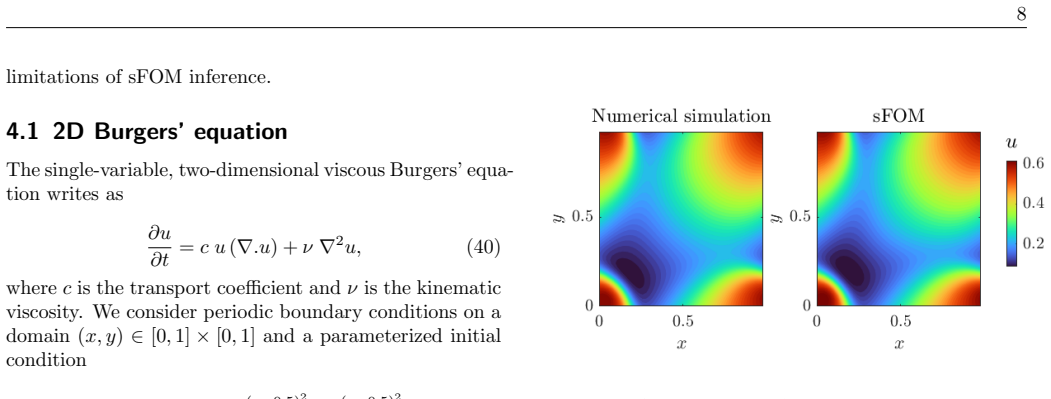
In this work, we investigate the data-driven inference of a discrete-time dynamical system via a sparse Full-Order Model (sFOM). We first formulate the involved Least Squares (LS) problem and discuss the need for regularization, indicating a connection between the typically employed $l_2$ regularization and the stability of the inferred discrete-time sFOM. We then provide theoretical insights considering the consistency and stability properties of the inferred numerical schemes that form the sFOM and exemplify them via illustrative, 1D test cases of linear diffusion and linear advection. For linear advection, we analytically derive a "sampling CFL" condition, which dictates a bound for the ratio of spatial and temporal discretization steps in the training data that ensures stability of the inferred sFOM. Finally, we investigate the sFOM inference for two nonlinear problems, namely a 2D Burgers' test case and the incompressible flow in an oscillating lid driven cavity, and draw connections between the theoretical findings and the properties of the inferred, nonlinear sFOMs.
Figures


Figures from the paper (3 more)


Forward citations
Cited by 1 Pith paper
-
Embodied-R1.5: Evolving Physical Intelligence via Embodied Foundation Models
Embodied-R1.5 is an 8B EFM achieving SOTA on 16 of 24 embodied VLM benchmarks, fine-tunable to outperform leading VLAs, with claimed zero-shot real-robot generalization.
Reference graph
Works this paper leans on
-
[1]
Tamer A. AbdelMigid, Khalid M. Saqr, Mohamed A. Kotb, and Ahmed A. Aboelfarag. Revisiting the lid- driven cavity flow problem: Review and new steady state benchmarking results using gpu accelerated code. Alexandria Engineering Journal , 56(1):123– 135, 2017. doi:10.1016/j.aej.2016.09.013
-
[2]
P. J. Baddoo, B. Herrmann, B. J. McKeon, J. Kutz, N., and S. L. Brunton. Physics-informed dynamic mode decomposition. Proceedings of the Royal Soci- ety A: Mathematical, Physical and Engineering Sci- ences, 479(2271), 2023. doi:10.1098/rspa.2022. 0576
-
[3]
M. Baumann, P. Benner, and J. Heiland. Space- time Galerkin POD with application in optimal con- trol of semi-linear parabolic partial differential equa- tions. 40(3):A1611–A1641, 2018. doi:10.1137/ 17M1135281
work page 2018
-
[4]
P. Benner, P. Goyal, J. Heiland, and I. Pontes Duff. Operator inference and physics-informed learn- ing of low-dimensional models for incompressible flows. Electronic Transactions on Numerical Anal- ysis, 56:28–51, 2021. doi:10.1553/ETNA_VOL56S28
-
[5]
Two-sided projec- tion methods for nonlinear model order reduction
Peter Benner and Tobias Breiten. Two-sided projec- tion methods for nonlinear model order reduction. SIAM Journal on Scientific Computing , 37(2):B239– B260, 2015. doi:10.1137/14097255X
-
[6]
P. Bickel and M. Lindner. Approximating the in- verse of banded matrices by banded matrices with applications to probability and statistics. Theory of Probability and its Applications , 56:1–20, 2012. doi:10.1137/S0040585X97985224
-
[7]
S. L. Brunton and J. N. Kutz. Data-Driven Sci- ence and Engineering: Machine Learning, Dynam- ical Systems, and Control . Cambridge University Press, 2019. doi:10.1017/9781108380690
-
[8]
S. L. Brunton, J. L. Proctor, and J. N. Kutz. Discov- ering governing equations from data by sparse identi- fication of nonlinear dynamical systems. Proceedings of the National Academy of Sciences , 113(15):3932– 3937, 2016
work page 2016
Show all 40 references
-
[9]
Cenedese, J
M. Cenedese, J. Ax˚ as, Bastian B¨ auerlein, K. Avila, and G. Haller. Data-driven modeling and predic- tion of non-linearizable dynamics via spectral sub- manifolds. Nature Communications, 872(13), 2022. doi:10.1038/s41467-022-28518-y
2022 doi
-
[10]
A. J. Chorin. Numerical solution of the Navier-Stokes equations. Mathematics of Computation, 22:745–762,
-
[11]
Digital twin: Enabling technologies, chal- lenges and open research
Aidan Fuller, Zhong Fan, Charles Day, and Chris Barlow. Digital twin: Enabling technologies, chal- lenges and open research. IEEE Access, 8:108952– 108971, 2020. doi:10.1109/ACCESS.2020.2998358. Preprint (Max Planck Institute for Dynamics of Complex Technical Systems, Magdebur...
2020
-
[12]
¨Uber die Abgren- zung der Eigenwerte einer Matrix
Semyon Aronovich Gershgorin. ¨Uber die Abgren- zung der Eigenwerte einer Matrix. Bulletin de l’Acad´ emie des Sciences de l’URSS, Classe des Sci- ences Math´ ematiques et Naturelles, 6:749–754, 1931
1931
-
[13]
Gkimisis, N
L. Gkimisis, N. Aretz, M. Tezzele, T. Richter, P. Ben- ner, and K. E. Willcox. Non-intrusive reduced-order modeling for dynamical systems with spatially local- ized features, 2025. arXiv:2501.04400
2025 arXiv
-
[14]
Gkimisis, T
L. Gkimisis, T. Richter, and P. Benner. Adjacency- based, non-intrusive reduced-order modeling for fluid-structure interactions. Proceedings in Applied Mathematics & Mechanics , 23(4), 2023. doi:10. 1002/pamm.202300047
2023
-
[15]
Gkimisis, T
L. Gkimisis, T. Richter, and P. Benner. Adjacency- based, non-intrusive model reduction for vortex- induced vibrations. Computers & Fluids, 275:106248,
-
[16]
P. C. Hansen. The L-curve and its use in the numeri- cal treatment of inverse problems.Computational In- verse Problems in Electrocardiology, 5:119–142, 2000. doi:10.1.1.33.6040
-
[17]
Kapteyn, D.J
M.G. Kapteyn, D.J. Knezevic, D.B.P. Huynh, M. Tran, and K.E. Willcox. Data-driven physics- based digital twins via a library of component-based reduced-order models. International Journal for Nu- merical Methods in Engineering, 123(13):2986–3003,
-
[18]
D. S. Karachalios, I. V. Gosea, L. Gkimisis, and A. C. Antoulas. Data-driven quadratic modeling in the loewner framework from input-output time-domain measurements. SIAM Journal on Applied Dynam- ical Systems , 24(1):457–500, 2025. doi:10.1137/ 22M153567X
2025
-
[19]
G. E. Karniadakis, I. G. Kevrekidis, L. Lu, P. Perdikaris, S. Wang, and L. Yang. Physics-informed machine learning. Na- ture Reviews Physics , 3:422–440, 2021. doi:10.1038/s42254-021-00314-5
2021 doi
-
[20]
Maddu, D
S. Maddu, D. Sturm, B. L. Cheeseman, C. L. M¨ uller, and I. F. Sbalzarini. Stencil-net: Data-driven solution-adaptive discretization of partial differential equations, 2021. arXiv:2101.06182
2021 arXiv
-
[21]
G. May. Numerical Methods for Partial Differen- tial Equations. RWTH Aachen M.Sc. Simulation Sci- ences Lecture Notes, 2019
2019
-
[22]
Mayo and A.C
A.J. Mayo and A.C. Antoulas. A framework for the solution of the generalized realization problem. Linear Algebra and its Applications, 425(2):634–662,
-
[23]
A McQuarrie, C
S. A McQuarrie, C. Huang, and K. E. Willcox. Data- driven reduced-order models via regularised opera- tor inference for a single-injector combustion pro- cess. Journal of the Royal Society of New Zealand , 51(2):194–211, 2021. doi:10.1080/03036758.2020. 1863237
2021
-
[24]
S. A. Niederer, M. S. Sacks, M. Girolami, and K. Willcox. Scaling digital twins from the ar- tisanal to the industrial, 2021. doi:10.1038/ s43588-021-00072-5
2021
-
[25]
Peherstorfer and K
B. Peherstorfer and K. E. Willcox. Data-driven operator inference for nonintrusive projection-based model reduction. Computer Methods in Applied Me- chanics and Engineering , 306:196–215, 2016. doi: 10.1016/j.cma.2016.03.025
2016 doi
-
[26]
Learning mesh-based simulation with graph networks
Tobias Pfaff, Meire Fortunato, Alvaro Sanchez- Gonzalez, and Peter Battaglia. Learning mesh-based simulation with graph networks. In International Conference on Learning Representations, 2021. URL: https://openreview.net/forum?id=roNqYL0_XP
2021
-
[27]
Prakash and Y
A. Prakash and Y. J. Zhang. Data-driven identi- fication of stable sparse differential operators using constrained regression. Computer Methods in Ap- plied Mechanics and Engineering , 429:117149, 2024. doi:10.1016/j.cma.2024.117149
2024
-
[28]
Prakash and Y
A. Prakash and Y. J. Zhang. Nonintrusive projection-based reduced order modeling using sta- ble learned differential operators. Computer Methods in Applied Mechanics and Engineering , 442:117946,
-
[29]
Raissi, P
M. Raissi, P. Perdikaris, and G.E. Karniadakis. Physics-informed neural networks: A deep learning framework for solving forward and inverse problems involving nonlinear partial differential equations. Journal of Computational Physics , 378:686–707,
-
[30]
Schaeffer, G
H. Schaeffer, G. Tran, and R. Ward. Extract- ing Sparse High-Dimensional Dynamics from Lim- ited Data. SIAM Journal on Applied Mathematics , 78(6):3279–3295, 2018. doi:10.1137/18M116798X
2018 doi
-
[31]
P. J. Schmid. Dynamic mode decomposition of numerical and experimental data. Journal of Fluid Mechanics , 656:5–28, 2010. doi:10.1017/ S0022112010001217
2010
-
[32]
Schumann and P
Y. Schumann and P. Neumann. Towards data-driven inference of stencils for discrete differential operators. In Proceedings of the Platform for Advanced Scien- tific Computing Conference , PASC ’22, New York, Preprint (Max Planck Institute for Dynamics of Complex Technical Syste...
2025
-
[33]
Schumann and P
Y. Schumann and P. Neumann. On linear mod- els for discrete operator inference in time depen- dent problems. Journal of Computational and Ap- plied Mathematics, 425:115022, 2023. doi:10.1016/ j.cam.2022.115022
2023
-
[34]
G. Strang. Introduction to Linear Algebra. Wellesley- Cambridge Press, 2023
2023
-
[35]
Cornelius
Yuanzhao Zhang, Edmilson Roque dos Santos, and Sean P. Cornelius. How more data can hurt: Insta- bility and regularization in next-generation reservoir computing, 2025. arXiv:2407.08641. Preprint (Max Planck Institute for Dynamics of Complex Technical Systems, Magdeburg). 2025-05-05
2025 arXiv
-
[2007]
doi:10.1016/j.laa.2007.03.008
Special Issue in honor of Paul Fuhrmann. doi:10.1016/j.laa.2007.03.008
2007 doi
-
[2019]
URL: https://www.sciencedirect.com/ science/article/pii/S0021999118307125, doi: https://doi.org/10.1016/j.jcp.2018.10.045
2018 doi
-
[2022]
doi:10.1002/nme.6423
-
[2024]
doi:10.1016/j.compfluid.2024.106248
2024
-
[2025]
doi:10.1016/j.cma.2025.117946
2025
Reviewed August 16, 2026 · model on record in the stance chip above.
Discussion (0). Continue with ORCID to comment.