REVIEW 4 major objections 7 minor 25 references
Arabs and Atheism: Religious Discussions in the Arab Twittersphere
T0 review · 4 major / 7 minor · reviewed 2026-08-14 · deepseek-v4-flash
Pith's one-line read This paper maps the most active Arabic Twitter discussion of atheism into four groups—atheistic, theistic, tanweeri (religious reformist), and other—and shows the groups differ in topics, linked sources, and retweet patterns.
desk verdict A useful exploratory map of Arab Twitter atheism discussions, with a novel tanweeri category, but the network homophily claims are partly circular and the sample is a single-seed convenience set. read the letter →
The pith
A machine-rendered reading of the paper's core claim, the machinery that carries it, and where it could break.
The reading
What carries the argument
The load-bearing instrument is a four-way manual annotation scheme applied to individual accounts, combined with descriptive counts of hashtags, web domains, and retweet/reply/mention links. 'Tanweeri' is the paper's label for accounts that identify with Islam (or another religion) while advocating religious reform and tolerating other beliefs. The scheme converts 1.3 million tweets into comparable group profiles, with annotator agreement at Cohen's kappa between 0.59 and 0.73 and the main confusion between the 'atheistic' and 'tanweeri' labels. The network counts then do the separating work: they show whom each group amplifies, which is how the paper distinguishes content differences from interaction patterns.
What would settle it
Collect the same four months of data but seed from theist and tanweeri accounts instead of atheist ones, and check whether a comparable set of accounts splits into the same four groups with similar proportions and whether theists still retweet in-group more; if the map changes with the entry point, the current descriptive findings are an artifact of sample selection.
Extended reading notes
Core claim
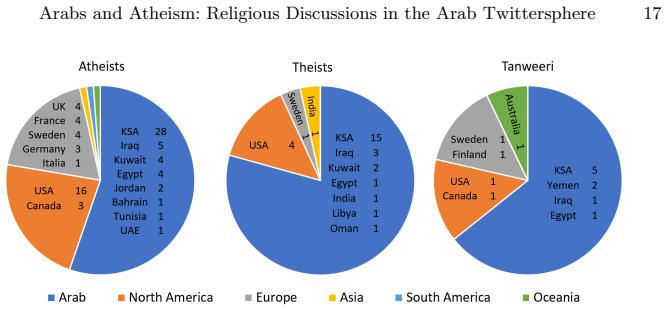
The authors collected tweets that interacted with 80 manually vetted Arab atheist accounts over four months, kept the 434 accounts that interacted more than 200 times, and assembled 1.3 million tweets from those timelines. Three native Arabic speakers labelled each account as atheistic (59% of the set), theistic (25%), tanweeri (9%), or other (7%). The central discovery is that the three main groups are distinct both in content and in social behaviour: atheists predominantly discuss science, evolution, leaving Islam, and campaigns such as dropping Saudi guardianship over women; theists, many of them based in Saudi Arabia, discuss Christianity, terrorism, and regional conflicts and are far more likely to retweet other theists than to retweet outsiders; tanweeris combine support for the Saudi government and crown prince with criticism of Islamist scholars and movements. The associated domain analysis shows the groups use different information ecosystems, from Islamic supplication auto-posts for theists to science, social-media, and human-rights sites for atheists.
Load-bearing premise
The analysis assumes that the 80 seed accounts and the more-than-200-interaction threshold capture a representative enough sample of the Arab Twitter discussion of atheism; if the seeds were one-sided or the threshold excluded significant strands of theists or reformists, the group proportions and topic profiles would shift.
Editorial extensions
If this is right
- Future studies can reuse the four labels as a starting taxonomy for Arab religious and non-religious discourse online.
- Theists' in-group retweeting combined with atheists being the most-mentioned accounts implies the discussion is best understood as several partially isolated publics, not one audience.
- Atheists' focus on women's rights and human-rights campaigns means research on Arab atheism should be tied to gender politics, not treated as purely theological.
- The different domain ecosystems indicate that the two sides receive news and information through separate channels, which may reinforce polarization.
- Given that open atheism is criminalized in some Arab countries, any replication must guard against re-identifying users; the paper's policy of not quoting tweets verbatim follows from that risk.
Reading between the lines
- This suggestion goes beyond the paper: the 59% atheist share is likely inflated by the atheist-only seed list; a theist- or tanweeri-seeded replication would test whether the four-group structure and proportions are stable.
- The lighter location disclosure among atheists hints that legal risk shapes self-censorship; tracking location-declaration rates over time could make that effect measurable.
- The alignment of topics on Saudi women's rights points to a testable extension: if the taxonomy is robust, the same four groups should predict positions on other regional debates such as normalization with Israel or religious-education reform.
Signed reviews
Editorial analysis
A structured set of objections, weighed in public.
Referee Report
Summary. The paper presents a descriptive, exploratory study of Arabic Twitter accounts engaged in discussions of atheism. The authors obtained 200 accounts from the Bridge Foundation, manually reduced these to 80 atheist seed accounts, collected tweets interacting with these seeds over four months, and retained 434 accounts that interacted more than 200 times with the seeds. Three native Arabic-speaking annotators labeled each account as atheistic, theistic, tanweeri, or other, with pairwise Cohen's kappa between 0.59 and 0.73. The paper then characterizes each group by frequent hashtags, shared web domains, and mention/reply/retweet networks. The central claims are that active Arab Twitter discourse about atheism is clustered into four meaningfully distinct groups and that these groups differ in topics, information sources, and interaction patterns, e.g., atheists emphasize women's rights while theists tend to retweet other theists.
Significance. If the findings hold, this is a valuable first descriptive map of an understudied and legally sensitive online community. The paper's strengths include the use of native Arabic-speaking annotators, a consistent category scheme tailored to the Islamic context, explicit attention to user privacy (translated rather than quoted tweets, anonymized network nodes), and a rich appendix of hashtag and domain frequencies. The topic and domain analyses offer a plausible, falsifiable profile of the four user groups, and the authors appropriately frame the study as a baseline for future work. The main risk is that the sample construction and annotation protocol are entangled with the network measures, and the group comparisons lack statistical support; these issues currently limit the strength of the paper's cross-group generalizations.
major comments (4)
- [Data Annotation; Network Interactions around Atheism] The network-behavior claim is partly circular. Annotators were instructed that judgments should be based 'both on the Twitter users' own tweets and on frequent retweets of a particular stance,' and the sample was selected from accounts that heavily interacted with atheist seed accounts. Under this rule, an account labeled theist because it frequently retweets theistic polemics will, by definition, have retweet edges to other theists. Therefore the observed same-group retweet clustering in Figure 3 is partly a re-statement of the labeling rule rather than independent behavioral evidence. Please repeat the network analysis using labels derived from content only (e.g., original tweets, excluding retweets and replies), or explicitly characterize how much of the homophily is attributable to the annotation protocol.
- [Distinctive Topic Discussion by Groups; Table 4] The group comparisons in the topic analysis lack statistical support. The text says a logistic regression with the top 50 hashtags was run, but Table 4 reports raw hashtag frequencies, not regression coefficients or weights. Because the group sizes differ (256 atheists, 109 theists, 39 tanweeris, 30 others) and activity levels vary, raw frequencies confound group membership with group size and posting volume. To support claims such as 'Atheists focus more on the rights of some groups,' please report user-level normalized rates (e.g., hashtag usage per account), significance tests with multiple-comparison correction, and effect sizes, or clearly state that only descriptive frequencies are being reported.
- [Data Collection] The sample construction rests on a single seed source and an arbitrary interaction threshold. The 80 seeds came from one non-profit organization and were manually vetted, and the 434 accounts are defined by retweeting, replying to, or mentioning the seeds more than 200 times. The paper calls these 'the most active users on the topic of atheism,' but no evidence is provided that this set saturates the discussion space or is representative of the broader Arab Twittersphere. Because the topic, domain, and network profiles all depend on this sample, please add a sensitivity analysis varying the interaction threshold, discuss how the single seed source could bias group composition, and soften generalizations from this sample to the Arab Twittersphere as a whole.
- [Data Annotation] Annotator agreement is moderate, with Cohen's kappa between 0.59 and 0.73 and the main confusion between 'Atheistic' and 'Tanweeri.' The paper does not report how the final labels for the initial 50 accounts were resolved (e.g., majority vote, adjudication, re-labeling after discussion), nor whether the remaining 383 accounts were each labeled by one annotator only. Since the four-group taxonomy is the foundation of all downstream analyses, this uncertainty is load-bearing. Please report per-label agreement, the resolution procedure, and the distribution of disagreements, and discuss how label noise could affect the topic and network profiles.
minor comments (7)
- [Abstract] The phrase 'Our findings have implication for the study' should be 'Our findings have implications for the study.'
- [Data Annotation] The bullet for the tanweeri category contains a stray space ('T anweeri') and the term is later written as 'Tanweeri' and 'Tanweeris'; please standardize the spelling throughout.
- [Network Interactions around Atheism] Figure 3 is referenced but the actual network plot is not visible in the manuscript text; please ensure the figure is included with a clear legend distinguishing the four groups and the interaction types.
- [Distinctive Topic Discussion by Groups] The text says logistic regression weights were used to identify distinctive hashtags, but Table 4 lists 'most frequent hashtags.' Clarify whether the table shows regression coefficients, ranked frequencies, or both, and if coefficients are available report them with confidence intervals.
- [Domains Analysis] Domain frequencies in Table 5 appear to be raw counts but it is unclear whether they are counts of tweets, per-user counts, or domain mentions; please specify the aggregation unit.
- [References] Reference [21] is listed as 'Schfer, S.' but the surname appears to be 'Schäfer' or 'Schaefer'; please correct the spelling.
- [Discussion, Conclusion and Future Work] Several general statements in the conclusion are not directly tied to a reported statistic, e.g., 'Tanweeris are less likely to be mentioned by atheists' and 'Most of the accounts with tanweeri contents are fans of this club.' Add the supporting numbers or mark these as impressionistic observations.
Circularity Check
Network findings partly repeat the annotation and sampling rules; topic and domain analyses are self-contained.
-
self definitional
[Data Annotation (p. 4) and Network Interactions around Atheism (p. 10, Fig. 3)]
"Judgements were based both on the Twitter users’ own tweets and on frequent retweets of a particular stance. ... Atheists are more likely to mention, reply and retweet to members from their groups. ... Arab Theists are more likely to retweet each other than to retweet other groups."
The four group labels were assigned partly from the stance of accounts a user frequently retweets. The network section then reports same-group retweet clustering as a behavioral finding. For accounts labelled because they frequently retweet theistic content, the observation that theists retweet theists is partly a restatement of the labelling rule rather than an independent measurement of homophily. The mention/reply results and the hashtag/domain profiles are less affected, because those signals were not part of the labelling definition.
-
other
[Data Collection (p. 4) and Network Interactions around Atheism (p. 10)]
"We used the Twitter streaming API to collect all the tweets that interacted with these accounts ... and limited our analysis to those 434 user accounts interacted with the seed accounts over 200 times, either by retweeting, replying, or mentioning them. ... Also, they are the most mentioned accounts by users of different beliefs."
The sampling criterion requires every account to have more than 200 interactions with the 80 atheist seed accounts. Atheist accounts are therefore guaranteed to be prominent mention, reply, and retweet targets in this sample. Reporting that atheists are the most mentioned accounts by users of different beliefs partly restates the inclusion criterion instead of being an independent network discovery. This does not invalidate the comparison of within-group homophily among non-seed accounts, but it weakens the 'most mentioned' claim.
full rationale
Most of the paper is a self-contained descriptive study. The four groups are produced by manual annotation of timelines, and the reported hashtag and domain profiles summarize those timelines; no fitted parameter is relabeled as a prediction, and no load-bearing result is imported from a same-author citation (the one self-citation, Magdy et al., appears only as background context). The two caveats are localized to the network claims. First, annotators were instructed to use frequent retweets of a stance when labelling accounts, so the later finding that theists retweet theists is partly a restatement of the labelling rule. Second, the sample was selected for more than 200 interactions with atheist seed accounts, so the statement that atheists are the most mentioned by other groups is partly built into the inclusion criterion. These issues do not infect the content analysis: hashtags and domains are outcomes of the labels rather than label inputs, and within-group retweet homophily among non-seed accounts retains some empirical content. Overall, the circularity burden is low and the core descriptive contribution stands.
Assumptions & free parameters
free parameters (2)
- Interaction threshold =
200 interactions over 4 months
- Number of hashtag features in logistic regression =
50
assumptions (4)
- domain assumption Bridge Foundation seed list is a valid starting point for locating Arab atheist discussion
- domain assumption Manual annotation of timelines reliably recovers true belief categories
- domain assumption Hashtags and domains are valid indicators of topics and information sources
- ad hoc to paper The greater-than-200 interaction threshold identifies the most active users discussing atheism
invented entities (1)
-
Tanweeri (religious reform) user category
independent evidence
Cite this review
Pith. "Pith review of Arabs and Atheism: Religious Discussions in the Arab Twittersphere." pith.science (2026). https://pith.science/paper/6V7SCDVH
@misc{pith2026190807811,
  author       = {Pith},
  title        = {Pith review of: Arabs and Atheism: Religious Discussions in the Arab Twittersphere},
  year         = {2026},
  howpublished = {\url{https://pith.science/paper/6V7SCDVH}},
  note         = {Machine review of arXiv:1908.07811}
}
read the original abstract
Most previous research on online discussions of atheism has focused on atheism within a Christian context. In contrast, discussions about atheism in the Arab world and from Islamic background are relatively poorly studied. An added complication is that open atheism is against the law in some Arab countries, which may further restrict atheist activity on social media. In this work, we explore atheistic discussion in the Arab Twittersphere. We identify four relevant categories of Twitter users according to the content they post: atheistic, theistic, tanweeri (religious renewal), and other. We characterise the typical content posted by these four sets of users and their social networks, paying particular attention to the topics discussed and the interaction among them. Our findings have implication for the study of religious and spiritual discourse on social media and provide a better cross-cultural understanding of relevant aspects.
Figures


Reference graph
Works this paper leans on
-
[1]
Albadi, N., Kurdi, M., Mishra, S.: Are they Our Brothers? Analy- sis and Detection of Religious Hate Speech in the Arabic Twitter- sphere. In: 2018 IEEE/ACM International Conference on Advances in So- cial Networks Analysis and Mining (ASONAM). pp. 69–76 (Aug 2018). https://doi.org/10.1109/ASONAM.2018.8508247
arXiv 2018
-
[2]
Awan, I.: Cyber-Extremism: ISIS and the Power of Social Media. Society 54(2), 138–149 (2017)
work page 2017
-
[3]
Banks, J.A.: Citizenship Education and Global Migration: Implications for Theory, Research, and Teaching. American Educational Research Association, Washington DC, USA (2017), https://books.google.co.uk/books?id=IYQwDwAAQBAJ
work page 2017
-
[4]
The New Republic 246(4), 24–31 (May 2015)
Benchemsi, A.: Invisible atheists.(freedom of speech and atheist views in Arab countries). The New Republic 246(4), 24–31 (May 2015)
work page 2015
-
[5]
(ed.): The desecularization of the world : resurgent religion and world politics
Berger, P.L. (ed.): The desecularization of the world : resurgent religion and world politics. Ethics and Public Policy Center, Washington, D.C. (1999)
work page 1999
-
[6]
(eds.): Being godless : ethnographies of atheism and non-religion
Blanes, R.L., Oustinova-Stjepanovic, G. (eds.): Being godless : ethnographies of atheism and non-religion. Berghahn Books, Incorporated, New York, NY (2017)
work page 2017
-
[7]
In: International Conference on Social Informatics
Chen, L., Weber, I., Okulicz-Kozaryn, A.: US religious landscape on Twitter. In: International Conference on Social Informatics. pp. 544–560. Springer (2014)
work page 2014
-
[8]
Oxford Research Encyclopedia of Communication (2017)
Croucher, S.M., Zeng, C., Rahmani, D., Sommier, M.: Religion, culture, and communication. Oxford Research Encyclopedia of Communication (2017). https://doi.org/10.1093/acrefore/9780190228613.013.166
arXiv 2017
Show all 25 references
-
[9]
Allen and Unwin (1976), https://books.google.co.uk/books?id=rFwVAAAAIAAJ
Durkheim, ´E.: The Elementary Forms of the Religious Life. Allen and Unwin (1976), https://books.google.co.uk/books?id=rFwVAAAAIAAJ
1976
-
[10]
Perspec- tives on Terrorism 9(3) (2015), http://www.terrorismanalysts.com/pt/index
Fisher, A.: How Jihadist Networks Maintain a Persistent Online Presence. Perspec- tives on Terrorism 9(3) (2015), http://www.terrorismanalysts.com/pt/index. php/pot/article/view/426
2015
-
[11]
The Guardian (London, England) (December 2014)
Kingsley, P.: Egypt has the highest number of atheists in the Arab world – 866; Figure is according to Dar al-Ifta, an official government wing, which says the number of atheists is a dangerous development. The Guardian (London, England) (December 2014)
2014
-
[12]
First Monday 21(2) (2016)
Magdy, W., Darwish, K., Weber, I.: FailedRevolutions: Using Twitter to study the antecedents of ISIS support. First Monday 21(2) (2016). https://doi.org/10.5210/fm.v21i2.6372
2016 doi
-
[13]
Mourtada, R., Salem, F.: Social Media in the Arab World: Influencing Societal and Cultural Change? Governance and Innovation Program, Dubai School of Govern- ment (01 2012)
2012
-
[14]
Nabeel, G.: Atheists in Muslim world: Growing silent minor- ity (2017), https://www.washingtontimes.com/news/2017/aug/1/ atheists-in-muslim-world-growing-silent-minority/
2017
-
[15]
Online: http://www.pewforum.org/2015/04/02/ religious-projection-table/2010/number/all/ (2015)
Pew Research Center’s Religion & Public Life Project: Religious composi- tion by country, 2010-2050. Online: http://www.pewforum.org/2015/04/02/ religious-projection-table/2010/number/all/ (2015)
2015
-
[16]
Quack, J., Schuh, C.: Conceptualising religious indifferences in relation to religion and nonreligion, pp. 1–23. Springer International Publishing (2017)
2017
-
[17]
Rees, J.: Religion and culture (2018), https://www.e-ir.info/2017/01/08/ religion-and-culture/
2018
-
[18]
Online: http://www
Religion & Public Life Project: Global religious diversity. Online: http://www. pewforum.org/2014/04/04/global-religious-diversity/ (2014) 14 Y. Al Hariri, W. Magdy and M. Wolters
2014
-
[19]
International Jour- nal of Intelligence and CounterIntelligence 28(2), 347–364 (2015)
Richey, M.K., Binz, M.: Open Source Collection Methods for Iden- tifying Radical Extremists Using Social Media. International Jour- nal of Intelligence and CounterIntelligence 28(2), 347–364 (2015). https://doi.org/10.1080/08850607.2014.962374, https://doi.org/10.1080/ 0885060...
2015
-
[20]
Social Psy- chological and Personality Science 5(2), 243–249 (2014)
Ritter, R.S., Preston, J.L., Hernandez, I.: Happy tweets: Christians are happier, more socially connected, and less analytical than atheists on Twitter. Social Psy- chological and Personality Science 5(2), 243–249 (2014)
2014
-
[21]
ASEAS - Austrian Journal of South-East Asian Studies 9(2), 253–268 (2016)
Schfer, S.: Forming ’forbidden’ identities online: Atheism in indonesia. ASEAS - Austrian Journal of South-East Asian Studies 9(2), 253–268 (2016)
2016
-
[22]
Kegan Paul International, London (1984)
Shahrastani, M.i..a.K.: Muslim sects and divisions : the section on Muslim sects in Kitab al- Milal Wa I-Nihal. Kegan Paul International, London (1984)
1984
-
[23]
Miller-McCune.com (2016)
Stuart, H.: The hard lives of non-believers in the middle east. Miller-McCune.com (2016)
2016
-
[24]
Society 50(2), 99 (2013)
The Global Religious Landscape: Social science and the public interest (brief arti- cle). Society 50(2), 99 (2013)
2013
-
[25]
We Are Social, Hootsuite, DataReportal: Most popular social net- works worldwide as of july 2019, ranked by number of active users (in millions). https://www.statista.com/statistics/272014/ global-social-networks-ranked-by-number-of-users/ (2019) Arabs and Atheism: Religious D...
2019
Reviewed August 14, 2026 · model on record in the stance chip above.
Discussion (0). Continue with ORCID to comment.