Coexistence of topologically nontrivial and trivial insulating states in topological Anderson Chern insulator
Pith reviewed 2026-06-28 11:30 UTC · model grok-4.3
The pith
Disorder drives the time-reversal-broken quantum spin Hall state of ferromagnetic MnBi4Te7 into a quantum anomalous Hall phase called topological Anderson Chern insulator.
A machine-rendered reading of the paper's core claim, the machinery that carries it, and where it could break.
Core claim
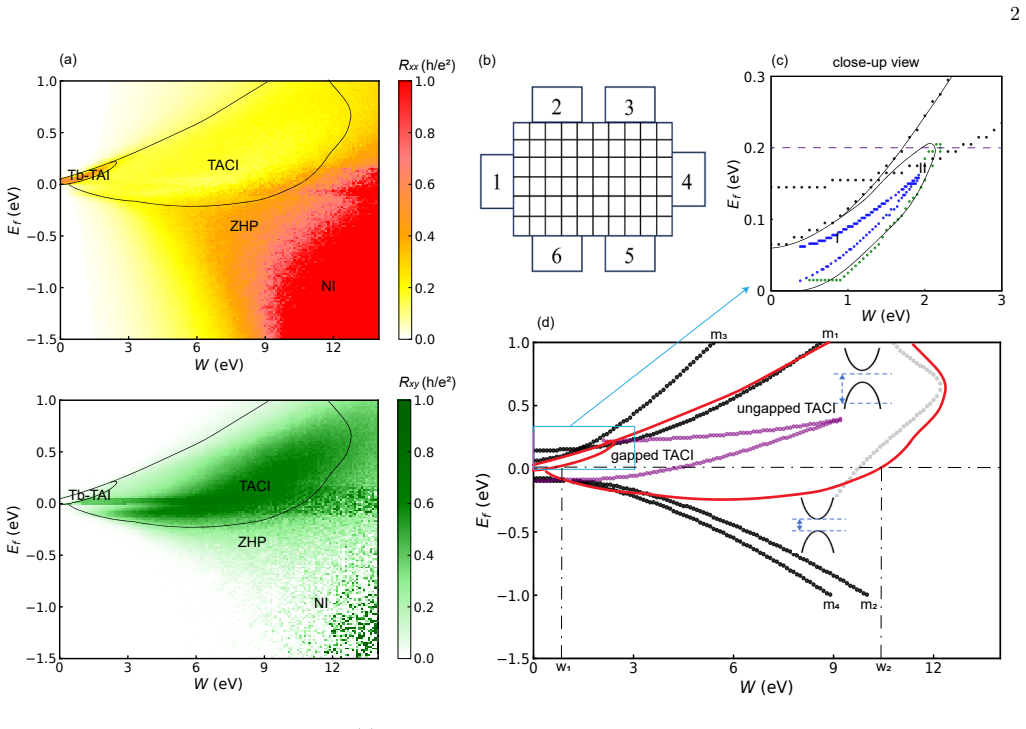
Disorder drives the clean-limit T-broken QSH state of FM monolayer MnBi4Te7 into a QAH phase (TACI) as the two effective band inversions are suppressed at distinct critical disorder strengths, with the survival of a single inversion stabilizing the TACI over a finite window; at strong disorder a zero Hall plateau insulating state coexists with the TACI, distinct from a conventional Chern insulator.
What carries the argument
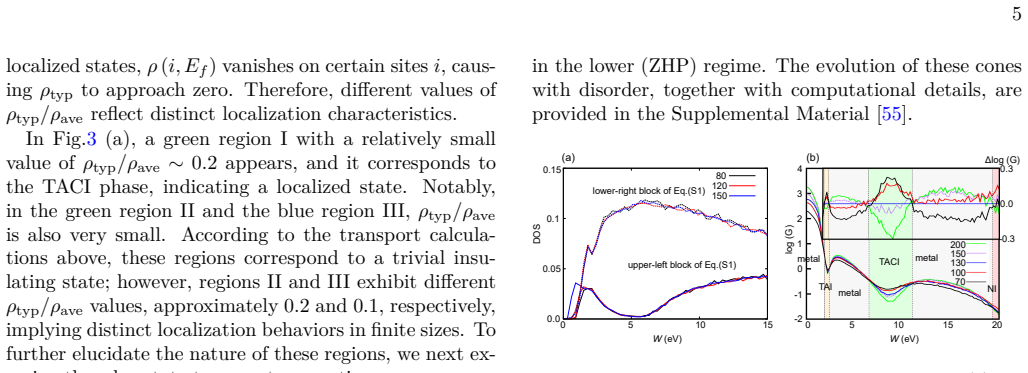
Topological Anderson Chern insulator (TACI) stabilized when one band inversion survives while the other is closed by disorder, identified by self-consistent Born approximation density of states that distinguishes gapped and ungapped phases.
Load-bearing premise
The self-consistent Born approximation within nonequilibrium Green's functions accurately distinguishes gapped from ungapped topological phases even in the strong disorder regime.
What would settle it
Transport measurement showing a finite disorder window with Hall conductance quantized at e²/h, followed by a higher-disorder regime with zero Hall conductance yet insulating bulk behavior.
Figures
read the original abstract
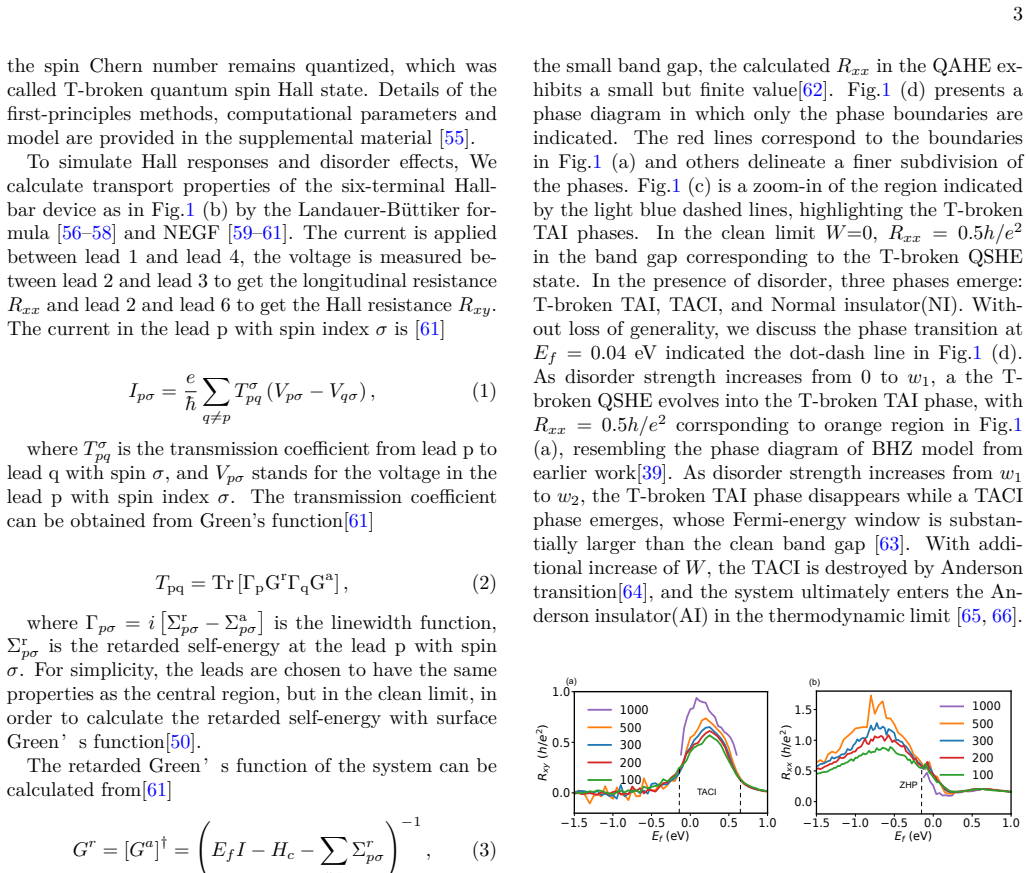
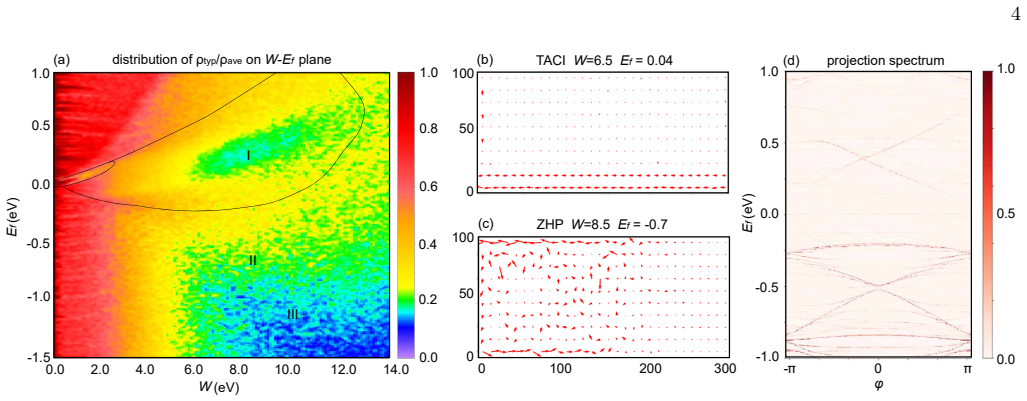
The interplay between disorder and topology has become a central theme in condensed matter physics. Disorder can not only destroy topological phases but also induce them, as exemplified by the topological Anderson insulator (TAI). Here we show that, in close analogy, disorder can drive the clean-limit, time-reversal-broken(T-broken) quantum spin Hall state of ferromagnetic(FM) monolayer MnBi4Te7 into a quantum anomalous Hall phase, which was called topological Anderson Chern insulator (TACI). Using density functional theory (DFT) and nonequilibrium Green's func tion (NEGF) calculations in the presence of disorder, we identify disorder induced phases-including T-broken TAI, TACI, Normal insulator, etc., then construct a comprehensive phase diagram. To discriminate multiple phases in the strong disorder regime, we further use the density of states computed within the self-consistent Born approximation (SCBA), which in particular distinguishes gapped and ungapped topological phases. We find that the two effective band inversions of Hamiltonian are suppressed at distinct critical disorder strengths; the survival of a single inversion over a finite disorder window stabilizes the TACI. Remarkably, at strong disorder, we further propose a zero Hall plateau insulating state characterized by an insulating bulk and edge channels subject to diffusive scattering that can coexist with the TACI. This behavior is distinct from a conventional band-gap Chern insulator and provides a clear experimental signature.
Editorial analysis
A structured set of objections, weighed in public.
Referee Report
Summary. The paper claims that disorder in ferromagnetic monolayer MnBi4Te7 drives the clean-limit time-reversal-broken quantum spin Hall state into a quantum anomalous Hall phase (topological Anderson Chern insulator, TACI) by suppressing two effective band inversions at distinct critical disorder strengths. Using DFT and NEGF calculations, it constructs a phase diagram including TACI, T-broken TAI, and normal insulator phases. At strong disorder, a zero Hall plateau insulating state (insulating bulk with diffusively scattered edge channels) is proposed to coexist with TACI, distinguished via SCBA-computed density of states that identifies gapped versus ungapped topological phases.
Significance. If the central claims hold, the work extends the topological Anderson insulator paradigm to time-reversal-broken Chern systems and identifies a disorder window stabilizing TACI via differential suppression of band inversions. The proposed coexistence of a zero-Hall-plateau state with TACI offers a distinct experimental signature. The methodological use of SCBA within NEGF to resolve multiple phases in the strong-disorder regime is noted, though its validity range requires explicit checks.
major comments (2)
- [Abstract; numerical methods (SCBA implementation)] Abstract and numerical methods section on SCBA: The identification of TACI (survival of a single band inversion over a finite disorder window) and the coexistence with the zero Hall plateau state rests exclusively on SCBA-derived density of states to locate gap closings and distinguish gapped/ungapped phases. SCBA is a second-order perturbative resummation whose validity requires the self-energy to remain small relative to the bandwidth; this condition is least secure precisely in the strong-disorder regime where the phase boundaries and coexistence are reported. No cross-check (exact diagonalization, kernel polynomial method, or finite-cluster transport) is described to confirm that the SCBA gap closings survive beyond the approximation.
- [Abstract] Abstract: The claim that the two effective band inversions are suppressed at distinct critical disorder strengths (stabilizing TACI) is determined solely from SCBA DOS features. Without an independent verification that SCBA accurately captures the disorder-driven gap closings in this regime, the reported finite disorder window for TACI and the subsequent zero-Hall state cannot be considered secured.
minor comments (2)
- Notation for the effective Hamiltonian and the two band inversions should be defined explicitly with equation numbers when first introduced, to allow readers to trace which inversion survives in the TACI window.
- Figure captions for the phase diagram should state the precise criterion (e.g., DOS threshold or Hall conductivity value) used to delineate each phase boundary.
Simulated Author's Rebuttal
We thank the referee for the careful reading of our manuscript and the constructive comments on the use of SCBA. We address each major comment below and agree that the manuscript requires revision to better contextualize the approximation's limitations.
read point-by-point responses
-
Referee: [Abstract; numerical methods (SCBA implementation)] Abstract and numerical methods section on SCBA: The identification of TACI (survival of a single band inversion over a finite disorder window) and the coexistence with the zero Hall plateau state rests exclusively on SCBA-derived density of states to locate gap closings and distinguish gapped/ungapped phases. SCBA is a second-order perturbative resummation whose validity requires the self-energy to remain small relative to the bandwidth; this condition is least secure precisely in the strong-disorder regime where the phase boundaries and coexistence are reported. No cross-check (exact diagonalization, kernel polynomial method, or finite-cluster transport) is described to confirm that the SCBA gap closings survive beyond the approximation.
Authors: We agree that SCBA is an approximation whose reliability is reduced in the strong-disorder regime and that the manuscript would benefit from explicit discussion of this point. The SCBA is used here within the NEGF framework solely to track the evolution of the density of states and locate the disorder strengths at which the two band inversions are suppressed; the underlying clean-limit band structure is obtained from DFT. In the revised version we will add a paragraph in the numerical methods section that (i) recalls the regime of validity of SCBA, (ii) cites its prior successful application to TAI problems, and (iii) states that the reported phase boundaries should be regarded as approximate. We will also note that a full non-perturbative verification lies beyond the present scope but would be a natural extension. revision: yes
-
Referee: [Abstract] Abstract: The claim that the two effective band inversions are suppressed at distinct critical disorder strengths (stabilizing TACI) is determined solely from SCBA DOS features. Without an independent verification that SCBA accurately captures the disorder-driven gap closings in this regime, the reported finite disorder window for TACI and the subsequent zero-Hall state cannot be considered secured.
Authors: The referee correctly notes that the finite disorder window for TACI is inferred from the SCBA density of states. The two distinct critical disorder strengths arise because the two effective band inversions (identified already in the clean DFT Hamiltonian) respond differently to the same disorder potential; SCBA then tracks when each inversion is lifted. We will revise the abstract and the relevant results section to make this dependence on the approximation explicit and to qualify the TACI window as approximate. This does not alter the qualitative picture but improves transparency. revision: yes
Circularity Check
No circularity: phase identification rests on independent numerical outputs
full rationale
The derivation chain relies on DFT band structures feeding into NEGF+SCBA computations of DOS and transport quantities to map phase boundaries. These are standard external approximations whose outputs are not defined in terms of the target TACI or zero-Hall states; the distinctions between gapped/ungapped phases and Hall plateaus emerge from the computed spectra rather than being presupposed by the method. No self-citation is invoked as a uniqueness theorem, no parameter is fitted to the final phase diagram, and no ansatz is smuggled via prior work. The central claims therefore remain falsifiable against the numerical data and do not reduce to their inputs by construction.
Axiom & Free-Parameter Ledger
axioms (2)
- domain assumption DFT provides an accurate clean-limit Hamiltonian for FM MnBi4Te7
- domain assumption NEGF combined with SCBA correctly captures disorder-induced topological transitions and density of states
Reference graph
Works this paper leans on
-
[1]
Quantized anoma- lous hall effect in two-dimensional ferromagnets: Quan- tum hall effect in metals
Masaru Onoda and Naoto Nagaosa. Quantized anoma- lous hall effect in two-dimensional ferromagnets: Quan- tum hall effect in metals. Phys. Rev. Lett. , 90:206601, May 2003
2003
-
[2]
Surface-quantized anomalous hall current and the magnetoelectric effect in magnetically disordered topological insulators
Kentaro Nomura and Naoto Nagaosa. Surface-quantized anomalous hall current and the magnetoelectric effect in magnetically disordered topological insulators. Phys. Rev. Lett., 106:166802, Apr 2011
2011
-
[3]
F. D. M. Haldane. Model for a quantum hall effect with- out landau levels: Condensed-matter realization of the ”parity anomaly” . Phys. Rev. Lett. , 61:2015–2018, Oct 1988
2015
-
[4]
MacDonald
Cui-Zu Chang, Chao-Xing Liu, and Allan H. MacDonald. Colloquium: Quantum anomalous hall effect. Rev. Mod. Phys., 95:011002, Jan 2023
2023
-
[5]
Quantized anomalous hall effect in magnetic topological insulators
Rui Yu, Wei Zhang, Hai-Jun Zhang, Shou-Cheng Zhang, Xi Dai, and Zhong Fang. Quantized anomalous hall effect in magnetic topological insulators. Science, 329(5987):61–64, 2010
2010
-
[6]
Experimental observation of the quan- tum anomalous hall effect in a magnetic topological in- sulator
Cui-Zu Chang, Jinsong Zhang, Xiao Feng, Jie Shen, Zuocheng Zhang, Minghua Guo, Kang Li, Yunbo Ou, Pang Wei, Li-Li Wang, Zhong-Qing Ji, Yang Feng, Shuai- hua Ji, Xi Chen, Jinfeng Jia, Xi Dai, Zhong Fang, Shou- Cheng Zhang, Ke He, Yayu Wang, Li Lu, Xu-Cun Ma, and Qi-Kun Xue. Experimental observation of the quan- tum anomalous hall effect in a magnetic topol...
2013
-
[7]
M. Mogi, R. Yoshimi, A. Tsukazaki, K. Yasuda, Y. Kozuka, K. S. Takahashi, M. Kawasaki, and Y. Tokura. Magnetic modulation doping in topological insulators toward higher-temperature quantum anoma- lous hall effect. Applied Physics Letters , 107(18):182401, 2015
2015
-
[8]
Topological axion states in the magnetic insulator mnbi 2te4 with the quantized magnetoelectric effect
Dongqin Zhang, Minji Shi, Tongshuai Zhu, Dingyu Xing, Haijun Zhang, and Jing Wang. Topological axion states in the magnetic insulator mnbi 2te4 with the quantized magnetoelectric effect. Phys. Rev. Lett., 122:206401, May 2019
2019
-
[9]
Intrinsic magnetic topological insulators in van der waals layered mnbi2te4-family materials
Jiaheng Li, Yang Li, Shiqiao Du, Zun Wang, Bing-Lin Gu, Shou-Cheng Zhang, Ke He, Wenhui Duan, and Yong Xu. Intrinsic magnetic topological insulators in van der waals layered mnbi2te4-family materials. Science Ad- vances, 5(6):eaaw5685, 2019
2019
-
[10]
Experimental realization of an intrinsic magnetic topological insulator
Yan Gong, Jingwen Guo, Jiaheng Li, Kejing Zhu, Meng- han Liao, Xiaozhi Liu, Qinghua Zhang, Lin Gu, Lin Tang, Xiao Feng, Ding Zhang, Wei Li, Canli Song, Lili Wang, Pu Yu, Xi Chen, Yayu Wang, Hong Yao, Wenhui Duan, Yong Xu, Shou-Cheng Zhang, Xucun Ma, Qi-Kun Xue, and Ke He. Experimental realization of an intrinsic magnetic topological insulator. Chinese Phy...
2019
-
[11]
Quantum anomalous hall effect in intrin- sic magnetic topological insulator mnbi 2te4
Yujun Deng, Yijun Yu, Meng Zhu Shi, Zhongxun Guo, Zihan Xu, Jing Wang, Xian Hui Chen, and Yuanbo Zhang. Quantum anomalous hall effect in intrin- sic magnetic topological insulator mnbi 2te4. Science, 367(6480):895–900, 2020
2020
-
[12]
M. M. Otrokov, I. I. Klimovskikh, H. Bentmann, et al. Prediction and observation of an antiferromagnetic topo- logical insulator. Nature, 576(7787):416–422, 2019
2019
-
[13]
Y. J. Chen, L. X. Xu, J. H. Li, Y. W. Li, H. Y. Wang, C. F. Zhang, H. Li, Y. Wu, A. J. Liang, C. Chen, S. W. Jung, C. Cacho, Y. H. Mao, S. Liu, M. X. Wang, Y. F. Guo, Y. Xu, Z. K. Liu, L. X. Yang, and Y. L. Chen. Topo- logical electronic structure and its temperature evolu- tion in antiferromagnetic topological insulator mnbi 2te4. Phys. Rev. X , 9:041040...
2019
-
[14]
High-chern- number and high-temperature quantum hall effect with- out landau levels
Jun Ge, Yanzhao Liu, Jiaheng Li, Hao Li, Tianchuang Luo, Yang Wu, Yong Xu, and Jian Wang. High-chern- number and high-temperature quantum hall effect with- out landau levels. National Science Review , 7(8):1280– 1287, 04 2020. 7
2020
-
[15]
Liu, J.-Q
C. Liu, J.-Q. Yan, M. M. Otrokov, D. K. Kim, H. C. Chuang, Z. H. Zhu, B. M. Hunt, M. A. Alwakeel, S. S. Tsirkin, P. M. Pérez, J. Qi, A. A. Soluyanov, E. V. Chulkov, R. R. Biswas, H. Bernien, M. Scharf, M. L. Tsai, N. A. Spaldin, C.-Z. Chang, J. Wang, A. H. MacDon- ald, and Y. Tokura. Robust axion insulator and chern insulator phases in a two‑dimensional a...
2020
-
[16]
C. Liu, Y. Wang, H. Li, et al. Robust axion insulator and Chern insulator phases in a two-dimensional anti- ferromagnetic topological insulator. Nature Materials , 19:522–527, 2020
2020
-
[17]
Yi‐Fan Zhao, Ling‐Jie Zhou, Fei Wang, Guang Wang, Tiancheng Song, Dmitry Ovchinnikov, Hemian Yi, Ruob- ing Mei, Ke Wang, Moses H. W. Chan, Chao‐Xing Liu, Xiaodong Xu, and Cui‑Zu Chang. Even ⚶odd layer‑dependent anomalous hall effect in topological mag- net MnBi2Te4 thin films. Nano Letters , 21(18):7691– 7698, 2021
2021
-
[18]
Y. Wang, B. Fu, Y. Wang, et al. Towards the quantized anomalous hall effect in AlO x-capped MnBi 2Te4. Nature Communications, 16:1727, 2025
2025
-
[19]
Z. Lian, Y. Wang, Y. Wang, et al. Antiferromagnetic quantum anomalous hall effect under spin flips and flops. Nature, 641:70–75, 2025
2025
-
[20]
Serlin, C
M. Serlin, C. L. Tschirhart, H. Polshyn, Y. Zhang, J. Zhu, K. Watanabe, T. Taniguchi, L. Balents, and A. F. Young. Intrinsic quantized anomalous hall effect in a moiré het- erostructure. Science, 367(6480):900–903, 2020
2020
-
[21]
Sharpe, Eli J
Guorui Chen, Aaron L. Sharpe, Eli J. Fox, Ya-Hui Zhang, Shaoxin Wang, Lili Lyu, Bo Sun, Hongyuan Li, Kenji Li, Takashi Watanabe, Takashi Taniguchi, Zhiwen Shi, T. Senthil, David Goldhaber-Gordon, Yuanbo Zhang, and Feng Wang. Tunable correlated chern insulator and ferromagnetism in a moiré superlattice. Nature, 579:56– 61, Mar 2020
2020
-
[22]
Quantum anomalous hall effect from intertwined moiré bands
Tong Li, Shengwei Jiang, Bo Shen, Yani Zhang, Lizhong Li, Tiancheng Song, Takashi Taniguchi, Kenji Watanabe, Jie Shan, and Kin Fai Mak. Quantum anomalous hall effect from intertwined moiré bands. Nature, 600:641– 646, Dec 2021
2021
-
[23]
Observation of a chern insu- lator in crystalline abca-tetralayer graphene with spin- orbit coupling
Yating Sha, Jian Zheng, Kai Liu, Hong Du, Kenji Watan- abe, Takashi Taniguchi, Jinfeng Jia, Zhiwen Shi, Ruidan Zhong, and Guorui Chen. Observation of a chern insu- lator in crystalline abca-tetralayer graphene with spin- orbit coupling. Science, 384(6694):414–419, 2024
2024
-
[24]
Large quantum anomalous hall effect in spin- orbit proximitized rhombohedral graphene
Tonghang Han, Zhengguang Lu, Yuxuan Yao, Jixi- ang Yang, Junseok Seo, Chiho Yoon, Kenji Watan- abe, Takashi Taniguchi, Liang Fu, Fan Zhang, and Long Ju. Large quantum anomalous hall effect in spin- orbit proximitized rhombohedral graphene. Science, 384(6696):647–651, 2024
2024
-
[25]
Klimovskikh, M.M
I.I. Klimovskikh, M.M. Otrokov, and D. Estyunin et al. Tunable 3d/2d magnetism in the (mnbi2te4)(bi2te3)m topological insulators family. npj Quantum Mater.5 , 54, 2020
2020
-
[26]
Aliev, Imamaddin R
Ziya S. Aliev, Imamaddin R. Amiraslanov, Daria I. Na- sonova, Andrei V. Shevelkov, Nadir A. Abdullayev, Za- kir A. Jahangirli, Elnur N. Orujlu, Mikhail M. Otrokov, Nazim T. Mamedov, Mahammad B. Babanly, and Evgueni V. Chulkov. Novel ternary layered manganese bismuth tellurides of the mnte-bi2te3 system: Synthesis and crystal structure. Journal of Alloys a...
2019
-
[27]
Schwier, Shiv Ku- mar, Hongyi Sun, Pengfei Liu, Kenya Shimada, Koji Miyamoto, Taichi Okuda, Kedong Wang, Maohai Xie, Chaoyu Chen, Qihang Liu, Chang Liu, and Yue Zhao
Xuefeng Wu, Jiayu Li, Xiao-Ming Ma, Yu Zhang, Yun- tian Liu, Chun-Sheng Zhou, Jifeng Shao, Qiaoming Wang, Yu-Jie Hao, Yue Feng, Eike F. Schwier, Shiv Ku- mar, Hongyi Sun, Pengfei Liu, Kenya Shimada, Koji Miyamoto, Taichi Okuda, Kedong Wang, Maohai Xie, Chaoyu Chen, Qihang Liu, Chang Liu, and Yue Zhao. Distinct topological surface states on the two termina...
2020
-
[28]
Vidal, Alexander Zeugner, Jorge I
Raphael C. Vidal, Alexander Zeugner, Jorge I. Fa- cio, Rajyavardhan Ray, M. Hossein Haghighi, Anja U. B. Wolter, Laura T. Corredor Bohorquez, Federico Caglieris, Simon Moser, Tim Figgemeier, Thiago R. F. Peixoto, Hari Babu Vasili, Manuel Valvidares, Sung- won Jung, Cephise Cacho, Alexey Alfonsov, Kavita Mehlawat, Vladislav Kataev, Christian Hess, Manuel R...
2019
-
[29]
Y. D. Guan, C. H. Yan, S. H. Lee, X. Gui, W. Ning, J. L. Ning, Y. L. Zhu, M. Kothakonda, C. Q. Xu, X. L. Ke, J. W. Sun, W. W. Xie, S. L. Yang, and Z. Q. Mao. Fer- romagnetic mnbi 4te7 obtained with low-concentration sb doping: A promising platform for exploring topological quantum states. Phys. Rev. Mater. , 6:054203, May 2022
2022
-
[30]
Rational design principles of the quan- tum anomalous hall effect in superlatticelike magnetic topological insulators
Hongyi Sun, Bowen Xia, Zhongjia Chen, Yingjie Zhang, Pengfei Liu, Qiushi Yao, Hong Tang, Yujun Zhao, Hu Xu, and Qihang Liu. Rational design principles of the quan- tum anomalous hall effect in superlatticelike magnetic topological insulators. Phys. Rev. Lett. , 123:096401, Aug 2019
2019
-
[31]
Sheng, Baigeng Wang, D
Yunyou Yang, Zhong Xu, L. Sheng, Baigeng Wang, D. Y. Xing, and D. N. Sheng. Time-reversal-symmetry-broken quantum spin hall effect. Phys. Rev. Lett. , 107:066602, Aug 2011
2011
-
[33]
P. M. Ostrovsky, I. V. Gornyi, and A. D. Mirlin. Quan- tum criticality and minimal conductivity in graphene with long-range disorder. Phys. Rev. Lett. , 98:256801, Jun 2007
2007
-
[34]
Topological insulators and super- conductors: tenfold way and dimensional hierarchy
Shinsei Ryu, Andreas P Schnyder, Akira Furusaki, and Andreas W W Ludwig. Topological insulators and super- conductors: tenfold way and dimensional hierarchy. New Journal of Physics , 12(6):065010, jun 2010
2010
-
[35]
Liang Fu and C. L. Kane. Topology, delocalization via average symmetry and the symplectic anderson transi- tion. Phys. Rev. Lett. , 109:246605, Dec 2012
2012
-
[36]
Anderson localization and the topology of clas- sifying spaces
Takahiro Morimoto, Akira Furusaki, and Christopher Mudry. Anderson localization and the topology of clas- sifying spaces. Phys. Rev. B , 91:235111, Jun 2015
2015
-
[37]
C. W. Groth, M. Wimmer, A. R. Akhmerov, J. Tworzydło, and C. W. J. Beenakker. Theory of the topological anderson insulator. Phys. Rev. Lett. , 103:196805, Nov 2009. 8
2009
-
[38]
Hua Jiang, Lei Wang, Qing-feng Sun, and X. C. Xie. Numerical study of the topological anderson insulator in hgte/cdte quantum wells. Phys. Rev. B , 80:165316, Oct 2009
2009
-
[39]
Jian Li, Rui-Lin Chu, J. K. Jain, and Shun-Qing Shen. Topological anderson insulator. Phys. Rev. Lett. , 102:136806, Apr 2009
2009
-
[40]
H.-M. Guo, G. Rosenberg, G. Refael, and M. Franz. Topological anderson insulator in three dimensions. Phys. Rev. Lett. , 105:216601, Nov 2010
2010
-
[41]
Juntao Song, Haiwen Liu, Hua Jiang, Qing-feng Sun, and X. C. Xie. Dependence of topological anderson insulator on the type of disorder. Phys. Rev. B , 85:195125, May 2012
2012
-
[42]
Localization and mobility gap in the topological anderson insulator
Yan-Yang Zhang, Rui-Lin Chu, Fu-Chun Zhang, and Shun-Qing Shen. Localization and mobility gap in the topological anderson insulator. Phys. Rev. B , 85:035107, Jan 2012
2012
-
[43]
Meier, Fangzhao Alex An, Alexandre Dauphin, Maria Maffei, Pietro Massignan, Taylor L
Eric J. Meier, Fangzhao Alex An, Alexandre Dauphin, Maria Maffei, Pietro Massignan, Taylor L. Hughes, and Bryce Gadway. Observation of the topological an- derson insulator in disordered atomic wires. Science, 362(6417):929–933, 2018
2018
-
[44]
Topological an- derson insulator in disordered photonic crystals
Gui-Geng Liu, Yihao Yang, Xin Ren, Haoran Xue, Xiao Lin, Yuan-Hang Hu, Hong-xiang Sun, Bo Peng, Peiheng Zhou, Yidong Chong, and Baile Zhang. Topological an- derson insulator in disordered photonic crystals. Phys. Rev. Lett., 125:133603, Sep 2020
2020
-
[45]
Re- alization of gapped and ungapped photonic topological anderson insulators
Mina Ren, Ye Yu, Bintao Wu, Xin Qi, Yiwei Wang, Xi- aogang Yao, Jie Ren, Zhiwei Guo, Haitao Jiang, Hong Chen, Xiong-Jun Liu, Zhigang Chen, and Yong Sun. Re- alization of gapped and ungapped photonic topological anderson insulators. Phys. Rev. Lett. , 132:066602, Feb 2024
2024
-
[46]
Topological anderson insulator in electric circuits
Zhi-Qiang Zhang, Bing-Lan Wu, Juntao Song, and Hua Jiang. Topological anderson insulator in electric circuits. Phys. Rev. B , 100:184202, Nov 2019
2019
-
[47]
D. A. Khudaiberdiev, Z. D. Kvon, M. S. Ryzhkov, D. A. Kozlov, N. N. Mikhailov, and A. Pimenov. Two- dimensional topological anderson insulator in a hgte- based semimetal. Phys. Rev. Res. , 7:L022033, May 2025
2025
-
[48]
Quantum anomalous hall ef- fect in hg 1−ymnyTe quantum wells
Chao-Xing Liu, Xiao-Liang Qi, Xi Dai, Zhong Fang, and Shou-Cheng Zhang. Quantum anomalous hall ef- fect in hg 1−ymnyTe quantum wells. Phys. Rev. Lett. , 101:146802, Oct 2008
2008
-
[49]
A vishai, and X
Ying Su, Y. A vishai, and X. R. Wang. Topological an- derson insulators in systems without time-reversal sym- metry. Phys. Rev. B , 93:214206, Jun 2016
2016
-
[50]
Takuya Okugawa, Peizhe Tang, Angel Rubio, and Dante M. Kennes. Topological phase transitions induced by disorder in magnetically doped (Bi, Sb)2te3 thin films. Phys. Rev. B , 102:201405, Nov 2020
2020
-
[51]
Evolution of berry curvature and reentrant quantum anomalous hall effect in an intrinsic magnetic topological insulator
Chui-Zhen Chen, Junjie Qi, Dong-Hui Xu, and XinCheng Xie. Evolution of berry curvature and reentrant quantum anomalous hall effect in an intrinsic magnetic topological insulator. Science China Physics, Mechanics & Astron- omy, 64(12):127211, 2021
2021
-
[52]
Yuanzhao Li, Yunhe Bai, Yang Feng, Jianli Luan, Zongwei Gao, Yang Chen, Yitian Tong, Ruixuan Liu, Su Kong Chong, Kang L. Wang, Xiaodong Zhou, Jian Shen, Jinsong Zhang, Yayu Wang, Chui-Zhen Chen, XinCheng Xie, Xiao Feng, Ke He, and Qi-Kun Xue. Reentrant quantum anomalous hall effect in molec- ular beam epitaxy-grown mnbi2te4 thin films, 2024. arXiv:2401.11...
-
[53]
C. L. Kane and E. J. Mele. Z2 topological order and the quantum spin hall effect. Phys. Rev. Lett. , 95:146802, Sep 2005
2005
-
[54]
Andrei Bernevig, Taylor L
B. Andrei Bernevig, Taylor L. Hughes, and Shou- Cheng Zhang. Quantum spin hall effect and topolog- ical phase transition in HgTe quantum wells. Science, 314(5806):1757–1761, 2006
2006
-
[55]
See Supplemental Material
-
[56]
Landauer
R. Landauer. Electrical resistance of disordered one-dimensional lattices. Philosophical Magazine , 21(172):863–867, 1970
1970
-
[57]
Büttiker
M. Büttiker. Absence of backscattering in the quan- tum hall effect in multiprobe conductors. Phys. Rev. B , 38:9375–9389, Nov 1988
1988
-
[58]
D. S. Fisher and P. A. Lee. Relation between con- ductivity and transmission matrix. Physical Review B , 23(12):6851–6854, 1981
1981
-
[59]
Wingreen, and Yigal Meir
Antti-Pekka Jauho, Ned S. Wingreen, and Yigal Meir. Time-dependent transport in interacting and nonin- teracting resonant-tunneling systems. Phys. Rev. B , 50:5528–5544, Aug 1994
1994
-
[60]
Wingreen
Yigal Meir and Ned S. Wingreen. Landauer formula for the current through an interacting electron region. Phys. Rev. Lett., 68:2512–2515, Apr 1992
1992
-
[61]
The non-equilibrium green function (negf) method
Kerem Yunus Camsari, Supriyo Chowdhury, and Supriyo Datta. The non-equilibrium green function (negf) method. arXiv:2008.01275 [cond-mat.mes-hall]
-
[62]
Chiral edge state coupling theory of transport in quan- tum anomalous hall insulators
Rui Chen, Hai-Peng Sun, Bin Zhou, and Dong-Hui Xu. Chiral edge state coupling theory of transport in quan- tum anomalous hall insulators. Science China Physics, Mechanics & Astronomy , 66:287211, 2023
2023
-
[63]
Zhi-Qiang Zhang, Chui-Zhen Chen, Yijia Wu, Hua Jiang, Junwei Liu, Qing-feng Sun, and X. C. Xie. Chiral inter- face states and related quantized transport in disordered chern insulators. Phys. Rev. B , 103:075434, Feb 2021
2021
-
[64]
Building programmable integrated circuits through disordered chern insulators
Bing-Lan Wu, Zi-Bo Wang, Zhi-Qiang Zhang, and Hua Jiang. Building programmable integrated circuits through disordered chern insulators. Phys. Rev. B , 104:195416, Nov 2021
2021
-
[65]
P. W. Anderson. Absence of diffusion in certain random lattices. Phys. Rev. , 109:1492–1505, Mar 1958
1958
-
[66]
Castro, M
Eduardo V. Castro, M. Pilar López-Sancho, and María A. H. Vozmediano. Anderson localization and topological transition in chern insulators. Phys. Rev. B , 92:085410, Aug 2015
2015
-
[67]
Cui-Zu Chang, Weiwei Zhao, Jian Li, J. K. Jain, Chaox- ing Liu, Jagadeesh S. Moodera, and Moses H. W. Chan. Observation of the quantum anomalous hall insulator to anderson insulator quantum phase transition and its scal- ing behavior. Phys. Rev. Lett. , 117:126802, Sep 2016
2016
-
[68]
Finite-size effects in the quantum anomalous hall system
Hua-Hua Fu, Jing-Tao Lü, and Jin-Hua Gao. Finite-size effects in the quantum anomalous hall system. Phys. Rev. B, 89:205431, May 2014
2014
-
[69]
Chui-Zhen Chen, Haiwen Liu, and X. C. Xie. Effects of random domains on the zero hall plateau in the quantum anomalous hall effect. Phys. Rev. Lett. , 122:026601, Jan 2019
2019
-
[70]
Magnetic-field-induced robust zero hall plateau state in mnbi2te4 chern insulator
Chang Liu, Yongchao Wang, Ming Yang, Jiahao Mao, Hao Li, Yaoxin Li, Jiaheng Li, Haipeng Zhu, Junfeng Wang, Liang Li, Yang Wu, Yong Xu, Jinsong Zhang, and Yayu Wang. Magnetic-field-induced robust zero hall plateau state in mnbi2te4 chern insulator. Nature Com- munications, 12:4647, 2021. 9
2021
-
[71]
Assun ç ao, Gerson J
Bryan D. Assun ç ao, Gerson J. Ferreira, and Caio H. Lewenkopf. Phase transitions and scale invariance in topological anderson insulators. Phys. Rev. B , 109:L201102, May 2024
2024
-
[72]
Chui-Zhen Chen, Juntao Song, Hua Jiang, Qing-feng Sun, Ziqiang Wang, and X. C. Xie. Disorder and metal- insulator transitions in weyl semimetals. Phys. Rev. Lett., 115:246603, Dec 2015
2015
-
[73]
Topological phase transitions in disordered electric quadrupole insulators
Chang-An Li, Bo Fu, Zi-Ang Hu, Jian Li, and Shun-Qing Shen. Topological phase transitions in disordered electric quadrupole insulators. Phys. Rev. Lett. , 125:166801, Oct 2020
2020
-
[74]
Dongwei Xu, Junjie Qi, Jie Liu, Vincent Sacksteder, X. C. Xie, and Hua Jiang. Phase structure of the topo- logical anderson insulator. Phys. Rev. B , 85:195140, May 2012
2012
-
[75]
Weak quantization of noninteracting topological anderson insulator
DinhDuy Vu and Sankar Das Sarma. Weak quantization of noninteracting topological anderson insulator. Phys. Rev. B , 106:134201, Oct 2022
2022
-
[76]
The kernel polynomial method
Alexander Weiße, Gerhard Wellein, Andreas Alvermann, and Holger Fehske. The kernel polynomial method. Rev. Mod. Phys. , 78:275–306, Mar 2006
2006
-
[77]
Algebraic and geometric mean density of states in topological anderson insulators
Yan-Yang Zhang and Shun-Qing Shen. Algebraic and geometric mean density of states in topological anderson insulators. Phys. Rev. B , 88:195145, Nov 2013
2013
-
[78]
Hailong Li, Chui-Zhen Chen, Hua Jiang, and X. C. Xie. Coexistence of quantum hall and quantum anomalous hall phases in disordered mnbi 2te4. Phys. Rev. Lett. , 127:236402, Dec 2021
2021
-
[79]
H.-M. Guo. Topological invariant in three-dimensional band insulators with disorder. Phys. Rev. B , 82:115122, Sep 2010
2010
-
[80]
Disorder dependence of helical edge states in hgte/cdte quantum wells
Liang Chen, Qin Liu, Xulin Lin, Xiaogang Zhang, and Xunya Jiang. Disorder dependence of helical edge states in hgte/cdte quantum wells. New Journal of Physics , 14(4):043028, apr 2012
2012
-
[81]
Sacksteder
Quansheng Wu, Liang Du, and Vincent E. Sacksteder. Robust topological insulator conduction under strong boundary disorder. Phys. Rev. B , 88:045429, Jul 2013
2013
discussion (0)
Sign in with ORCID, Apple, or X to comment. Anyone can read and Pith papers without signing in.