REVIEW 2 major objections 5 minor 38 references
CPA-laser effect and exceptional points in PT-symmetric multilayer structures
T0 review · 2 major / 5 minor · reviewed 2026-08-14 · deepseek-v4-flash
Pith's one-line read A PT-symmetric multilayer can switch between absorption and amplification at pump levels below the exceptional point, so the transition is interference, not lasing.
desk verdict A computational paper claiming the CPA-laser contrast peak sits below the EP; qualitatively plausible, but the 'well below' claim is fragile because the phase is not optimized and the EP threshold is imported. read the letter →
The pith
A machine-rendered reading of the paper's core claim, the machinery that carries it, and where it could break.
The reading
What carries the argument
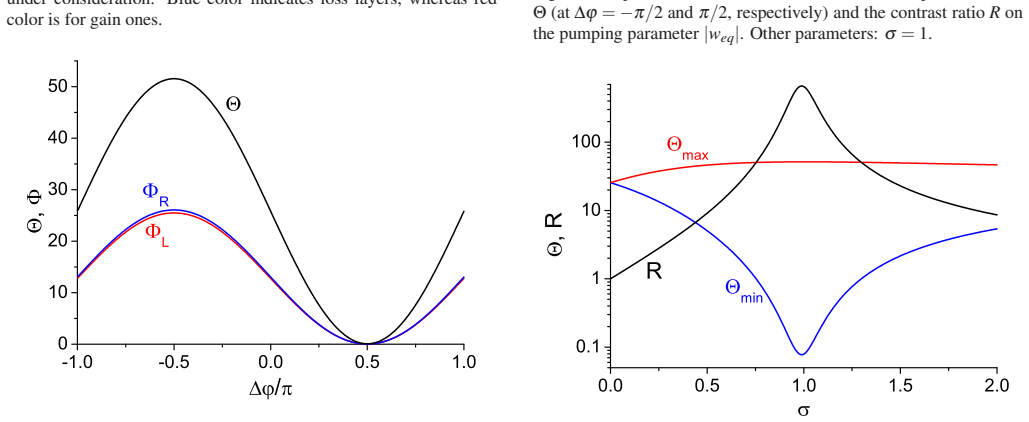
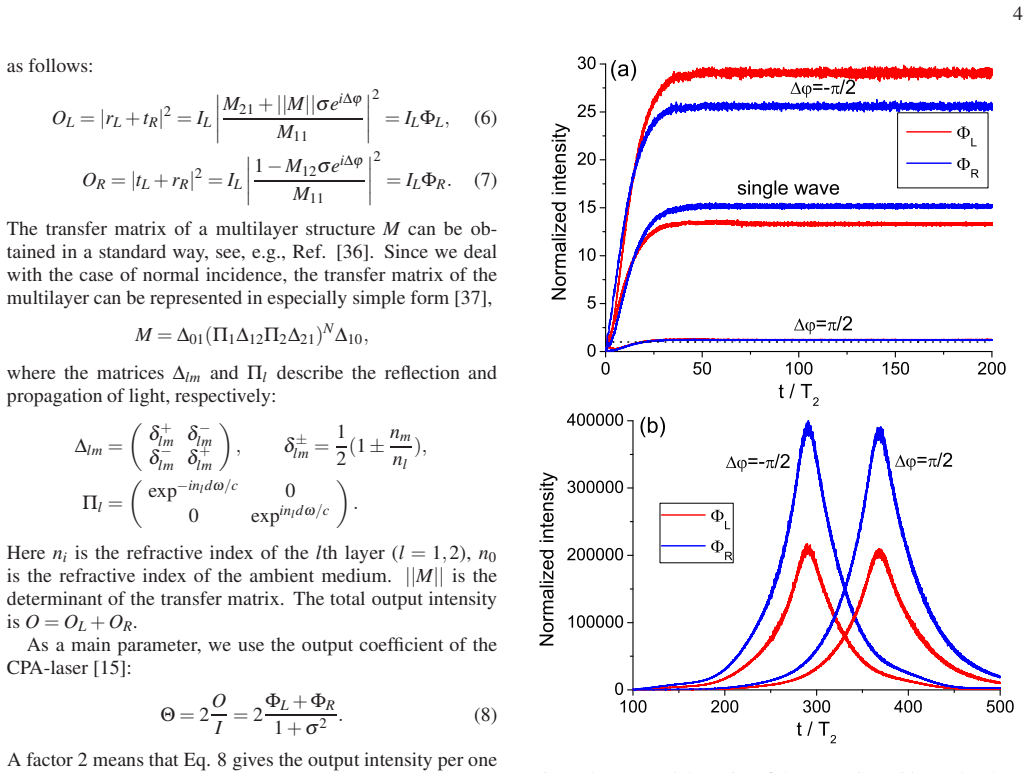
The load-bearing objects are the output coefficient $\Theta=2O/I$ and the contrast ratio $R=\Theta_{\max}/\Theta_{\min}$, computed for a $\mathcal{PT}$-symmetric multilayer of alternating loss and gain layers with effective permittivities $\varepsilon_{\mathrm{eff}\pm}=n_d^2 \pm 3i l^2\omega_L T_2|w_{eq}|$. Two counter-propagating input waves with amplitude ratio $\sigma$ and phase difference $\Delta\phi$ are combined through the transfer matrix $\mathbf{M}$ (built from interface and propagation matrices), giving $\Theta$ as a function of $\Delta\phi$. The physical mechanism is interference: changing $\Delta\phi$ from $\pi/2$ to $-\pi/2$ moves the intensity maxima from the loss layers (absorption) to the gain layers (amplification). The exceptional point, defined via the scattering matrix as adopted in the paper, marks the onset of $\mathcal{PT}$-symmetry breaking and, above it, genuine lasing; the paper's argument is that the contrast peak sits below that point. The Maxwell-Bloch equations with resonant two-level loss and gain provide the dynamical check that the stationary transfer-matrix picture captures the same peak location.
What would settle it
A scattering-matrix calculation of the exceptional point for the actual two-input geometry (equal amplitudes, variable $\Delta\phi$) would settle it: if the threshold moves down to $|w_{eq}|\lesssim 0.20$, the contrast peak is no longer below the exceptional point. A pump-probe experiment would also falsify the claim if genuine lasing—output independent of input amplitude and growing in time—is observed at pumping levels at or below $|w_{eq}|=0.2$ with the phase difference set to $\Delta\phi=-\pi/2$.
Extended reading notes
Core claim
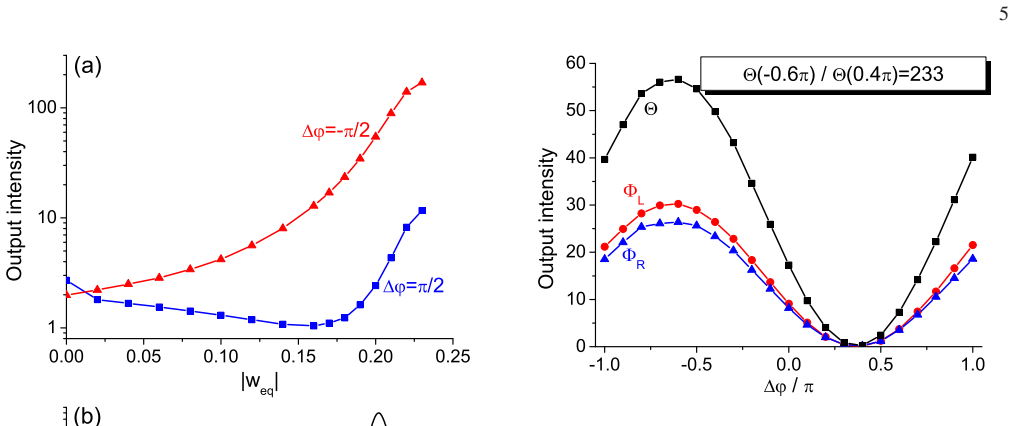
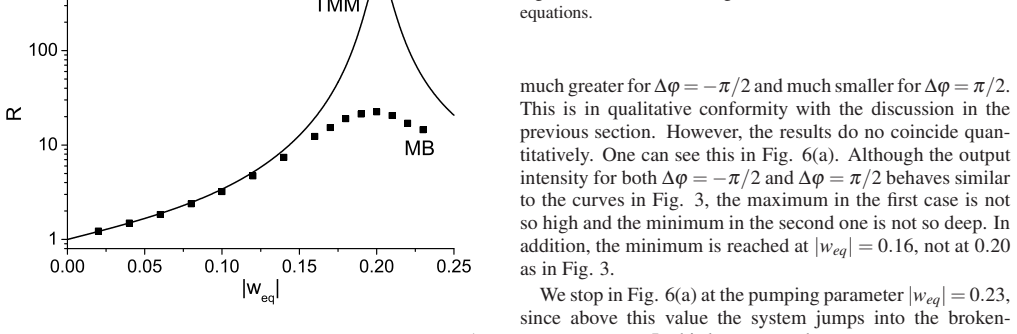
The paper's central claim is that the sharpest switch between the absorbing and amplifying responses of a two-input loss-gain multilayer is not a signature of $\mathcal{PT}$-symmetry breaking or lasing. For equal-amplitude counter-propagating waves ($\sigma=1$), the output coefficient $\Theta(\Delta\phi)$ is minimized at $\Delta\phi=\pi/2$ and maximized at $\Delta\phi=-\pi/2$, and the contrast ratio $R=\Theta_{\max}/\Theta_{\min}$ reaches its peak at $|w_{eq}|\approx 0.20$, while the exceptional point of the structure lies at $|w_{eq}|>0.22$. Both the transfer-matrix calculation and the full Maxwell-Bloch simulations place the contrast peak at the same pumping parameter, even though they disagree quantitatively ($R\approx 700$ versus about 22, or about 230 when the phase shift seen in the simulations is taken into account). Above the exceptional point, lasing sets in for any input phase and the input phase no longer controls the output level. The author concludes that the maximum absorption-amplification contrast corresponds to a CPA amplifier, not to a CPA laser.
Load-bearing premise
The load-bearing assumption is that the exceptional point at $|w_{eq}|>0.22$, taken from the earlier single-input study [24], remains the $\mathcal{PT}$-breaking threshold when two counter-propagating waves are present, since the paper does not recompute it for the two-beam geometry.
Editorial extensions
If this is right
- The absorber-amplifier switch can be operated below the lasing threshold, so the pump requirement for phase-controlled switching is set by the contrast resonance, not by $\mathcal{PT}$-symmetry breaking.
- Above the exceptional point, true lasing overrides the input phase and the useful switching window closes, bounding the practical operating range from above at $|w_{eq}|\approx 0.22$.
- The regime studied here is more accurately called a CPA amplifier than a CPA laser, since the maximal contrast involves no lasing per se.
- Changing the amplitude ratio $\sigma$ of the two inputs shifts the contrast peak relative to the exceptional point, providing a tuning parameter for where in pump space the switch operates.
- The qualitative result is robust across two very different computational models, since both locate the contrast peak at the same pumping value.
Reading between the lines
- If the exceptional point is recomputed for the two-input geometry and the threshold shifts appreciably, the paper's 'well below' conclusion could weaken; a two-beam exceptional-point calculation is the direct test.
- The same interference mechanism suggests that loss-gain stacks without exact $\mathcal{PT}$ symmetry could show similar phase-controlled absorption-amplification contrast, because the operative effect is field placement, not symmetry breaking.
- Because the contrast resonance is spectrally narrow, practical switching would require precise matching of wavelength and layer thickness; the Maxwell-Bloch results suggest saturation and discretization can lower the achievable contrast from hundreds to tens.
- A natural experimental extension is to measure the contrast ratio versus pump in a semiconductor quantum-dot-doped multilayer and check that the peak appears at a pump below the lasing threshold while spontaneous emission remains negligible.
Signed reviews
Editorial analysis
A structured set of objections, weighed in public.
Referee Report
Summary. Novitsky studies a PT-symmetric multilayer of 20 unit cells with balanced gain and loss, using both the transfer-matrix method (TMM) and numerical Maxwell-Bloch (MB) simulations. The response to two counter-propagating waves of equal amplitude is analyzed as a function of the phase difference Δφ and the pumping parameter |weq|. The output coefficient Θ(Δφ) and the contrast ratio R = Θ_max/Θ_min between maximum and minimum output are computed, and the paper's central claim is that the maximum contrast for equal-amplitude waves occurs at |weq| ≈ 0.20, below the exceptional point (EP) at |weq| ≈ 0.22. This is interpreted as a CPA-amplifier effect in the PT-symmetric phase rather than a manifestation of lasing; above the EP, lasing occurs irrespective of the input phases. Both methods agree qualitatively that the R peak is at |weq| ≈ 0.20, but the quantitative values differ substantially (TMM R ≈ 700, MB R ≈ 22, later revised to ≈ 230).
Significance. If the conclusion holds, the paper clarifies the long-standing question of how the CPA-laser effect relates to the exceptional point, and it provides a practical design rule: high-contrast phase-controlled switching can be achieved below the EP, without entering the lasing regime. The use of two independent computational methods (TMM and MB) and the explicit disclosure of quantitative discrepancies are strengths. The central prediction that the R peak lies below the EP is falsifiable experimentally with a side-pumped semiconductor multilayer. However, the quantitative agreement between methods is poor, and the conclusion is sensitive to how the phase extrema are defined; in particular, the MB data in Fig. 7 show that the extrema at |weq| = 0.20 occur at phases shifted from the fixed values used in the R curves, so the reported R peak position may not be the true phase-optimized contrast.
major comments (2)
- [Section IV, Eqs. (6)-(8), Figs. 6(b) and 7] The R(|weq|) curves in Fig. 6(b) are computed at fixed phase differences Δφ = −π/2 and +π/2, but for the Maxwell-Bloch simulations at |weq| = 0.20, Fig. 7 shows that the actual extrema occur at Δφ = 0.4π and −0.6π. The text states that using these shifted phases raises R from 22 to about 230, yet Fig. 6(b) and the subsequent conclusion still rely on the unshifted values. Since Eq. (8) yields Θ(Δφ) of the form C + 2|D|cos(Δφ + arg D), where arg D depends on the transfer-matrix elements and hence on |weq|, the fixed-phase curves may not represent the true maximal contrast at each pump level. If the phase of the extrema drifts with |weq|, the R peak at |weq| ≈ 0.20 could move toward or beyond the EP at 0.22. A phase-optimized scan of R(|weq|) (or an explicit demonstration that the phase of the extrema is pump-independent) is required to support the central claim.
- [Sections III and IV] The exceptional-point threshold |weq| ≈ 0.22 is imported from the prior single-input study [24] and is not recomputed for the two-input counter-propagating geometry used here. The central conclusion that the R peak at |weq| ≈ 0.20 lies 'well below' the EP depends on this threshold, and the margin is only about 2% in |weq|. The manuscript should either compute the EP directly from the scattering matrix used in Eqs. (6)-(8) (for example, from the coalescence of its eigenvalues) or explicitly justify that the EP is unchanged under two-beam illumination. This is load-bearing because the MB simulations alone only demonstrate a transition to pulsed output above |weq| = 0.23, which does not by itself fix the EP location precisely.
minor comments (5)
- [Abstract] The phrase 'the link between CPA lasing and PT symmetry breaking ... need clarification' should be 'needs clarification' to agree with the singular subject.
- [Fig. 3 caption] The caption 'at Δϕ = −π/2 and π/2, respectively' is ambiguous; it should specify that the maximum Θ corresponds to −π/2 and the minimum to π/2.
- [Section IV, Fig. 6(b)] The MB R values in Fig. 6(b) (R ≈ 22) are inconsistent with the text's later recalculation using the shifted phases (R ≈ 230); the figure should be updated or the text should clearly state that the figure uses fixed phases.
- [Section IV] The term 'broken-symmetry state' should be defined at first use, e.g., as the PT-broken phase above the exceptional point.
- [Section V] The phrase 'does not requires' in the conclusion is a typo and should read 'does not require'.
Circularity Check
No significant circularity: the central contrast-ratio result is a numerical observation, and the imported EP threshold is independent of the paper's fitted quantities.
full rationale
The paper's main claim is that the maximal contrast ratio R between absorption and amplification occurs at |weq| ≈ 0.20, below the exceptional point at |weq| > 0.22, and therefore does not require PT symmetry breaking or lasing. This claim is supported by direct transfer-matrix calculations using Eq. (5) and by Maxwell-Bloch simulations of Eqs. (1)-(3). The output coefficient Θ in Eq. (8) and contrast ratio R in Eq. (9) are computed from the transfer-matrix elements and field amplitudes; no parameter is fitted to the predicted R value, and the R peak is not introduced as an input. The EP threshold is imported from the author's prior work [24], which is a self-citation, but it is an independent numerical result obtained for the same structure and model under single-wave illumination, not a quantity fitted to the two-wave contrast data used here. The paper explicitly acknowledges the quantitative discrepancy between TMM and Maxwell-Bloch results and even notes that using the actual phase extrema from Fig. 7 raises R from about 22 to about 230, which shows that the discrepancy is not masked. The fixed-phase assumption in Figs. 3 and 6 is a potential correctness limitation, not a circularity, because the paper does not define the EP in terms of R or redefine the contrast ratio as the input. No derivation step reduces by construction to its own input, and no load-bearing conclusion depends solely on an unverified self-citation chain.
Assumptions & free parameters
free parameters (3)
- Operating wavelength lambda =
1.513 μm
- Layer thickness d and unit cells N =
d = 1 μm, N = 20
- MB input amplitude Omega_0 =
10^-5 gamma_2
assumptions (4)
- domain assumption Two-level medium description for both loss and gain with phenomenological pumping parameter weq
- domain assumption Low-intensity stationary approximation for permittivity, Eq. (4), valid at exact resonance delta = 0 and |Omega| much less than Omega_sat
- ad hoc to paper The EP definition follows Ge et al. (2012) and the EP threshold |weq| greater than 0.22 from prior work [24] remains valid in the two-input geometry
- ad hoc to paper Contrast ratio R = Theta_max / Theta_min evaluated at fixed phase differences Delta_phi = +/- pi/2 is the correct measure of the CPA-laser effect
Cite this review
Pith. "Pith review of CPA-laser effect and exceptional points in PT-symmetric multilayer structures." pith.science (2026). https://pith.science/paper/6WUBSONL
@misc{pith2026190804523,
  author       = {Pith},
  title        = {Pith review of: CPA-laser effect and exceptional points in PT-symmetric multilayer structures},
  year         = {2026},
  howpublished = {\url{https://pith.science/paper/6WUBSONL}},
  note         = {Machine review of arXiv:1908.04523}
}
read the original abstract
The simultaneous existence of coherent perfect absorption (CPA) and lasing is one of the most intriguing features of non-Hermitian photonics. However, the link between CPA lasing and PT symmetry breaking at the exceptional point (EP) needs clarification. In this paper, we study the manifestations of the CPA-laser effect in a PT-symmetric multilayer loss-gain structure using both the transfer-matrix method and numerical simulations of the Maxwell-Bloch equations. We show that the maximal contrast between absorption and amplification at different phase relations between the input waves is reached well below the EP and therefore is not connected to true lasing. In this regime, there is a good qualitative agreement between both computational approaches. Above the EP, the system demonstrates lasing regardless of the parameters of the input waves. Thus, the maximal contrast between the absorption and amplification rather corresponds to the CPA amplifier than to the CPA laser.
Figures

Figures from the paper (2 more)
Reference graph
Works this paper leans on
- [20]
-
[15]
J. Schindler, Z. Lin, J. M. Lee, H. Ramezani, F. M. Ellis, and T. Kottos, J. Phys. A 45, 444029 (2012)
work page 2012
-
[24]
M. Sakhdari, N. M. Estakhri, H. Bagci, and P .-Y . Chen, Ph ys. Rev. Appl. 10, 024030 (2018)
work page 2018
-
[1]
Photonics, Opto- and Microelectronics
are demonstrated in Fig. 3. Θ max increases with growing pump and reaches the maximum at |weq| ≈ 0.23 (just above the EP), whereas Θ min decreases, has the minimal value at |weq| ≈ 0.20 and then rapidly grows approaching the EP . As a result, the peak value of R (up to about 700) occurs at the same /s48 /s53/s48 /s49/s48/s48 /s49/s53/s48 /s50/s48/s48 /s48...
-
[2]
A. A. Zyablovsky, A. P . Vinogradov, A. A. Pukhov, A. V . Do- rofeenko, and A. A. Lisyansky, Phys. Usp. 57, 1063 (2014)
work page 2014
-
[3]
L. Feng, R. El-Ganainy, and L. Ge, Nat. Photon. 11, 752 (2017)
2017
-
[4]
R. El-Ganainy, K. G. Makris, M. Khajavikhan, Z. H. Mussli - mani, S. Rotter, and D. N. Christodoulides, Nat. Phys. 13, 11 (2018)
work page 2018
-
[5]
K. G. Makris, R. El-Ganainy, D. N. Christodoulides, and Z. H. Musslimani, Phys. Rev. Lett. 100, 103904 (2008)
work page 2008
Show all 38 references
-
[6]
L. Ge, Y . D. Chong, and A. D. Stone, Phys. Rev. A 85, 023802 (2012)
2012
-
[7]
Z. Lin, H. Ramezani, T. Eichelkraut, T. Kottos, H. Cao, an d D. N. Christodoulides, Phys. Rev. Lett. 106, 213901 (2011)
2011
-
[8]
Fleury, D
R. Fleury, D. L. Sounas, and A. Al` u, Phys. Rev. Lett. 113, 023903 (2014)
2014
-
[9]
Weimann, M
S. Weimann, M. Kremer, Y . Plotnik, Y . Lumer, S. Nolte, K. G. Makris, M. Segev, M. C. Rechtsman, and A. Szameit, Nat. Mater .16, 433 (2017)
2017
-
[10]
Goldzak, A
T. Goldzak, A. A. Mailybaev, and N. Moiseyev, Phys. Rev. Lett. 120, 013901 (2018)
2018
-
[11]
Ramezani, D
H. Ramezani, D. N. Christodoulides, V . Kovanis, I. Vite bskiy, and T. Kottos, Phys. Rev. Lett. 109, 033902 (2012)
2012
-
[12]
S. Wang, B. Wang, and P . Lu, Phys. Rev. A 98, 043832 (2018)
2018
-
[13]
Y . D. Chong, L. Ge, H. Cao, and A. D. Stone, Phys. Rev. Lett . 105, 053901 (2010)
2010
-
[14]
Longhi, Phys
S. Longhi, Phys. Rev. A 82, 031801(R) (2010)
2010
-
[16]
Z. J. Wong, Y .-L. Xu, J. Kim, K. O’Brien, Y . Wang, L. Feng, and X. Zhang, Nat. Photon. 10, 796 (2016)
2016
-
[17]
Longhi, Opt
S. Longhi, Opt. Lett. 39, 5026 (2014)
2014
-
[18]
B. Baum, H. Alaeian, and J. Dionne, J. Appl. Phys. 117, 063106 (2015)
2015
-
[19]
Y . Sun, W. Tan, H. Q. Li, J. Li, and H. Chen, Phys. Rev. Lett . 112, 143903 (2014)
2014
-
[21]
Y . D. Chong, L. Ge, and A. D. Stone, Phys. Rev. Lett. 106, 093902 (2011)
2011
-
[22]
P . Bai, K. Ding, G. Wang, J. Luo, Z.-Q. Zhang, C. T. Chan, Y . Wu, and Y . Lai, Phys. Rev. A94, 063841 (2016)
2016
-
[23]
Y . Fu, Y . Cao, S. A. Cummer, Y . Xu, and H. Chen, Phys. Rev. A 96, 043838 (2017)
2017
-
[25]
D. V . Novitsky, A. Karabchevsky, A. V . Lavrinenko, A. S. Shalin, and A. V . Novitsky, Phys. Rev. B 98, 125102 (2018)
2018
-
[26]
D. V . Novitsky, Phys. Rev. A 84, 013817 (2011)
2011
-
[27]
M. E. Crenshaw, Phys. Rev. A 78, 053827 (2008)
2008
-
[28]
Bloembergen, Nonlinear Optics (Benjamin, New Y ork, 1965)
N. Bloembergen, Nonlinear Optics (Benjamin, New Y ork, 1965)
1965
-
[29]
D. V . Novitsky, V . R. Tuz, S. L. Prosvirnin, A. V . Lavrine nko, and A. V . Novitsky, Phys. Rev. B96, 235129 (2017)
2017
-
[30]
Svelto, Principles of Lasers , 1st ed
O. Svelto, Principles of Lasers , 1st ed. (Springer, New Y ork, 1976)
1976
-
[31]
A. V . Dorofeenko, A. A. Zyablovsky, A. A. Pukhov, A. A. Lisyansky, and A. P . Vinogradov, Phys. Usp. 55, 1080 (2012)
2012
-
[32]
Harayama, S
T. Harayama, S. Sunada, and K. S. Ikeda, Phys. Rev. A 72, 013803 (2005)
2005
-
[33]
D. V . Novitsky, Phys. Rev. A 79, 023828 (2009)
2009
-
[34]
E. D. Palik (ed.), Handbook of Optical Constants of Solids (Academic Press, San Diego, 1998)
1998
-
[35]
Diels and W
J.-C. Diels and W. Rudolph, Ultrashort Laser Pulse Phenom- ena, 2nd ed. (Academic Press, San Diego, 2006)
2006
-
[36]
V . E. Babicheva, I. V . Kulkova, R. Malureanu, K. Yvind, a nd A. V . Lavrinenko, Photon. Nanostruct. – Fund. Appl. 10, 389 (2012)
2012
-
[37]
Born and E
M. Born and E. Wolf, Principles of Optics , 7th ed. (Cambridge University Press, Cambridge, 1999)
1999
-
[38]
D. V . Novitsky and S. Y u. Mikhnevich, J. Opt. Soc. Am. B 25, 1362 (2008)
2008
Reviewed August 14, 2026 · model on record in the stance chip above.
Discussion (0). Continue with ORCID to comment.