REVIEW 3 major objections 5 minor 8 references
Singularities and Genus of the k-Ellipse
T0 review · 3 major / 5 minor · reviewed 2026-08-14 · deepseek-v4-flash
Pith's one-line read The singularities and genus of a generic algebraic k-ellipse are now determined by closed-form formulas.
desk verdict A serious paper that likely solves the open k-ellipse genus question, but the proof leans on unproven genericity assumptions that need to be made explicit before the result is fully rigorous. read the letter →
The pith
A machine-rendered reading of the paper's core claim, the machinery that carries it, and where it could break.
The reading
What carries the argument
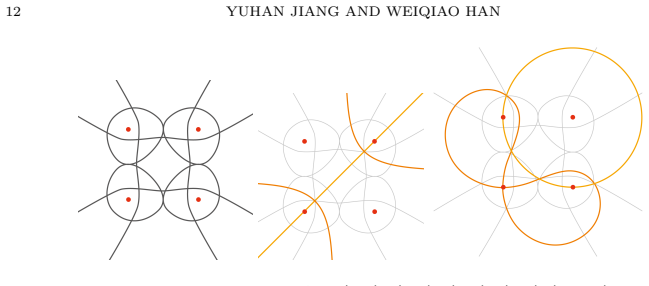
Two mechanisms carry the argument. The product formula $q_k(x,y,z)=\prod_{\sigma\in\{\pm1\}^k}\bigl(rz-\sum_{i=1}^k\sigma_i\sqrt{(x-u_i z)^2+(y-v_i z)^2}\bigr)$, with the even-$k$ normalization $p_k=z^{-\binom{k}{k/2}}q_k$, organizes the curve into sheets indexed by sign vectors. The second is the theorem that affine singularities are precisely intersections of a degenerate $j$-ellipse with a $(k-j)$-ellipse; counting those intersections with the classical multiplicity theorem, after subtracting the contributions of the two points at infinity, gives the number of nodes. At infinity, local power-series parametrizations show that each tangent line at $[\pm i:1:0]$ belongs to two branches forming an ordinary cusp, so the point is a bouquet of cusps with distinct tangents; this determines its delta invariant and completes the genus computation.
What would settle it
Take an explicit generic configuration for $k=7$, resolve all its singularities by direct local computation, and compare: the paper predicts 3808 ordinary nodes, two points at infinity of multiplicity 64, and genus 161. Any mismatch—or any concrete configuration where the genericity assumptions fail—would settle whether the formulas are correct.
Extended reading notes
Core claim
The central discovery is a complete description of the singular locus of a generic algebraic $k$-ellipse. In the affine plane, every singularity arises as an intersection of a degenerate $j$-ellipse (radius zero) on one subset of the foci with a $(k-j)$-ellipse on the complementary subset, for some $2\le j\le k-1$; generically these intersections are ordinary nodes, and their number is $2^{2k-2}-(k+2)2^{k-2}$ when $k$ is odd and $2^{2k-2}-(k+2)2^{k-2}-\binom{k}{k/2}\bigl(\binom{k-1}{k/2}-1\bigr)$ when $k$ is even. At infinity the only singular points are $[i:1:0]$ and $[-i:1:0]$, with multiplicity $2^{k-1}$ (odd $k$) or $2^{k-1}-\binom{k}{k/2}$ (even $k$); locally the curve is a bouquet of ordinary cusps with distinct tangents, so the number of local branches is half the multiplicity and no infinitely near singularities occur. The degree-genus formula then yields $g_k=(k-2)2^{k-2}+1$ for odd $k>3$ and $g_k=(k-2)2^{k-2}-\binom{k-1}{k/2}+1$ for even $k$. The dual curve has degree $(k+1)2^{k-1}$ for odd $k$ and $(k+1)2^{k-1}-2\binom{k}{k/2}$ for even $k$.
Load-bearing premise
The formulas hold only under the paper's genericity assumptions—distinct tangent lines at the two points at infinity, a nonzero leading power-series coefficient at each tangent, irreducibility of the auxiliary polynomials that detect affine singularities, and no reducible focus-conic through certain intersections—and the paper asserts, rather than proves for each $k$, that the configurations satisfying them form a nonempty Zariski-open set.
Editorial extensions
If this is right
- For odd $k>3$, every generic algebraic $k$-ellipse has genus $(k-2)2^{k-2}+1$; for $k=5$ this is 25, matching the previously known value.
- For even $k$, the genus is $(k-2)2^{k-2}-\binom{k-1}{k/2}+1$, which gives 6 for $k=4$ and 55 for $k=6$.
- All affine singularities are ordinary nodes with delta invariant 1, so the genus is fully accounted for by the node count plus the delta invariant of the two points at infinity.
- The dual-degree formulas also give the algebraic degree of the semidefinite representation of the $k$-ellipse, so they fix the exact algebraic complexity of the associated convex optimization problem.
- The explicit singular locus makes the adjoint series and canonical model of a $k$-ellipse computable, opening the way to studying these curves in moduli space.
Reading between the lines
- The same subset-counting mechanism suggests an explicit formula for the number of real affine nodes of a real generic $k$-ellipse: one would count real points among the complex intersections of a degenerate $j$-ellipse and a $(k-j)$-ellipse. The paper does not perform this real count.
- Because the dual degree equals the algebraic degree of the semidefinite representation, these formulas give optimization theory an exact critical-point count: a generic interior-point path on a $k$-ellipse instance should encounter exactly that many complex solutions. This interpretation is not developed in the paper.
- For $k=3$, the genus formula and the six-dimensional parameter space of 3-ellipses up to projective transformation suggest a possible dominance question: whether every smooth quartic is the canonical model of some 3-ellipse. The paper raises this as future work rather than a claim.
Signed reviews
Editorial analysis
A structured set of objections, weighed in public.
Referee Report
Summary. The paper studies the Zariski closure in CP^2 of the k-ellipse, the set of points whose distances from k fixed foci sum to a constant r. Using the determinantal representation of Nie--Parrilo--Sturmfels, the authors prove three main claims: Theorem 4 gives the genus g_k = (k-2)2^{k-2}+1 for odd k (k>3) and g_k = (k-2)2^{k-2} - C(k-1,k/2)+1 for even k; Theorem 5 states that all singularities are nodal except at P=[±i:1:0], where the multiplicity is twice the number of local branches; and Theorem 6 gives the dual degree d^vee_k = (k+1)2^{k-1} for odd k and d^vee_k = (k+1)2^{k-1} - 2 C(k,k/2) for even k. The core argument is a singularity analysis at infinity in Section 3, via Puiseux series, and a classification of affine singularities in Section 4 as intersections of degenerate j-ellipses with (k-j)-ellipses. The genus formula then follows from Noether's formula using the affine nodal count of Proposition 23 and the delta-invariant at infinity.
Significance. If the theorems are correct, they resolve the open problem posed by Nie, Parrilo, and Sturmfels in 2008 and give a complete description of the singular locus of the algebraic k-ellipse. The formulas reproduce the known values for k=1,...,6 and are derived from singularity counts and standard Noether/Bezout input, with no fitted parameters. The geometric characterization of affine singularities via degenerate ellipses is appealing and likely to be useful for further adjoint and canonical-model computations. The dual-degree formula also has a natural connection to the algebraic degree of the semidefinite representation. However, the paper currently leaves a central genericity hypothesis unproved, so the results are conditional on a nonempty Zariski open locus that is never delimited. This is a load-bearing gap rather than a presentation issue.
major comments (3)
- [§1, Propositions 14-15, Theorem 21, Proposition 23] The introduction asserts that the set of generic k-ellipses is a nonempty Zariski open set, but the paper never proves this or gives defining equations for the complement. The proof uses at least five separate generic assumptions: distinct tangent lines at [±i:1:0] in Proposition 14; nonzero coefficient a10 in the Puiseux expansion for every tangent in Proposition 15; irreducibility of the polynomials ~fx and ~fy so that V(~fx,~fy) is finite in Theorem 21; absence of a reducible conic (x-u_i z)^2+(y-v_i z)^2 through any intersection counted in Proposition 23; and nonsingularity of the extra even-k points at infinity. Since the nodal count of Proposition 23 and the delta-invariant at infinity feed directly into Theorem 4, the genus and dual-degree formulas remain conditional until the simultaneous generic locus is proved nonempty. I ask for a proof, either by exhibiting explicit inequalities defining a nonempty open set or by a dimension argument showing that the excluded loci are proper Zariski closed.
- [Proposition 15] In the Puiseux analysis proving r_P = m_P/2, the case m = 1/2 is handled by writing 'we set d20 = r^2'. This appears to choose the leading coefficient of x2 to force cancellation rather than showing that the generic assumptions imply such a solution exists. One needs to justify, for each of the m_P/2 tangents, that the Newton polygon admits a solution with the required leading term and that the resulting branches are distinct. Because the equality r_P = m_P/2 is used in Theorem 5 and in the dual-degree computation of Theorem 6, this step needs a complete argument.
- [Theorem 21] The converse direction of the affine singularity classification relies on the assertion that ~fx and ~fy are irreducible, justified by 'no proper subproduct of the right hand side lies in the ground field K'. This is a genericity statement of exactly the type that the paper needs to prove, and it is used to conclude that V(~fx,~fy) is finite. In addition, the exclusion of the case j=1 ends with the implication u_k = ± i v_k and the statement that p = [±i:1:0]; the displayed equation only shows that the z-derivative vanishes, and the reader needs the corresponding x- and y-derivative equations to rule out other points on the (k-1)-ellipse.
minor comments (5)
- [§2] There is a typo in the phrase 'tanget cone'; it should be 'tangent cone'.
- [Example 7] The sentence 'has 8 singularities' is ambiguous about whether singular points are counted with or without multiplicity; since [±i:1:0] each have multiplicity 4, please state the convention.
- [§5, Definition 24] The displayed definition of E_k^circ mixes the curve variables (x,y) with the polar variables (w1,w2) and is not a set in (w1,w2) as written; existential quantification over x,y should be made explicit.
- [Corollary 19 and Proposition 23] The symbols d_k and m_k are used without formal definition; they should be defined as the degree and the multiplicity at [±i:1:0] of the algebraic k-ellipse.
- [Proposition 13] In the even-k case, the phrase 'points in quadratic extensions of K' should be made precise; the points lie in extensions of the function field after adjoining the square root of r^2(x^2+y^2)-(x sum sigma_i u_i + y sum sigma_i v_i)^2.
Circularity Check
No circularity: the genus and dual-degree formulas are derived from external determinantal input, explicit singularity counts, and standard Noether/Plücker relations, with no fitted constants or self-citations.
full rationale
The derivation chain for the genus (Theorem 4) is self-contained relative to its stated inputs. The degree of the algebraic k-ellipse is taken from the external result [4, Theorem 1.1] by Nie, Parrilo, and Sturmfels; this is not a self-citation and does not already contain the genus. The affine singularity count (Proposition 23) is a Bézout count of intersections of degenerate j-ellipses with (k−j)-ellipses, with the explicit subtraction of the contribution at [±i:1:0]. The contribution at infinity (Propositions 13–16) is computed directly from the tangent cone and Puiseux parametrizations, and the delta invariant at P is obtained from the standard blow-up formula (Theorem 10). Noether's formula (Theorem 9) then combines these independent counts to produce g_k. The dual-degree formula (Theorem 6) is derived from the already-proved genus, the degree, and the standard relation d∨ − 2g = 2(d−1) − Σ(mP−rP), not from a fitted parameter or from the claimed conclusion. The paper's 'generic' hypotheses (distinct tangent lines at [±i:1:0], a10≠0, irreducibility of ~fx and ~fy, and absence of reducible conics at counted intersections) are explicit assumptions rather than hidden restatements of the target formulas; whether their union is always a nonempty Zariski open set is a correctness/genericity gap, not circularity. There are no self-citations by the authors, and no load-bearing step reduces by construction to the claimed genus or dual degree. Accordingly, the paper merits a circularity score of 0.
Assumptions & free parameters
assumptions (4)
- domain assumption Determinantal representation and degree formula for p_k from [4]
- standard math Noether's formula g = (d-1 choose 2) - sum_P delta_P
- standard math Delta invariant via blow-up: delta_P = sum C(m_Q,2) over infinitely near points
- ad hoc to paper Generic position conditions: distinct tangent lines at [±i:1:0], a10 != 0 for each tangent, irreducibility of ~fx and ~fy, no reducible conics through intersection points, nonemptiness of the generic locus
Cite this review
Pith. "Pith review of Singularities and Genus of the k-Ellipse." pith.science (2026). https://pith.science/paper/6WWVFWV3
@misc{pith2026190801414,
  author       = {Pith},
  title        = {Pith review of: Singularities and Genus of the k-Ellipse},
  year         = {2026},
  howpublished = {\url{https://pith.science/paper/6WWVFWV3}},
  note         = {Machine review of arXiv:1908.01414}
}
read the original abstract
A k-ellipse is a plane curve consisting of all points whose distances from k fixed foci sum to a constant. We determine the singularities and genus of its Zariski closure in the complex projective plane. The paper resolves an open problem stated by Nie, Parrilo and Sturmfels in 2008.
Figures


Figures from the paper (2 more)

Reference graph
Works this paper leans on
-
[1]
William Fulton, Algebraic curves, Advanced Book Classics, Addison-Wesley, 1989
work page 1989
-
[2]
Maxim E. Kazaryan, Sergei K. Lando, and Victor Prasolov, Algebraic curves, Moscow Lectures, vol. 2, Springer International Publishing, 2018
work page 2018
-
[3]
Frances Kirwan, Complex algebraic curves, London Mathematical Society Student Texts, Cam- bridge University Press, 1992
work page 1992
-
[4]
Jiawang Nie, Pablo A. Parrilo, and Bernd Sturmfels, Semidefinite representation of the k- ellipse, Algorithms in Algebraic Geometry (Alicia Dickenstein, Frank-Olaf Schreyer, and An- drew J. Sommese, eds.), Springer New York, New York, NY, 2008, pp. 117–132
work page 2008
-
[5]
Jiawang Nie, Kristian Ranestad, and Bernd Sturmfels, The algebraic degree of semidefinite programming, Mathematical Programming 122 (2010), no. 2, 379–405
work page 2010
- [6]
-
[7]
117, Springer-Verlag New York, 1988
Jean-Pierre Serre, Algebraic groups and class fields , Graduate Texts in Mathematics, vol. 117, Springer-Verlag New York, 1988
work page 1988
-
[8]
63, Cambridge University Press, 2004
Charles Terence Clegg Wall, Singular points of plane curves , London Mathematical Society Student Texts, vol. 63, Cambridge University Press, 2004. Department of Mathematics, University of California, Berkeley E-mail address: michelle.jiang@berkeley.edu Department of Electrical Engineering and Computer Science, Massachusetts Insti- tute of Technology E-ma...
work page 2004
Reviewed August 14, 2026 · model on record in the stance chip above.
Discussion (0). Continue with ORCID to comment.