REVIEW 4 major objections 5 minor 48 references
Phase-adaptive cooling of fringe-trapped nanoparticles at room temperature in hollow-core photonic crystal fiber
T0 review · 4 major / 5 minor · reviewed 2026-08-06 · deepseek-v4-flash
Pith's one-line read This paper reports the first experimental realization of phase-adaptive feedback cooling: modulating the relative phase of counterpropagating fiber modes damps a trapped nanoparticle's axial motion without intensity-modulation recoil…
desk verdict First experimental demonstration of phase-adaptive cooling in a fiber trap, with a credible cooling signature but a detection-linearity gap that needs tightening before the temperatures are taken at face value. read the letter →
The pith
A machine-rendered reading of the paper's core claim, the machinery that carries it, and where it could break.
The reading
What carries the argument
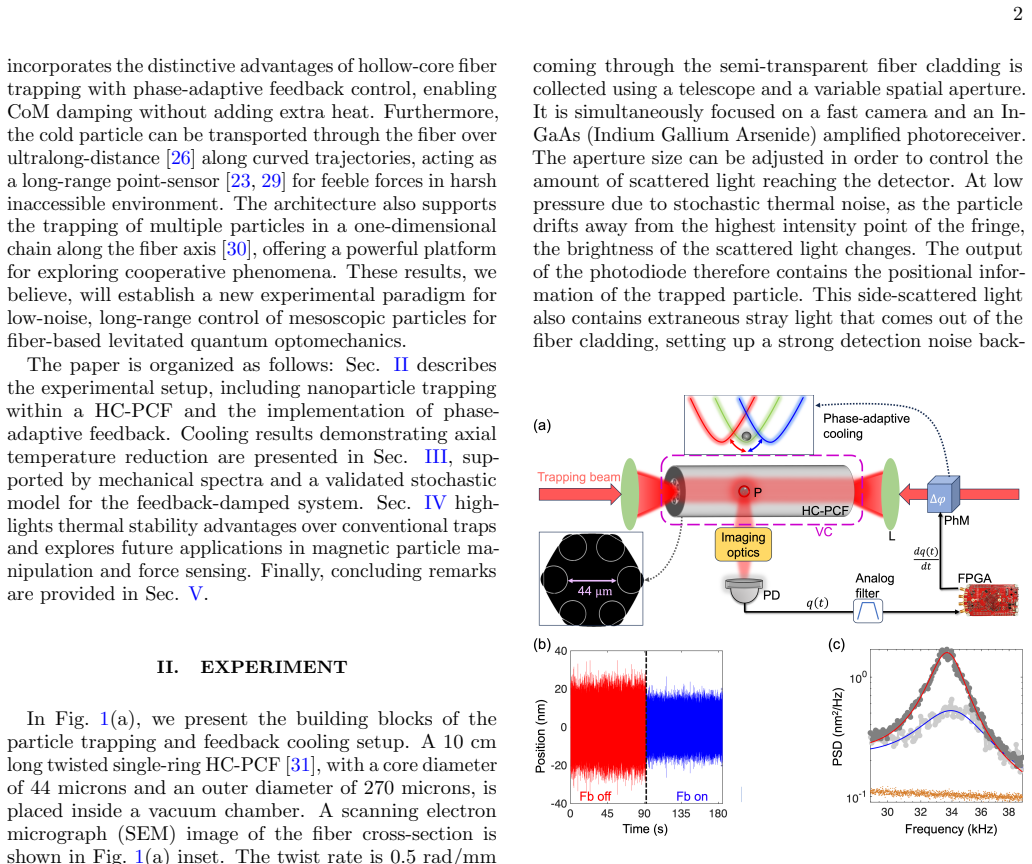
The central object is the fringe trap: a standing wave formed in the 44-micron core of a twisted single-ring hollow-core photonic crystal fiber by counterpropagating, co-linearly polarized 1064 nm LP01 modes, giving a 532 nm fringe spacing. The feedback loop measures side-scattered light from the particle as a position signal, differentiates it to obtain axial velocity, and applies a proportional signal to a phase modulator in one beam arm. This dynamically shifts the fringe pattern, producing a phase φ(t) = (C/Ω) dq_det/dt and a dissipative force −βφ(t) that damps motion without changing the trap stiffness. The effective damping γ + βC is the quantity that carries the cooling argument.
What would settle it
Perform a direct calibration of the position signal by sweeping the phase modulator with a known slow ramp while a particle is trapped and recording the photodiode output; if the response is not linear in displacement over the operating range—for instance quadratic near an intensity antinode—the velocity quadrature fed back is wrong and the inferred temperatures are unreliable. A second check is to measure the momentum-diffusion rate of the cooled particle independently of the position readout.
Extended reading notes
Core claim
The central discovery is that a standing-wave optical trap inside a hollow-core photonic crystal fiber can be turned into a cold-damping engine by phase-modulating the trapping fringe rather than its intensity. A silica nanoparticle is trapped in the interference pattern of two co-linearly polarized LP01 modes, and the side-scattered photodiode signal is filtered and differentiated to produce a phase signal proportional to the particle's axial velocity. That signal drives a lithium niobate phase modulator, shifting the fringe position so the particle always feels a force opposing its motion. The result is a Stokes-type dissipative force that increases the effective damping from γ to γ + βC, with β = κ/k0 pzpm and C the feedback strength. At 2 mbar the axial temperature drops to half of its room-temperature value, and at 0.5 mbar it reaches 58.6 K, while the measured position spectra are well fitted by Eq. (1), which includes thermal noise, detection noise, and feedback-amplified noise.
Load-bearing premise
The load-bearing premise is that the side-scattered photodiode signal is a linear, faithful measure of the particle's axial displacement, because the feedback differentiates this signal to get velocity and the reported temperatures are calibrated from it by equipartition.
Editorial extensions
If this is right
- The technique extends active feedback cooling to uncharged particles, removing the need for electrostatic forces and their sensitivity to stray electric fields.
- Because the trap intensity and depth are not modulated, the scheme avoids the photon-recoil heating that limits intensity-modulation feedback.
- Since the trap sits inside a hollow-core fiber, cooled particles could in principle be transported over long distances and along curved paths while phase control is maintained, enabling distributed sensing.
- The same phase-control hardware is compatible with optical conveyor-belt motion, so cooling and translation of the trapped particle could be combined in a single platform.
- The authors calculate that hollow-core fringe trapping keeps magnetic particles cooler than diffraction-limited trapping under the same conditions, suggesting a path to manipulating magnetic microparticles without exceeding their Curie temperature.
Reading between the lines
- A natural next test is to calibrate the side-scattered position signal directly by sweeping the phase modulator with a known ramp; that would quantify any nonlinearity in the detection transfer function and refine the reported temperature estimates.
- Combining axial phase-adaptive cooling with parametric feedback in the radial directions should enable full three-dimensional cooling inside the fiber, a step the authors note is not yet implemented.
- The demonstration suggests that a moving fringe pattern could act simultaneously as an optical conveyor belt and a coolant, allowing a particle to be delivered to a distant location already cold.
- If extended to chains of optically bound particles, collective phase feedback might cool common and relative vibrational modes differently, offering a platform for studying cooperative optomechanical effects.
Editorial analysis
A structured set of objections, weighed in public.
Referee Report
Summary. The paper reports an experimental demonstration of phase-adaptive feedback cooling of silica nanoparticles trapped in a standing-wave potential inside a hollow-core photonic crystal fiber. The feedback modulates the relative optical phase between counterpropagating fiber modes proportionally to the particle's axial velocity, producing a Stokes-like dissipative force. The authors present time-domain traces, mechanical spectra, and phase-space distributions showing reduced axial motion, and fit the spectra to a stochastic model (Eq. (1)) that includes thermal noise, detection noise, and feedback-amplified noise. They report a reduction of the axial center-of-mass temperature by roughly a factor of two at 2 mbar and down to 58.6 K at 0.5 mbar, and argue the results validate the phase-adaptive cooling mechanism.
Significance. If the central claim holds, this is the first experimental realization of phase-adaptive cooling of levitated nanoparticles, a conceptually distinct approach from intensity-modulation cold damping and electrostatic feedback. The paper provides direct evidence of cooling through time-domain RMS reduction, spectral broadening and area reduction, and phase-space contraction, and it presents an analytical PSD model that captures the main spectral features. The hollow-core fiber platform is also of independent interest for long-range force sensing and for trapping particles that are difficult to cool by conventional means. However, the quantitative claims rest on the assumption that the side-scattered photodiode signal is a linear, faithful measurement of axial displacement, and this assumption is not independently validated. Because the detector is inside the feedback loop and its transduction nonlinearity is uncharacterized, the reported temperatures and fitted parameters are not yet fully secure.
major comments (4)
- [Section III, Fig. 1 and Eq. (1)] The central quantitative claims rely on the side-scattered photodiode signal being a linear measure of axial displacement z(t). The paper only states that 'the brightness of the scattered light changes' as the particle drifts from the intensity maximum (Section II), and that the signal is calibrated using equipartition in the absence of feedback (Section III). For a small particle near a standing-wave antinode, the local intensity is quadratic in displacement, which would produce no signal at the mechanical frequency for a position measurement; a linear response requires operation on a slope of the fringe or an asymmetrical aperture. Equipartition calibration cannot distinguish linear from nonlinear transduction, and because the detector is in the feedback loop it cannot rule out direct feedthrough of the phase-modulation actuation into the measured signal. This issue affects the fitted parameters in Eq. (1), the area-integrated CoM temperatures in Fig. 2(a), and the phase-space contraction in Fig. 2(b). The authors should provide an independent calibration of the position signal, for example using the simultaneously recorded fast-camera image to measure the particle position, or by driving the particle with a known force and checking the absence of harmonic distortion in the detected spectrum, and they should characterize the phase-modulation feedthrough with the particle absent.
- [Section III, Eq. (1) fit parameters] The PSD model in Eq. (1) is taken from the same group's Ref. [21] and the parameters γ, η, and C are extracted from the data themselves: the feedback-off spectrum determines η, Ω, and γ, and the feedback-on spectrum yields C. The paper does not report uncertainties on these fits or any goodness-of-fit measure, and the three free parameters plus a fixed β provide considerable flexibility. To support the claim that 'the measured mechanical spectra agree well with our analytical model,' the authors should show residuals or confidence intervals, and ideally cross-validate γ with an independent ring-down measurement and η with the independently measured detection noise floor.
- [Section III, Fig. 2(a) and temperature inference] The CoM temperature is inferred from the integrated spectral area after subtracting the noise floor, assuming a linear transduction gain and additive noise. This inherits the detection-linearity uncertainty of the first major comment, and the reported error bars reflect only the statistical spread over 32 spectra, not the systematic calibration uncertainty. If the transduction is nonlinear, the relationship between spectral area and potential energy is not valid. The authors should either justify the linearity assumption with explicit calibration data or report the temperature with a systematic error budget that includes the transduction uncertainty.
- [Appendix B and Section II] The feedback implementation is described only qualitatively: a derivative circuit and phase shifter provide a signal proportional to axial velocity, with the phase delay set to π/2 at resonance. No details are given on how the loop phase was calibrated, what the open-loop transfer function is, or what the feedback latency is. Since phase-adaptive cooling works only when the feedback force is in quadrature with the displacement, an uncompensated delay or a mis-set phase would degrade cooling or even heat the particle. The absence of this information makes it difficult to reproduce the experiment and to verify that the observed effect is genuinely due to the intended cold-damping force rather than a spurious loop effect.
minor comments (5)
- [Abstract and Section III] The abstract states the technique damps motion 'without introducing excess heating,' but Eq. (1) explicitly includes a feedback-amplified detection-noise term, which is an excess heating channel. The phrase should be qualified, for example 'without intensity-modulation recoil heating,' to avoid overstatement.
- [Fig. 1 caption] The caption notes that 'sharp spikes in the time trace are caused by detectors and electronics,' but the RMS reduction is computed from these traces. It would be helpful to explain how these spikes were handled (e.g., removed, clipped, or included) because they could affect the reported RMS and the inferred temperature.
- [Section III, reference [33]] The equipartition calibration is attributed to reference [33], which is about sensing static forces with free-falling nanoparticles and does not describe the equipartition calibration of a trapped oscillator. A standard levitodynamics calibration reference would be more appropriate.
- [Eq. (1) and Appendix D] The detection-noise term η²/ω² diverges as ω→0, which is unphysical for a real detector with finite bandwidth. The text says this term 'dominates the off-resonant spectrum at low frequencies,' but the model is only expected to be valid near the mechanical resonance. The authors should state the frequency range over which Eq. (1) is intended to be applied.
- [Appendix A] The simulation uses a silica density of 2000 kg/m³, whereas the commonly used value for fused silica is about 2200 kg/m³. If this is intentional (e.g., for the specific particle material), it should be justified; otherwise it is likely a typographical error.
Circularity Check
Cooling claim rests on direct area measurement; only the model-validation statement is weakened by fitting C from the same spectra.
-
fitted input called prediction
[Section III, Fig. 1(c), Eq. (1); abstract validation sentence]
"We fit the position PSD in Fig. 1(c) for feedback-off (solid red line) and feedback-on (solid blue line) conditions using Eq. (1), extracting γ = 2 kHz, η = 9.4 × 10^6 √Hz and C = 3.84 × 10^−6 through a two-step procedure: First, the feedback-off spectrum determines η, Ω, and γ; second, with these fixed, the feedback-on spectrum yields C. ... The measured mechanical spectra agree well with our analytical model, validating the cooling mechanism."
The feedback-specific parameter C in Eq. (1) is extracted from the very feedback-on spectrum that is then said to 'agree well' with the model. The agreement is therefore a property of the fit, not an independent prediction or validation of the cooling mechanism. The central cooling observation—reduced RMS amplitude and reduced integrated spectral area—is measured directly and does not depend on this fit, so the circularity is partial and confined to the model-validation wording.
full rationale
The paper's central claim, axial CoM temperature reduction from 293 K to half at 2 mbar and to 58.6 K at 0.5 mbar, is obtained by integrating the measured position PSD area above the noise floor after an equipartition calibration at 293 K. This is an external, direct measurement rather than a quantity derived from the analytical model. The fitted parameters (γ, η, C) are used for spectral interpretation, but the temperature and phase-space contraction do not reduce to those fits. Appendix D reproduces the same-group theoretical formalism of Ref. [21]; while this is a self-citation by overlapping authors, the derivation is presented in the paper and is checked against measured spectra, so it is not an unverified imported uniqueness theorem. The one genuine weakness is that the statement 'the measured mechanical spectra agree well with our analytical model, validating the cooling mechanism' relies on a spectrum from which the model's feedback gain C was itself fitted, so that particular agreement is not an independent test. This does not undermine the direct cooling measurement, and no other circularity—definitional, renaming, or imported uniqueness—is present.
Assumptions & free parameters
free parameters (3)
- gamma (gas damping rate) =
2 kHz
- eta (detection noise amplitude) =
9.4 x 10^6 sqrt(Hz)
- C (feedback gain) =
3.84 x 10^-6 for 195 nm; 4.1 x 10^-7 for 400 nm
assumptions (4)
- domain assumption The stochastic dynamics of the trapped particle follow the discretized cold-damping model of Ref. [21], including additive white thermal noise and a velocity-proportional feedback force.
- ad hoc to paper The side-scattered photodiode signal is a linear measure of axial displacement after filtering, calibrated by equipartition in the absence of feedback.
- domain assumption The feedback loop applies a phase shift of pi/(2 Omega) so that the feedback force is proportional to velocity, with negligible latency beyond this designed delay.
- domain assumption The thermal bath is Markovian at T_th = 293 K with pressure-dependent damping gamma and white noise.
Cite this review
Pith. "Pith review of Phase-adaptive cooling of fringe-trapped nanoparticles at room temperature in hollow-core photonic crystal fiber." pith.science (2026). https://pith.science/paper/6Z4SV4R4
@misc{pith2026250717601,
  author       = {Pith},
  title        = {Pith review of: Phase-adaptive cooling of fringe-trapped nanoparticles at room temperature in hollow-core photonic crystal fiber},
  year         = {2026},
  howpublished = {\url{https://pith.science/paper/6Z4SV4R4}},
  note         = {Machine review of arXiv:2507.17601}
}
read the original abstract
Active feedback cooling of levitated dielectric particles is a pivotal technique for creating ultrasensitive sensors and probing fundamental physics. Here we demonstrate phase-adaptive feedback cooling of silica nanoparticles optically trapped in standing-wave potential formed by two co-linearly polarized counterpropagating diffraction-free guided modes in a hollow-core photonic crystal fiber at room temperature. Unlike standard laser intensity- or Coulomb force-based feedback, our approach modulates the relative optical phase between the counterpropagating fundamental modes proportionally to the particle's axial momentum. This generates a Stokes-like dissipative force which effectively damps the center-of-mass motion without introducing excess heating and can also work with uncharged particles. At 2 mbar air pressure, the axial center-of-mass temperature of a 195 nm silica particle is reduced by half upon application of the feedback and to 58.6 K at 0.5 mbar. The measured mechanical spectra agree well with our analytical model, validating the cooling mechanism. We envision this approach will open up pathways towards long-range, coherent control of mesoscopic particles inside hollow-core fibers, offering a fiber-integrated versatile platform for future quantum manipulation.
Figures


Figures from the paper (2 more)


Reference graph
Works this paper leans on
-
[21]
and for probing weak magnetic forces over extended distances using moving interference fringes as an optical conveyor belt [39, 41]. The hollow-core fiber enables weak trapping of magnetic particles without the need for tightly focused, diffraction-limited laser beams, which can signifi- cantly increase the internal temperature of the particle and, in ext...
work page 2000
-
[1]
Aspelmeyer, T
M. Aspelmeyer, T. J. Kippenberg, and F. Marquardt, Cavity optomechanics, Rev. Mod. Phys. 86, 1391 (2014)
2014
-
[2]
A. Ashkin and J. M. Dziedzic, Optical levitation in high vacuum, Applied Physics Letters 28, 333 (1976)
work page 1976
-
[3]
J. Millen and B. A. S. and, Quantum experiments with mi- croscale particles, Contemporary Physics 61, 155 (2020)
work page 2020
- [4]
-
[5]
Geraci and H
A. Geraci and H. Goldman, Sensing short range forces with a nanosphere matter-wave interferometer, Phys. Rev. D 92, 062002 (2015)
2015
-
[6]
A. Vinante, A. Pontin, M. Rashid, M. Toroˇ s, P. F. Barker, and H. Ulbricht, Testing collapse models with levitated nanoparticles: Detection challenge, Phys. Rev. A 100, 012119 (2019). 8
work page 2019
-
[7]
Romero-Isart, Quantum superposition of massive ob- jects and collapse models, Phys
O. Romero-Isart, Quantum superposition of massive ob- jects and collapse models, Phys. Rev. A 84, 052121 (2011)
work page 2011
Show all 48 references
-
[8]
Schliesser, R
A. Schliesser, R. Rivi` ere, G. Anetsberger, O. Arcizet, and T. Kippenberg, Resolved-sideband cooling of a microme- chanical oscillator, Nature Physics 4, 415 (2008)
2008
-
[9]
Deli´ c, M
U. Deli´ c, M. Reisenbauer, K. Dare, D. Grass, V. Vuleti´ c, N. Kiesel, and M. Aspelmeyer, Cooling of a levitated nanoparticle to the motional quantum ground state, Sci- ence 367, 892 (2020)
2020
-
[10]
Marquardt, J
F. Marquardt, J. P. Chen, A. A. Clerk, and S. M. Girvin, Quantum theory of cavity-assisted sideband cooling of mechanical motion, Phys. Rev. Lett. 99, 093902 (2007)
2007
-
[11]
Genes, D
C. Genes, D. Vitali, P. Tombesi, S. Gigan, and M. As- pelmeyer, Ground-state cooling of a micromechanical os- cillator: Comparing cold damping and cavity-assisted cooling schemes, Phys. Rev. A 77, 033804 (2008)
2008
-
[12]
Poggio, C
M. Poggio, C. L. Degen, H. J. Mamin, and D. Rugar, Feed- back cooling of a cantilever’s fundamental mode below 5 mk, Phys. Rev. Lett. 99, 017201 (2007)
2007
-
[13]
Gieseler, B
J. Gieseler, B. Deutsch, R. Quidant, and L. Novotny, Subkelvin parametric feedback cooling of a laser-trapped nanoparticle, Phys. Rev. Lett. 109, 103603 (2012)
2012
-
[14]
T. Li, S. Kheifets, and M. Raizen, Millikelvin cooling of an optically trapped microsphere in vacuum, Nature Physics 7, 527 (2011)
2011
-
[15]
Sommer and C
C. Sommer and C. Genes, Partial optomechanical refrig- eration via multimode cold-damping feedback, Phys. Rev. Lett. 123, 203605 (2019)
2019
-
[16]
Sommer, A
C. Sommer, A. Ghosh, and C. Genes, Multimode cold- damping optomechanics with delayed feedback, Phys. Rev. Res. 2, 033299 (2020)
2020
-
[18]
V. Jain, J. Gieseler, C. Moritz, C. Dellago, R. Quidant, and L. Novotny, Direct measurement of photon recoil from a levitated nanoparticle, Phys. Rev. Lett. 116, 243601 (2016)
2016
-
[19]
Tebbenjohanns, M
F. Tebbenjohanns, M. Frimmer, A. Militaru, V. Jain, and L. Novotny, Cold damping of an optically levitated nanoparticle to microkelvin temperatures, Phys. Rev. Lett. 122, 223601 (2019)
2019
-
[20]
Ghosh, P
A. Ghosh, P. Kumar, C. Sommer, F. G. Jimenez, V. Sud- hir, and C. Genes, Theory of phase-adaptive parametric cooling, Phys. Rev. A 107, 053521 (2023)
2023
-
[22]
Kumar, F
P. Kumar, F. G. Jimenez, S. Chakraborty, G. K. L. Wong, N. Y. Joly, and C. Genes, Prospects of phase-adaptive cooling of levitated magnetic particles in a hollow-core photonic-crystal fiber, Phys. Rev. Res. 7, 023191 (2025)
2025
-
[23]
S. K. Manikandan and S. Qvarfort, Optimal quantum parametric feedback cooling, Phys. Rev. A 107, 023516 (2023)
2023
-
[24]
D. S. Bykov, O. A. Schmidt, T. G. Euser, and P. S. J. Russell, Flying particle sensors in hollow-core photonic crystal fibre, Nature Photonics 9, 461 (2015)
2015
-
[25]
Benabid, J
F. Benabid, J. C. Knight, and P. S. J. Russell, Particle levitation and guidance in hollow-core photonic crystal fiber, Opt. Exp. 10, 1195 (2002)
2002
-
[26]
Grass, J
D. Grass, J. Fesel, S. G. Hofer, N. Kiesel, and M. As- pelmeyer, Optical trapping and control of nanoparticles inside evacuated hollow core photonic crystal fibers, Appl. Phys. Lett. 108, 221103 (2016)
2016
-
[27]
Lindner, P
S. Lindner, P. Juschitz, J. Rieser, Y. Y. Fein, M. De- biossac, M. A. Ciampini, M. Aspelmeyer, and N. Kiesel, Hollow-core fiber loading of nanoparticles into ultra-high vacuum, Appl. Phys. Lett. 124, 143501 (2024)
2024
-
[28]
Garc´ es-Ch´ avez, D
V. Garc´ es-Ch´ avez, D. Roskey, M. D. Summers, H. Melville, D. McGloin, E. M. Wright, and K. Dholakia, Optical levitation in a bessel light beam, Applied Physics Letters 85, 4001 (2004)
2004
-
[29]
Zeltner, R
R. Zeltner, R. Pennetta, S. Xie, and P. S. Russell, Flying particle microlaser and temperature sensor in hollow-core photonic crystal fiber, Opt. Lett. 43, 1479 (2018)
2018
-
[30]
Freitag, M
J. Freitag, M. Koeppel, M. Romodina, N. Joly, and B. Schmauss, Flying particle thermosensor in hollow-core fiber based on fluorescence lifetime measurements, IEEE Journal of Selected Topics in Quantum Electronics PP, 1 (2023)
2023
-
[31]
Sharma, S
A. Sharma, S. Xie, and P. S. Russell, Reconfigurable millimeter-range optical binding of dielectric microparti- cles in hollow-core photonic crystal fiber, Opt. Lett. 46, 3909 (2021)
2021
-
[32]
N. N. Edavalath, M. C. G¨ unendi, R. Beravat, G. K. L. Wong, M. H. Frosz, J.-M. M´ enard, and P. S. Russell, Higher-order mode suppression in twisted single-ring hollow-core photonic crystal fibers, Opt. Lett. 42, 2074 (2017)
2017
-
[33]
D. S. Bykov, S. Xie, R. Zeltner, A. Machnev, G. K. L. Wong, T. G. Euser, and P. S. Russell, Long-range optical trapping and binding of microparticles in hollow-core photonic crystal fibre, Light: Science & Applications 7, 22 (2018)
2018
-
[34]
Hebestreit, M
E. Hebestreit, M. Frimmer, R. Reimann, and L. Novotny, Sensing static forces with free-falling nanoparticles, Phys. Rev. Lett. 121, 063602 (2018)
2018
-
[35]
Whittle, E
C. Whittle, E. D. Hall, S. Dwyer, N. Mavalvala, V. Sudhir, et al. , Approaching the motional ground state of a 10-kg object, Science 372, 1333 (2021)
2021
-
[36]
See Supplemental Material for: feedback cooling methods, the influence of particle size on the axial spring constant, trap frequency verification via sinusoidal drive, detection noise improvement, and derivation of the position power spectral density
-
[37]
Ricci, Levitodynamics toward force nano-sensors in vac- uum (Tesi doctoral, UPC, Institut de Ci` encies Fot` oniques, 2019)
F. Ricci, Levitodynamics toward force nano-sensors in vac- uum (Tesi doctoral, UPC, Institut de Ci` encies Fot` oniques, 2019)
2019
-
[38]
Hebestreit, R
E. Hebestreit, R. Reimann, M. Frimmer, and L. Novotny, Measuring the internal temperature of a levitated nanopar- ticle in high vacuum, Phys. Rev. A 97, 043803 (2018)
2018
-
[39]
D. E. Chang, C. A. Regal, S. B. Papp, D. J. Wilson, J. Ye, O. Painter, H. J. Kimble, and P. Zoller, Cavity opto-mechanics using an optically levitated nanosphere, Proceedings of the National Academy of Sciences 107, 1005 (2010)
2010
-
[40]
Chakraborty, G
S. Chakraborty, G. K. L. Wong, P. S. J. Russell, and N. Y. Joly, Velocity-modulated drag-trapping of nanopar- ticles by moving fringe pattern in hollow-core fiber, arXiv:2506.04770 [physics.optics]
-
[41]
Dania, K
L. Dania, K. Heidegger, D. S. Bykov, G. Cerchiari, G. Araneda, and T. E. Northup, Position measurement of a levitated nanoparticle via interference with its mirror image, Phys. Rev. Lett. 129, 013601 (2022)
2022
-
[42]
ˇCiˇ zm´ ar, V
T. ˇCiˇ zm´ ar, V. Garc´ es-Ch´ avez, K. Dholakia, and P. Zem´ anek, Optical conveyor belt for delivery of submi- cron objects, Appl. Phys. Lett. 86, 174101 (2005). 9
2005
-
[43]
Millen, T
J. Millen, T. Deesuwan, P. Barker, and J. An- ders, Nanoscale temperature measurements using non- equilibrium brownian dynamics of a levitated nanosphere, Nature Nanotechnology 9, 425 (2014)
2014
-
[44]
Davies, J
G.-L. Davies, J. O’Brien, and Y. Gun’ko, Rare earth doped silica nanoparticles via thermolysis of a single source met- allasilsesquioxane precursor, Scientific Reports 7, 45862 (2017)
2017
-
[45]
A. T. M. A. Rahman and P. F. Barker, Laser refrigeration, alignment and rotation of levitated Yb 3+:YLF nanocrys- tals, Nature Photonics 11, 634 (2017)
2017
-
[46]
T. A. Nieminen, V. L. Y. Loke, A. B. Stilgoe, G. Kn¨ oner, A. M. Bra´ nczyk, N. R. Heckenberg, and H. Rubinsztein- Dunlop, Optical tweezers computational toolbox, Journal of Optics A: Pure and Applied Optics 9, S196 (2007)
2007
-
[47]
Zem´ anek, A
P. Zem´ anek, A. Jon´ aˇ s, L.ˇSr´ amek, and M. Liˇ ska, Optical trapping of rayleigh particles using a gaussian standing wave, Optics Communications 151, 273 (1998)
1998
-
[48]
Porcelli, P
A. Porcelli, P. S. Kincaid, A. A. R. Neves, E. Arimondo, A. Camposeo, D. Pisignano, and D. Ciampini, Low-order- mode optical trapping of microspheres in hollow-core photonic crystal fibers, Phys. Rev. A 111, 063511 (2025)
2025
-
[49]
Neuhaus, R
L. Neuhaus, R. Metzdorff, S. Chua, T. Jacqmin, T. Bri- ant, A. Heidmann, P.-F. Cohadon, and S. Del´ eglise, Pyrpl (python red pitaya lockbox) — an open-source software package for fpga-controlled quantum optics ex- periments, in 2017 Conference on Lasers and Electro- Optics Eu...
2017
Reviewed August 6, 2026 · model on record in the stance chip above.
Discussion (0). Continue with ORCID to comment.