REVIEW 3 major objections 5 minor 1 cited by
Identifying galactic binary systems of neutron stars and black holes with LISA
T0 review · 3 major / 5 minor · reviewed 2026-08-06 · deepseek-v4-flash
Pith's one-line read For a realistic isolated-binary-evolution population, LISA can measure the individual masses of about 10% of detected black-hole and black-hole-neutron-star binaries and about 50% of neutron-star binaries, enabling component classification.
desk verdict A careful end-to-end Bayesian forecast that LISA can measure individual masses for ~10% of detected BHBHs/BHNSs and ~50% of NSNSs, but the headline fractions rest on analysis priors scaled to the true injections and should be read as optimistic upper bounds until tested with search-realistic priors. read the letter →
The pith
A machine-rendered reading of the paper's core claim, the machinery that carries it, and where it could break.
The reading
What carries the argument
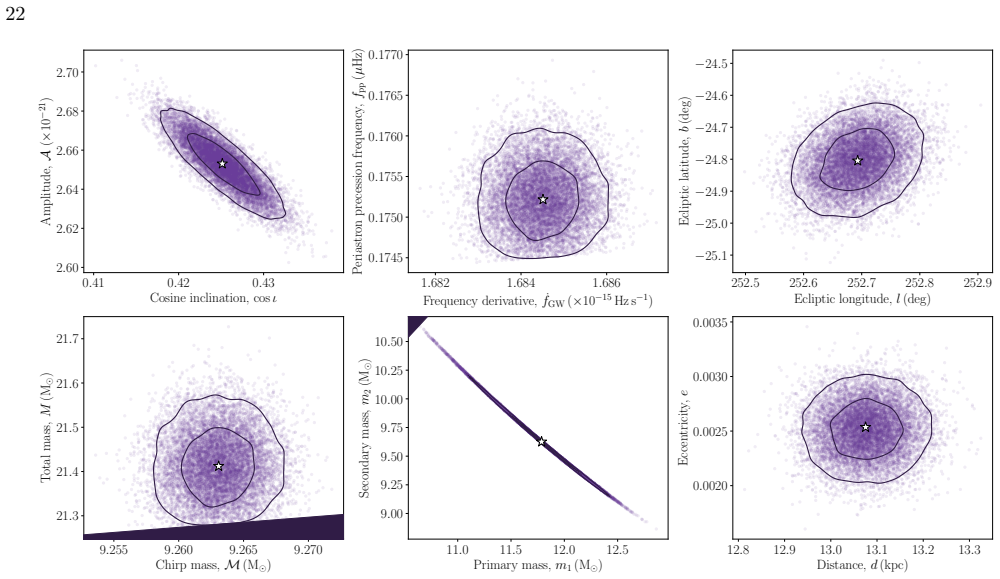
The load-bearing mechanism is the trio of phase-evolution parameters—$\dot f_{\rm GW}$, $f_{\rm PP}$, and $e$—extracted from the harmonic decomposition of an eccentric quasi-monochromatic waveform. In the leading post-Newtonian approximation, $\dot f_{\rm GW} \propto \mathcal{M}^{5/3} f_{\rm GW}^{11/3} F(e)$, where $\mathcal{M}$ is the chirp mass and $F(e)$ encodes the eccentricity enhancement of gravitational-wave emission, while $f_{\rm PP} \propto M^{2/3} f_{\rm GW}^{5/3}/(1-e^2)$, where $M$ is the total mass; together they separate $\mathcal{M}$ and $M$ and hence the two component masses. A Bayesian nested-sampling analysis over the 11 signal parameters produces the posterior distributions, and a parameter is counted as measured when its median is more than three times its posterior width, $S_k = \mathrm{med}(\theta_k)/(3\sigma_{\theta_k}) > 1$.
What would settle it
Re-run the same end-to-end analysis on the same or similar synthetic data with priors that are not centered on the injected parameters (for example, physical ranges spanning plausible masses, periods, and eccentricities), and with a harmonic count larger than 10; the claim is contradicted if the fraction of sources with all three of $\dot f_{\rm GW}$, $f_{\rm PP}$, and $e$ measured, and mass errors at the stated level, drops significantly below 10% for BHBH/BHNS binaries and below 50% for NSNS binaries.
Extended reading notes
Core claim
The central discovery is that the quasi-monochromatic LISA signal of a galactic double compact object still carries enough structure to yield both component masses in a substantial minority of cases. When the gravitational-wave frequency derivative $\dot f_{\rm GW}$, the periastron precession frequency $f_{\rm PP}$, and the orbital eccentricity $e$ can all be measured, the chirp mass and total mass follow directly, and from them the individual masses. For a population consistent with current isolated-binary-evolution predictions, that happens for about 10% of detected BHBH and BHNS binaries and about 50% of NSNS binaries, with fractional mass errors from roughly 1% to 100% (typically about 10%). The same measurements break the mass-distance degeneracy, giving distances with 1%–100% errors and sky-localization areas of $10^{-2}$–$10$ deg$^2$, so these binaries can be placed within the Milky Way and targeted for follow-up.
Load-bearing premise
The analysis assumes the search already knows each source's parameters well enough to place its priors within a small factor of the true values—frequency-derivative and precession priors span zero to five times the injected value, and eccentricity spans a factor of 3–10—so the 10% and 50% fractions could shrink if real LISA searches use wider or biased priors.
Editorial extensions
If this is right
- For the mass-measurable systems, LISA will also fix the binary's three-dimensional Milky Way location, with sky areas from $10^{-2}$ to $10$ deg$^2$ and distances accurate to about 1%–100%, making targeted electromagnetic follow-up possible.
- The measured masses will classify most primaries in BHBH and BHNS binaries as black holes and will confidently exclude a black hole in nearly all NSNS binaries, though some secondaries remain ambiguous against massive white dwarfs.
- Eccentricity will be measured down to about $10^{-3}$, and since double white dwarfs are expected to be nearly circular, a measured nonzero eccentricity helps separate neutron-star binaries from the dominant double-white-dwarf population.
- Because NSNSs are detected at higher frequencies and signal-to-noise ratios, mass measurement succeeds for about half of them, even though their total number is five to ten times smaller than BHBHs and BHNSs.
- The resulting sample of roughly ten gravitational-wave-selected galactic double compact objects with known masses and locations will inform the formation and evolution channels of black holes and neutron stars and the star formation history of the Milky Way.
Reading between the lines
- If the true galactic population has fewer detected systems than the fiducial model (population variations bracket BHBH detections from roughly 6 to 154), the number of binaries with measured masses could drop to a handful, so the demographic payoff depends strongly on formation-channel assumptions.
- The same $\dot f_{\rm GW}$–$f_{\rm PP}$–$e$ machinery should apply to neutron-star–white-dwarf binaries, whose residual eccentricity also survives into the LISA band; a dedicated population study could test how often mass measurements separate them from NSNSs.
- The measurable subset is selected by frequency, eccentricity, and signal-to-noise ratio rather than chosen randomly, so population-level inferences drawn from it will need an explicit selection function to avoid biased conclusions about the Milky Way's compact-object demographics.
- A direct testable extension would be to run the same end-to-end pipeline on mock LISA data with realistic broad priors and a larger harmonic count, checking whether the 10% and 50% measurement fractions survive outside the idealized injection-centered setup.
Editorial analysis
A structured set of objections, weighed in public.
Referee Report
Summary. The paper investigates whether LISA will be able to measure the individual component masses of Galactic double compact objects (DCOs: BHBHs, BHNSs, NSNSs) that are expected to be detected in large numbers. Using the Wagg et al. (2022) fiducial population, the authors draw 100 sources of each type, generate synthetic LISA TDI data with the SciRD noise model, and perform a full Bayesian inference with an 11-dimensional parameter space. They define a measurability criterion S_k based on the median and width of the marginalized posterior, and find that ~10% of detected BHBHs and BHNSs and ~50% of detected NSNSs have measurable frequency derivative, periastron precession, and eccentricity, enabling individual mass measurements with fractional errors from ~1% to 100%. For these systems they also report 3D sky localization and distance estimates. The paper concludes that a small but useful sample of ~10 DCOs will have identified constituent masses, enabling astrophysical follow-up and population studies, while acknowledging several idealized assumptions in the analysis.
Significance. If the quantitative fractions are robust, this is a valuable forecast for LISA science operations: it is the first end-to-end simulation of mass measurement for Galactic DCOs using an astrophysically motivated population, and it identifies the key observables (frequency derivative, periastron precession, eccentricity) that drive the measurement. Credit is due for the transparent presentation, the public release of posterior chains and notebooks, and the open discussion of many limitations, including noise assumptions and global-fit challenges. The qualitative conclusion that a subset of DCOs will have measurable masses is likely correct. However, the headline 10%/50% numbers are derived under idealized analysis priors that are scaled to the injected true parameters, and the same truncated waveform is used for injection and recovery, so the quantitative fractions must be considered provisional until the sensitivity to these choices is quantified. The paper is within the standard scope of a forecasting study, and the issues identified below are addressable within the manuscript's framework.
major comments (3)
- [Table 1; Sec. 5.2; Sec. 5.3] The analysis priors for fdot, fPP, and e are set relative to the injected values (Table 1: U[0,5 fdot_inj], U[0,5 fPP_inj], and U[0,10 e_inj] or U[0,3 e_inj]). In a real LISA global fit, these parameters are not known within factors of 3–10: fdot can be consistent with zero, and e can span orders of magnitude across the DCO population. The 10%/50% fractions quoted in Sec. 5.3 and Table 2 therefore assume the search has already localized each source to within a factor of a few of the truth. This is load-bearing for the central claim. I ask the authors to rerun the analysis with search-realistic priors (e.g., wide priors, or priors whose central values are not matched to the injections) and report how the fractions in Table 2 change, or at minimum to quantify what fraction of the 'measured' systems retain S_k>1 when the prior boundary is moved by a factor of 2–3.
- [Sec. 5.2; Eq. (3a)-(3b)] The same truncated n=10 harmonic waveform is used for both signal generation and the likelihood (Sec. 5.2). The analysis therefore tests parameter recovery conditional on the model being exactly the one used to create the data; it does not test the effect of missing harmonics, which the paper itself notes will be needed for e ≳ 0.1 in realistic data. Since the mass measurements rely on fdot, fPP, and e, a systematic error from harmonic truncation could shift the recovered masses for the very systems being counted. Please perform a check on a representative subset (for example, all systems in Tables 3–6 with e > 0.1) using a larger harmonic count or the full Peters–Mathews sum, and report whether the S_k>1 classifications and the mass posteriors change.
- [Eq. (20); Tables 3–6] The criterion S_k = med(θ_k)/(3σ_θk) is lenient. Because σ_θk is the 16–50 percentile width, for a Gaussian posterior S_k>1 corresponds to a fractional uncertainty of up to roughly 75–100%. Tables 3–6 indeed include systems with fractional mass errors of order 50–100% (e.g., BHBH-65, NSNS-5, NSNS-11 in Tables 3 and 5). The abstract and conclusions state that masses are measured 'typically at the 10% level,' which is not representative of the full 'measured' sample. I recommend reporting the fractions for a few threshold values of S_k (e.g., S_k>2 and S_k>3) and, more importantly, the distribution of fractional mass errors for the 'measured' set, so that the reader can evaluate how many systems have genuinely informative mass measurements.
minor comments (5)
- [Abstract] The phrase 'short-period galactic binaries ∼ 10^7 − 10^3 yr from coalescence' is confusing; a decreasing range (10^7 to 10^3) should be clarified, for example by writing '10^7 to 10^3 yr before coalescence' with the ordering reversed.
- [Sec. 6] There is a typo in the Acknowledgments-adjacent sentence: 'It will will play an important role' should read 'It will play an important role'.
- [Appendix A, Table 3 caption] The table caption says 'for BHBSs' but should say 'for BHBHs' to match the naming convention used elsewhere.
- [Fig. 3 caption] The listing of measured parameter combinations in the caption uses shorthand that is sometimes ambiguous; for example 'measured ˙fGW, e' could be read as 'measured fdot and e' or as a list, and it is inconsistent with the fuller notation in the text and Table 2.
- [Sec. 5.4] The sentence 'The 90% probability region of the projected location of the source in the sky is ∆Ω ≈ 10^-2 − 10 deg^2' would be clearer as 'ranges from about 10^-2 to 10 deg^2'.
Circularity Check
Simulation-based forecast; no Eq-to-Eq circularity. Injection-scaled priors in Table 1 are a realism caveat, not a logical reduction; the central mass-measurement results rest on independent Bayesian posteriors and an external population.
full rationale
The paper is a forward-modeling simulation study: it draws binaries from the external Wagg et al. (2022) population, injects signals into synthetic LISA TDI data, and runs a Bayesian inference pipeline to compute posteriors on the signal parameters. The mass parameters are then derived from standard gravitational-wave relations, Eqs. (9), (11), and (12), combined with Eq. (1); no equation defining the target quantity is itself defined in terms of that target. The measurability criterion in Eq. (20), S_k = med(theta_k)/(3 sigma_theta_k), is an independent statistical condition on the posterior width, not an identity that forces a parameter to be counted. The principal caveat is that the analysis priors in Table 1 are scaled to the true injected values (e.g., fdot prior U[0,5 fdot_inj], fpp prior U[0,5 fpp_inj], e prior within a factor of 3-10 of e_inj), so the headline fractions in Table 2 and Sec. 5.3 should be read as idealized upper estimates conditional on the global fit already having localized the source to within these factors. This is a limitation on realism, but it is not a circular reduction: the posteriors are still computed from the likelihood, and the S_k>1 criterion requires the posterior to be narrow relative to its own median rather than merely equal to the prior. Similarly, the choices of zero-noise realisations, known noise PSD, and the same n=10 harmonic model for injection and recovery (Sec. 5.2) are model-consistency simplifications; the paper explicitly acknowledges these and the search-related challenge of identifying the eccentricity harmonic forest as a global-fit problem (Sec. 6). Self-citations to the authors' own pipeline (Moore et al. 2024, Klein et al. 2022, etc.) are tool references, and the underlying waveform expressions trace to standard results by Peters & Mathews and Moreno-Garrido et al., not to a self-cited uniqueness theorem. No load-bearing self-citation chain or definitional equivalence is present, so no significant circularity is found.
Assumptions & free parameters
free parameters (6)
- Analysis prior scale for frequency derivative =
5 (U[0, 5 fdot_inj])
- Analysis prior scale for periastron precession frequency =
5 (U[0, 5 fpp_inj])
- Analysis prior scale for eccentricity =
10 or 3 times e_inj (capped at 0.9)
- Measurability threshold S_k =
1
- Harmonic truncation order =
n = 10
- Eccentricity inclusion cut =
e < 0.9
assumptions (6)
- standard math Peters-Mathews gravitational radiation reaction and eccentricity enhancement F(e) describe the orbital decay of DCOs in the LISA band.
- standard math The Moreno-Garrido et al. (1995) harmonic amplitudes An(e) are a sufficient description of eccentric GW emission.
- domain assumption The W22 fiducial isolated binary evolution model is representative of the true galactic DCO population detectable by LISA.
- domain assumption The LISA noise is Gaussian, stationary, known a priori, and the A/E/T TDI channels are noise-orthogonal.
- ad hoc to paper The analysis priors reflect the information available from a real LISA global fit.
- ad hoc to paper The S_k>1 measurability criterion identifies parameters that are genuinely measured.
Cite this review
Pith. "Pith review of Identifying galactic binary systems of neutron stars and black holes with LISA." pith.science (2026). https://pith.science/paper/72TYPWGI
@misc{pith2026250711442,
  author       = {Pith},
  title        = {Pith review of: Identifying galactic binary systems of neutron stars and black holes with LISA},
  year         = {2026},
  howpublished = {\url{https://pith.science/paper/72TYPWGI}},
  note         = {Machine review of arXiv:2507.11442}
}
abstract
The Laser Interferometer Space Antenna (LISA) will detect ~ 100 galactic binary systems comprised of black holes (BHs) and neutron stars (NSs). Identifying the nature of the constituents of these binaries as BHs or NSs, and distinguishing them from $\sim 10^4$ detected double white dwarfs will be challenging. In the absence of any other information, the inferred values of the component masses can be used to classify the nature of these objects. However, short-period galactic binaries $\sim 10^7 - 10^3$ yr from coalescence produce a quasi-monochromatic signal which carries little information about their masses. We generate synthetic LISA data sets containing gravitational waves (GWs) from galactic binary BHs, binary NSs and BHNSs drawn from an astrophysically realistic population produced through the isolated binary evolution channel. We process the data with an end-to-end Bayesian inference pipeline to explore the accuracy with which the individual component masses can be measured. We find that for $\approx 10\% - 50\%$ of the detected systems LISA will be able to measure the individual component masses by measuring the orbital eccentricity, periapse precession frequency, and GW induced frequency derivative. Typical fractional mass errors are $\approx 1\% - 100\%$ (depending on the specific value of the source parameters), which will enable in many circumstances the classification of the objects as BHs or NSs. For these binaries, LISA will also be able to determine their 3-dimensional position in the Milky Way. The LISA-detected sample of these double compact objects will provide new information about the galactic population of BHs and NSs, the star formation history of the Milky Way and the astrophysical processes leading to the formation of these systems. However, for a significant fraction of the LISA-detected binaries the nature of their constituent objects may remain unclear.
Figures


Figures from the paper (8 more)




Forward citations
Cited by 1 Pith paper
-
Pulsars in Globular Clusters With the SKAO
SKA-MID and SKA-LOW are predicted to discover 150–1700 new pulsars in Galactic globular clusters, more than doubling the current population of 345.
Reference graph
Works this paper leans on
-
[1]
2025, arXiv e-prints, arXiv:2503.12263, doi: 10.48550/arXiv.2503.12263
Abac, A., Abramo, R., Albanesi, S., et al. 2025, arXiv e-prints, arXiv:2503.12263, doi: 10.48550/arXiv.2503.12263
-
[2]
G., Abbott, R., Abouelfettouh, I., et al
Abac, A. G., Abbott, R., Abouelfettouh, I., et al. 2024, ApJL, 970, L34, doi: 10.3847/2041-8213/ad5beb
-
[3]
Abbott, B. P., Abbott, R., Abbott, T. D., et al. 2019, Physical Review X, 9, 031040, doi: 10.1103/PhysRevX.9.031040
-
[4]
Abbott, R., Abbott, T. D., Abraham, S., et al. 2021, Physical Review X, 11, 021053, doi: 10.1103/PhysRevX.11.021053
-
[5]
Abbott, R., Abbott, T. D., Acernese, F., et al. 2023, Physical Review X, 13, 041039, doi: 10.1103/PhysRevX.13.041039
-
[6]
2017, arXiv e-prints, arXiv:1702.00786, doi: 10.48550/arXiv.1702.00786
Amaro-Seoane, P., Audley, H., Babak, S., et al. 2017, arXiv e-prints, arXiv:1702.00786, doi: 10.48550/arXiv.1702.00786
-
[7]
2020, ApJL, 892, L9, doi: 10.3847/2041-8213/ab5b9a Astropy Collaboration, Price-Whelan, A
Safarzadeh, M. 2020, ApJL, 892, L9, doi: 10.3847/2041-8213/ab5b9a Astropy Collaboration, Price-Whelan, A. M., Sip˝ ocz, B. M., et al. 2018, AJ, 156, 123, doi: 10.3847/1538-3881/aabc4f
-
[8]
2021, arXiv e-prints, arXiv:2108.01167, doi: 10.48550/arXiv.2108.01167
Babak, S., Hewitson, M., & Petiteau, A. 2021, arXiv e-prints, arXiv:2108.01167, doi: 10.48550/arXiv.2108.01167
Show all 70 references
-
[9]
2024, Living Reviews in Relativity, 27, 4, doi: 10.1007/s41114-024-00050-z
Blanchet, L. 2024, Living Reviews in Relativity, 27, 4, doi: 10.1007/s41114-024-00050-z
2024 doi
-
[10]
2020, ApJ, 898, 71, doi: 10.3847/1538-4357/ab9d85
Breivik, K., Coughlin, S., Zevin, M., et al. 2020, ApJ, 898, 71, doi: 10.3847/1538-4357/ab9d85
2020 doi
-
[11]
S., Berger, E., Neijssel, C
Broekgaarden, F. S., Berger, E., Neijssel, C. J., et al. 2021, MNRAS, 508, 5028, doi: 10.1093/mnras/stab2716
2021 doi
-
[12]
S., Berger, E., Stevenson, S., et al
Broekgaarden, F. S., Berger, E., Stevenson, S., et al. 2022, MNRAS, 516, 5737, doi: 10.1093/mnras/stac1677
2022 doi
- [13]
-
[14]
2021, PhRvD, 104, 044065, doi: 10.1103/PhysRevD.104.044065
Buscicchio, R., Klein, A., Roebber, E., et al. 2021, PhRvD, 104, 044065, doi: 10.1103/PhysRevD.104.044065
2021 doi
-
[15]
B., Fuller, J., et al
Caiazzo, I., Burdge, K. B., Fuller, J., et al. 2021, Nature, 595, 39, doi: 10.1038/s41586-021-03615-y
2021 doi
-
[16]
Casares, J., & Jonker, P. G. 2014, SSRv, 183, 223, doi: 10.1007/s11214-013-0030-6
2014 doi
-
[17]
T., Gandolfi, S., et al
Chatziioannou, K., Cromartie, H. T., Gandolfi, S., et al. 2024, arXiv e-prints, arXiv:2407.11153, doi: 10.48550/arXiv.2407.11153
2024 doi
- [18]
-
[19]
1998, PhRvD, 57, 7089, doi: 10.1103/PhysRevD.57.7089 14
Cutler, C. 1998, PhRvD, 57, 7089, doi: 10.1103/PhysRevD.57.7089 14
1998 doi
-
[20]
Baker, J. G. 2025, ApJ, 981, 66, doi: 10.3847/1538-4357/ada9e2
2025 doi
-
[21]
2025, PhRvD, 111, 103014, doi: 10.1103/PhysRevD.111.103014 D’Orazio, D
Deng, S., Babak, S., Le Jeune, M., et al. 2025, PhRvD, 111, 103014, doi: 10.1103/PhysRevD.111.103014 D’Orazio, D. J., & Samsing, J. 2018, MNRAS, 481, 4775, doi: 10.1093/mnras/sty2568
2025 doi
-
[22]
2023a, MNRAS, 518, 1057, doi: 10.1093/mnras/stac3140
El-Badry, K., Rix, H.-W., Quataert, E., et al. 2023a, MNRAS, 518, 1057, doi: 10.1093/mnras/stac3140
-
[23]
2023b, MNRAS, 521, 4323, doi: 10.1093/mnras/stad799
El-Badry, K., Rix, H.-W., Cendes, Y., et al. 2023b, MNRAS, 521, 4323, doi: 10.1093/mnras/stad799
-
[24]
D., Reggiani, H., et al
El-Badry, K., Simon, J. D., Reggiani, H., et al. 2024a, The Open Journal of Astrophysics, 7, 27, doi: 10.33232/001c.116675
-
[25]
W., et al
El-Badry, K., Rix, H.-W., Latham, D. W., et al. 2024b, The Open Journal of Astrophysics, 7, 58, doi: 10.33232/001c.121261
-
[26]
2023, MNRAS, 522, 5358, doi: 10.1093/mnras/stad1288 Gaia Collaboration, Panuzzo, P., Mazeh, T., et al
Finch, E., Bartolucci, G., Chucherko, D., et al. 2023, MNRAS, 522, 5358, doi: 10.1093/mnras/stad1288 Gaia Collaboration, Panuzzo, P., Mazeh, T., et al. 2024, A&A, 686, L2, doi: 10.1051/0004-6361/202449763
2023 doi
-
[27]
R., Millman, K
Harris, C. R., Millman, K. J., van der Walt, S. J., et al. 2020, Nature, 585, 357, doi: 10.1038/s41586-020-2649-2
2020 doi
-
[28]
Hunter, J. D. 2007, Computing in Science & Engineering, 9, 90, doi: 10.1109/MCSE.2007.55
2007 doi
-
[29]
1996, ApJL, 470, L61, doi: 10.1086/310296
Kalogera, V., & Baym, G. 1996, ApJL, 470, L61, doi: 10.1086/310296
1996 doi
-
[30]
2021, PhRvD, 104, 043019, doi: 10.1103/PhysRevD.104.043019
Littenberg, T. 2021, PhRvD, 104, 043019, doi: 10.1103/PhysRevD.104.043019
2021 doi
-
[31]
2025, PhRvD, 111, 024060, doi: 10.1103/PhysRevD.111.024060
Stergioulas, N. 2025, PhRvD, 111, 024060, doi: 10.1103/PhysRevD.111.024060
2025 doi
- [32]
-
[33]
P., Toonen, S., et al
Korol, V., Igoshev, A. P., Toonen, S., et al. 2024, MNRAS, 530, 844, doi: 10.1093/mnras/stae889
2024 doi
-
[34]
2020, A&A, 638, A153, doi: 10.1051/0004-6361/202037764
Korol, V., Toonen, S., Klein, A., et al. 2020, A&A, 638, A153, doi: 10.1051/0004-6361/202037764
2020 doi
-
[35]
2018, PhRvL, 120, 191103, doi: 10.1103/PhysRevLett.120.191103
Kremer, K., Chatterjee, S., Breivik, K., et al. 2018, PhRvL, 120, 191103, doi: 10.1103/PhysRevLett.120.191103
2018 doi
-
[36]
F., et al
Lamberts, A., Garrison-Kimmel, S., Hopkins, P. F., et al. 2018, MNRAS, 480, 2704, doi: 10.1093/mnras/sty2035
2018 doi
-
[37]
W., & Pati, D
Lim, Y., Bhattacharya, A., Holt, J. W., & Pati, D. 2021, PhRvC, 104, L032802, doi: 10.1103/PhysRevC.104.L032802
2021 doi
-
[38]
B., & Cornish, N
Littenberg, T. B., & Cornish, N. J. 2023, PhRvD, 107, 063004, doi: 10.1103/PhysRevD.107.063004
2023 doi
-
[39]
2016, ApJ, 830, 41, doi: 10.3847/0004-637X/830/1/41
Kozlowski, S. 2016, ApJ, 830, 41, doi: 10.3847/0004-637X/830/1/41
2016 doi
-
[40]
N., Hobbs, G
Manchester, R. N., Hobbs, G. B., Teoh, A., & Hobbs, M. 2005, AJ, 129, 1993, doi: 10.1086/428488
2005 doi
-
[41]
C., Lamb, F
Miller, M. C., Lamb, F. K., Dittmann, A. J., et al. 2021, ApJL, 918, L28, doi: 10.3847/2041-8213/ac089b
2021 doi
-
[42]
J., Finch, E., Klein, A., et al
Moore, C. J., Finch, E., Klein, A., et al. 2024, MNRAS, 531, 2817, doi: 10.1093/mnras/stae1288
2024 doi
-
[43]
1995, MNRAS, 274, 115, doi: 10.1093/mnras/274.1.115
Moreno-Garrido, C., Mediavilla, E., & Buitrago, J. 1995, MNRAS, 274, 115, doi: 10.1093/mnras/274.1.115
1995 doi
-
[44]
E., Rodriguez, J., Jourdain, E., et al
Motta, S. E., Rodriguez, J., Jourdain, E., et al. 2021, NewAR, 93, 101618, doi: 10.1016/j.newar.2021.101618
2021
- [45]
-
[46]
R., & Portegies Zwart, S
Nelemans, G., Yungelson, L. R., & Portegies Zwart, S. F. 2001, A&A, 375, 890, doi: 10.1051/0004-6361:20010683
2001 doi
-
[47]
Ng, K. K. Y., Vitale, S., Farr, W. M., & Rodriguez, C. L. 2021, ApJL, 913, L5, doi: 10.3847/2041-8213/abf8be ¨Ozel, F., & Freire, P. 2016, ARA&A, 54, 401, doi: 10.1146/annurev-astro-081915-023322
2021 doi
-
[48]
Peters, P. C. 1964, Physical Review, 136, 1224, doi: 10.1103/PhysRev.136.B1224
1964 doi
-
[49]
C., & Mathews, J
Peters, P. C., & Mathews, J. 1963, Physical Review, 131, 435, doi: 10.1103/PhysRev.131.435
1963 doi
-
[50]
J., et al
Pratten, G., Klein, A., Moore, C. J., et al. 2023a, PhRvD, 107, 123026, doi: 10.1103/PhysRevD.107.123026
-
[51]
2023b, PhRvD, 108, 124045, doi: 10.1103/PhysRevD.108.124045
Pratten, G., Schmidt, P., Middleton, H., & Vecchio, A. 2023b, PhRvD, 108, 124045, doi: 10.1103/PhysRevD.108.124045
-
[52]
K., Hebeler, K., et al
Raaijmakers, G., Greif, S. K., Hebeler, K., et al. 2021, ApJL, 918, L29, doi: 10.3847/2041-8213/ac089a
2021 doi
-
[53]
A., & McClintock, J
Remillard, R. A., & McClintock, J. E. 2006, ARA&A, 44, 49, doi: 10.1146/annurev.astro.44.051905.092532
2006 arXiv
-
[54]
E., & Ruffini, R
Rhoades, C. E., & Ruffini, R. 1974, PhRvL, 32, 324, doi: 10.1103/PhysRevLett.32.324
1974 doi
-
[55]
2020, ApJL, 894, L15, doi: 10.3847/2041-8213/ab8ac9
Roebber, E., Buscicchio, R., Vecchio, A., et al. 2020, ApJL, 894, L15, doi: 10.3847/2041-8213/ab8ac9
2020 doi
-
[56]
S., & Tyles, J
Samsing, J., Hamers, A. S., & Tyles, J. G. 2019, PhRvD, 100, 043010, doi: 10.1103/PhysRevD.100.043010
2019 doi
-
[57]
2020, MNRAS, 494, L75, doi: 10.1093/mnrasl/slaa039
Sesana, A., Lamberts, A., & Petiteau, A. 2020, MNRAS, 494, L75, doi: 10.1093/mnrasl/slaa039
2020 doi
-
[58]
2001, PhRvL, 87, 251101, doi: 10.1103/PhysRevLett.87.251101
Seto, N. 2001, PhRvL, 87, 251101, doi: 10.1103/PhysRevLett.87.251101
2001 doi
-
[59]
2020, PhRvD, 102, 063006, doi: 10.1103/PhysRevD.102.063006 15
Shao, D.-S., Tang, S.-P., Jiang, J.-L., & Fan, Y.-Z. 2020, PhRvD, 102, 063006, doi: 10.1103/PhysRevD.102.063006 15
2020 doi
-
[60]
2004, in American Institute of Physics Conference Series, Vol
Skilling, J. 2004, in American Institute of Physics Conference Series, Vol. 735, Bayesian Inference and Maximum Entropy Methods in Science and Engineering: 24th International Workshop on Bayesian Inference and Maximum Entropy Methods in Science and Engineering, ed. R. Fischer,...
2004 doi
-
[61]
H., Ferraioli, L., Schmelzbach, C., St¨ ahler, S
Strub, S. H., Ferraioli, L., Schmelzbach, C., St¨ ahler, S. C., & Giardini, D. 2024, PhRvD, 110, 024005, doi: 10.1103/PhysRevD.110.024005
2024 doi
-
[62]
J., Meyer, R., et al
Tang, P., Eldridge, J. J., Meyer, R., et al. 2024, MNRAS, 534, 1707, doi: 10.1093/mnras/stae2154
2024 doi
-
[63]
Tinto, M., & Dhurandhar, S. V. 2021, Living Reviews in Relativity, 24, 1, doi: 10.1007/s41114-020-00029-6
2021 doi
-
[64]
E., et al
Virtanen, P., Gommers, R., Oliphant, T. E., et al. 2020, Nature Methods, 17, 261, doi: 10.1038/s41592-019-0686-2
2020 doi
-
[65]
S., de Mink, S
Wagg, T., Broekgaarden, F. S., de Mink, S. E., et al. 2021, Dataset from: Gravitational wave sources in our Galactic backyard - Predictions for BHBH, BHNS and NSNS binaries in LISA, doi: 10.5281/zenodo.4699713 —. 2022, ApJ, 937, 118, doi: 10.3847/1538-4357/ac8675
2021 doi
-
[66]
Waskom, M. L. 2021, Journal of Open Source Software, 6, 3021, doi: 10.21105/joss.03021
2021 doi
-
[67]
Williams, M. J. 2021, nessai: Nested Sampling with Artificial Intelligence, latest, Zenodo, doi: 10.5281/zenodo.4550693
2021 doi
-
[68]
J., Veitch, J., & Messenger, C
Williams, M. J., Veitch, J., & Messenger, C. 2021, Phys. Rev. D, 103, 103006, doi: 10.1103/PhysRevD.103.103006 —. 2023, Mach. Learn. Sci. Tech., 4, 035011, doi: 10.1088/2632-2153/acd5aa
2021 doi
-
[69]
2020, A&A, 636, A20, doi: 10.1051/0004-6361/201935842
Wyrzykowski, L., & Mandel, I. 2020, A&A, 636, A20, doi: 10.1051/0004-6361/201935842
2020 doi
-
[70]
2025, arXiv e-prints, arXiv:2501.18682, doi: 10.48550/arXiv.2501.18682 16 APPENDIX A
Xuan, Z., Kremer, K., & Naoz, S. 2025, arXiv e-prints, arXiv:2501.18682, doi: 10.48550/arXiv.2501.18682 16 APPENDIX A. ADDITIONAL TABLES AND PLOTS In this Appendix, we provide Tables of injected and recovered (selected) parameters for the BHBHs (Table 3), BHNSs (Table 4) and N...
Reviewed August 6, 2026 · model on record in the stance chip above.
Discussion (0). Sign in to comment.