REVIEW 2 minor 53 references
Geometry of geodesics through Busemann measures in directed last-passage percolation
T0 review · 0 major / 2 minor · reviewed 2026-08-14 · deepseek-v4-flash
Pith's one-line read In exponential directed last-passage percolation, a random countably infinite dense set of exceptional directions carries exactly two semi-infinite geodesics per site—a left and a right one—each family forming a coalescing tree, while…
desk verdict First complete geometry of semi-infinite geodesics in exponential LPP, built on a genuinely new Busemann-measure framework; the central theorem holds up, with only minor statement-level blemishes. read the letter →
The pith
A machine-rendered reading of the paper's core claim, the machinery that carries it, and where it could break.
The reading
What carries the argument
The machinery is the Busemann measure: the signed Lebesgue–Stieltjes measure $\mu_{x,y}$ obtained from the direction-indexed family of generalized Busemann functions $B^{\xi\pm}_{x,y}$, whose support records those directions in which the one-sided geodesics out of $x$ and $y$ fail to meet. The analysis runs through the support of these measures, the ordering and one-sided continuity of the Busemann geodesics, and two structural conditions: the regularity condition (2.4) on the shape function (strict concavity at non-differentiability points) and the jump process condition (3.5) (every point of every support is isolated). The jump process condition is what forces the exceptional set to be countable and to equal the competition-interface directions, and in the exponential model it holds by a theorem on the queueing representation of the Busemann functions; the strictly concave square-root shape function then gives $U_\xi = \{\xi\}$, so every geodesic is genuinely direction-directed.
What would settle it
To refute the general framework, find an i.i.d. weight distribution satisfying (1.1) with a realization in which some Busemann measure has a non-isolated support point—equivalently, a direction that is a limit of competition-interface directions without being one—since the jump process condition (3.5) and the equality $V_\omega = \{\xi^*(T_x\omega)\}$ would then both fail; to refute the exponential statistics, check numerically whether the spacings of horizontal jump locations in a fixed exceptional direction follow the Catalan law $C_{n-1}2^{-(2n-1)}$ that matches the zero set of simple symmetric random walk.
Extended reading notes
Core claim
The paper's central discovery is that the set of exceptional directions of a realization is exactly the union $V_\omega = \bigcup_{x,y} \operatorname{supp} \mu_{x,y}$ of the supports of the Busemann measures, and that this set completely controls the geodesic geometry. In the exponential model, Theorem 3.10 and Theorem 3.11 prove that for every $\xi \notin V_\omega$ the left and right Busemann geodesics $\gamma_{x,\xi-}$ and $\gamma_{x,\xi+}$ coincide for all $x$, form the unique $\xi$-directed geodesic from each site, and all these geodesics coalesce; for every $\xi \in V_\omega$, the two one-sided geodesics from each $x$ differ from the first step, never meet again, and are the only two $\xi$-directed geodesics from $x$, while the left families (and separately the right families) coalesce into trees. The same theorems identify $V_\omega$ with the set of asymptotic directions of competition interfaces and with the set of discontinuities of the Busemann process, establishing a three-way equivalence between geodesic non-uniqueness, interface directions, and jump discontinuities of the stochastic Hamilton–Jacobi solution.
Load-bearing premise
The load-bearing premise is that the support of every Busemann measure consists only of isolated points (the jump process condition (3.5)), which is proven for exponential weights but open for general i.i.d. weights; if it fails, the equalities between the exceptional-direction set, the competition-interface directions, and the discontinuity set of the Busemann process, and with them the full two-tree classification, would break.
Editorial extensions
If this is right
- For every site $x$ and every direction $\xi \notin V_\omega$, the finite geodesic from $x$ to any sequence of endpoints with asymptotic direction $\xi$ converges to the unique $\xi$-directed semi-infinite geodesic; for $\xi \in V_\omega$ it converges to the left or right geodesic according to the side of the competition interface on which the endpoints lie, so the limiting geometry of finite geode
- The equality of $V_\omega$ with the set of discontinuity directions of the Busemann process means that geodesic non-uniqueness is the same phenomenon as non-uniqueness of the backward Hamiltonian–Jacobi solution: the exceptional directions are exactly the shock directions of the discrete stochastic Burgers equation.
- In the exponential model the Palm distribution of the locations of jumps of the Busemann process on a line is the zero set of simple symmetric random walk sampled at even times; consequently, the number of instability points in an $n\times n$ box is almost surely $O(n^{3/2}\sqrt{\log n})$.
- The set $V_\omega$ is dense in the set of directions where the shape function is either non-differentiable or strictly concave, so the exceptional directions are not isolated artifacts—they occur throughout the entire interior of the direction space.
Reading between the lines
- If the jump process condition holds for general i.i.d. weights, as the paper's open problems anticipate, then the same dichotomy—one coalescing tree outside $V_\omega$, two coalescing trees at each direction in $V_\omega$—would govern geodesics in every planar directed LPP, making the exponential picture the universal one rather than an integrable special case.
- The Busemann-measure framework uses only cocycle, monotonicity, and support properties, so it should transfer to undirected first-passage percolation and to stochastic Hamilton–Jacobi equations with a Hopf–Lax–Oleinik semigroup; in those models the support of the Busemann measures would serve as the full shock set, including branching shocks.
- The random-walk statistics suggest a sharper universality prediction than the paper states: in any model where the jump condition holds, the law of the location of instability points on a line should be the same SSRW-zero-set law, which could be tested in non-integrable models by simulation.
Signed reviews
Editorial analysis
A structured set of objections, weighed in public.
Referee Report
Summary. This paper studies the full family of semi-infinite geodesics in planar directed last-passage percolation with i.i.d. continuous weights of finite p>2 moment. The authors introduce Busemann measures, the Lebesgue--Stieltjes measures associated with the monotone Busemann process, and use their supports to encode exceptional directions in which uniqueness or coalescence fails. The main general-weight results characterize the support of Busemann measures via disjoint geodesics (Theorem 3.1), relate coalescence points to isolated points of the support (Theorems 3.4 and 3.5), identify the random set V_omega of exceptional directions with competition-interface directions under the jump process condition (3.5) (Theorem 3.7), and describe uniqueness and coalescence of geodesics inside and outside V_omega (Theorems 3.9 and 3.10). In the exponential model, Theorem 3.11 gives a complete description: countably many dense exceptional directions in which every site emits exactly two semi-infinite geodesics forming left and right coalescing trees, and all other directions in which there is a unique coalescing tree of geodesics. Sections 4 and 5 develop the dynamical-systems interpretation through webs of instability and derive explicit statistics of instability points, including a connection to the zero set of simple symmetric random walk.
Significance. If the results are correct, Theorem 3.11 is the first complete characterization of semi-infinite geodesics in a KPZ-class lattice growth model, and the paper is likely to become a standard reference for the geometry of geodesics in exactly solvable last-passage percolation. The architecture of the proof is sound: the external inputs are cited precisely (Theorems A.1, A.4, A.7, and A.8; the jump-process condition (3.5) from [22]; the no-bigeodesic condition (4.2) from [8,9]), and the internal arguments correctly assemble these inputs. I particularly credit the careful separation of unconditional general-weight results from results that require condition (3.5), which the authors explicitly leave open for non-solvable weights in Section 6, Problem 3. The Palm-kernel arguments in Section 9 are handled in detail through Kallenberg's framework and lead to concrete, falsifiable statistics, including the unexpected comparison with the zero set of simple symmetric random walk.
minor comments (2)
- [Theorem 3.11(c)] The statement quantifies over all xi in ri U, but for xi not in V_omega the split point s_xi(x) is infinity by definition (3.9), and the competition interface phi^{s_xi(x)} is not defined. Please either restrict the statement to xi in V_omega or add a convention for the case s_xi(x)=infinity, in which both alternative assumptions are vacuous and the conclusion should be the unique-geodesic convergence already contained in Theorem 3.10(c). This is a statement-level omission and does not affect the proof of the main characterization.
- [Proof of Theorem 3.11] In the proof of part (c), the line 'call k = x dot hat e' appears to have a missing subscript: it should be k = x dot hat e_1. The same sentence should also specify that the convergence gamma_{x,v_n} -> gamma_{x,xi-} is in the sense of finite-segment convergence, consistent with the definition before the theorem.
Circularity Check
No circularity: central exponential characterization rests on external theorems and nontrivial internal proofs; self-citations are independent prior results.
full rationale
The paper's central claim, Theorem 3.11, is not circular. Its load-bearing inputs are external theorems with proofs: the exponential shape function (3.8) from Rost [47], the Busemann process from [27,36], the jump-process condition (3.5) from [22, Theorem 3.4], the no-bigeodesic condition (4.2) from [8,9], and Coupier's at-most-two geodesics theorem, Theorem A.8. None of these is defined in terms of the target theorem, and the paper does not attempt to prove them here. The set V_omega is defined in (3.6) as the union of the supports of the Busemann measures, while the statements that V_omega equals the set of competition-interface directions and the set of Busemann discontinuities are proved via substantial intermediate results, especially Propositions 7.1 and 7.2. The equivalence between the jump-process condition (3.5) and coalescence in Theorem 3.5 is also proved from the support/coalescence characterization of Theorem 3.4, not assumed. The paper is explicit about the open status of (3.5) outside solvable models, listing it as Problem 3 in Section 6, so it does not silently rely on an unverified hypothesis. The only soft spot is a statement-level technical omission in Theorem 3.11(c), where the competition interface phi^{s_xi(x)} is not defined when s_xi(x)=infinity for xi outside V_omega; this is a gap in presentation, not a circular derivation. Accordingly, no fitted parameter is renamed as a prediction and no self-citation chain forces the main conclusion.
Assumptions & free parameters
assumptions (9)
- domain assumption Existence and properties of the Busemann process (Theorem A.1 from [27,36]): covariant cocycles B_{xi±}(x,y) with weights recovery, monotonicity, one-sided continuity, and shape-gradient expectations.
- domain assumption Regularity condition (2.4): the shape function g is strictly concave at all xi outside D, or equivalently g is differentiable at endpoints of its linear segments.
- domain assumption Jump process condition (3.5): every point of supp mu_{x,y} is isolated, for all x,y.
- domain assumption No bi-infinite geodesics condition (4.2): the only bi-infinite geodesics are the trivial axis-parallel ones.
- domain assumption Exponential weights assumption (3.7) and the shape function g(xi) = (sqrt(xi.e1)+sqrt(xi.e2))^2 (Rost 1981).
- domain assumption Coupier's theorem (Theorem A.8): in exponential LPP there are at most two xi-directed semi-infinite geodesics out of a given site.
- standard math Shape theorem for LPP (Martin 2004): existence of the non-random concave homogeneous limit g and known behavior near the boundary.
- standard math Palm theory and disintegration of Campbell measures (Kallenberg [38,39]) used in Section 9.1-9.2.
- standard math Renewal theory for simple symmetric random walk (Feller's inter-arrival distribution (5.5), Revesz's law of iterated logarithm and Chung-type bounds) in Section 5.
invented entities (1)
-
Instability graph S^*_{[zeta,eta]} (web of instability)
independent evidence
Cite this review
Pith. "Pith review of Geometry of geodesics through Busemann measures in directed last-passage percolation." pith.science (2026). https://pith.science/paper/73D72FVH
@misc{pith2026190809040,
  author       = {Pith},
  title        = {Pith review of: Geometry of geodesics through Busemann measures in directed last-passage percolation},
  year         = {2026},
  howpublished = {\url{https://pith.science/paper/73D72FVH}},
  note         = {Machine review of arXiv:1908.09040}
}
read the original abstract
We consider planar directed last-passage percolation on the square lattice with general i.i.d. weights and study the geometry of the full set of semi-infinite geodesics in a typical realization of the random environment. The structure of the geodesics is studied through the properties of the Busemann functions viewed as a stochastic process indexed by the asymptotic direction. Our results are further connected to the ergodic program for and stability properties of random Hamilton-Jacobi equations. In the exactly solvable exponential model, our results specialize to give the first complete characterization of the uniqueness and coalescence structure of the entire family of semi-infinite geodesics for any model of this type. Furthermore, we compute statistics of locations of instability, where we discover an unexpected connection to simple symmetric random walk.
Figures

Figures from the paper (10 more)

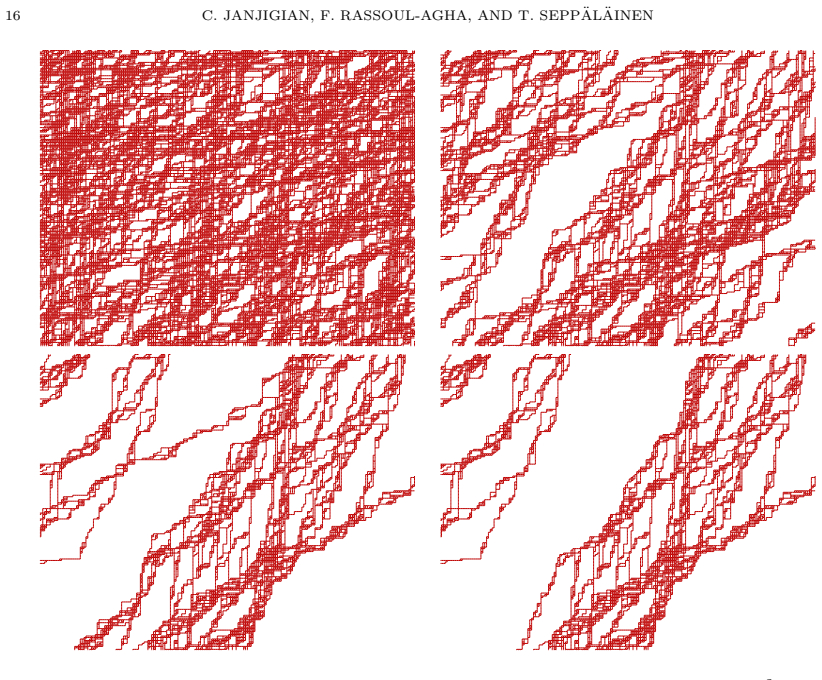


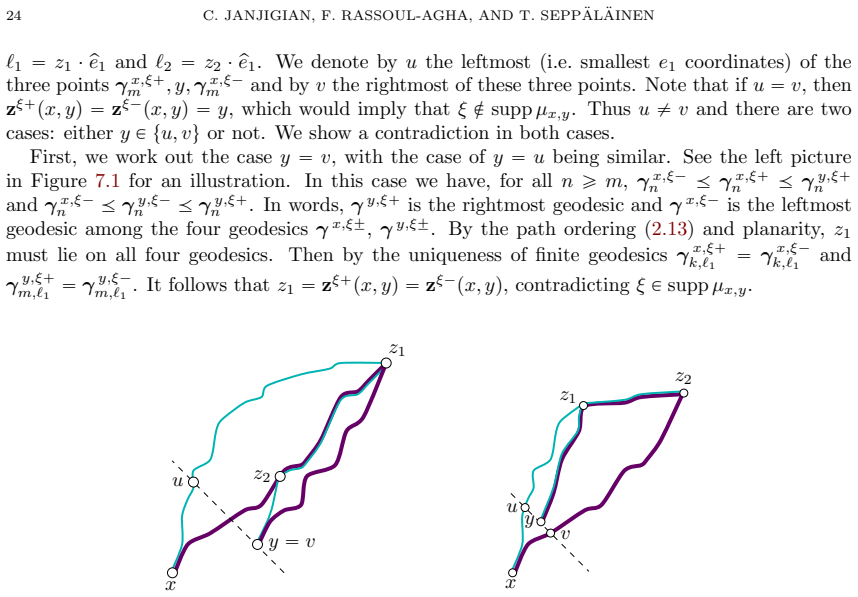

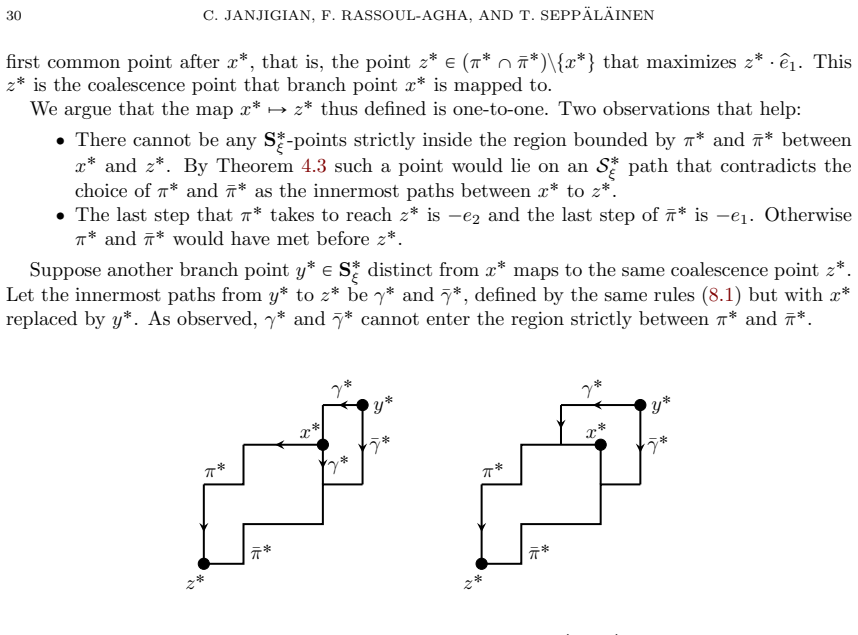
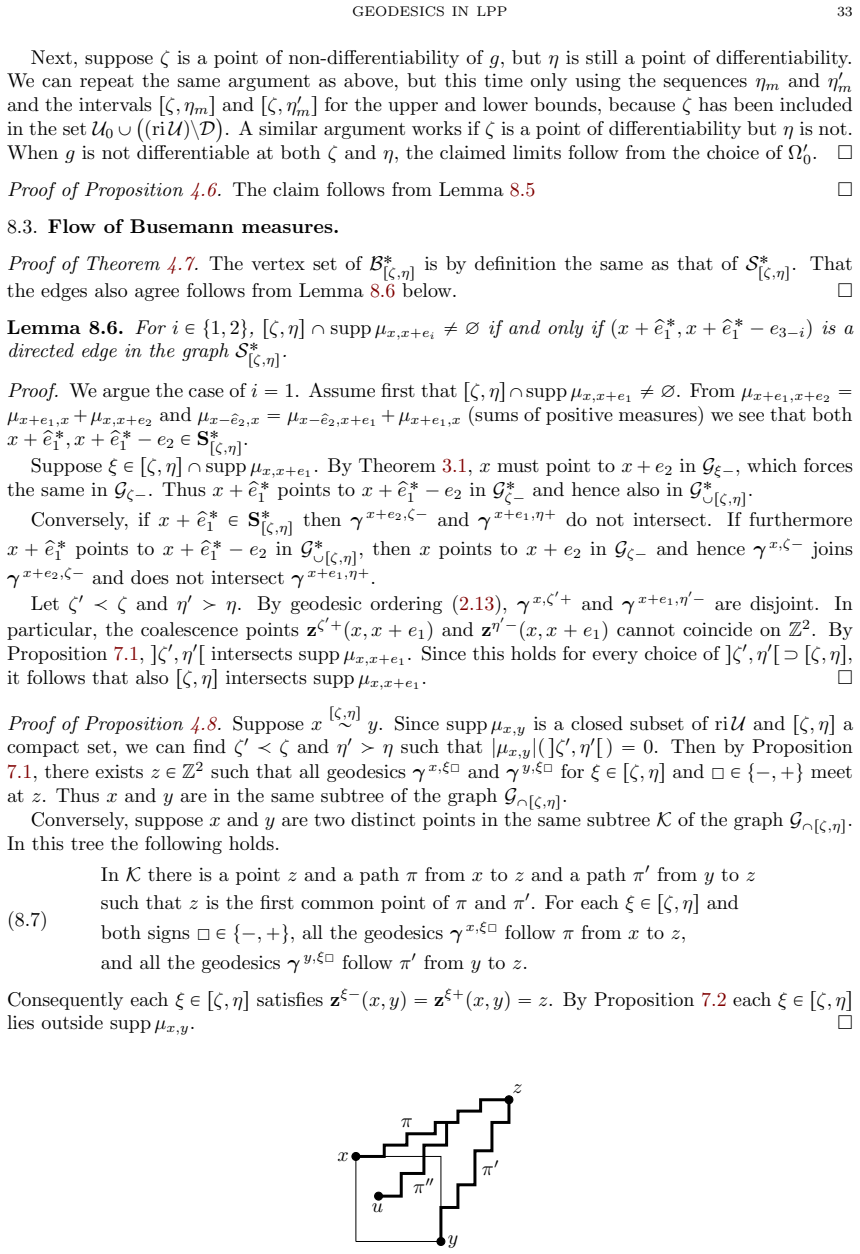
Reference graph
Works this paper leans on
-
[22]
Joint distribution of Busemann functions in the exactly solvable corner growth model
Wai-Tong Louis Fan and Timo Sepp¨ al¨ ainen. Joint distribution of Busemann functions in the exactly solvable corner growth model. 2018. Preprint ( arXiv 1808.09069 )
work page Pith review arXiv 2018
-
[1]
Random coalescing geodesics in first-passage percolation
Daniel Ahlberg and Christopher Hoffman. Random coalescing geodesics in first-passage percolation
-
[2]
50 years of first passage percolation, volume 68 of University Lecture Series
Antonio Auffinger, Jack Hanson, and Michael Damron. 50 years of first passage percolation, volume 68 of University Lecture Series. American Mathematical Society, Providence, RI, 2017
work page 2017
-
[3]
On the distribution of the length of the longest increasing subsequence of random permutations
Jinho Baik, Percy Deift, and Kurt Johansson. On the distribution of the length of the longest increasing subsequence of random permutations. J. Amer. Math. Soc. , 12(4):1119–1178, 1999
work page 1999
-
[4]
Inviscid Burgers equation with random kick forcing in noncompact setting
Yuri Bakhtin. Inviscid Burgers equation with random kick forcing in noncompact setting. Electron. J. Probab., 21:Paper No. 37, 50, 2016. 48 C. JANJIGIAN, F. RASSOUL-AGHA, AND T. SEPP ¨AL¨AINEN
work page 2016
-
[5]
Space-time stationary solutions for the Burgers equation
Yuri Bakhtin, Eric Cator, and Konstantin Khanin. Space-time stationary solutions for the Burgers equation. J. Amer. Math. Soc. , 27(1):193–238, 2014
work page 2014
-
[6]
On global solutions of the random Hamilton-Jacobi equations and the KPZ problem
Yuri Bakhtin and Konstantin Khanin. On global solutions of the random Hamilton-Jacobi equations and the KPZ problem. Nonlinearity, 31(4):R93–R121, 2018
work page 2018
-
[7]
Thermodynamic limit for directed polymers and stationary solutions of the Burgers equation
Yuri Bakhtin and Liying Li. Thermodynamic limit for directed polymers and stationary solutions of the Burgers equation. Comm. Pure Appl. Math. , 72(3):536–619, 2019
work page 2019
Show all 53 references
-
[8]
Non-existence of bi-infinite geodesics in the exponential corner growth model
M´ arton Bal´ azs, Ofer Busani, and Timo Sepp¨ al¨ ainen. Non-existence of bi-infinite geodesics in the exponential corner growth model. 2019. Preprint ( arXiv 1909.06883 )
2019 arXiv
-
[9]
Nonexistence of bigeodesics in integrable models of last passage percolation
Riddhipratim Basu, Christopher Hoffman, and Allan Sly. Nonexistence of bigeodesics in integrable models of last passage percolation. 11 2018. Preprint ( arXiv 1811.04908 )
2018 arXiv
-
[10]
Burgers turbulence.Phys
J´ er´ emie Bec and Konstantin Khanin. Burgers turbulence.Phys. Rep., 447(1-2):1–66, 2007
2007
-
[11]
Eric Cator and Leandro P. R. Pimentel. A shape theorem and semi-infinite geodesics for the Ham- mersley model with random weights. ALEA Lat. Am. J. Probab. Math. Stat. , 8:163–175, 2011
2011
-
[12]
Eric Cator and Leandro P. R. Pimentel. Busemann functions and equilibrium measures in last passage percolation models. Probab. Theory Related Fields, 154(1-2):89–125, 2012
2012
-
[13]
Eric Cator and Leandro P. R. Pimentel. Busemann functions and the speed of a second class particle in the rarefaction fan. Ann. Probab., 41(4):2401–2425, 2013
2013
-
[14]
The Kardar-Parisi-Zhang equation and universality class
Ivan Corwin. The Kardar-Parisi-Zhang equation and universality class. Random Matrices Theory Appl., 1(1):1130001, 76, 2012
2012
-
[15]
Kardar-Parisi-Zhang universality
Ivan Corwin. Kardar-Parisi-Zhang universality. Notices Amer. Math. Soc. , 63(3):230–239, 2016
2016
-
[16]
Multiple geodesics with the same direction
David Coupier. Multiple geodesics with the same direction. Electron. Commun. Probab., 16:517–527, 2011
2011
-
[17]
Busemann functions and infinite geodesics in two-dimensional first-passage percolation
Michael Damron and Jack Hanson. Busemann functions and infinite geodesics in two-dimensional first-passage percolation. Comm. Math. Phys. , 325(3):917–963, 2014
2014
-
[18]
Bigeodesics in First-Passage Percolation
Michael Damron and Jack Hanson. Bigeodesics in First-Passage Percolation. Comm. Math. Phys. , 349(2):753–776, 2017
2017
-
[19]
R. A. Doney. Last exit times for random walks. Stochastic Process. Appl., 31(2):321–331, 1989
1989
-
[20]
Khanin, A
Weinan E, K. Khanin, A. Mazel, and Ya. Sinai. Invariant measures for Burgers equation with stochastic forcing. Ann. of Math. (2) , 151(3):877–960, 2000
2000
-
[21]
A two-dimensional growth process
Murray Eden. A two-dimensional growth process. In Proc. 4th Berkeley Sympos. Math. Statist. and Prob., Vol. IV , pages 223–239. Univ. California Press, Berkeley, Calif., 1961
1961
-
[23]
An introduction to probability theory and its applications
William Feller. An introduction to probability theory and its applications. Vol. I . Third edition. John Wiley & Sons Inc., New York, 1968
1968
-
[24]
An introduction to probability theory and its applications
William Feller. An introduction to probability theory and its applications. Vol. II. Second edition. John Wiley & Sons Inc., New York, 1971
1971
-
[25]
Ferrari, James B
Pablo A. Ferrari, James B. Martin, and Leandro P. R. Pimentel. A phase transition for competition interfaces. Ann. Appl. Probab., 19(1):281–317, 2009
2009
-
[26]
Ferrari and Leandro P
Pablo A. Ferrari and Leandro P. R. Pimentel. Competition interfaces and second class particles. Ann. Probab., 33(4):1235–1254, 2005
2005
-
[27]
Geodesics and the competition interface for the corner growth model
Nicos Georgiou, Firas Rassoul-Agha, and Timo Sepp¨ al¨ ainen. Geodesics and the competition interface for the corner growth model. Probab. Theory Related Fields, 169(1-2):223–255, 2017
2017
-
[28]
Stationary cocycles and Busemann functions for the corner growth model
Nicos Georgiou, Firas Rassoul-Agha, and Timo Sepp¨ al¨ ainen. Stationary cocycles and Busemann functions for the corner growth model. Probab. Theory Related Fields, 169(1-2):177–222, 2017
2017
-
[29]
Glynn and Ward Whitt
Peter W. Glynn and Ward Whitt. Departures from many queues in series. Ann. Appl. Probab. , 1(4):546–572, 1991
1991
-
[30]
Takeuchi
Timothy Halpin-Healy and Kazumasa A. Takeuchi. A KPZ cocktail—shaken, not stirred . . . toasting 30 years of kinetically roughened surfaces. J. Stat. Phys. , 160(4):794–814, 2015
2015
-
[31]
Hammersley and J
John M. Hammersley and J. A. Dominic Welsh. First-passage percolation, subadditive processes, stochastic networks, and generalized renewal theory. In Proc. Internat. Res. Semin., Statist. Lab., Univ. California, Berkeley, Calif , pages 61–110. Springer-Verlag, New York, 1965
-
[32]
Geodesics in first passage percolation
Christopher Hoffman. Geodesics in first passage percolation. Ann. Appl. Probab. , 18(5):1944–1969, 2008
1944
-
[33]
Douglas Howard and Charles M
C. Douglas Howard and Charles M. Newman. Euclidean models of first-passage percolation. Probab. Theory Related Fields, 108(2):153–170, 1997
1997
-
[34]
Douglas Howard and Charles M
C. Douglas Howard and Charles M. Newman. Geodesics and spanning trees for Euclidean first-passage percolation. Ann. Probab., 29(2):577–623, 2001. GEODESICS IN LPP 49
2001
-
[35]
Busemann functions and Gibbs measures in directed polymer models on Z2
Christopher Janjigian and Firas Rassoul-Agha. Busemann functions and Gibbs measures in directed polymer models on Z2. 2018. Extended version ( arXiv 1810.03580v2 )
2018 arXiv
-
[36]
Busemann functions and Gibbs measures in directed polymer models on Z2
Christopher Janjigian and Firas Rassoul-Agha. Busemann functions and Gibbs measures in directed polymer models on Z2. Ann. Probab., 2019. To appear
2019
-
[37]
Shape fluctuations and random matrices
Kurt Johansson. Shape fluctuations and random matrices. Comm. Math. Phys. , 209(2):437–476, 2000
2000
-
[38]
Random measures
Olav Kallenberg. Random measures. Akademie-Verlag, Berlin; Academic Press, Inc. [Harcourt Brace Jovanovich, Publishers], London, third edition, 1983
1983
-
[39]
Random measures, theory and applications , volume 77 of Probability Theory and Stochastic Modelling
Olav Kallenberg. Random measures, theory and applications , volume 77 of Probability Theory and Stochastic Modelling. Springer, Cham, 2017
2017
-
[40]
Cristina Licea and Charles M. Newman. Geodesics in two-dimensional first-passage percolation. Ann. Probab., 24(1):399–410, 1996
1996
-
[41]
James B. Martin. Limiting shape for directed percolation models. Ann. Probab., 32(4):2908–2937, 2004
2004
-
[42]
Eginhard J. Muth. The reversibility property of production lines. Management Sci., 25(2):152–158, 1979/80
1979
-
[43]
Charles M. Newman. A surface view of first-passage percolation. In Proceedings of the International Congress of Mathematicians, Vol. 1, 2 (Z¨ urich, 1994), pages 1017–1023, Basel, 1995. Birkh¨ auser
1994
-
[44]
Introduction to KPZ
Jeremy Quastel. Introduction to KPZ. In Current developments in mathematics, 2011, pages 125–194. Int. Press, Somerville, MA, 2012
2011
-
[45]
The one-dimensional KPZ equation and its universality class
Jeremy Quastel and Herbert Spohn. The one-dimensional KPZ equation and its universality class. J. Stat. Phys. , 160(4):965–984, 2015
2015
-
[46]
World Scientific Publishing Co
P´ al R´ ev´ esz.Random walk in random and non-random environments . World Scientific Publishing Co. Pte. Ltd., Hackensack, NJ, second edition, 2005
2005
-
[47]
Nonequilibrium behaviour of a many particle process: density profile and local equilibria
Hermann Rost. Nonequilibrium behaviour of a many particle process: density profile and local equilibria. Z. Wahrsch. Verw. Gebiete , 58(1):41–53, 1981
1981
-
[48]
Hydrodynamic scaling, convex duality and asymptotic shapes of growth models
Timo Sepp¨ al¨ ainen. Hydrodynamic scaling, convex duality and asymptotic shapes of growth models. Markov Process. Related Fields, 4(1):1–26, 1998
1998
-
[49]
Yakov G. Sina˘ ı. Statistics of shocks in solutions of inviscid Burgers equation. Comm. Math. Phys. , 148(3):601–621, 1992
1992
-
[50]
Wladyslaw Szczotka and Frank P. Kelly. Asymptotic stationarity of queues in series and the heavy traffic approximation. Ann. Probab., 18(3):1232–1248, 1990
1990
-
[51]
Tracy and Harold Widom
Craig A. Tracy and Harold Widom. Level-spacing distributions and the Airy kernel. Comm. Math. Phys., 159(1):151–174, 1994
1994
-
[52]
W¨ uthrich
Mario V. W¨ uthrich. Asymptotic behaviour of semi-infinite geodesics for maximal increasing subse- quences in the plane. In In and out of equilibrium (Mambucaba, 2000) , volume 51 of Progr. Probab., pages 205–226. Birkh¨ auser Boston, Boston, MA, 2002. Christopher Janjigian, Un...
2000
-
[2016]
Preprint ( arXiv 1609.02447 )
Reviewed August 14, 2026 · model on record in the stance chip above.
Discussion (0). Continue with ORCID to comment.