REVIEW 1 major objections 5 minor 30 references
Structure and classification results for the $\infty$-elastica problem
T0 review · 1 major / 5 minor · reviewed 2026-08-14 · deepseek-v4-flash
Pith's one-line read Curves minimizing the $L^\infty$-norm of curvature are exactly the solutions of a differential system, and every solution is either a finite planar arc-and-line chain around a line or a three-dimensional helical-type curve.
desk verdict First complete treatment of the L∞-elastica problem; the characterization and classification hold up, with one fixable technical gap in Lemma 19. read the letter →
The pith
A machine-rendered reading of the paper's core claim, the machinery that carries it, and where it could break.
The reading
What carries the argument
An $L^p$ approximation with a deliberately added penalization term carries the argument. For finite $p$, minimizers of $K_p(\tau)+\frac{\mu}{2L}\int_0^L\beta|\tau-\tau_0|^2\,dt$ satisfy an explicit Euler-Lagrange equation on the sphere, and the penalization forces the approximating tangents to converge back to a chosen pseudo-minimizer $\tau_0$ as $p\to\infty$, despite nonuniqueness. Dividing the renormalized Euler-Lagrange equation by $1+|\Lambda_p|$ and passing to the limit yields the system $u'+ (u\cdot\tau')\tau=\beta(\lambda-(\lambda\cdot\tau)\tau)$ and $|u|\tau'=ku$, which reparametrization and projection convert into the system of Theorem 2. The structural dichotomy comes from the zero set of $f=k|u|$: wherever $f>0$ the ODE is nondegenerate and produces three-dimensional solutions; wherever $f=0$ the curve must run along circular arcs on great circles through $\lambda$, collapsing onto a line; Lemma 19 uses bounded variation of $\alpha$ to force only finitely many such intervals.
What would settle it
Take a bounded but non-$(BV)$ weight $\alpha$ and boundary data for which the multiplier $g$ from the weak system would vanish at a sequence of points accumulating inside the interval; numerically solve the system and check whether a curve with infinitely many planar arcs of curvature magnitude $k$ satisfies the weak equations. If such a curve exists, Theorem 4's 'finitely many intervals' is false without bounded variation.
Extended reading notes
Core claim
The central claim, Theorem 2, is that a curve $\gamma$ with unit tangent $T=\gamma'$ and curvature norm $k=K_\alpha(\gamma)$ is an $\infty$-elastica if and only if there exist a unit vector $\lambda$ and a nonzero, nonnegative function $g$ such that $g((\alpha T')' + k^2T/\alpha)=k^2\,\mathrm{proj}^{\perp}_{T,T'}(\lambda)$ and $g'=\alpha\,\lambda\cdot T'$ hold weakly. Theorem 4 then separates the solutions into two regimes. In the first, the curve leaves a single line $L\parallel \lambda$ only on finitely many relatively open intervals; on each such interval it is planar, its weighted curvature $\alpha\gamma''$ is continuous with magnitude exactly $k$, and the sign of $\lambda\cdot\gamma''$ flips at the ends of the interval. In the second, the curve lies in a three-dimensional affine subspace, $\alpha\gamma''$ is $W^{1,\infty}$ with $|\alpha\gamma''|\equiv k$, and the system holds with $g>0$ almost everywhere. The same system yields a sufficient condition for genuine minimizers, and examples show that $\infty$-elasticas can fail to be minimizers.
Load-bearing premise
The proof that the planar pieces are finite relies on the weight $\alpha$ having bounded variation with $1/\alpha$ bounded; if $\alpha$ is merely bounded, nothing in the argument stops the zero set of the multiplier from accumulating and the curve from having infinitely many alternating pieces.
Editorial extensions
If this is right
- Every $R$-geodesic in the bounded-curvature shortest-path problem minimizes the unweighted functional $K_1$, so Theorem 4 reproves and sharpens the classical planar and three-dimensional classifications of that problem.
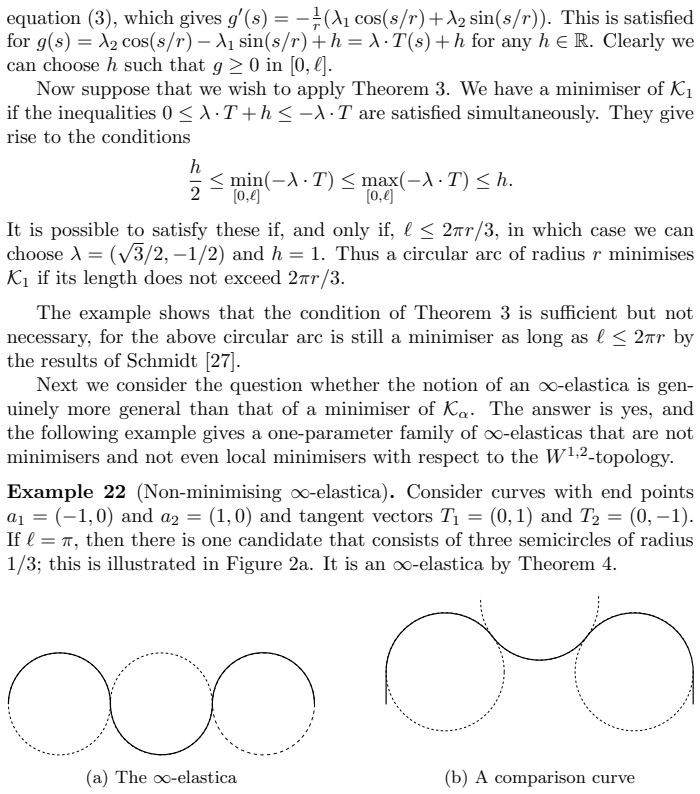
- With unit weight, planar $\infty$-elasticas are exactly two shapes: a circular arc, then line segments and equal-radius full circles, then a circular arc, or several equal-radius arcs of equal length with alternating orientation.
- A circular arc of radius $r$ is a minimizer of $K_1$ whenever its length is at most $2\pi r/3$ under the sufficient condition; the older chord result extends this bound to $2\pi r$, showing the sufficient condition is not necessary.
- There are $\infty$-elasticas that are not minimizers, including a one-parameter family of three-arc curves that are not even local minimizers in $W^{1,2}$.
- The theory covers weights $\alpha$ of bounded variation with bounded reciprocal, so the same classification applies to weighted maximum-curvature problems after reparametrization by the weight.
Reading between the lines
- If one drops bounded variation and only keeps $\alpha$ bounded, the proof's finiteness step fails; a natural extension would be to build a weight whose zero set accumulates and to check whether infinitely many planar pieces satisfy the weak system, which would mark the exact boundary of the classification.
- The same penalization trick, adding a distance term to select one solution in the limit, could transfer to other nonunique $L^\infty$ variational problems, where classical $L^p$ approximations only recover one of many minimizers.
- Because every $R$-geodesic minimizes $K_\alpha$, any uniqueness or regularity result proved for $K_\alpha$ minimizers automatically constrains shortest-path solutions, so the differential-equation description may offer a new route to stability questions in motion planning.
Signed reviews
Editorial analysis
A structured set of objections, weighed in public.
Referee Report
Summary. The paper studies the L-infinity elastica problem: among arc-length parametrized curves of fixed length with prescribed endpoints and endpoint tangents, minimize the essential supremum of alpha |gamma''|. After reparametrization by the weight alpha, the problem is reformulated in terms of tangent vector fields tau, minimizing ||tau'||_infinity under endpoint and integral constraints. The main results are Theorem 2, which characterizes infinity-elasticas (defined through a quadratic penalization inequality) by the ODE system (2)-(3); Theorem 3, a sufficient condition for genuine minimizers; and Theorem 4, a classification into finitely many planar circular-arc/line-segment pieces around a single line, or a three-dimensional curve solving the ODE system with a positive multiplier. The proof strategy is L^p approximation with a penalization term, passage p -> infinity, and then detailed analysis of the resulting ODE system. Section 7 connects the results to the Markov-Dubins problem and sketches an alternative proof of Dubins's and Sussmann's theorems.
Significance. If correct, these results are a substantial and novel contribution. The paper provides a usable Euler-Lagrange-type characterization for a non-differentiable L-infinity geometric variational problem and a complete structural classification of its solutions, going substantially beyond existing work on second-order L-infinity variational problems. The L^p approximation with penalization is well designed and the ODE analysis is detailed. The connection to Dubins's R-geodesics provides a valuable independent check on the classification. The main proofs are presented in considerable detail, and the treatment is largely self-contained. The classification theorem is significant enough to merit publication once the one load-bearing proof gap identified below is repaired.
major comments (1)
- [Section 6, Lemma 19] The paragraph beginning 'If b'_i <= b_i, then we may choose omega_i ...' applies a weighted mean value theorem to conclude that the integral of beta against a nonnegative weight is comparable to the weight evaluated at a point. This step requires continuity (or at least a Darboux-type property) of beta, whereas the standing assumption only gives beta of bounded variation, which permits jumps. As written, the inequalities displayed there are not justified. This is load-bearing: the estimate on the sum of |1 - b'_i/b_i| is exactly what forces I\Omega to be finite, and hence what yields the finite-decomposition conclusion in Theorem 4(i). The gap is repairable: replace the pointwise choices of omega_i and omega'_i by weighted averages of beta over the two subintervals; the identity between the two integrals gives b'_i/b_i as a ratio of two weighted averages of beta, and the difference of those averages is bounded by Var(beta, [t_i, t_{i+1}]) / inf beta. I recommend that the authors rewrite this paragraph accordingly.
minor comments (5)
- [Section 2, proof of Proposition 7(2)] The proof assumes an inequality with 'm > 0', while Definition 6 permits any real m; the argument goes through after replacing m by max{m,0}, but this reduction should be stated explicitly.
- [Section 3, Proposition 11] In the display following (18), 'beta|tau~ - tau'|^2' should read 'beta|tau~ - tau|^2', since sigma = tau~ - tau; the same typo appears two lines below.
- [Section 6, Lemma 17] The sentence 'It follows that Omega'\Omega is a null set, and so is Omega'\Omega' contains a duplication; the second clause should state that Omega'\Omega is open relative to [0,L], which is why it must be empty.
- [Section 7] The alternative proof of Dubins's theorem is only sketched and explicitly invokes Dubins's Lemma 2; the authors should list precisely which facts from [8] are used, so that the claimed alternative proof is checkable.
- [Section 2, Proposition 7(1)] The Euler-Lagrange derivation is omitted with a reference to standard harmonic-map-style constrained variation computations; a short derivation or a precise citation would improve self-containedness, though this is not a substantive issue.
Circularity Check
No significant circularity: the derivation is self-contained from the pseudo-minimiser definition through explicit L^p approximation and ODE analysis.
full rationale
The paper's central derivation is self-contained. Definition 1 introduces the ∞-elastica/pseudo-minimiser as an inequality with a quadratic penalty; this is the starting point, not an assumed conclusion. Section 2 reparametrises the problem and defines the L^p approximations J^µ_p with a penalisation term, and Proposition 7 proves existence and convergence using the direct method and the pseudo-minimiser inequality. The Euler-Lagrange equation (7) is derived from J^µ_p; Lemma 8 bounds the Lagrange multipliers; Proposition 9 passes p → ∞ to obtain the first-order system (10)-(11). Propositions 11 and 12 prove the converse and show equivalence with the second-order ODE system (19)-(20), giving Theorem 2. The classification in Theorem 4 follows from the ODE analysis in Lemmas 14-20, not from any prior result assumed as an input. The extra hypothesis that α has bounded variation and 1/α is bounded is an explicit standing assumption and is used transparently in Lemma 19; removing it would weaken the finite-interval conclusion of Theorem 4(i), but that is a scoping statement, not a circular step. The self-citations [13, 23, 26] are methodological comparisons and are not load-bearing for the main theorems. The Markov-Dubins connection in Proposition 5 is proved in the paper and is checked externally against Dubins's and Sussmann's results; it is not used to derive Theorem 2 or Theorem 4. No fitted parameter is renamed as a prediction, and no load-bearing uniqueness theorem is imported from the author's prior work.
Assumptions & free parameters
assumptions (3)
- domain assumption The admissible set G of curves satisfying (1) is nonempty for the given boundary data.
- standard math Standard existence, regularity, and ODE theory used throughout (direct method, Sobolev embedding, Picard-Lindelof) is valid.
- standard math The Euler-Lagrange equation (7) for minimizers on the sphere S^{n-1} holds as stated.
Cite this review
Pith. "Pith review of Structure and classification results for the $\infty$-elastica problem." pith.science (2026). https://pith.science/paper/73HOH6SB
@misc{pith2026190801569,
  author       = {Pith},
  title        = {Pith review of: Structure and classification results for the $\infty$-elastica problem},
  year         = {2026},
  howpublished = {\url{https://pith.science/paper/73HOH6SB}},
  note         = {Machine review of arXiv:1908.01569}
}
abstract
Consider the following variational problem: among all curves in $\mathbb{R}^n$ of fixed length with prescribed end points and prescribed tangents at the end points, minimise the $L^\infty$-norm of the curvature. We show that the solutions of this problem, and of a generalised version, are characterised by a system of differential equations. Furthermore, we have a lot of information about the structure of solutions, which allows a classification.
Figures

Reference graph
Works this paper leans on
-
[1]
Aronsson, Minimization problems for the functional supxF (x, f(x), f′(x)), Ark
G. Aronsson, Minimization problems for the functional supxF (x, f(x), f′(x)), Ark. Mat. 6 (1965), 33–53
work page 1965
-
[2]
, Minimization problems for the functional supxF (x,f (x),f′(x)). II, Ark. Mat. 6 (1966), 409–431
work page 1966
-
[3]
, Extension of functions satisfying Lipschitz conditions , Ark. Mat. 6 (1967), 551–561
work page 1967
-
[4]
, On certain minimax problems and Pontryagin’s maximum princi- ple, Calc. Var. Partial Differential Equations 37 (2010), no. 1-2, 99–109
work page 2010
-
[5]
W. Blaschke, Vorlesungen ¨ uber Differentialgeometrie und geometrische Grundlagen von Einsteins Relativit¨ atstheorie. Band I. Elementare Differ- entialgeometrie, Dover Publications, New York, N. Y., 1945, 3d ed
work page 1945
-
[6]
R. Bryant and P. Griffiths, Reduction for constrained variational problems and ´ 1 2k2ds, Amer. J. Math. 108 (1986), no. 3, 525–570
work page 1986
-
[7]
S. S. Chern, Curves and surfaces in Euclidean space , Studies in Global Geometry and Analysis, Math. Assoc. Amer. (distributed by Prentice-Hall, Englewood Cliffs, N.J.), 1967, pp. 16–56
work page 1967
-
[8]
L. E. Dubins, On curves of minimal length with a constraint on average curvature, and with prescribed initial and terminal positions and tangents , Amer. J. Math. 79 (1957), 497–516. 26
work page 1957
Show all 30 references
-
[9]
L. Euler, Methodus inveniendi lineas curvas maximi minimive proprietate gaudentes sive solutio problematis isoperimetrici latissimo sensu accepti , Marc-MichelBousquet & Co., Lausanne–Geneva, 1744
-
[10]
Ferone, B
V. Ferone, B. Kawohl, and C. Nitsch, Generalized elastica problems under area constraint, Math. Res. Lett. 25 (2018), no. 2, 521–533
2018
-
[11]
Huang, A note on the p-elastica in a constant sectional curvature man- ifold, J
R. Huang, A note on the p-elastica in a constant sectional curvature man- ifold, J. Geom. Phys. 49 (2004), no. 3-4, 343–349
2004
-
[12]
Katzourakis, An introduction to viscosity solutions for fully nonlinear PDE with applications to calculus of variations in L∞, SpringerBriefs in Mathematics, Springer, Cham, 2015
N. Katzourakis, An introduction to viscosity solutions for fully nonlinear PDE with applications to calculus of variations in L∞, SpringerBriefs in Mathematics, Springer, Cham, 2015
2015
-
[13]
Katzourakis and R
N. Katzourakis and R. Moser, Existence, uniqueness and structure of second order absolute minimisers , Arch. Ration. Mech. Anal. 231 (2019), no. 3, 1615–1634
2019
-
[14]
Katzourakis and E
N. Katzourakis and E. Parini, The eigenvalue problem for the ∞- Bilaplacian, NoDEA Nonlinear Differential Equations Appl. 24 (2017), no. 6, Art. 68, 25
2017
-
[15]
Katzourakis and T
N. Katzourakis and T. Pryer, Second-order L∞ variational problems and the ∞-polylaplacian, Adv. Calc. Var. (Ahead of Print) (2018), DOI:10.1515/acv-2016-0052
2018 doi
-
[16]
Methods Partial Differential Equations 35 (2019), no
, On the numerical approximation of p-biharmonic and ∞- biharmonic functions , Numer. Methods Partial Differential Equations 35 (2019), no. 1, 155–180
2019
-
[17]
Langer and D
J. Langer and D. A. Singer, Knotted elastic curves in R3, J. London Math. Soc. (2) 30 (1984), no. 3, 512–520
1984
-
[18]
Differential Geom
, The total squared curvature of closed curves , J. Differential Geom. 20 (1984), no. 1, 1–22
1984
-
[19]
Laumond, S
J. Laumond, S. Sekhavat, and F. Lamiraux, Guidelines in nonholonomic motion planning for mobile robots , Robot Motion Planning and Control, Lecture Notes in Control and Information Sciences, vol. 229, Springer- Verlag, Berlin–Heidelberg, 1998, pp. 1–53
1998
-
[20]
Linn´ er, Explicit elastic curves , Ann
A. Linn´ er, Explicit elastic curves , Ann. Global Anal. Geom. 16 (1998), no. 5, 445–475
1998
-
[21]
A. A. Markov, Some examples of the solution of a special kind of problem on greatest and least quantities, Soobshch. Kharkovsk. Mat. Obshch. 1 (1887), 250–276, in Russian
-
[22]
Masnou and J.-M
S. Masnou and J.-M. Morel, Level lines based disocclusion , Proceedings 1998 IEEE International Conference on Image Processing, 1998, pp. 259– 263
1998
-
[23]
Moser and H
R. Moser and H. Schwetlick, Minimizers of a weighted maximum of the Gauss curvature, Ann. Global Anal. Geom. 41 (2012), no. 2, 199–207. 27
2012
-
[24]
A Oldfather, C
W. A Oldfather, C. A. Ellis, and D. M. Brown, Leonhard Euler’s elastic curves, Isis 20 (1933), 72–160
1933
-
[25]
J. A. Reeds and L. A. Shepp, Optimal paths for a car that goes both forwards and backwards, Pacific J. Math. 145 (1990), no. 2, 367–393
1990
-
[26]
Z. N. Sakellaris, Minimization of scalar curvature in conformal geometry , Ann. Global Anal. Geom. 51 (2017), no. 1, 73–89
2017
-
[27]
Schmidt, ¨Uber das Extremum der Bogenl¨ ange einer Raumkurve bei vergeschriebenen Einschr¨ ankungen ihrer Kr¨ ummung, Sitzungsberichte preuss
E. Schmidt, ¨Uber das Extremum der Bogenl¨ ange einer Raumkurve bei vergeschriebenen Einschr¨ ankungen ihrer Kr¨ ummung, Sitzungsberichte preuss. Akad. Wissenschaften Berlin 1925 (1925), 485–490
1925
-
[28]
Schur, ¨Uber die Schwarzsche Extremaleigenschaft des Kreises unter den Kurven konstanter Kr¨ ummung, Math
A. Schur, ¨Uber die Schwarzsche Extremaleigenschaft des Kreises unter den Kurven konstanter Kr¨ ummung, Math. Ann. 83 (1921), 143–148
1921
-
[29]
Simon, Theorems on regularity and singularity of energy minimizing maps, Lectures in Math
L. Simon, Theorems on regularity and singularity of energy minimizing maps, Lectures in Math. ETH Z¨ urich, Birkh¨ auser, Basel, 1996
1996
-
[30]
H. J. Sussmann, Shortest 3-dimensional paths with a prescribed curvature bound, Proceedings of 1995 34th IEEE Conference on Decision and Control, vol. 4, 1995, pp. 3306–3312. 28
1995
Reviewed August 14, 2026 · model on record in the stance chip above.
Discussion (0). Continue with ORCID to comment.