REVIEW 2 major objections 5 minor 109 references
Constraining $\nu$-Process Production of Fluorine through Cosmic Ray Nucleosynthesis
T0 review · 2 major / 5 minor · reviewed 2026-08-14 · deepseek-v4-flash
Pith's one-line read The supernova neutrino process made fluorine early, but AGB stars made most of today's fluorine.
desk verdict A useful GCE paper that makes the right call on AGB-dominated solar fluorine, but the 11B/10B-based ν-process normalization is shakier than the paper admits, which mainly weakens the low-metallicity F predictions. read the letter →
The pith
A machine-rendered reading of the paper's core claim, the machinery that carries it, and where it could break.
The reading
What carries the argument
The load-bearing device is a one-parameter interpolation between two published $\nu$-process yield sets, $Y = \alpha Y_{\rm low} + (1-\alpha) Y_{\rm high}$, where low and high refer to different assumed neutrino temperatures. The same $\alpha$ multiplies the $^7$Li, $^{11}$B, and $^{19}$F yields. Setting $\alpha = 0.9$ makes the model reproduce the observed $^{11}$B/$^{10}$B = 4 at solar metallicity; since the same dial scales the fluorine yield, the fluorine evolution is determined rather than fitted.
What would settle it
A supernova yield calculation in which the ratio of $^{19}$F to $^{11}$B production changes substantially between the low- and high-temperature yield sets would break the single-parameter interpolation. Alternatively, fluorine measurements in several ultra-metal-poor stars with [Fe/H] below about $-2.5$ would test the predicted low-metallicity dominance of the $\nu$-process: a flat or declining [F/Fe] trend there would contradict the model.
Extended reading notes
Core claim
The paper argues that the supernova $\nu$-process (neutrino spallation on C, N, O, and Ne shell material) and AGB nucleosynthesis divide fluorine production by epoch rather than competing for the same stars. Using a one-zone chemical evolution model with standard Galactic cosmic-ray nucleosynthesis and a low-energy cosmic-ray component, the authors include three fluorine sources, massive stars, AGB stars, and the $\nu$-process, and calibrate the $\nu$-process by requiring the present-day $^{11}$B/$^{10}$B ratio to equal the observed value of 4. This fixes the interpolation parameter $\alpha = 0.9$ between the low- and high-energy neutrino yield sets, which then also fixes the $^7$Li and $^{19}$F yields. The resulting B/Be evolution is fully predicted, and the [F/H] evolution fits the data across metallicities. The central conclusion is that the $\nu$-process dominates fluorine at [Fe/H] below roughly $-1.5$ to $-2.2$, whereas the present-day fluorine abundance is almost entirely a product of AGB stars.
Load-bearing premise
The argument hinges on the assumption that fluorine and boron respond to supernova neutrino temperature in the same way, so a single dial set by the boron isotope ratio also fixes the fluorine yield; if fluorine's response differs, the fluorine prediction could be wrong.
Editorial extensions
If this is right
- At metallicities below about [Fe/H] = $-1.5$ to $-2.2$, fluorine tracks the supernova rate, so future low-metallicity fluorine measurements directly test the $\nu$-process normalization.
- The present-day fluorine abundance is essentially an AGB output, so improvements in intermediate-mass-star yields matter more than further neutrino-temperature refinements for matching solar fluorine.
- Because B/Be is predicted once $^{11}$B/$^{10}$B is fitted, a robust low-metallicity measurement of B/Be provides an independent check of the same calibration.
- Solar-metallicity fluorine data cannot distinguish the high from the low neutrino-temperature yield choices; the discriminating power lies only at low metallicity.
Reading between the lines
- If the single-$\alpha$ transfer is valid, the same calibration strategy could be applied to other $\nu$-process isotopes, turning the boron isotope ratio into a general dial for neutrino-created nuclei.
- A targeted yield calculation comparing $^{19}$F and $^{11}$B production across a range of neutrino temperatures would quantify how much error the linear interpolation hides; the paper does not provide this calculation.
- If future fluorine observations at [Fe/H] below about $-2.2$ fail to show the predicted $\nu$-process dominance, the boron-calibrated $\alpha$ would need to be lowered, which would then require an additional $^{11}$B source to keep $^{11}$B/$^{10}$B at 4.
Signed reviews
Editorial analysis
A structured set of objections, weighed in public.
Referee Report
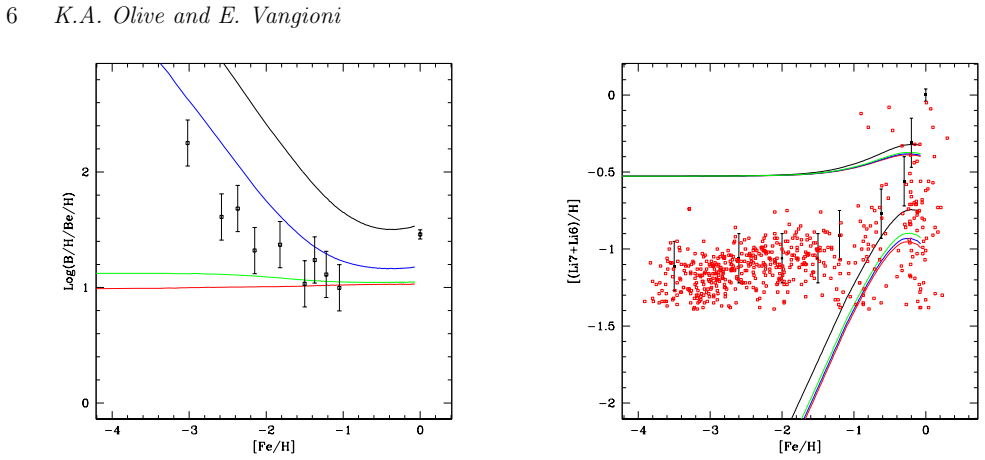
Summary. The paper combines a one-zone closed-box Galactic chemical evolution model with a standard GCRN treatment to follow Li, Be, B, and F self-consistently. It uses AGB yields, massive-star yields, and the low- and high-neutrino-temperature ν-process yields of Sieverding et al. (2018), interpolating between the two sets with a single parameter α (Eq. 3). The GCR flux is normalized to the present Be abundance, the LEC component to the low-metallicity Be slope, and α = 0.9 is fixed by requiring 11B/10B = 4 today. The resulting model reproduces the evolution of Be, B, B/Be, 11B/10B, and F, and yields the main conclusion that ν-process F dominates at low metallicity while present-day F is dominated by AGB production.
Significance. The central solar-metallicity conclusion is robust: even the high-energy ν yields in Fig. 10 fall far below the solar F abundance, so the claim that AGB stars dominate present-day F does not depend on the interpolation. The paper also provides a falsifiable prediction: once α is fixed from 11B/10B, the B/Be ratio and the F evolution are no longer free, and the agreement in Figs. 8 and 12 is a nontrivial success. The main weakness is that the quantitative low-metallicity F prediction relies on an untested interpolation ansatz, and no uncertainties are propagated. These issues are fixable and do not undermine the AGB-domination result.
major comments (2)
- [§4.2, Eq. (3)] Section 4.2, Eq. (3): The interpolation Y = αY_low + (1−α)Y_high is applied with a single α to all ν-process products, and α = 0.9 is fixed solely from 11B/10B. This determines the F yield only if the 19F/11B production ratio is nearly independent of where the true neutrino spectrum lies between the low and high Sieverding sets. That is not demonstrated: 11B is made in the C shell while 19F is made in the Ne shell, and the two yield sets differ in several neutrino temperatures (Tνe = 2.8 vs 4 MeV; Tν̄e,νμ,τ = 4 vs 5/6 MeV). Please report the 19F/11B yield ratio for both sets, and either show that it is approximately constant or allow a separate interpolation parameter for F (e.g., fitted to the available F data). Without this, the predicted [F/H] in Fig. 12 and the low-metallicity dominance thresholds in Section 4.3 are not consequences of the 11B/10B normalization.
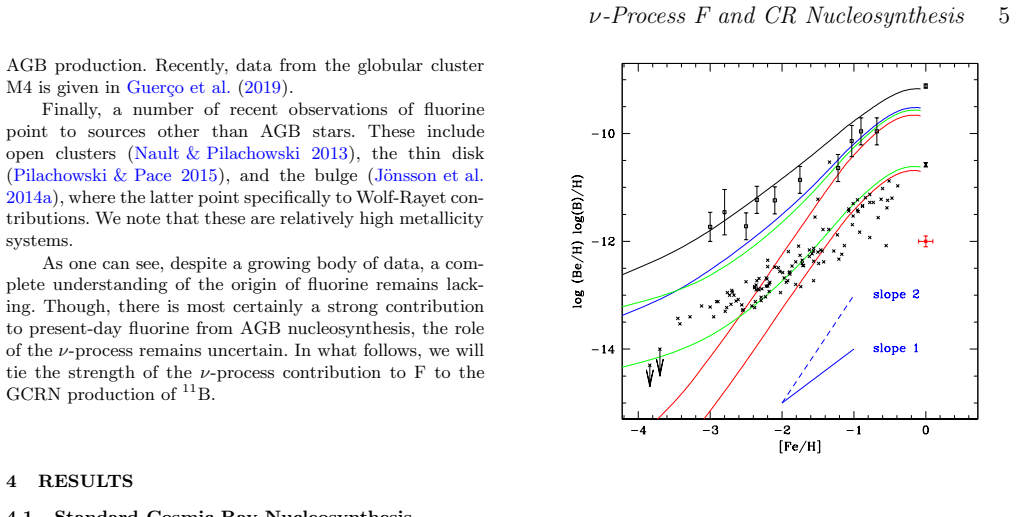
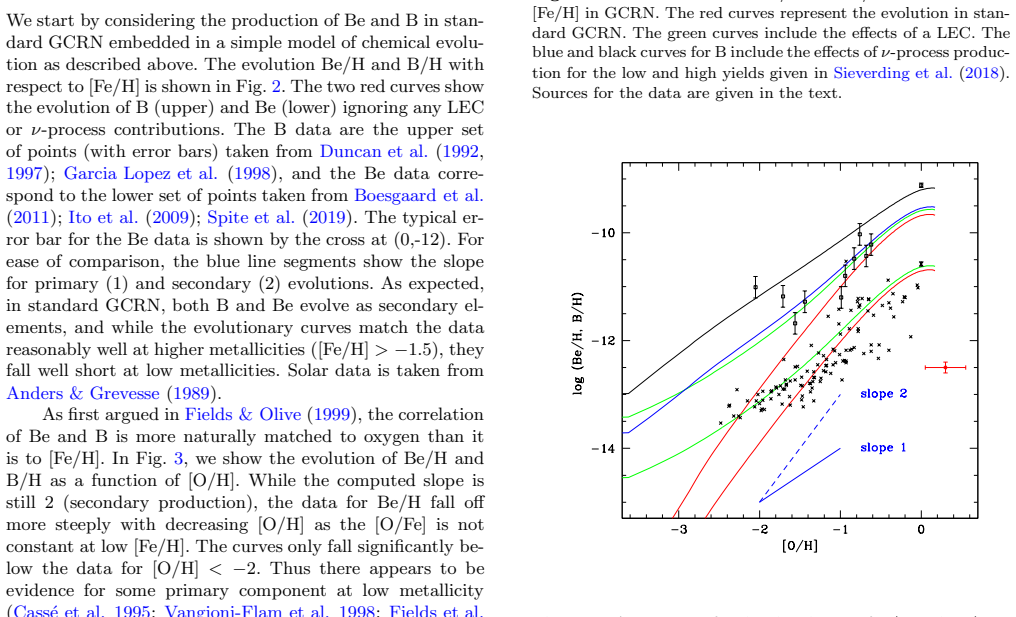
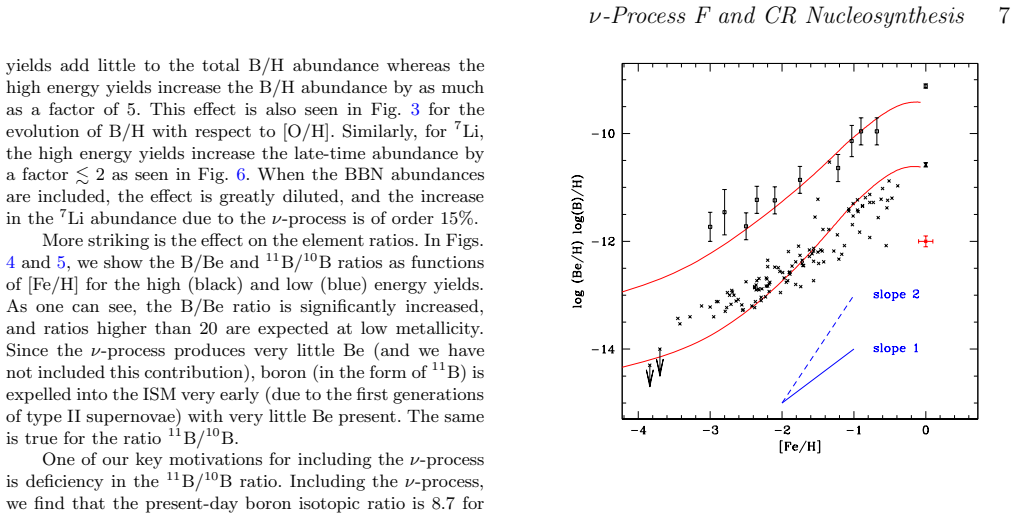
- [§4.1–4.3, Figs. 7–12] Throughout Sections 4.1–4.3: The model contains at least five fitted or uncertain inputs (star formation efficiency ν, IMF slope, GCR flux normalization, LEC strength, and α), but all quoted results are single curves with no uncertainty band or sensitivity study. The claim that the final model 'fits the data well' (Fig. 12) is therefore hard to evaluate, especially given the large dispersion in F data. Please add a sensitivity analysis, at minimum varying α within its plausible range and varying the AGB yield set, and state whether the conclusions (AGB domination at solar metallicity and ν-process domination at low [Fe/H]) survive.
minor comments (5)
- [§3.2] The text contains a typo: '[F/H[' should be '[F/H]'.
- [Fig. 12 caption] The caption says 'As in Fig. 7 for the evolution of [F/H]', but Fig. 7 shows B/H and Be/H; the intended cross-reference is likely Fig. 10.
- [§4.2] The phrase 'We normalize the "neutrino temperature" and interpolate' is misleading: the quantity actually fixed is the interpolation parameter α, not the neutrino temperature.
- [§2.2 / §4.2] The paper would be easier to reproduce if the adopted ν-process yields for 7Li, 11B, and 19F (low and high) were given in a table, since Eq. (3) is central to the analysis.
- [§5] In the concluding section, 'the present-day abundance of F, it almost entirely a result of AGB production' contains a grammatical error ('it' should be 'is').
Circularity Check
No significant circularity: the ν-process normalization is fixed by 11B/10B, and the F abundance and B/Be are genuine outputs; the interpolation assumption is a physics caveat, not a circular reduction.
full rationale
The paper fits only the parameter α in Eq. (3) to the observed present-day 11B/10B = 4.05. The F abundance and B/Be ratio are not used in that fit, so the resulting F evolution in Fig. 12 and B/Be in Fig. 8 are outputs of the model rather than re-statements of the input. The same α is applied to all ν-process products; this is an explicit assumption about the relative response of 7Li, 11B, and 19F yields to neutrino temperature. If the 19F/11B yield ratio were strongly temperature dependent, the F prediction would be less robust, but this is a modeling and robustness concern, not circularity, because the F prediction cannot be algebraically reduced to the 11B/10B input by the paper's equations. The GCRN framework is drawn from the authors' earlier papers (Fields & Olive 1999; Fields et al. 2000), but those are standard and externally benchmarked calculations, and the ν-process yields come from the independent Sieverding et al. (2018) work. No uniqueness theorem or ansatz is imported solely through a self-citation, and no fitted parameter is renamed as a prediction for F. The central conclusion that present-day F is dominated by AGB stars is robust even for the high-energy ν yields, as shown in Fig. 10. Therefore, there is no significant circularity.
Assumptions & free parameters
free parameters (5)
- star formation efficiency ν =
0.3
- IMF slope =
-2.7
- GCR flux normalization =
not stated
- LEC component strength =
not stated
- α (ν-process yield interpolation) =
0.9
assumptions (5)
- domain assumption The one-zone, closed-box chemical evolution model with instantaneous recycling approximations describes the Galaxy.
- domain assumption GCRN production rate follows Eq. (1) with a leaky-box propagation and a source spectrum proportional to the star formation rate.
- domain assumption Published stellar yields (Woosley & Weaver 1995; Karakas 2010; Sieverding et al. 2018) are accurate for C, N, O, F, Li, Be, B.
- ad hoc to paper The true ν-process yields lie on the linear interpolation between the low and high energy sets of Sieverding et al. (2018).
- domain assumption The 11B/10B ratio in the ISM is 4, as observed in meteorites.
Cite this review
Pith. "Pith review of Constraining $\nu$-Process Production of Fluorine through Cosmic Ray Nucleosynthesis." pith.science (2026). https://pith.science/paper/73I6RXAA
@misc{pith2026190801723,
  author       = {Pith},
  title        = {Pith review of: Constraining $\nu$-Process Production of Fluorine through Cosmic Ray Nucleosynthesis},
  year         = {2026},
  howpublished = {\url{https://pith.science/paper/73I6RXAA}},
  note         = {Machine review of arXiv:1908.01723}
}
abstract
Fluorine is massive enough that it is not considered to be a light ($Z\le5$) element, yet compared to its near neighbors, C, N, O, and Ne, it is far underproduced in the course of stellar evolution, making its origin more complex. In fact, the abundance of fluorine is the lowest among all elements between Z = 5 and 21 and is roughly 3-4 orders of magnitude below that of C, N, O, and Ne. There are several plausible sources for F beyond standard stellar evolution. These include the production in the asymptotic giant branch phase (AGB) in intermediate mass stars, production in Wolf-Rayet stars, and the production through neutrino spallation in supernovae. The latter, known as the $\nu$-process, is an important source for B11, and may contribute to the abundance of Li7 as well. We combine a simple model of Galactic chemical evolution with a standard Galactic cosmic ray nucleosynthesis model to treat self-consistently the evolution of the Li, Be, and B isotopes. We include massive star production of F, as well as contributions from AGB stars, and the $\nu$-process. Given the uncertainties in neutrino energies in supernovae, we normalize the $\nu$-process using the observed B11/B10 ratio as a constraint. As a consequence, we are able to determine the relative importance of each contribution to the F abundance. We find that although the $\nu$-process dominates at early times (low metallicity), the present-day F abundance is found to originate primarily from AGB stars.
Figures

Figures from the paper (8 more)



Reference graph
Works this paper leans on
-
[1]
Abia C., Canal R., 1988, , https://ui.adsabs.harvard.edu/abs/1988A&A...189...55A 189, 55
1988
-
[2]
Abia C., Cunha K., Cristallo S., de Laverny P., Dom \' nguez I., Recio-Blanco A., Smith V. V., Straniero O., 2011, @doi [ ] 10.1088/2041-8205/737/1/L8 , https://ui.adsabs.harvard.edu/abs/2011ApJ...737L...8A 737, L8
-
[3]
Abia C., Cunha K., Cristallo S., de Laverny P., 2015, @doi [ ] 10.1051/0004-6361/201526586 , https://ui.adsabs.harvard.edu/abs/2015A&A...581A..88A 581, A88
-
[4]
Alib \'e s A., Labay J., Canal R., 2001, @doi [ ] 10.1051/0004-6361:20010296 , https://ui.adsabs.harvard.edu/abs/2001A&A...370.1103A 370, 1103
-
[5]
Alves-Brito A., Yong D., Mel \'e ndez J., V \'a squez S., Karakas A. I., 2012, @doi [ ] 10.1051/0004-6361/201118623 , https://ui.adsabs.harvard.edu/abs/2012A&A...540A...3A 540, A3
-
[6]
Anders E., Grevesse N., 1989, @doi [ ] 10.1016/0016-7037(89)90286-X , https://ui.adsabs.harvard.edu/abs/1989GeCoA..53..197A 53, 197
-
[7]
Banerjee P., Qian Y.-Z., Haxton W. C., Heger A., 2013, @doi [ ] 10.1103/PhysRevLett.110.141101 , https://ui.adsabs.harvard.edu/abs/2013PhRvL.110n1101B 110, 141101
-
[8]
Bensby T., Feltzing S., Oey M. S., 2014, @doi [ ] 10.1051/0004-6361/201322631 , https://ui.adsabs.harvard.edu/abs/2014A&A...562A..71B 562, A71
Show all 109 references
-
[9]
Bloemen H., et al., 1994, , https://ui.adsabs.harvard.edu/abs/1994A&A...281L...5B 281, L5
1994
-
[10]
M., King J
Boesgaard A. M., King J. R., 1993, @doi [ ] 10.1086/116803 , https://ui.adsabs.harvard.edu/abs/1993AJ....106.2309B 106, 2309
1993 doi
-
[11]
M., King J
Boesgaard A. M., King J. R., Deliyannis C. P., Vogt S. S., 1999a, @doi [ ] 10.1086/300691 , https://ui.adsabs.harvard.edu/abs/1999AJ....117..492B 117, 492
-
[12]
M., Deliyannis C
Boesgaard A. M., Deliyannis C. P., King J. R., Ryan S. G., Vogt S. S., Beers T. C., 1999b, @doi [ ] 10.1086/300780 , https://ui.adsabs.harvard.edu/abs/1999AJ....117.1549B 117, 1549
-
[13]
M., Rich J
Boesgaard A. M., Rich J. A., Levesque E. M., Bowler B. P., 2011, @doi [ ] 10.1088/0004-637X/743/2/140 , https://ui.adsabs.harvard.edu/abs/2011ApJ...743..140B 743, 140
2011 doi
-
[14]
Cass \'e M., Lehoucq R., Vangioni-Flam E., 1995, @doi [ ] 10.1038/373318a0 , https://ui.adsabs.harvard.edu/abs/1995Natur.373..318C 373, 318
1995 doi
-
[15]
Chaussidon M., Robert F., 1995, @doi [ ] 10.1038/374337a0 , https://ui.adsabs.harvard.edu/abs/1995Natur.374..337C 374, 337
1995 doi
-
[16]
D., 1983, Principles of stellar evolution and nucleosynthesis
Clayton D. D., 1983, Principles of stellar evolution and nucleosynthesis
1983
-
[18]
V., Lambert D
Cunha K., Smith V. V., Lambert D. L., Hinkle K. H., 2003, @doi [ ] 10.1086/377023 , https://ui.adsabs.harvard.edu/abs/2003AJ....126.1305C 126, 1305
2003 doi
-
[19]
H., Fields B
Cyburt R. H., Fields B. D., Olive K. A., 2008, @doi [ ] 10.1088/1475-7516/2008/11/012 , https://ui.adsabs.harvard.edu/abs/2008JCAP...11..012C 2008, 012
2008 doi
-
[20]
H., Fields B
Cyburt R. H., Fields B. D., Olive K. A., Yeh T.-H., 2016, @doi [Reviews of Modern Physics] 10.1103/RevModPhys.88.015004 , https://ui.adsabs.harvard.edu/abs/2016RvMP...88a5004C 88, 015004
2016 doi
-
[21]
D'Orazi V., et al., 2013, @doi [ ] 10.1088/0004-637X/763/1/22 , https://ui.adsabs.harvard.edu/abs/2013ApJ...763...22D 763, 22
2013 doi
-
[22]
K., Lambert D
Duncan D. K., Lambert D. L., Lemke M., 1992, @doi [ ] 10.1086/172088 , https://ui.adsabs.harvard.edu/abs/1992ApJ...401..584D 401, 584
1992 doi
-
[23]
K., Primas F., Rebull L
Duncan D. K., Primas F., Rebull L. M., Boesgaard A. M., Deliyannis C. P., Hobbs L. M., King J. R., Ryan S. G., 1997, @doi [ ] 10.1086/304683 , https://ui.adsabs.harvard.edu/abs/1997ApJ...488..338D 488, 338
1997 doi
-
[24]
K., Rebull L
Duncan D. K., Rebull L. M., Primas F., Boesgaard A. M., Deliyannis C. P., Hobbs L. M., King J. R., Ryan S. G., 1998, , https://ui.adsabs.harvard.edu/abs/1998A&A...332.1017D 332, 1017
1998
-
[25]
C., Drury L
Ellison D. C., Drury L. O., Meyer J.-P., 1997, @doi [ ] 10.1086/304580 , https://ui.adsabs.harvard.edu/abs/1997ApJ...487..197E 487, 197
1997 doi
-
[26]
R., Sheffer Y., Lambert D
Federman S. R., Sheffer Y., Lambert D. L., Smith V. V., 2005, @doi [ ] 10.1086/426778 , https://ui.adsabs.harvard.edu/abs/2005ApJ...619..884F 619, 884
2005 doi
-
[27]
D., Olive K
Fields B. D., Olive K. A., 1999, @doi [ ] 10.1086/307145 , https://ui.adsabs.harvard.edu/abs/1999ApJ...516..797F 516, 797
1999 doi
-
[28]
D., Olive K
Fields B. D., Olive K. A., Schramm D. N., 1994, @doi [ ] 10.1086/174805 , https://ui.adsabs.harvard.edu/abs/1994ApJ...435..185F 435, 185
1994 doi
-
[29]
D., Olive K
Fields B. D., Olive K. A., Schramm D. N., 1995, @doi [ ] 10.1086/175224 , https://ui.adsabs.harvard.edu/abs/1995ApJ...439..854F 439, 854
1995 doi
-
[30]
D., Cass \'e M., Vangioni-Flam E., Nomoto K., 1996, @doi [ ] 10.1086/177148 , https://ui.adsabs.harvard.edu/abs/1996ApJ...462..276F 462, 276
Fields B. D., Cass \'e M., Vangioni-Flam E., Nomoto K., 1996, @doi [ ] 10.1086/177148 , https://ui.adsabs.harvard.edu/abs/1996ApJ...462..276F 462, 276
1996 doi
-
[31]
D., Olive K
Fields B. D., Olive K. A., Vangioni-Flam E., Cass \'e M., 2000, @doi [ ] 10.1086/309356 , https://ui.adsabs.harvard.edu/abs/2000ApJ...540..930F 540, 930
2000 doi
-
[32]
Forestini M., Goriely S., Jorissen A., Arnould M., 1992, , https://ui.adsabs.harvard.edu/abs/1992A&A...261..157F 261, 157
1992
-
[33]
L., Bromm V., 2007, @doi [ ] 10.1111/j.1745-3933.2007.00344.x , https://ui.adsabs.harvard.edu/abs/2007MNRAS.380L..40F 380, L40
Frebel A., Johnson J. L., Bromm V., 2007, @doi [ ] 10.1111/j.1745-3933.2007.00344.x , https://ui.adsabs.harvard.edu/abs/2007MNRAS.380L..40F 380, L40
2007
-
[34]
J., Lambert D
Garcia Lopez R. J., Lambert D. L., Edvardsson B., Gustafsson B., Kiselman D., Rebolo R., 1998, @doi [ ] 10.1086/305722 , https://ui.adsabs.harvard.edu/abs/1998ApJ...500..241G 500, 241
1998 doi
-
[35]
E., 1992, @doi [ ] 10.1038/357379a0 , https://ui.adsabs.harvard.edu/abs/1992Natur.357..379G 357, 379
Gilmore G., Gustafsson B., Edvardsson B., Nissen P. E., 1992, @doi [ ] 10.1038/357379a0 , https://ui.adsabs.harvard.edu/abs/1992Natur.357..379G 357, 379
1992 doi
-
[36]
Guer c o R., et al., 2019, @doi [ ] 10.3847/1538-4357/ab1340 , https://ui.adsabs.harvard.edu/abs/2019ApJ...876...43G 876, 43
2019 doi
-
[37]
C., Langanke K., Mart \' nez-Pinedo G., Woosley S
Heger A., Kolbe E., Haxton W. C., Langanke K., Mart \' nez-Pinedo G., Woosley S. E., 2005, @doi [Physics Letters B] 10.1016/j.physletb.2004.12.017 , https://ui.adsabs.harvard.edu/abs/2005PhLB..606..258H 606, 258
2005 doi
-
[38]
C., Lingenfelter R
Higdon J. C., Lingenfelter R. E., Ramaty R., 1998, @doi [ ] 10.1086/311757 , https://ui.adsabs.harvard.edu/abs/1998ApJ...509L..33H 509, L33
1998 doi
-
[39]
J., Rebolo R., 1998, @doi [ ] 10.1086/306351 , https://ui.adsabs.harvard.edu/abs/1998ApJ...507..805I 507, 805
Israelian G., Garc \' a L \'o pez R. J., Rebolo R., 1998, @doi [ ] 10.1086/306351 , https://ui.adsabs.harvard.edu/abs/1998ApJ...507..805I 507, 805
1998 doi
-
[40]
J., Bonifacio P., Molaro P., Basri G., Shchukina N., 2001, @doi [ ] 10.1086/320225 , https://ui.adsabs.harvard.edu/abs/2001ApJ...551..833I 551, 833
Israelian G., Rebolo R., Garc \' a L \'o pez R. J., Bonifacio P., Molaro P., Basri G., Shchukina N., 2001, @doi [ ] 10.1086/320225 , https://ui.adsabs.harvard.edu/abs/2001ApJ...551..833I 551, 833
2001 doi
-
[41]
C., 2009, @doi [ ] 10.1088/0004-637X/698/1/L37 , https://ui.adsabs.harvard.edu/abs/2009ApJ...698L..37I 698, L37
Ito H., Aoki W., Honda S., Beers T. C., 2009, @doi [ ] 10.1088/0004-637X/698/1/L37 , https://ui.adsabs.harvard.edu/abs/2009ApJ...698L..37I 698, L37
2009 doi
-
[42]
J \"o nsson H., et al., 2014a, @doi [ ] 10.1051/0004-6361/201423597 , https://ui.adsabs.harvard.edu/abs/2014A&A...564A.122J 564, A122
-
[43]
M., Richter M
J \"o nsson H., Ryde N., Harper G. M., Richter M. J., Hinkle K. H., 2014b, @doi [ ] 10.1088/2041-8205/789/2/L41 , https://ui.adsabs.harvard.edu/abs/2014ApJ...789L..41J 789, L41
-
[44]
J \"o nsson H., Ryde N., Spitoni E., Matteucci F., Cunha K., Smith V., Hinkle K., Schultheis M., 2017, @doi [ ] 10.3847/1538-4357/835/1/50 , https://ui.adsabs.harvard.edu/abs/2017ApJ...835...50J 835, 50
2017 doi
-
[45]
V., Lambert D
Jorissen A., Smith V. V., Lambert D. L., 1992, , https://ui.adsabs.harvard.edu/abs/1992A&A...261..164J 261, 164
1992
-
[46]
I., 2010, @doi [ ] 10.1111/j.1365-2966.2009.16198.x , http://adsabs.harvard.edu/abs/2010MNRAS.403.1413K 403, 1413
Karakas A. I., 2010, @doi [ ] 10.1111/j.1365-2966.2009.16198.x , http://adsabs.harvard.edu/abs/2010MNRAS.403.1413K 403, 1413
2010
-
[47]
I., Lattanzio J
Karakas A. I., Lattanzio J. C., 2014, @doi [ ] 10.1017/pasa.2014.21 , http://adsabs.harvard.edu/abs/2014PASA...31...30K 31, e030
2014 doi
-
[48]
R., 2001, @doi [ ] 10.1086/324452 , https://ui.adsabs.harvard.edu/abs/2001AJ....122.3115K 122, 3115
King J. R., 2001, @doi [ ] 10.1086/324452 , https://ui.adsabs.harvard.edu/abs/2001AJ....122.3115K 122, 3115
2001 doi
-
[49]
I., Umeda H., 2011a, @doi [ ] 10.1111/j.1365-2966.2011.18621.x , https://ui.adsabs.harvard.edu/abs/2011MNRAS.414.3231K 414, 3231
Kobayashi C., Karakas A. I., Umeda H., 2011a, @doi [ ] 10.1111/j.1365-2966.2011.18621.x , https://ui.adsabs.harvard.edu/abs/2011MNRAS.414.3231K 414, 3231
2011
-
[50]
I., Yoshida T., Yong D., Umeda H., 2011b, @doi [ ] 10.1088/2041-8205/739/2/L57 , https://ui.adsabs.harvard.edu/abs/2011ApJ...739L..57K 739, L57
Kobayashi C., Izutani N., Karakas A. I., Yoshida T., Yong D., Umeda H., 2011b, @doi [ ] 10.1088/2041-8205/739/2/L57 , https://ui.adsabs.harvard.edu/abs/2011ApJ...739L..57K 739, L57
-
[51]
Kusakabe M., et al., 2019, @doi [ ] 10.3847/1538-4357/aafc35 , https://ui.adsabs.harvard.edu/abs/2019ApJ...872..164K 872, 164
2019 doi
-
[52]
arXiv:1901.03741
Langanke K., Martinez-Pinedo G., Sieverding A., 2019, arXiv e-prints, https://ui.adsabs.harvard.edu/abs/2019arXiv190103741L p. arXiv:1901.03741
2019 arXiv
-
[53]
Lemoine M., Vangioni-Flam E., Cass \'e M., 1998, @doi [ ] 10.1086/305650 , https://ui.adsabs.harvard.edu/abs/1998ApJ...499..735L 499, 735
1998 doi
-
[54]
N., Ludwig H
Li H. N., Ludwig H. G., Caffau E., Christlieb N., Zhao G., 2013, @doi [ ] 10.1088/0004-637X/765/1/51 , https://ui.adsabs.harvard.edu/abs/2013ApJ...765...51L 765, 51
2013 doi
-
[55]
A., Pignatari M., Herwig F., 2011, @doi [ ] 10.1088/0004-637X/729/1/40 , https://ui.adsabs.harvard.edu/abs/2011ApJ...729...40L 729, 40
Lucatello S., Masseron T., Johnson J. A., Pignatari M., Herwig F., 2011, @doi [ ] 10.1088/0004-637X/729/1/40 , https://ui.adsabs.harvard.edu/abs/2011ApJ...729...40L 729, 40
2011 doi
-
[56]
Meneguzzi M., Reeves H., 1975, , https://ui.adsabs.harvard.edu/abs/1975A&A....40...99M 40, 99
1975
-
[57]
Meneguzzi M., Audouze J., Reeves H., 1971, , https://ui.adsabs.harvard.edu/abs/1971A&A....15..337M 15, 337
1971
-
[58]
Meynet G., Arnould M., 2000, , https://ui.adsabs.harvard.edu/abs/2000A&A...355..176M 355, 176
2000
-
[59]
Molaro P., Bonifacio P., Castelli F., Pasquini L., 1997, , https://ui.adsabs.harvard.edu/abs/1997A&A...319..593M 319, 593
1997
-
[60]
Mowlavi N., Jorissen A., Arnould M., 1996, , https://ui.adsabs.harvard.edu/abs/1996A&A...311..803M 311, 803
1996
-
[61]
Mowlavi N., Jorissen A., Arnould M., 1998, , https://ui.adsabs.harvard.edu/abs/1998A&A...334..153M 334, 153
1998
-
[62]
A., Pilachowski C
Nault K. A., Pilachowski C. A., 2013, @doi [ ] 10.1088/0004-6256/146/6/153 , https://ui.adsabs.harvard.edu/abs/2013AJ....146..153N 146, 153
2013 doi
-
[63]
E., Primas F., Asplund M., Lambert D
Nissen P. E., Primas F., Asplund M., Lambert D. L., 2002, @doi [ ] 10.1051/0004-6361:20020736 , https://ui.adsabs.harvard.edu/abs/2002A&A...390..235N 390, 235
2002 doi
-
[64]
A., Schramm D
Olive K. A., Schramm D. N., 1992, @doi [ ] 10.1038/360439a0 , https://ui.adsabs.harvard.edu/abs/1992Natur.360..439O 360, 439
1992 doi
-
[65]
A., Prantzos N., Scully S., Vangioni-Flam E., 1994, @doi [ ] 10.1086/173922 , https://ui.adsabs.harvard.edu/abs/1994ApJ...424..666O 424, 666
Olive K. A., Prantzos N., Scully S., Vangioni-Flam E., 1994, @doi [ ] 10.1086/173922 , https://ui.adsabs.harvard.edu/abs/1994ApJ...424..666O 424, 666
1994 doi
-
[66]
Parizot E. M. G., 1998, , https://ui.adsabs.harvard.edu/abs/1998A&A...331..726P 331, 726
1998
-
[67]
Parizot E., 2000, , https://ui.adsabs.harvard.edu/abs/2000A&A...362..786P 362, 786
2000
-
[68]
Parizot E., Drury L., 2000, , https://ui.adsabs.harvard.edu/abs/2000A&A...356L..66P 356, L66
2000
-
[69]
E., Prochaska J
Penprase B. E., Prochaska J. X., Sargent W. L. W., Toro-Martinez I., Beeler D. J., 2010, @doi [ ] 10.1088/0004-637X/721/1/1 , https://ui.adsabs.harvard.edu/abs/2010ApJ...721....1P 721, 1
2010 doi
-
[70]
A., Pace C., 2015, @doi [ ] 10.1088/0004-6256/150/3/66 , https://ui.adsabs.harvard.edu/abs/2015AJ....150...66P 150, 66
Pilachowski C. A., Pace C., 2015, @doi [ ] 10.1088/0004-6256/150/3/66 , https://ui.adsabs.harvard.edu/abs/2015AJ....150...66P 150, 66
2015 doi
-
[71]
Pitrou C., Coc A., Uzan J.-P., Vangioni E., 2018, @doi [ ] 10.1016/j.physrep.2018.04.005 , https://ui.adsabs.harvard.edu/abs/2018PhR...754....1P 754, 1
2018 doi
-
[72]
K., Peterson R
Primas F., Duncan D. K., Peterson R. C., Thorburn J. A., 1999, , https://ui.adsabs.harvard.edu/abs/1999A&A...343..545P 343, 545
1999
-
[73]
Primas F., Molaro P., Bonifacio P., Hill V., 2000a, , https://ui.adsabs.harvard.edu/abs/2000A&A...362..666P 362, 666
-
[74]
E., Hill V., 2000b, , https://ui.adsabs.harvard.edu/abs/2000A&A...364L..42P 364, L42
Primas F., Asplund M., Nissen P. E., Hill V., 2000b, , https://ui.adsabs.harvard.edu/abs/2000A&A...364L..42P 364, L42
-
[75]
M., Prochaska J
Rafelski M., Wolfe A. M., Prochaska J. X., Neeleman M., Mendez A. J., 2012, @doi [ ] 10.1088/0004-637X/755/2/89 , http://adsabs.harvard.edu/abs/2012ApJ...755...89R 755, 89
2012 doi
-
[76]
E., 1995, @doi [ ] 10.1086/187705 , https://ui.adsabs.harvard.edu/abs/1995ApJ...438L..21R 438, L21
Ramaty R., Kozlovsky B., Lingenfelter R. E., 1995, @doi [ ] 10.1086/187705 , https://ui.adsabs.harvard.edu/abs/1995ApJ...438L..21R 438, L21
1995 doi
-
[77]
E., 1996, @doi [ ] 10.1086/176677 , https://ui.adsabs.harvard.edu/abs/1996ApJ...456..525R 456, 525
Ramaty R., Kozlovsky B., Lingenfelter R. E., 1996, @doi [ ] 10.1086/176677 , https://ui.adsabs.harvard.edu/abs/1996ApJ...456..525R 456, 525
1996 doi
-
[78]
M., Viola V
Read S. M., Viola V. E. J., 1984, @doi [Atomic Data and Nuclear Data Tables] 10.1016/0092-640X(84)90009-3 , https://ui.adsabs.harvard.edu/abs/1984ADNDT..31..359R 31, 359
1984 doi
-
[79]
E., 1988, , https://ui.adsabs.harvard.edu/abs/1988A&A...193..193R 193, 193
Rebolo R., Molaro P., Abia C., Beckman J. E., 1988, , https://ui.adsabs.harvard.edu/abs/1988A&A...193..193R 193, 193
1988
-
[80]
C., Melo C., Israelian G., 2012, @doi [ ] 10.1051/0004-6361/201118261 , https://ui.adsabs.harvard.edu/abs/2012A&A...538A.117R 538, A117
Recio-Blanco A., de Laverny P., Worley C., Santos N. C., Melo C., Israelian G., 2012, @doi [ ] 10.1051/0004-6361/201118261 , https://ui.adsabs.harvard.edu/abs/2012A&A...538A.117R 538, A117
2012 doi
-
[81]
A., Hoyle F., 1970, @doi [ ] 10.1038/226727a0 , https://ui.adsabs.harvard.edu/abs/1970Natur.226..727R 226, 727
Reeves H., Fowler W. A., Hoyle F., 1970, @doi [ ] 10.1038/226727a0 , https://ui.adsabs.harvard.edu/abs/1970Natur.226..727R 226, 727
1970 doi
-
[82]
Renda A., et al., 2004, @doi [ ] 10.1111/j.1365-2966.2004.08215.x , https://ui.adsabs.harvard.edu/abs/2004MNRAS.354..575R 354, 575
2004
-
[83]
Renda A., et al., 2005, @doi [ ] 10.1016/j.nuclphysa.2005.05.058 , https://ui.adsabs.harvard.edu/abs/2005NuPhA.758..324R 758, 324
2005 doi
-
[84]
A., Boesgaard A
Rich J. A., Boesgaard A. M., 2009, @doi [ ] 10.1088/0004-637X/701/2/1519 , https://ui.adsabs.harvard.edu/abs/2009ApJ...701.1519R 701, 1519
2009 doi
-
[85]
G., Bessell M
Ryan S. G., Bessell M. S., Sutherland R. S., Norris J. E., 1990, @doi [ ] 10.1086/185630 , https://ui.adsabs.harvard.edu/abs/1990ApJ...348L..57R 348, L57
1990 doi
-
[86]
G., Norris J
Ryan S. G., Norris J. E., Bessell M. S., Deliyannis C., 1992, @doi [ ] 10.1086/171141 , https://ui.adsabs.harvard.edu/abs/1992ApJ...388..184R 388, 184
1992 doi
-
[87]
Sieverding A., Mart \' nez-Pinedo G., Huther L., Langanke K., Heger A., 2018, @doi [ ] 10.3847/1538-4357/aadd48 , https://ui.adsabs.harvard.edu/abs/2018ApJ...865..143S 865, 143
2018 doi
-
[88]
G., Randich S., Wolff B., 2009, @doi [ ] 10.1051/0004-6361/200810592 , https://ui.adsabs.harvard.edu/abs/2009A&A...499..103S 499, 103
Smiljanic R., Pasquini L., Bonifacio P., Galli D., Gratton R. G., Randich S., Wolff B., 2009, @doi [ ] 10.1051/0004-6361/200810592 , https://ui.adsabs.harvard.edu/abs/2009A&A...499..103S 499, 103
2009 doi
-
[89]
P., Destree J
Snow T. P., Destree J. D., Jensen A. G., 2007, @doi [ ] 10.1086/510187 , https://ui.adsabs.harvard.edu/abs/2007ApJ...655..285S 655, 285
2007 doi
-
[90]
J., 2019, @doi [ ] 10.1051/0004-6361/201834741 , https://ui.adsabs.harvard.edu/abs/2019A&A...624A..44S 624, A44
Spite M., Bonifacio P., Spite F., Caffau E., Sbordone L., Gallagher A. J., 2019, @doi [ ] 10.1051/0004-6361/201834741 , https://ui.adsabs.harvard.edu/abs/2019A&A...624A..44S 624, A44
2019 doi
-
[91]
Spitoni E., Matteucci F., J \"o nsson H., Ryde N., Romano D., 2018, @doi [ ] 10.1051/0004-6361/201732092 , https://ui.adsabs.harvard.edu/abs/2018A&A...612A..16S 612, A16
2018 doi
-
[92]
P., 1992, @doi [ ] 10.1086/186266 , https://ui.adsabs.harvard.edu/abs/1992ApJ...385L..13S 385, L13
Steigman G., Walker T. P., 1992, @doi [ ] 10.1086/186266 , https://ui.adsabs.harvard.edu/abs/1992ApJ...385L..13S 385, L13
1992 doi
-
[93]
Suda T., et al., 2008, @doi [ ] 10.1093/pasj/60.5.1159 , https://ui.adsabs.harvard.edu/abs/2008PASJ...60.1159S 60, 1159
2008 doi
-
[94]
A., Hobbs L
Thorburn J. A., Hobbs L. M., 1996, @doi [ ] 10.1086/117947 , https://ui.adsabs.harvard.edu/abs/1996AJ....111.2106T 111, 2106
1996 doi
-
[95]
X., Woosley S
Timmes F. X., Woosley S. E., Weaver T. A., 1995, @doi [ ] 10.1086/192172 , https://ui.adsabs.harvard.edu/abs/1995ApJS...98..617T 98, 617
1995 doi
-
[96]
A., 2019, @doi [ ] 10.1093/mnras/stz210 , https://ui.adsabs.harvard.edu/abs/2019MNRAS.484.3561V 484, 3561
Vangioni E., Olive K. A., 2019, @doi [ ] 10.1093/mnras/stz210 , https://ui.adsabs.harvard.edu/abs/2019MNRAS.484.3561V 484, 3561
2019 doi
-
[97]
Vangioni-Flam E., Cass \'e M., Audouze J., Oberto Y., 1990, @doi [ ] 10.1086/169439 , https://ui.adsabs.harvard.edu/abs/1990ApJ...364..568V 364, 568
1990 doi
-
[98]
D., Olive K
Vangioni-Flam E., Cass \'e M., Fields B. D., Olive K. A., 1996, @doi [ ] 10.1086/177682 , https://ui.adsabs.harvard.edu/abs/1996ApJ...468..199V 468, 199
1996 doi
-
[99]
A., Cass \'e M., 1998, , https://ui.adsabs.harvard.edu/abs/1998A&A...337..714V 337, 714
Vangioni-Flam E., Ramaty R., Olive K. A., Cass \'e M., 1998, , https://ui.adsabs.harvard.edu/abs/1998A&A...337..714V 337, 714
1998
-
[100]
P., Viola V
Walker T. P., Viola V. E., Mathews G. J., 1985, @doi [ ] 10.1086/163740 , https://ui.adsabs.harvard.edu/abs/1985ApJ...299..745W 299, 745
1985 doi
-
[101]
P., Steigman G., Schramm D
Walker T. P., Steigman G., Schramm D. N., Olive K. A., Fields B., 1993, @doi [ ] 10.1086/173025 , https://ui.adsabs.harvard.edu/abs/1993ApJ...413..562W 413, 562
1993 doi
-
[102]
W., 2005, @doi [ ] 10.1051/0004-6361:20042258 , https://ui.adsabs.harvard.edu/abs/2005A&A...433..641W 433, 641
Werner K., Rauch T., Kruk J. W., 2005, @doi [ ] 10.1051/0004-6361:20042258 , https://ui.adsabs.harvard.edu/abs/2005A&A...433..641W 433, 641
2005 doi
-
[103]
E., Haxton W
Woosley S. E., Haxton W. C., 1988, @doi [ ] 10.1038/334045a0 , https://ui.adsabs.harvard.edu/abs/1988Natur.334...45W 334, 45
1988 doi
-
[104]
E., Weaver T
Woosley S. E., Weaver T. A., 1995, @doi [ ] 10.1086/192237 , https://ui.adsabs.harvard.edu/abs/1995ApJS..101..181W 101, 181
1995 doi
-
[105]
E., Hartmann D
Woosley S. E., Hartmann D. H., Hoffman R. D., Haxton W. C., 1990, @doi [ ] 10.1086/168839 , https://ui.adsabs.harvard.edu/abs/1990ApJ...356..272W 356, 272
1990 doi
-
[106]
I., Norris J
Yong D., Mel \'e ndez J., Cunha K., Karakas A. I., Norris J. E., Smith V. V., 2008, @doi [ ] 10.1086/592229 , https://ui.adsabs.harvard.edu/abs/2008ApJ...689.1020Y 689, 1020
2008 doi
-
[107]
write newline
" write newline "" before.all 'output.state := FUNCTION fin.entry write newline FUNCTION new.block output.state before.all = 'skip after.block 'output.state := if FUNCTION new.sentence output.state after.block = 'skip output.state before.all = 'skip after.sentence 'output.stat...
-
[108]
@esa ( ) , n @biblabelnum##1 ##1
\@ifclassloaded aguplus natbib The aguplus class already includes natbib coding, so you should not add it explicitly Type <Return> for now, but then later remove the command natbib from the document \@ifclassloaded nlinproc natbib The nlinproc class already includes natbib cod...
-
[109]
@stdbsttrue NAT@ctr \@lbibitem[ NAT@ctr ] \@lbibitem[#1]#2 \@extra@b@citeb \@ifundefined br@#2\@extra@b@citeb \@namedef br@#2 \@nameuse br@#2\@extra@b@citeb \@ifundefined b@#2\@extra@b@citeb @num @parse #2 [ @natanchorstart #2\@extra@b@citeb \@biblabel @num @natanchorend] @ifc...
-
[110]
@open @close @open @close and [1] URL: #1 \@ifundefined chapter * \@mkboth \@ifundefined NAT@sectionbib * \@mkboth * \@mkboth\@gobbletwo \@ifclassloaded amsart * \@ifclassloaded amsbook * \@ifundefined bib@heading @heading NAT@ctr thebibliography [1] @ \@biblabel NAT@ctr \@bib...
1969
Reviewed August 14, 2026 · model on record in the stance chip above.
Discussion (0). Continue with ORCID to comment.