REVIEW 2 major objections 5 minor 27 references
Unique Ergodicity For Infinite Area Translation Surfaces
T0 review · 2 major / 5 minor · reviewed 2026-08-14 · deepseek-v4-flash
Pith's one-line read The paper establishes that Baire-generic infinite staircases and wind-tree configurations are uniquely ergodic in almost every direction, while periodic infinite translation surfaces never are.
desk verdict A genuinely new infinite-area analogue of Kerckhoff–Masur–Smillie for generic staircases and wind-trees, undermined by a repairable gap in Corollary 7: non-conservative ergodic Radon measures on escaping orbits are not excluded by the written argument. read the letter →
The pith
A machine-rendered reading of the paper's core claim, the machinery that carries it, and where it could break.
The reading
What carries the argument
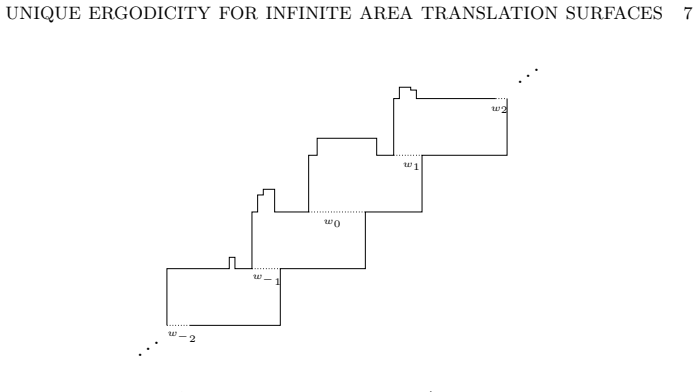
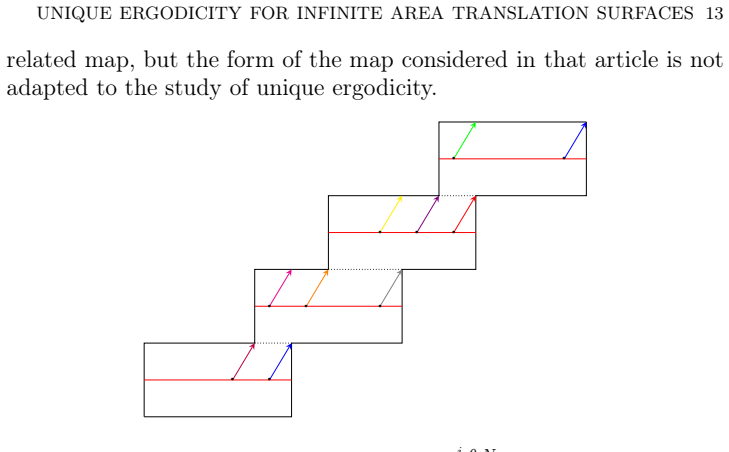
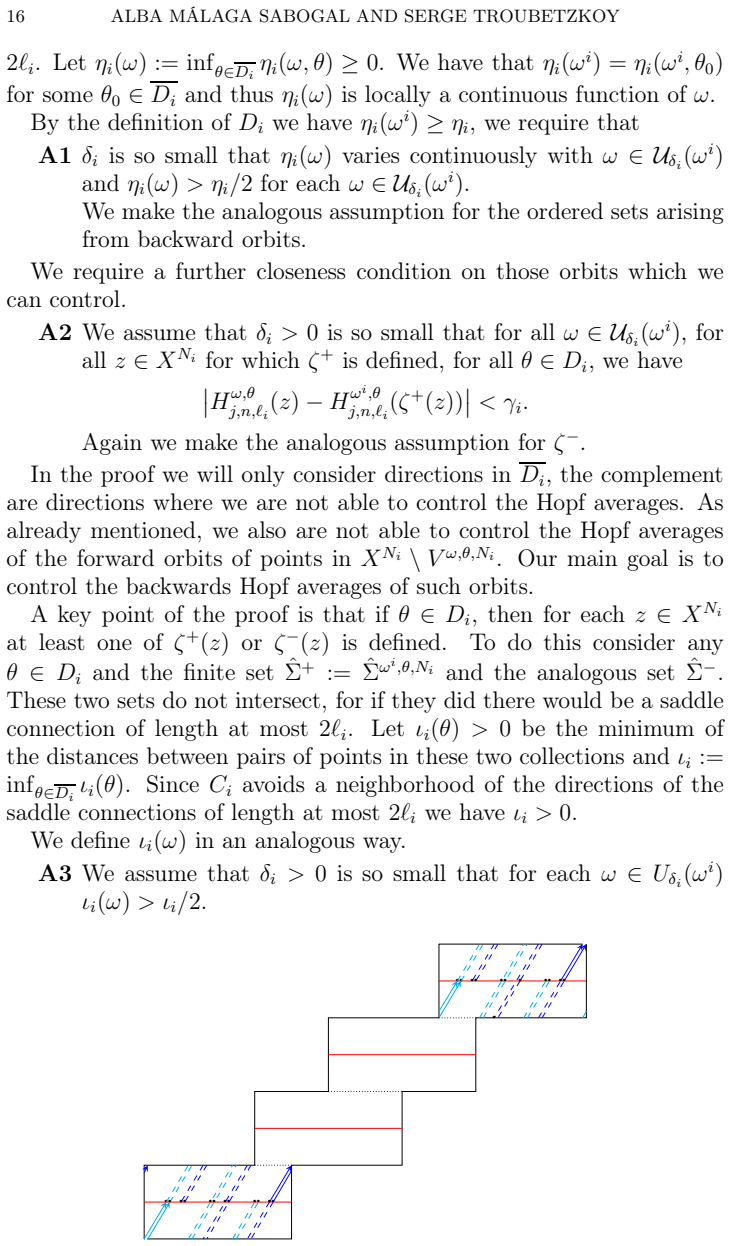
The load-bearing object is the ringed staircase, a parameter choice with w_N = w_{-N} = 0 that splits the surface into a finite compact core X_N, the ring, and two disconnected tails. Inside the ring, the return map is an interval exchange on a finite measure space, so the compact-surface unique-ergodicity theorem applies for almost every direction. For a nearby parameter that is not ringed, the blocking points at the ring boundary bifurcate into small intervals, and the maps ζ+ and ζ− match each point's forward or backward orbit segment to an orbit of the ringed surface, keeping Hopf averages close. The proof's criterion (Lemma 6) says that if every point has either its forward or backward Hopf averages converging to the ratio of the integrals, then at most one conservative invariant ergodic Radon measure exists; Proposition 2 supplies conservativity from the step sizes tending to zero, and the Baire structure of the parameter spaces makes the good parameters a dense Gδ set. For periodic surfaces, the corresponding machinery is the Maharam measure: for each additive character χ of Z^d, a conformal measure on the base interval is twisted into a locally finite invariant measure for the skew product, yielding a family of distinct measures.
What would settle it
Find a single parameter in the constructed dense Gδ set and a direction in the full-measure direction set for which some orbit is neither periodic nor dense and visits each compact set only finitely often. The sum of point masses along that bi-infinite orbit is a locally finite invariant ergodic measure distinct from the area measure, so the main theorem would be false. A computer search over staircases with step lengths tending to zero could look directly for such an escaping, non-dense orbit.
Extended reading notes
Core claim
On the paper's own terms, the discovery is that unique ergodicity in the infinite-measure sense can hold for genuinely non-compact translation surfaces. For a dense Gδ set of step sequences w in (0,1)^Z and a dense Gδ set of full Lebesgue measure of directions θ, the first-return map T_{w,θ} has, up to scaling, exactly one invariant ergodic Radon measure, namely the length measure μ. The same statement holds for a dense Gδ set of wind-tree configurations in the Hausdorff topology on configurations. The proof works by exhausting the infinite surface by finite compact cores whose inner dynamics is a compact translation surface; on those cores the classical compact-surface theorem gives finite-area unique ergodicity for almost every direction, and a perturbation argument transfers that uniqueness to the infinite surface for all directions outside a small exceptional set. In the opposite direction, every periodic infinite translation surface has at least two non-proportional invariant ergodic Radon measures in every direction, constructed as Maharam measures built from conformal densities twisted by group characters.
Load-bearing premise
The proof assumes that any non-conservative invariant ergodic Radon measure must be supported on a dense bi-infinite orbit; if an escaping orbit that is not dense can carry a locally finite invariant measure, the uniqueness conclusion in Corollary 7 and Theorem 3 would fail.
Editorial extensions
If this is right
- A Baire-generic staircase has, for almost every direction, the area measure as the unique invariant ergodic Radon measure up to scaling.
- A Baire-generic wind-tree configuration has the same unique-ergodicity property for almost every billiard direction.
- Every periodic infinite translation surface, including periodic staircases and periodic wind-trees, is non-uniquely ergodic in every direction, so periodicity is incompatible with the conclusion.
- The proof transfers finite-area uniqueness from compact rings to the infinite surface, so the same scheme applies to any Baire space of infinite-area translation surfaces satisfying the paper's two structural conditions: a dense countable set of surfaces containing a compact subsurface, and convergence of compact cores.
Reading between the lines
- Editorial inference: the proof's conservative-measure restriction is the only thing standing between Theorem 3 and the stronger broad-sense unique ergodicity discussed in the paper; a minimality statement covering every orbit in the generic class would close the gap.
- Editorial inference: the box-sequence proof of conservativity only uses w_i → 0, so the theorem is likely robust to slow decay of step lengths; a natural test is whether w_i ~ |i|^{-α} for small α still yields the full-measure direction set.
- Editorial inference: the non-uniqueness construction for periodic surfaces means periodic staircases have at least two distinct invariant ergodic Radon measures per direction; making these measures explicit for concrete staircases would give a constructive picture of the contrast.
Signed reviews
Editorial analysis
A structured set of objections, weighed in public.
Referee Report
Summary. The paper studies unique ergodicity for infinite-area translation surfaces, focusing on staircases with varying step sizes and on the Ehrenfest wind-tree model. For staircases, Theorem 3 asserts that for a dense Gδ set of step-size sequences and a dense Gδ set of full measure of directions, the translation flow has, up to scaling, a unique invariant ergodic Radon measure. An analogous statement, Theorem 4, is claimed for typical wind-tree configurations. The paper also proves Theorem 1, that no periodic translation surface is uniquely ergodic in any direction, using Maharam measures. The main proof scheme is to approximate a generic staircase by finite ringed staircases, use Kerckhoff--Masur--Smillie unique ergodicity inside the rings, transfer Hopf-average estimates to the generic surface via maps ζ±, and then apply Lemma 6 together with Proposition 2 and Corollary 7 to conclude uniqueness among all ergodic Radon measures.
Significance. If the main theorems are correct, they provide the first infinite-area analogues of the Kerckhoff--Masur--Smillie theorem for generic staircases and wind-tree models, in the sense of uniqueness of the invariant Radon measure up to scaling. The paper also gives a clean obstruction result for periodic translation surfaces, Theorem 1, which is interesting in its own right. The exposition includes useful self-contained tools: the box-sequence criterion for conservativity, the Cantor-representation proof of uniform convergence of Hopf averages for uniquely ergodic interval exchange transformations, and the Maharam-measure construction. The authors are also explicit about the limitations of their result relative to Sarig's stronger notions of unique ergodicity. However, a load-bearing gap in the proof of Corollary 7 currently leaves the passage from conservative uniqueness to full uniqueness incomplete.
major comments (2)
- [Section 4, Corollary 7] The proof of Corollary 7 only excludes non-conservative ergodic Radon measures whose supporting bi-infinite orbit is dense. A non-conservative ergodic measure supported on a non-dense orbit can be locally finite and hence Radon; the simple example of the shift on Z with the counting measures on the positive and negative orbits shows that such orbit measures need not be excluded by the Hopf-average assumption of Lemma 6. The later 'key point' in the proof of Theorem 3, that for θ∈D_i at least one of ζ_+(z) or ζ_-(z) is defined, could supply the missing argument by showing that every orbit is recurrent in at least one time direction, but this implication is not stated or proved, and Corollary 7 does not use it. Since Corollary 7 is the bridge from Lemma 6 to uniqueness among all ergodic Radon measures, Theorem 3 is not fully established as written.
- [Section 4, proof of Theorem 3, Eqs. (5)-(6)] The construction shows that for each z and each scale i at least one of the forward or backward estimates holds, because the domains of ζ_+ and ζ_- cover X_{N_i}. It does not show that the same infinite sequence i_k can be chosen for all z simultaneously, nor that the choice of the forward versus backward side is stable in i for a fixed z. The text asserts 'there is an infinite sequence i_k such that for all z ... either (5) or (6)' without proving uniformity in z. If Lemma 6 is intended to allow a z-dependent sequence, the quantifier structure of Lemma 6 and its proof should be adjusted; if a single sequence is required, an argument for uniformity is missing. This point is needed for the application of Lemma 6.
minor comments (5)
- [Abstract] The sentence 'Our result also hold for typical configurations' should be 'Our results also hold for typical configurations'.
- [Section 2.6] In the definition of a generic point, the condition 'g ≥ 0 and g ≥ 0' is duplicated; the duplicate should be removed, since the intended hypothesis is that g is nonnegative and has positive integral.
- [Section 4, definition of V_{ω,θ,N_i}] The displayed definition V_{ω,θ,N_i} := ∪_{I∈ I^{w,θ,N_i,*}} I appears to have a typo; it should presumably be the union over the full partition collection {I^{w,θ}_j}, since the following sentence treats X_{N_i}\V_{ω,θ,N_i} as the complement of the domain of ζ_+.
- [Section 4, estimates after A2] The notation H^{ω,θ}_{n,ℓ_i}h_j(z) is used interchangeably with H^{ω,θ}_{j,n,ℓ_i}(z); please define the Hopf average with two function subscripts consistently and clarify the order of the indices.
- [References] The reference [RaRa] is given as a YouTube URL; a citable publication or preprint identifier would be preferable.
Circularity Check
No significant circularity: the central derivation is a Baire-category transfer from compact KMS rings, not a restatement of its inputs.
full rationale
The main proof does not derive unique ergodicity from a fitted parameter or from a self-citation. Section 4 starts with a dense countable family of N_i-ringed staircases; inside each ring X_{N_i} the direction set A_i has full measure by the external Kerckhoff-Masur-Smillie theorem, and Corollary 12, proved in the appendix via the Cantor representation, gives uniform Hopf-average convergence. The rest is a standard perturbation and diagonal argument: choose δ_i so that nearby ω inherit controlled Hopf averages at scale ℓ_i, define the ζ± maps by piecewise affine transfers, and pass to the residual set G and a full-measure Gδ direction set H. None of these steps redefines the target measure; the measure µ is the same length measure throughout. The self-citations [MSTr1], [MSTr2], and [MSTr3] are used only for supporting facts, such as compactness of Conf, earlier minimality and ergodicity in the wind-tree setting, and related conservativity results, not as the uniqueness conclusion. Proposition 2's conservativity is proved in Section 6.1 by a box-sequence argument and is not the same as uniqueness. The only serious issue visible in the text is a non-circular correctness gap: Corollary 7 excludes non-conservative ergodic Radon measures only when their supporting bi-infinite orbit is dense, and the text does not prove that non-dense escaping orbits cannot carry locally finite invariant measures. Closing that gap would require minimality or recurrence, for example from the earlier articles, but the paper does not invoke it there. This affects validity rather than circularity, since the missing statement is not identical to the theorem's conclusion by construction.
Assumptions & free parameters
assumptions (5)
- standard math Kerckhoff-Masur-Smillie theorem: compact translation surfaces are uniquely ergodic in almost every direction.
- standard math Schmidt's theorem on conformal measures for cocycles over countable Markov maps, Theorem 4.1 in [Sc].
- standard math Cantor representation of interval exchanges from [GaKrTr] is uniquely ergodic if and only if the interval exchange is uniquely ergodic.
- domain assumption Each ringed staircase core X_N is a compact translation surface to which the KMS theorem applies.
- domain assumption The flow on generic staircases and wind-trees is minimal in almost every direction, from [MSTr1] and [MSTr2], implicitly needed to exclude non-dense escaping orbits.
Cite this review
Pith. "Pith review of Unique Ergodicity For Infinite Area Translation Surfaces." pith.science (2026). https://pith.science/paper/742PWHTL
@misc{pith2026190804019,
  author       = {Pith},
  title        = {Pith review of: Unique Ergodicity For Infinite Area Translation Surfaces},
  year         = {2026},
  howpublished = {\url{https://pith.science/paper/742PWHTL}},
  note         = {Machine review of arXiv:1908.04019}
}
read the original abstract
We consider infinite staircase translation surfaces with varying step sizes. For typical step sizes we show that the translation flow is uniquely ergodic in almost every direction. Our result also hold for typical configurations of the Ehrenfest wind-tree model endowed with the Hausdorff topology. In contrast, we show that the translation flow on a periodic translation surface can not be uniquely ergodic in any direction.
Figures


Figures from the paper (6 more)




Reference graph
Works this paper leans on
-
[1]
J.\ Aaronson, H.\ Nakada, O.\ Sarig, R.\ Solomyak, Invariant measures and asymptotics for some skew products Israel J.\ Math.\ 128 (2002) 93--134
work page 2002
-
[2]
S\'eminaire Bourbaki, Vol.\ 1987/88
P.\ Arnoux, Ergodicit\'e g\'en\'erique des billards polygonaux (d'apr\`es Kerckhoff, Masur, Smillie). S\'eminaire Bourbaki, Vol.\ 1987/88. Ast\'erisque No.\ 161--162 (1988), Exp. No. 696, 5, 203--221 (1989)
work page 1988
-
[3]
P.\ and T.\ Ehrenfest Begriffliche Grundlagen der statistischen Auffassung in der Mechanik Encykl. d. Math. Wissensch. IV 2 II, Heft 6, 90 S (1912) (in German, translated in:) The conceptual foundations of the statistical approach in mechanics, (trans. Moravicsik, M. J.), 10-13 Cornell University Press, Itacha NY (1959)
work page 1912
-
[4]
K.\ Fr a czek and P.\ Hubert Recurrence and non-ergodicity in generalized wind-tree models Math.\ Nachrichen 291 (2018) 1686--711
work page 2018
-
[5]
K.\ Fr a czek and C.\ Ulcigrai Non-ergodic Z -periodic billiards and infinite translation surfaces Invent.\ Math.\ 197 (2014) 241--298
work page 2014
-
[6]
K.\ Fr a czek and C.\ Ulcigrai Ergodic directions for billiards in a strip with periodically located obstacles Communications in Mathematical Physics 327 (2014) 643--663
work page 2014
-
[7]
G.\ Galperin, T.\ Kr\"uger and S.\ Troubetzkoy Local instability of orbits in polygonal and polyhedral billiards Comm.\ Math.\ Phys.\ 169 (1995), no. 3, 463--473
work page 1995
-
[8]
S.\ Gou\"ezel and E.\ Lanneau Un th\'eor\`eme de Kerckhoff, Masur et Smillie: unique ergodicit\'e sur les surfaces plates (French) \'Ecole de Th\'eorie Ergodique, 113--145, S\'emin.\ Congr., 20, Soc. Math.\ France, Paris, 2010
work page 2010
Show all 27 references
-
[9]
P.\ Hooper, P.\ Hubert and B.\ Weiss Dynamics on the infinite staircase Discrete Cont.\ Dyn.\ Sys.\ 33 (2013) 4341--4347
2013
-
[10]
P.\ Hooper, The invariant measures of some infinite interval exchange maps Geom.\ Topol.\ 19 (2015)1895--2038
2015
-
[11]
656 (2011) 223--244
P.\ Hubert, Pascal, S.\ Leli\`evre and S.\ Troubetzkoy The Ehrenfest wind-tree model: periodic directions, recurrence, diffusion J.\ Reine Angew.\ Math. 656 (2011) 223--244
2011
-
[12]
149 (2013) 1364--1380
P.\ Hubert, and B.\ Weiss Ergodicity for infinite periodic translation surfaces Composito Math. 149 (2013) 1364--1380
2013
-
[13]
1, 151--160
A.\ Katok The growth rate for the number of singular and periodic orbits for a polygonal billiard Comm.\ Math.\ Phys.\ 111 (1987), no. 1, 151--160
1987
-
[14]
2, 293--311
S.\ Kerckhoff, H.\ Masur, and J.\ Smillie, Ergodicity of billiard flows and quadratic differentials, Annals of Math.\ (2) 124 (1986), no. 2, 293--311
1986
-
[15]
A. M. Málaga Sabogal Étude d'une famille de transformations préservant la mesure de Z T PhD dissertation, Paris-Sud 11 University, 2014
2014
-
[16]
A.\ M\'alaga Sabogal and S.\ Troubetzkoy Minimality of the Ehrenfest wind-tree model Journal Modern Dynamics 10 (2016), 209--228
2016
-
[17]
A.\ M\'alaga Sabogal and S.\ Troubetzkoy Ergodicity of the Ehrenfest wind-tree model Comptes Rendus Mathematique 354 (2016) 1032--1036
2016
-
[18]
A.\ M\'alaga Sabogal and S.\ Troubetzkoy Infinite ergodic index of the Ehrenfest wind-tree model Comm.\ Math.\ Phys.\ 358 (2018) 995--1006
2018
-
[19]
Masur and S
H. Masur and S. Tabachnikov, Rational billiards and flat structures, Handbook of dynamical systems, Vol. 1A, 1015--1089, North-Holland, Amsterdam, 2002
2002
-
[20]
pp.955-1015, 2010, Oberwolfach Report
T.\ Monteil Introduction to the theorem of Kerkhoff, Masur and Smillie Workshop Arbeitsgemeinschaft: Mathematical Billards, Apr 2010, Franckfurt, Germany. pp.955-1015, 2010, Oberwolfach Report
2010
-
[21]
K.\ Rafi and A.\ Randecker www.youtube.com/watch?v=byEo9PpHE8Y
-
[22]
D.\ Ralston and S.\ Troubetzkoy Ergodic infinite group extensions of geodesic flows on translation surfaces Journal Modern Dynamics 6 (2012) 477--497
2012
-
[23]
O.\ Sarig Unique ergodicity for infinite measures Proceedings of the International Congress of Mathematicians Hyderabad, India, 2010 1777-1803
2010
-
[24]
188--198 in ``Ergodic theory proceedings Oberwolfach'' Lecture Notes in Mathematics 729, Springer Verlag, Berlin-New York 1979
K.\ Schmidt Unique ergodicity and related problems pp. 188--198 in ``Ergodic theory proceedings Oberwolfach'' Lecture Notes in Mathematics 729, Springer Verlag, Berlin-New York 1979
1979
-
[25]
S.\ Troubetzkoy Recurrence in generic staircases Discrete and Continuous Dynamical Systems - Series A 32, 3 (2012) 1047-1053
2012
-
[26]
D'Analyse Math., 55, (1990) 117--171
W.\ Veech Moduli spaces of quadratic differentials J. D'Analyse Math., 55, (1990) 117--171
1990
-
[27]
Eisenstein series and an application to triangular billiards
W.\ Veech Teichmuller curves in moduli space. Eisenstein series and an application to triangular billiards. Invent. Math., 97, (1989) 553--583
1989
Reviewed August 14, 2026 · model on record in the stance chip above.
Discussion (0). Continue with ORCID to comment.