REVIEW 7 minor 71 references
Thermal Instability of Halo Gas Heated by Streaming Cosmic Rays
T0 review · 0 major / 7 minor · reviewed 2026-08-14 · deepseek-v4-flash
Pith's one-line read The paper shows that thermal instability in halo gas heated by streaming cosmic rays is controlled by the ratio of cosmic-ray pressure to gas pressure, and that the unstable modes oscillate at the Alfvén speed rather than growing…
desk verdict A careful and explicit linear stability analysis that corrects earlier CR-heated TI work and maps out the parameter space; the main caveat is the assumed Alfvén-speed streaming transport. read the letter →
The pith
A machine-rendered reading of the paper's core claim, the machinery that carries it, and where it could break.
The reading
What carries the argument
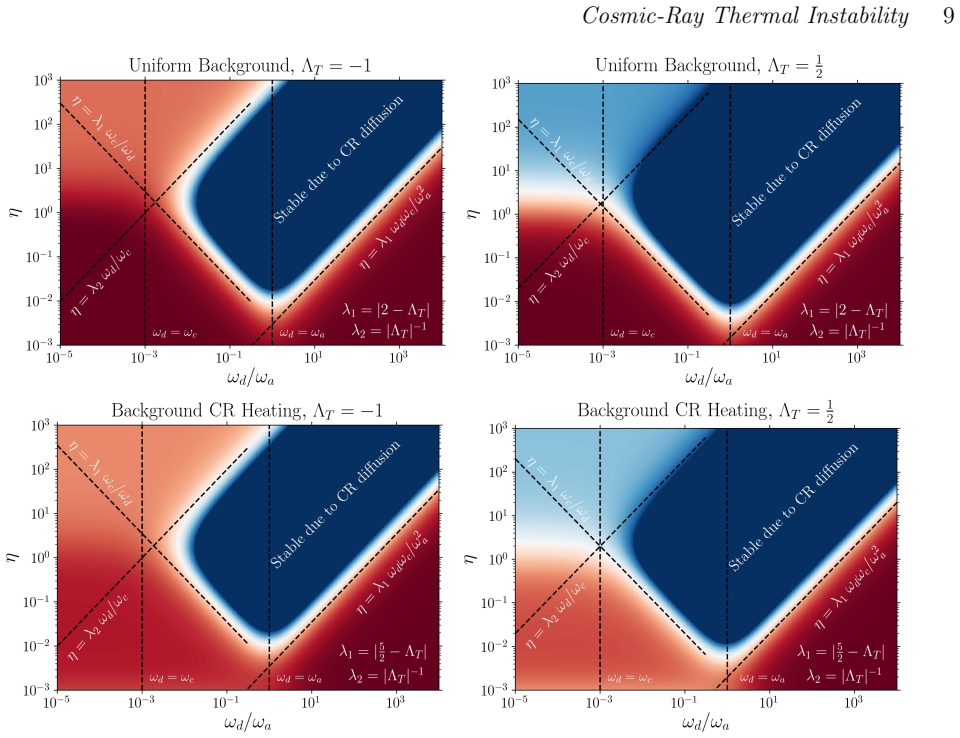
The machinery is the linearized system built from the gas and cosmic-ray pressure equations. In the high-$\beta$ limit the dispersion relation reduces to a quadratic in the mode frequency $\omega$, coupling $\delta p_c$ and $\delta p_g$ through pressure balance $\delta p_c\approx-\delta p_g$. The organizing parameter is $\eta=p_c/p_g$, which decides whether the eigenmode is isobaric or isochoric. The frequency $\omega_a=\mathbf{k}\cdot\mathbf{v}_A$ appears through the perturbed CR heating and supplies the real part of the entropy mode, while $\omega_d=\kappa(\hat{\mathbf{b}}\cdot\mathbf{k})^2$ parametrizes diffusion and can damp a band of unstable wavenumbers, giving a CR Field length $\lambda_{\rm CRF}\sim 2\pi|\hat{\mathbf{b}}\cdot\hat{\mathbf{k}}|\sqrt{\eta\kappa/\omega_c}$ for $\eta<1$ when $\kappa\omega_c/(\eta v_A^2)\lesssim1$.
What would settle it
Numerically solve the linearized gas-plus-cosmic-ray equations in a uniform, high-$\beta$, CR-heated background with $\kappa=0$, cooling slope $\Lambda_T=-1$, and $\eta=1$. The paper predicts the gas entropy mode has frequency $\omega\approx-(2/3)\omega_a-(2/3)i\Lambda_T\omega_c$, so the unstable mode oscillates at the Alfvén frequency; if the mode is purely growing with no real oscillatory part at finite $\eta$, the central overstability claim is wrong.
Extended reading notes
Core claim
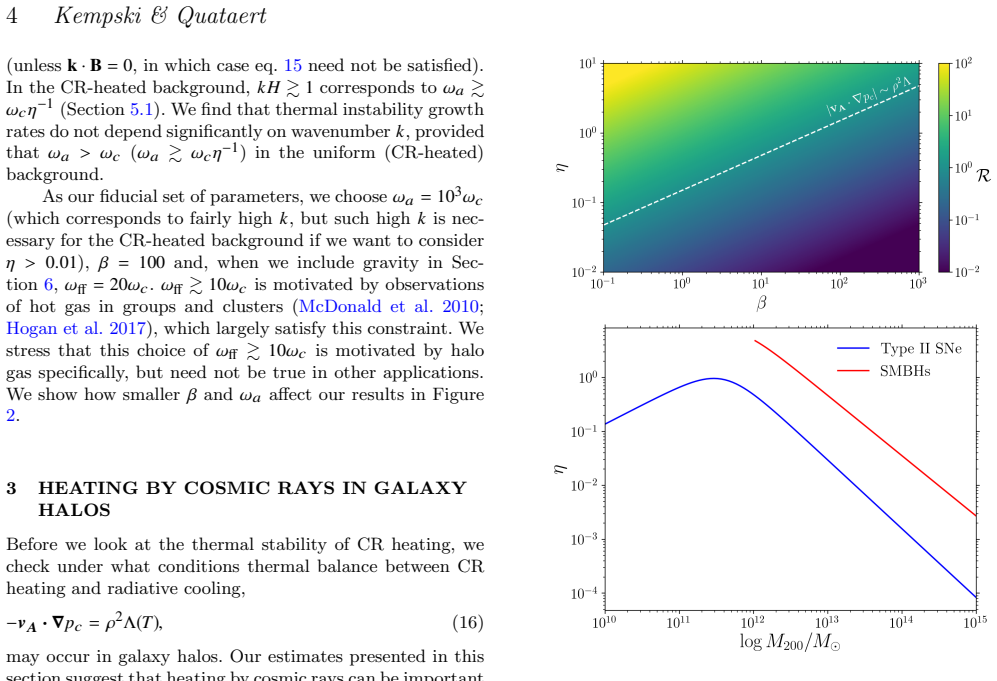
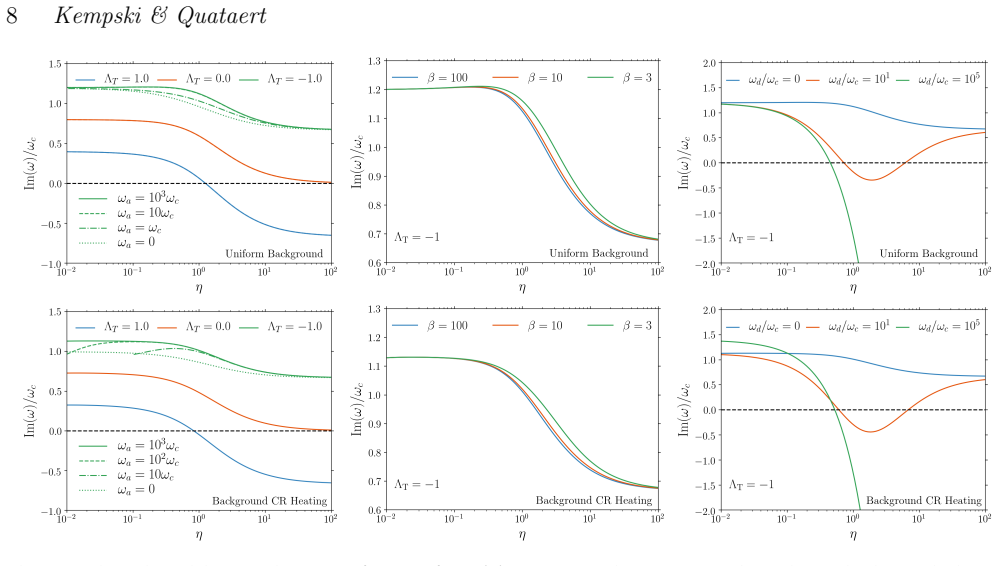
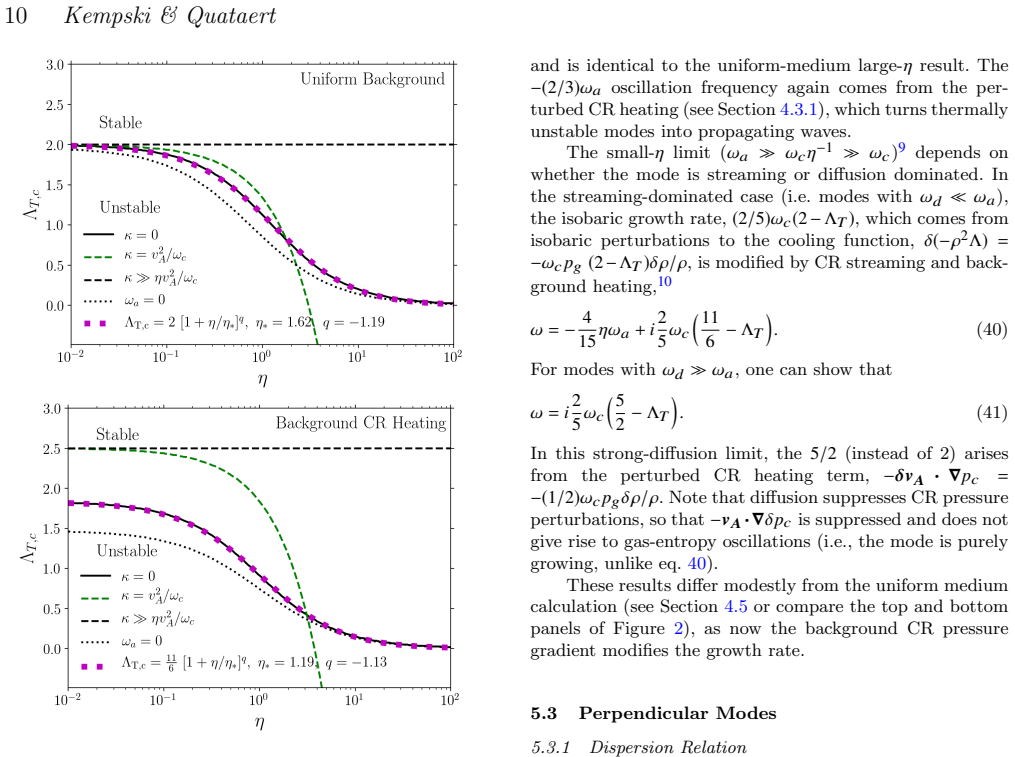
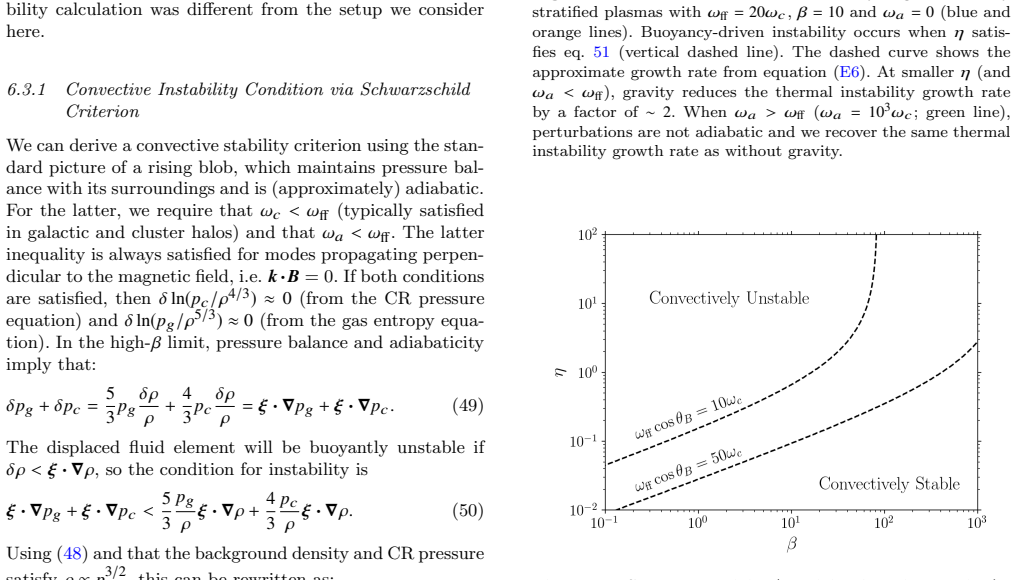
The central claim is that in a plasma heated by streaming cosmic rays, linear thermal stability is governed by the ratio of cosmic-ray pressure to gas pressure, $\eta=p_c/p_g$, through the coupling of the perturbed CR pressure to density. In the high-$\beta$ limit the entropy mode obeys a quadratic dispersion relation combining the gas and CR energy equations. For $\eta\ll1$ the mode is isobaric with growth rate $(2/5)(2-\Lambda_T)\omega_c$; for $\eta\gg1$ it is isochoric with growth rate $-(2/3)\Lambda_T\omega_c$. In both regimes CR streaming introduces an oscillation frequency $\omega_a=\mathbf{k}\cdot\mathbf{v}_A$ in the gas entropy mode, so thermal instability is an overstability. CR diffusion can suppress instability in an intermediate band of $\eta$ and wavenumber, acting effectively like thermal conduction with a CR Field length, but only when $\kappa\omega_c/(\eta v_A^2)\lesssim1$. In gravitationally stratified halos, the convective-instability criterion takes the Schwarzschild form $d s_{\rm eff}/dz<0$ with $s_{\rm eff}=\ln(p_g/\rho^{5/3})+\eta\ln(p_c/\rho^{4/3})$, and the entropy-mode oscillation frequency can exceed the free-fall frequency.
Load-bearing premise
The conclusions assume cosmic rays stream down their pressure gradient at exactly the Alfvén speed, with any residual transport captured by a constant diffusion coefficient along the magnetic field; if super-Alfvénic or non-diffusive transport dominates, the predicted heating perturbations and stability boundaries would change.
Editorial extensions
If this is right
- In collisional-ionization-equilibrium halo gas, which has a cooling slope $\Lambda_T<0$, cosmic-ray heating does not stabilize thermal instability for realistic $\eta$; multiphase cold gas can still condense.
- Thermally unstable perturbations in CR-heated gas are not stationary growing modes but waves traveling at roughly the Alfvén speed once $\eta\sim1$, so the condensation process carries an intrinsic oscillation.
- Cosmic-ray diffusion suppresses thermal instability only in a limited range of parameters, and for $\kappa\omega_c/(\eta v_A^2)\gtrsim1$ even high-wavenumber perturbations remain isobarically unstable; there is no universal CR Field length.
- In gravitationally stratified halos the CR-driven entropy-mode frequency can exceed the free-fall frequency, which would shift the critical $t_{\rm cool}/t_{\rm ff}$ quoted for multiphase gas formation.
- A stratified CR-heated medium is convectively unstable exactly when $d s_{\rm eff}/dz<0$, giving a Schwarzschild-like criterion that depends only on gas and CR pressure scale heights.
Reading between the lines
- A direct test of the overstability claim is a nonlinear CR-MHD simulation of a cooling parcel with streaming at $v_A$: if the saturated condensation develops coherent oscillations at the local Alfvén frequency, the linear prediction is borne out.
- The CR Field length implies a minimum clump size when streaming is subdominant; comparing observed sizes of cold circumgalactic-medium clouds with $\lambda_{\rm CRF}$ for adopted $\kappa$ and $\eta$ could constrain the diffusion coefficient.
- Because photoionization-equilibrium gas is predicted to be always stable while collisional-ionization-equilibrium gas is usually unstable, the mere existence of cold gas in a halo becomes a diagnostic of the dominant ionization and heating balance, apart from CR pressure.
- If the correct transport is super-Alfvénic streaming rather than $v_A$ streaming plus constant diffusion, the perturbed heating term changes and the predicted oscillation frequencies and stability maps would need to be recomputed; this is the natural next step the paper leaves open.
Signed reviews
Editorial analysis
A structured set of objections, weighed in public.
Referee Report
Summary. The paper presents a linear thermal stability analysis of dilute plasma heated by streaming cosmic rays, modeled with the standard gas-CR fluid equations (1)-(5). It treats three equilibria: a uniform background with unspecified heating balancing cooling (Section 4), a background in which CR heating balances radiative cooling (Section 5), and a gravitationally stratified CR-heated background (Section 6). The central variables are eta = p_c/p_g and beta, and the characteristic frequencies omega_c, omega_a, omega_d, and omega_ff. The main results are: (i) thermal instability growth rates depend strongly on eta, with perturbations isobaric for eta<<1 and isochoric for eta>>1; (ii) the perturbed CR heating term introduces oscillations at the Alfven frequency, making thermally unstable modes overstable for k dot B != 0; (iii) CR diffusion suppresses a finite band of modes and can introduce a CR Field length; (iv) gas in photoionization equilibrium is thermally stable for any eta, whereas CIE halo gas is generally unstable; and (v) a stratified CR-heated medium obeys a Schwarzschild-like convective instability criterion d s_eff/dz < 0. The analytic asymptotic limits (28)-(29), (40)-(41), and (43)-(44) are checked against the numerical solutions shown in Figures 2-3.
Significance. This is a careful and largely self-contained derivation that corrects and extends earlier heuristic treatments (e.g., Pfrommer 2013) by perturbing the CR energy equation consistently. The explicit linearization (20)-(24), the high-beta quadratic (25), and the asymptotic limits are mutually consistent, and the agreement with the full numerical solution in Figure 2 supports the central claim. The results are physically useful: they give falsifiable stability boundaries in the (eta, omega_d/omega_a) plane, identify the CR Field length, and predict an overstability frequency proportional to the Alfven speed. A notable strength is that the stability boundaries are derived rather than fitted; the only fits, equations (35) and (47), are descriptive broken power laws for the numerically computed Lambda_T,c. The main caveat is the adopted CR transport model: streaming exactly at v_A with a constant parallel diffusion coefficient kappa (Section 2.2). If super-Alfvenic streaming or non-diffusive transport dominates, the perturbed CR heating response changes and the predicted overstability frequencies and diffusion-sensitive boundaries would shift.
minor comments (7)
- [Section 4.1, footnote 3] In footnote 3, 'equlibrium' should be 'equilibrium', and the notation delta Q/Q should be defined explicitly or by example, since it is not immediately clear which fluid variables are included in Q.
- [Section 6.3.1, Eq. (49)] In Eq. (49) and the surrounding paragraph, delta appears to denote Lagrangian perturbations, whereas everywhere else in the paper (e.g., Eqs. 20-24 and Appendix C) delta denotes Eulerian perturbations. Please state this explicitly or use a different symbol such as Delta for Lagrangian perturbations; as printed, the triple equality in Eq. (49) is confusing and could be misread as an inconsistency.
- [Section 4.6 and Appendix B] The sentence 'CR diffusion does not suppress the overall excitation of thermal instability' is ambiguous because Figure 3 shows a broad region where diffusion does suppress instability. Rephrase to indicate that diffusion does not suppress the instability of all modes, but rather of a range of modes.
- [Eq. (34)] There is an extra comma inside the parenthetical factor: '(omega_c/10^-15 s^-1,)^-1/2' should read '(omega_c/10^-15 s^-1)^-1/2'.
- [Abstract and Section 7] The acronym CIE is used without definition at first use; define 'collisional ionization equilibrium (CIE)' when it first appears, and keep the terminology consistent with the abstract.
- [Section 5.1] The statement that 'the cosmic-ray pressure equation (5) then implies that p_c proportional to rho^2/3' is not immediately obvious; add a brief derivation or a pointer to the relevant equations so the reader can verify this background relation.
- [Sections 4-6] The full dispersion relation is not written out, and the numerical eigenvalue solutions depend on MATLAB; for reproducibility, consider providing the code as supplementary material or an appendix.
Circularity Check
No significant circularity; stability boundaries and overstability frequencies follow from the stated fluid equations and tabulated external cooling functions.
full rationale
The paper's central results are derived by linearizing the gas-CR equations (1)-(5) and solving the resulting eigenvalue problem, rather than by fitting to a target. The eta-dependent isobaric/isochoric transition, the O(omega_a) oscillation of thermally unstable modes, the diffusion-modified stability maps, and the PIE/CIE stability conclusions all follow from the dispersion relations (25) and (38) and their asymptotic limits (28)-(29) and (39)-(41). The only fitted expressions, equations (35) and (47), are descriptive broken power-law fits to the computed Lambda_T,c(eta) boundary and do not enter any derivation. External inputs are standard: the CR transport model (streaming at v_A plus constant kappa) is stated as an assumption, and the stability conclusions for PIE/CIE use Lambda_T > 2 from Wiersma et al. (2009) and Lambda_T < 0 in the 1e5-1e7 K range from Draine (2011). Author self-citations (e.g., McCourt et al. 2012; Sharma et al. 2012) are contextual and not load-bearing; no uniqueness theorem is invoked from prior work. The uniform-medium and CR-heated-background results agree with the full numerical eigenvalues shown in Figure 2, and the Appendix E convective-instability calculation independently recovers the Schwarzschild-like criterion (51). No step reduces by construction to its own input.
Assumptions & free parameters
free parameters (5)
- eta* and q in Lambda_T,c broken power law (uniform medium, eq. 35) =
eta* = 1.62, q = -1.19
- eta* and q in Lambda_T,c broken power law (CR-heated background, eq. 47) =
eta* = 1.19, q = -1.13
- fiducial omega_a/omega_c =
10^3
- fiducial beta =
100
- fiducial omega_ff/omega_c =
20
assumptions (7)
- domain assumption CRs stream down their pressure gradient at the Alfvén speed v_A, giving the heating rate -v_A dot grad p_c (self-confinement limit of the streaming instability).
- domain assumption The high-beta limit delta_pc approximately equals -delta_pg holds for the analytic dispersion relations, verified numerically for beta greater than about 3.
- domain assumption Local WKB ordering: omega_s much greater than omega_c and omega_ff, and omega_a much greater than omega_c (unless k dot B = 0).
- domain assumption Cooling functions: collisional ionization equilibrium has Lambda_T less than or about 0 at 10^5 to 10^7 K (Draine 2011); photoionization equilibrium has Lambda_T greater than 2 (Wiersma et al. 2009).
- domain assumption The background with CR heating balancing cooling has grad p_c = -grad p_g (hydrostatic equilibrium, no gravity) and p_c proportional to rho^(2/3).
- domain assumption For the convective criterion, the rising blob is adiabatic, requiring omega_c less than omega_ff and omega_a less than omega_ff.
- standard math Linear perturbation theory with Fourier modes exp(ik dot r - i omega t) is valid for small perturbations.
Cite this review
Pith. "Pith review of Thermal Instability of Halo Gas Heated by Streaming Cosmic Rays." pith.science (2026). https://pith.science/paper/74A3OIVE
@misc{pith2026190810367,
  author       = {Pith},
  title        = {Pith review of: Thermal Instability of Halo Gas Heated by Streaming Cosmic Rays},
  year         = {2026},
  howpublished = {\url{https://pith.science/paper/74A3OIVE}},
  note         = {Machine review of arXiv:1908.10367}
}
abstract
Heating of virialized gas by streaming cosmic rays (CRs) may be energetically important in galaxy halos, groups and clusters. We present a linear thermal stability analysis of plasmas heated by streaming CRs. We separately treat equilibria with and without background gradients, and with and without gravity. We include both CR streaming and diffusion along the magnetic-field direction. Thermal stability depends strongly on the ratio of CR pressure to gas pressure, which determines whether modes are isobaric or isochoric. Modes with $\mathbf{k \cdot B }\neq 0$ are strongly affected by CR diffusion. When the streaming time is shorter than the CR diffusion time, thermally unstable modes (with $\mathbf{k \cdot B }\neq 0$) are waves propagating at a speed $\propto$ the Alfv\'en speed. Halo gas in photoionization equilibrium is thermally stable independent of CR pressure, while gas in collisional ionization equilibrium is unstable for physically realistic parameters. In gravitationally stratified plasmas, the oscillation frequency of thermally overstable modes can be higher in the presence of CR streaming than the buoyancy/free-fall frequency. This may modify the critical $t_{\rm cool}/t_{\rm ff}$ at which multiphase gas is present. The criterion for convective instability of a stratified, CR-heated medium can be written in the familiar Schwarzschild form $d s_{\rm eff} / d z < 0$, where $s_{\rm eff}$ is an effective entropy involving the gas and CR pressures. We discuss the implications of our results for the thermal evolution and multiphase structure of galaxy halos, groups and clusters.
Figures
Figures from the paper (3 more)

Reference graph
Works this paper leans on
-
[1]
write newline
" write newline "" before.all 'output.state := FUNCTION fin.entry write newline FUNCTION new.block output.state before.all = 'skip after.block 'output.state := if FUNCTION new.sentence output.state after.block = 'skip output.state before.all = 'skip after.sentence 'output.state := if if FUNCTION not #0 #1 if FUNCTION and 'skip pop #0 if FUNCTION or pop #1...
- [2]
-
[3]
Ackermann M., et al., 2013, @doi [Science] 10.1126/science.1231160 , https://ui.adsabs.harvard.edu/abs/2013Sci...339..807A 339, 807
-
[4]
A., 1995, in Ferrara A., McKee C
Balbus S. A., 1995, in Ferrara A., McKee C. F., Heiles C., Shapiro P. R., eds, Astronomical Society of the Pacific Conference Series Vol. 80, The Physics of the Interstellar Medium and Intergalactic Medium. p. 328
work page 1995
-
[5]
Beck R., 2015, @doi [The Astronomy and Astrophysics Review] 10.1007/s00159-015-0084-4 , 24, 4
-
[6]
Bernet M. L., Miniati F., Lilly S. J., 2013, @doi [ ] 10.1088/2041-8205/772/2/L28 , https://ui.adsabs.harvard.edu/abs/2013ApJ...772L..28B 772, L28
-
[7]
Binney J., Nipoti C., Fraternali F., 2009, @doi [ ] 10.1111/j.1365-2966.2009.15113.x , https://ui.adsabs.harvard.edu/abs/2009MNRAS.397.1804B 397, 1804
arXiv 2009
- [8]
Show all 71 references
-
[9]
P., 1990, @doi [ ] 10.1086/169509 , https://ui.adsabs.harvard.edu/abs/1990ApJ...365..544B 365, 544
Boulares A., Cox D. P., 1990, @doi [ ] 10.1086/169509 , https://ui.adsabs.harvard.edu/abs/1990ApJ...365..544B 365, 544
1990 doi
-
[10]
V., Chelouche D., Jenkins E
Bowen D. V., Chelouche D., Jenkins E. B., Tripp T. M., Pettini M., York D. G., Frye B. L., 2016, @doi [ ] 10.3847/0004-637X/826/1/50 , https://ui.adsabs.harvard.edu/abs/2016ApJ...826...50B 826, 50
2016 doi
-
[11]
Cai Z., et al., 2017, @doi [ ] 10.3847/1538-4357/aa6a1a , https://ui.adsabs.harvard.edu/abs/2017ApJ...839..131C 839, 131
2017 doi
-
[12]
X., Hennawi J
Cantalupo S., Arrigoni-Battaia F., Prochaska J. X., Hennawi J. F., Madau P., 2014, @doi [ ] 10.1038/nature12898 , https://ui.adsabs.harvard.edu/abs/2014Natur.506...63C 506, 63
2014 doi
-
[13]
W., Donahue M., Voit G
Cavagnolo K. W., Donahue M., Voit G. M., Sun M., 2009, @doi [ ] 10.1088/0067-0049/182/1/12 , https://ui.adsabs.harvard.edu/abs/2009ApJS..182...12C 182, 12
2009 doi
-
[14]
D., Dennis T
Chandran B. D., Dennis T. J., 2006, @doi [ ] 10.1086/499229 , https://ui.adsabs.harvard.edu/abs/2006ApJ...642..140C 642, 140
2006 doi
-
[15]
P., Sharma P., Quataert E., 2019, arXiv e-prints, https://ui.adsabs.harvard.edu/abs/2019arXiv190102903C p
Choudhury P. P., Sharma P., Quataert E., 2019, arXiv e-prints, https://ui.adsabs.harvard.edu/abs/2019arXiv190102903C p. arXiv:1901.02903
2019 arXiv
-
[16]
Dekel A., et al., 2009, @doi [ ] 10.1038/nature07648 , https://ui.adsabs.harvard.edu/abs/2009Natur.457..451D 457, 451
2009 doi
-
[17]
J., Chandran B
Dennis T. J., Chandran B. D. G., 2009, @doi [ ] 10.1088/0004-637X/690/1/566 , https://ui.adsabs.harvard.edu/abs/2009ApJ...690..566D 690, 566
2009 doi
-
[18]
T., 2011, Physics of the Interstellar and Intergalactic Medium
Draine B. T., 2011, Physics of the Interstellar and Intergalactic Medium. Princeton University Press, NJ
2011
-
[19]
Ehlert K., Weinberger R., Pfrommer C., Pakmor R., Springel V., 2018, @doi [ ] 10.1093/mnras/sty2397 , https://ui.adsabs.harvard.edu/abs/2018MNRAS.481.2878E 481, 2878
2018 doi
-
[20]
E., Zweibel E
Everett J. E., Zweibel E. G., Benjamin R. A., McCammon D., Rocks L., Gallagher John S. I., 2008, @doi [ ] 10.1086/524766 , https://ui.adsabs.harvard.edu/abs/2008ApJ...674..258E 674, 258
2008 doi
-
[21]
B., 1965, @doi [ ] 10.1086/148317 , 142, 531
Field G. B., 1965, @doi [ ] 10.1086/148317 , 142, 531
1965 doi
-
[22]
P., 2008, @doi [ ] 10.1111/j.1365-2966.2007.12692.x , https://ui.adsabs.harvard.edu/abs/2008MNRAS.384..251G 384, 251
Guo F., Oh S. P., 2008, @doi [ ] 10.1111/j.1365-2966.2007.12692.x , https://ui.adsabs.harvard.edu/abs/2008MNRAS.384..251G 384, 251
2008
-
[23]
P., Ruszkowski M., 2008, @doi [ ] 10.1086/592320 , https://ui.adsabs.harvard.edu/abs/2008ApJ...688..859G 688, 859
Guo F., Oh S. P., Ruszkowski M., 2008, @doi [ ] 10.1086/592320 , https://ui.adsabs.harvard.edu/abs/2008ApJ...688..859G 688, 859
2008 doi
-
[24]
G., 2018, @doi [ ] 10.3847/1538-4357/aac208 , https://ui.adsabs.harvard.edu/abs/2018ApJ...860...97H 860, 97
Heintz E., Zweibel E. G., 2018, @doi [ ] 10.3847/1538-4357/aac208 , https://ui.adsabs.harvard.edu/abs/2018ApJ...860...97H 860, 97
2018 doi
-
[25]
F., Prochaska J
Hennawi J. F., Prochaska J. X., Cantalupo S., Arrigoni-Battaia F., 2015, @doi [Science] 10.1126/science.aaa5397 , https://ui.adsabs.harvard.edu/abs/2015Sci...348..779H 348, 779
2015 doi
-
[26]
T., et al., 2017, @doi [ ] 10.3847/1538-4357/aa9af3 , https://ui.adsabs.harvard.edu/abs/2017ApJ...851...66H 851, 66
Hogan M. T., et al., 2017, @doi [ ] 10.3847/1538-4357/aa9af3 , https://ui.adsabs.harvard.edu/abs/2017ApJ...851...66H 851, 66
2017 doi
-
[27]
F., et al., 2019, preprint ( @eprint arXiv:1905.04321 )
Hopkins P. F., et al., 2019, preprint ( @eprint arXiv:1905.04321 )
2019 arXiv
-
[28]
Huber B., Tchernin C., Eckert D., Farnier C., Manalaysay A., Straumann U., Walter R., 2013, @doi [ ] 10.1051/0004-6361/201321947 , https://ui.adsabs.harvard.edu/abs/2013A&A...560A..64H 560, A64
2013 doi
-
[29]
Jacob S., Pfrommer C., 2017a, @doi [ ] 10.1093/mnras/stx131 , https://ui.adsabs.harvard.edu/abs/2017MNRAS.467.1449J 467, 1449
-
[30]
Jacob S., Pfrommer C., 2017b, @doi [ ] 10.1093/mnras/stx132 , https://ui.adsabs.harvard.edu/abs/2017MNRAS.467.1478J 467, 1478
-
[31]
P., McCourt M., 2018, @doi [ ] 10.1093/mnras/sty293 , https://ui.adsabs.harvard.edu/abs/2018MNRAS.476..852J 476, 852
Ji S., Oh S. P., McCourt M., 2018, @doi [ ] 10.1093/mnras/sty293 , https://ui.adsabs.harvard.edu/abs/2018MNRAS.476..852J 476, 852
2018 doi
-
[32]
M., Cesarsky C
Kulsrud R. M., Cesarsky C. J., 1971, Astrophysical Letters, https://ui.adsabs.harvard.edu/abs/1971ApL.....8..189K 8, 189
1971
-
[33]
P., 1969, @doi [ ] 10.1086/149981 , 156, 445
Kulsrud R., Pearce W. P., 1969, @doi [ ] 10.1086/149981 , 156, 445
1969 doi
-
[34]
Linden T., Profumo S., Anderson B., 2010, @doi [ ] 10.1103/PhysRevD.82.063529 , https://ui.adsabs.harvard.edu/abs/2010PhRvD..82f3529L 82, 063529
2010 doi
-
[35]
Zweibel E., C
Loewenstein M., G. Zweibel E., C. Begelman M., 1991, @doi [The Astrophysical Journal] 10.1086/170369 , 377
1991 doi
-
[37]
McDonald M., Veilleux S., Rupke D. S. N., Mushotzky R., 2010, @doi [ ] 10.1088/0004-637X/721/2/1262 , https://ui.adsabs.harvard.edu/abs/2010ApJ...721.1262M 721, 1262
2010 doi
-
[38]
R., Nulsen P
McNamara B. R., Nulsen P. E. J., 2007, @doi [ ] 10.1146/annurev.astro.45.051806.110625 , https://ui.adsabs.harvard.edu/abs/2007ARA&A..45..117M 45, 117
2007 arXiv
-
[39]
R., O'Shea B
Meece G. R., O'Shea B. W., Voit G. M., 2015, @doi [ ] 10.1088/0004-637X/808/1/43 , https://ui.adsabs.harvard.edu/abs/2015ApJ...808...43M 808, 43
2015 doi
-
[40]
C., Krause M., 2013, @doi [ ] 10.1051/0004-6361/201321043 , https://ui.adsabs.harvard.edu/abs/2013A&A...560A..42M 560, A42
Mora S. C., Krause M., 2013, @doi [ ] 10.1051/0004-6361/201321043 , https://ui.adsabs.harvard.edu/abs/2013A&A...560A..42M 560, A42
2013 doi
-
[41]
P., Naab T., White S
Moster B. P., Naab T., White S. D. M., 2013, @doi [ ] 10.1093/mnras/sts261 , https://ui.adsabs.harvard.edu/abs/2013MNRAS.428.3121M 428, 3121
2013 doi
-
[42]
Nulsen P. E. J., 1986, @doi [ ] 10.1093/mnras/221.2.377 , https://ui.adsabs.harvard.edu/abs/1986MNRAS.221..377N 221, 377
1986 doi
-
[43]
Paglione T. A. D., Abrahams R. D., 2012, @doi [ ] 10.1088/0004-637X/755/2/106 , https://ui.adsabs.harvard.edu/abs/2012ApJ...755..106P 755, 106
2012 doi
-
[44]
R., Fabian A
Peterson J. R., Fabian A. C., 2006, @doi [ ] 10.1016/j.physrep.2005.12.007 , https://ui.adsabs.harvard.edu/abs/2006PhR...427....1P 427, 1
2006 doi
-
[45]
Pfrommer C., 2013, @doi [ ] 10.1088/0004-637X/779/1/10 , https://ui.adsabs.harvard.edu/abs/2013ApJ...779...10P 779, 10
2013 doi
-
[46]
Pizzolato F., Soker N., 2005, @doi [ ] 10.1086/444344 , https://ui.adsabs.harvard.edu/abs/2005ApJ...632..821P 632, 821
2005 doi
-
[47]
E., Volonteri M., 2015, @doi [ ] 10.1088/0004-637X/813/2/82 , https://ui.adsabs.harvard.edu/abs/2015ApJ...813...82R 813, 82
Reines A. E., Volonteri M., 2015, @doi [ ] 10.1088/0004-637X/813/2/82 , https://ui.adsabs.harvard.edu/abs/2015ApJ...813...82R 813, 82
2015 doi
-
[48]
Ruszkowski M., Yang H. Y. K., Zweibel E., 2017, @doi [ ] 10.3847/1538-4357/834/2/208 , https://ui.adsabs.harvard.edu/abs/2017ApJ...834..208R 834, 208
2017 doi
-
[49]
Salom \'e P., et al., 2006, @doi [ ] 10.1051/0004-6361:20054745 , https://ui.adsabs.harvard.edu/abs/2006A&A...454..437S 454, 437
2006 doi
-
[50]
Scannapieco E., Br \"u ggen M., 2015, @doi [ ] 10.1088/0004-637X/805/2/158 , https://ui.adsabs.harvard.edu/abs/2015ApJ...805..158S 805, 158
2015 doi
-
[51]
J., 2012, @doi [ ] 10.1111/j.1365-2966.2011.20246.x , https://ui.adsabs.harvard.edu/abs/2012MNRAS.420.3174S 420, 3174
Sharma P., McCourt M., Quataert E., Parrish I. J., 2012, @doi [ ] 10.1111/j.1365-2966.2011.20246.x , https://ui.adsabs.harvard.edu/abs/2012MNRAS.420.3174S 420, 3174
2012
-
[52]
Singh A., Sharma P., 2015, @doi [ ] 10.1093/mnras/stu2264 , https://ui.adsabs.harvard.edu/abs/2015MNRAS.446.1895S 446, 1895
2015 doi
-
[53]
Skilling J., 1971, @doi [ ] 10.1086/151210 , 170, 265
1971 doi
-
[54]
W., Ramirez-Ruiz E., 2008, @doi [ ] 10.1086/590046 , https://ui.adsabs.harvard.edu/abs/2008ApJ...687..202S 687, 202
Socrates A., Davis S. W., Ramirez-Ruiz E., 2008, @doi [ ] 10.1086/590046 , https://ui.adsabs.harvard.edu/abs/2008ApJ...687..202S 687, 202
2008 doi
-
[55]
T., Keeney B
Stocke J. T., Keeney B. A., Danforth C. W., Shull J. M., Froning C. S., Green J. C., Penton S. V., Savage B. D., 2013, @doi [ ] 10.1088/0004-637X/763/2/148 , https://ui.adsabs.harvard.edu/abs/2013ApJ...763..148S 763, 148
2013 doi
-
[56]
A., Quataert E., Zhang D., Weinberg D
Thompson T. A., Quataert E., Zhang D., Weinberg D. H., 2016, @doi [ ] 10.1093/mnras/stv2428 , https://ui.adsabs.harvard.edu/abs/2016MNRAS.455.1830T 455, 1830
2016 doi
-
[57]
M., 2018, @doi [ ] 10.3847/1538-4357/aae8e2 , https://ui.adsabs.harvard.edu/abs/2018ApJ...868..102V 868, 102
Voit G. M., 2018, @doi [ ] 10.3847/1538-4357/aae8e2 , https://ui.adsabs.harvard.edu/abs/2018ApJ...868..102V 868, 102
2018 doi
-
[58]
M., Donahue M., Bryan G
Voit G. M., Donahue M., Bryan G. L., McDonald M., 2015, @doi [ ] 10.1038/nature14167 , https://ui.adsabs.harvard.edu/abs/2015Natur.519..203V 519, 203
2015 doi
-
[59]
M., Meece G., Li Y., O'Shea B
Voit G. M., Meece G., Li Y., O'Shea B. W., Bryan G. L., Donahue M., 2017, @doi [ ] 10.3847/1538-4357/aa7d04 , https://ui.adsabs.harvard.edu/abs/2017ApJ...845...80V 845, 80
2017 doi
-
[60]
G., 1971, , 163, 503
Wentzel D. G., 1971, , 163, 503
1971
-
[61]
K., Prochaska J
Werk J. K., Prochaska J. X., Thom C., Tumlinson J., Tripp T. M., O'Meara J. M., Peeples M. S., 2013, @doi [ ] 10.1088/0067-0049/204/2/17 , https://ui.adsabs.harvard.edu/abs/2013ApJS..204...17W 204, 17
2013 doi
-
[62]
P., Guo F., 2013a, @doi [ ] 10.1093/mnras/stt1163 , https://ui.adsabs.harvard.edu/abs/2013MNRAS.434.2209W 434, 2209
Wiener J., Oh S. P., Guo F., 2013a, @doi [ ] 10.1093/mnras/stt1163 , https://ui.adsabs.harvard.edu/abs/2013MNRAS.434.2209W 434, 2209
-
[63]
G., Oh S
Wiener J., Zweibel E. G., Oh S. P., 2013b, @doi [The Astrophysical Journal] 10.1088/0004-637x/767/1/87 , 767, 87
-
[64]
G., Oh S
Wiener J., Zweibel E. G., Oh S. P., 2018, @doi [ ] 10.1093/mnras/stx2603 , https://ui.adsabs.harvard.edu/abs/2018MNRAS.473.3095W 473, 3095
2018 doi
-
[65]
Wiersma R. P. C., Schaye J., Smith B. D., 2009, @doi [ ] 10.1111/j.1365-2966.2008.14191.x , https://ui.adsabs.harvard.edu/abs/2009MNRAS.393...99W 393, 99
2009
-
[66]
A., Quataert E., Murray N., 2017, @doi [ ] 10.1093/mnras/stx822 , 468, 4801
Zhang D., Thompson T. A., Quataert E., Murray N., 2017, @doi [ ] 10.1093/mnras/stx822 , 468, 4801
2017 doi
-
[67]
G., 2013, @doi [Physics of Plasmas] 10.1063/1.4807033 , 20, 055501
Zweibel E. G., 2013, @doi [Physics of Plasmas] 10.1063/1.4807033 , 20, 055501
2013 doi
-
[68]
G., 2017, @doi [Physics of Plasmas] 10.1063/1.4984017 , 24, 055402
Zweibel E. G., 2017, @doi [Physics of Plasmas] 10.1063/1.4984017 , 24, 055402
2017 doi
-
[69]
write newline
" write newline "" before.all 'output.state := FUNCTION fin.entry write newline FUNCTION new.block output.state before.all = 'skip after.block 'output.state := if FUNCTION new.sentence output.state after.block = 'skip output.state before.all = 'skip after.sentence 'output.stat...
-
[70]
N., 2013, Journal of Improbable Astronomy, 1, 1
Author A. N., 2013, Journal of Improbable Astronomy, 1, 1
2013
-
[71]
D., 2015, Journal of Interesting Stuff, 17, 198
Jones C. D., 2015, Journal of Interesting Stuff, 17, 198
2015
-
[72]
B., 2014, The Example Journal, 12, 345 (Paper I)
Smith A. B., 2014, The Example Journal, 12, 345 (Paper I)
2014
Reviewed August 14, 2026 · model on record in the stance chip above.
Discussion (0). Continue with ORCID to comment.