REVIEW 3 major objections 5 minor 150 references
On the use of field RR Lyrae as Galactic probes: I. The Oosterhoff dichotomy based on fundamental variables
T0 review · 3 major / 5 minor · reviewed 2026-08-14 · deepseek-v4-flash
Pith's one-line read The RR Lyrae period 'dichotomy' is a missing-metallicity gap
desk verdict Two things to know: this paper delivers the largest homogeneous RR Lyrae metallicity sample to date, and its headline Oosterhoff interpretation is an old idea, now backed by a much bigger sample than ever before, with a calibration chain that is careful but thin at the metal-poor end. read the letter →
The pith
A machine-rendered reading of the paper's core claim, the machinery that carries it, and where it could break.
The reading
What carries the argument
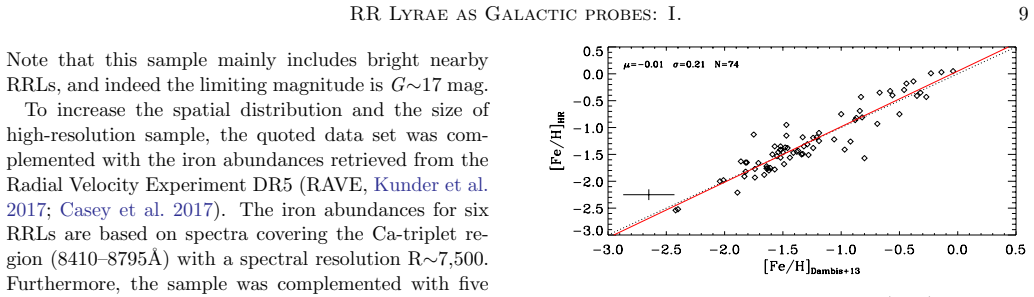
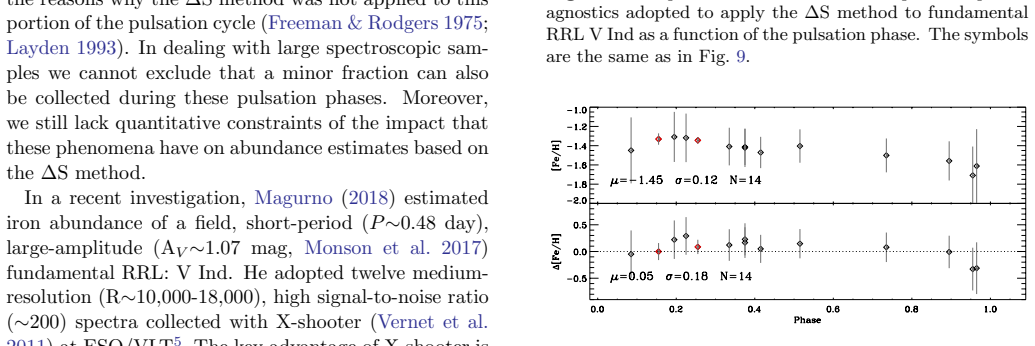
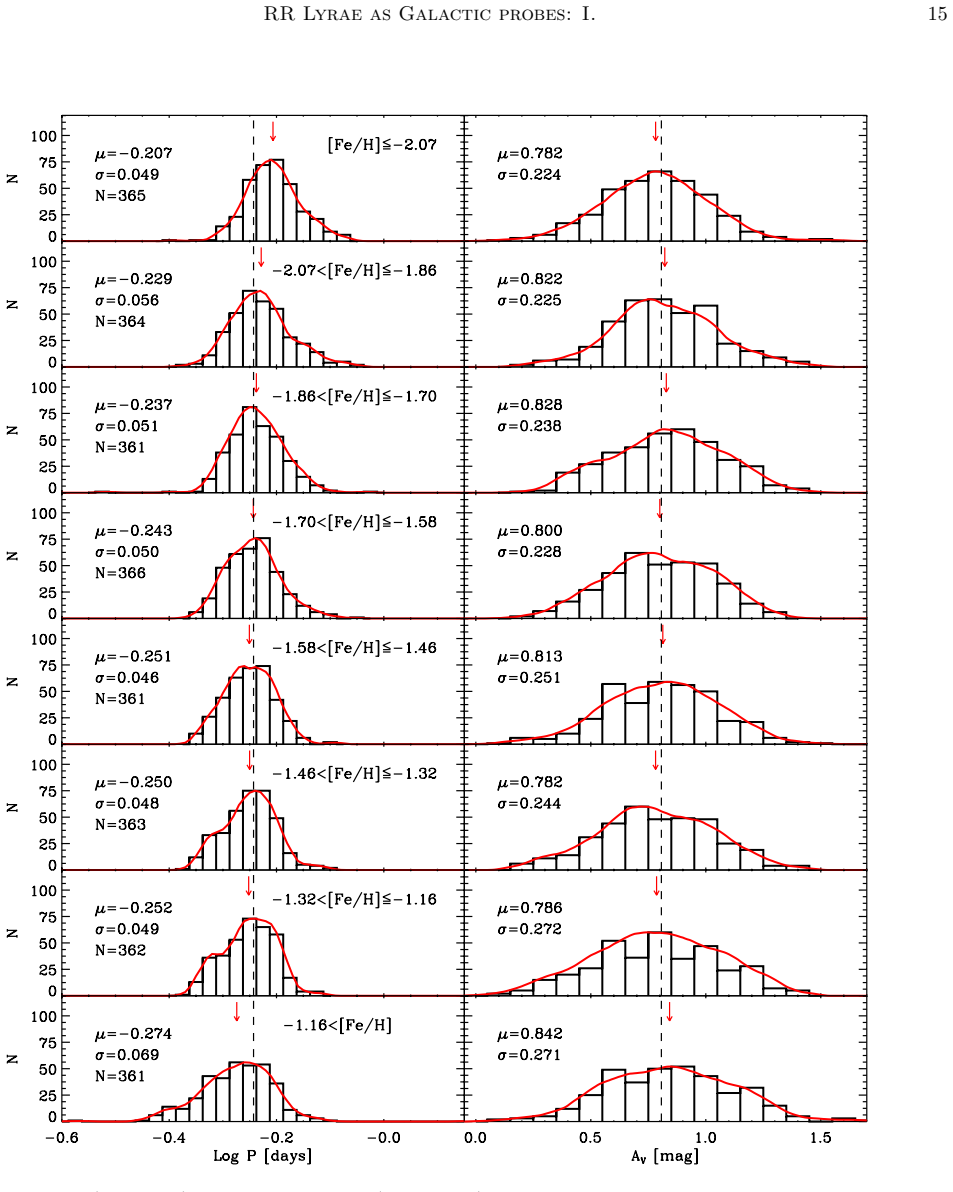
The load-bearing object is the homogeneous spectroscopic metallicity catalogue of 2,903 RRab stars, built by measuring pseudo-equivalent widths of Ca II K and Hβ/Hγ/Hδ from SEGUE spectra, converting through an intermediate low-resolution system onto the standard ΔS scale, and tying that scale to high-resolution abundances; a full-cycle X-shooter observation of one bright RR Lyrae confirms that the abundances are phase-independent. The argument then runs through the Bailey diagram: tracing the ridge lines of period–amplitude density defines OoI, OoII, and intermediate loci, and binning in metallicity shows the period peak moving smoothly from 0.63 to 0.51 days across 2 dex in [Fe/H].
What would settle it
If a large, unbiased sample of RR Lyrae with high-resolution metallicities in a single narrow metallicity bin (say [Fe/H] = −1.5 ± 0.1) still shows two separate period peaks near 0.56 and 0.66 days, then the period distribution is genuinely dichotomic and the smooth-transition explanation fails.
Extended reading notes
Core claim
Using the ΔS method (the ratio of Ca II K to hydrogen line strengths) on 2,382 SDSS-SEGUE spectra, calibrated through literature samples onto a common scale anchored by high-resolution spectra, the paper measures iron abundances for 2,903 fundamental RR Lyrae stars in the Galactic halo. In the Bailey diagram (period vs. luminosity amplitude), the stars shift steadily from long periods at [Fe/H]≈−3 to short periods at [Fe/H]≈0, with a linear relation logP = −0.311 − 0.044[Fe/H]. This continuity is incompatible with a genuine two-family dichotomy. The paper concludes that the Oosterhoff split seen in globular clusters is the selection effect of the clusters' bimodal metallicity distribution: metal-intermediate clusters that would fill the period gap do not host RR Lyrae stars.
Load-bearing premise
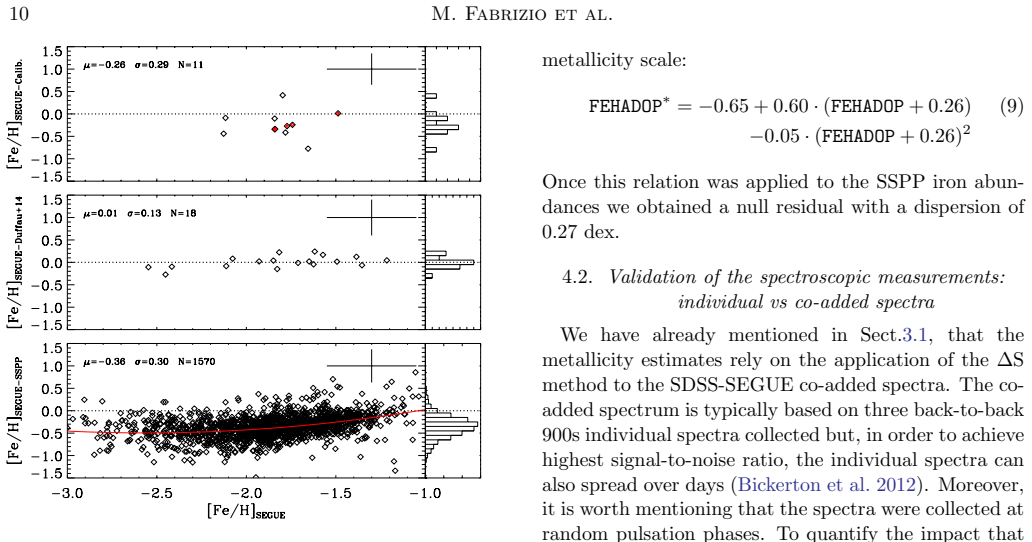
The central claim stands on the assumption that the metallicity scale, anchored by only eleven overlapping stars, is accurate across the whole [Fe/H] range from about −3 to 0; a systematic drift in that calibration would erase the smooth period–metallicity trend.
Editorial extensions
If this is right
- The mean period of an RR Lyrae population can serve as a metallicity indicator, since logP decreases linearly with [Fe/H] by about 0.044 dex per dex.
- Globular cluster Oosterhoff types I and II are not distinct pulsation families; clusters with intermediate metallicity are simply missing from the current samples.
- Luminosity amplitude is a poor proxy for metallicity, so period–amplitude–metallicity relations should be treated cautiously.
- Field RR Lyrae can be used to map the metallicity distribution of the halo out to large distances, complementing cluster-based studies.
- Metal-rich RR Lyrae near solar abundance are real and common in the field, suggesting their apparent absence in clusters is partly observational bias.
Reading between the lines
- If the smooth trend holds, galaxies currently classed as 'Oosterhoff intermediate' are not a distinct class; their mean periods simply reflect their intermediate iron abundance.
- The analysis predicts that deep searches in metal-intermediate globular clusters, or in their stripped remnants, should reveal RR Lyrae whose periods fill the 0.58–0.62 day gap.
- Extending the same calibration to first-overtone RRc stars would test whether the smooth period–metallicity relation also holds for overtone pulsators.
- The period–metallicity relation could be inverted to estimate iron abundances for hundreds of thousands of RR Lyrae from Gaia photometry alone once amplitudes are homogeneous.
Signed reviews
Editorial analysis
A structured set of objections, weighed in public.
Referee Report
Summary. The paper assembles a large catalogue of candidate RR Lyrae stars from literature surveys and Gaia DR2, applies conservative cuts to select halo fundamental-mode RRab variables, and derives iron abundances for 2,382 stars from SDSS-SEGUE spectra using the ΔS method, complemented by literature samples to a total of 2,903 RRab stars. The metallicity scale is calibrated onto a high-resolution pivot sample and validated with X-shooter spectra of V Ind covering the full pulsation cycle. The authors then study the Bailey diagram as a function of metallicity and report a continuous, nearly linear decrease of mean period with increasing [Fe/H] (Eq. 14). Their central conclusion is that the Oosterhoff dichotomy among Galactic globular clusters is not an intrinsic pulsation or evolutionary property of RR Lyrae stars but a reflection of the lack of metal-intermediate globular clusters hosting RR Lyrae stars.
Significance. If the central claim holds, this is a substantial advance on a long-standing problem, and the homogenized spectroscopic sample is a valuable community resource. The paper is careful in several respects: the phase-dependent validation with V Ind is a genuinely useful test of the ΔS method, the comparison of individual versus co-added spectra supports the use of public SEGUE spectra, and the authors explicitly flag the uncertainty in the metal-poor tail of the calibration. Nevertheless, the strength of the main conclusion is limited by the thin anchor of the absolute metallicity scale at the metal-poor end and by the partly circular definition of the Oosterhoff groups. These issues are addressable with robustness tests, and the empirical relations and the catalogue itself will remain useful even if the interpretation is refined.
major comments (3)
- [Section 4.1 and Section 5(b)] The absolute zero point of the ΔS metallicity scale is fixed by 11 common stars with an offset-only correction of −0.26 dex, and Section 5(b) explicitly concedes that the metal-poor tail ([Fe/H] < −2.3) may reflect a drift of the absolute calibration rather than an intrinsic signal. Since Eq. (14), the running averages in Fig. 15, and the OoI/OoInt/OoII mean metallicities ([Fe/H] = −1.46/−1.69/−1.88) are computed on this scale, a metallicity-dependent error below −2.3 could steepen or flatten the period–metallicity trend and could create or erase the continuous sequence that drives the paper's main conclusion. I ask the authors to propagate the uncertainty of the 11-star zero point and to test explicitly whether a conservative extrapolation error at [Fe/H] < −2.3 (for example, a slope uncertainty of ±0.1 dex per dex) removes the monotonic decrease of mean period with metallicity. An independent check of the ΔS scale in that regime, using the few available high-resolution metal-poor RRLs or cluster RRLs, is needed to support the claim.
- [Section 6 and Fig. 16] The Oosterhoff loci in Eqs. (10)–(12) are empirical ridges fitted to the 3D histogram of the same field sample, and the OoI, OoInt, and OoII subsamples in Fig. 16 are then selected around those fitted loci. The reported differences in mean metallicity among these groups therefore partly confirm the classification that was put in by construction. To make the central argument non-circular, the authors should compare the field-based period–metallicity relation with independent cluster data: for example, predict <Pab> for Galactic globulars at their spectroscopically known [Fe/H] and compare with observed cluster mean periods, or show that the conclusions are unchanged when Oo type is assigned using external criteria. This would directly test the claim that the Oosterhoff gap is populated by metal-intermediate clusters rather than by the fitted loci.
- [Section 3.1.1 and Table 1] The SEGUE-to-Sesar EW transformations (Eqs. 2–5) are fitted with only 10 stars, and the ΔS-to-HR zero point uses 11 stars. Given that the final sample contains 2,903 stars, these anchors are very thin, and the quoted internal scatter of 0.29 dex does not include the covariance of the four transformation slopes. Please report the uncertainties of the transformation parameters and the resulting systematic error in [Fe/H] as a function of equivalent width, and state explicitly how the assumed individual errors listed in Table 1 were propagated into the running averages and linear fits in Fig. 15.
minor comments (5)
- [Section 8] The conclusions describe a 'continuous and linear correlation' between period and metallicity, but Eq. (14) is a linear fit to a running average; the authors should clarify whether linearity is tested against a quadratic or broken-linear model, or whether the available evidence supports only monotonicity.
- [Section 2.2] The selection function of the cleaned halo sample is described qualitatively; a brief quantitative discussion of how the plane cut, reddening cut, SED 1σ cut, and galactocentric distance cut affect the resulting metallicity distribution would help readers assess possible biases in the quoted peak ([Fe/H] = −1.59) and in the period–metallicity trend.
- [Section 4.3] The V Ind validation is performed at [Fe/H] ≈ −1.45, so it validates the ΔS method at intermediate metallicity but does not constrain the metal-poor end where the calibration is weakest; this limitation should be stated explicitly in the validation section.
- [Section 4.2 and Section 7] Minor typographical issues: 'similar similar estimated provided by Drake' should read 'similar estimates provided by Drake', and 'NGC 6338' should likely be 'NGC 6388'.
- [Fig. 14] The eight metallicity bins are said to contain similar numbers of objects, but only the bin-edge labels are shown; a small table listing bin ranges and counts would improve reproducibility.
Circularity Check
No significant circularity: the period–metallicity and Oosterhoff-group metallicity results are empirical correlations between independent observables, not derivations that reduce to fitted inputs.
full rationale
The paper's central claim is that field RR Lyrae stars show a continuous variation of mean fundamental-mode period with spectroscopic [Fe/H], and that the Oosterhoff dichotomy of Galactic globulars reflects the bimodal metallicity distribution of the clusters themselves. Each load-bearing step uses independent observables. The Oosterhoff loci (Eqs. 10-12) are traced from a 3D histogram in period, amplitude, and number of stars only; metallicity is not used to define them, so the later finding that OoI, OoInt, and OoII selections have mean abundances -1.46, -1.69, and -1.88 is an empirical correlation, not a construction. Equation 14 is a descriptive linear fit to the running average of log P versus [Fe/H], not a prediction derived from the same quantity. The concluding inference about globular clusters relies on the externally known bimodal metallicity distribution of Galactic globulars, not on any equation fitted in this paper. The calibration chain (Sesar et al. 2013b, Layden 1994, Magurno et al. 2018) involves prior work by co-authors, but it is used as a standard calibration anchor and is validated against independent high-resolution spectra of V Ind and external measurements; it does not by construction force the period-metallicity trend or the Oosterhoff interpretation. The paper even flags the residual calibration uncertainty at the metal-poor end (Section 5b), which is an honest limitation rather than a circular step. No fitted parameter is renamed as a prediction, and no uniqueness theorem or self-citation is invoked to forbid alternatives. The central result is therefore self-contained as an empirical analysis, with no step equivalent to its inputs by definition.
Assumptions & free parameters
free parameters (5)
- Layden Delta-S calibration coefficients =
a=13.858, b=-1.185, c=4.228, d=-0.32 (Eq 7)
- SEGUE-to-Sesar EW transformation coefficients =
CaK: 1.07, -0.34; Hbeta: 0.75, 1.17; Hgamma: 1.30, -1.14; Hdelta: 1.16, -0.90 (Eqs 2-5)
- Dambis-to-HR linear correction =
[Fe/H]_HR = 0.05 + 1.03 [Fe/H]_Dambis (Eq 8)
- Delta-S zero-point offset =
-0.26 dex
- SSPP quadratic calibration coefficients =
-0.65, 0.60, -0.05 (Eq 9)
assumptions (5)
- domain assumption The Delta-S method (Preston 1959; Layden 1994) provides iron abundances accurate to the claimed level for RRab stars.
- domain assumption The Beers (1990) model for interstellar Ca II absorption correctly corrects the Ca II K EW (Eq 6).
- domain assumption The adopted sample cuts (Section 2.2) yield a representative sample of field halo RRab stars.
- domain assumption The Gaia G-band to V-band amplitude transformation (Eq 2 of Clementini et al. 2019) is valid for these RRLs.
- domain assumption The period-amplitude criterion of Eq 1 correctly separates fundamental (RRab) from first-overtone (RRc) variables.
Cite this review
Pith. "Pith review of On the use of field RR Lyrae as Galactic probes: I. The Oosterhoff dichotomy based on fundamental variables." pith.science (2026). https://pith.science/paper/74C6IGTZ
@misc{pith2026190802064,
  author       = {Pith},
  title        = {Pith review of: On the use of field RR Lyrae as Galactic probes: I. The Oosterhoff dichotomy based on fundamental variables},
  year         = {2026},
  howpublished = {\url{https://pith.science/paper/74C6IGTZ}},
  note         = {Machine review of arXiv:1908.02064}
}
abstract
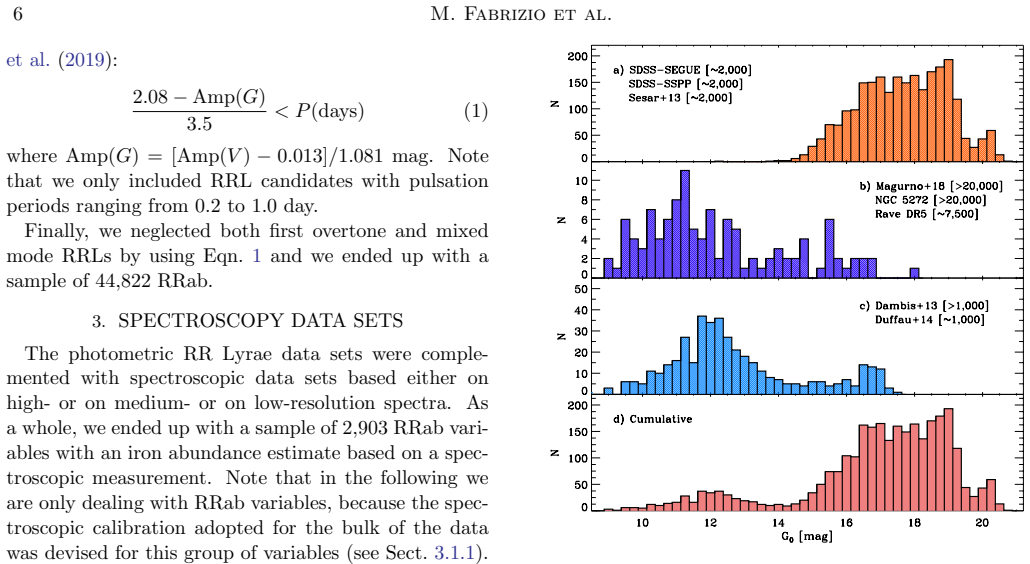
We collected a large data set of field RR Lyrae stars (RRLs) by using catalogues already available in the literature and Gaia DR2. We estimated the iron abundances for a sub-sample of 2,382 fundamental RRLs ($\Delta$S method: CaIIK, H$\beta$, H$\gamma$ and H$\delta$ lines) for which are publicly available medium-resolution SDSS-SEGUE spectra. We also included similar estimates available in the literature ending up with the largest and most homogeneous spectroscopic data set ever collected for RRLs (2,903). The metallicity scale was validated by using iron abundances based on high resolution spectra for a fundamental field RRL (V~Ind), for which we collected X-shooter spectra covering the entire pulsation cycle. The peak ([Fe/H]=-1.59$\pm$0.01) and the standard deviation ($\sigma$=0.43 dex) of the metallicity distribution agree quite well with similar estimates available in the literature. The current measurements disclose a well defined metal-rich tail approaching Solar iron abundance. The spectroscopic sample plotted in the Bailey diagram (period vs luminosity amplitude) shows a steady variation when moving from the metal-poor ([Fe/H]=-3.0/-2.5) to the metal-rich ([Fe/H]=-0.5/0.0) regime. The smooth transition in the peak of the period distribution as a function of the metallicity strongly indicates that the long-standing problem of the Oosterhoff dichotomy among Galactic globulars is the consequence of the lack of metal-intermediate clusters hosting RRLs. We also found that the luminosity amplitude, in contrast with period, does not show a solid correlation with metallicity. This suggests that period-amplitude-metallicity relations should be cautiously treated.
Figures


Figures from the paper (13 more)







Reference graph
Works this paper leans on
-
[1]
thebibliography [1] 20pt to REFERENCES 6pt =0pt 10pt plus 3pt =0pt =0pt =1pt plus 1pt =0pt =0pt -12pt =13pt plus 1pt =20pt =13pt plus 1pt \@M =10000 =-1.0em =0pt =0pt 0pt =0pt =1.0em @enumiv\@empty 10000 10000 `\.\@m \@noitemerr \@latex@warning Empty `thebibliography' environment \@ifnextchar \@reference \@latexerr Missing key on reference command Each re...
arXiv 2019
-
[2]
P., Alexandroff , R., Allende Prieto , C., et al
Ahn , C. P., Alexandroff , R., Allende Prieto , C., et al. 2012, , 203, 21, 10.1088/0067-0049/203/2/21
-
[3]
2000, , 119, 1901, 10.1086/301321
Akerlof , C., Amrose , S., Balsano , R., et al. 2000, , 119, 1901, 10.1086/301321
doi:10.1086/301321 2000
-
[4]
D., Allende Prieto , C., et al
Alam , S., Albareti , F. D., Allende Prieto , C., et al. 2015, , 219, 12, 10.1088/0067-0049/219/1/12
-
[5]
Allende Prieto , C., Sivarani , T., Beers , T. C., et al. 2008, , 136, 2070, 10.1088/0004-6256/136/5/2070
-
[6]
Arp , H. C. 1955, , 60, 317, 10.1086/107232
-
[7]
Asplund, M., Grevesse, N., Sauval, A. J., & Scott, P. 2009, Annual Review of Astronomy and Astrophysics, 47, 481, 10.1146/annurev.astro.46.060407.145222
arXiv 2009
-
[8]
Bailer-Jones , C. A. L., Rybizki , J., Fouesneau , M., Mantelet , G., & Andrae , R. 2018, , 156, 58, 10.3847/1538-3881/aacb21
Show all 150 references
-
[9]
Bailey , S. I. 1902, Annals of Harvard College Observatory, 38
1902
-
[10]
Beers , T. C. 1990, , 99, 323, 10.1086/115330
1990 doi
-
[11]
2017, , 230, 24, 10.3847/1538-4365/aa7053
Bianchi , L., Shiao , B., & Thilker , D. 2017, , 230, 24, 10.3847/1538-4365/aa7053
2017 doi
-
[12]
2012, in IAU Symposium, Vol
Bickerton , S., Badenes , C., Hettinger , T., Beers , T., & Huang , S. 2012, in IAU Symposium, Vol. 285, New Horizons in Time Domain Astronomy, ed. E. Griffin , R. Hanisch , & R. Seaman , 289--290
2012
-
[13]
1997, , 489, 822, 10.1086/304807
Bono , G., Caputo , F., Cassisi , S., Castellani , V., & Marconi , M. 1997, , 489, 822, 10.1086/304807
1997 doi
-
[14]
1995, , 110, 2365, 10.1086/117694
Bono , G., Caputo , F., & Marconi , M. 1995, , 110, 2365, 10.1086/117694
1995 doi
-
[15]
Bono , G., Caputo , F., & Stellingwerf , R. F. 1994, , 423, 294, 10.1086/173806
1994 doi
-
[16]
Bono , G., & Stellingwerf , R. F. 1994, , 93, 233, 10.1086/192054
1994 doi
-
[17]
2016, Commmunications of the Konkoly Observatory Hungary, 105, 149
Bono , G., Pietrinferni , A., Marconi , M., et al. 2016, Commmunications of the Konkoly Observatory Hungary, 105, 149
2016
-
[18]
F., et al
Bono , G., Iannicola , G., Braga , V. F., et al. 2019, , 870, 115, 10.3847/1538-4357/aaf23f
2019 doi
-
[19]
F., Stetson , P
Braga , V. F., Stetson , P. B., Bono , G., et al. 2016, , 152, 170, 10.3847/0004-6256/152/6/170
2016 doi
- [20]
-
[21]
2018, , 478, 4513, 10.1093/mnras/sty1281
Buder , S., Asplund , M., Duong , L., et al. 2018, , 478, 4513, 10.1093/mnras/sty1281
2018 doi
-
[22]
M., & Carney , B
Cacciari , C., Corwin , T. M., & Carney , B. W. 2005, , 129, 267, 10.1086/426325
2005 doi
-
[23]
1998, , 293, 364, 10.1046/j.1365-8711.1998.01171.x
Caputo , F., Santolamazza , P., & Marconi , M. 1998, , 293, 364, 10.1046/j.1365-8711.1998.01171.x
1998
-
[24]
A., Clayton , G
Cardelli , J. A., Clayton , G. C., & Mathis , J. S. 1989, , 345, 245, 10.1086/167900
1989 doi
-
[25]
Casagrande , L., & VandenBerg , D. A. 2018, , 479, L102, 10.1093/mnrasl/sly104
2018 doi
-
[26]
R., Hawkins , K., Hogg , D
Casey , A. R., Hawkins , K., Hogg , D. W., et al. 2017, , 840, 59, 10.3847/1538-4357/aa69c2
2017 doi
-
[27]
2004, , 426, 641, 10.1051/0004-6361:20041048
Cassisi , S., Castellani , M., Caputo , F., & Castellani , V. 2004, , 426, 641, 10.1051/0004-6361:20041048
2004 doi
-
[28]
2003, , 410, 871, 10.1051/0004-6361:20031381
Castellani , M., Caputo , F., & Castellani , V. 2003, , 410, 871, 10.1051/0004-6361:20031381
2003 doi
-
[29]
1983, , 54, 141
Castellani , V. 1983, , 54, 141
1983
-
[30]
2009, , 320, 261, 10.1007/s10509-009-9987-8
Catelan , M. 2009, , 320, 261, 10.1007/s10509-009-9987-8
2009 doi
-
[31]
Chadid , M., Sneden , C., & Preston , G. W. 2017, , 835, 187, 10.3847/1538-4357/835/2/187
2017 doi
-
[32]
V., Mieske , S., Hilker , M., & Infante , L
Chilingarian , I. V., Mieske , S., Hilker , M., & Infante , L. 2011, , 412, 1627, 10.1111/j.1365-2966.2010.18000.x
2011
-
[33]
Y., & Li , H
Choksi , N., Gnedin , O. Y., & Li , H. 2018, , 480, 2343, 10.1093/mnras/sty1952
2018 doi
-
[34]
M., Muzzin , A., Dufton , Q., et al
Clement , C. M., Muzzin , A., Dufton , Q., et al. 2001, , 122, 2587, 10.1086/323719
2001 doi
-
[35]
1990, , 85, 865
Clementini , G., Cacciari , C., & Lindgren , H. 1990, , 85, 865
1990
-
[36]
2003, , 125, 1309, 10.1086/367773
Clementini , G., Gratton , R., Bragaglia , A., et al. 2003, , 125, 1309, 10.1086/367773
2003 doi
-
[37]
2019, , 622, A60, 10.1051/0004-6361/201833374
Clementini , G., Ripepi , V., Molinaro , R., et al. 2019, , 622, A60, 10.1051/0004-6361/201833374
2019 doi
-
[38]
B., Marconi , M., et al
Coppola , G., Stetson , P. B., Marconi , M., et al. 2013, , 775, 6, 10.1088/0004-637X/775/1/6
2013 doi
-
[39]
B., et al
Coppola , G., Marconi , M., Stetson , P. B., et al. 2015, , 814, 71, 10.1088/0004-637X/814/1/71
2015 doi
-
[40]
M., & et al
Cutri , R. M., & et al. 2013, VizieR Online Data Catalog, 2328
2013
-
[41]
2016, , 829, 77, 10.3847/0004-637X/829/2/77
Dalessandro , E., Lapenna , E., Mucciarelli , A., et al. 2016, , 829, 77, 10.3847/0004-637X/829/2/77
2016 doi
-
[42]
2012, , 752, 42, 10.1088/0004-637X/752/1/42
Dall'Ora , M., Kinemuchi , K., Ripepi , V., et al. 2012, , 752, 42, 10.1088/0004-637X/752/1/42
2012 doi
-
[43]
K., Berdnikov , L
Dambis , A. K., Berdnikov , L. N., Kniazev , A. Y., et al. 2013, , 435, 3206, 10.1093/mnras/stt1514
2013 doi
-
[44]
2000, in , Vol
Dekker , H., D'Odorico , S., Kaufer , A., Delabre , B., & Kotzlowski , H. 2000, in , Vol. 4008, Optical and IR Telescope Instrumentation and Detectors, ed. M. Iye & A. F. Moorwood , 534--545
2000
-
[45]
J., Catelan , M., Djorgovski , S
Drake , A. J., Catelan , M., Djorgovski , S. G., et al. 2013 a , , 763, 32, 10.1088/0004-637X/763/1/32
2013 doi
-
[46]
2013 b , , 765, 154, 10.1088/0004-637X/765/2/154
---. 2013 b , , 765, 154, 10.1088/0004-637X/765/2/154
2013 doi
-
[47]
J., Graham , M
Drake , A. J., Graham , M. J., Djorgovski , S. G., et al. 2014, , 213, 9, 10.1088/0067-0049/213/1/9
2014 doi
-
[48]
K., Zinn , R., M \'e ndez , R
Duffau , S., Vivas , A. K., Zinn , R., M \'e ndez , R. A., & Ruiz , M. T. 2014, , 566, A118, 10.1051/0004-6361/201219654
2014 doi
-
[49]
2016, , 595, A82, 10.1051/0004-6361/201628700
Elorrieta , F., Eyheramendy , S., Jord \'a n , A., et al. 2016, , 595, A82, 10.1051/0004-6361/201628700
2016 doi
-
[50]
W., Riello , M., De Angeli , F., et al
Evans , D. W., Riello , M., De Angeli , F., et al. 2018, , 616, A4, 10.1051/0004-6361/201832756
2018 doi
-
[51]
2015, , 580, A18, 10.1051/0004-6361/201525753
Fabrizio , M., Nonino , M., Bono , G., et al. 2015, , 580, A18, 10.1051/0004-6361/201525753
2015 doi
-
[52]
2016, , 830, 126, 10.3847/0004-637X/830/2/126
Fabrizio , M., Bono , G., Nonino , M., et al. 2016, , 830, 126, 10.3847/0004-637X/830/2/126
2016 doi
-
[53]
G., Skillen , I., et al
Fernley , J., Barnes , T. G., Skillen , I., et al. 1998, , 330, 515
1998
-
[54]
2008, arXiv e-prints
Fiorentino , G., Contreras , R., Clementini , G., et al. 2008, arXiv e-prints. 0801.2713
2008 arXiv
-
[55]
2015, , 798, L12, 10.1088/2041-8205/798/1/L12
Fiorentino , G., Bono , G., Monelli , M., et al. 2015, , 798, L12, 10.1088/2041-8205/798/1/L12
2015 doi
-
[56]
B., et al
Fiorentino , G., Monelli , M., Stetson , P. B., et al. 2017, , 599, A125, 10.1051/0004-6361/201629501
2017 doi
- [57]
-
[58]
Gaia Collaboration , Brown , A. G. A., Vallenari , A., et al. 2018, , 616, A1, 10.1051/0004-6361/201833051
2018 doi
-
[59]
2004, , 42, 385, 10.1146/annurev.astro.42.053102.133945
Gratton , R., Sneden , C., & Carretta , E. 2004, , 42, 385, 10.1146/annurev.astro.42.053102.133945
2004
-
[60]
K., & Jurcsik , J
Hajdu , G., D \'e k \'a ny , I., Catelan , M., Grebel , E. K., & Jurcsik , J. 2018, , 857, 55, 10.3847/1538-4357/aab4fd
2018 doi
-
[61]
Harris , W. E. 1991, , 29, 543, 10.1146/annurev.aa.29.090191.002551
1991
- [62]
-
[63]
I., Harrison , T
Hoffman , D. I., Harrison , T. E., & McNamara , B. J. 2009, , 138, 466, 10.1088/0004-6256/138/2/466
2009 doi
-
[64]
2015, , 218, 31, 10.1088/0067-0049/218/2/31
Jang , S., & Lee , Y.-W. 2015, , 218, 31, 10.1088/0067-0049/218/2/31
2015 doi
-
[65]
S., Stanek , K
Jayasinghe , T., Kochanek , C. S., Stanek , K. Z., et al. 2018, , 477, 3145, 10.1093/mnras/sty838
2018 doi
-
[66]
1996, , 312, 111
Jurcsik , J., & Kovacs , G. 1996, , 312, 111
1996
-
[67]
C., Smith , H
Kinemuchi , K., Harris , H. C., Smith , H. A., et al. 2008, , 136, 1921, 10.1088/0004-6256/136/5/1921
2008 doi
-
[68]
Kinman , T. D. 1959, , 119, 134, 10.1093/mnras/119.2.134
1959 doi
-
[69]
D., Cacciari , C., Bragaglia , A., Buzzoni , A., & Spagna , A
Kinman , T. D., Cacciari , C., Bragaglia , A., Buzzoni , A., & Spagna , A. 2007, , 375, 1381, 10.1111/j.1365-2966.2006.11394.x
2007
-
[70]
D., Cacciari , C., Bragaglia , A., Smart , R., & Spagna , A
Kinman , T. D., Cacciari , C., Bragaglia , A., Smart , R., & Spagna , A. 2012, , 422, 2116, 10.1111/j.1365-2966.2012.20747.x
2012
-
[71]
Kraft , R. P. 1972, in The Evolution of Population II Stars, ed. A. G. D. Philip , Vol. 4, 69--96
1972
-
[72]
2017, , 153, 75, 10.3847/1538-3881/153/2/75
Kunder , A., Kordopatis , G., Steinmetz , M., et al. 2017, , 153, 75, 10.3847/1538-3881/153/2/75
2017 doi
-
[73]
Layden , A. C. 1993, , 105, 1367, 10.1086/133319
1993 doi
- [74]
- [75]
-
[76]
Lee , J.-W., & Carney , B. W. 1999, , 118, 1373, 10.1086/301008
1999 doi
-
[77]
S., Beers , T
Lee , Y. S., Beers , T. C., Sivarani , T., et al. 2008 a , , 136, 2022, 10.1088/0004-6256/136/5/2022
2008 doi
-
[78]
2008 b , , 136, 2050, 10.1088/0004-6256/136/5/2050
---. 2008 b , , 136, 2050, 10.1088/0004-6256/136/5/2050
2008 doi
-
[79]
1990, , 350, 155, 10.1086/168370
Lee , Y.-W., Demarque , P., & Zinn , R. 1990, , 350, 155, 10.1086/168370
1990 doi
- [80]
-
[81]
Tor Vergata
Magurno , D. 2018, PhD thesis, University of Rome "Tor Vergata"
2018
-
[82]
F., et al
Magurno , D., Sneden , C., Braga , V. F., et al. 2018, , 864, 57, 10.3847/1538-4357/aad4a3
2018 doi
-
[83]
R., Skrutskie , M
Majewski , S. R., Skrutskie , M. F., Weinberg , M. D., & Ostheimer , J. C. 2003, , 599, 1082, 10.1086/379504
2003 doi
-
[84]
R., Schiavon , R
Majewski , S. R., Schiavon , R. P., Frinchaboy , P. M., et al. 2017, , 154, 94, 10.3847/1538-3881/aa784d
2017 doi
-
[85]
2018, , 864, L13, 10.3847/2041-8213/aada17
Marconi , M., Bono , G., Pietrinferni , A., et al. 2018, , 864, L13, 10.3847/2041-8213/aada17
2018 doi
-
[86]
2005, , 623, L133, 10.1086/430273
Marconi , M., Nordgren , T., Bono , G., Schnider , G., & Caputo , F. 2005, , 623, L133, 10.1086/430273
2005 doi
-
[87]
2015, , 808, 50, 10.1088/0004-637X/808/1/50
Marconi , M., Coppola , G., Bono , G., et al. 2015, , 808, 50, 10.1088/0004-637X/808/1/50
2015 doi
-
[88]
M., Marinoni , S., Fabrizio , M., & Altavilla , G
Marrese , P. M., Marinoni , S., Fabrizio , M., & Altavilla , G. 2019, , 621, A144, 10.1051/0004-6361/201834142
2019 doi
-
[89]
M., Marinoni , S., Fabrizio , M., & Giuffrida , G
Marrese , P. M., Marinoni , S., Fabrizio , M., & Giuffrida , G. 2017, , 607, A105, 10.1051/0004-6361/201730965
2017 doi
-
[90]
E., Monelli , M., Bono , G., et al
Mart \' nez-V \'a zquez , C. E., Monelli , M., Bono , G., et al. 2015, , 454, 1509, 10.1093/mnras/stv2014
2015 doi
-
[91]
E., Stetson , P
Mart \' nez-V \'a zquez , C. E., Stetson , P. B., Monelli , M., et al. 2016, , 462, 4349, 10.1093/mnras/stw1895
2016 doi
-
[92]
McConnachie , A. W. 2012, , 144, 4, 10.1088/0004-6256/144/1/4
2012 doi
-
[93]
G., Banerji , M., Gonzalez , E., et al
McMahon , R. G., Banerji , M., Gonzalez , E., et al. 2013, The Messenger, 154, 35
2013
- [94]
-
[95]
J., et al
Monelli , M., Fiorentino , G., Bernard , E. J., et al. 2017, , 842, 60, 10.3847/1538-4357/aa738d
2017 doi
-
[96]
P., Fabrizio , M., et al
Monelli , M., Milone , A. P., Fabrizio , M., et al. 2014, , 796, 90, 10.1088/0004-637X/796/2/90
2014 doi
-
[97]
J., Beaton , R
Monson , A. J., Beaton , R. L., Scowcroft , V., et al. 2017, , 153, 96, 10.3847/1538-3881/153/3/96
2017 doi
-
[98]
M., Cohen , J
Nemec , J. M., Cohen , J. G., Ripepi , V., et al. 2013, , 773, 181, 10.1088/0004-637X/773/2/181
2013 doi
-
[99]
M., Wehlau , A., & Mendes de Oliveira , C
Nemec , J. M., Wehlau , A., & Mendes de Oliveira , C. 1988, , 96, 528, 10.1086/114830
1988 doi
- [100]
-
[101]
Oosterhoff , P. T. 1939, The Observatory, 62, 104
1939
-
[102]
2015, , 447, 2404, 10.1093/mnras/stu2616
Pancino , E., Britavskiy , N., Romano , D., et al. 2015, , 447, 2404, 10.1093/mnras/stu2616
2015 doi
-
[103]
2004, in Frontiers of the Universe, ed
Petroni , S., Bono , G., Castellani , V., & Marconi , M. 2004, in Frontiers of the Universe, ed. L. Celnikier & J. T. Thanh van , 199
2004
-
[104]
2015, , 811, 113, 10.1088/0004-637X/811/2/113
Pietrukowicz , P., Koz owski , S., Skowron , J., et al. 2015, , 811, 113, 10.1088/0004-637X/811/2/113
2015 doi
-
[105]
2013, , 495, 76, 10.1038/nature11878
Pietrzy \'n ski , G., Graczyk , D., Gieren , W., et al. 2013, , 495, 76, 10.1038/nature11878
2013 doi
-
[106]
2002, , 52, 397
Pojmanski , G. 2002, , 52, 397
2002
-
[107]
G., Gennaro , M., Bono , G., et al
Prada Moroni , P. G., Gennaro , M., Bono , G., et al. 2012, , 749, 108, 10.1088/0004-637X/749/2/108
2012 doi
-
[108]
Preston , G. W. 1959, , 130, 507, 10.1086/146743
1959 doi
- [109]
-
[110]
A., Catelan , M., & Sweigart , A
Pritzl , B., Smith , H. A., Catelan , M., & Sweigart , A. V. 2000, , 530, L41, 10.1086/312482
2000 doi
-
[111]
J., Smith , H
Pritzl , B. J., Smith , H. A., Stetson , P. B., et al. 2003, , 126, 1381, 10.1086/377024
2003 doi
-
[112]
1983, , 54, 335
Renzini , A. 1983, , 54, 335
1983
-
[113]
2018, in The RR Lyrae 2017 Conference
Salaris , M. 2018, in The RR Lyrae 2017 Conference. Revival of the Classical Pulsators: from Galactic Structure to Stellar Interior Diagnostics, ed. R. Smolec , K. Kinemuchi , & R. I. Anderson , Vol. 6, 21--28
2018
- [114]
- [115]
- [116]
- [117]
- [118]
- [119]
-
[120]
2010, , 722, 79, 10.1088/0004-637X/722/1/79
---. 2010, , 722, 79, 10.1088/0004-637X/722/1/79
2010 doi
-
[121]
F., & Finkbeiner , D
Schlafly , E. F., & Finkbeiner , D. P. 2011, , 737, 103, 10.1088/0004-637X/737/2/103
2011 doi
-
[122]
J., Finkbeiner , D
Schlegel , D. J., Finkbeiner , D. P., & Davis , M. 1998, , 500, 525, 10.1086/305772
1998 doi
-
[123]
S., et al
Sesar , B., Ivezi \'c , Z ., Stuart , J. S., et al. 2013 a , , 146, 21, 10.1088/0004-6256/146/2/21
2013 doi
-
[124]
J., Cohen , J
Sesar , B., Grillmair , C. J., Cohen , J. G., et al. 2013 b , , 776, 26, 10.1088/0004-637X/776/1/26
2013 doi
-
[125]
J., Prieto , J
Shappee , B. J., Prieto , J. L., Grupe , D., et al. 2014, , 788, 48, 10.1088/0004-637X/788/1/48
2014 doi
-
[126]
F., Cutri , R
Skrutskie , M. F., Cutri , R. M., Stiening , R., et al. 2006, , 131, 1163, 10.1086/498708
2006 doi
-
[127]
A., Gunn , J
Smee , S. A., Gunn , J. E., Uomoto , A., et al. 2013, , 146, 32, 10.1088/0004-6256/146/2/32
2013 doi
-
[128]
Smith , H. A. 1984, , 96, 505, 10.1086/131370
1984 doi
-
[129]
W., Kollmeier , J
Sneden , C., Preston , G. W., Kollmeier , J. A., et al. 2018, , 155, 45, 10.3847/1538-3881/aa9f16
2018 doi
-
[130]
K., et al
Soszy \'n ski , I., Udalski , A., Szyma \'n ski , M. K., et al. 2014, , 64, 177. 1410.1542
2014 arXiv
-
[131]
B., Fiorentino , G., Bono , G., et al
Stetson , P. B., Fiorentino , G., Bono , G., et al. 2014, , 126, 616, 10.1086/677352
2014 doi
-
[132]
Stobie , R. S. 1971, , 168, 381, 10.1086/151094
1971 doi
-
[133]
W., & Latham , D
Storm , J., Carney , B. W., & Latham , D. W. 1994, , 290, 443
1994
-
[134]
E., Kraft , R
Taam , R. E., Kraft , R. P., & Suntzeff , N. 1976, , 207, 201, 10.1086/154485
1976 doi
-
[135]
B., Beers , T
Tissera , P. B., Beers , T. C., Carollo , D., & Scannapieco , C. 2014, , 439, 3128, 10.1093/mnras/stu181
2014 doi
-
[136]
J., et al
Torrealba , G., Catelan , M., Drake , A. J., et al. 2015, , 446, 2251, 10.1093/mnras/stu2274
2015 doi
-
[137]
2018, , 616, A83, 10.1051/0004-6361/201832905
Valenti , E., Zoccali , M., Mucciarelli , A., et al. 2018, , 616, A83, 10.1051/0004-6361/201832905
2018 doi
- [138]
-
[139]
1993 a , , 262, 588, 10.1093/mnras/262.3.588
van den Bergh , S. 1993 a , , 262, 588, 10.1093/mnras/262.3.588
1993 doi
- [140]
-
[141]
2011, , 536, A105, 10.1051/0004-6361/201117752
Vernet , J., Dekker , H., D'Odorico , S., et al. 2011, , 536, A105, 10.1051/0004-6361/201117752
2011 doi
-
[142]
K., Zinn , R., Abad , C., et al
Vivas , A. K., Zinn , R., Abad , C., et al. 2004, , 127, 1158, 10.1086/380929
2004 doi
- [143]
- [144]
-
[145]
L., Eisenhardt , P
Wright , E. L., Eisenhardt , P. R. M., Mainzer , A. K., et al. 2010, , 140, 1868, 10.1088/0004-6256/140/6/1868
2010 doi
-
[146]
J., et al
Yanny , B., Rockosi , C., Newberg , H. J., et al. 2009, , 137, 4377, 10.1088/0004-6256/137/5/4377
2009 doi
-
[147]
Zinn , R., & West , M. J. 1984, , 55, 45, 10.1086/190947
1984 doi
-
[148]
Zoccali , M., Valenti , E., & Gonzalez , O. A. 2018, , 618, A147, 10.1051/0004-6361/201833147
2018 doi
-
[149]
M., et al
Zolotov , A., Willman , B., Brooks , A. M., et al. 2009, , 702, 1058, 10.1088/0004-637X/702/2/1058
2009 doi
-
[150]
A., et al
Zorotovic , M., Catelan , M., Smith , H. A., et al. 2010, , 139, 357, 10.1088/0004-6256/139/2/357
2010 doi
Reviewed August 14, 2026 · model on record in the stance chip above.
Discussion (0). Continue with ORCID to comment.