Gut microbiome composition: back to baseline?
Pith reviewed 2026-05-25 13:58 UTC · model grok-4.3
The pith
Re-analysis shows gut microbiomes after antibiotics stabilize at a new composition rather than recovering their original baseline.
A machine-rendered reading of the paper's core claim, the machinery that carries it, and where it could break.
Core claim
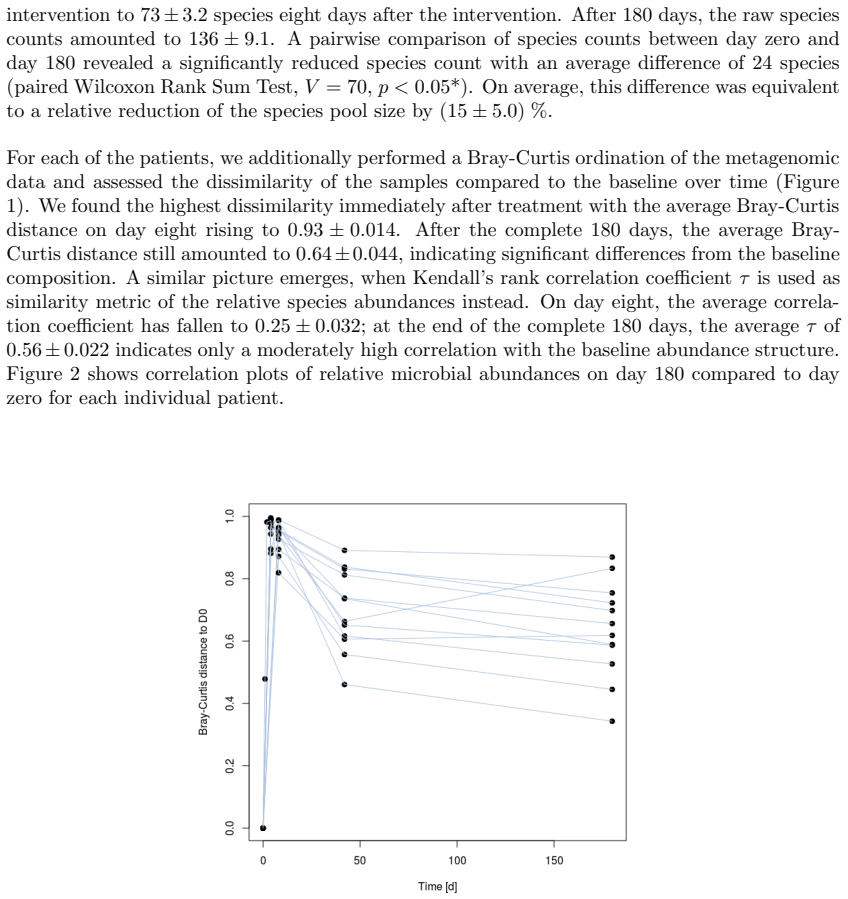
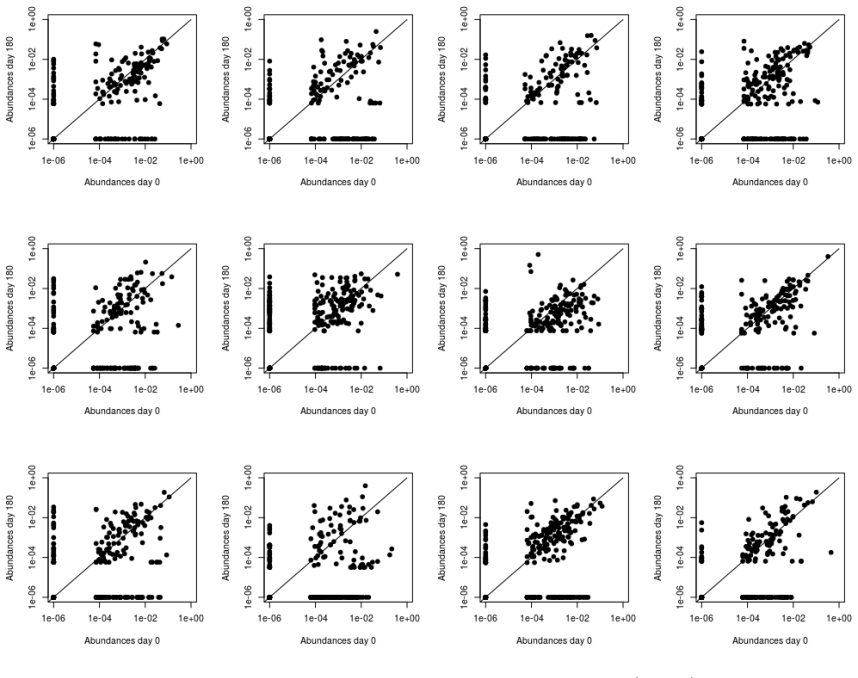
The microbiomes exhibit a significant loss of microbial taxa even after the complete study period of 180 days and their composition after 180 days only moderately correlates with the initial baseline states. Taken together with the lack of significant compositional differences between day 42 and day 180, these findings suggest the convergence of the microbiomes to another stable composition, which is different from the pre-treatment states, instead of a recovery of the baseline state.
What carries the argument
Comparisons of microbiome composition at multiple time points using taxon loss counts, correlation to baseline, and tests for significant differences between later sampling days.
If this is right
- Antibiotic exposure may shift the gut microbiome to a new equilibrium that persists beyond six months.
- The long-lasting effects of antibiotics on microbiome composition could be more substantial than concluded from the original analysis.
- These persistent differences in microbiome states after antibiotics warrant further investigation for links to health outcomes.
Where Pith is reading between the lines
- Recovery assessments in future antibiotic studies may need to extend beyond 180 days or incorporate different stability metrics.
- The new post-antibiotic state could be compared directly to microbiome profiles seen in disease contexts to test for shared features.
Load-bearing premise
The absence of statistically significant compositional differences between day 42 and day 180, together with taxon loss and only moderate correlation to baseline, demonstrates arrival at a new stable state rather than ongoing slow recovery or insufficient statistical power.
What would settle it
A follow-up observation of continued compositional shifts toward the original baseline after day 180, or a larger sample revealing significant differences between day 42 and day 180, would challenge the new stable state interpretation.
Figures
read the original abstract
In Nature Microbiology, Palleja and colleagues studied the changes in gut microbiome composition in twelve healthy men over a period of six months following an antibiotic intervention. The authors argued that the 'gut microbiota of the subjects recovered to near-baseline composition within 1.5 months' and only exhibited a 'mild yet long-lasting imprint following antibiotics exposure.' We here present a series of re-analyses of their original data which demonstrate a significant loss of microbial taxa even after the complete study period of 180 days. Additionally we show that the composition of the microbiomes after the complete study period only moderately correlates with the initial baseline states. Taken together with the lack of significant compositional differences between day 42 and day 180, we think that these findings suggest the convergence of the microbiomes to another stable composition, which is different from the pre-treatment states, instead of a recovery of the baseline state. Given the accumulating evidence of the role of microbiome perturbations in a variety of infectious and non-infectious diseases, as well as the crucial role antibiotics play in modern medicine, we consider these differences in compositional states worthy of further investigation.
Editorial analysis
A structured set of objections, weighed in public.
Referee Report
Summary. This manuscript re-analyzes publicly available sequencing data from Palleja et al. on the gut microbiomes of 12 healthy men over 180 days after antibiotic treatment. It reports significant taxon loss at day 180, only moderate correlation between day-180 and baseline compositions, and no significant compositional differences between day 42 and day 180. The authors conclude that the microbiomes converge to a new stable state distinct from the pre-treatment baseline rather than recovering to it.
Significance. If the reported statistical results hold after appropriate controls, the work offers a useful alternative reading of post-antibiotic microbiome dynamics and underscores the value of re-examining published datasets. The re-use of independent data avoids circularity and provides a concrete, falsifiable contrast to the original recovery narrative.
major comments (2)
- [Abstract, final paragraph] Abstract, final paragraph: the central interpretive claim—that absence of significant compositional differences between day 42 and day 180 demonstrates convergence to a distinct stable attractor—rests on an untested assumption about statistical power. With n=12 and high-dimensional compositional data, the test may be under-powered to detect small but biologically relevant shifts; no power analysis, effect-size reporting, or sensitivity calculation for the 42-vs-180 contrast is described, so the stability inference cannot yet be distinguished from continued slow recovery below the detection threshold.
- [Abstract] Abstract and methods (wherever the taxon-loss and correlation analyses are detailed): the reported significance values for taxon loss and the moderate baseline correlation lack any description of multiple-testing correction, the exact statistical tests employed, or the software/parameters used. These choices directly affect whether the taxon-loss and correlation results remain significant and are therefore load-bearing for the claim of incomplete recovery.
minor comments (1)
- [Abstract] The abstract would benefit from a one-sentence summary of the statistical methods and any multiple-testing procedures used, even if full details appear later in the text.
Simulated Author's Rebuttal
We thank the referee for the constructive comments on our re-analysis. We respond to each major comment below and will revise the manuscript to address the identified gaps in statistical reporting and power considerations.
read point-by-point responses
-
Referee: [Abstract, final paragraph] Abstract, final paragraph: the central interpretive claim—that absence of significant compositional differences between day 42 and day 180 demonstrates convergence to a distinct stable attractor—rests on an untested assumption about statistical power. With n=12 and high-dimensional compositional data, the test may be under-powered to detect small but biologically relevant shifts; no power analysis, effect-size reporting, or sensitivity calculation for the 42-vs-180 contrast is described, so the stability inference cannot yet be distinguished from continued slow recovery below the detection threshold.
Authors: We agree that the absence of a power or sensitivity analysis for the day-42 vs. day-180 contrast is a limitation. The manuscript will be revised to include effect-size reporting (Aitchison distances and taxon-specific changes) and a post-hoc sensitivity calculation showing the minimum detectable shift given n=12. We note, however, that the primary evidence for a distinct stable state is the significant taxon loss persisting at day 180 together with only moderate baseline correlation; these results do not rely on the 42-vs-180 test. The stability interpretation will be qualified accordingly. revision: yes
-
Referee: [Abstract] Abstract and methods (wherever the taxon-loss and correlation analyses are detailed): the reported significance values for taxon loss and the moderate baseline correlation lack any description of multiple-testing correction, the exact statistical tests employed, or the software/parameters used. These choices directly affect whether the taxon-loss and correlation results remain significant and are therefore load-bearing for the claim of incomplete recovery.
Authors: We acknowledge the omission of methodological detail. Taxon loss was evaluated with paired Wilcoxon signed-rank tests followed by Benjamini-Hochberg FDR correction; baseline correlations used Spearman rank correlation. All computations were performed in R (v3.5) with phyloseq and vegan. The revised methods section will fully specify the tests, correction procedure, software versions, and parameters so that significance can be independently verified. revision: yes
Circularity Check
No circularity: re-analysis of independent external sequencing data
full rationale
The manuscript is a statistical re-examination of publicly available 16S sequencing data originally published by Palleja et al. (Nature Microbiology). No equations, parameter fits, or model derivations appear in the text. The central inference—that absence of significant compositional differences between day 42 and day 180, combined with taxon loss and moderate baseline correlation, indicates convergence to a new stable state—is presented as an interpretive conclusion rather than a quantity derived from or defined by the same data. No self-citations are load-bearing; the only external reference is to the source study by different authors. The analysis is therefore self-contained against external benchmarks and exhibits none of the enumerated circularity patterns.
Axiom & Free-Parameter Ledger
axioms (1)
- domain assumption The published 16S sequencing data accurately reflect true taxon abundances at each sampled time point without batch or extraction artifacts
Lean theorems connected to this paper
-
IndisputableMonolith/Foundation/AbsoluteFloorClosure.leanreality_from_one_distinction unclear?
unclearRelation between the paper passage and the cited Recognition theorem.
Taken together with the lack of significant compositional differences between day 42 and day 180, we think that these findings suggest the convergence of the microbiomes to another stable composition, which is different from the pre-treatment states
-
IndisputableMonolith/Cost/FunctionalEquation.leanwashburn_uniqueness_aczel unclear?
unclearRelation between the paper passage and the cited Recognition theorem.
the microbiome can be conceptualised as sitting in a 'stability landscape' with multiple stable equilibria
What do these tags mean?
- matches
- The paper's claim is directly supported by a theorem in the formal canon.
- supports
- The theorem supports part of the paper's argument, but the paper may add assumptions or extra steps.
- extends
- The paper goes beyond the formal theorem; the theorem is a base layer rather than the whole result.
- uses
- The paper appears to rely on the theorem as machinery.
- contradicts
- The paper's claim conflicts with a theorem or certificate in the canon.
- unclear
- Pith found a possible connection, but the passage is too broad, indirect, or ambiguous to say the theorem truly supports the claim.
Reference graph
Works this paper leans on
-
[1]
Charness, G., Gneezy, U., and Kuhn, M. A. (2012). Experimental methods: Between-subject and within-subject design. Journal of Economic Behavior & Organization , 81(1)
work page 2012
-
[2]
Palleja, A., Mikkelsen, K. H., Forslund, S. K., Kashani, A., Allin, K. H., Nielsen, T., Hansen, T. H., Liang, S., Feng, Q., Zhang, C., et al. (2018). Recovery of gut microbiota of healthy adults following antibiotic exposure. Nature microbiology, 3(11):1255. Rodr´ ıguez, J. M., Murphy, K., Stanton, C., Ross, R. P., Kober, O. I., Juge, N., Avershina, E.,
work page 2018
- [3]
-
[4]
Shaw, L. P., Bassam, H., Barnes, C. P., Walker, A. S., Klein, N., and Balloux, F. (2019). Modelling microbiome recovery after antibiotics using a stability landscape framework. The ISME journal . 4
work page 2019
discussion (0)
Sign in with ORCID, Apple, or X to comment. Anyone can read and Pith papers without signing in.