REVIEW 3 major objections 5 minor 38 references
Physics-Informed Deep Learning for Nonlinear Friction Model of Bow-string Interaction
T0 review · 3 major / 5 minor · reviewed 2026-08-07 · deepseek-v4-flash
Pith's one-line read Physics-informed neural networks (PINNs) can match a high-rate finite-difference solution for a nonlinear bowed mass-spring system across bow forces 10, 100, and 1000, while physics-informed DeepONets fail at the highest force unless…
desk verdict Honest benchmark study of PINNs vs PI-DeepONets on a bowed-string toy model, with a real soft spot in the FB=1000 PINN result. read the letter →
The pith
A machine-rendered reading of the paper's core claim, the machinery that carries it, and where it could break.
The reading
What carries the argument
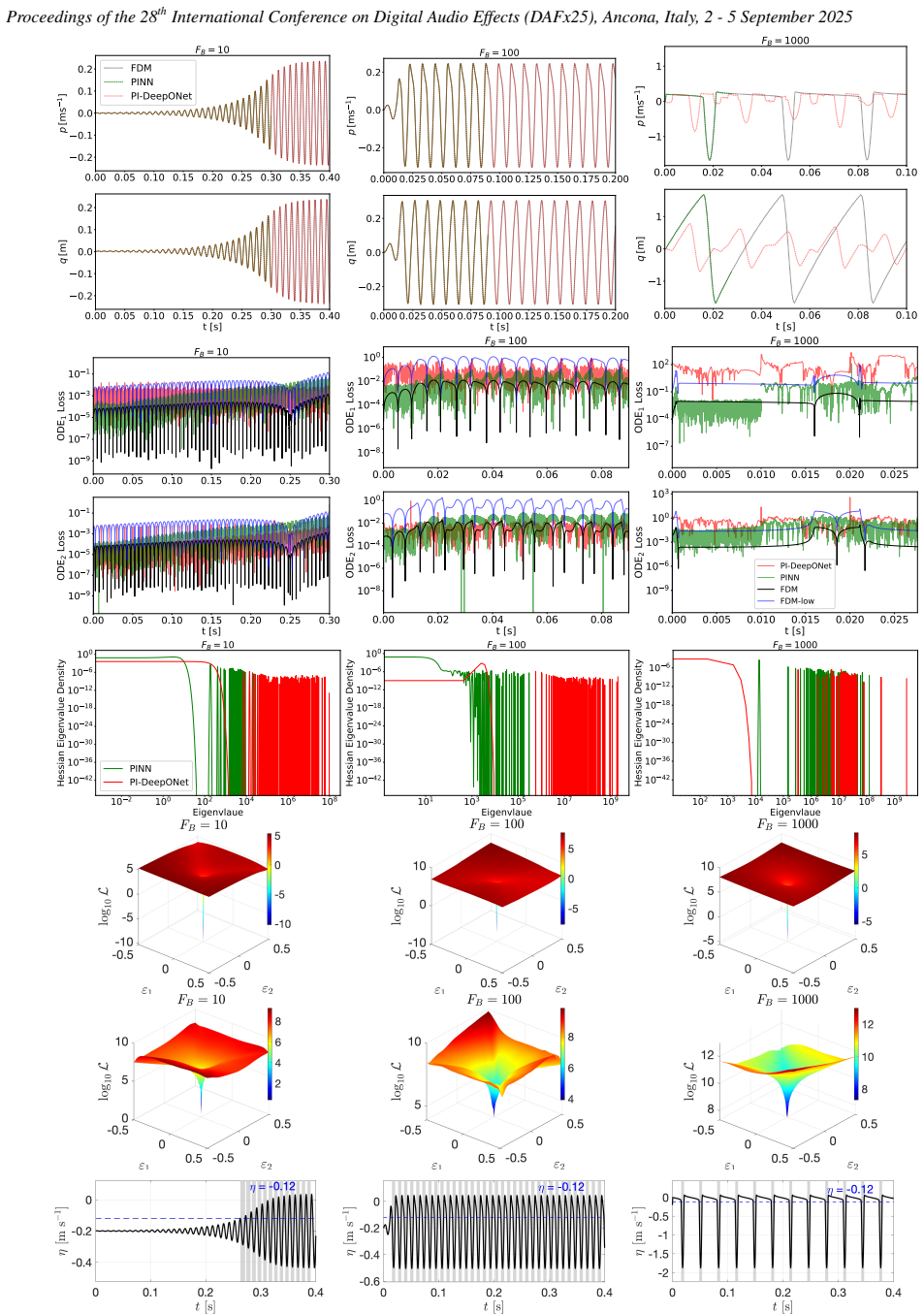
The central object is the bowed mass-spring system written in first-order form $q_t - \omega p = 0$, $p_t + \omega q + F_B\varphi(\eta) = 0$ with $\eta = p - v_B$ and the soft static friction law $\varphi(\eta)=\sqrt{2a\eta}\,e^{-a\eta^2+1/2}$. The networks minimize a mean-squared residual of these ODEs plus initial-condition terms. Two training mechanisms carry the argument: time-marching, which splits the interval into windows solved by separate networks, and causal training, which adds later time chunks only after earlier chunks are learned. The paper also uses Random Fourier Features to tame spectral bias, learning-rate annealing to balance loss terms, and a second-order optimizer. The diagnostic machinery is the Hessian eigenvalue density and loss-landscape visualization along the top two eigen-directions, which the paper uses to connect high-force failure to ill-conditioning.
What would settle it
Run the exact same training configuration, with fixed time-window count, fixed causal-training schedule, fixed loss weights, and no early stopping, across FB=10, 100, and 1000; if PINNs fail to converge at FB=1000 under that fixed protocol, then the paper's success claim holds only under case-specific tuning rather than as a general property.
Extended reading notes
Core claim
On the three bow-force values considered, PINNs converge to the reference solution in every case, with loss competitive with a 4410 kHz finite-difference benchmark, whereas PI-DeepONets achieve near-perfect accuracy for FB=10 and FB=100 but fail to converge for FB=1000. The authors attribute the high-force failure to the stick-slip dynamics: a larger bow force keeps the relative velocity inside the highly nonlinear friction region for a larger fraction of the time, making the loss landscape sharp and ill-conditioned, as evidenced by large maximum Hessian eigenvalues across both architectures. They further show that the PI-DeepONet failure is not intrinsic: equipping the loss with observation data in a hybrid supervised-unsupervised scheme restores accurate predictions at FB=1000. The paper's claim is that physics-informed deep learning is viable for nonlinear bow-string modeling, with the caveat that purely unsupervised optimization becomes fragile exactly where the physics is most nonlinear.
Load-bearing premise
The load-bearing premise is that the reported success reflects a stable property of the method rather than per-case engineering: the paper explicitly allows different hyperparameters for different bow forces, and for FB=1000 the causal training may stop before the final time chunk, so the claim that PINNs 'successfully address the problem' is demonstrated only for hand-tuned configurations.
Editorial extensions
If this is right
- For low bow forces, both PINNs and PI-DeepONets produce solutions close to a high-rate finite-difference reference, so physics-only training is sufficient in the weakly nonlinear regime.
- PI-DeepONets generalize over initial conditions with near-perfect accuracy at FB=10 and FB=100, supporting the authors' claim that operator networks are better suited than PINNs to sound synthesis.
- At FB=1000, the purely physics-informed PI-DeepONet fails, and the failure is associated with a sharper loss landscape, so ill-conditioned optimization is a concrete barrier for operator-based physics-informed learning.
- Adding observed data to the DeepONet loss recovers accurate predictions at FB=1000, suggesting that the hybrid supervised-unsupervised route is the practical path for high-nonlinearity regimes.
Reading between the lines
- An implication left implicit is that a single model trained once for realistic bowing, with bow force varying continuously, will likely need either a data term or an adaptive training strategy, since the paper only demonstrates fixed discrete bow forces.
- The stick-slip fraction, computable from the friction law, could serve as a cheap predictor of when physics-only training will fail; the paper reports the qualitative link but does not quantify a threshold.
- A natural next test is to train one hybrid DeepONet with bow force as an input and check whether the data term can cover the whole FB range, which would reveal whether operator generalization can be sustained across the ill-conditioned regime.
- The same physics-informed pipeline might fail or succeed analogously for other musical acoustics nonlinearities, such as reed or hammer interaction, whenever the system spends significant time in a steep nonlinear region.
Editorial analysis
A structured set of objections, weighed in public.
Referee Report
Summary. This paper applies physics-informed neural networks and PI-DeepONets to a one-degree-of-freedom bowed mass-spring system with a nonlinear friction law (Eqs. (1)-(4)). It compares learned solutions at bow forces FB = 10, 100, 1000 against a 4410 kHz finite-difference reference, reports ODE-residual plots, Hessian eigenvalue-density histograms, loss-landscape visualizations, and a random-initial-condition generalization test for PI-DeepONets. The central empirical claim is that PINNs solve all three cases, PI-DeepONets solve the low-force cases but fail at FB = 1000, and that adding FDM observations to a hybrid DeepONet restores accuracy at FB = 1000.
Significance. If the central claim withstands scrutiny, the paper provides a useful first demonstration of physics-informed deep learning on a nonlinear stick-slip oscillator relevant to musical acoustics. Strengths include the use of an independent high-rate FDM benchmark, explicit ODE-residual comparisons, a random-IC generalization study, Hessian eigenvalue-density analysis, and released code and sound examples. The conclusion that PI-DeepONets are better suited than PINNs for parametric sound synthesis is plausible for low forces, but the high-force comparison is currently conditional on early-stopped causal training, and the ill-conditioning diagnosis rests on an incomplete eigenvalue report.
major comments (3)
- [§4.1, Table 1, Eq. (12)] For FB = 1000, the paper explicitly allows the causal-training process to stop at an intermediate chunk (§4.1: "to successfully train PINNs for FB = 1000, the causal training process may terminate early..."). The trajectories and ODE-loss curves in Fig. 5 are shown over the full plotted interval, including time chunks that never contributed to any loss term. The reported agreement with FDM on those unobserved chunks is therefore extrapolation, and no per-chunk residual or error metric is given for them. Because FB = 1000 is the one case in which PINN succeeds and PI-DeepONet fails, the comparison is not on equal footing. Please report the actual stopping chunk, per-chunk ODE residuals, and either train through the final chunk or explicitly restrict the claimed solution interval.
- [§4.2.1, fifth row of Fig. 5] The text concludes that "the observed maximum eigenvalues are quite large, indicating a high condition number (ratio of maximum to minimum eigenvalues), which suggests that the optimization problem is ill-conditioned." Only the maximum eigenvalues are discussed; the minimum eigenvalues are not reported. A large maximum eigenvalue does not by itself imply a high condition number, since the condition number is the ratio λmax/λmin. Please report the minimum eigenvalue or an explicit condition-number estimate for each model and FB, or soften the ill-conditioning claim accordingly.
- [§4.2.3, Eq. (16), Fig. 7] The hybrid DeepONet is trained with observations p and q obtained from the high-rate FDM for zero initial conditions over t ∈ [0, 0.1] and is then evaluated against the same FDM solution under the same initial conditions (NMSE/NCC values in the text). This is a data-fitting check, not an independent validation of predictive accuracy. Please evaluate the hybrid model on a withheld FDM trajectory, on different initial conditions, or on a separate reference solution, or explicitly describe the experiment as a fit to the benchmark.
minor comments (5)
- [Fig. 5] The label "Eigenvlaue" is a typo for "Eigenvalue" and appears in the fifth-row histogram panels.
- [§3.3] The notation p ⊂ R^{1×M} and q ⊂ R^{1×M} should use set membership (∈) rather than the subset symbol (⊂); the same applies to the input time vector t.
- [§3.4, Fig. 3(b)] The text states that t is fed to the branch network and the initial conditions to the trunk network, which is the reverse of the usual DeepONet convention (branch encodes the input function, trunk encodes coordinates). Please clarify the convention or correct the naming, and check Fig. 3(b) for consistency.
- [§4.1, Table 1] Training iterations, early-stopping criteria, and random seeds are not specified, which makes the per-case hyperparameter dependence in Table 1 difficult to reproduce despite the provided code.
- [§5] The concluding claim that PI-DeepONets "are well-suited for sound synthesis" is stronger than the evidence presented, since no sound-synthesis or real-time inference experiment is reported; consider framing this as a future direction.
Circularity Check
Hybrid DeepONet accuracy is evaluated on its own FDM training data; main PINN/PI-DeepONet comparison is independently benchmarked against FDM.
-
fitted input called prediction
[Section 4.2.3, Eq. (16), Fig. 7]
"Therefore, we add Lob1 = 1/Nob ||pˆ − p||, Lob2 = 1/Nob ||qˆ − q||, (16) where p and q are obtained from FDM with a high sampling rate, given zero initial conditions and t ∈ [0, 0.1]. ... The evaluation metrics comparing the hybrid DeepONet with the high sampling rate FDM under zero initial conditions are: NMSE(p) = 6.88×10⁻³, NMSE(q) = 1.72×10⁻³, NCC(p) = 99.66% and NCC(q) = 99.91%. Clearly, the hybrid DeepONets demonstrate accurate predictions."
The supervised targets in Eq. (16) are the high-rate FDM solution for zero ICs over t ∈ [0, 0.1], and the reported NMSE/NCC are computed against 'the high sampling rate FDM under zero initial conditions' — the same trajectories used as regression targets. The low error therefore only confirms that the network fit its own training labels; it is not an independent prediction or generalization test. The claim that PI-DeepONet limitations are 'mitigated' is thus demonstrated by construction rather than by held-out evaluation. No unseen ICs or untrained time intervals are used in this hybrid assessment.
full rationale
The main derivation chain is not circular: the bowed mass-spring ODEs (1)/(4) are solved with PINN residuals (8)-(9) and PI-DeepONet losses, and both are compared against an external high-rate FDM benchmark (Section 4.2.1, Table 2), so the PINN-success / PI-DeepONet-failure comparison does not reduce to the training data. No load-bearing self-citations or imported uniqueness theorems appear; the authors' prior works are cited only as context. The one genuine circular step is the hybrid DeepONet demonstration in Section 4.2.3, where the supervised data used in Eq. (16) is the same FDM zero-IC trajectory used for the reported accuracy metrics, making that specific 'prediction' a fit check. Separately, the early-terminated causal training for FB = 1000 (Section 4.1) means the unverified suffix is extrapolation, but that is a validation-gap/fairness concern rather than circularity. Overall, because the core comparison is independently benchmarked and only the supplementary hybrid evaluation reduces to its own training target, the circularity is localized and modest.
Assumptions & free parameters
free parameters (6)
- Loss weights lambda_ODE1, lambda_ODE2, lambda_IC1, lambda_IC2 =
10, 10, 1e6, 1e6 fixed; annealed otherwise
- Time-marching window count Mtm =
3 for FB=10,100; 5 for FB=1000
- Causal training chunks Mcau and threshold eta_cau =
Mcau=50, eta_cau=0.1 (FB=1000 PINN)
- RFF scale sigma_prime =
1 or 3 depending on case
- Input scaling st and sp,q =
st in {0.1, 0.03, 0.01}; sp,q in {0.2, 0.35, 1, 2}
- Network widths and depth =
cU=cV=cZ=100, L=4 (PINN) or 6 (DeepONet)
assumptions (5)
- domain assumption The soft static friction model with a=100 approximates bow-string friction.
- domain assumption The 1-DOF bowed mass-spring system captures the essential numerical challenges of full bowed-string simulation.
- domain assumption FDM at 4410 kHz is an accurate ground-truth solution of the ODE system.
- standard math Neural networks with tanh activations and the modified FCNN can represent the solution and its derivatives sufficiently well.
- ad hoc to paper Random IC sampling in PI-DeepONets is sufficient to cover the goal space G.
Cite this review
Pith. "Pith review of Physics-Informed Deep Learning for Nonlinear Friction Model of Bow-string Interaction." pith.science (2026). https://pith.science/paper/75LFMQJC
@misc{pith2026250518950,
  author       = {Pith},
  title        = {Pith review of: Physics-Informed Deep Learning for Nonlinear Friction Model of Bow-string Interaction},
  year         = {2026},
  howpublished = {\url{https://pith.science/paper/75LFMQJC}},
  note         = {Machine review of arXiv:2505.18950}
}
read the original abstract
This study investigates the use of an unsupervised, physics-informed deep learning framework to model a one-degree-of-freedom mass-spring system subjected to a nonlinear friction bow force and governed by a set of ordinary differential equations. Specifically, it examines the application of Physics-Informed Neural Networks (PINNs) and Physics-Informed Deep Operator Networks (PI-DeepONets). Our findings demonstrate that PINNs successfully address the problem across different bow force scenarios, while PI-DeepONets perform well under low bow forces but encounter difficulties at higher forces. Additionally, we analyze the Hessian eigenvalue density and visualize the loss landscape. Overall, the presence of large Hessian eigenvalues and sharp minima indicates highly ill-conditioned optimization. These results underscore the promise of physics-informed deep learning for nonlinear modelling in musical acoustics, while also revealing the limitations of relying solely on physics-based approaches to capture complex nonlinearities. We demonstrate that PI-DeepONets, with their ability to generalize across varying parameters, are well-suited for sound synthesis. Furthermore, we demonstrate that the limitations of PI-DeepONets under higher forces can be mitigated by integrating observation data within a hybrid supervised-unsupervised framework. This suggests that a hybrid supervised-unsupervised DeepONets framework could be a promising direction for future practical applications.
Figures


Figures from the paper (3 more)


Reference graph
Works this paper leans on
-
[1]
INTRODUCTION In recent years, Physics-Informed Neural Networks (PINNs) [1], a prominent framework in scientific machine learning (SciML), has gained significant traction in computational physics. The core idea of PINNs is to approximate the solution of ordinary differential equations (ODEs) or partial differential equations (PDEs) using a neural network, ...
arXiv 2025
-
[2]
BOWED MASS-SPRING MODEL Instead of modeling the full string dynamics, we consider a bowed simple harmonic oscillator, represented by a mass-spring system with nonlinear frictional forcing. This archetypal test model is widely used in research to study numerical simulation challenges [7, 21]. The schematic illustration is shown in Fig. 1. The motion of the...
-
[3]
NEURAL NETWORKS We present the solution of the bowed mass-spring system by for- mulating it as an optimization problem, which is then solved using the PINNs and PI-DeepONets frameworks. 3.1. Modified FCNN A modified fully-connected neural network (FCNN) [23], inspired by attention mechanisms, is used in this study. It outperforms stan- dard FCNNs in PINNs...
work page 2025
-
[4]
SIMULATION RESULTS 4.1. Implementation We validate the PINNs and PI-DeepONets for ω = 2 πf, f = 100 Hz, a = 100, and vB = 0.2 m s−1, considering three differ- ent values of FB set as 10, 100, and 1000. The choice of varying FB is motivated by its influence on the bowing mechanism, result- ing in different waveforms. For both PINNs and PI-DeepONets, the hy...
-
[5]
The training of PINNs follows a full-batch paradigm
The ODEs input t are uniformly sampled within the interval [0, st]. The training of PINNs follows a full-batch paradigm. For PI-DeepONets, NODE 1 = NODE 2 = 10000 × 1000, NIC 1 = NIC 2 = 10000 . To construct the dataset, we first generate a single group of data. Each group starts with an IC input (p, q) randomly sampled from the range [−sp,q, sp,q] at t =...
work page 2025
-
[6]
DISCUSSION AND CONCLUSION In this study, PINNs and PI-DeepONets are utilized to solve the nonlinear bowed one-degree-of-freedom mass-spring system. The equation-solving task is formulated as an optimization problem and carried out within the framework of physics-informed deep learning. Scenarios with different bow forces have been investi- gated using bot...
work page 2025
-
[7]
Physics-informed neural networks: A deep learning framework for solving forward and inverse problems involving nonlinear partial differential equations,
M. Raissi, P. Perdikaris, and G. E. Karniadakis, “Physics-informed neural networks: A deep learning framework for solving forward and inverse problems involving nonlinear partial differential equations,” J. Comput. Phys., vol. 378, pp. 686–707, 2019
2019
-
[8]
S. Wang, H. Wang, and P. Perdikaris, “Learning the solution opera- tor of parametric partial differential equations with physics-informed deeponets,” Sci. Adv., vol. 7, no. 40, p. eabi8605, 2021
work page 2021
Show all 38 references
-
[9]
Long-time integration of parametric evolution equations with physics-informed deeponets,
S. Wang and P. Perdikaris, “Long-time integration of parametric evolution equations with physics-informed deeponets,” J. Comput. Phys., vol. 475, p. 111855, 2023
2023
-
[10]
Deeponet: Learning non- linear operators for identifying differential equations based on the universal approximation theorem of operators,
L. Lu, P. Jin, and G. E. Karniadakis, “Deeponet: Learning non- linear operators for identifying differential equations based on the universal approximation theorem of operators,” arXiv preprint arXiv:1910.03193, 2019
1910 arXiv
-
[11]
Characterizing possible failure modes in physics-informed neural networks,
A. Krishnapriyan, A. Gholami, S. Zhe, R. Kirby, and M. W. Ma- honey, “Characterizing possible failure modes in physics-informed neural networks,” Adv. Neural Inf. Process. Syst. (NeurIPS), vol. 34, pp. 26 548–26 560, 2021
2021
-
[12]
Respecting causality for training physics-informed neural networks,
S. Wang, S. Sankaran, and P. Perdikaris, “Respecting causality for training physics-informed neural networks,” Comput. Methods Appl. Mech. Eng., vol. 421, p. 116813, 2024
2024
-
[13]
Bilbao, Numerical sound synthesis: finite difference schemes and simulation in musical acoustics
S. Bilbao, Numerical sound synthesis: finite difference schemes and simulation in musical acoustics. John Wiley & Sons, 2009
2009
-
[14]
Chaigne and J
A. Chaigne and J. Kergomard, Acoustics of musical instruments . Springer, 2016
2016
-
[15]
A physics- informed neural network approach for nearfield acoustic hologra- phy,
M. Olivieri, M. Pezzoli, F. Antonacci, and A. Sarti, “A physics- informed neural network approach for nearfield acoustic hologra- phy,”Sensors, vol. 21, no. 23, p. 7834, 2021
2021
-
[16]
Complex-valued physics-informed neural network for near-field acoustic holography,
X. Luan, M. Olivieri, M. Pezzoli, F. Antonacci, and A. Sarti, “Complex-valued physics-informed neural network for near-field acoustic holography,” in 2024 32nd Eur. Signal Process. Conf (EU- SIPCO). IEEE, 2024, pp. 126–130
2024
-
[17]
Physics-informed neural network-driven sparse field discretization method for near- field acoustic holography,
X. Luan, M. Pezzoli, F. Antonacci, and A. Sarti, “Physics-informed neural network-driven sparse field discretization method for near- field acoustic holography,”arXiv preprint arXiv:2505.00897, 2025
2025 arXiv
-
[18]
Physics-informed neural net- work for acoustic resonance analysis in a one-dimensional acoustic tube,
K. Yokota, T. Kurahashi, and M. Abe, “Physics-informed neural net- work for acoustic resonance analysis in a one-dimensional acoustic tube,” J. Acoust. Soc. Am., vol. 156, no. 1, pp. 30–43, 2024
2024
-
[19]
Physics-informed cnn for the design of acoustic equipment,
K. Yokota, M. Ogura, T. Kurahashi, and M. Abe, “Physics-informed cnn for the design of acoustic equipment,” in2024 Int. Jt. Conf. Neu- ral Netw. (IJCNN). IEEE, 2024, pp. 1–8
2024
-
[20]
Synthesis of voiced sounds using physics-informed neural networks,
K. Yokota, M. Ogura, and M. Abe, “Synthesis of voiced sounds using physics-informed neural networks,” Acoust. Sci. Technol. , vol. 45, no. 6, pp. 333–336, 2024
2024
-
[21]
Acoustic field reconstruc- tion in tubes via physics-informed neural networks,
X. Luan, K. Yokota, and G. Scavone, “Acoustic field reconstruc- tion in tubes via physics-informed neural networks,” arXiv preprint arXiv:2505.12557, 2025
2025 arXiv
-
[22]
Identification of physical prop- erties in acoustic tubes using physics-informed neural networks,
K. Yokota, M. Ogura, and M. Abe, “Identification of physical prop- erties in acoustic tubes using physics-informed neural networks,” Mech. Eng. J., vol. 11, no. 5, pp. 24–00 228, 2024
2024
-
[23]
Physical modelling of stiff membrane vibration using neural networks with spectral convolution layers,
C. D. L. V . Martin and M. B. Sandler, “Physical modelling of stiff membrane vibration using neural networks with spectral convolution layers,” Proc. 10th Conv. Eur. Acoust. Assoc. Forum Acusticum, 2023
2023
-
[24]
Physical mod- eling using recurrent neural networks with fast convolutional layers,
S. Schlecht, J. Parker, M. Schäfer, and R. Rabenstein, “Physical mod- eling using recurrent neural networks with fast convolutional layers,” in Int. Conf. Digit. Audio Eff. (DAFx). DAFx, 2022, pp. 138–145
2022
-
[25]
Towards efficient mod- elling of string dynamics: A comparison of state space and koopman based deep learning methods,
R. Diaz, C. D. L. V . Martin, and M. Sandler, “Towards efficient mod- elling of string dynamics: A comparison of state space and koopman based deep learning methods,” in Proc. of the 27th Int. Conf. Digit. Audio Eff. (DAFx), Guildford, United Kingdom, September 2024, pp. 200–207
2024
-
[26]
Loss landscape engi- neering via data regulation on pinns,
V . Gopakumar, S. Pamela, and D. Samaddar, “Loss landscape engi- neering via data regulation on pinns,”Mach. Learn. Appl., vol. 12, p. 100464, 2023
2023
-
[27]
Efficient simulation of the bowed string in modal form,
R. Russo, M. Ducceschi, and S. Bilbao, “Efficient simulation of the bowed string in modal form,” in Int. Conf. Digit. Audio Eff. (DAFx), 2022, pp. 122–129
2022
-
[28]
A comparison of friction models for bow-string interaction based on experimental measurements,
E. Matusiak and V . Chatziioannou, “A comparison of friction models for bow-string interaction based on experimental measurements,” in Proc. Stockh. Music Acoust. Conf., 2023
2023
-
[29]
Understanding and mitigat- ing gradient flow pathologies in physics-informed neural networks,
S. Wang, Y . Teng, and P. Perdikaris, “Understanding and mitigat- ing gradient flow pathologies in physics-informed neural networks,” SIAM J. Sci. Comput., vol. 43, no. 5, pp. A3055–A3081, 2021
2021
-
[30]
Fourier features let networks learn high frequency functions in low dimen- sional domains,
M. Tancik, P. Srinivasan, B. Mildenhall, S. Fridovich-Keil, N. Ragha- van, U. Singhal, R. Ramamoorthi, J. Barron, and R. Ng, “Fourier features let networks learn high frequency functions in low dimen- sional domains,” Adv. Neural Inf. Process. Syst. (NeurIPS) , vol. 33, pp. 75...
2020
-
[31]
On the spectral bias of neural net- works,
N. Rahaman, A. Baratin, D. Arpit, F. Draxler, M. Lin, F. Hamprecht, Y . Bengio, and A. Courville, “On the spectral bias of neural net- works,” inInt. Conf. Mach. Learn. (ICML). PMLR, 2019, pp. 5301– 5310
2019
-
[32]
On the eigenvector bias of fourier feature networks: From regression to solving multi-scale pdes with physics-informed neural networks,
S. Wang, H. Wang, and P. Perdikaris, “On the eigenvector bias of fourier feature networks: From regression to solving multi-scale pdes with physics-informed neural networks,” Comput. Methods Appl. Mech. Eng., vol. 384, p. 113938, 2021
2021
-
[33]
An expert’s guide to training physics-informed neural networks,
S. Wang, S. Sankaran, H. Wang, and P. Perdikaris, “An expert’s guide to training physics-informed neural networks,” arXiv preprint arXiv:2308.08468, 2023
2023 arXiv
-
[34]
Soap: Improving and stabilizing shampoo using adam,
N. Vyas, D. Morwani, R. Zhao, I. Shapira, D. Brandfonbrener, L. Janson, and S. Kakade, “Soap: Improving and stabilizing shampoo using adam,” arXiv preprint arXiv:2409.11321, 2024
2024 arXiv
-
[35]
Gradient align- ment in physics-informed neural networks: A second-order optimiza- tion perspective,
S. Wang, A. K. Bhartari, B. Li, and P. Perdikaris, “Gradient align- ment in physics-informed neural networks: A second-order optimiza- tion perspective,” arXiv preprint arXiv:2502.00604, 2025
2025
-
[36]
Pyhessian: Neural networks through the lens of the hessian,
Z. Yao, A. Gholami, K. Keutzer, and M. W. Mahoney, “Pyhessian: Neural networks through the lens of the hessian,” in 2020 IEEE Int. Conf. Big Data (Big data). IEEE, 2020, pp. 581–590
2020
-
[37]
Visualizing the loss landscape of neural nets,
H. Li, Z. Xu, G. Taylor, C. Studer, and T. Goldstein, “Visualizing the loss landscape of neural nets,” Adv. Neural Inf. Process. Syst. (NeurIPS), vol. 31, 2018
2018
-
[38]
On large-batch training for deep learning: Generalization gap and sharp minima,
N. S. Keskar, D. Mudigere, J. Nocedal, M. Smelyanskiy, and P. T. P. Tang, “On large-batch training for deep learning: Generalization gap and sharp minima,” arXiv preprint arXiv:1609.04836, 2016. DAFx.8
2016 arXiv
Reviewed August 7, 2026 · model on record in the stance chip above.
Discussion (0). Continue with ORCID to comment.