REVIEW 2 major objections 4 minor 81 references
Subgap pumping of antiferromagnetic Mott insulators: photoexcitation mechanisms and applications
T0 review · 2 major / 4 minor · reviewed 2026-08-07 · deepseek-v4-flash
Pith's one-line read Subgap laser pumping of a Mott insulator yields four photoexcitation regimes, with the Mott gap feeding back on its own carrier generation in real time.
desk verdict A careful variational treatment of subgap pumping in Mott insulators that plausibly recovers the known Keldysh limits and adds two new regimes, but the central cooperative-regime claim rests on an explicitly incomplete analytic derivation and an unbenchmarked mean-field ansatz. read the letter →
The pith
A machine-rendered reading of the paper's core claim, the machinery that carries it, and where it could break.
The reading
What carries the argument
The central object is a time-dependent Gaussian variational density matrix for the antiferromagnetic (spin-density-wave) state of the Hubbard model, factorized over momentum sectors in the reduced Brillouin zone and restricted to doublon-hole pairs at zero total momentum. Its evolution is governed by a time-dependent Bogoliubov angle $\varphi_k(t) = \arctan[2\epsilon_k(t)/(US(t))]$, a quasiparticle dispersion $E_k(t) = \sqrt{\epsilon_k^2(t) + (US(t)/2)^2}$, and the self-consistency condition on the N\'eel order parameter $S(t)$, so the gap $\Delta(t) = US(t)$ responds to the carriers it helps create. The analytic engine is a generalized resonance condition that matches the poles of a two-frequency propagator $H(\Omega,\omega)$ at the doublon-hole energy $2E_k$ against peaks of the spectral weight of $\partial_t\varphi_k$; this yields the multiphoton power law $(eE_0a/\hbar\omega_d)^{2\Delta/\omega_d}$, the tunneling exponential $\exp(-\gamma\Delta/eE_0a)$, and, at finite $\Gamma$, the linear-absorption rate proportional to $\Gamma$.
What would settle it
Benchmark the same driven half-filled 2D Hubbard model ($U=1.93$ eV, $\tau=189$ meV, 100 fs Gaussian pump) against a method that does not assume the ansatz, such as dynamical mean-field theory, tensor networks, or time-dependent exact diagonalization on small clusters, and compare total photocarrier density, momentum distributions, and real-time saturation curves. If the exact calculation shows no persistent multiphoton thresholds above the Keldysh line, no saturation plateau while the pump is still on, or no sharp onset of absorption when the transiently renormalized gap crosses $n\omega_d$, the central claim fails.
Extended reading notes
Core claim
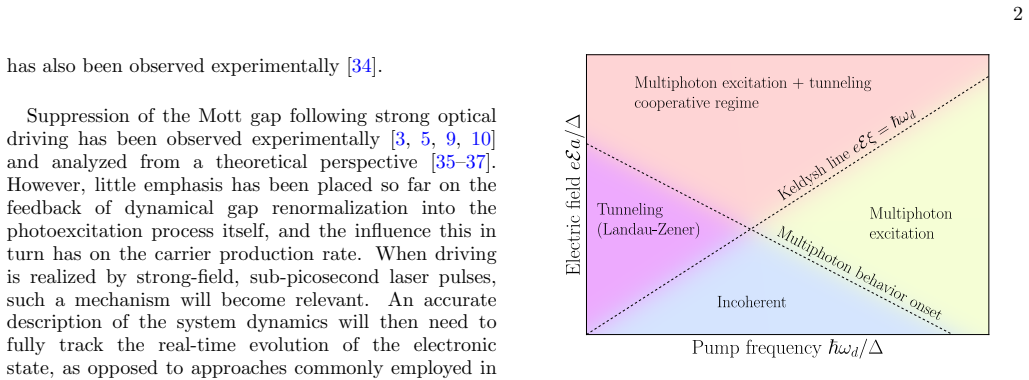
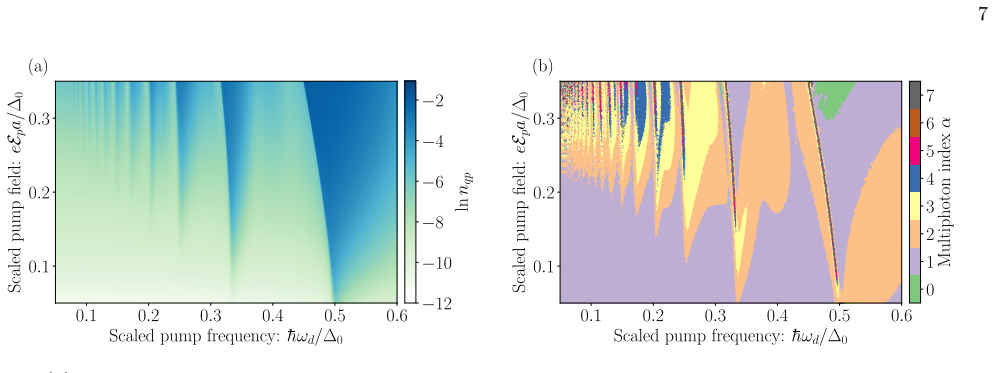
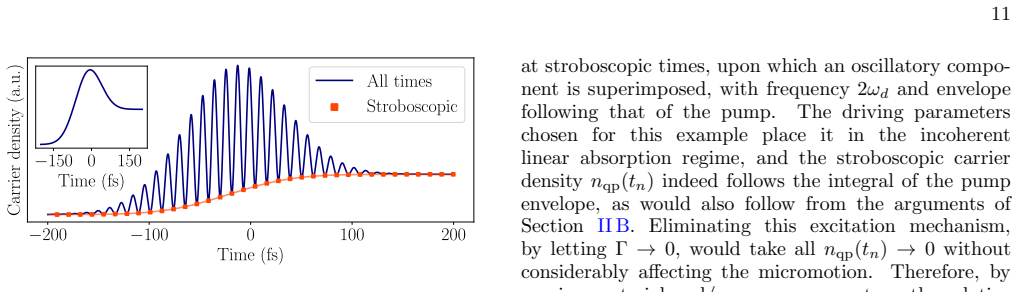
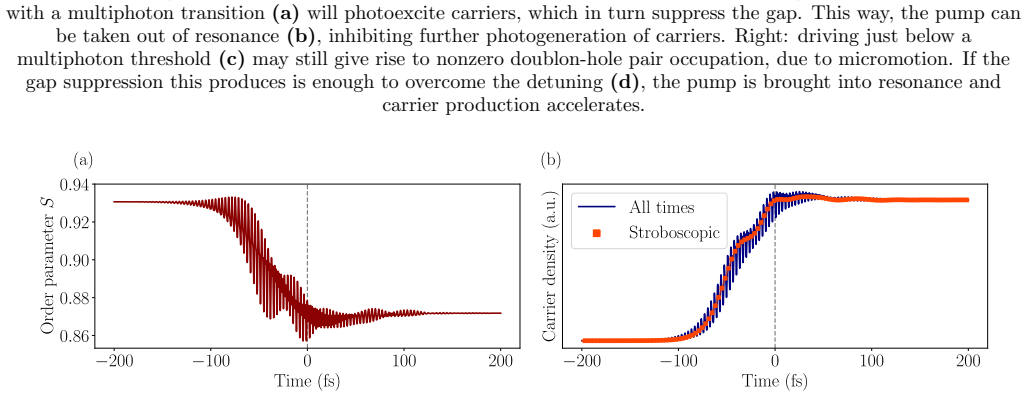
On its own terms, the paper's central discovery is that a subgap-driven antiferromagnetic Mott insulator has not two but four photoexcitation regimes. Besides the standard multiphoton and Landau-Zener tunneling mechanisms separated by the Keldysh crossover, the authors find a broad cooperative region in which the carrier density follows the exponential tunneling dependence on field, $n \propto E^2 \exp(-\gamma\Delta/eEa)$, while simultaneously displaying sharp multiphoton thresholds whenever the gap is an integer multiple of the pump frequency, $\Delta/\omega_d \in \mathbb{Z}$; below a multiphoton-onset line, an incoherent linear-absorption pathway set by the dephasing rate $\Gamma$ dominates. Because the time-dependent variational treatment computes the N\'eel order parameter, and therefore the Mott gap $\Delta(t) = US(t)$, self-consistently during the pulse, gap suppression feeds back into the generation rate: on resonance the pump is driven out of resonance and carrier density saturates in real time, while below resonance transient micromotion can suppress the gap enough to bring the pump into resonance and effectively lower the multiphoton threshold. The momentum distribution of doublon-hole pairs (the charge excitations left when hopping transfers an electron across the Mott gap) immediately after the pump is proposed as a quantitative diagnostic of the active mechanism.
Load-bearing premise
The entire picture rests on the variational ansatz: the driven state is assumed to be a product of independent momentum sectors containing only zero-total-momentum doublon-hole pairs, with a single Markovian dephasing rate and no carrier redistribution among momenta during the pump, so that all correlations beyond this simple structure are neglected on the pump timescale.
Editorial extensions
If this is right
- A single set of evolution equations reproduces both the rigid-band analytic regimes and the strong-drive phenomenology, so pump shape and pump duration become control parameters that interpolate between rate-like generation, saturation, and quasi-steady states.
- Experiments inferring the excitation mechanism from field dependence alone will misread the cooperative region: carrier density scales as tunneling in the field while frequency thresholds at $\Delta/\omega_d \in \mathbb{Z}$ persist, meaning multiphoton and tunneling signatures coexist above the Keldysh line.
- Near a multiphoton resonance at strong drive, pump-probe measurements should show carrier density saturating before the pulse peak, because the renormalized gap has already pushed the system off resonance.
- Pumping just below $\Delta_0/n$ should show a drive-strength-dependent redshift of the absorption edge, with efficient excitation switching on once micromotion-driven gap suppression closes the detuning.
- The momentum-space spread of photocarriers, and the amplitude of coherent acoustic phonons emitted at wavevector $\sim \lambda_{\rm pump}^{-1}$, both track the total carrier density and can serve as regime diagnostics in momentum-resolved and transient-reflectivity experiments.
- Inference beyond the paper: the threshold-lowering mechanism implies that pulse shape is an active control knob, so a chirped pulse that walks the instantaneous frequency across the dropping gap could sustain resonance longer and raise the saturated carrier density above what a transform-limited pulse produces.
- Inference beyond the paper: the single-Markovian-rate ansatz makes the saturation effect a prediction to be stress-tested by numerically exact methods that include doublon-doublon interactions and non-Markovian relaxation, which could sharpen or wash out the saturation plateau and shift the boundary of the incoherent regime.
- Inference beyond the paper: the momentum-distribution diagnostic suggests a direct cold-atom test, in which quantum gas microscopy maps the distribution of doublon-hole pairs after a lattice-shaking pulse, exposing the predicted crossover from flat tunneling profiles to contour-localized multiphoton profiles to striped incoherent profiles without phononic or disorder complications.
Editorial analysis
A structured set of objections, weighed in public.
Referee Report
Summary. The manuscript studies photoexcitation of the half-filled two-dimensional Hubbard model under subgap ac driving, using a time-dependent Gaussian variational ansatz built on the SDW mean-field state. It derives coupled evolution equations for the doublon-hole coherences and the self-consistent Néel order parameter, then analyzes the rigid-band limit to obtain approximate analytic rates: multiphoton excitation (Eq. 12), tunneling (Eq. 13), and a new incoherent linear-absorption pathway (Eq. 16). On this basis it claims a four-regime landscape in the frequency-field plane, including a cooperative region in which the field dependence is tunneling-like while frequency thresholds remain at integer Δ/ω_d, and a low-field incoherent region. The numerical solution of the full variational equations for cuprate-like parameters is used to study gap-renormalization feedback, saturation and threshold-lowering dynamics, momentum-resolved carrier distributions, and coherent acoustic phonon generation as a probe of photocarrier density.
Significance. If correct, the paper would provide a unified variational framework that recovers the known Keldysh multiphoton/tunneling limits while predicting additional experimentally accessible regimes and real-time gap-feedback effects. The analytic derivations are careful in the rigid-band sector, the incoherent formula (D49) is explicit, and the parameters are physical inputs rather than back-fitted free parameters; the recovery of the dc tunneling and multiphoton functional forms of Ref. [23] is a genuine strength. The momentum-distribution metric of Fig. 5 and the acoustic-phonon probe of Sec. V are potentially useful and testable. However, the paper's central new claim, the cooperative regime, rests on an incomplete analytic derivation of γ(ω_d) and on an unbenchmarked variational ansatz in exactly the strong-drive regime where the ansatz is least controlled; the significance is therefore conditional on resolving those issues.
major comments (2)
- [Section II B and Appendix D3b, Eq. (13)] The cooperative regime, which is the paper's central new claim, is encoded in the frequency-dependent tunneling rate γ(ω_d) appearing in Eq. (13). However, Appendix D3b explicitly states that 'a more precise calculation of this enhancement needs to count all possible combinations of frequencies {n_i} satisfying the generalized resonance, rather than just the case n_1 ∼ n_2 ∼ ... ≡ n considered above'. No closed expression for γ(ω_d) is provided; the numerical fits in Fig. 3c extract the slope ex post, so the claimed coexistence of tunneling field dependence and multiphoton frequency thresholds is not an analytically established prediction. Please complete the calculation of γ(ω_d) from the generalized resonance condition (D36), or replace the claim with a direct numerical verification that is not based on fits to the asserted form.
- [Section II A, Eq. (5), and Appendix C] The variational density matrix factorizes over momentum sectors, keeps only zero-total-momentum doublon-hole pairs, collapses decoherence into a single Markovian rate Γ, and neglects intraband relaxation during the pump. No benchmark against numerically exact methods (DMFT, MPS, or exact diagonalization) is provided. The cooperative regime eEa ≫ ℏω_d is precisely where the vector potential sweeps the full Brillouin zone and the final carrier density becomes large, so inter-sector correlations, doublon-doublon scattering, and non-Markovian effects are expected to be strongest; the sharp thresholds in Fig. 2 and the saturation/threshold-lowering effects in Figs. 8 and 9 could therefore be artifacts of the ansatz. I ask for a concrete benchmark on a small cluster or 1D chain, or an explicit argument identifying a controlled limit in which the ansatz becomes exact, before the high-field predictions are presented as quantitative.
minor comments (4)
- [Footnote [58]] The footnote contains a duplicated phrase: 'At first, it may seem surprising that the regionsAt first, it may seem surprising that the regions in Fig. 2b...'.
- [Appendix D1, Eq. (D11)] There is a typo: 'intergral over δ' should be 'integral over δ'.
- [Figure 3 caption] The caption reads 'at frequecy ω_d = Δ0/10'; this should be 'frequency'.
- [Section III B] The text switches between the continuous-wave amplitude E_0 used in the analytic rates and the peak pulse field E_p used in the numerics; the statement that E_p should replace E_0 is physically reasonable, but the approximation should be justified more explicitly, since the pulse envelope modifies the effective duration available for tunneling.
Circularity Check
No significant circularity: the central derivation starts from the Hubbard Hamiltonian and an explicit variational ansatz, is benchmarked against the independent rigid-band results of Ref. [23], and does not back-fit any target observable through free parameters.
full rationale
The paper's derivation chain starts from the explicit Hubbard Hamiltonian (Eq. 1) and an explicit variational density matrix (Eq. 5), with inputs U, tau, Gamma, and T_pump stated as material and pump parameters rather than fitted to the target outputs. The analytic photoexcitation rates (Eqs. 11-14 and 16) follow by expansion in d_t phi and by the Bessel/Jacobi-Anger structure of a monochromatic Peierls drive; no target observable is back-substituted into the derivation. The multiphoton and dc-tunneling limits are benchmarked against the functional forms of the independent 1D calculation in Ref. [23]. The finite-frequency tunneling enhancement and the cooperative region are derived (App. D3b) from the same resonance-matching procedure, and later compared to numerical solutions of the same evolution equations; this is an internal consistency check, not a fit of the predicted quantity. The acknowledged incompleteness in App. D3b ('a more precise calculation needs to count all possible combinations') limits the analytic precision of the gamma(omega_d) enhancement but does not make the argument circular. The self-citations with overlapping authorship (e.g., Refs. [34,67]) are used as experimental motivation or future-direction context and are not load-bearing; no uniqueness theorem or ansatz is imported solely by citation. The lack of an exact numerical benchmark (DMFT, MPS, or exact diagonalization) for the variational ansatz is a correctness and robustness concern, not a circularity. No circular step could be identified and quoted, so the score is 0.
Assumptions & free parameters
free parameters (5)
- Hubbard interaction U =
1.93 eV
- Nearest-neighbor hopping τ =
189 meV
- Dephasing rate Γ =
1.64 meV
- Pump duration T_pump =
100 fs
- Pump penetration depth λ_pump =
100a
assumptions (8)
- domain assumption Mean-field SDW factorization of the Hubbard interaction keeps only q=0 and q=Q=(π,π) correlators.
- domain assumption Gaussian product-state density matrix factorizes over k and spin sectors, with only two-point correlators.
- domain assumption Pump duration is much shorter than intraband relaxation, so inter-k scattering is neglected and a single dephasing rate Γ acts.
- domain assumption Rigid-band approximation S(t) ≈ S0 for analytic rates.
- domain assumption Expansion parameter (∂t φ)/U small and eEa ≤ U in the analytic treatment.
- domain assumption Long-range Néel order along z with ordering wavevector Q = (π,π).
- domain assumption Timescale separation T_pump << τ_intraband << τ_acoustic << τ_recombination.
- domain assumption Pulsed driving replaced by monochromatic field in analytic derivations.
Cite this review
Pith. "Pith review of Subgap pumping of antiferromagnetic Mott insulators: photoexcitation mechanisms and applications." pith.science (2026). https://pith.science/paper/76NLYZSG
@misc{pith2026250515343,
  author       = {Pith},
  title        = {Pith review of: Subgap pumping of antiferromagnetic Mott insulators: photoexcitation mechanisms and applications},
  year         = {2026},
  howpublished = {\url{https://pith.science/paper/76NLYZSG}},
  note         = {Machine review of arXiv:2505.15343}
}
read the original abstract
We study the behavior of the 2D repulsive Hubbard model on a square lattice at half filling, under strong driving with ac electric fields, by employing a time-dependent Gaussian variational approach. Within the same theoretical framework, we analytically obtain the conventional Keldysh crossover between multiphoton and tunneling photoexcitation mechanisms, as well as two new regimes beyond the Keldysh paradigm. We discuss how dynamical renormalization of the Mott-Hubbard gap feeds back into the photoexcitation process, modulating the carrier generation rate in real time. The momentum distribution of quasiparticle excitations immediately after the drive is calculated, and shown to contain valuable information about the generation mechanism. Finally, we discuss experimental probing of the pump-induced nonequilibrium electronic state.
Figures

Figures from the paper (16 more)





Reference graph
Works this paper leans on
-
[23]
T. Oka, Nonlinear doublon production in a mott insu- lator: Landau-dykhne method applied to an integrable model, Phys. Rev. B86, 075148 (2012)
work page 2012
-
[1]
System Hamiltonian and external drive As a prototype of strongly interacting electron systems, we consider a 2D single-band Fermi-Hubbard model at half filling, with an on-site interaction termUtaken to be much stronger than the nearest-neighbor hoppingτ. Assuming that the external driving is spatially uniform, we incorporate it in the Hamiltonian via a P...
-
[2]
Order parameter and factorizing the interaction term The relevant SDW operator on the square lattice, with ˆztaken as the ordering axis, is [71] Sz Q ≡ 1 N X k,β,γ c† k+Q,β σβγ z ck,γ = 1 N X k,α α c† k+Q,αck,α. (A6) This will acquire an expectation valueS 0 in the varia- tional ground state|Ω⟩: Ω|Sz Q|Ω ≡S 0.(A7) The self-consistent variational approach ...
-
[3]
1 2 1 + ϵk(t)p ϵ2 k(t) + (U S(t)/2)2 !#1/2 ,(A19a) vk(t) =
Solution of the decoupled Hamiltonian, and self-consistency condition Ignoring the energy-shift terms in (A15), we are left with H HF(t) = X k,α ϵk(t)c † k,αck,α − U S(t) 2 X k,α α c† k+Q,αck,α = X k∈BZ ′ α ϵk(t)c † k,αck,α +ϵ k+Q(t)c † k+Q,αck+Q,α − U S(t) 2 α c† k+Q,αck,α − U S(t) 2 α c† k,αck+Q,α = X k∈BZ ′ α c† k,α c† k+Q,α ϵk(t)−αU S(t)/2 −αU S(t)/2−...
-
[4]
Computing observables An observable defined on a single (k, α) sector can be expanded as O=O 0 σ0 +O x ασx +O y ασy +O z σz +O doublePdouble +O emptyPempty (C29) whereP double projects onto the doubly-occupied state in the sector, andP empty onto the electronic vacuum. The observable’s expectation becomes ⟨O⟩= trace(Oρ) =O 0 + 2Oxρx + 2Oyρy −O zρz + (Odou...
-
[5]
Incoherent excitation mechanism As discussed previously,H(Ω, ω) will have most of its weight where Ω is low, andωis on the order of the gap ∆ =U S. On the other hand, (∂φ) ω mostly gets contributions at frequencies set by the pump field strengthE(via Bloch oscillations) or the pump frequency ωd itself. In the regimeℏω d, eEa≪∆, these two terms will be far...
work page 1920
-
[8]
Kaiser, S
S. Kaiser, S. R. Clark, D. Nicoletti, G. Cotugno, R. I. Tobey, N. Dean, S. Lupi, H. Okamoto, T. Hasegawa, D. Jaksch, and A. Cavalleri, Optical Properties of a Vi- brationally Modulated Solid State Mott Insulator, Scien- tific Reports4, 3823 (2014), publisher: Nature Publish- ing Group
2014
-
[9]
F. Novelli, G. De Filippis, V. Cataudella, M. Espos- ito, I. Vergara, F. Cilento, E. Sindici, A. Amaricci, C. Giannetti, D. Prabhakaran, S. Wall, A. Perucchi, S. Dal Conte, G. Cerullo, M. Capone, A. Mishchenko, M. Gr¨ uninger, N. Nagaosa, F. Parmigiani, and D. Fausti, Witnessing the formation and relaxation of dressed quasi- particles in a strongly correl...
work page 2014
Show all 81 references
-
[10]
X. Wang, R. Y. Engel, I. Vaskivskyi, D. Turenne, V. Shokeen, A. Yaroslavtsev, O. Gr ˚ an¨ as, R. Knut, J. O. Schunck, S. Dziarzhytski, G. Brenner, R.-P. Wang, M. Kuhlmann, F. Kuschewski, W. Bronsch, C. Sch¨ ußler- Langeheine, A. Styervoyedov, S. S. P. Parkin, F. Parmi- giani, ...
2022
-
[11]
J. R. Hortensius, D. Afanasiev, M. Matthiesen, R. Leen- ders, R. Citro, A. V. Kimel, R. V. Mikhaylovskiy, B. A. Ivanov, and A. D. Caviglia, Coherent spin-wave transport in an antiferromagnet, Nature Physics17, 1001 (2021), publisher: Nature Publishing Group
2021
-
[12]
Radovskaia, R
V. Radovskaia, R. Andrei, J. R. Hortensius, R. V. Mikhaylovskiy, R. Citro, S. Chattopadhyay, M. X. Na, B. A. Ivanov, E. Demler, A. V. Kimel, A. D. Caviglia, and D. Afanasiev, Photoengineering the Magnon Spectrum in an Insulating Antiferromagnet (2025), arXiv:2505.00459 [cond-mat]
2025 arXiv
-
[13]
Perfetti, P
L. Perfetti, P. A. Loukakos, M. Lisowski, U. Boven- siepen, H. Berger, S. Biermann, P. S. Cornaglia, A. Georges, and M. Wolf, Time Evolution of the Elec- tronic Structure of$1T\mathrm{\text{\ensuremath{- }}}{\mathrm{TaS}} {2}$through the Insulator-Metal Transition, Physical Re...
2006
-
[14]
Gillmeister, D
K. Gillmeister, D. Goleˇ z, C.-T. Chiang, N. Bittner, Y. Pavlyukh, J. Berakdar, P. Werner, and W. Widdra, Ultrafast coupled charge and spin dynamics in strongly correlated NiO, Nature Communications11, 4095 (2020), publisher: Nature Publishing Group
2020
-
[15]
M. P. M. Dean, Y. Cao, X. Liu, S. Wall, D. Zhu, R. Mankowsky, V. Thampy, X. M. Chen, J. G. Vale, D. Casa, J. Kim, A. H. Said, P. Juhas, R. Alonso-Mori, J. M. Glownia, A. Robert, J. Robinson, M. Sikorski, S. Song, M. Kozina, H. Lemke, L. Patthey, S. Owada, T. Katayama, M. Yabas...
2016
-
[16]
D. Choi, C. Yue, D. Azoury, Z. Porter, J. Chen, F. Petoc- chi, E. Baldini, B. Lv, M. Mogi, Y. Su, S. D. Wilson, M. Eckstein, P. Werner, and N. Gedik, Light-induced in- sulator–metal transition in Sr2IrO4 reveals the nature of the insulating ground state, Proceedings of the Nat...
2024
-
[17]
Stojchevska, I
L. Stojchevska, I. Vaskivskyi, T. Mertelj, P. Kusar, D. Svetin, S. Brazovskii, and D. Mihailovic, Ultrafast Switching to a Stable Hidden Quantum State in an Elec- tronic Crystal, Science344, 177 (2014), publisher: Amer- ican Association for the Advancement of Science
2014
-
[18]
Janod, J
E. Janod, J. Tranchant, B. Corraze, M. Querr´ e, P. Stoliar, M. Rozenberg, T. Cren, D. Roditchev, V. T. Phuoc, M.-P. Besland, and L. Cario, Resistive Switching in Mott Insulators and Correlated Systems, Advanced Functional Materials25, 6287 (2015), eprint: https://onlinelibrar...
2015 doi
-
[19]
de la Torre, D
A. de la Torre, D. M. Kennes, M. Claassen, S. Gerber, J. W. McIver, and M. A. Sentef, Colloquium: Nonther- mal pathways to ultrafast control in quantum materials, Reviews of Modern Physics93, 041002 (2021), publisher: American Physical Society
2021
-
[20]
Murakami, D
Y. Murakami, D. Goleˇ z, M. Eckstein, and P. Werner, Photo-induced nonequilibrium states in mott insulators (2023), arXiv:2310.05201 [cond-mat.str-el]
2023 arXiv
-
[21]
L. V. Keldysh, Ionization in the Field of a Strong Elec- tromagnetic Wave, J. Exp. Theor. Phys.20, 1307 (1965)
1965
-
[22]
For the detailed dependence ofξ/aonU/τ in the 1D Hubbard model, see also Ref
In the limit of strong interactionsU/τ≫1 (see Section II for definitions of the interactionUand electron hopping τ), the correlation lengthξis on the order of the lattice constanta. For the detailed dependence ofξ/aonU/τ in the 1D Hubbard model, see also Ref. [68] and Figure 3...
-
[24]
Eckstein, T
M. Eckstein, T. Oka, and P. Werner, Dielectric break- down of mott insulators in dynamical mean-field theory, Phys. Rev. Lett.105, 146404 (2010). 19
2010
-
[25]
Aron, Dielectric breakdown of a mott insulator, Phys
C. Aron, Dielectric breakdown of a mott insulator, Phys. Rev. B86, 085127 (2012)
2012
-
[26]
Eckstein and P
M. Eckstein and P. Werner, Dielectric breakdown of mott insulators – doublon production and doublon heat- ing, Journal of Physics: Conference Series427, 012005 (2013)
2013
-
[27]
Lee and K
W.-R. Lee and K. Park, Dielectric breakdown via emer- gent nonequilibrium steady states of the electric-field- driven mott insulator, Phys. Rev. B89, 205126 (2014)
2014
-
[28]
J. Li, C. Aron, G. Kotliar, and J. E. Han, Electric- field-driven resistive switching in the dissipative hubbard model, Phys. Rev. Lett.114, 226403 (2015)
2015
-
[29]
Mazza, A
G. Mazza, A. Amaricci, M. Capone, and M. Fabrizio, Field-driven mott gap collapse and resistive switch in cor- related insulators, Phys. Rev. Lett.117, 176401 (2016)
2016
-
[30]
Udono, T
M. Udono, T. Kaneko, and K. Sugimoto, Wannier-stark ladders and stark shifts of excitons in mott insulators, Phys. Rev. B108, L081304 (2023)
2023
-
[31]
Tsuji, T
N. Tsuji, T. Oka, and H. Aoki, Correlated electron sys- tems periodically driven out of equilibrium: Floquet + dmft formalism, Phys. Rev. B78, 235124 (2008)
2008
-
[32]
Herrmann, Y
A. Herrmann, Y. Murakami, M. Eckstein, and P. Werner, Floquet prethermalization in the resonantly driven hub- bard model, Europhysics Letters120, 57001 (2018)
2018
-
[33]
Murakami and P
Y. Murakami and P. Werner, Nonequilibrium steady states of electric field driven mott insulators, Phys. Rev. B98, 075102 (2018)
2018
-
[34]
X. Li, H. Ning, O. Mehio, H. Zhao, M.-C. Lee, K. Kim, F. Nakamura, Y. Maeno, G. Cao, and D. Hsieh, Keldysh space control of charge dynamics in a strongly driven mott insulator, Phys. Rev. Lett.128, 187402 (2022)
2022
-
[35]
Goleˇ z, M
D. Goleˇ z, M. Eckstein, and P. Werner, Dynamics of screening in photodoped mott insulators, Phys. Rev. B 92, 195123 (2015)
2015
-
[36]
Goleˇ z, M
D. Goleˇ z, M. Eckstein, and P. Werner, Multiband nonequilibrium gw + edmft formalism for correlated in- sulators, Phys. Rev. B100, 235117 (2019)
2019
-
[37]
Goleˇ z, E
D. Goleˇ z, E. Paprotzki, P. Werner, and M. Eckstein, The- ory of ultrafast screening of$U$in driven charge-transfer insulators: A time-resolved x-ray absorption study, Phys- ical Review B111, 045147 (2025), publisher: American Physical Society
2025
-
[38]
Hackl, T
L. Hackl, T. Guaita, T. Shi, J. Haegeman, E. Demler, and J. I. Cirac, Geometry of variational methods: dynamics of closed quantum systems, SciPost Phys.9, 048 (2020)
2020
-
[39]
T. Shi, E. Demler, and J. Ignacio Cirac, Variational study of fermionic and bosonic systems with non-gaussian states: Theory and applications, Annals of Physics390, 245 (2018)
2018
-
[40]
M. J. Stephen, Transport equations for superconductors, Phys. Rev.139, A197 (1965)
1965
-
[41]
Betbeder-Matibet and P
O. Betbeder-Matibet and P. Nozieres, Transport equa- tions in clean superconductors, Annals of Physics51, 392 (1969)
1969
-
[42]
R. A. Barankov, L. S. Levitov, and B. Z. Spivak, Col- lective rabi oscillations and solitons in a time-dependent bcs pairing problem, Phys. Rev. Lett.93, 160401 (2004)
2004
-
[43]
E. A. Yuzbashyan, B. L. Altshuler, V. B. Kuznetsov, and V. Z. Enolskii, Solution for the dynamics of the bcs and central spin problems, Journal of Physics A: Mathemat- ical and General38, 7831 (2005)
2005
-
[44]
E. A. Yuzbashyan, B. L. Altshuler, V. B. Kuznetsov, and V. Z. Enolskii, Nonequilibrium cooper pairing in the nonadiabatic regime, Phys. Rev. B72, 220503 (2005)
2005
-
[45]
E. A. Yuzbashyan, O. Tsyplyatyev, and B. L. Altshuler, Relaxation and persistent oscillations of the order pa- rameter in fermionic condensates, Phys. Rev. Lett.96, 097005 (2006)
2006
-
[46]
Chern and K
G.-W. Chern and K. Barros, Nonequilibrium dynamics of superconductivity in the attractive hubbard model, Phys. Rev. B99, 035162 (2019)
2019
-
[47]
J. R. Schrieffer, X. G. Wen, and S. C. Zhang, Dynamic spin fluctuations and the bag mechanism of high-T c su- perconductivity, Phys. Rev. B39, 11663 (1989)
1989
-
[48]
Thomsen, H
C. Thomsen, H. T. Grahn, H. J. Maris, and J. Tauc, Sur- face generation and detection of phonons by picosecond light pulses, Phys. Rev. B34, 4129 (1986)
1986
-
[49]
Bozovic, M
I. Bozovic, M. Schneider, Y. Xu, R. Sobolewski, Y. H. Ren, G. L¨ upke, J. Demsar, A. J. Taylor, and M. Onel- lion, Long-lived coherent acoustic waves generated by femtosecond light pulses, Phys. Rev. B69, 132503 (2004)
2004
-
[50]
Ruello and V
P. Ruello and V. E. Gusev, Physical mechanisms of coher- ent acoustic phonons generation by ultrafast laser action, Ultrasonics56, 21 (2015)
2015
-
[51]
W. P. Su, J. R. Schrieffer, and A. J. Heeger, Solitons in polyacetylene, Phys. Rev. Lett.42, 1698 (1979)
1979
-
[52]
Johnston, F
S. Johnston, F. Vernay, B. Moritz, Z.-X. Shen, N. Na- gaosa, J. Zaanen, and T. P. Devereaux, Systematic study of electron-phonon coupling to oxygen modes across the cuprates, Phys. Rev. B82, 064513 (2010)
2010
-
[53]
Sheshadri, D
K. Sheshadri, D. Malterre, A. Fujimori, and A. Chainani, Connecting the one-band and three-band hubbard mod- els of cuprates via spectroscopy and scattering experi- ments, Phys. Rev. B107, 085125 (2023)
2023
-
[54]
Note that only the short-range part of AFM correlations is essential here, so the results will also be qualitatively valid aboveT N ; see Appendix A 1 for further discussion
-
[55]
(8) directly is much more convenient than computingφ k(ω) and multiplying byiω; hence the unusual notation
Note that Fourier transforming eq. (8) directly is much more convenient than computingφ k(ω) and multiplying byiω; hence the unusual notation. The resonance condi- tion (10) is also more transparent in this form
-
[56]
However, for our strongly-interacting regimeU/τ∼10, we haveξ≈a, and for simplicity we useaas our typical length scale
As discussed in the introduction, the length scale charac- terizing this crossover in the literature is the doublon-hole correlation lengthξ, rather than the lattice constanta. However, for our strongly-interacting regimeU/τ∼10, we haveξ≈a, and for simplicity we useaas our typ...
-
[57]
We remark that resonant features have been numerically found in a different context, when analyzing nonequilib- rium steady states of continuously driven Mott insula- tors in infinite dimensions [33]. However, we expect the extremely high field strengths considered in that cas...
-
[58]
2b whereµ matches the multiphoton ordernare very narrow, com- pared to the area marked ‘Multiphoton excitation’ in Fig- ure 1
At first, it may seem surprising that the regionsAt first, it may seem surprising that the regions in Fig. 2b whereµ matches the multiphoton ordernare very narrow, com- pared to the area marked ‘Multiphoton excitation’ in Fig- ure 1. Part of the cause is the strongly-peaked de...
-
[59]
S. Ito, M. Sch¨ uler, M. Meierhofer, S. Schlauderer, J. Freudenstein, J. Reimann, D. Afanasiev, K. A. Kokh, O. E. Tereshchenko, J. G¨ udde, M. A. Sentef, U. H¨ ofer, and R. Huber, Build-up and dephasing of floquet–bloch bands on subcycle timescales, Nature616, 696 (2023)
2023
-
[60]
Abergel, Band build-up, Nature Physics19, 621 (2023)
D. Abergel, Band build-up, Nature Physics19, 621 (2023)
2023
-
[61]
R¨ osch and O
O. R¨ osch and O. Gunnarsson, Electron-Phonon In- teraction in the$t\mathrm{\text{\ensuremath{-}}}J$ Model, Physical Review Letters92, 146403 (2004), pub- lisher: American Physical Society
2004
-
[62]
T. P. Devereaux, A. Virosztek, and A. Zawadowski, Neutron scattering and the${B} {1g}$phonon in the cuprates, Physical Review B59, 14618 (1999), publisher: American Physical Society
1999
-
[63]
Strohmaier, D
N. Strohmaier, D. Greif, R. J¨ ordens, L. Tarruell, H. Moritz, T. Esslinger, R. Sensarma, D. Pekker, E. Alt- man, and E. Demler, Observation of elastic doublon de- cay in the fermi-hubbard model, Phys. Rev. Lett.104, 080401 (2010)
2010
-
[64]
Sensarma, D
R. Sensarma, D. Pekker, E. Altman, E. Demler, N. Strohmaier, D. Greif, R. J¨ ordens, L. Tarruell, H. Moritz, and T. Esslinger, Lifetime of double occu- pancies in the fermi-hubbard model, Phys. Rev. B82, 224302 (2010)
2010
-
[65]
Werner and M
P. Werner and M. Eckstein, Phonon-enhanced relaxation and excitation in the holstein-hubbard model, Phys. Rev. B88, 165108 (2013)
2013
-
[66]
Optical phonons may contribute to Γ, an argument which is sketched in Section B 1
Electron-phonon coupling has not been explicitly con- sidered in previous sections because acoustic phonon en- ergies are too low to significantly alter the high-energy photoexcitaton process. Optical phonons may contribute to Γ, an argument which is sketched in Section B 1
-
[67]
Mehio, X
O. Mehio, X. Li, H. Ning, Z. Lenarˇ ciˇ c, Y. Han, M. Buch- hold, Z. Porter, N. J. Laurita, S. D. Wilson, and D. Hsieh, A hubbard exciton fluid in a photo-doped antiferromag- netic mott insulator, Nature Physics19, 1876 (2023)
2023
-
[68]
C. A. Stafford and A. J. Millis, Scaling theory of the mott-hubbard metal-insulator transition in one dimen- sion, Phys. Rev. B48, 1409 (1993)
1993
-
[69]
AboveTN , we re- tain strong short-range spin correlations even in the ab- sence of long-range order
At low temperatures, we expect an AFM phase, where the N´ eel order assumption is justified. AboveTN , we re- tain strong short-range spin correlations even in the ab- sence of long-range order. As the typical doublon-hole correlation length is short - on the order of a few la...
-
[70]
This justifies ignoring the direct effect of the electric field on the SSH part of the Hamiltonian
During the drive, Peierls phases should also be added to the hopping terms in (A5); however, we will only consider pulses of much shorter duration compared to the char- acteristic timescale of the low-energy acoustic phonons. This justifies ignoring the direct effect of the el...
-
[71]
In real space, this readsS z Q = 1 N P j eiQ·j (nj↑ −n j↓)
-
[72]
However, sinceS(t) is time-dependent, this term should be considered towards conservation of energy
-
[73]
We are ignoring Γrelax in the equation forρ z, but keeping it in those forρ x/y. The reason is that, in the former case, it only leads to a (slow) redistribution of the photoex- cited carriers between momentum states; in the latter, it strongly impacts excitation rates under w...
-
[74]
However, performing this procedure is not 25 straightfoward in the original electron basis, due to the strong Hubbard interaction
Effect of phonons on short timescales For the duration of the pump, we are interested in the phonons as a source of decoherence and relaxation of quasiparticles, so we can integrate them out to obtain jump operators. However, performing this procedure is not 25 straightfoward ...
-
[75]
magnons, optical phonons, etc)
Coherent phonons at intermediate times Following photoexcitation, quasiparticles can relax within their respective Hubbard bands, by transferring energy to other degrees of freedom (e.g. magnons, optical phonons, etc). After this has occurred, but on timescales still shorter t...
-
[76]
To include effects of quasipar- ticle scattering / dephasing, we formulate the problem as an open system
Density-matrix ansatz As discussed in section A 2, we employ a Gaussian ansatz which captures correlations between operators with momentakandk+Qand identical spins, while taking other expectations of the form D c† kck+q E to van- ish wheneverq/∈ {0,Q}. To include effects of qu...
-
[77]
Combined with the assumption that all sectors start in their respective|Ω k⟩, we see that the drive will only couple the first two states in each basis
Time evolution of density matrix elements Since we restrict our attention to spatially uniform driving of the system, only doublon-hole pairs at zero total momentum will be created, and the electronic occupations of each momentum sector defined above will be constant. Combined...
-
[78]
Time evolution of order parameter We now turn to the evolution ofS, which is coupled to the system (C18) via the definition (C8) ofφ, as well as its presence in the quasiparticle dispersion (A21). Recall the expression (A24) forS z Q in the doublon/hole basis: Sz Q = 1 N X k∈B...
-
[79]
Rather, the system of equations (C18) contains another natural expansion parameter in the form of (∂tφ)/U
Perturbative approach As the tunneling expression (13) contains an expo- nential dependence onE −1, it will not be recovered by standard perturbation theory in the electric field E. Rather, the system of equations (C18) contains another natural expansion parameter in the form ...
-
[80]
It follows from the structure of the equations (D2) that ρz will contain contributions at even order in (∂ tφ)/U, whileρ + will only have odd ones. Then, at first order, useρ (0) z = 1 to find ∂tρ(1) + = ∂tφ 2 + 2i(E k +iΓ)ρ (1) + (D3) The complication is thatE k is also time-...
-
[81]
Consider for simplicity a monochromatic drive E=E 0 cos(ωdt), such that the vector potential is given byA(t) =−(E 0/ωd) sin(ωdt)
High-frequency regime We start by recovering the conventional multiphoton and dc tunneling regimes, in the absence of decoherence terms; let Γ→0 +, and work with the expression (D15). Consider for simplicity a monochromatic drive E=E 0 cos(ωdt), such that the vector potential ...
-
[82]
Low-frequency regime Having recovered the usual multiphoton dependence from the high-frequency limitℏω d ≫ E0ea, we turn to the opposite regimeℏω d ≪ E0ea, to investigate tunneling. a. DC limit Let us first considerω d →0, which allows for the vector potential to be taken of t...
-
[83]
Non-monochromatic driving In a realistic experimental setting, and especially when strong electric fields are required, the sample will be pumped with short laser pulses, which will therefore con- tain a finite range of frequencies. In general, we should write for the field an...
Reviewed August 7, 2026 · model on record in the stance chip above.
Discussion (0). Continue with ORCID to comment.