REVIEW 4 major objections 5 minor 1 cited by
VolSegGS: Segmentation and Tracking in Dynamic Volumetric Scenes via Deformable 3D Gaussians
T0 review · 4 major / 5 minor · reviewed 2026-08-06 · deepseek-v4-flash
Pith's one-line read VolSegGS establishes that segment labels stored on deformable 3D Gaussians can be tracked through time in dynamic volume scenes without a separate correspondence search.
desk verdict Solid integration work for dynamic volume visualization, with a real tracking-validation gap that needs closing before the central claim is credible. read the letter →
The pith
A machine-rendered reading of the paper's core claim, the machinery that carries it, and where it could break.
The reading
What carries the argument
The load-bearing object is the deformable 3D Gaussian set: each Gaussian carries a spatial mean, rotation quaternion, scaling vector, view-dependent color, and opacity, and a deformation field network predicts per-timestep changes to all attributes except color. The deformation field network uses a hybrid spatiotemporal encoder that factorizes a 4D feature tensor into spatial low-rank matrices and vectors plus a temporal vector, decoded by a lightweight MLP; this is what lets one set of canonical Gaussians render every timestep at high speed. Around that core sit the two segmentation mechanisms: a color clustering step on averaged view-independent colors, and a scale-conditioned affinity field network trained with a contrastive loss on 2D masks from SAM. Tracking needs no separate tracker because a segment is just a subset of Gaussians, and their time-varying deformation is the tracking itself.
What would settle it
Take a synthetic dynamic volume with known ground-truth material labels, such as a scalar field advected by a prescribed velocity; train VolSegGS on its rendered views, select one material region at an early timestep, track it to a late timestep, and compare the rendered mask of the tracked Gaussians against the ground-truth mask of the material region at that timestep. If the IoU falls substantially when the material changes appearance, the identity assumption behind tracking is refuted.
Extended reading notes
Core claim
The central claim is that a dynamic volumetric scene can be represented as canonical 3D Gaussians plus a learned deformation field, and that a segmentation made on one deformed frame can be propagated to every other sampled or interpolated timestep simply by applying the same deformation. The paper anchors this in a two-stage pipeline: first, approximate view-independent colors of Gaussians are clustered to produce a coarse segment; second, an affinity field network queried per Gaussian and conditioned on a mask scale refines that segment using 2D masks generated from rendered views. Because color is held time-invariant during deformation, the coarse segment is stable, and because the affinity field is defined on the canonical Gaussians, the refined segment follows the same deformation as the scene. The authors report real-time rendering at roughly 88 frames per second while outperforming the compared dynamic-scene and 3D-segmentation baselines on rendering quality, intersection-over-union, and training time across their five datasets.
Load-bearing premise
The deformation field is optimized only to reproduce the rendered images, with no constraint that a Gaussian keeps representing the same physical feature as it moves; the tracking claim assumes that optimized canonical Gaussians preserve feature identity, so a selected set still corresponds to the same region at later timesteps.
Editorial extensions
If this is right
- Users can switch between timesteps and viewpoints at real-time rates without loading the original volume, because the entire dynamic scene is stored as Gaussians plus a small deformation network.
- Any segment selected in one frame can be followed forward or backward, including through splits, joins, and disappearances, as long as the deformation field keeps the selected Gaussians coherent.
- Edits applied to a segment, such as recolor, opacity change, or transformation, persist across all timesteps because they are applied to the tracked Gaussians.
- The same pretrained scene representation supports both visualization generation and 3D segmentation, so segmentation and tracking do not require additional per-frame computation at inference.
- Because the labels live on rendered visualization images rather than on the original volume, they remain surrogate-level labels that cannot be applied directly to raw volumetric data without a separate mapping step.
Reading between the lines
- The identity-preservation assumption is testable on synthetic data: if a volume is advected by a known velocity field, the tracked segment labels can be compared against the true advected labels, isolating whether reconstruction loss alone keeps Gaussians attached to physical material.
- Because color is frozen during deformation, coarse color segmentation can only track appearance-stable features; datasets where material changes color, fades, or is hidden by changing transfer functions would likely need per-timestep color deformation or a semantic feature field.
- The single-transfer-function dependence suggests a natural extension: train one canonical Gaussian set per transfer function and merge them, which would turn segmentation into a transfer-function-space exploration tool rather than a snapshot tied to one transfer function.
- If the affinity field were conditioned on time as well as scale, fine-level segment boundaries could in principle be redefined interactively at any timestep without retraining; the current design trains it on the selected timestep's deformed Gaussians.
Editorial analysis
A structured set of objections, weighed in public.
Referee Report
Summary. The paper presents VolSegGS, a deformable 3D Gaussian splatting framework for dynamic volumetric visualization. It represents a time-varying DVR-rendered scene with canonical 3D Gaussians plus a hybrid deformation field network, renders novel views in real time, segments Gaussians at two levels (k-means on view-independent colors, then SAM-supervised affinity field), and tracks user-selected segments by following Gaussian deformations. The experiments compare against InSituNet, CoordNet, ViSNeRF, 4DGS, and D3DGS for rendering, and against SAM 2, SAGD, and SAGA for static segmentation, across five synthetic scientific datasets. The paper also provides ablations on losses, initialization, opacity deformation, network structure, number of views/timesteps/iterations, and SAM mask settings.
Significance. The paper has clear strengths: the pipeline is well specified, the rendering and static-segmentation experiments are extensive and mostly support the stated claims, Table 3 documents a genuine practical advantage in per-frame rendering cost over DVR, and the appendix ablations are useful. If the tracking claim were validated, the work would be a valuable contribution to interactive visualization of large time-varying data. However, the central novelty and title-level contribution is deformation-based tracking, and the current evaluation does not establish that the tracked Gaussian set corresponds to a physical region over time. The identity assumption is not tested, and the dynamic tracking metrics are not defined against a clear ground truth. These issues are load-bearing for the paper's main claim and must be addressed before the work can be accepted.
major comments (4)
- [Section 4.3, Tables 5 and 6] The dynamic tracking evaluation does not state how ground-truth masks for the reported IoU values are generated. Section 4.2 explicitly says that static segmentation ground truth is obtained by manually segmented volumes rendered with DVR, but Section 4.3 gives no analogous protocol for the combustion and vortex sequences. If the reference masks are derived from VolSegGS itself or from SAM/VolSegGS-assisted segmentation, the IoU numbers are largely definitional. The authors must specify the protocol and, ideally, use independent ground truth (e.g., manually segmented DVR volumes at every tracked timestep or simulation-derived correspondence) so that the tracking claim can be tested rather than assumed.
- [Section 3.2, Eq. (10); Section 4.4] The central claim in Section 1 that 'embedding segmentation results within the Gaussians ... ensures continuous tracking of segmented regions over time' is not supported by the optimization objective. The loss in Eq. (10) is purely photometric (L2, TV, DSSIM) with no correspondence, cycle-consistency, or temporal-identity constraint. With roughly 150,000 semi-transparent Gaussians and 10-30 training views per timestep, many deformation fields can produce similar images while permuting which Gaussian represents which physical parcel. The fixed-color assumption (Section 3.2, Eq. 11) does not prevent swaps when features are similarly colored or occluded. Section 4.4's concession of 'potential difficulty with long-term tracking' does not address this identity assumption. Please add a direct test, for example by tracking known features using the simulation's ground-truth velocity or volume correspondence and comparing against the evolution of the selected Gaussian set, or explicitly re-scope the claim from physical-feature tracking to tracking of the learned Gaussian segment.
- [Section 4.3, Tables 5 and 6] The quantitative tracking metrics are not matched to the claim. PSNR, SSIM, and LPIPS on rendered masks measure image similarity, not object correspondence, and IoU requires an independent reference to be meaningful. A wrong tracked region can still achieve high mask-similarity scores if the rendered mask resembles the reference mask. The paper should report trajectory-level correspondence errors (e.g., average region distance, coverage of the ground-truth region over time) and should accompany the tables with information about whether these are single-run results, since all tables appear to report one run without variance.
- [Section 3.4, Eqs. (13)-(14)] The affinity field network is trained on a per-view basis, as stated in Section 3.4, but the segmentation output is a 3D labeling of Gaussians. Without a multi-view consistency loss or a cross-view validation protocol, it is unclear whether the learned affinity features produce consistent labels for the same Gaussian across all test views. The paper reports only aggregate IoU across 181 views; it should report per-view IoU statistics or otherwise demonstrate that the 3D labels are view-consistent.
minor comments (5)
- [Section 3.3] The hyperparameters of the coarse-level segmentation are not specified: the number of k-means clusters k, the outlier-removal radius, and the neighbor-count threshold are all needed to reproduce the results in Section 4.2 and Table 4.
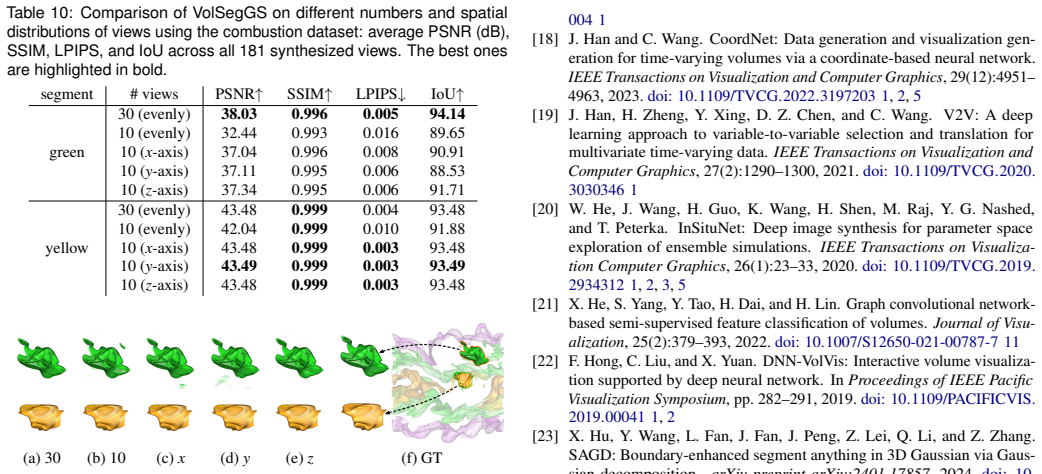
- [Section 4.3] The tracking experiments do not state how the displayed segments (e.g., the three combustion segments at timestep 20 or the vortex group at timestep 50) were selected, nor whether the reported 181-view averages use the same views at every timestep. This information is needed for reproducibility.
- [Table 1] The column label 'volume volume' appears to be a typo; it should read 'volume resolution'.
- [Figure 3] The color scale for the difference images is not quantified. The text 'purple to green to red' does not convey the magnitude of pixel-wise differences, making it difficult to assess the claimed improvement of the hybrid encoder.
- [Section 4.2, SAM 2 comparison] SAM 2 is applied to a video assembled from the predefined camera path, which is a favorably controlled setup, but the prompt-propagation strategy and failure modes are not described. This limits the comparability of the SAM 2 results with the 3D methods.
Circularity Check
The tracking claim is self-definitional: a segment is a Gaussian subset, so 'tracking' is that subset's deformation under F, and the paper asserts this construction 'ensures' consistent tracking while its quantitative validation (Tables 5-6) restates no independent reference protocol; rendering and static-segmentation claims are independently benchmarked against DVR ground truth.
-
self definitional
[Abstract; Section 1 (Contributions); Section 3 (Overview, para. 2); Section 4.3 (Summary; Tables 5-6)]
"Since segmentation is performed directly on the Gaussians, the segmented regions naturally follow Gaussian deformations, ensuring consistent tracking throughout the dynamic scene."
The 'tracked segment' at time t is, by construction, the image under the deformation field F of the user-selected Gaussian subset at the reference timestep; once a segment is defined as a set of Gaussians, 'tracking' is defined as deforming that set, so the guarantee stated in the Abstract ('by embedding segmentation results within the Gaussians, we ensure that their deformation enables continuous tracking') is a consequence of the definition, not an independently established result.
full rationale
VolSegGS is not circular in its rendering or static-segmentation claims. Table 2 evaluates synthesized images against held-out DVR renderings of the original volumes (a standard NVS protocol), and Table 4 evaluates segmentation against 'manually segmented volumes using DVR as the GT,' an independent reference. The coarse-level color segmentation is openly acknowledged as 'aligning with TF-based classification,' not presented as a renamed discovery. The affinity field is trained on SAM masks but scored against manual DVR masks, so the training signal and the evaluation reference differ. Self-citations are present but not load-bearing: the ViSNeRF-inspired hybrid deformation encoder (Section 3.2) is supported by the paper's own ablation (Appendix Table 5: hybrid vs. implicit), and ViSNeRF itself is an externally published paper; DL4SciVis [62] and related-work self-citations are contextual. No uniqueness theorem is imported, and no ansatz is smuggled via citation, since the deformation-network formulation 'following [67, 71]' cites independent external works (4DGS, D3DGS). The one definitional element is the tracking guarantee: once a segment is a set of Gaussians, following the deformation field makes 'tracking' a property of the construction, and Section 4.3's quantitative evaluation does not restate an independent reference, leaving the physical-correspondence question under-specified; Section 4.4 candidly concedes 'potential difficulty with long-term tracking,' and the training loss (Eq. 10) contains no correspondence or identity regularization. Because rendering and static segmentation are independently benchmarked and the tracking IoU values (80-97) are non-trivial, suggesting a non-self reference, the paper does not fully reduce to its inputs; the definitional framing plus the unspecified tracking reference warrant a moderate score of 4.
Assumptions & free parameters
free parameters (5)
- k-means cluster count k =
not reported, dataset-specific
- outlier removal radius and neighbor threshold =
not reported
- number of views for SAM mask generation =
30 (default), 10 in ablation
- loss weights lambda1, lambda2 =
1e-4, 0.2
- training timesteps and views per timestep =
10-30 timesteps; 20-40 views depending on dataset
assumptions (4)
- domain assumption A dynamic volumetric scene is sufficiently represented by DVR images rendered with a single transfer function; segmentation and tracking operate on this surrogate, not on the original volume data.
- domain assumption Gaussian colors are time-invariant and their view-dependent colors can be averaged to obtain a view-independent color for clustering.
- domain assumption SAM generates reliable 2D masks on rendered DVR images, and contrastive training on per-view masks yields a consistent 3D affinity field.
- domain assumption The deformation field network trained for reconstruction preserves the correspondence and identity of individual Gaussians over time.
Cite this review
Pith. "Pith review of VolSegGS: Segmentation and Tracking in Dynamic Volumetric Scenes via Deformable 3D Gaussians." pith.science (2026). https://pith.science/paper/76UR46UV
@misc{pith2026250712667,
  author       = {Pith},
  title        = {Pith review of: VolSegGS: Segmentation and Tracking in Dynamic Volumetric Scenes via Deformable 3D Gaussians},
  year         = {2026},
  howpublished = {\url{https://pith.science/paper/76UR46UV}},
  note         = {Machine review of arXiv:2507.12667}
}
read the original abstract
Visualization of large-scale time-dependent simulation data is crucial for domain scientists to analyze complex phenomena, but it demands significant I/O bandwidth, storage, and computational resources. To enable effective visualization on local, low-end machines, recent advances in view synthesis techniques, such as neural radiance fields, utilize neural networks to generate novel visualizations for volumetric scenes. However, these methods focus on reconstruction quality rather than facilitating interactive visualization exploration, such as feature extraction and tracking. We introduce VolSegGS, a novel Gaussian splatting framework that supports interactive segmentation and tracking in dynamic volumetric scenes for exploratory visualization and analysis. Our approach utilizes deformable 3D Gaussians to represent a dynamic volumetric scene, allowing for real-time novel view synthesis. For accurate segmentation, we leverage the view-independent colors of Gaussians for coarse-level segmentation and refine the results with an affinity field network for fine-level segmentation. Additionally, by embedding segmentation results within the Gaussians, we ensure that their deformation enables continuous tracking of segmented regions over time. We demonstrate the effectiveness of VolSegGS with several time-varying datasets and compare our solutions against state-of-the-art methods. With the ability to interact with a dynamic scene in real time and provide flexible segmentation and tracking capabilities, VolSegGS offers a powerful solution under low computational demands. This framework unlocks exciting new possibilities for time-varying volumetric data analysis and visualization.
Figures



Figures from the paper (17 more)




Forward citations
Cited by 1 Pith paper
-
Toward Distributed 3D Gaussian Splatting for High-Resolution Isosurface Visualization
Multi-GPU 3D Gaussian splatting, adapted from Grendel-GS, trains isosurface visualizations up to 5.6x faster and handles larger datasets than a single A100 GPU.
Reference graph
Works this paper leans on
-
[1]
K. Ai, K. Tang, and C. Wang. NLI4V olVis: Natural language interaction for volume visualization via multi-LLM agents and editable 3D Gaussian splatting. IEEE Transactions on Visualization and Computer Graphics, 32(1), 2026. Accepted. 9
2026
-
[2]
Bauer, Q
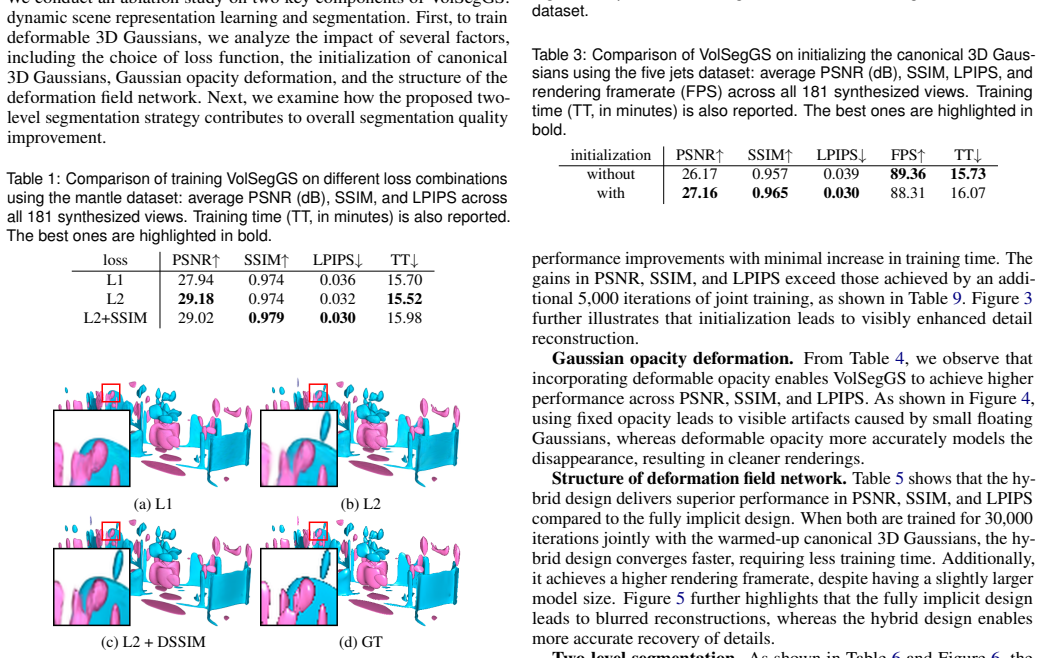
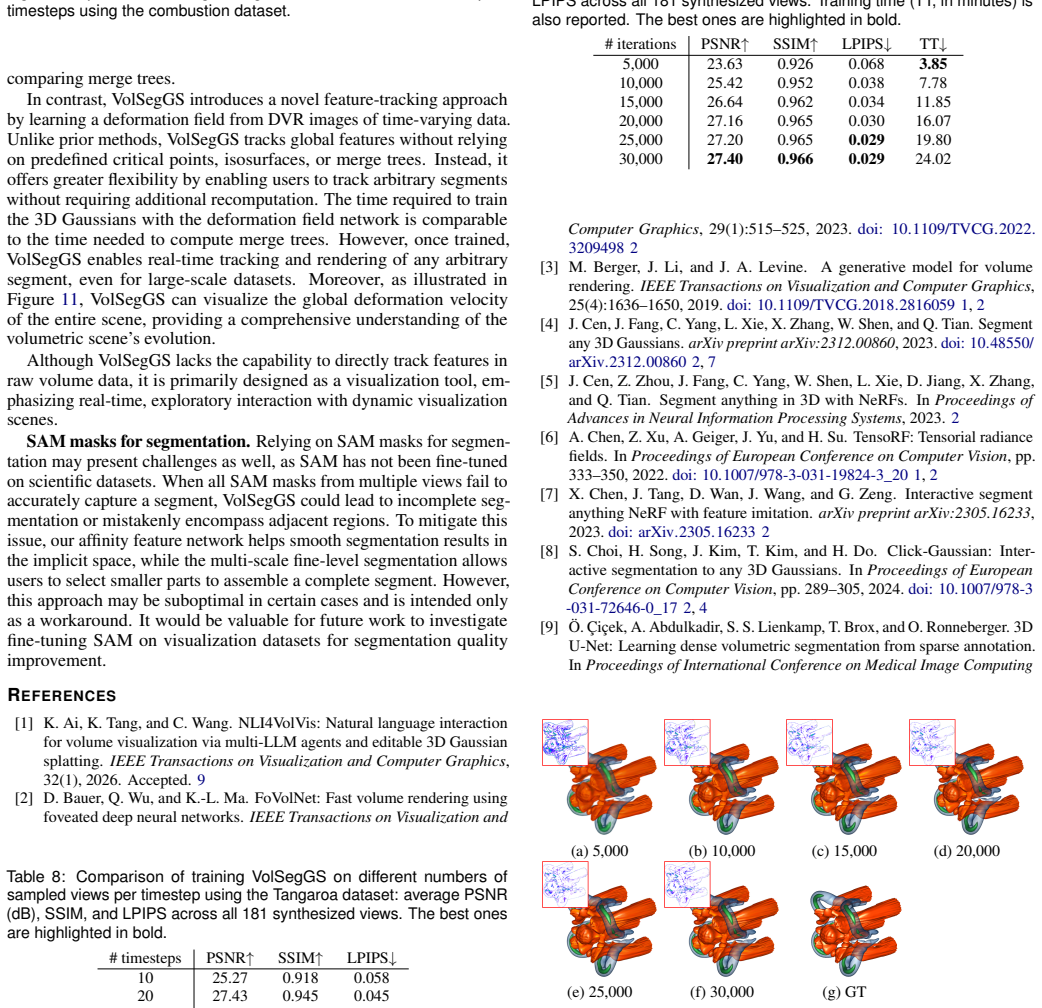
D. Bauer, Q. Wu, and K.-L. Ma. FoV olNet: Fast volume rendering using foveated deep neural networks. IEEE Transactions on Visualization and Table 8: Comparison of training VolSegGS on different numbers of sampled views per timestep using the Tangaroa dataset: average PSNR (dB), SSIM, and LPIPS across all 181 synthesized views. The best ones are highlighte...
2023
- [3]
-
[4]
J. Cen, J. Fang, C. Yang, L. Xie, X. Zhang, W. Shen, and Q. Tian. Segment any 3D Gaussians. arXiv preprint arXiv:2312.00860, 2023. doi: 10.48550/ arXiv.2312.00860 2, 7
-
[5]
J. Cen, Z. Zhou, J. Fang, C. Yang, W. Shen, L. Xie, D. Jiang, X. Zhang, and Q. Tian. Segment anything in 3D with NeRFs. In Proceedings of Advances in Neural Information Processing Systems, 2023. 2
work page 2023
-
[6]
A. Chen, Z. Xu, A. Geiger, J. Yu, and H. Su. TensoRF: Tensorial radiance fields. In Proceedings of European Conference on Computer Vision, pp. 333–350, 2022. doi: 10.1007/978-3-031-19824-3_20 1, 2
-
[8]
S. Choi, H. Song, J. Kim, T. Kim, and H. Do. Click-Gaussian: Inter- active segmentation to any 3D Gaussians. In Proceedings of European Conference on Computer Vision, pp. 289–305, 2024. doi: 10.1007/978-3 -031-72646-0_17 2, 4
doi:10.1007/978-3 2024
-
[9]
Ö. Çiçek, A. Abdulkadir, S. S. Lienkamp, T. Brox, and O. Ronneberger. 3D U-Net: Learning dense volumetric segmentation from sparse annotation. In Proceedings of International Conference on Medical Image Computing (a) 5,000 (b) 10,000 (c) 15,000 (d) 20,000 (e) 25,000 (f) 30,000 (g) GT Fig. 9: Comparison of training VolSegGS on different numbers of itera- t...
work page 2016
Show all 80 references
-
[10]
Dutta and H.-W
S. Dutta and H.-W. Shen. Distribution driven extraction and tracking of features for time-varying data analysis. IEEE Transactions on Visualiza- tion and Computer Graphics, 22(1):837–846, 2016. doi: 10.1109/TVCG. 2015.2467436 2, 11
2016
-
[11]
Fridovich-Keil, A
S. Fridovich-Keil, A. Yu, M. Tancik, Q. Chen, B. Recht, and A. Kanazawa. Plenoxels: Radiance fields without neural networks. In Proceedings of IEEE Conference on Computer Vision and Pattern Recognition, pp. 5501– 5510, 2022. doi: 10.1109/CVPR52688.2022.00542 2
2022
-
[12]
R. Goel, D. Sirikonda, S. Saini, and P. J. Narayanan. Interactive seg- mentation of radiance fields. In Proceedings of IEEE Conference on Computer Vision and Pattern Recognition, pp. 4201–4211, 2023. doi: 10. 1109/CVPR52729.2023.00409 2
2023
-
[14]
P. Gu, J. Han, D. Z. Chen, and C. Wang. Reconstructing unsteady flow data from representative streamlines via diffusion and deep learning based denoising. IEEE Computer Graphics and Applications, 41(6):111–121,
-
[15]
P. Gu, J. Han, D. Z. Chen, and C. Wang. Scalar2Vec: Translating scalar fields to vector fields via deep learning. In Proceedings of IEEE Pacific Vi- sualization Symposium, pp. 31–40, 2022. doi: 10.1109/PACIFICVIS53943 .2022.00012 1
2022
-
[16]
Han and C
J. Han and C. Wang. TSR-VFD: Generating temporal super-resolution for unsteady vector field data. Computers & Graphics, 103:168–179, 2022. doi: 10.1016/J.CAG.2022.02.001 1
2022 doi
-
[17]
Han and C
J. Han and C. Wang. VCNet: A generative model for volume completion. Visual Informatics, 6(2):62–73, 2022. doi: 10.1016/J.VISINF.2022.04. 004 1
2022 doi
-
[18]
Han and C
J. Han and C. Wang. CoordNet: Data generation and visualization gen- eration for time-varying volumes via a coordinate-based neural network. IEEE Transactions on Visualization and Computer Graphics, 29(12):4951– 4963, 2023. doi: 10.1109/TVCG.2022.3197203 1, 2, 5
2023
-
[19]
J. Han, H. Zheng, Y . Xing, D. Z. Chen, and C. Wang. V2V: A deep learning approach to variable-to-variable selection and translation for multivariate time-varying data. IEEE Transactions on Visualization and Computer Graphics, 27(2):1290–1300, 2021. doi: 10.1109/TVCG.2020. 3030346 1
2021 doi
-
[20]
W. He, J. Wang, H. Guo, K. Wang, H. Shen, M. Raj, Y . G. Nashed, and T. Peterka. InSituNet: Deep image synthesis for parameter space exploration of ensemble simulations. IEEE Transactions on Visualiza- tion Computer Graphics, 26(1):23–33, 2020. doi: 10.1109/TVCG.2019. 2934312 ...
2020 doi
-
[21]
X. He, S. Yang, Y . Tao, H. Dai, and H. Lin. Graph convolutional network- based semi-supervised feature classification of volumes. Journal of Visu- alization, 25(2):379–393, 2022. doi: 10.1007/S12650-021-00787-7 11
2022 doi
-
[22]
F. Hong, C. Liu, and X. Yuan. DNN-V olVis: Interactive volume visualiza- tion supported by deep neural network. In Proceedings of IEEE Pacific Visualization Symposium, pp. 282–291, 2019. doi: 10.1109/PACIFICVIS. 2019.00041 1, 2
2019
-
[23]
X. Hu, Y . Wang, L. Fan, J. Fan, J. Peng, Z. Lei, Q. Li, and Z. Zhang. SAGD: Boundary-enhanced segment anything in 3D Gaussian via Gaus- sian decomposition. arXiv preprint arXiv:2401.17857 , 2024. doi: 10. 48550/arXiv:2401.17857 2, 7
2024 arXiv
-
[24]
Huang and K.-L
R. Huang and K.-L. Ma. RGVis: Region growing based techniques for volume visualization. In Proceedings of Pacific Conference on Computer Graphics and Applications, pp. 355–363, 2003. doi: 10.1109/PCCGA. 2003.1238277 2, 11
2003 arXiv
-
[25]
C. Y . Ip, A. Varshney, and J. F. JáJá. Hierarchical exploration of volumes using multilevel segmentation of the intensity-gradient histograms. IEEE Transactions on Visualization and Computer Graphics, 18(12):2355–2363,
-
[26]
Ji, H.-W
G. Ji, H.-W. Shen, and R. Wenger. V olume tracking using higher dimen- sional isosurfacing. In Proceedings of IEEE Visualization Conference,
- [27]
-
[28]
Kerbl, G
B. Kerbl, G. Kopanas, T. Leimkühler, and G. Drettakis. 3D Gaussian splatting for real-time radiance field rendering. ACM Transactions on Graphics, 42(4):139:1–139:14, 2023. doi: 10.1145/3592433 2, 3, 4, 5
2023 doi
-
[31]
S. Kim, Y . Jang, and S.-E. Kim. Image-based TF colorization with CNN for direct volume rendering. IEEE Access, 9:124281–124294, 2021. doi: 10.1109/ACCESS.2021.3100429 11
2021
-
[32]
Kirillov, E
A. Kirillov, E. Mintun, N. Ravi, H. Mao, C. Rolland, L. Gustafson, T. Xiao, S. Whitehead, A. C. Berg, W.-Y . Lo, P. Dollár, and R. B. Girshick. Segment anything. In Proceedings of IEEE International Conference on Computer Vision, pp. 3992–4003, 2023. doi: 10.1109/ICCV51070.202...
2023
-
[33]
Kobayashi, E
S. Kobayashi, E. Matsumoto, and V . Sitzmann. Decomposing NeRF for editing via feature field distillation. In Proceedings of Advances in Neural Information Processing Systems, 2022. 2
2022
-
[34]
Y .-J. Li, M. Gladkova, Y . Xia, and D. Cremers. SADG: Segment any dy- namic Gaussian without object trackers. arXiv preprint arXiv:2411.19290,
-
[35]
Y . Lu, P. Gu, and C. Wang. FCNR: Fast compressive neural representation of visualization images. In Proceedings of IEEE VIS Conference (Short Papers), pp. 31–35, 2024. doi: 10.1109/VIS55277.2024.00014 1
2024
-
[36]
Luiten, G
J. Luiten, G. Kopanas, B. Leibe, and D. Ramanan. Dynamic 3D Gaus- sians: Tracking by persistent dynamic view synthesis. In Proceedings of International Conference on 3D Vision, pp. 800–809, 2024. doi: 10. 1109/3DV62453.2024.00044 3
2024
-
[37]
Ma and A
B. Ma and A. Entezari. V olumetric feature-based classification and vis- ibility analysis for transfer function design. IEEE Transactions on Vi- sualization and Computer Graphics, 24(12):3253–3267, 2018. doi: 10. 1109/TVCG.2017.2776935 2, 11
2018
-
[38]
J. Ma, Y . He, F. Li, L. Han, C. You, and B. Wang. Segment anything in medical images. Nature Communications, 15(1):654, 2024. doi: 10. 1038/s41467-024-44824-z 2
2024
-
[39]
Marques, C
R. Marques, C. Bouville, M. Ribardière, L. P. Santos, and K. Bouatouch. Spherical Fibonacci point sets for illumination integrals. Computer Graph- ics Forum, 32(8):134–143, 2013. doi: 10.1111/CGF.12190 5
2013 doi
-
[40]
Mildenhall, P
B. Mildenhall, P. P. Srinivasan, M. Tancik, J. T. Barron, R. Ramamoorthi, and R. Ng. NeRF: Representing scenes as neural radiance fields for view synthesis. In Proceedings of European Conference on Computer Vision, pp. 405–421, 2020. doi: 10.1007/978-3-030-58452-8_24 1, 2, 3
2020 doi
-
[41]
Muelder and K.-L
C. Muelder and K.-L. Ma. Interactive feature extraction and tracking by utilizing region coherency. In Proceedings of IEEE Pacific Visualization Symposium, 2009. doi: 10.1109/PACIFICVIS.2009.4906833 2, 11
2009
-
[42]
Müller, A
T. Müller, A. Evans, C. Schied, and A. Keller. Instant neural graphics primitives with a multiresolution hash encoding. ACM Transactions on Graphics, 41(4):102:1–102:15, 2022. doi: 10.1145/3528223.3530127 2
2022
-
[43]
Neubeck and L
A. Neubeck and L. V . Gool. Efficient non-maximum suppression. In Proceedings of International Conference on Pattern Recognition, pp. 850– 855, 2006. doi: 10.1109/ICPR.2006.479 5
2006 doi
-
[45]
Pumarola, E
A. Pumarola, E. Corona, G. Pons-Moll, and F. Moreno-Noguer. D-NeRF: Neural radiance fields for dynamic scenes. In Proceedings of IEEE Con- ference on Computer Vision and Pattern Recognition, pp. 10318–10327,
-
[46]
T. M. Quan, J. Choi, H. Jeong, and W.-K. Jeong. An intelligent system approach for probabilistic volume rendering using hierarchical 3D convo- lutional sparse coding. IEEE Transactions on Visualization and Computer Graphics, 24(1):964–973, 2018. doi: 10.1109/TVCG.2017.2744078 2, 11
2018
- [47]
-
[48]
Saikia and T
H. Saikia and T. Weinkauf. Global feature tracking and similarity es- timation in time-dependent scalar fields. Computer Graphics Forum , 36(3):1–11, 2017. doi: 10.1111/cgf.13163 3, 11
2017 doi
-
[49]
Schnorr, D
A. Schnorr, D. N. Helmrich, D. Denker, T. W. Kuhlen, and B. Hentschel. Feature tracking by two-step optimization. IEEE Transactions on Vi- sualization and Computer Graphics , 26(6):2219–2233, 2020. doi: 10. 1109/TVCG.2018.2883630 2, 11
2020
-
[50]
Sharma, T
O. Sharma, T. Arora, and A. Khattar. Graph-based transfer function for volume rendering. Computer Graphics Forum, 39(1):76–88, 2020. doi: 10 .1111/CGF.13663 11
2020
-
[51]
doi: 10.1109/CVPR46437.2021.01018 2
2021
-
[52]
Silver and X
D. Silver and X. Wang. Tracking and visualizing turbulent 3D features. IEEE Transactions on Visualization and Computer Graphics, 3(2):129– 141, 1997. doi: 10.1109/2945.597796 2, 11
1997
-
[53]
H. Son, J. Noh, S. Jeon, C. Wang, and W.-K. Jeong. MC-INR: Efficient encoding of multivariate scientific simulation data using meta-learning and clustered implicit neural representations. In Proceedings of IEEE VIS Conference (Short Papers), 2025. Accepted. 1
2025
-
[54]
K. P. Soundararajan and T. Schultz. Learning probabilistic transfer func- tions: A comparative study of classifiers. Computer Graphics Forum, 34(3):111–120, 2015. doi: 10.1111/CGF.12623 2, 11
2015 doi
-
[55]
K. Tang, K. Ai, J. Han, and C. Wang. TexGS-V olVis: Expressive scene editing for volume visualization via textured Gaussian splatting. IEEE Transactions on Visualization and Computer Graphics, 32(1), 2026. Ac- cepted. 2
2026
-
[56]
Tang and C
K. Tang and C. Wang. ECNR: Efficient compressive neural representation of time-varying volumetric datasets. In Proceedings of IEEE Pacific Visu- alization Conference, pp. 72–81, 2024. doi: 10.1109/PACIFICVIS60374. 2024.00017 1
2024
-
[57]
N. Shi, J. Xu, H. Guo, J. Woodring, and H.-W. Shen. VDL-Surrogate: A view-dependent latent-based model for parameter space exploration of ensemble simulations. IEEE Transactions on Visualization and Computer Graphics, 29(1):820–830, 2023. doi: 10.1109/TVCG.2022.3209413 2
2023
-
[58]
Tang and C
K. Tang and C. Wang. StyleRF-V olVis: Style transfer of neural radiance fields for expressive volume visualization.IEEE Transactions on Visualiza- tion and Computer Graphics, 31(1):613–623, 2025. doi: 10.1109/TVCG. 2024.3456342 1, 2
2025
-
[59]
K. Tang, S. Yao, and C. Wang. iVR-GS: Inverse volume rendering for explorable visualization via editable 3D Gaussian splatting. IEEE Trans- actions on Visualization and Computer Graphics, 31(6):3783–3795, 2025. doi: 10.1109/TVCG.2025.3567121 2
2025
-
[60]
I. E. Toubal, Y . Duan, and D. Yang. Deep learning semantic segmentation for high-resolution medical volumes. In Proceedings of IEEE Applied Imagery Pattern Recognition Workshop, pp. 1–9, 2020. doi: 10.1109/ AIPR50011.2020.9425041 2
2020
-
[61]
Tzeng, E
F.-Y . Tzeng, E. B. Lum, and K.-L. Ma. An intelligent system approach to higher-dimensional classification of volume data. IEEE Transactions on Visualization and Computer Graphics, 11(3):273–284, 2005. doi: 10. 1109/TVCG.2005.38 2, 11
2005
-
[62]
Wang and J
C. Wang and J. Han. DL4SciVis: A state-of-the-art survey on deep learning for scientific visualization. IEEE Transactions on Visualization and Computer Graphics, 29(8):3714–3733, 2023. doi: 10.1109/TVCG. 2022.3167896 1
2023
-
[63]
Tang and C
K. Tang and C. Wang. STSR-INR: Spatiotemporal super-resolution for time-varying multivariate volumetric data via implicit neural representa- tion. Computers & Graphics, 119:103874, 2024. doi: 10.1016/J.CAG. 2024.01.001 1
2024 doi
-
[64]
Weiss, P
S. Weiss, P. Hermüller, and R. Westermann. Fast neural representations for direct volume rendering. Computer Graphics Forum, 41(6):196–211,
-
[65]
Weiss, M
S. Weiss, M. I¸ sIk, J. Thies, and R. Westermann. Learning adaptive sam- pling and reconstruction for volume visualization. IEEE Transactions on Visualization and Computer Graphics, 28(7):2654–2667, 2022. doi: 10. 1109/TVCG.2020.3039340 2
2022
-
[66]
Widanagamaachchi, C
W. Widanagamaachchi, C. Christensen, V . Pascucci, and P.-T. Bremer. Interactive exploration of large-scale time-varying data using dynamic tracking graphs. In Proceedings of IEEE Symposium on Large Data Analysis and Visualization, 2012. doi: 10.1109/LDA V.2012.6378962 3, 11
2012
-
[68]
Q. Wu, D. Bauer, M. J. Doyle, and K.-L. Ma. Interactive volume visualiza- tion via multi-resolution hash encoding based neural representation. IEEE Transactions on Visualization and Computer Graphics, 30(8):5404–5418,
-
[69]
Weiss, M
S. Weiss, M. Chu, N. Thuerey, and R. Westermann. V olumetric isosurface rendering with deep learning-based super-resolution. IEEE Transactions on Visualization and Computer Graphics, 27(6):3064–3078, 2021. doi: 10 .1109/TVCG.2019.2956697 2
2021
-
[70]
M. Yang, K. Tang, and C. Wang. Meta-INR: Efficient encoding of volumet- ric data via meta-learning implicit neural representation. In Proceedings of IEEE Pacific Visualization Conference (Visualization Notes), pp. 246–251,
-
[71]
Z. Yang, X. Gao, W. Zhou, S. Jiao, Y . Zhang, and X. Jin. Deformable 3D Gaussians for high-fidelity monocular dynamic scene reconstruction. In Proceedings of IEEE Conference on Computer Vision and Pattern Recognition, pp. 20331–20341, 2024. doi: 10.1109/CVPR52733.2024. 01922 2, 3, 5
2024
-
[72]
Z. Yang, H. Yang, Z. Pan, and L. Zhang. Real-time photorealistic dynamic scene representation and rendering with 4D Gaussian splatting. In Pro- ceedings of International Conference on Learning Representations, 2024. 2, 3, 5
2024
-
[73]
S. Yao, J. Han, and C. Wang. GMT: A deep learning approach to general- ized multivariate translation for scientific data analysis and visualization. Computers & Graphics, 112:92–104, 2023. doi: 10.1016/J.CAG.2023.04. 002 1
2023 doi
-
[74]
S. Yao, Y . Lu, and C. Wang. ViSNeRF: Efficient multidimensional neural radiance field representation for visualization synthesis of dynamic volu- metric scenes. In Proceedings of IEEE Pacific Visualization Conference, pp. 235–245, 2025. doi: 10.1109/PacificVis64226.2025.00029...
2025
-
[75]
Yao and C
S. Yao and C. Wang. ReV olVE: Neural reconstruction of volumes for visualization enhancement of direct volume rendering. Computers & Graphics, 2025. Accepted. 2
2025
-
[76]
doi: 10.1109/TVCG.2023.3293121 2
2023
-
[77]
S. W. Wurster, T. Xiong, H.-W. Shen, H. Guo, and T. Peterka. Adaptively placed multi-grid scene representation networks for large-scale data visu- alization. IEEE Transactions on Visualization and Computer Graphics, 30(1):965–974, 2024. doi: 10.1109/TVCG.2023.3327194 2
2024
-
[78]
Zhang, P
R. Zhang, P. Isola, A. A. Efros, E. Shechtman, and O. Wang. The unreason- able effectiveness of deep features as a perceptual metric. In Proceedings of IEEE Conference on Computer Vision and Pattern Recognition , pp. 586–595, 2018. doi: 10.1109/CVPR.2018.00068 6
2018
-
[85]
M. Ye, M. Danelljan, F. Yu, and L. Ke. Gaussian Grouping: Segment and edit anything in 3D scenes. In Proceedings of European Conference on Computer Vision, pp. 162–179, 2024. doi: 10.1007/978-3-031-73397 -0_10 2, 4
2024 doi
-
[86]
A. Yu, R. Li, M. Tancik, H. Li, R. Ng, and A. Kanazawa. PlenOctrees for real-time rendering of neural radiance fields. In Proceedings of IEEE International Conference on Computer Vision, pp. 5752–5761, 2021. doi: 10.1109/ICCV48922.2021.00570 2
2021
-
[2003]
doi: 10.1109/VISUAL.2003.1250374 2, 11
2003 arXiv
-
[2012]
doi: 10.1109/TVCG.2012.231 2, 11
2012 doi
-
[2021]
doi: 10.1109/MCG.2021.3089627 1
2021
-
[2022]
doi: 10.1111/CGF.14578 2
-
[2023]
doi: arXiv.2305.16233 2
-
[2024]
doi: 10.48550/arXiv.2411.19290 8
Reviewed August 6, 2026 · model on record in the stance chip above.
Discussion (0). Sign in to comment.