REVIEW 4 major objections 6 minor 44 references
Joint phase reconstruction and magnitude segmentation from velocity-encoded MRI data
T0 review · 4 major / 6 minor · reviewed 2026-08-14 · deepseek-v4-flash
Pith's one-line read Joint MRI reconstruction cuts velocity error versus sequential methods.
desk verdict A coherent extension of joint reconstruction-and-segmentation to velocity-encoded MRI, but the headline claim that joint reconstruction improves velocity is not actually supported by the reported quantitative results. read the letter →
The pith
A machine-rendered reading of the paper's core claim, the machinery that carries it, and where it could break.
The reading
What carries the argument
The central object is the joint variational energy of Eq. (20), which couples a Fourier-domain data-fidelity term $\tfrac{1}{2}\|A(u_j e^{i\varphi_j})-f_j\|_2^2$ for each of the four acquisitions with a two-region segmentation term $\delta\sum_n [v_{nj}(c_1-u_{nj})^2+(1-v_{nj})(c_2-u_{nj})^2]$ on the magnitude images. The optimizer is an alternating Bregman iteration in which total variation (a penalty on local intensity changes) regularizes magnitude and segmentation, while an $H^1$-type penalty smooths the phase difference, so the velocity—recovered afterwards from Eq. (12)—is regularized directly without assuming known phase structure. The Bregman distance, the difference between a functional and its linearization at a previous iterate, is what lets the scheme handle non-smooth and non-convex terms in an inverse-scale-space manner.
What would settle it
Take a straight-tube phantom with known steady flow and acquire the four-measurement velocity-encoded sequence twice, changing only the background magnetic field between runs. If the joint method returns different velocity maps while the physical flow is unchanged, the zero-flow cancellation of Eq. (12) is not complete, and the claimed improvement is in phase consistency rather than true velocity measurement.
Extended reading notes
Core claim
The paper claims that the four measurements of a velocity-encoded MRI acquisition—two gradient polarities in the flow-on state plus their zero-flow references—can be inverted as one joint problem rather than as separate magnitude and phase reconstructions. The proposed model is the non-convex energy of Eq. (20), in which each magnitude image $u_j$ and phase map $\varphi_j$ must explain the undersampled k-space data through $A(u_j e^{i\varphi_j})$, while a binary segmentation $v_j$ pulls the magnitudes toward two intensity levels $c_1$ and $c_2$. Alternating Bregman iteration with total variation on magnitudes and segmentations and an $H^1$ penalty on the phase difference solves the system. Afterward the velocity component is computed from the four recovered phases via Eq. (12). The paper reports that this joint approach lowers mean-squared error for magnitudes and phases relative to the sequential baseline on simulated bubble-rise data and produces visually cleaner velocity fields, magnitudes, and segmentations on real bursting-bubble data.
Load-bearing premise
The whole velocity estimate rests on the assumption that subtracting the zero-flow reference from the two opposite-polarity measurements cancels every background phase contribution exactly, leaving only motion-induced phase; if any field imperfection fails to cancel, the reconstructed phase differences are not the true velocities.
Editorial extensions
If this is right
- At 11 percent k-space sampling on simulated data, the joint approach lowers mean-squared error for both magnitude images and phase maps compared with the sequential baseline, so the same reconstruction quality becomes available at lower sampling fractions.
- Because the model regularizes the phase difference rather than each phase separately, smoothness is imposed directly on the quantity that becomes velocity.
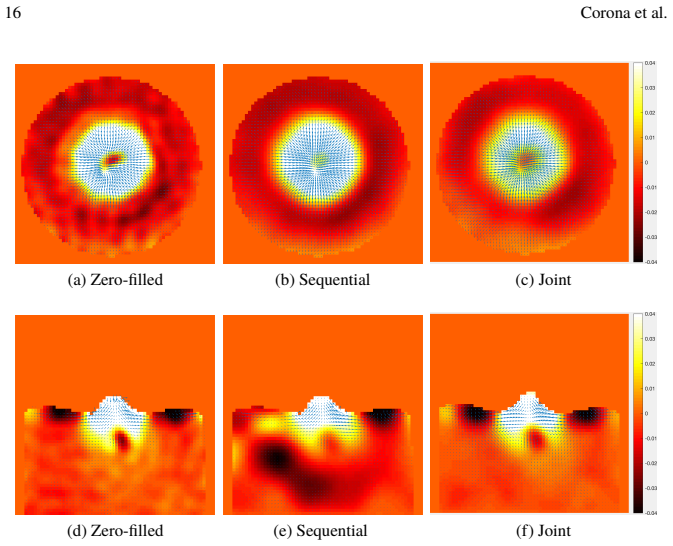
- On real bubble-burst data, the joint approach produces noise-reduced velocity fields and sharp fluid/air boundaries in magnitude and segmentation, compared with zero-filling and the sequential pipeline.
- The four-measurement model, with velocity recovered from Eq. (12), applies to any single-component velocity-encoded MRI acquisition, not only bubbly flows.
- Early stopping of the Bregman iteration acts as iterative regularization, so the algorithm does not need a global minimizer of the non-convex energy to produce useful reconstructions.
Reading between the lines
- Editorial inference: the largest joint-versus-sequential differences should occur at bubble edges, because that is where the segmentation term changes the reconstruction; the paper reports global MSE only, so a per-pixel error map on the synthetic data would make this prediction testable.
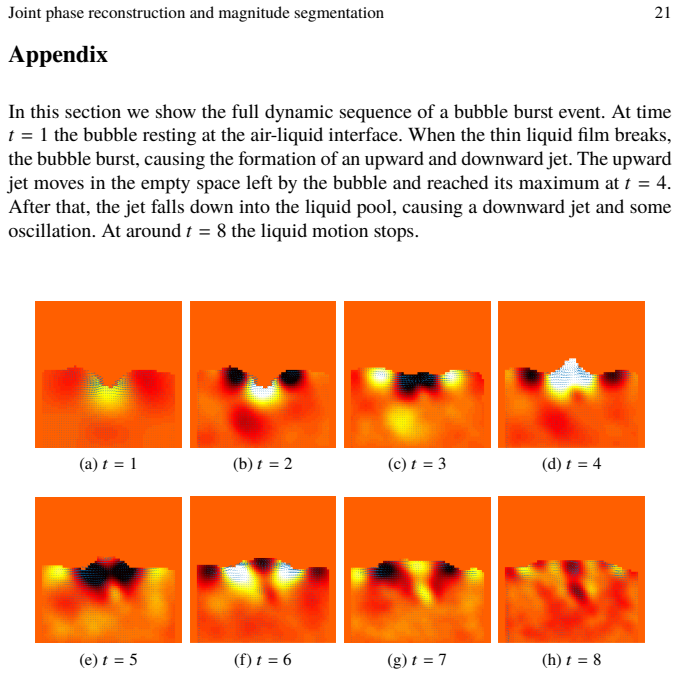
- Editorial inference: the method reconstructs each time frame independently, and the paper notes that the lack of a 4D dataset prevents joint space-time reconstruction; a simulated dynamic phantom with known time-varying flow could test the expected gains before new real acquisitions.
- Editorial inference: the fixed two-level segmentation constants tie the model to bimodal images; generalizing to multiple regions or data-driven intensity levels would extend the coupling idea to medical settings such as cardiac blood flow, where the same joint phase-magnitude structure holds.
Signed reviews
Editorial analysis
A structured set of objections, weighed in public.
Referee Report
Summary. The paper proposes a joint variational approach for reconstructing magnitude, phase, and segmentation from undersampled velocity-encoded MRI. It models the acquired k-space signal as A(u e^{i\phi}) and defines velocity as a phase difference over four acquisitions (two flow polarities and two zero-flow references). The authors introduce a non-convex Bregman iteration algorithm (Eq. 21) with TV regularization on magnitude/segmentation and H1-type smoothing on the phase-difference velocity. They report synthetic experiments on a rising-bubble phantom (32 frames, 11% sampling) comparing a joint model to a sequential CS-TV approach, and visual results on real bubble-burst data. The central claim is that the joint model improves velocity, magnitude, and segmentation.
Significance. If the claimed improvements hold, the approach offers a practically useful way to exploit structure in undersampled velocity-encoded MRI, and the extension of non-convex Bregman iteration to velocity-regularized phase reconstruction is methodologically interesting. The paper includes a physically motivated forward model and a concrete algorithmic scheme with synthetic and real-data demonstrations. However, the quantitative support for the headline velocity claim is incomplete: Table 1 reports MSE for only two of the four phases and two magnitudes, with no velocity MSE, no variance estimates, and no parameter values. The real-data evaluation is visual only. The significance is therefore conditional on substantial additional quantitative evidence.
major comments (4)
- [Section 5.1, Table 1] The central claim that the joint method improves velocity is not quantitatively demonstrated, because Table 1 reports averaged MSE only for u1, u2, phi1, and phi2; no MSE is given for the velocity field defined in Eq. (12) as v = 1/2((phi1 - phi2) - (phi3 - phi4)), nor for the omitted u3, u4, phi3, and phi4. Please add per-frame velocity MSE, and ideally the full set of magnitude and phase errors, with standard deviations or confidence intervals; without this, the abstract's "improves velocity" assertion is unsupported by the synthetic experiment.
- [Sections 4 and 5] The numerical results are not reproducible because no parameter values are reported: alpha, beta, delta, eta, tau, c1, c2, the early-stopping iteration number, and the PDHG inner-loop settings are all unspecified. Please provide these values and either the tuning procedure or a sensitivity analysis; if space permits, releasing code would address this fully.
- [Section 5.1, baseline description] The sequential baseline is described only as a "classic CS-TV-regularised approach" followed by the phase method of [37] and [44], which are the authors' own prior works; no algorithmic details, regularization weights, or stopping rules are given. Because every quantitative comparison in the paper is against this baseline, a substantial description (or a reference to a standardized implementation) is needed to rule out that the reported gains are due to a weak or undertuned comparator.
- [Sections 2.3, 2.4, and 5.2] The velocity interpretation depends on Eq. (12), which assumes exact cancellation of background, off-resonance, and eddy-current phase between flow-on and zero-flow acquisitions; the paper provides no validation of this cancellation on the real data, where no independent velocity ground truth exists. The comparative claim may survive this concern (both methods use the same phase combination), but the absolute velocity accuracy on real data is not established and should be stated as a limitation.
minor comments (6)
- [Eq. (20)] The fidelity term uses phi_i while the sum is over j; it should be phi_j.
- [Eq. (20) and Eq. (21)] Eq. (20) is presented as the joint cost, but the TV and H1 regularizers enter only through the Bregman distances in Eq. (21); please state explicitly that the overall model is E + J_u + J_v + J_phi and that Eq. (21) is an iterative regularization scheme for it.
- [Section 3.2] The admissible set for the segmentation variable v (for example, v in [0,1] or binary) is not specified; please state it.
- [Section 5.1, Fig. 1] The text says that visual differences are not significant while MSE improves; showing error maps would help the reader judge where the improvement occurs.
- [Fig. 6 caption] The caption contains a typo: "Bottow" should be "Bottom".
- [Figs. 3-6] The figures would benefit from colorbars and explicit display windows for the velocity and phase maps.
Circularity Check
No circular derivation: the joint model and its comparisons are self-contained, with only non-load-bearing self-citations.
full rationale
The phase/velocity forward model is derived from the Bloch equations (Eqs. 9-16), and the velocity map is defined by the standard two-polarity/zero-flow subtraction in Eq. (12). The joint variational model in Eq. (20) combines a data-fidelity term, a Chan-Vese segmentation term, and a Bregman-iteration scheme; the velocity regularity is introduced explicitly in Eq. (22) as an H1 penalty on (φ1−φ2)−(φ3−φ4), the same phase difference that defines velocity in Eq. (12). This is a modelling choice, not a hidden fit: the synthetic experiments use an independent ground truth and report MSE, so the claimed improvements are not equivalent to the model's inputs by construction. The paper does cite the authors' own prior work as motivation and as baselines: Section 3.2 builds on [15], and Section 5.1 uses 'the method proposed in [37] and presented in [44]' as the sequential comparator, where [37] and [44] are by overlapping author groups. These self-citations are not load-bearing for the central claim, because the joint method's superiority is demonstrated numerically against that baseline rather than assumed from the citations. The main weaknesses are evidentiary: Table 1 reports average MSE only for φ1, φ2, u1, and u2 and omits a velocity-map MSE, and the weights α, β, δ, η, τ and constants c1, c2 are not reported. Missing evidence and unspecified tuning are not circularity. No equation in the paper reduces a predicted quantity to a fitted parameter or to a self-referential definition.
Assumptions & free parameters
free parameters (5)
- alpha (magnitude TV weight) =
not reported
- beta (segmentation TV weight) =
not reported
- delta (segmentation coupling weight) =
not reported
- eta (velocity smoothness weight) =
not reported
- c1, c2 (region intensity means) =
not reported
assumptions (5)
- domain assumption Forward model f = A(u e^{i phi}) + eta (Eq. 16) with Gaussian zero-mean noise; the continuous derivation is replaced by a discrete model that assumes phase is constant during readout and ignores T2* decay and uncorrected field inhomogeneities.
- domain assumption Velocity is recoverable from phase differences of four measurements via Eq. (12), requiring the background phase and system artefacts to cancel exactly between flow-on and zero-flow acquisitions.
- domain assumption The segmentation term in Eq. (20) assumes the image consists of two regions with known intensity means c1 and c2.
- ad hoc to paper The alternating Bregman iteration (21) with early stopping finds useful approximate minimizers of (20).
- standard math The total variation and H1 penalties chosen in Eq. (22) and J_phi are proper, lower semi-continuous, convex functions, so generalized Bregman distances are well-defined.
Cite this review
Pith. "Pith review of Joint phase reconstruction and magnitude segmentation from velocity-encoded MRI data." pith.science (2026). https://pith.science/paper/7BKYH2FZ
@misc{pith2026190805285,
  author       = {Pith},
  title        = {Pith review of: Joint phase reconstruction and magnitude segmentation from velocity-encoded MRI data},
  year         = {2026},
  howpublished = {\url{https://pith.science/paper/7BKYH2FZ}},
  note         = {Machine review of arXiv:1908.05285}
}
read the original abstract
Velocity-encoded MRI is an imaging technique used in different areas to assess flow motion. Some applications include medical imaging such as cardiovascular blood flow studies, and industrial settings in the areas of rheology, pipe flows, and reactor hydrodynamics, where the goal is to characterise dynamic components of some quantity of interest. The problem of estimating velocities from such measurements is a nonlinear dynamic inverse problem. To retrieve time-dependent velocity information, careful mathematical modelling and appropriate regularisation is required. In this work, we propose an optimisation algorithm based on non-convex Bregman iteration to jointly estimate velocity-, magnitude- and segmentation-information for the application of bubbly flow imaging. Furthermore, we demonstrate through numerical experiments on synthetic and real data that the joint model improves velocity, magnitude and segmentation over a classical sequential approach.
Figures


Figures from the paper (5 more)



Reference graph
Works this paper leans on
-
[37]
Martin Benning, Marta M Betcke, Matthias J Ehrhardt, and Carola-Bibiane Schönlieb. Choose your path wisely: gradient descent in a Bregman distance framework.arXiv preprint arXiv:1712.04045, 2017
arXiv 2017
-
[44]
Signal sampling and processing inmagnetic resonance applications
Andi Reci. Signal sampling and processing inmagnetic resonance applications. PhD thesis, University of Cambridge, 2019
work page 2019
-
[1]
C.T. Burt. NMR measurements and flow.Journal of Nuclear Medicine, 23(11):1044–1045,
-
[2]
L Axel. Blood flow effects in magnetic resonance imaging.American Journal of Roentgenol- ogy, 143(6):1157–1166, dec 1984
work page 1984
-
[3]
P. T. Callaghan.Translational Dynamics and Magnetic Resonance. Oxford University Press, 2011
work page 2011
-
[5]
Christopher J. Elkins and Marcus T. Alley. Magnetic resonance velocimetry: applications of magnetic resonance imaging in the measurement of fluid motion.Experiments in Fluids, 43(6):823–858, Dec 2007
work page 2007
-
[6]
LynnF.GladdenandAndrewJ.Sederman. RecentadvancesinflowMRI. JournalofMagnetic Resonance, 229:2 – 11, 2013. Frontiers of In Vivo and Materials MRI Research
work page 2013
-
[7]
Gatehouse, Jennifer Keegan, Lindsey A
Peter D. Gatehouse, Jennifer Keegan, Lindsey A. Crowe, Sharmeen Masood, Raad H. Mohi- addin, Karl-Friedrich Kreitner, and David N. Firmin. Applications of phase-contrast flow and velocity imaging in cardiovascular mri.European Radiology, 15(10):2172–2184, Oct 2005
work page 2005
Show all 44 references
-
[8]
Rheo-NMR: nuclear magnetic resonance and the rheology of complex fluids.Reports on Progress in Physics, 62(4):599, 1999
Paul T Callaghan. Rheo-NMR: nuclear magnetic resonance and the rheology of complex fluids.Reports on Progress in Physics, 62(4):599, 1999
1999
-
[9]
Structure-flowcorrelationsinpacked beds
AJSederman,MLJohns,PAlexander,andLFGladden. Structure-flowcorrelationsinpacked beds. Chemical Engineering Science, 53(12):2117–2128, 1998. 18 Corona et al. (a) Zero-filled (b) Sequential (c) Joint (d) Zero-filled (e) Sequential (f) Joint Fig. 5: Magnitude reconstructions (top row...
1998
-
[10]
Magneticresonancevelocityimaging ofliquidandgastwo-phaseflowinpackedbeds
MHSankey,DJHolland,AJSederman,andLFGladden. Magneticresonancevelocityimaging ofliquidandgastwo-phaseflowinpackedbeds. JournalofMagneticResonance ,196(2):142– 148, 2009
2009
-
[11]
Reducingdataacquisitiontimesinphase-encodedvelocityimagingusingcompressedsensing
DanielJHolland,DmitryMMalioutov,AndrewBlake,AndrewJSederman,andLFGladden. Reducingdataacquisitiontimesinphase-encodedvelocityimagingusingcompressedsensing. Journal of magnetic resonance, 203(2):236–246, 2010
2010
-
[12]
Nuclearmagneticresonanceasatooltostudyflow
EiichiFukushima. Nuclearmagneticresonanceasatooltostudyflow. AnnualReviewofFluid Mechanics, 31(1):95–123, 1999
1999
-
[13]
Spatially resolved measurement of anisotropic granular temperature in gas-fluidized beds
Daniel J Holland, Christoph R Müller, John S Dennis, Lynn F Gladden, and Andrew J Se- derman. Spatially resolved measurement of anisotropic granular temperature in gas-fluidized beds. Powder Technology, 182(2):171–181, 2008
2008
-
[14]
Exploring the origins of turbulence in multiphase flow using compressed sensing MRI.Physical review letters, 108(26):264505, 2012
Alexander B Tayler, Daniel J Holland, Andrew J Sederman, and Lynn F Gladden. Exploring the origins of turbulence in multiphase flow using compressed sensing MRI.Physical review letters, 108(26):264505, 2012
2012
-
[15]
Enhancingjointreconstructionandsegmentationwithnon-convexBregmaniteration
Veronica Corona, Martin Benning, Matthias Joachim Ehrhardt, Lynn Faith Gladden, Richard Mair, Andi Reci, Andrew J Sederman, Stefanie Reichelt, and Carola-Bibiane SchÃűnlieb. Enhancingjointreconstructionandsegmentationwithnon-convexBregmaniteration. Inverse Problems, 2019
2019
-
[16]
Velocity encoding and flow imaging
Michael Markl. Velocity encoding and flow imaging. 2006
2006
-
[17]
Robust uncertainty principles: Ex- act signal reconstruction from highly incomplete frequency information
Emmanuel Candes, Justin Romberg, and Terence Tao. Robust uncertainty principles: Ex- act signal reconstruction from highly incomplete frequency information. arXiv preprint math/0409186, 2004. Joint phase reconstruction and magnitude segmentation 19 (a) Zero-filled (b) Sequentia...
2004 arXiv
-
[18]
IEEETransactionsoninformationtheory ,52(4):1289– 1306, 2006
DavidL.Donoho.Compressedsensing. IEEETransactionsoninformationtheory ,52(4):1289– 1306, 2006
2006
-
[19]
MichaelLustig,DavidDonoho,andJohnMPauly.SparseMRI:Theapplicationofcompressed sensing for rapid MR imaging.Magnetic Resonance in Medicine: An Official Journal of the International Society for Magnetic Resonance in Medicine, 58(6):1182–1195, 2007
2007
-
[20]
Highly k-t- space–acceleratedphase-contrastMRI.MagneticResonanceinMedicine:AnOfficialJournal of the International Society for Magnetic Resonance in Medicine, 60(5):1169–1177, 2008
Bernd Jung, Matthias Honal, Peter Ullmann, Jürgen Hennig, and Michael Markl. Highly k-t- space–acceleratedphase-contrastMRI.MagneticResonanceinMedicine:AnOfficialJournal of the International Society for Magnetic Resonance in Medicine, 60(5):1169–1177, 2008
2008
-
[21]
Ultrafastmicroscopyofmicrofluidics:compressedsensing and remote detection.Angewandte Chemie International Edition, 50(23):5258–5260, 2011
EvaPaciokandBernhardBlümich. Ultrafastmicroscopyofmicrofluidics:compressedsensing and remote detection.Angewandte Chemie International Edition, 50(23):5258–5260, 2011
2011
-
[22]
Compressed sensing of remotely detectedMRIvelocimetryinmicrofluidics
Jeffrey Paulsen, Vikram S Bajaj, and Alexander Pines. Compressed sensing of remotely detectedMRIvelocimetryinmicrofluidics. JournalofMagneticResonance ,205(2):196–201, 2010
2010
-
[23]
Quantitative single point imaging with compressed sensing.Journal of Magnetic resonance, 201(1):72–80, 2009
P Parasoglou, D Malioutov, AJ Sederman, J Rasburn, H Powell, LF Gladden, A Blake, and ML Johns. Quantitative single point imaging with compressed sensing.Journal of Magnetic resonance, 201(1):72–80, 2009
2009
-
[24]
Cooley and John W
James W. Cooley and John W. Tukey. An algorithm for the machine calculation of complex fourier series.Mathematics of Computation, 19(90):297–301, 1965
1965
-
[25]
Nonuniformfastfouriertransformsusingmin-maxinterpolation
J.A.FesslerandB.P.Sutton. Nonuniformfastfouriertransformsusingmin-maxinterpolation. IEEE Transactions on Signal Processing, 51(2):560–574, Feb 2003
2003
-
[26]
Phase reconstruction from velocity-encoded MRI measurements–a survey of sparsity- promoting variational approaches.Journal of Magnetic Resonance, 238:26–43, 2014
MartinBenning,LynnGladden,DanielHolland,Carola-BibianeSchönlieb,andTuomoValko- nen. Phase reconstruction from velocity-encoded MRI measurements–a survey of sparsity- promoting variational approaches.Journal of Magnetic Resonance, 238:26–43, 2014. 20 Corona et al
2014
-
[27]
J. A. Fessler and D. C. Noll. Iterative image reconstruction in MRI with separate magnitude and phase regularization. InProc. 2nd IEEE Int. Symp. Biomedical Imaging: Nano to Macro (IEEE Cat No. 04EX821), pages 209–212 Vol. 1, April 2004
2004
-
[28]
M. V. W. Zibetti and A. R. De Pierro. Separate magnitude and phase regularization in MRI with incomplete data: Preliminary results. InProc. IEEE Int. Symp. Biomedical Imaging: From Nano to Macro, pages 736–739, April 2010
2010
-
[29]
Separatemagnitudeandphaseregularization viacompressedsensing
F.Zhao,D.C.Noll,J.Nielsen,andJ.A.Fessler. Separatemagnitudeandphaseregularization viacompressedsensing. IEEETransactionsonMedicalImaging ,31(9):1713–1723,September 2012
2012
-
[30]
A primal–dual hybrid gradient method for nonlinear operators with appli- cations to mri.Inverse Problems, 30(5):055012, 2014
Tuomo Valkonen. A primal–dual hybrid gradient method for nonlinear operators with appli- cations to mri.Inverse Problems, 30(5):055012, 2014
2014
-
[31]
Zibetti and Alvaro R
Marcelo V. Zibetti and Alvaro R. Pierro. Improving compressive sensing in mri with sepa- rate magnitude and phase priors.Multidimensional Syst. Signal Process., 28(4):1109–1131, October 2017
2017
-
[32]
Gladden and Andrew J
Lynn F. Gladden and Andrew J. Sederman. Magnetic resonance imaging and velocity map- ping in chemical engineering applications.Annual Review of Chemical and Biomolecular Engineering, 8(1):227–247, 2017. PMID: 28592175
2017
-
[33]
Chan and Luminita A
Tony F. Chan and Luminita A. Vese. Active contours without edges.IEEE Transactions on Image Processing, 10(2):266–277, 2001
2001
-
[34]
SIAMjournalonappliedmathematics ,66(5):1632– 1648, 2006
TonyF.Chan,SelimEsedoglu,andMilaNikolova.Algorithmsforfindingglobalminimizersof imagesegmentationanddenoisingmodels. SIAMjournalonappliedmathematics ,66(5):1632– 1648, 2006
2006
-
[35]
Lev M Bregman. The relaxation method of finding the common point of convex sets and its application to the solution of problems in convex programming.USSR computational mathematics and mathematical physics, 7(3):200–217, 1967
1967
-
[36]
Proximal minimization methods with generalized bregman functions
Krzysztof C Kiwiel. Proximal minimization methods with generalized bregman functions. SIAM journal on control and optimization, 35(4):1142–1168, 1997
1997
-
[38]
YangyangXuandWotaoYin. Ablockcoordinatedescentmethodforregularizedmulticonvex optimization with applications to nonnegative tensor factorization and completion.SIAM Journal on imaging sciences, 6(3):1758–1789, 2013
2013
-
[39]
Proximalalternatinglinearizedminimiza- tionfornonconvexandnonsmoothproblems
JérômeBolte,ShohamSabach,andMarcTeboulle. Proximalalternatinglinearizedminimiza- tionfornonconvexandnonsmoothproblems. MathematicalProgramming,146(1-2):459–494, 2014
2014
-
[40]
An efficient primal-dual hybrid gradient algorithm for total variation image restoration.UCLA CAM Report, 34, 2008
Mingqiang Zhu and Tony Chan. An efficient primal-dual hybrid gradient algorithm for total variation image restoration.UCLA CAM Report, 34, 2008
2008
-
[41]
An algorithm for minimizing the mumford-shah functional
Thomas Pock, Daniel Cremers, Horst Bischof, and Antonin Chambolle. An algorithm for minimizing the mumford-shah functional. In2009 IEEE 12th International Conference on Computer Vision, pages 1133–1140. IEEE, 2009
2009
-
[42]
A general framework for a class of first order primal-dualalgorithmsforconvexoptimizationinimagingscience
Ernie Esser, Xiaoqun Zhang, and Tony F Chan. A general framework for a class of first order primal-dualalgorithmsforconvexoptimizationinimagingscience. SIAMJournalonImaging Sciences, 3(4):1015–1046, 2010
2010
-
[43]
AntoninChambolleandThomasPock.Afirst-orderprimal-dualalgorithmforconvexproblems with applications to imaging.Journal of mathematical imaging and vision, 40(1):120–145, 2011
2011
-
[45]
Exploring the origins of turbulence in multiphase flow using compressed sensing MRI.Physical review letters, 108(26):264505, 2012
AlexanderB.Tayler,DanielJ.Holland,AndrewJ.Sederman,andLynnF.Gladden. Exploring the origins of turbulence in multiphase flow using compressed sensing MRI.Physical review letters, 108(26):264505, 2012. Joint phase reconstruction and magnitude segmentation 21 Appendix In this sect...
2012
Reviewed August 14, 2026 · model on record in the stance chip above.
Discussion (0). Continue with ORCID to comment.