REVIEW 2 major objections 1 minor 37 references
CompRank: Efficient LLM Reranking via Token-Level Compression and Decoding-Free Scoring
T0 review · 2 major / 1 minor · reviewed 2026-06-27 · grok-4.3
Pith's one-line read CompRank reranks documents at near full-token accuracy while retaining only 10.2 percent of tokens through compression and decoding-free scoring.
desk verdict CompRank gets close reranking numbers on BEIR with 10% tokens via compression and decoupled states, but the abstract leaves the method details thin. read the letter →
The pith
A machine-rendered reading of the paper's core claim, the machinery that carries it, and where it could break.
The reading
What carries the argument
Segment-wise token compression paired with a CopyNet-style objective that produces decoding-free attention scores while preserving ranking signals.
What would settle it
A large drop in NDCG@10 on one or more BEIR datasets when the same model is run with 10.2 percent token retention versus full-token attention.
Extended reading notes
Core claim
CompRank decouples document representations from candidate order and query context, enabling reusable document-side states; applies segment-wise token compression to reduce query-document interaction cost; and introduces a CopyNet-style objective that directly aligns attention-based document scoring with training supervision, achieving an average NDCG@10 of 39.2 while retaining only 10.2 percent of document tokens compared with 39.7 under full-token attention.
Load-bearing premise
Segment-wise token compression and the CopyNet-style objective preserve sufficient ranking-relevant signals from the full query-document interaction.
Editorial extensions
If this is right
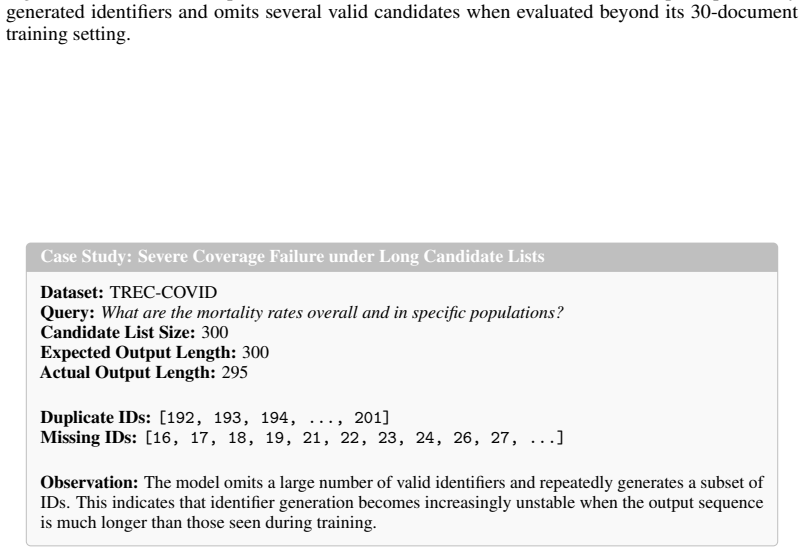
- Reranking performance remains stable when candidate lists grow from 30 to 500 documents after training on short lists.
- End-to-end speedup reaches 4.9x to 9.5x over generation-based listwise reranking.
- An additional 1.3x speedup is obtained relative to the uncompressed CompRank variant.
- The approach supports scalable LLM reranking for retrieval pipelines that must handle long candidate sets.
Reading between the lines
- Precomputed document states could be reused across many different queries without recompression.
- The same compression pattern might reduce cost in other attention-heavy LLM tasks that exhibit ranking-like sparsity.
- Integration with existing retrieval indexes could allow token budgets to be allocated dynamically per query-document pair.
Editorial analysis
A structured set of objections, weighed in public.
Referee Report
Summary. The paper proposes CompRank, a token-efficient LLM reranking framework that decouples document representations from query context and candidate order, applies segment-wise token compression, and uses a CopyNet-style objective for decoding-free attention-based scoring. It reports that on seven BEIR datasets, CompRank retains only 10.2% of document tokens while achieving an average NDCG@10 of 39.2 compared to 39.7 for full-token attention, along with scaling stability up to 500-document lists and speedups of 4.9×–9.5× over generation-based rerankers.
Significance. If the results hold under more detailed validation, the work offers a concrete path to scalable LLM reranking by exploiting sparsity in ranking signals, with reusable states and compression enabling efficiency gains without substantial performance loss. The multi-dataset evaluation and scaling tests on TREC-COVID provide initial evidence of practical utility in retrieval pipelines.
major comments (2)
- [Experiments] Experiments section (implied by abstract results): the central performance claim of comparable NDCG@10 (39.2 vs 39.7) at 10.2% token retention is reported only as an average across seven BEIR datasets with no per-dataset scores, standard deviations, or statistical significance tests, which is load-bearing for assessing whether the compression truly preserves ranking signals consistently.
- [Method] Method description (abstract and implied §3): the segment-wise compression and CopyNet-style objective are presented as aligning with sparse ranking signals, but no ablation results or analysis of signal preservation (e.g., impact of compression parameters on query-document interactions) are referenced, leaving the weakest assumption untested in the reported evidence.
minor comments (1)
- [Abstract] The abstract mentions 'approximately 1.3× speedup over the full-token CompRank variant' but does not clarify if this variant is an internal ablation or external baseline.
Simulated Author's Rebuttal
We thank the referee for the constructive feedback. We address each major comment below and will revise the manuscript to provide the requested experimental details and analyses.
read point-by-point responses
-
Referee: [Experiments] Experiments section (implied by abstract results): the central performance claim of comparable NDCG@10 (39.2 vs 39.7) at 10.2% token retention is reported only as an average across seven BEIR datasets with no per-dataset scores, standard deviations, or statistical significance tests, which is load-bearing for assessing whether the compression truly preserves ranking signals consistently.
Authors: We agree that per-dataset breakdowns, standard deviations, and statistical tests are important for validating consistency. In the revised manuscript we will add a table reporting NDCG@10 for each of the seven BEIR datasets individually (for both CompRank and the full-token baseline), include standard deviations across runs where available, and report paired statistical significance tests confirming that the observed differences are not significant. revision: yes
-
Referee: [Method] Method description (abstract and implied §3): the segment-wise compression and CopyNet-style objective are presented as aligning with sparse ranking signals, but no ablation results or analysis of signal preservation (e.g., impact of compression parameters on query-document interactions) are referenced, leaving the weakest assumption untested in the reported evidence.
Authors: We acknowledge that explicit ablations would strengthen the claims. We will add an ablation study in the experiments section that varies compression parameters (segment size and retention ratio) and measures their effect on both end-to-end NDCG@10 and on the preservation of query-document attention patterns, thereby directly testing the signal-preservation assumption underlying the segment-wise compression and CopyNet-style objective. revision: yes
Circularity Check
No significant circularity identified
full rationale
The paper presents CompRank as an empirical framework for token-efficient LLM reranking via segment-wise compression and a CopyNet-style objective, with all load-bearing claims consisting of direct performance measurements on seven public BEIR datasets (NDCG@10 of 39.2 at 10.2% retention vs. 39.7 full-token). No equations, derivations, or uniqueness theorems are invoked that reduce results to self-definitions, fitted inputs renamed as predictions, or self-citation chains. The method is externally benchmarked against full-token attention and generation-based rerankers on standard datasets, rendering the evaluation chain self-contained.
Assumptions & free parameters
free parameters (1)
- segment compression parameters
assumptions (2)
- domain assumption LLM attention patterns can serve as direct document scores after targeted training
- domain assumption BEIR datasets are representative benchmarks for reranking quality
Cite this review
Pith. "Pith review of CompRank: Efficient LLM Reranking via Token-Level Compression and Decoding-Free Scoring." pith.science (2026). https://pith.science/paper/7C2ZIFBY
@misc{pith2026260611700,
  author       = {Pith},
  title        = {Pith review of: CompRank: Efficient LLM Reranking via Token-Level Compression and Decoding-Free Scoring},
  year         = {2026},
  howpublished = {\url{https://pith.science/paper/7C2ZIFBY}},
  note         = {Machine review of arXiv:2606.11700}
}
abstract
Large language model (LLM) rerankers have become an important component of modern retrieval and retrieval-augmented generation pipelines, but their high computational cost limits their applicability to long candidate lists. In this paper, we propose \textbf{CompRank}, a token-efficient reranking framework that reduces redundant computation by aligning reranker design with the sparsity of ranking signals. CompRank decouples document representations from candidate order and query context, enabling reusable document-side states; applies segment-wise token compression to reduce query--document interaction cost; and introduces a CopyNet-style objective that directly aligns attention-based document scoring with training supervision. Experiments on seven BEIR datasets show that CompRank achieves strong reranking performance while retaining only 10.2\% of document tokens, reaching an average NDCG@10 of 39.2 compared with 39.7 under full-token attention. Further scaling experiments on TREC-COVID show that CompRank remains stable when evaluated on candidate lists of up to 500 documents after training on 30-document lists, while achieving $4.9\times$--$9.5\times$ end-to-end speedup over generation-based listwise reranking and approximately $1.3\times$ speedup over the full-token CompRank variant. These results suggest that token-level compression and decoding-free attention scoring provide an effective path toward scalable LLM-based reranking.
Figures


Figures from the paper (7 more)


Reference graph
Works this paper leans on
-
[1]
Hyperrag: Enhancing quality-efficiency tradeoffs in retrieval-augmented generation with reranker kv-cache reuse, 2025
Yuwei An, Yihua Cheng, Seo Jin Park, and Junchen Jiang. Hyperrag: Enhancing quality-efficiency tradeoffs in retrieval-augmented generation with reranker kv-cache reuse, 2025
2025
-
[2]
Peters, and Arman Cohan
Iz Beltagy, Matthew E. Peters, and Arman Cohan. Longformer: The long-document transformer, 2020
2020
-
[3]
Attention in large language models yields efficient zero-shot re-rankers
Shijie Chen, Bernal Jimenez Gutierrez, and Yu Su. Attention in large language models yields efficient zero-shot re-rankers. InThe Thirteenth International Conference on Learning Representations, 2025
2025
-
[4]
Deepseek-v3.2-exp: Boosting long-context efficiency with deepseek sparse attention, 2025
DeepSeek-AI. Deepseek-v3.2-exp: Boosting long-context efficiency with deepseek sparse attention, 2025
2025
-
[5]
Deepseek-v4: Towards highly efficient million-token context intelligence, 2026
DeepSeek-AI. Deepseek-v4: Towards highly efficient million-token context intelligence, 2026
2026
-
[6]
Reranking with compressed document representation, 2025
Hervé Déjean and Stéphane Clinchant. Reranking with compressed document representation, 2025
2025
-
[7]
minireranker: Efficient multimodal reranking through visual cache reuse and interaction sparsity, 2026
Yingqi Fan, Xuan Lu, Anhao Zhao, Junlong Tong, Ping Nie, Kai Zou, Yunpu Ma, Wei Zhang, and Xiaoyu Shen. minireranker: Efficient multimodal reranking through visual cache reuse and interaction sparsity, 2026
2026
-
[8]
Jiatao Gu, Zhengdong Lu, Hang Li, and Victor O.K. Li. Incorporating copying mechanism in sequence-to- sequence learning. In Katrin Erk and Noah A. Smith, editors,Proceedings of the 54th Annual Meeting of the Association for Computational Linguistics (Volume 1: Long Papers), pages 1631–1640, Berlin, Germany, August 2016. Association for Computational Linguistics
2016
Show all 37 references
-
[9]
Nilesh Gupta, Chong You, Srinadh Bhojanapalli, Sanjiv Kumar, Inderjit S Dhillon, and Felix X. Yu. Scalable in-context ranking with generative models. InThe Thirty-ninth Annual Conference on Neural Information Processing Systems, 2025
2025
-
[10]
Mmeb-v3: Measuring the performance gaps of omni-modality embedding models
Haohang Huang, Xuan Lu, Mingyi Su, Xuan Zhang, Ziyan Jiang, Ping Nie, Kai Zou, Tomas Pfister, Wenhu Chen, Wei Zhang, et al. Mmeb-v3: Measuring the performance gaps of omni-modality embedding models. arXiv preprint arXiv:2604.23321, 2026
2026 arXiv
-
[11]
Retrieval-augmented generation for knowledge- intensive nlp tasks.Advances in neural information processing systems, 33:9459–9474, 2020
Patrick Lewis, Ethan Perez, Aleksandra Piktus, Fabio Petroni, Vladimir Karpukhin, Naman Goyal, Heinrich Küttler, Mike Lewis, Wen-tau Yih, Tim Rocktäschel, et al. Retrieval-augmented generation for knowledge- intensive nlp tasks.Advances in neural information processing systems...
2020
-
[12]
Efficient long-document reranking via block-level embeddings and top-k interaction refinement, 2026
Minghan Li, Eric Gaussier, and Guodong Zhou. Efficient long-document reranking via block-level embeddings and top-k interaction refinement, 2026
2026
-
[13]
Leveraging passage embeddings for efficient listwise reranking with large language models
Qi Liu, Bo Wang, Nan Wang, and Jiaxin Mao. Leveraging passage embeddings for efficient listwise reranking with large language models. InProceedings of the ACM on Web Conference 2025, pages 4274–4283, 2025
2025
-
[14]
Rethinking reasoning in document ranking: Why chain-of-thought falls short
Xuan Lu, Haohang Huang, Rui Meng, Yaohui Jin, Wenjun Zeng, and Xiaoyu Shen. Rethinking reasoning in document ranking: Why chain-of-thought falls short. InThe Fourteenth International Conference on Learning Representations, 2026
2026
-
[15]
Tools are under- documented: Simple document expansion boosts tool retrieval
Xuan Lu, Haohang Huang, Rui Meng, Yaohui Jin, Wenjun Zeng, and Xiaoyu Shen. Tools are under- documented: Simple document expansion boosts tool retrieval. InThe Fourteenth International Conference on Learning Representations, 2026
2026
-
[16]
Beyond global similarity: Multi-conditional retrieval for fine-grained cross-modal understanding
Xuan Lu, Kangle Li, Haohang Huang, Rui Meng, Wenjun Zeng, and Xiaoyu Shen. Beyond global similarity: Multi-conditional retrieval for fine-grained cross-modal understanding. InProceedings of the IEEE/CVF Conference on Computer Vision and Pattern Recognition, pages 9699–9709, 2026
2026
-
[17]
MultiConIR: Towards multi-condition information retrieval
Xuan Lu, Sifan Liu, Bochao Yin, Yongqi Li, Xinghao Chen, Hui Su, Yaohui Jin, Wenjun Zeng, and Xiaoyu Shen. MultiConIR: Towards multi-condition information retrieval. In Christos Christodoulopoulos, Tanmoy Chakraborty, Carolyn Rose, and Violet Peng, editors,Findings of the Asso...
2025
-
[18]
Fine-tuning llama for multi-stage text retrieval
Xueguang Ma, Liang Wang, Nan Yang, Furu Wei, and Jimmy Lin. Fine-tuning llama for multi-stage text retrieval. InProceedings of the 47th International ACM SIGIR Conference on Research and Development in Information Retrieval, pages 2421–2425, 2024
2024
-
[19]
Multi-stage document ranking with bert, 2019
Rodrigo Nogueira, Wei Yang, Kyunghyun Cho, and Jimmy Lin. Multi-stage document ranking with bert, 2019. 10
2019
-
[20]
Document ranking with a pretrained sequence-to-sequence model
Rodrigo Frassetto Nogueira, Zhiying Jiang, Ronak Pradeep, and Jimmy Lin. Document ranking with a pretrained sequence-to-sequence model. InEMNLP (Findings), 2020
2020
-
[21]
Rankvicuna: Zero-shot listwise document reranking with open-source large language models, 2023
Ronak Pradeep, Sahel Sharifymoghaddam, and Jimmy Lin. Rankvicuna: Zero-shot listwise document reranking with open-source large language models, 2023
2023
-
[22]
Rankzephyr: Effective and robust zero-shot listwise reranking is a breeze!, 2023
Ronak Pradeep, Sahel Sharifymoghaddam, and Jimmy Lin. Rankzephyr: Effective and robust zero-shot listwise reranking is a breeze!, 2023
2023
-
[23]
Large language models are effective text rankers with pairwise ranking prompting
Zhen Qin, Rolf Jagerman, Kai Hui, Honglei Zhuang, Junru Wu, Le Yan, Jiaming Shen, Tianqi Liu, Jialu Liu, Donald Metzler, Xuanhui Wang, and Michael Bendersky. Large language models are effective text rankers with pairwise ranking prompting. In Kevin Duh, Helena Gomez, and Steve...
2024
-
[24]
First: Faster improved listwise reranking with single token decoding
Revanth Gangi Reddy, JaeHyeok Doo, Yifei Xu, Md Arafat Sultan, Deevya Swain, Avirup Sil, and Heng Ji. First: Faster improved listwise reranking with single token decoding. InProceedings of the 2024 Conference on Empirical Methods in Natural Language Processing, pages 8642–8652, 2024
2024
-
[25]
Rankllm: A python package for reranking with llms
Sahel Sharifymoghaddam, Ronak Pradeep, Andre Slavescu, Ryan Nguyen, Andrew Xu, Zijian Chen, Yilin Zhang, Yidi Chen, Jasper Xian, and Jimmy Lin. Rankllm: A python package for reranking with llms. InProceedings of the 48th International ACM SIGIR Conference on Research and Devel...
2025
-
[26]
Is chatgpt good at search? investigating large language models as re-ranking agents
Weiwei Sun, Lingyong Yan, Xinyu Ma, Shuaiqiang Wang, Pengjie Ren, Zhumin Chen, Dawei Yin, and Zhaochun Ren. Is chatgpt good at search? investigating large language models as re-ranking agents. InProceedings of the 2023 Conference on Empirical Methods in Natural Language Proces...
2023
-
[27]
Is chatgpt good at search? investigating large language models as re-ranking agents, 2024
Weiwei Sun, Lingyong Yan, Xinyu Ma, Shuaiqiang Wang, Pengjie Ren, Zhumin Chen, Dawei Yin, and Zhaochun Ren. Is chatgpt good at search? investigating large language models as re-ranking agents, 2024
2024
-
[28]
BEIR: A het- erogeneous benchmark for zero-shot evaluation of information retrieval models
Nandan Thakur, Nils Reimers, Andreas Rücklé, Abhishek Srivastava, and Iryna Gurevych. BEIR: A het- erogeneous benchmark for zero-shot evaluation of information retrieval models. InThirty-fifth Conference on Neural Information Processing Systems Datasets and Benchmarks Track (R...
2021
-
[29]
Contrastive retrieval heads improve attention-based re-ranking, 2026
Linh Tran, Yulong Li, Radu Florian, and Wei Sun. Contrastive retrieval heads improve attention-based re-ranking, 2026
2026
-
[30]
Headrank: Decoding-free passage reranking via preference-aligned attention heads, 2026
Juyuan Wang, Chenxing Wang, Yuchen Fang, Huiyun Hu, Junwu Du, Aolin Li, Haijun Wu, Jin Xu, Ligang Liu, and Dongliang Liao. Headrank: Decoding-free passage reranking via preference-aligned attention heads, 2026
2026
-
[31]
When should queries be decomposed? a stage-aware study of query decomposition for multi-condition retrieval, 2026
Bochao Yin, Xuan Lu, Zhengyu Qi, and Xiaoyu Shen. When should queries be decomposed? a stage-aware study of query decomposition for multi-condition retrieval, 2026
2026
-
[32]
Big bird: Transformers for longer sequences
Manzil Zaheer, Guru Guruganesh, Kumar Avinava Dubey, Joshua Ainslie, Chris Alberti, Santiago Ontanon, Philip Pham, Anirudh Ravula, Qifan Wang, Li Yang, et al. Big bird: Transformers for longer sequences. Advances in neural information processing systems, 33:17283–17297, 2020
2020
-
[33]
Query-focused retrieval heads improve long-context reasoning and re-ranking
Wuwei Zhang, Fangcong Yin, Howard Yen, Danqi Chen, and Xi Ye. Query-focused retrieval heads improve long-context reasoning and re-ranking. In Christos Christodoulopoulos, Tanmoy Chakraborty, Carolyn Rose, and Violet Peng, editors,Proceedings of the 2025 Conference on Empirical...
2025
-
[34]
Compress-then-rank: Faster and better listwise reranking with large language models via ranking-aware passage compression
Zhewei Zhi, Yingyi Zhang, Yizhen Jing, Xianneng Li, Jianing Liu, Huajie Liu, and Yongliang Ding. Compress-then-rank: Faster and better listwise reranking with large language models via ranking-aware passage compression. 2026
2026
-
[35]
Lon- granker: Efficient one-pass document reranking with long-context large language models
Changjiang Zhou, Ruqing Zhang, Jiafeng Guo, Maarten de Rijke, Fan Yixing, and Xueqi Cheng. Lon- granker: Efficient one-pass document reranking with long-context large language models. InProceedings of the ACM Web Conference 2026, pages 2004–2013, 2026
2026
-
[36]
A setwise approach for effective and highly efficient zero-shot ranking with large language models
Shengyao Zhuang, Honglei Zhuang, Bevan Koopman, and Guido Zuccon. A setwise approach for effective and highly efficient zero-shot ranking with large language models. InProceedings of the 47th International ACM SIGIR Conference on Research and Development in Information Retriev...
2024
-
[37]
[n] {passage_n} Search Query: {query}
{passage_1} [2] {passage_2} ... [n] {passage_n} Search Query: {query}. Rank the {n} passages above based on their relevance to the search query. All the passages should be included and listed using identifiers, in descending order of relevance. The output format should be []>[...
Reviewed June 27, 2026 · model on record in the stance chip above.
Discussion (0). Sign in to comment.