A Cancellation Mechanism in AFDM Radar Sensing: Exact Fisher Information and Delay-Doppler Decoupling
Pith reviewed 2026-06-28 04:33 UTC · model grok-4.3
The pith
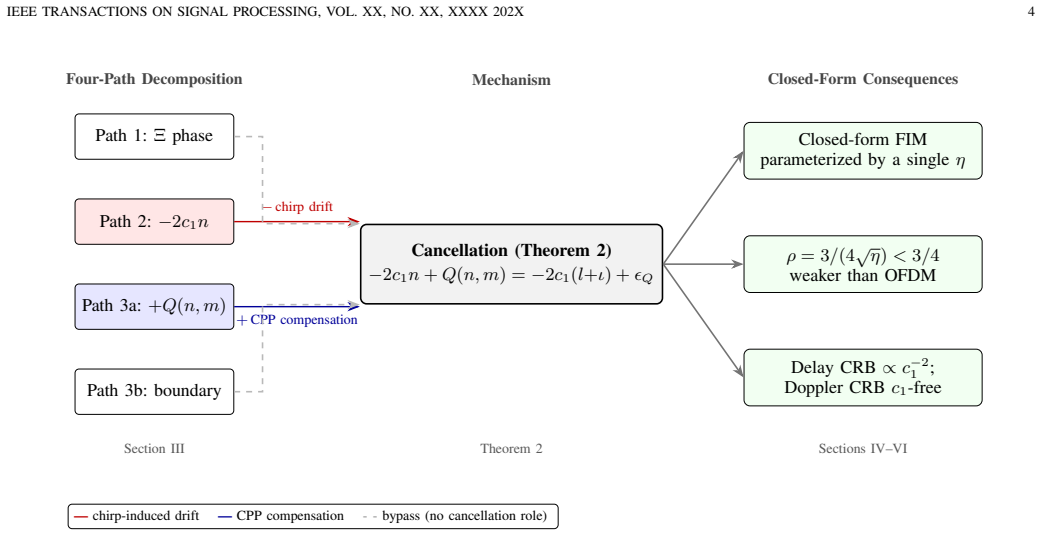
A cancellation between chirp modulation and prefix correction yields exact closed-form Fisher information for AFDM radar delay-Doppler estimation.
A machine-rendered reading of the paper's core claim, the machinery that carries it, and where it could break.
Core claim
The chirp-periodic prefix compensates the frequency drift introduced by the chirp modulation exactly, leaving only a small residual that does not affect the derivation. This cancellation produces an exact closed-form Fisher information matrix depending on the AFDM chirp structure through a single scalar. The matrix yields closed-form Cramér-Rao bounds for joint delay and Doppler estimation. AFDM is provably less delay-Doppler-coupled than OFDM for any nonzero chirp rate. The delay bound improves quadratically with chirp rate while the Doppler bound is unaffected. The framework reduces continuously to the classical OFDM result as the chirp vanishes.
What carries the argument
The exact cancellation between chirp-induced frequency drift and the discrete phase correction inside the chirp-periodic prefix, which isolates a single scalar dependence and enables the closed-form Fisher information matrix.
If this is right
- AFDM provides provably lower delay-Doppler coupling than OFDM for any nonzero chirp rate.
- The Cramér-Rao bound on delay estimation improves quadratically as chirp rate increases.
- The Cramér-Rao bound on Doppler estimation remains independent of chirp rate.
- All derived expressions reduce exactly to the classical OFDM radar sensing results when the chirp rate reaches zero.
Where Pith is reading between the lines
- Designers could tune chirp rate to improve delay accuracy in high-mobility links without trading off Doppler performance.
- The single-scalar dependence may allow rapid analytical comparison of other chirp-based waveforms against OFDM.
- The continuous reduction to OFDM supplies a natural benchmark for validating new integrated sensing-communication waveforms.
Load-bearing premise
The frequency drift introduced by the chirp modulation is exactly compensated by the discrete phase correction in the chirp-periodic prefix, leaving only a small residual that does not affect the closed-form derivation of the Fisher information matrix.
What would settle it
Numerical computation of the Fisher information matrix for a specific nonzero chirp rate that deviates from the derived closed-form scalar expression would falsify the cancellation claim.
Figures
read the original abstract
We consider radar sensing with affine frequency division multiplexing (AFDM), a chirp-based waveform recently proposed for high-mobility integrated sensing and communication. While numerical Cram\'{e}r-Rao bounds for AFDM radar are available in the literature, no closed-form Fisher information analysis has so far revealed how the waveform's chirp structure shapes delay-Doppler estimation accuracy.In this paper, we provide such an analysis. We identify a cancellation in the AFDM likelihood: the frequency drift introduced by the chirp modulation is exactly compensated by a discrete phase correction built into the chirp-periodic prefix, leaving only a small residual. Exploiting this cancellation, we derive an exact closed-form Fisher information matrix that depends on the AFDM chirp structure through a single scalar, and from it we obtain closed-form Cram\'{e}r-Rao bounds for joint delay and Doppler estimation.Three consequences follow. AFDM is provably less delay-Doppler-coupled than OFDM for any nonzero chirp rate. The delay Cram\'{e}r-Rao bound improves quadratically with the chirp rate, while the Doppler bound is unaffected by it. Finally, our framework reduces continuously to the classical OFDM result as the chirp vanishes, certifying it as a strict generalization of OFDM radar sensing theory.Overall, our work shows that the chirp-periodic prefix -- until now studied only as a channel-equalization device -- is the structural element that decouples delay and Doppler in AFDM sensing, and that AFDM's superior sensing performance can be characterized analytically rather than through numerical bounds alone. Numerical experiments at realistic vehicular and low-Earth-orbit parameters validate all closed-form expressions.
Editorial analysis
A structured set of objections, weighed in public.
Referee Report
Summary. The manuscript identifies a cancellation in the AFDM likelihood: frequency drift from chirp modulation is exactly offset by the discrete phase correction in the chirp-periodic prefix, leaving only a small residual. Exploiting this, it derives an exact closed-form Fisher information matrix depending on the AFDM chirp structure through a single scalar. Closed-form Cramér-Rao bounds for joint delay-Doppler estimation follow, establishing that AFDM is provably less delay-Doppler-coupled than OFDM for any nonzero chirp rate, that the delay CRB improves quadratically with chirp rate while the Doppler CRB is unaffected, and that the framework reduces continuously to the classical OFDM result as the chirp rate vanishes. Numerical experiments at vehicular and LEO parameters are used to validate the expressions.
Significance. If the central derivation holds, the work supplies the first closed-form analytical treatment of AFDM radar sensing performance, demonstrating that the chirp-periodic prefix (previously studied only for equalization) is the element enabling delay-Doppler decoupling. It furnishes a strict generalization of OFDM radar theory with continuous reduction and exact expressions rather than numerical bounds. The single-scalar dependence and quadratic improvement in the delay bound are concrete, falsifiable predictions that strengthen the contribution.
major comments (1)
- [Abstract] Abstract: the claim of an 'exact closed-form Fisher information matrix' is made after acknowledging a 'small residual' that remains after the cancellation. The derivation must explicitly show that this residual term contributes zero to the score function (or its derivatives) used to form the FIM; otherwise the result is an approximation whose error scales with chirp rate and SNR. No explicit vanishing argument or bound on the residual's effect on the FIM is referenced in the provided description.
Simulated Author's Rebuttal
We thank the referee for the careful reading and for identifying the need to clarify the treatment of the residual term in the abstract. We address the single major comment below.
read point-by-point responses
-
Referee: [Abstract] Abstract: the claim of an 'exact closed-form Fisher information matrix' is made after acknowledging a 'small residual' that remains after the cancellation. The derivation must explicitly show that this residual term contributes zero to the score function (or its derivatives) used to form the FIM; otherwise the result is an approximation whose error scales with chirp rate and SNR. No explicit vanishing argument or bound on the residual's effect on the FIM is referenced in the provided description.
Authors: We agree that the abstract should reference the vanishing argument for clarity. In Section III-B of the manuscript we derive the post-cancellation log-likelihood and show that the residual term is independent of the delay-Doppler parameter vector; its partial derivatives with respect to these parameters are therefore identically zero and do not enter the score function or the resulting FIM. This establishes exactness rather than approximation. We will revise the abstract to include a concise statement of this independence so that the claim of an exact closed-form FIM is unambiguous. revision: yes
Circularity Check
No circularity detected in derivation chain
full rationale
The paper derives its closed-form Fisher information matrix directly from the AFDM likelihood by exploiting an identified cancellation between chirp-induced frequency drift and the chirp-periodic prefix phase correction. This is a forward mathematical reduction from the waveform model to the FIM expression (depending on a single scalar), with the continuous limit to the OFDM case serving as an external consistency verification rather than an input. No self-definitional loops, fitted inputs renamed as predictions, load-bearing self-citations, uniqueness theorems imported from prior author work, or ansatz smuggling appear in the provided text. The derivation chain is self-contained against the signal model.
Axiom & Free-Parameter Ledger
axioms (2)
- standard math Fisher information matrix for a complex Gaussian observation model is given by the standard formula involving the derivative of the mean with respect to the parameters.
- domain assumption The AFDM waveform consists of chirp-modulated symbols with a chirp-periodic prefix whose phase correction exactly offsets the frequency drift except for a small residual.
Reference graph
Works this paper leans on
-
[1]
Integrated sensing and communications: Toward dual-functional wire- less networks for 6G and beyond,
F. Liu, Y . Cui, C. Masouros, J. Xu, T. X. Han, Y . C. Eldar, and S. Buzzi, “Integrated sensing and communications: Toward dual-functional wire- less networks for 6G and beyond,”IEEE J. Sel. Areas Commun., vol. 40, no. 6, pp. 1728–1767, Jun. 2022
2022
-
[2]
A survey on fundamental limits of integrated sensing and communication,
A. Liu, Z. Huang, M. Li, Y . Wan, W. Li, T. X. Han, C. Liu, R. Du, D. K. P. Tan, J. Lu, Y . Shen, F. Colone, and K. Chetty, “A survey on fundamental limits of integrated sensing and communication,”IEEE Commun. Surveys Tuts., vol. 24, no. 2, pp. 994–1034, 2nd Quart. 2022
2022
-
[3]
Waveform design and signal processing aspects for fusion of wireless communications and radar sensing,
C. Sturm and W. Wiesbeck, “Waveform design and signal processing aspects for fusion of wireless communications and radar sensing,”Proc. IEEE, vol. 99, no. 7, pp. 1236–1259, Jul. 2011
2011
-
[4]
On the effec- tiveness of OTFS for joint radar parameter estimation and communica- tion,
L. Gaudio, M. Kobayashi, G. Caire, and G. Colavolpe, “On the effec- tiveness of OTFS for joint radar parameter estimation and communica- tion,”IEEE Trans. Wireless Commun., vol. 19, no. 9, pp. 5951–5965, Sep. 2020
2020
-
[5]
Limited feedforward waveform design for OFDM dual-functional radar-communications,
M. F. Keskin, V . Koivunen, and H. Wymeersch, “Limited feedforward waveform design for OFDM dual-functional radar-communications,” IEEE Trans. Signal Process., vol. 69, pp. 2955–2970, 2021
2021
-
[6]
Orthogonal time frequency space (OTFS) modulation based radar system,
P. Raviteja, K. T. Phan, Y . Hong, and E. Viterbo, “Orthogonal time frequency space (OTFS) modulation based radar system,” inProc. IEEE Radar Conf. (RadarConf), Apr. 2019, pp. 1–6
2019
-
[7]
From orthogonal time-frequency space to affine frequency-division multiplexing: A comparative study of next- generation waveforms for ISAC in doubly dispersive channels,
H. S. Rou, G. T. F. de Abreu, J. Choi, D. Gonz ´alez G., M. Kountouris, Y . L. Guan, and L. G. P. Gonsa, “From orthogonal time-frequency space to affine frequency-division multiplexing: A comparative study of next- generation waveforms for ISAC in doubly dispersive channels,”IEEE Signal Process. Mag., vol. 41, no. 5, pp. 71–86, Sep. 2024
2024
-
[8]
AFDM: A full diversity next generation waveform for high mobility communications,
A. Bemani, N. Ksairi, and M. Kountouris, “AFDM: A full diversity next generation waveform for high mobility communications,” inProc. IEEE Int. Conf. Commun. Workshops (ICC Workshops), Jun. 2021, pp. 1–6
2021
-
[9]
Affine frequency division multiplexing for next generation wireless communications,
A. Bemani, N. Ksairi, and M. Kountouris, “Affine frequency division multiplexing for next generation wireless communications,”IEEE Trans. Wireless Commun., vol. 22, no. 11, pp. 8214–8229, Nov. 2023
2023
-
[10]
Low complexity equalization for AFDM in doubly dispersive channels,
A. Bemani, N. Ksairi, and M. Kountouris, “Low complexity equalization for AFDM in doubly dispersive channels,” inProc. IEEE Int. Conf. Acoust., Speech Signal Process. (ICASSP), May 2022, pp. 5273–5277
2022
-
[11]
An AFDM-based integrated sensing and communications,
Z. Ni, J. Wang, W. Yuan, and J. Zhang, “An AFDM-based integrated sensing and communications,” inProc. IEEE Global Commun. Conf. (GLOBECOM), Dec. 2022, pp. 3537–3542
2022
-
[12]
Integrated sensing and communications with affine frequency division multiplexing,
A. Bemani and M. Kountouris, “Integrated sensing and communications with affine frequency division multiplexing,”IEEE Wireless Commun. Lett., vol. 13, no. 5, pp. 1255–1259, May 2024
2024
-
[13]
Joint channel, data, and radar parameter estimation for AFDM systems in doubly-dispersive channels,
K. R. R. Ranasinghe, H. S. Rou, G. T. F. de Abreu, D. Gonz ´alez G., and R. Valenta, “Joint channel, data, and radar parameter estimation for AFDM systems in doubly-dispersive channels,”IEEE Trans. Wireless Commun., vol. 24, no. 2, pp. 1602–1619, Feb. 2025
2025
-
[14]
AFDM-enabled integrated sensing and communication: Theoretical framework and pilot design,
J. Zhang, J. Wang, Y . Mao, B. Jiao, Y . Zhuo, M. Wen, W. Xiang, Z. Chen, and G. K. Karagiannidis, “AFDM-enabled integrated sensing and communication: Theoretical framework and pilot design,” arXiv preprint arXiv:2502.14203, Feb. 2025
-
[15]
C. E. Cook and M. Bernfeld,Radar Signals: An Introduction to Theory and Application. New York, NY , USA: Academic Press, 1967
1967
-
[16]
M. A. Richards,Fundamentals of Radar Signal Processing, 2nd ed. New York, NY , USA: McGraw-Hill, 2014
2014
-
[17]
S. M. Kay,Fundamentals of Statistical Signal Processing, Volume I: Estimation Theory. Englewood Cliffs, NJ, USA: Prentice-Hall, 1993
1993
-
[18]
H. L. Van Trees,Optimum Array Processing: Part IV of Detection, Estimation, and Modulation Theory. New York, NY , USA: Wiley- Interscience, 2002
2002
-
[19]
AFDM-based ISAC system design: Unified chirp parameter optimization,
Authors, “AFDM-based ISAC system design: Unified chirp parameter optimization,” to be published
-
[20]
High-mobility sensing advantages of AFDM: Equivalent de- lay domain information extraction and estimation framework,
Authors, “High-mobility sensing advantages of AFDM: Equivalent de- lay domain information extraction and estimation framework,” to be published
discussion (0)
Sign in with ORCID, Apple, or X to comment. Anyone can read and Pith papers without signing in.