REVIEW 3 major objections 6 minor 50 references
A two-dimensional analytical model of vertical water entry for asymmetric bodies with flow separation
T0 review · 3 major / 6 minor · reviewed 2026-08-14 · deepseek-v4-flash
Pith's one-line read A two-dimensional analytical model with fictitious flat-plate continuations gives reliable slamming-load estimates for asymmetric water entry, including after flow separation.
desk verdict A solid, honest extension of the FBC model to asymmetric water entry with useful benchmarks; the pre-calibrated continuation angles are the main caveat, but the paper flags them itself. read the letter →
The pith
A machine-rendered reading of the paper's core claim, the machinery that carries it, and where it could break.
The reading
What carries the argument
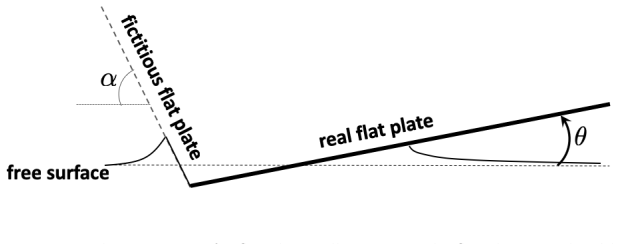
The central device is the Fictitious Body Continuation: after flow separates, the real contour is extended by flat fictitious plates so that Wagner's flat-plate solution can still be applied to the composite body, with the separated cavity flow represented by those plates. The pressure is then evaluated with the Modified Logvinovich Model, which uses the exact Bernoulli equation along the body contour and removes negative-pressure regions near the contact points, and the load is integrated only over the real part. The continuation angles $\alpha_1$ and $\alpha_2$ are the parameters that carry the model's predictive power: they set where and at what slope the fictitious plates attach, hence when separation occurs and how fast the cavity widens. A modified added-mass term with min operators interpolates between the two separation heights, which is what lets the model survive the asymmetric phase when only one side has separated.
What would settle it
Run the FBC model with the standard angles, $60^\circ$ at a smooth separation and $47^\circ$ at a chine, against CFD or experiment for an asymmetric body outside the calibration family, for example a wedge or foil at an inclination beyond the tested $-30^\circ$ to $20^\circ$ range, and check whether force and moment stay within about 10%; a single clear miss would refute the generic-angle claim. Alternatively, measure the initial cavity opening angle in a water-entry experiment and compare it with the fictitious plate angle.
Extended reading notes
Core claim
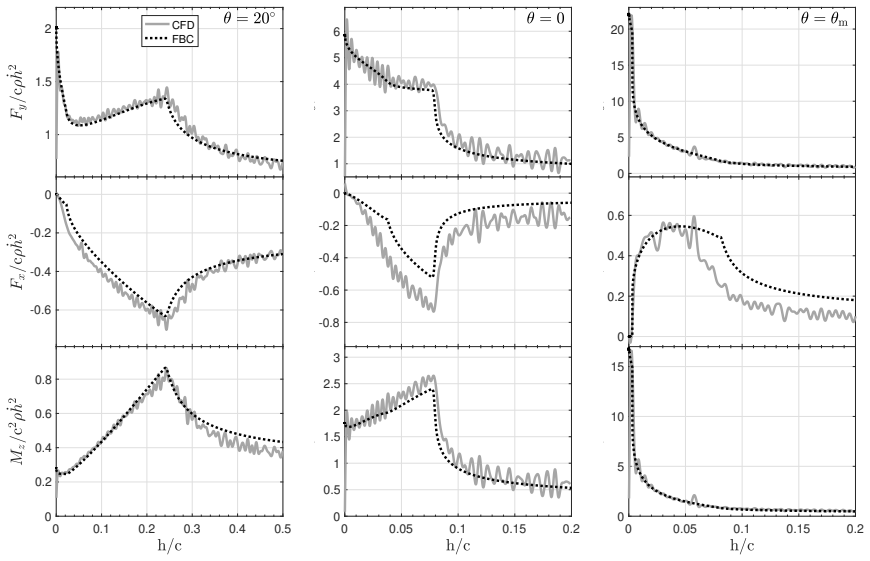
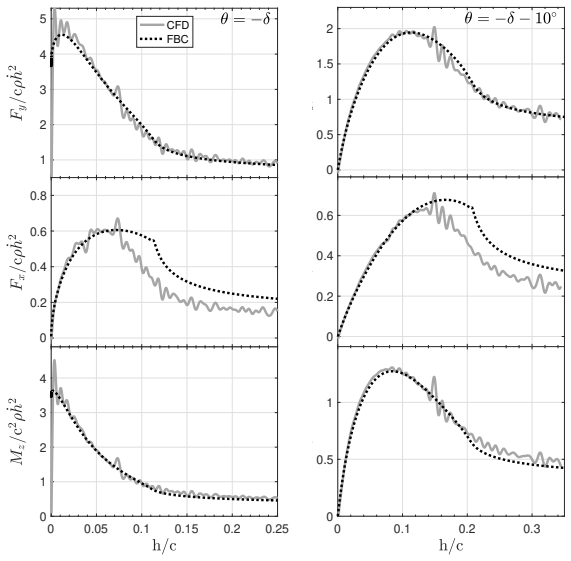
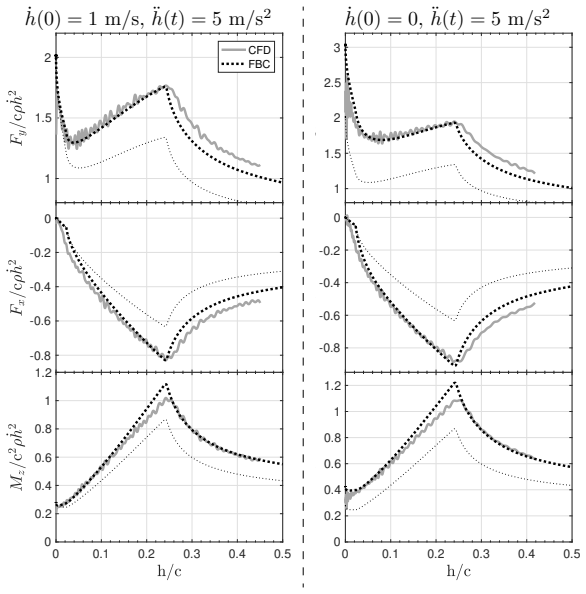
On its own terms, the paper's discovery is that a single pair of continuation angles can represent separated cavity flow for asymmetric bodies: $\alpha=60^\circ$ at a smooth leading edge, the value calibrated for a circular cylinder, and $\alpha=47^\circ$ at a chine, the value calibrated for a flat plate. With those fixed values, the FBC model reproduces the CFD-computed vertical slamming force $F_y$ and moment $M_z$ on a 28%-thick foil for initial inclinations from $\theta=-28.1^\circ$ to $\theta=20^\circ$, and captures the order of separation events. In the intermediate phase when separation has occurred on only one side, the model still works because the added-mass term is modified to interpolate between the two separation heights; the loads during this phase are set by the competition between the local pressure drop and continued wetted-area growth. The horizontal force estimate is less accurate, but its magnitude is small for moderate deadrise angles, so the practical load picture remains reliable.
Load-bearing premise
The model's usefulness depends on the a-priori choice of the two continuation angles, inherited from a cylinder and a flat plate; if those angles are not generic across body shapes and inclinations, the claimed reliability collapses.
Editorial extensions
If this is right
- Slamming loads on asymmetric sections can be estimated analytically in near-real time, making FBC a practical screening tool before detailed CFD.
- Two pre-calibrated continuation angles, one for smooth-body separation and one for chine separation, transfer across different body shapes without per-case tuning, at least within the tested range of inclinations.
- The model captures separation timing and the vertical force and moment evolutions, including the peak loads reached when trailing-edge separation finally occurs.
- For accelerated entries, the modified added-mass term keeps the added-mass force estimate within about 10% of CFD for the moment peak, so early-stage acceleration loads are also covered.
- Horizontal slamming force is not predicted as reliably; users should treat $F_x$ as indicative only, relying on $F_y$ and $M_z$ for structural load estimates.
Reading between the lines
- If the continuation angles are truly generic, the same two-angle FBC recipe could be embedded in strip-theory ship-slamming or ditching tools, replacing expensive two-dimensional CFD at each station with a few seconds of algebra.
- The fact that calibrated angles cluster near $47^\circ$--$60^\circ$ across very different shapes suggests they may encode a property of the separated jet itself rather than of the body; measuring the initial cavity-opening angle in experiments across shapes would test that interpretation.
- The model's known weakness in $F_x$ points at the jet-root region, where nonlinearity is strongest; a local correction for the jet-root pressure distribution could improve the horizontal load without changing the FBC structure.
- One testable extension is to vary the entry velocity over a wider range to check whether the continuation angles depend on impact speed, which the current constant-velocity calibrations leave open.
Signed reviews
Editorial analysis
A structured set of objections, weighed in public.
Referee Report
Summary. The paper extends the Fictitious Body Continuation (FBC) concept to two-dimensional vertical water entry of asymmetric bodies with flow separation. It combines linearised Wagner theory with the Modified Logvinovich Model, introduces a generalised added-mass term (Eq. 18) for non-simultaneous separation on the two sides, and validates the approach against a nonlinear self-similar model for an inclined flat plate (Section 3) and against ABAQUS/Explicit CFD for a NACA 0028 foil at several inclination angles and accelerations (Section 4). The reported agreement is good for the vertical force Fy and moment Mz, while Fx is less accurate; the paper also presents slamming-load maps for foils of different thicknesses (Section 4.4).
Significance. If the central claim is accepted, the FBC model provides a fast, semi-analytical tool for estimating slamming loads on asymmetric bodies with separated flow, a configuration not covered by Tassin et al. (2014). The paper's strengths are its use of external benchmarks (nonlinear model and CFD), its explicit handling of the added-mass term in asymmetric configurations, and its candid discussion of the model's limitations. However, the predictive claim hinges on two continuation angles (alpha1=60°, alpha2=47°) inherited from earlier calibration for a circular cylinder and a flat plate; the paper does not demonstrate sensitivity to these angles or transferability to other body shapes. The validation is limited to one foil shape and a flat-plate benchmark that degrades for theta above about 20°. These issues make the general 'reliable estimates' conclusion premature, although the model appears promising for the specific configurations tested.
major comments (3)
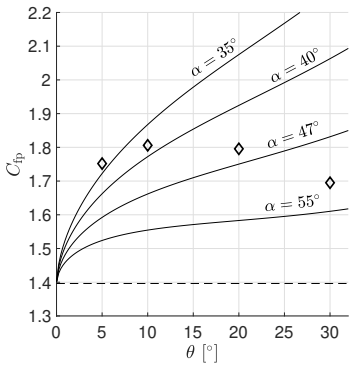
- [Section 5 and Section 3.2] The central claim that the FBC model provides reliable slamming-load estimates for asymmetric bodies rests on the a priori continuation angles alpha1=60° and alpha2=47°, inherited from calibrations for a circular cylinder and a flat plate. Section 5 states that 'the critical point in the model is the choice, a priori, of the continuation angles', and Section 3.2 shows that for an inclined flat plate the agreement with the nonlinear model holds only for theta in [5°, 30°] with alpha=47°, with divergence for theta larger than about 20°. The foil validation uses fixed alpha1 and alpha2 across the whole range of theta, but only one foil shape. Thus the paper demonstrates that the chosen angles work for the tested configurations, not that they are generic; the abstract's claim of reliable estimates is stronger than the evidence supports.
- [Section 4.3.2, Figs. 6-8] No quantitative error metrics are reported; the statements 'agree very well' for Fy and Mz are based on visual inspection of curves. Given that the paper's conclusion is about reliability, the authors should provide a normalized error (e.g., L2 or maximum relative error over the reported penetration range) for Fy, Mz, and Fx, and ideally as a function of the inclination angle. This is especially important because Section 4.3.4 shows that the free surface in the FBC model deviates significantly from CFD once separation occurs, so the good load agreement is not self-evident from the flow solution.
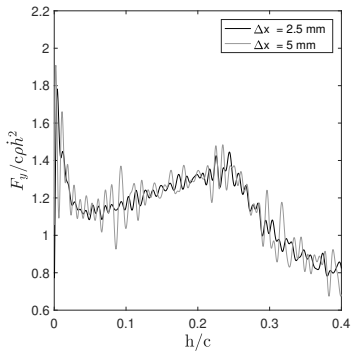
- [Section 4.2, Fig. 5] The mesh-convergence study is presented only for the vertical force Fy at a single inclination (theta=20°). The horizontal force Fx is explicitly identified in Section 4.3.2 as sensitive to the contact region, and the moment Mz and the separation times (Section 4.3.1) are also key outputs. Without a grid-dependence check for these quantities, the CFD reference used for validation is not fully characterised, which weakens the quantitative support for the FBC predictions.
minor comments (6)
- [Eq. (18) and Eq. (28)] The notation min(λ1,l1) and min(λ2,l2) in Eq. (18) is not fully explained; state which side each quantity refers to and specify the integration limits in Eq. (28) in terms of these min-operators.
- [Section 3.2, Eq. (22)] The normalisation Cfp = (tan²θ/h) Fy/(ρ ḣ²) is unusual; the tan²θ factor is introduced 'to limit the range of values' and deserves a brief justification or a reference.
- [Section 4.2] The CFD simulations use a speed of sound of 500 m/s, which is lower than physical water; the artificial compressibility effect is discussed only through Eq. (27). Please quantify the resulting error in the reported load coefficients or cite a previous verification for this parameter choice.
- [Appendix A, Eq. (32)] The factor 1/β in the gravity-neglect criterion is justified by a hand-wavy argument ('the gravity component acting along streamlines'); this could be derived more rigorously or removed.
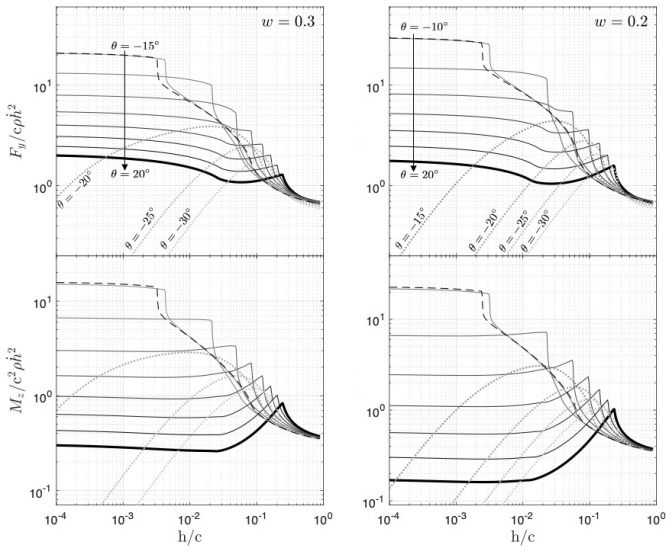
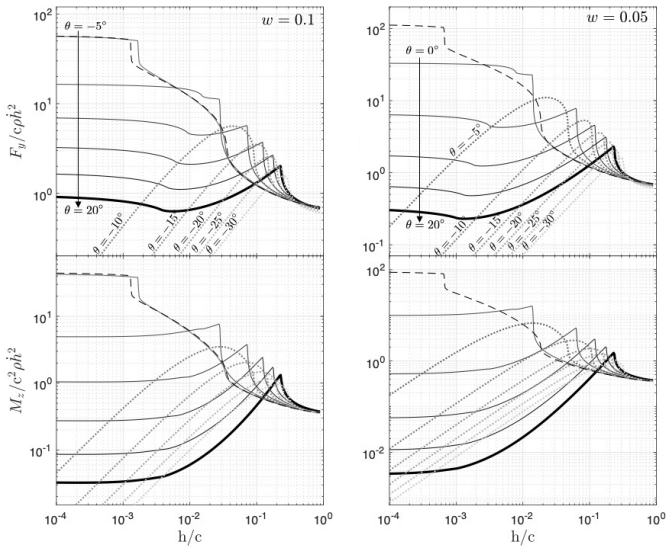
- [Section 4.4] The slamming-load maps for foil thicknesses w=0.05 and w=0.1 are computed with FBC without direct CFD or experimental validation for those cases; the text should state explicitly that these are extrapolations.
- [Fig. 9] The statement that, after separation from both sides, the agreement on loads remains good despite the free-surface deviation is purely qualitative. Adding the integrated pressure difference between FBC and CFD would make the point quantitative.
Circularity Check
No significant circularity: the FBC load predictions are tested against independent nonlinear-model and CFD benchmarks, and the pre-calibrated continuation angles are model parameters, not fitted outputs of this paper.
full rationale
The derivation chain is self-contained once the FBC ansatz is adopted: Wagner's linearized problem (Eqs. 1-10) determines the wetted region, the MLM pressure formula (Eq. 16) supplies the loads, and the FBC extension (Eqs. 17-19) handles separated flow. The continuation angles are fixed in Section 4.1 from prior calibration (alpha1 = 60 deg from Tassin et al. 2014 for a circular cylinder, alpha2 = 47 deg for a flat plate) and are then held constant. The central claim that the FBC model gives reliable slamming loads is not circular because the paper validates it against independent external results: the nonlinear self-similar model of Faltinsen and Semenov for the inclined flat plate (Section 3.2) and ABAQUS/Explicit CFD for the NACA 0028 foil (Section 4.3), including constant-velocity and constant-acceleration cases. No force or moment result in the paper is constructed by fitting to these benchmark outputs; the agreements are genuine comparisons with fixed parameters. The self-citation to Tassin et al. (2014) supplies the FBC concept and calibrated constants, but the present claim is re-tested here against data that are independent of those fitted values, so the citation is not load-bearing in a circular way. The paper's own caveat that the continuation angles are chosen a priori and that comparative studies on other bodies are needed to delimit their genericness (Section 5) is a robustness and transferability limitation, not a circularity. No equation reduces by construction to its inputs, and no fitted parameter is renamed as a prediction.
Assumptions & free parameters
free parameters (2)
- α1 = 60° continuation angle at smooth leading edge (foil) =
60°
- α2 = 47° continuation angle at chine / trailing edge (foil and inclined plate) =
47°
assumptions (6)
- domain assumption Potential flow, inviscid, incompressible, irrotational, with gravity and surface tension neglected.
- domain assumption Small deadrise angles and projection of the body onto a flat plate (Wagner linearization).
- ad hoc to paper Negative MLM pressure regions close to contact points are ignored.
- ad hoc to paper A fictitious flat-plate continuation can mimic the separated cavity flow after flow separation.
- ad hoc to paper The modified added-mass pressure (Eqs. 17-18) with min operators and linear interpolation f̃ is valid after separation.
- domain assumption Separation on a smooth body occurs at the point where the local deadrise angle equals the continuation angle, with a tangential connection.
invented entities (1)
-
Fictitious flat plates continuing the real body beyond separation points
Cite this review
Pith. "Pith review of A two-dimensional analytical model of vertical water entry for asymmetric bodies with flow separation." pith.science (2026). https://pith.science/paper/7C7T2KLV
@misc{pith2026190809201,
  author       = {Pith},
  title        = {Pith review of: A two-dimensional analytical model of vertical water entry for asymmetric bodies with flow separation},
  year         = {2026},
  howpublished = {\url{https://pith.science/paper/7C7T2KLV}},
  note         = {Machine review of arXiv:1908.09201}
}
read the original abstract
The vertical water entry of asymmetric two-dimensional bodies with flow separation is considered. As long as there is no flow separation, linearised Wagner's theory combined with the Modified Logvinovich Model has been shown to provide computationally fast and reliable estimates of slamming loads during water entry. Tassin et al. (2014) introduced the Fictitious Body Continuation (FBC) concept as a way to extend the use of Wagner's model to separated flow configurations, but they only considered symmetric bodies. In the present study, we investigate the ability of the FBC concept to provide accurate estimates of slamming loads for asymmetric bodies. In this case, flow separation may not occur simultaneously on both sides of the body. During an intermediate phase, slamming loads are governed by a competition between the local drop in pressure due to partial flow separation and the ongoing expansion of the wetted area. As a first benchmark for the model, we consider the water entry of an inclined flat plate and compare the FBC estimates with the results of a nonlinear model. Then, we consider the case of a foil and compare the FBC results with Computational Fluid Dynamics predictions. In both cases, we find that the FBC model is able to provide reliable estimates of the slamming loads.
Figures

Figures from the paper (8 more)


Reference graph
Works this paper leans on
-
[1]
H. Wagner, ¨Uber sto- und gleitvorg¨ ange an der oberfl¨ ache von fl¨ ussigkeiten, ZAMM - Journal of Applied Mathematics and Mechanics / Zeitschrift f¨ ur Angewandte Mathematik und Mechanik 12 (4) (1932) 193–215. doi:10. 1002/zamm.19320120402
work page 1932
-
[2]
S. Muzaferija, M. Peric, P. Sames, T. Schellin, A two-fluid navier-stokes solver to simulate water entry, in: Proc, 22nd Symp. Naval Hydrodyn., 1998, pp. 638–651
work page 1998
-
[3]
M. Greenhow, W.-M. Lin, Nonlinear-free surface effects: experiments and theory, Tech. rep., Massachussetts Inst. of Tech. Cambridge Dept. of Ocean Engineering (1983)
work page 1983
- [4]
-
[5]
R. Cointe, Two-dimensional water-solid impact, Journal of Offshore Me- chanics and Arctic Engineering 111 (2) (1989) 109–114. doi:10.1115/1. 3257083
doi:10.1115/1 1989
-
[6]
S. D. Howison, J. R. Ockendon, S. K. Wilson, Incompressible water-entry problems at small deadrise angles, Journal of Fluid Mechanics 222 (1991) 215–230. doi:10.1017/S0022112091001076
-
[7]
Greenhow, Wedge entry into initially calm water, Applied Ocean Re- search 9 (4) (1987) 214 – 223
M. Greenhow, Wedge entry into initially calm water, Applied Ocean Re- search 9 (4) (1987) 214 – 223. doi:10.1016/0141-1187(87)90003-4
-
[8]
T. Tveitnes, A. Fairlie-Clarke, K. Varyani, An experimental investigation into the constant velocity water entry of wedge-shaped sections, Ocean Engineering 35 (14) (2008) 1463 – 1478. doi:10.1016/j.oceaneng.2008. 06.012
Show all 50 references
-
[9]
J. Wang, C. Lugni, O. M. Faltinsen, Experimental and numerical inves- tigation of a freefall wedge vertically entering the water surface, Applied Ocean Research 51 (2015) 181 – 203. doi:10.1016/j.apor.2015.04.003
2015 doi
-
[10]
G. V. Logvinovich, Hydrodynamics of free-boundary flows, Israel Program for Scientific Translations, 1972
1972
-
[11]
Tassin, A
A. Tassin, A. Korobkin, M. Cooker, On analytical models of vertical water entry of a symmetric body with separation and cavity initiation, Applied Ocean Research 48 (2014) 33 – 41. doi:10.1016/j.apor.2014.07.008
2014 doi
-
[12]
W.-Y. Duan, X. Zhu, Y. Ni, S.-J. Yu, Constant velocity water entry of finite wedge section with flow separation, J Ship Mech 17 (8) (2013) 911 [in Chinese]. 25
2013
-
[13]
R. Zhao, O. Faltinsen, J. Aarsnes, Water Entry of Arbitrary Two- Dimensional Sections with and Without Flow Separation, in: Twenty-First Symposium on Naval Hydrodynamics, 1996, pp. 408–423
1996
-
[14]
Iafrati, D
A. Iafrati, D. Battistin, Hydrodynamics of water entry in presence of flow separation from chines, in: Proceedings of the 8th International Conference on Numerical Ship Hydrodynamics, 2003, pp. 22–25
2003
-
[15]
C. Bao, G. Wu, G. Xu, Simulation of water entry of a two-dimension finite wedge with flow detachment, Journal of Fluids and Structures 65 (2016) 44 – 59. doi:https://doi.org/10.1016/j.jfluidstructs.2016.05.010
2016 doi
-
[16]
C. Bao, G. Wu, G. Xu, Simulation of freefall water entry of a finite wedge with flow detachment, Applied Ocean Research 65 (2017) 262 – 278. doi: 10.1016/j.apor.2017.04.014
2017 doi
-
[17]
K. J. Maki, D. Lee, A. W. Troesch, N. Vlahopoulos, Hydroelastic impact of a wedge-shaped body, Ocean Engineering 38 (4) (2011) 621 – 629. doi: 10.1016/j.oceaneng.2010.12.011
2011 doi
-
[18]
D. J. Piro, K. J. Maki, Hydroelastic analysis of bodies that enter and exit water, Journal of Fluids and Structures 37 (2013) 134 – 150. doi: 10.1016/j.jfluidstructs.2012.09.006
2013 doi
-
[19]
H. Gu, L. Qian, D. Causon, C. Mingham, P. Lin, Numerical simulation of water impact of solid bodies with vertical and oblique entries, Ocean Engineering 75 (2014) 128 – 137. doi:10.1016/j.oceaneng.2013.11.021
2014 doi
-
[20]
G. Oger, M. Doring, B. Alessandrini, P. Ferrant, Two-dimensional SPH simulations of wedge water entries, Journal of Computational Physics 213 (2) (2006) 803 – 822. doi:10.1016/j.jcp.2005.09.004
2006 doi
-
[21]
A. M. Worthington, A study of splashes, Longmans, Green, and Company, 1908
1908
-
[22]
C. Duez, C. Ybert, C. Clanet, L. Bocquet, Making a splash with water repellency, Nature Physics 3 (2007) 180–183. doi:10.1038/nphys545
2007 doi
-
[23]
X. Zhu, O. M. Faltinsen, C. Hu, Water entry and exit of a horizontal circular cylinder, Journal of Offshore Mechanics and Arctic Engineering 129 (4) (2006) 253–264. doi:10.1115/1.2199558
2006 doi
-
[24]
H. Sun, O. M. Faltinsen, Water impact of horizontal circular cylinders and cylindrical shells, Applied Ocean Research 28 (5) (2006) 299 – 311. doi:10.1016/j.apor.2007.02.002
2006 doi
-
[25]
Sun, A boundary element method applied to strongly nonlinear wave- body interaction problems, Ph.D
H. Sun, A boundary element method applied to strongly nonlinear wave- body interaction problems, Ph.D. thesis, Norwegian University of Science and Technology (2007). 26
2007
-
[26]
Fairlie-Clarke, T
A. Fairlie-Clarke, T. Tveitnes, Momentum and gravity effects during the constant velocity water entry of wedge-shaped sections, Ocean Engineering 35 (7) (2008) 706–716. doi:10.1016/j.oceaneng.2006.11.011
2008 doi
-
[27]
Malenica, A
S. Malenica, A. Korobkin, J. Tuitman, MLM ROC modified Logvinovich model for 2D sections constant roll angle, Tech. rep., Bureau Veritas (2007)
2007
-
[28]
Korobkin, Analytical models of water impact, European Jour- nal of Applied Mathematics 15 (6) (2004) 821–838
A. Korobkin, Analytical models of water impact, European Jour- nal of Applied Mathematics 15 (6) (2004) 821–838. doi:10.1017/ S0956792504005765
2004
-
[29]
O. M. Faltinsen, Y. A. Semenov, Nonlinear problem of flat-plate entry into an incompressible liquid, Journal of Fluid Mechanics 611 (2008) 151–173. doi:10.1017/S0022112008002735
2008 doi
-
[30]
Y. M. Scolan, E. Coche, T. Coudray, E. Fontaine, Etude analytique et num´ erique de l’impact hydrodynamique sur des car` enes dissym´ etriques, in: 7e Journ´ ees de l’Hydrodynamique, 1999, pp. 151–164 [in French]. URL http://website.ec-nantes.fr/actesjh/images/7JH/Annexe/ S4P2.pdf
1999
-
[31]
Cointe, E
R. Cointe, E. Fontaine, B. Molin, Y. M. Scolan, On energy arguments ap- plied to the hydrodynamic impact force, Journal of Engineering Mathemat- ics 48 (3) (2004) 305–319. doi:10.1023/B:engi.0000018189.83070.78
2004
-
[32]
O. M. Faltinsen, Hydrodynamics of High-Speed Marine Vehicles, Cam- bridge University Press, 2006. doi:10.1017/CBO9780511546068
2006 doi
-
[33]
Cointe, J.-L
R. Cointe, J.-L. Armand, Hydrodynamic impact analysis of a cylinder, Journal of Offshore Mechanics and Arctic Engineering 109 (3) (1987) 237–
1987
-
[34]
R. Zhao, O. Faltinsen, Water entry of two-dimensional bodies, Journal of Fluid Mechanics 246 (1993) 593–612. doi:10.1017/S002211209300028X
1993 doi
-
[35]
Korobkin, Second-order Wagner theory of wave impact, Journal of Engineering Mathematics 58 (1) (2007) 121–139
A. Korobkin, Second-order Wagner theory of wave impact, Journal of Engineering Mathematics 58 (1) (2007) 121–139. doi:10.1007/ s10665-006-9105-7
2007
-
[36]
J. M. Oliver, Second-order Wagner theory for two-dimensional water-entry problems at small deadrise angles, Journal of Fluid Mechanics 572 (2007) 59–85. doi:10.1017/S002211200600276X
2007 doi
-
[37]
Korobkin, S
A. Korobkin, S. Malenica, Modified Logvinovich model for hydrodynamic loads on asymmetric contours entering water, International Workshop on Water Waves and Floating Bodies (2005) 4p
2005
-
[38]
Tassin, N
A. Tassin, N. Jacques, A. Alaoui, A. Nˆ eme, B. Lebl´ e, Assessment and comparison of several analytical models of water impact, The International Journal of Multiphysics 4 (2) (2010) 125 – 140. doi:10.1260/1750-9548. 4.2.125. 27
2010 doi
-
[39]
S. Seng, P. Pedersen, J. Jensen, Slamming and whipping analysis of ships, Ph.D. thesis, DTU Mechanical Engineering (2012)
2012
-
[40]
Reinhard, Free elastic plate impact into water, Ph.D
M. Reinhard, Free elastic plate impact into water, Ph.D. thesis, University of East Anglia (2013)
2013
-
[41]
Iafrati, A
A. Iafrati, A. A. Korobkin, Hydrodynamic loads during early stage of flat plate impact onto water surface, Physics of Fluids 20 (8) (2008) 082104. doi:10.1063/1.2970776
2008 doi
-
[42]
I. H. Abbott, A. E. Von Doenhoff, L. Stivers Jr, Summary of airfoil data, NACA Technical Report 824 (1945) 270p
1945
-
[43]
A. A. Korobkin, V. V. Pukhnachov, Initial stage of water impact, Annual Review of Fluid Mechanics 20 (1) (1988) 159–185. doi:10.1146/annurev. fl.20.010188.001111
1988
-
[44]
Aquelet, M
N. Aquelet, M. Souli, L. Olovsson, Euler-Lagrange coupling with damping effects: Application to slamming problems, Computer Methods in Applied Mechanics and Engineering 195 (1) (2006) 110 – 132. doi:10.1016/j.cma. 2005.01.010
2006 doi
-
[45]
Tassin, N
A. Tassin, N. Jacques, A. E. M. Alaoui, A. Nˆ eme, B. Lebl´ e, Hydrody- namic loads during water impact of three-dimensional solids: Modelling and experiments, Journal of Fluids and Structures 28 (2012) 211 – 231. doi:10.1016/j.jfluidstructs.2011.06.012
2012 doi
-
[46]
A. G. Mackie, Gravity effects in the water entry problem, Journal of the Australian Mathematical Society 5 (4) (1965) 427–433. doi:10.1017/ S1446788700028457
1965
-
[47]
H. J. Zekri, The influence of gravity on fluid-structure impact, Ph.D. thesis, University of East Anglia (2016)
2016
-
[48]
H. Yan, Y. Liu, Nonlinear computation of water impact of axisymmetric bodies, Journal of Ship Research 55 (1) (2011) 29–44. 28
2011
-
[112]
doi:10.1016/S0141-1187(97)00014-X
-
[243]
doi:10.1115/1.3257015
Reviewed August 14, 2026 · model on record in the stance chip above.
Discussion (0). Continue with ORCID to comment.