REVIEW 2 major objections 4 minor 15 references
On algebraic integers all conjugates of which belong to a given compact subset of the complex plane
T0 review · 2 major / 4 minor · reviewed 2026-08-14 · deepseek-v4-flash
Pith's one-line read For finite unions of real intervals, logarithmic capacity above 1 guarantees infinitely many algebraic integers whose conjugates all stay in the set, and capacity below 1 guarantees only finitely many.
desk verdict A clearly written undergraduate exposition of capacity theory and Robinson's theorem, with no new results and one load-bearing reduction whose proof sketch is invalid as written. read the letter →
The pith
A machine-rendered reading of the paper's core claim, the machinery that carries it, and where it could break.
The reading
What carries the argument
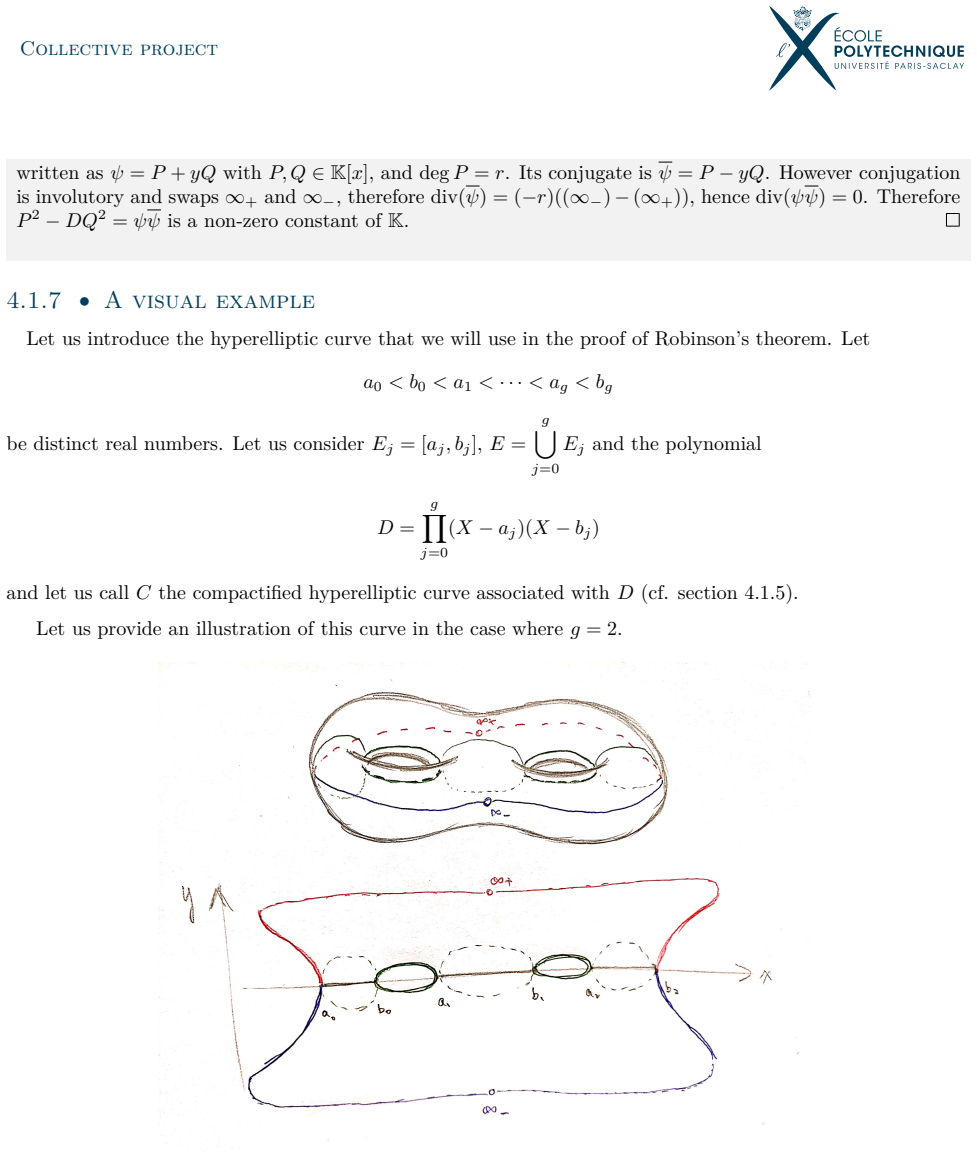
The load-bearing objects are the logarithmic capacity $\operatorname{Cap}(E)$—equivalently the transfinite diameter and the Chebyshev constant—and the hyperelliptic curve $C:y^2=D(x)$ with $D(X)=\prod_{j=0}^g (X-a_j)(X-b_j)$. On $C$, the Pell–Abel equation $P^2-DQ^2=M^2$ is equivalent to the divisor $r((\infty^-)-(\infty^+))$ being principal. The argument uses the unique differential form of the third kind $\eta=R(x)\,dx/y$ whose periods over the gaps $[b_{j-1},a_j]$ vanish; the numbers $r_j=r|\eta_j|/\pi$ control how many roots of $P$ lie in each interval $E_j$, so $P$ equioscillates on $E$. Finally, the perturbation lemma $|q|<M$ on $E$ preserves the $r$ roots of $P-q$ and transfers the construction to monic integer polynomials.
What would settle it
One could test the density step directly in a one-parameter family of interval configurations by computing, on the associated Jacobian variety, whether the torsion points that make $r((\infty^-)-(\infty^+))$ principal occur in every open set of parameters; an open region entirely free of such points would falsify Theorem 4.7 and break the reduction from the Pell–Abel case to the general case.
Extended reading notes
Core claim
The central claim, Theorem 4.3, states that every finite union $E$ of real intervals with $\operatorname{Cap}(E)>1$ contains infinitely many algebraic integers totally in $E$. The proof first assumes a Pell–Abel solution $P^2-DQ^2=M^2$ attached to the polynomial $D(X)=\prod_{j=0}^g (X-a_j)(X-b_j)$; in that case $P$ is the Chebyshev polynomial of $E$, $\operatorname{Cap}(E)=(M/2)^{1/r}$, and the roots of $P$ and $Q$ interlace with $r_j$ roots of $P$ inside each interval $E_j$. Writing $f=P+yQ$, the paper shows $df/f=r\eta$ for the canonical differential form of the third kind, whose periods compute $r_j=r|\eta_j|/\pi$. Raising $f$ to high powers and subtracting a small rational perturbation yields monic integer polynomials with arbitrarily large degree and all roots in $E$, proving the theorem in the solvable case. A density argument then extends the conclusion to all finite unions of intervals with capacity above 1.
Load-bearing premise
The load-bearing assumption is that for purposes of approximation, every union of intervals can be nudged so that the associated Pell–Abel equation $P^2-DQ^2=M^2$ has real polynomial solutions, and the paper gives only a sketch of this density fact, referring to the Bourbaki seminar for details.
Editorial extensions
If this is right
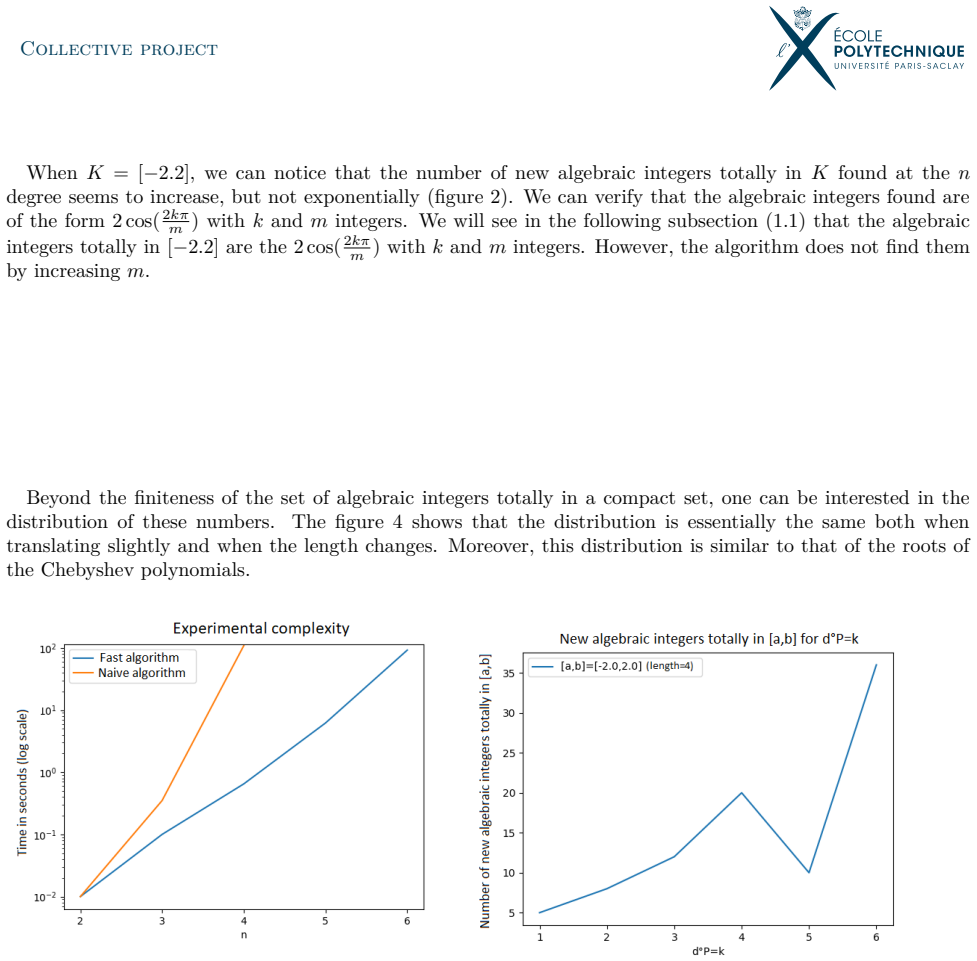
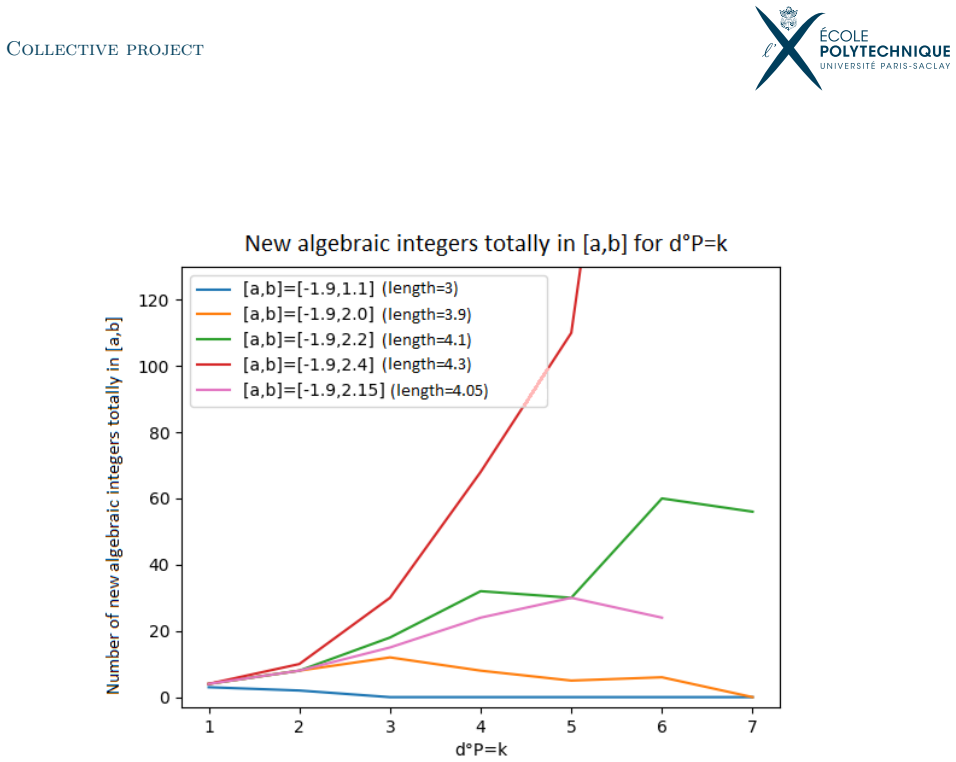
- For a single interval, lengths below 4 yield only finitely many algebraic integers totally in it, lengths above 4 yield infinitely many, and the equality case length 4 is settled only for integer endpoints.
- In the Pell–Abel case the proof is constructive: it produces explicit monic integer polynomials of unbounded degree whose roots all lie in $E$.
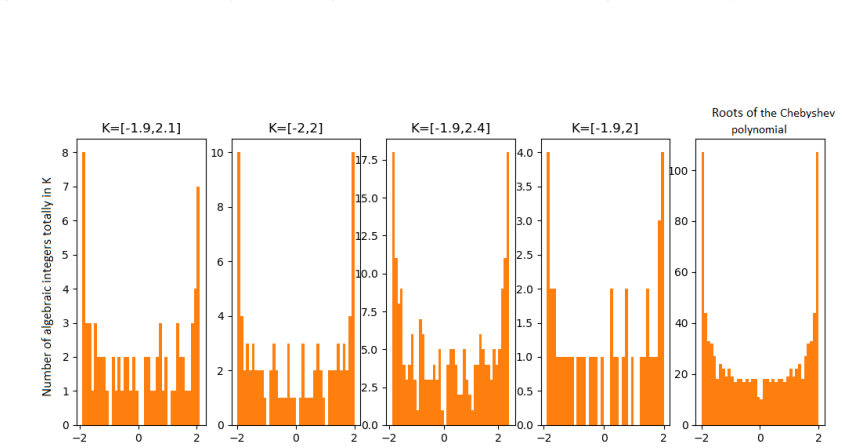
- The equidistribution upgrade, Theorem 4.6, says the roots of the constructed polynomials converge in the weak-* sense to the equilibrium measure of $E$, partially answering the distribution question raised by Frobenius eigenvalues.
- Combined with Fekete's theorem, the result leaves capacity exactly 1 as the only unresolved threshold for unions of real intervals.
Reading between the lines
- The period formula $r_j=r|\eta_j|/\pi$ could be turned into an effective algorithm: compute the periods of the canonical differential form numerically and read off how many roots of the eventual integer polynomial lie in each interval, avoiding exhaustive coefficient search.
- The length-4 case is plausibly sensitive to arithmetic: for integer endpoints the paper exhibits infinitely many numbers of the form $n+2\cos(2k\pi/m)$, while for non-integer endpoints no analogous construction exists, suggesting a rational-versus-irrational divide.
- The open question in the conclusion suggests a stronger equidistribution conjecture: counting measures of conjugates of any infinite sequence of distinct algebraic integers totally in $E$ may converge to the equilibrium measure of $E$, not just for the constructed family.
Signed reviews
Editorial analysis
A structured set of objections, weighed in public.
Referee Report
Summary. The paper is an expository study, aimed at undergraduates, of algebraic integers all of whose conjugates lie in a fixed compact set K⊂C. It develops logarithmic capacity via three equivalent definitions (transfinite diameter, potential-theoretic capacity, Chebyshev constant), proves Fekete's finiteness theorem and the Fekete-Szegö theorem, and then presents a proof of Robinson's theorem: a finite union E of real intervals with Cap(E)>1 contains infinitely many algebraic integers totally in E. The proof follows Serre's Bourbaki seminar: the Pell-Abel case P^2-DQ^2=M^2 is worked out in detail, and the general case is reduced to it by a density statement about configurations for which the Pell-Abel equation has a solution. The paper also includes algorithms, numerical experiments, and appendices on measure theory and potential theory.
Significance. The paper is not a research article in the usual sense: the main theorems are classical (Fekete, Fekete-Szegö, Robinson) and the deepest input, the density of Pell-Abel configurations, is taken from Serre's seminar. Its value is pedagogical: it gives a largely self-contained development of capacity theory, a detailed treatment of the Pell-Abel construction, and a clear statement of the reduction. The Pell-Abel part of the Robinson proof is essentially sound, and the expository appendices are useful. However, the final reduction in §4.2.5 contains an invalid proof sketch of the needed density theorem, so the paper as submitted does not give a complete proof of Robinson's theorem; the gap is fixable by importing Theorem 4.7 as a black box from Serre.
major comments (2)
- [§4.2.5, Theorem 4.7] The reduction from the general union-of-intervals case to the Pell-Abel case rests on the density of U_PA in U. The proof sketch given in the text is not valid as written: it asserts that one can lift ν: U→R^g/Z^g to a continuous function θ: U→Q^g, and that ν(u) is a torsion point iff θ(u)∈Q^g. But U is connected and Q^g is totally disconnected, so every continuous θ:U→Q^g is constant; the stated equivalence would force all ν(u) to coincide, which is not the case. No alternative argument is supplied to show that the preimage of Q^g is dense. Since this density statement is load-bearing for the proof of Robinson's theorem, the manuscript either needs a correct proof of Theorem 4.7 or should explicitly import it as a black box from Serre [2] with a precise reference, deleting the invalid 'main steps' paragraph.
- [§2.4, Theorem 2.10 proof] In the first half of the proof, after establishing ||F_n||_K^{1/n} ≤ δ_{n+1}(K) and t_n(K) ≤ ||F_n||_K^{1/n}, the displayed chain 'τ(K) > lim sup ||F_n||^{1/n} > lim inf ||F_n||^{1/n} > Cheb(K)' has the inequalities reversed: the correct conclusion is Cheb(K) ≤ lim inf ||F_n||^{1/n} ≤ lim sup ||F_n||^{1/n} ≤ τ(K). The later argument proving the reverse inequality makes the theorem true, but the displayed chain as written is false and should be corrected.
minor comments (4)
- [§3.1, Fekete's theorem proof] In the displayed lower bound, the exponent on δ_{d_n}(K) should be d_n(d_n-1)/2, not d_n(d_n-1), and the right-hand side should be written with absolute values (the product over ordered pairs is the square of the Vandermonde product). The intended argument goes through after this correction.
- [§4.2.4, Proposition 4.13] The notation 'M̃∈[0,M]\Q' conflicts with the later instruction to choose M̃ rational; it should be M̃∈[0,M]∩Q (with 0<M̃<M for Lemma 4.1 to apply).
- [§2.4, Theorem 2.10 statement] The displayed limit F_n(z)^{1/n} → exp(-U_{μK}(z)) is not well-posed for complex F_n(z); the proof actually establishes uniform convergence of (1/n)log|F_n(z)| (equivalently |F_n(z)|^{1/n}) on compact subsets of C\K. Please restate accordingly, since the later use in Theorem 3.2 is the logarithmic form.
- [Throughout] There are numerous small typographical slips (for example, the repeated use of √(-D(x)) versus i√(-D(x)) and some indexing inconsistencies in the interval endpoints); these do not affect the mathematics but should be cleaned up.
Circularity Check
No circularity: the paper is an expository derivation from capacity theory and independent results of Serre; no fitted parameter is renamed as a prediction and no self-citation is load-bearing.
full rationale
The derivation chain is: capacity theory (Fekete, Fekete-Szegö) -> Pell-Abel equation via hyperelliptic curves -> construction of monic integer polynomials whose roots lie in E -> reduction from the Pell-Abel case to the general case via density of U_PA. No term is defined in terms of the conclusion, no parameter is fitted to data and then called a prediction, and no self-citation is used as evidence. The Pell-Abel polynomials P,Q are constructed from the curve y^2 = D(x) and the proof explicitly produces an infinite family P_n - q_n with integer coefficients and all roots in E; this is a construction, not a fit. The reduction from the general case to the Pell-Abel case invokes Theorem 4.7, which is cited from Serre's Bourbaki article [2], an external source not authored by the paper's authors. The equidistribution statement in Theorem 4.6 is likewise referred to Serre [2]. These are independent supporting references, so by the hard rules they do not raise the circularity score. A possible topological objection to the sketch in §4.2.5 (a continuous map into Q^g would be constant) identifies a gap in the sketch, but it is a correctness concern rather than circularity: the density theorem is cited from external work, not derived from the paper's own target result. Overall the burden of circularity is effectively zero.
Assumptions & free parameters
assumptions (4)
- standard math ZFC set theory, complex analysis, measure theory, and standard facts about Riemann surfaces (residue theorem, genus, period matrix invertibility).
- domain assumption Existence and uniqueness of the equilibrium measure and its characterization via Frostman's theorem (Theorems 2.2 and 2.5).
- domain assumption Theorem 4.7: U_PA is dense in U (the reduction from the general case to the Pell-Abel case).
- domain assumption Theorem 4.6: the constructed polynomials' root counting measures converge to the equilibrium measure.
Cite this review
Pith. "Pith review of On algebraic integers all conjugates of which belong to a given compact subset of the complex plane." pith.science (2026). https://pith.science/paper/7CSUEHPV
@misc{pith2026190807569,
  author       = {Pith},
  title        = {Pith review of: On algebraic integers all conjugates of which belong to a given compact subset of the complex plane},
  year         = {2026},
  howpublished = {\url{https://pith.science/paper/7CSUEHPV}},
  note         = {Machine review of arXiv:1908.07569}
}
abstract
The study of Frobenius endomorphism provides numerous information about its corresponding Abelian variety. To understand the action of the Frobenius endomorphism, one may be interested in its eigenvalues. According to Weil's third conjecture ("Riemann hypothesis over finite fields"), they all have absolute value less than or equal to $2g\sqrt{p}$. Thus, the eigenvalues of the Frobenius endomorphism all belong to the same compact subset of the complex plane, and are roots of the same monic polynomial with integer coefficients (the characteristic polynomial of the Frobenius endomorphism). Such complex numbers are called algebraic integers "totally" in a compact subset, which means algebraic integers all conjugates of which belong to a same given compact subset of the complex plane. The study of such algebraic integers helps to understand the eigenvalues of the Frobenius endomorphism, especially their distribution. In this paper, we will study the following question : under which conditions a compact subset of the complex plane has a finite or infinite number of algebraic integers "totally" in it ? The problem can be studied in light of the notion of capacity of a compact subset, which comes from potential theory. In this paper, we will present the theory of capacity and some theorems (Fekete, Szeg\"o, Robinson) derived from it that partially answer the question: in the case of a union of real segments, when the capacity is smaller (resp. larger) than 1, it contains a finite (resp. infinite) number of algebraic integers totally in it. For instance, for real line segments, the limit length is 4. This paper is written as part of a collective project conducted in \'Ecole Polytechnique (France). It is aimed towards undergraduate audience in mathematics, with basic knowledge in algebra, topology, analysis, and dwells into a modern topic of research.
Figures
Figures from the paper (9 more)




Reference graph
Works this paper leans on
-
[3]
Moscow Journal of Combinatorics and Number Theory, 1, 01 2011
Valérie Flammang, Georges Rhin et Qiang wu : The totally real algebraic integers with diameter less than 4. Moscow Journal of Combinatorics and Number Theory, 1, 01 2011
work page 2011
-
[2]
J.-P. Serre : Distribution asymptotique des valeurs propres des endomorphismes de Frobenius [d’après Abel, Chebyshev, Robinson, ...].Séminaire Bourbaki, n◦1146, 2018
work page 2018
-
[1]
Pierre Deligne : La conjecture de weil : I.Publications Mathématiques de l’IHÉS, 43:273–307, 1974
work page 1974
-
[4]
Springer Science & Business Media, 2013
Edward B Saff et Vilmos Totik : Logarithmic potentials with external fields, volume 316. Springer Science & Business Media, 2013
work page 2013
-
[5]
The Journal of Online Mathematics and Its Applications, 6, 2006
Robert Mayans : The chebyshev equioscillation theorem. The Journal of Online Mathematics and Its Applications, 6, 2006
work page 2006
-
[6]
Springer Berlin Heidelberg, Berlin, Heidelberg, 1992
Jean-Benoît Bost : Introduction to Compact Riemann Surfaces, Jacobians, and Abelian Varieties, pages 64–211. Springer Berlin Heidelberg, Berlin, Heidelberg, 1992
work page 1992
-
[7]
Ransford : Potential theory in the complex plane, volume 28
T. Ransford : Potential theory in the complex plane, volume 28. Cambridge University Press, 1995
work page 1995
-
[8]
E. B. Saff : Logarithmic potential theory with applications to approximation theory.Surveys in Approx- imation Theory, 5 (2010), 165–200
work page 2010
Show all 15 references
-
[9]
I.Burgos Gil et R.Menares : Equidistribución, teoría del potencial y aplicaciones aritméticas
J. I.Burgos Gil et R.Menares : Equidistribución, teoría del potencial y aplicaciones aritméticas. Notes de cours
-
[10]
Tsuji : Potential theory in modern function theory, volume 4
M. Tsuji : Potential theory in modern function theory, volume 4. Chelsea Publ. Co., New York, 1975
1975
-
[11]
Fekete et G
M. Fekete et G. Szegö : On algebraic equations with integral coefficients whose roots belong to a given point set. Mathematische Zeitschrift, 63(1):158–172, 1955
1955
-
[12]
Ransford : Computation of logarithmic capacity
T. Ransford : Computation of logarithmic capacity. Computational Methods and Function Theory, 10(2):555–578, 2011
2011
-
[13]
Rémond : Conjectures uniformes sur les variétés abéliennes.Quart.,J
G. Rémond : Conjectures uniformes sur les variétés abéliennes.Quart.,J. Math.(to appear), 2017
2017
-
[14]
In Mémoires de la S
Bertrand et W aldschmidt: Quelques travaux récents en théorie des nombres transcendants. In Mémoires de la S. M. F. 2e série, volume 2, pages 107–119. 1980
1980
-
[15]
In Cahiers du séminaire d’histoire des mathématiques 2e série, volume 3, pages 79–84
Marc Hindry : Géométrie arithmétique. In Cahiers du séminaire d’histoire des mathématiques 2e série, volume 3, pages 79–84. 1993. 76
1993
Reviewed August 14, 2026 · model on record in the stance chip above.
Discussion (0). Continue with ORCID to comment.