REVIEW 4 major objections 3 minor 41 references
Scaling of thin wire cylindrical compression after 100 fs Joule surface heating with material, diameter and laser energy
T0 review · 4 major / 3 minor · reviewed 2026-08-06 · deepseek-v4-flash
Pith's one-line read This paper establishes that return-current-driven thin-wire implosions obey a modified inverse-radius scaling with negligible material dependence and an $E_L^{2/3}$ laser-energy law.
desk verdict First systematic dataset on return-current wire scaling, but the validation is more model-dependent than the abstract suggests; the energy scaling holds up, the 10 µm radius point does not. read the letter →
The pith
A machine-rendered reading of the paper's core claim, the machinery that carries it, and where it could break.
The reading
What carries the argument
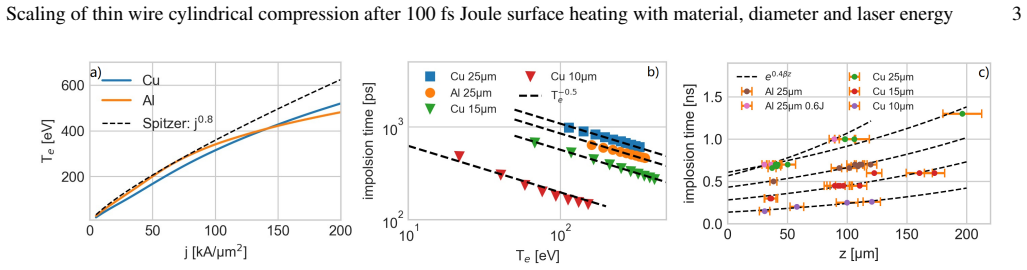
The load-bearing construction is the reconstructed surface current-density profile $j(z)$, obtained by composing three mappings: the electron-energy equation with low- and high-temperature resistivity models, which gives $T_e \propto j^{0.8}$; the strong-shock relation for ablation-driven implosion, which gives $\tau_{\rm im}\propto T_e^{-1/2}$; and the surface-wave propagation model $j(z,t)\propto j_0(z-v_g t)e^{-\beta z}$ along the wire axis. The inverse-radius scaling is then modified by an escaping-charge correction $\varphi(r)=(r/25\,\mu{\rm m})^{0.16}$ derived from a Lambert-W solution of the sheath Poisson equation, yielding the final ratio law $j_{r_1}/j_{r_2}\approx (r_2/r_1)^{0.84} e^{(\beta_{r_1}-\beta_{r_2})z}$. X-ray free-electron laser backlit images supply the measured implosion times $\tau_{\rm im}(z)$ that feed the inversion.
What would settle it
Measure the escaping hot-electron charge as a function of wire diameter, for example with a Faraday cup or by proton-emission anisotropy; the model predicts $Q_{\rm es}(r)\propto r^{0.16}$, so a measurably different radius dependence would invalidate the modified inverse-radius exponent $0.84$ without involving the temperature-to-implosion-time conversion chain.
Extended reading notes
Core claim
The paper claims that the surface return current driving a thin-wire implosion obeys one quantitative scaling family: for fixed laser focus and pulse duration the peak current density varies inversely with wire radius but with a modified exponent, $j \propto r^{-0.84} e^{-\beta z}$, where the $0.84$ combines the nominal $-1$ with a weak geometric correction $\varphi(r)\propto r^{0.16}$ from hot-electron sheath escape; it is essentially independent of material between copper and aluminum; and it follows $j \propto E_L^{2/3}$ with incident laser energy. This is established by imaging the cylindrical compression of 10-25 $\mu$m copper and aluminum wires with sub-micrometer spatial and femtosecond temporal resolution, extracting the axial profile of implosion time, and inverting it through a calibrated chain of mappings from current density to electron temperature, temperature to implosion time, and axial position back to current density. Deviations from the naive inverse-radius law, reduced to about 5% by the geometric correction, are attributed to the weak radius dependence of the escaping hot-electron charge and to stronger surface-wave attenuation in thinner wires.
Load-bearing premise
The inferred scaling of the current density with radius and energy depends on two unmeasured calibration steps: implosion time is assumed to fall as the inverse square root of surface temperature, and surface temperature is assumed to rise as the $0.8$ power of current density; if either mapping is inaccurate, the reported exponents change.
Editorial extensions
If this is right
- For wire diameters from 10 to 25 $\mu$m, thinner wires produce systematically higher surface return-current densities, and the ratio is quantitatively predicted by the $r^{-0.84}$ law rather than the naive $r^{-1}$ law.
- Copper and aluminum wires of the same diameter and laser conditions yield indistinguishable current-density profiles, so atomic-number/material choice is not a controlling parameter for this platform.
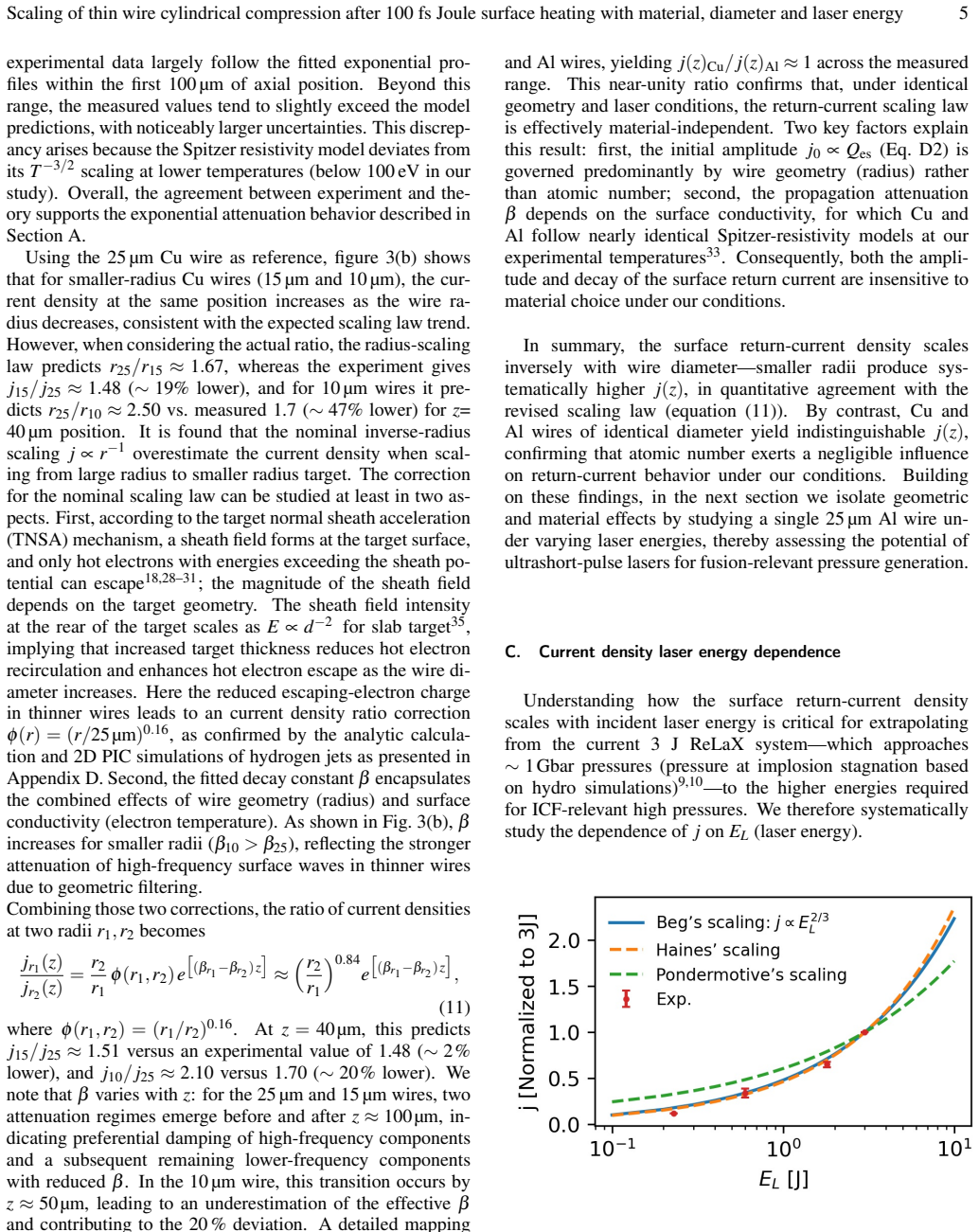
- With focus and pulse duration fixed, the peak return current, and therefore the achievable stagnation pressure, scales as $E_L^{2/3}$, giving a predictive rule for scaling up laser energy.
- Deviations from simple scaling, about 5%, are captured by geometry-dependent electron escape and radius-dependent surface-wave attenuation, so the same correction factors should transfer to other cylindrical targets.
- The combination of X-ray free-electron laser imaging and femtosecond laser pumping provides a reduced-scale testbed for implosion dynamics relevant to inertial confinement fusion.
Reading between the lines
- If the $E_L^{2/3}$ law holds beyond the 3 J data range, doubling the laser energy would raise the peak return current by only about 59%, so reaching much higher stagnation pressures will require more than linear increases in energy; this extrapolation is an inference, not a paper claim.
- The $r^{0.16}$ escaping-charge correction was validated in the paper against particle-in-cell simulations of hydrogen jets; applying it to solid metal wires assumes the same sheath dynamics, which could be tested by measuring escaping charge or ion emission versus wire diameter.
- Because current density is reconstructed indirectly from implosion timing, an independent measurement of the surface temperature or of the magnetic field near the wire, for example by X-ray Thomson scattering or an inductive probe, would anchor the conversion chain.
- The exponential surface-wave attenuation $e^{-\beta z}$ makes compression timing position-dependent along the wire; structured or multi-material wires could exploit or compensate this attenuation to shape implosion symmetry.
Signed reviews
Editorial analysis
A structured set of objections, weighed in public.
Referee Report
Summary. This paper reports an experimental study of return-current-driven cylindrical compression of thin metal wires (Cu and Al, 10–25 μm diameter) irradiated by femtosecond joule-class laser pulses at the European XFEL. Using time-resolved X-ray imaging, the authors measure the implosion time as a function of position along the wire and reconstruct the peak surface current density j(z) through a cascade of mappings: surface temperature from the electron energy equation, implosion time from hydrodynamic simulations, and an exponential propagation model. They then test three scaling predictions—j ∝ r^{-1}, material independence, and j ∝ E_L^{2/3}—introducing a radius-dependent escape correction φ(r) and an attenuation factor β. They report good agreement for 15 μm wires but a 20% residual for 10 μm wires, and close agreement with the energy scaling except for a 33% deviation at the lowest energy.
Significance. If the scaling laws are validated, the result is significant: it provides a predictive framework for joule-class laser-induced implosion platforms and a bridge to ICF-relevant pressures. The experiment exploits XFEL diagnostics with sub-micron and femtosecond resolution, includes a parameter scan across radius, material, and energy, and publishes raw data via a DOI. However, the validation is not fully independent: j is reconstructed using the same transport and shock models that enter the theory, the correction factors are calibrated on the authors' own PIC simulations, and the reported '5% deviations' are not supported by the 10 μm and 0.23 J data.
major comments (4)
- [§III.A, Eqs. (7)–(8)] The reconstruction of j(z) from the measured implosion time relies on the assumed strong-shock scaling τim ∝ T_e^{-1/2} (Eq. 8) and the Spitzer/Burgess heating relation T_e ∝ j^{0.8} (Eq. 7). These exponents are taken from standard transport models and hydrodynamic simulations, not from independent measurements in this experiment. Because the inversion gives j ∝ τim^{-2.5}, a 10% systematic error in τim or in either exponent changes the reconstructed j by roughly 25% and can shift the derived radius and energy slopes. The paper should quantify the sensitivity of the inferred scaling exponents to plausible variations in Eqs. (7)–(8), ideally by recomputing the reconstruction using the full numerical f1 and f2 curves rather than the power-law fits.
- [§III.B, Eq. (11); Introduction] The Introduction claims 'systematic deviations of 5% captured by geometry- and attenuation-based correction factors,' but the body of the paper reports a 20% residual for the 10 μm wire at z = 40 μm (predicted j10/j25 ≈ 2.10 vs. measured 1.70). The explanation that a β(z) transition at z ≈ 50 μm causes this deviation is not supported by an independent measurement of β(z). Thus the 5% claim is not representative of the full dataset and should be either removed or replaced with a clear statement of the 20% residual and its uncertainty.
- [§III.C, Fig. 4] In Fig. 4, the extracted amplitude factors C are 1.00, 0.65, 0.34, and 0.12 for E_L = 3, 1.8, 0.6, and 0.23 J. The E_L^{2/3} scaling predicts, after normalization to 3 J, C = 1.00, 0.71, 0.34, and 0.18. The 1.8 J point is 8% below the prediction and the 0.23 J point is 33% below. The statement that the data show 'close agreement across the full range' is therefore not supported. The authors should provide error bars for C and either address the outlier or limit the claim to the 0.6–3 J range.
- [§III.B and Appendix D] The radius correction φ(r) = (r/25 μm)^{0.16} is introduced to reconcile the nominal inverse-radius scaling with the data, but this exponent is fitted to the authors' own 2D PIC simulations of hydrogen jets (Appendix D), using model inputs such as r1 = 1 mm and energy apportionment rates fL from the simulations. Consequently, Eq. (11) is not a purely experimental scaling law; the correction is partly calibrated to the same class of simulations used to define the return-current model. The paper should explicitly state this model dependence and, if possible, estimate an experimental uncertainty for the exponent 0.16.
minor comments (3)
- [§III.A, Eq. (9)] The notation j0(z - vg t) is confusing because j0 is later used as an amplitude in the fits y(z) = α exp(-βz); please clarify the argument of j0 and the relation between β and the fitting parameter.
- [References] Reference [34] is listed as 'unpublished'; since it supplies the surface-wave propagation model used in Eq. (9), please replace it with a published reference or include the derivation as an appendix.
- [Introduction] The paper uses 'Europe XFEL' in the Introduction; the correct name is 'European XFEL'.
Circularity Check
Partial circularity: the radius-scaling 'correction' is fitted to self-cited PIC results, and the surface-wave model used to reconstruct j is the same ansatz the paper claims to confirm.
-
fitted input called prediction
[Section III B, Eq. (11), and Appendix D, Fig. 6]
"Here the reduced escaping-electron charge in thinner wires leads to an current density ratio correction φ (r) = (r/25µm )0.16, as confirmed by the analytic calculation and 2D PIC simulations of hydrogen jets as presented in Appendix D. ... In this calculation, the values of fL obtained from the PIC simulations were used to adjust the computation of Qes(r). ... An exponential function of the form rx was used to fit the data (dashed line in Figure 6(b)), yielding an exponent of 0.16."
The exponent 0.16 is not derived from an independent first-principles constraint; it is obtained by fitting to the analytic/PIC results, and the analytic calculation itself is adjusted using fL values taken from the same PIC simulations. This fitted exponent is then inserted into Eq. (11) as the 'geometry correction' to the nominal inverse-radius law, and the resulting r^{-0.84} scaling is presented as the predicted law that the experiment confirms. Thus the radius-scaling validation is partly a calibrated correction presented as a prediction, reducing the independence of the claimed agreement.
-
ansatz smuggled in via citation
[Section III A, Eqs. (9) and (10), with Refs. [33,34]]
"The current density along the z position of the wire propagates with j(z,t) ∝ j0(z − vgt) exp(−β z), where j0 is the initial current density at z = 0, β is the decay constant associated with wire impedance... By incorporating equations (7), (8) and (9), it has τim(z) ∝ exp(0.4 β z)... A strong agreement between the experimental data and the fitting confirms the surface wave behavior on the wire targets."
Equation (9) is the surface-wave attenuation ansatz taken from the same first author's thesis and unpublished note (Refs. 33 and 34), and it is used to derive the exponential form of τim(z) in Eq. (10). This same assumed form is then used in mapping f3 to reconstruct j(z) via Eq. (5), after which the exponential fit of τim(z) is presented as confirming the surface-wave model. The model is therefore an input to the inference of j, so the subsequent 'validation' of the surface-wave part of the scaling law is not an independent experimental test of that ansatz.
full rationale
The paper is not wholly circular: the measured implosion times are external data, and the E_L^{2/3} energy scaling is anchored to the Beg hot-electron scaling rather than to an in-paper fit. However, two load-bearing steps reduce the independence of the central radius-scaling claim. First, the 'geometry correction' φ(r) = (r/25 µm)^{0.16} that converts the nominal r^{-1} law into the r^{-0.84} law is a fitted exponent: Appendix D obtains 0.16 by fitting analytic/PIC results, and the analytic calculation itself uses fL values taken from the same PIC simulations. Inserting this calibrated exponent into Eq. (11) and quoting 2% agreement presents a fitted correction as a prediction. Second, the surface-current attenuation model of Eq. (9) is cited to the same first author's thesis and unpublished note, and it is used both to derive the exponential form of τim(z) (Eq. 10) and to reconstruct j(z) through Eq. (5); the paper then interprets the exponential fit as confirming that model. Thus the reconstructed j inherits both the transport exponents of Eqs. (7)-(8) and the surface-wave ansatz, making the radius-scaling test partially self-referential. The claimed 5% systematic deviations are therefore not obtained from a fully independent prediction. Nevertheless, the measured implosion times, the external Beg scaling for energy dependence, and the explicit Cu-vs-Al comparison provide independent content, so the central claim is not defined into existence. A moderate score of 4 is appropriate.
Assumptions & free parameters
free parameters (6)
- Radius correction exponent φ =
0.16
- Per-case attenuation constant β =
not reported numerically in text; shown in figure labels
- Energy apportion rate fL =
0.082, 0.097, 0.10 for radii 2.5, 5, 7.5 µm
- Effective outer conductor radius r1 =
1 mm
- PIC temperature reduction factor =
10
- Per-case amplitude factor C =
1.00, 0.65, 0.34, 0.12 for 3, 1.8, 0.6, 0.23 J
assumptions (6)
- domain assumption Spitzer and Burgess electrical resistivity models describe the surface layer transport.
- domain assumption Implosion time scales as T_e^{-1/2} in the strong-shock limit.
- domain assumption Surface return current propagates as a wave with exponential decay j(z,t) ∝ exp(-β z).
- domain assumption Hot electrons follow a Boltzmann distribution and total number scales as N_t = f_L E_L / T_h.
- domain assumption Sheath potential is set by an effective capacitance V_s = Q_es / C_eff.
- domain assumption One-dimensional cylindrical hydrodynamic simulations with SESAME equations of state capture the implosion.
Cite this review
Pith. "Pith review of Scaling of thin wire cylindrical compression after 100 fs Joule surface heating with material, diameter and laser energy." pith.science (2026). https://pith.science/paper/7DS7DXEB
@misc{pith2026250712109,
  author       = {Pith},
  title        = {Pith review of: Scaling of thin wire cylindrical compression after 100 fs Joule surface heating with material, diameter and laser energy},
  year         = {2026},
  howpublished = {\url{https://pith.science/paper/7DS7DXEB}},
  note         = {Machine review of arXiv:2507.12109}
}
read the original abstract
We present the first systematic experimental validation of return-current-driven implosion scaling in micrometer-sized wires irradiated by femtosecond laser pulses. Employing XFEL-based imaging with sub-micrometer spatial and femtosecond temporal resolution, supported by hydrodynamic and particle-in-cell simulations, we reveal how return current density depends precisely on wire diameter, material properties, and incident laser energy. We identify deviations from simple theoretical predictions due to geometrically influenced electron escape dynamics. These results refine and confirm the scaling laws essential for predictive modeling in high-energy-density physics and inertial fusion research.
Figures


Figures from the paper (3 more)


Reference graph
Works this paper leans on
-
[1]
author author A. Zylstra , author O. Hurricane , author D. Callahan , author A. Kritcher , author J. Ralph , author H. Robey , author J. Ross , author C. Young , author K. Baker , author D. Casey , et al. ,\ title title Burning plasma achieved in inertial fusion , \ @noop journal journal Nature \ volume 601 ,\ pages 542--548 ( year 2022 ) NoStop
work page 2022
-
[2]
author author C. Williams , author R. Betti , author V. Gopalaswamy , author J. Knauer , author C. Forrest , author A. Lees , author R. Ejaz , author P. Farmakis , author D. Cao , author P. Radha , et al. ,\ title title Demonstration of hot-spot fuel gain exceeding unity in direct-drive inertial confinement fusion implosions , \ @noop journal journal Natu...
work page 2024
-
[3]
author author V. Gopalaswamy , author C. Williams , author R. Betti , author D. Patel , author J. Knauer , author A. Lees , author D. Cao , author E. Campbell , author P. Farmakis , author R. Ejaz , et al. ,\ title title Demonstration of a hydrodynamically equivalent burning plasma in direct-drive inertial confinement fusion , \ @noop journal journal Natu...
work page 2024
-
[4]
author author R. Betti \ and\ author O. Hurricane ,\ title title Inertial-confinement fusion with lasers , \ @noop journal journal Nature Physics \ volume 12 ,\ pages 435--448 ( year 2016 ) NoStop
work page 2016
-
[5]
author author J. D. \ Lindl , author P. Amendt , author R. L. \ Berger , author S. G. \ Glendinning , author S. H. \ Glenzer , author S. W. \ Haan , author R. L. \ Kauffman , author O. L. \ Landen , \ and\ author L. J. \ Suter ,\ title title The physics basis for ignition using indirect-drive targets on the national ignition facility , \ @noop journal jou...
work page 2004
-
[6]
author author S. H. \ Glenzer \ and\ author R. Redmer ,\ title title X-ray thomson scattering in high energy density plasmas , \ @noop journal journal Reviews of Modern Physics \ volume 81 ,\ pages 1625--1663 ( year 2009 ) NoStop
work page 2009
-
[7]
author author O. Hurricane , author D. Callahan , author D. Casey , author P. Celliers , author C. Cerjan , author E. Dewald , author T. Dittrich , author T. D \"o ppner , author D. Hinkel , author L. B. \ Hopkins , et al. ,\ title title Fuel gain exceeding unity in an inertially confined fusion implosion , \ @noop journal journal Nature \ volume 506 ,\ p...
work page 2014
-
[8]
author author E. Moses , author R. Boyd , author B. Remington , author C. Keane , \ and\ author R. Al-Ayat ,\ title title The national ignition facility: Ushering in a new age for high energy density science , \ @noop journal journal Physics of Plasmas \ volume 16 ( year 2009 ) NoStop
work page 2009
Show all 41 references
-
[9]
Laso Garcia , author L
author author A. Laso Garcia , author L. Yang , author V. Bouffetier , author K. Appel , author C. Baehtz , author J. Hagemann , author H. H \"o ppner , author O. Humphries , author T. Kluge , author M. Mishchenko , et al. ,\ title title Cylindrical compression of thin wires b...
2024
-
[10]
Yang , author M
author author L. Yang , author M. Rehwald , author T. Kluge , author A. Laso Garcia , author T. Toncian , author K. Zeil , author U. Schramm , author T. E. \ Cowan , \ and\ author L. Huang ,\ title title Dynamic convergent shock compression initiated by return current in high-...
2024
-
[11]
a htz , author E. Brambrink , author M. Bussmann , author A. Laso Garcia , author M. Garten , author L. Gaus , author S. G \
author author P. Ordyna , author C. B \"a htz , author E. Brambrink , author M. Bussmann , author A. Laso Garcia , author M. Garten , author L. Gaus , author S. G \"o de , author J. Grenzer , author C. Gutt , et al. ,\ title title Visualizing plasmons and ultrafast kinetic ins...
2024
-
[12]
Kluge , author M
author author T. Kluge , author M. Bussmann , author H.-K. \ Chung , author C. Gutt , author L. G. \ Huang , author M. Zacharias , author U. Schramm , \ and\ author T. E. \ Cowan ,\ title title Nanoscale femtosecond imaging of transient hot solid density plasmas with elemental...
-
[13]
Sawada , author T
author author H. Sawada , author T. Yabuuchi , author N. Higashi , author T. Iwasaki , author K. Kawasaki , author Y. Maeda , author T. Izumi , author Y. Nakagawa , author K. Shigemori , \ and\ author Y. Sakawa ,\ title title Ultrafast time-resolved 2d imaging of laser-driven ...
2023
-
[14]
Huang , author M
author author L. Huang , author M. S m \' d , author L. Yang , author O. Humphries , author J. Hagemann , author T. Engler , author X. Pan , author Y. Cui , author T. Kluge , author R. Aguilar , et al. ,\ title title Demonstration of full-scale spatio-temporal diagnostics of s...
2025
-
[15]
author author P. Gibbon ,\ title title Efficient production of fast electrons from femtosecond laser interaction with solid targets , \ @noop journal journal Physical review letters \ volume 73 ,\ pages 664 ( year 1994 ) NoStop
1994
-
[16]
Malka \ and\ author J
author author G. Malka \ and\ author J. Miquel ,\ title title Experimental confirmation of ponderomotive-force electrons produced by an ultrarelativistic laser pulse on a solid target , \ @noop journal journal Physical review letters \ volume 77 ,\ pages 75 ( year 1996 ) NoStop
1996
-
[17]
Gibbon ,\ @noop title Short pulse laser interactions with matter: an introduction \ ( publisher World Scientific ,\ year 2005 ) NoStop
author author P. Gibbon ,\ @noop title Short pulse laser interactions with matter: an introduction \ ( publisher World Scientific ,\ year 2005 ) NoStop
2005
-
[18]
Snavely , author M
author author R. Snavely , author M. Key , author S. Hatchett , author T. Cowan , author M. Roth , author T. Phillips , author M. Stoyer , author E. Henry , author T. Sangster , author M. Singh , et al. ,\ title title Intense high-energy proton beams from petawatt-laser irradi...
2000
-
[19]
Kaymak , author A
author author V. Kaymak , author A. Pukhov , author V. N. \ Shlyaptsev , \ and\ author J. J. \ Rocca ,\ title title Nanoscale ultradense z-pinch formation from laser-irradiated nanowire arrays , \ @noop journal journal Physical review letters \ volume 117 ,\ pages 035004 ( yea...
2016
-
[20]
Beg , author M
author author F. Beg , author M. Wei , author E. Clark , author A. Dangor , author R. Evans , author P. Gibbon , author A. Gopal , author K. Lancaster , author K. Ledingham , author P. McKenna , et al. ,\ title title Return current and proton emission from short pulse laser in...
2004
-
[21]
Hauer \ and\ author R
author author A. Hauer \ and\ author R. Mason ,\ title title Return-current heating and implosion of cylindrical c o 2-laser-driven targets , \ @noop journal journal Physical review letters \ volume 51 ,\ pages 459 ( year 1983 ) NoStop
1983
-
[22]
author author R. F. \ Benjamin , author G. H. \ McCall , \ and\ author A. W. \ Ehler ,\ title title Measurement of return current in a laser-produced plasma , \ @noop journal journal Physical Review Letters \ volume 42 ,\ pages 890 ( year 1979 ) NoStop
1979
-
[23]
author author M. Rehwald ,\ @noop title Laser-proton acceleration in the near-critical regime using density tailored cryogenic hydrogen jets \ ( publisher Technische Universit\"at Dresden ,\ address Dresden ,\ year 2022 )\ pp.\ pages Online--Ressource NoStop
2022
-
[24]
Zastrau , author K
author author U. Zastrau , author K. Appel , author C. Baehtz , author O. Baehr , author L. Batchelor , author A. Bergh \"a user , author M. Banjafar , author E. Brambrink , author V. Cerantola , author T. E. \ Cowan , et al. ,\ title title The high energy density scientific i...
2021
-
[25]
author author T. J. \ Burgess ,\ @noop title Electrical resistivity model of metals , \ type Tech. Rep. \ ( institution Sandia National Labs., Albuquerque, NM (USA). Pulsed Power Theory Div. ,\ year 1986 ) NoStop
1986
-
[26]
Johnson ,\ @noop title The sesame database , \ type Tech
author author J. Johnson ,\ @noop title The sesame database , \ type Tech. Rep. \ ( institution Los Alamos National Lab.(LANL), Los Alamos, NM (United States) ,\ year 1994 ) NoStop
1994
-
[27]
author author A. S. \ Richardson ,\ @noop title 2019 nrl plasma formulary , \ type Tech. Rep. \ ( institution US Naval Research Laboratory ,\ year 2019 ) NoStop
2019
-
[28]
author author S. P. \ Hatchett , author C. G. \ Brown , author T. E. \ Cowan , author E. A. \ Henry , author J. S. \ Johnson , author M. H. \ Key , author J. A. \ Koch , author A. B. \ Langdon , author B. F. \ Lasinski , author R. W. \ Lee , et al. ,\ title title Electron, pho...
2000
-
[29]
Cowan , author J
author author T. Cowan , author J. Fuchs , author H. Ruhl , author A. Kemp , author P. Audebert , author M. Roth , author R. Stephens , author I. Barton , author A. Blazevic , author E. Brambrink , et al. ,\ title title Ultralow emittance, multi-mev proton beams from a laser v...
2004
-
[30]
author author L. G. \ Huang , author M. Molodtsova , author A. Ferrari , author A. L. \ Garcia , author T. Toncian , \ and\ author T. E. \ Cowan ,\ title title Dynamics of hot refluxing electrons in ultra-short relativistic laser foil interactions , \ 10.1063/5.0077222 journal...
-
[31]
Rehwald , author S
author author M. Rehwald , author S. Assenbaum , author C. Bernert , author F.-E. \ Brack , author M. Bussmann , author T. E. \ Cowan , author C. B. \ Curry , author F. Fiuza , author M. Garten , author L. Gaus , et al. ,\ title title Ultra-short pulse laser acceleration of pr...
2023
-
[32]
Yang , author L
author author L. Yang , author L. Huang , author S. Assenbaum , author T. E. \ Cowan , author I. Goethel , author S. G \"o de , author T. Kluge , author M. Rehwald , author X. Pan , author U. Schramm , et al. ,\ title title Time-resolved optical shadowgraphy of solid hydrogen ...
2023
-
[33]
Yang ,\ title Return current heating in relativistic laser matter interactions ,\ @noop Ph.D
author author L. Yang ,\ title Return current heating in relativistic laser matter interactions ,\ @noop Ph.D. thesis ,\ school Technische Universität Dresden ( year 2024 ) NoStop
2024
-
[34]
Yang ,\ @noop title The propogation of the surface return current along the thin wire generated by high intensity laser solid interactions (unpublished) , \ ( year 2025 ) NoStop
author author L. Yang ,\ @noop title The propogation of the surface return current along the thin wire generated by high intensity laser solid interactions (unpublished) , \ ( year 2025 ) NoStop
2025
-
[35]
Roth \ and\ author M
author author M. Roth \ and\ author M. Schollmeier ,\ title title Ion acceleration-target normal sheath acceleration , \ @noop journal journal arXiv preprint arXiv:1705.10569 \ ( year 2017 ) NoStop
2017 arXiv
-
[36]
Beg , author A
author author F. Beg , author A. Bell , author A. Dangor , author C. Danson , author A. Fews , author M. Glinsky , author B. Hammel , author P. Lee , author P. Norreys , \ and\ author M. Tatarakis ,\ title title A study of picosecond laser--solid interactions up to 10^ 19 Wcm ...
1997
-
[37]
Wilks , author A
author author S. Wilks , author A. Langdon , author T. Cowan , author M. Roth , author M. Singh , author S. Hatchett , author M. Key , author D. Pennington , author A. MacKinnon , \ and\ author R. Snavely ,\ title title Energetic proton generation in ultra-intense laser--solid...
2001
-
[38]
Haines , author M
author author M. Haines , author M. Wei , author F. Beg , \ and\ author R. Stephens ,\ title title Hot-electron temperature and laser-light absorption in fast ignition , \ @noop journal journal Physical Review Letters \ volume 102 ,\ pages 045008 ( year 2009 ) NoStop
2009
-
[39]
Fryxell , author K
author author B. Fryxell , author K. Olson , author P. Ricker , author F. X. \ Timmes , author M. Zingale , author D. Lamb , author P. MacNeice , author R. Rosner , author J. Truran , \ and\ author H. Tufo ,\ title title Flash: An adaptive mesh hydrodynamics code for modelinga...
2000
-
[40]
Dubey , author K
author author A. Dubey , author K. Antypas , author M. K. \ Ganapathy , author L. B. \ Reid , author K. Riley , author D. Sheeler , author A. Siegel , \ and\ author K. Weide ,\ title title Extensible component-based architecture for flash, a massively parallel, multiphysics si...
2009
-
[41]
Bussmann , author H
author author M. Bussmann , author H. Burau , author T. E. \ Cowan , author A. Debus , author A. Huebl , author G. Juckeland , author T. Kluge , author W. E. \ Nagel , author R. Pausch , author F. Schmitt , author U. Schramm , author J. Schuchart , \ and\ author R. Widera ,\ t...
Reviewed August 6, 2026 · model on record in the stance chip above.
Discussion (0). Continue with ORCID to comment.