Power-Integrity Modeling of VR Faults in High-Performance Applications
Pith reviewed 2026-06-29 23:59 UTC · model grok-4.3
The pith
Analytical inductor-current models from control signals enable sub-microsecond fault detection and dual-fuse isolation in vertical power delivery systems.
A machine-rendered reading of the paper's core claim, the machinery that carries it, and where it could break.
Core claim
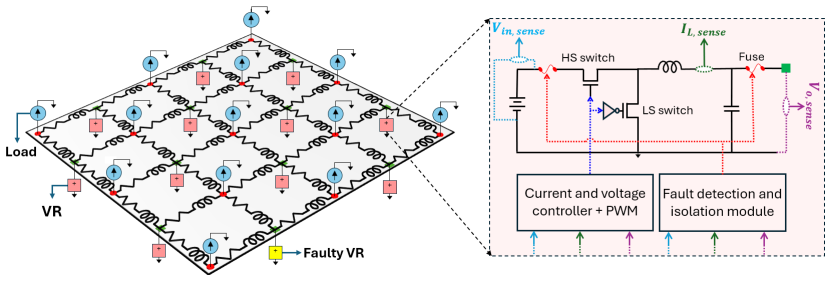
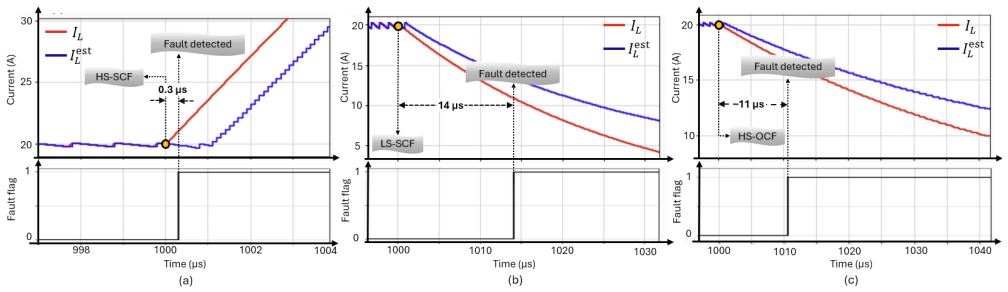
A real-time fault-detection and isolation methodology for vertical power delivery systems is developed based on analytical inductor-current models that rely solely on signals available within the converter control circuitry, thereby eliminating additional sensing overhead. The proposed framework is designed and simulated in SPICE environment, demonstrating sub-microsecond fault detection and effective dual-fuse isolation, maintaining uninterrupted power delivery with a system-wide efficiency degradation of less than 2%.
What carries the argument
analytical inductor-current models that rely solely on signals available within the converter control circuitry
If this is right
- Fault isolation can occur without adding sensing components or overhead to the power delivery network.
- Dual-fuse mechanisms allow the system to maintain continuous power delivery after a fault occurs.
- System-wide efficiency remains within 2 percent of nominal even after fault events.
- The method applies directly to stacked-substrate voltage regulator configurations in high-current-density computing platforms.
Where Pith is reading between the lines
- If the models hold in silicon, control-circuitry-only monitoring could become standard in future vertical power architectures, reducing component count.
- The same signal-based modeling approach may generalize to detect other transient anomalies such as voltage droops or thermal hotspots.
- Hardware validation would also clarify whether the sub-microsecond response time remains achievable when board parasitics and noise are present.
Load-bearing premise
The analytical inductor-current models derived solely from control circuitry signals are sufficiently accurate to enable reliable real-time fault detection and isolation in actual hardware, without post-simulation validation or additional sensing.
What would settle it
Side-by-side comparison of model-predicted inductor currents against measured currents on physical hardware during induced short-circuit and open-circuit faults under realistic thermal and mechanical stress.
Figures

read the original abstract
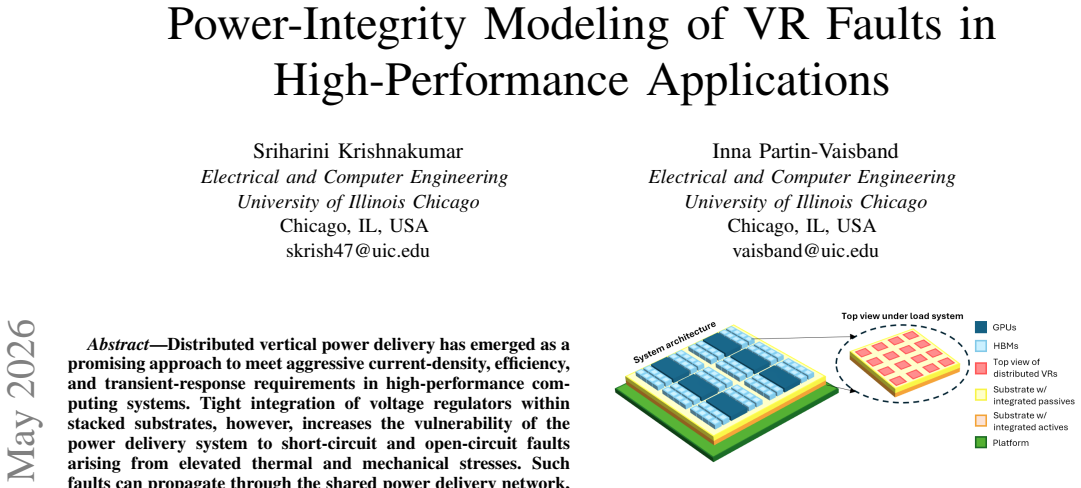
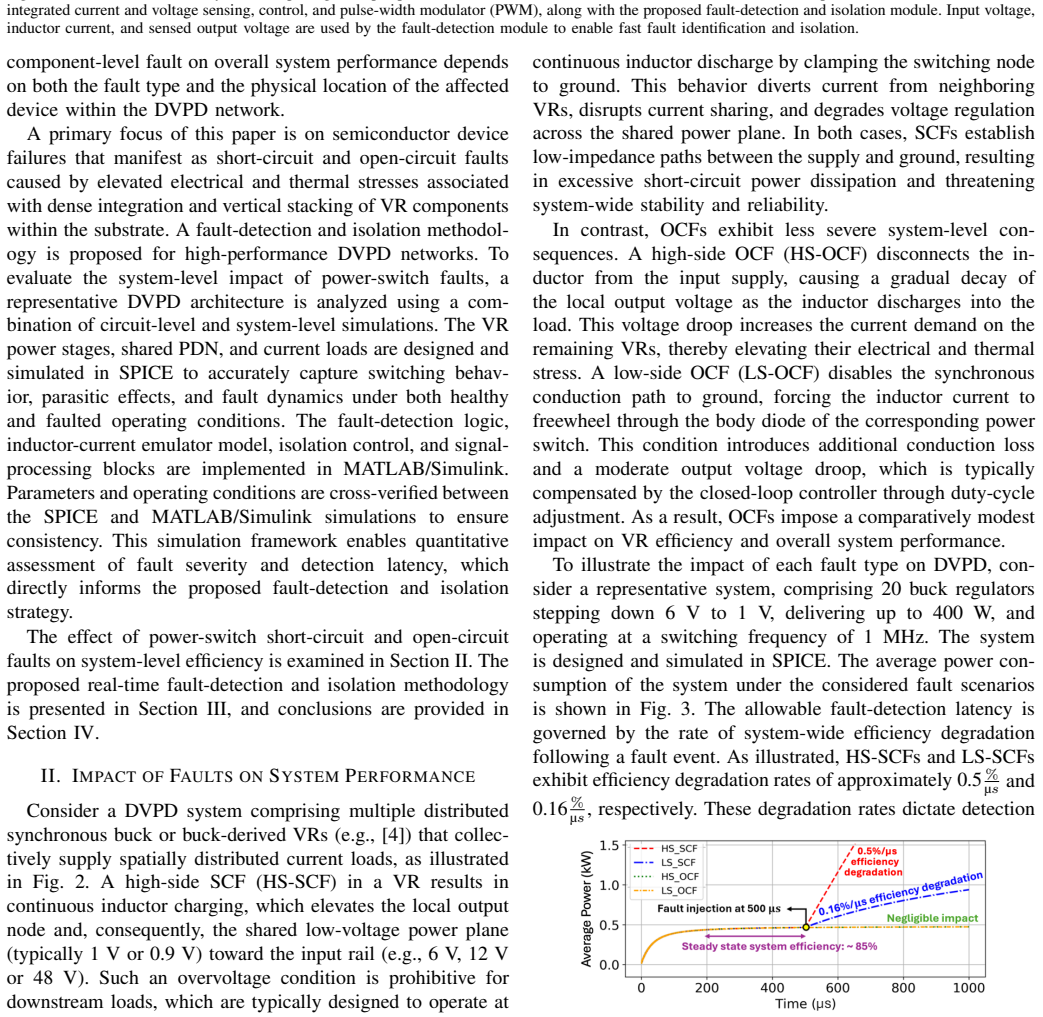
Distributed vertical power delivery has emerged as a promising approach to meet aggressive current-density, efficiency, and transient response requirements in high-performance computing systems. Tight integration of voltage regulators within stacked substrates, however, increases the vulnerability of the power delivery system to short-circuit and open-circuit faults arising from elevated thermal and mechanical stresses. Such faults can propagate through the shared power delivery network, leading to rapid degradation of system-wide efficiency at worst-case rates of up to 0.5% per microsecond. Advanced fault-tolerant power management strategies are therefore required to ensure efficient power delivery. A real-time fault-detection and isolation methodology are proposed in this paper for vertical power delivery systems. The methodology is developed based on an analytical inductor-current models that rely solely on signals available within the converter control circuitry, thereby eliminating additional sensing overhead. The proposed framework is designed and simulated in SPICE environment, demonstrating sub-microsecond fault detection and effective dual-fuse isolation, maintaining uninterrupted power delivery with a system-wide efficiency degradation of less than 2%.
Editorial analysis
A structured set of objections, weighed in public.
Referee Report
Summary. The paper proposes a real-time fault-detection and isolation methodology for vertical power delivery systems in high-performance computing. It relies on analytical inductor-current models derived solely from signals in the converter control circuitry (no extra sensors), with the framework implemented and tested exclusively via SPICE simulations that report sub-microsecond fault detection, effective dual-fuse isolation, and system-wide efficiency degradation below 2%.
Significance. If the analytical models prove transferable to hardware, the approach would address a practical need for low-overhead fault tolerance in tightly integrated voltage regulators, where faults can degrade efficiency at rates up to 0.5% per microsecond. The elimination of additional sensing hardware is a clear strength if validated.
major comments (1)
- [Abstract / Simulation Results] Abstract and simulation-results section: the central claims of sub-microsecond detection and <2% efficiency degradation rest entirely on SPICE simulations of the analytical inductor-current models; no hardware prototype, noise-injection tests, component-tolerance analysis, or layout-parasitic study is reported, leaving the transferability of the models to physical VR hardware unverified and load-bearing for the real-time reliability assertion.
Simulated Author's Rebuttal
We thank the referee for the detailed review and constructive feedback. We address the major comment below, providing a point-by-point response while maintaining the simulation-based scope of the work.
read point-by-point responses
-
Referee: [Abstract / Simulation Results] Abstract and simulation-results section: the central claims of sub-microsecond detection and <2% efficiency degradation rest entirely on SPICE simulations of the analytical inductor-current models; no hardware prototype, noise-injection tests, component-tolerance analysis, or layout-parasitic study is reported, leaving the transferability of the models to physical VR hardware unverified and load-bearing for the real-time reliability assertion.
Authors: We agree that all reported results derive from SPICE simulations of the proposed analytical inductor-current models, with no hardware prototypes, noise-injection experiments, tolerance sweeps, or parasitic extractions included. The manuscript's core contribution is the derivation of these models from existing control-circuitry signals and their demonstration of sub-microsecond detection and dual-fuse isolation under ideal simulated conditions. We will revise the abstract, simulation-results section, and conclusions to explicitly qualify all performance claims as simulation-based, add a limitations paragraph discussing unmodeled effects (component variation, layout parasitics, and noise), and outline hardware validation as future work. These textual clarifications will be made without altering the modeling framework or simulation data. revision: partial
Circularity Check
No circularity: analytical models presented as independent of simulation outcomes
full rationale
The paper derives inductor-current models analytically from control-circuitry signals alone and then reports SPICE simulation results for detection latency and efficiency. No equations reduce to their own inputs by construction, no fitted parameters are relabeled as predictions, and no self-citation chain is invoked to justify uniqueness or an ansatz. The central claims rest on the stated analytical independence of the models from the reported simulation metrics, making the derivation self-contained against external benchmarks.
Axiom & Free-Parameter Ledger
axioms (1)
- domain assumption Analytical inductor-current models derived from control circuitry signals accurately represent short-circuit and open-circuit fault behavior in vertical power delivery systems.
Forward citations
Cited by 1 Pith paper
-
A Comprehensive Design Framework for Vertical Power Delivery in High-Performance Computing
A design framework for distributed vertical power delivery in HPC systems achieves 84% end-to-end efficiency for 48V-to-1V conversion while using 54% of the area under the load.
Reference graph
Works this paper leans on
-
[1]
Vertical power delivery for emerging packaging and integration platforms-power conversion and distribution,
S. Krishnakumar and I. Partin-Vaisband, “Vertical power delivery for emerging packaging and integration platforms-power conversion and distribution,” inIEEE International System-on-Chip Conference (SOCC), 2023, pp. 1–6
2023
-
[2]
System architec- ture optimization for vertical power delivery,
S. Krishnakumar, Y . Popryho, and I. Partin-Vaisband, “System architec- ture optimization for vertical power delivery,” inProceedings of the Great Lakes Symposium on VLSI, 2024, pp. 351–352
2024
-
[3]
Review on fault-diagnosis and fault- tolerance for dc–dc converters,
G. K. Kumar and D. Elangovan, “Review on fault-diagnosis and fault- tolerance for dc–dc converters,”IET Power Electronics, vol. 13, no. 1, pp. 1–13, 2020
2020
-
[4]
High-efficiency nonisolated converter with very high step-down conversion ratio,
O. Kirshenboim and M. M. Peretz, “High-efficiency nonisolated converter with very high step-down conversion ratio,”IEEE Transactions on Power Electronics, vol. 32, no. 5, pp. 3683–3690, 2017
2017
-
[5]
Model-based fault detection and identification for switching power converters,
J. Poon, P. Jain, I. C. Konstantakopoulos, C. Spanos, S. K. Panda, and S. R. Sanders, “Model-based fault detection and identification for switching power converters,”IEEE Transactions on Power Electronics, vol. 32, no. 2, pp. 1419–1430, 2016
2016
-
[6]
Fault detection in a hybrid dickson dc– dc converter for 48-v automotive applications,
M. Ashourloo, V . R. Namburi, G. V . Piqu ´e, J. Pigott, H. J. Bergveld, A. El Sherif, and O. Trescases, “Fault detection in a hybrid dickson dc– dc converter for 48-v automotive applications,”IEEE Transactions on Power Electronics, vol. 36, no. 4, pp. 4254–4268, 2020
2020
-
[7]
Fault diagnosis and fault-tolerant control operation of nonisolated dc–dc converters,
E. Pazouki, Y . Sozer, and J. A. De Abreu-Garcia, “Fault diagnosis and fault-tolerant control operation of nonisolated dc–dc converters,”IEEE transactions on Industry Applications, vol. 54, no. 1, pp. 310–320, 2017
2017
-
[8]
Predictive digi- tal current programmed control,
J. Chen, A. Prodic, R. W. Erickson, and D. Maksimovic, “Predictive digi- tal current programmed control,”IEEE transactions on Power Electronics, vol. 18, no. 1, pp. 411–419, 2003
2003
discussion (0)
Sign in with ORCID, Apple, or X to comment. Anyone can read and Pith papers without signing in.